





Introduction
This study examines differences in the creativity of architectural design outcomes across levels of expertise, while considering gender as a secondary exploratory grouping variable. Creativity is central to architectural design because designers must generate solutions that are original and responsive to functional, contextual, and user requirements (Lawson and Dorst, Reference Lawson and Dorst2013). Creative performance, therefore, requires integrating novelty with usefulness and other complementary qualities of the design outcome (Sarkar and Chakrabarti, Reference Sarkar and Chakrabarti2011; Han et al., Reference Han, Forbes and Schaefer2021; Chaudhuri and Dhar, Reference Chaudhuri and Dhar2024).
Research on design creativity has examined the knowledge, cognitive strategies, and skills associated with expertise (Cross, Reference Cross2004; Tollestrup et al., Reference Tollestrup, Laursen and Vesti2023). Expertise is particularly relevant because it reflects accumulated domain knowledge and professional experience. Expert designers differ from novices in how they explore and frame problems, organize information, develop alternatives, and integrate constraints into design solutions (Cross, Reference Cross2004; Atman et al., Reference Atman, Adams, Cardella, Turns, Mosborg and Saleem2007; Lawson and Dorst, Reference Lawson and Dorst2013; Casakin and Levy, Reference Casakin and Levy2023). These capabilities may support more strategic exploration and a stronger balance between originality and functional adequacy.
Evidence concerning gender and creativity is mixed. Research shows that gender differences in creative performance are small and depend on contextual factors (Hora et al., Reference Hora, Badura, Lemoine and Grijalva2022; Taylor et al., Reference Taylor, Said-Metwaly, Camarda and Barbot2024; Abdulla Alabbasi et al., Reference Abdulla Alabbasi, Thompson, Runco, Alansari and Ayoub2025; Baer & Kaufman, Reference Baer and Kaufman2008). Design studies likewise report inconsistent patterns, with some identifying differences in particular strategies or outcome dimensions, and others finding comparable performance among women and men (Koronis et al., Reference Koronis, Chia, Kang Kai Siang, Silva, Yogiaman and Raghunath2019; Dong and Zhu, Reference Dong and Zhu2023). Such variation may reflect differences in task, assessment criteria, disciplinary settings, and the creativity dimensions examined.
Moreover, limited research has examined whether expertise-related differences in architectural design creativity are expressed similarly among women and men under common task and assessment conditions. Because expertise and gender are often studied separately, it remains unclear whether observed subgroup patterns reflect gender, accumulated design expertise, or differences in tasks and evaluation conditions. Examining both variables within a common design setting can help distinguish consistent expertise-related differences from more context-dependent variation.
Creativity in design is assessed across five dimensions: Novelty, Usefulness, Surprise, Elaboration, and Overall Creativity. Together, they represent originality, functional adequacy, unexpectedness, refinement, and holistic creative quality (Vasconcelos et al., Reference Vasconcelos, Neroni, Cardoso and Crilly2018; Han et al., Reference Han, Forbes and Schaefer2021; Chaudhuri and Dhar, Reference Chaudhuri and Dhar2024). This multidimensional approach allows determining whether expertise is associated only with Overall Creativity or with a broader pattern across specific qualities of the design outcome.
The study contributes to creativity research by examining creativity as a multidimensional outcome, testing whether expertise-related differences extend across all five dimensions and are expressed similarly among women and men, and exploring whether novice and expert designers exhibit different creativity profiles.
Forty students and practicing architects completed a controlled 55-minute design task, and their outcomes were independently evaluated by expert judges across the five creativity dimensions. Gender refers to participants’ self-reported identification as women or men, the categories represented in the sample. The aim is to examine whether expertise-related differences are expressed similarly across these groups, not to attribute creative ability to gender.
The study addresses the following research questions:
-
1. How do creativity outcomes differ between novice and expert designers across the five creativity dimensions?
-
2. How are expertise-related differences in creativity expressed among women and men designers?
-
3. How are expertise, gender, and the five creativity dimensions associated with architectural design outcomes?
Literature review
Creativity in design
Creativity in design is widely conceptualized as a multidimensional phenomenon (Chaudhuri and Dhar, Reference Chaudhuri and Dhar2024). Creativity is commonly defined as the production of outcomes that are novel and functional (Runco and Jaeger, Reference Runco and Jaeger2012; Corazza, Reference Corazza2016). In design, creativity draws on cognitive flexibility and domain knowledge (Preiss, Reference Preiss2022; Yang et al., Reference Yang, Quan and Zeng2022). It is also shaped by how designers frame and manage constraints to develop novel and functional solutions (Stacey and Eckert, Reference Stacey and Eckert2010; Onarheim, Reference Onarheim2012; Hatchuel and Klasing Chen, Reference Hatchuel and Klasing Chen2017).
The ability to generate ideas provides an objective indicator of divergent thinking (Olson et al., Reference Olson, Nahas, Chmoulevitch, Cropper and Webb2021; Kern et al., Reference Kern, Wu and Chao2026). However, divergent thinking primarily reflects creative potential, and its association with real-world creative achievement is modest (Said-Metwaly et al., Reference Said-Metwaly, Taylor, Camarda and Barbot2024). This highlights the need to study creativity through domain-specific performance outcomes, such as the architectural design solutions examined in the present study. Such outcomes can be evaluated through multiple outcome qualities, including novelty, usefulness, surprise, functionality, aesthetics, and overall creativity (Han et al., Reference Han, Forbes and Schaefer2021).
Creative thinking is widely regarded as a core twenty-first-century competence and can be strengthened through targeted curricula (Dilekçi and Karatay, Reference Dilekçi and Karatay2023; Thornhill-Miller et al., Reference Thornhill-Miller, Camarda, Mercier, Burkhardt, Morisseau, Bourgeois-Bougrine, Vinchon, El Hayek, Augereau-Landais, Mourey, Feybesse, Sundquist and Lubart2023). In design education, these skills are especially relevant because students must generate, represent, evaluate, and refine alternative solutions as part of their learning process. Reviews identify diverse pedagogical, cognitive, representational, and assessment approaches to creativity in architectural and design education (Casakin and Wodehouse, Reference Casakin and Wodehouse2021; Chaudhuri and Dhar, Reference Chaudhuri and Dhar2024). However, much of this work addresses creativity at a general level or in terms of individual skills, processes, or assessment methods. Less attention has been given to how multiple creativity dimensions are manifested in completed design outcomes produced by different designer cohorts under common task and evaluation conditions.
Dimensions of creativity in design
Design creativity can be evaluated as a multidimensional construct instead of a single dimension. Research identifies multiple outcome dimensions, including novelty, usefulness, surprise, and elaboration, which can inform judgements of Overall Creativity (Vasconcelos et al., Reference Vasconcelos, Neroni, Cardoso and Crilly2018; Han et al., Reference Han, Forbes and Schaefer2021; Chaudhuri and Dhar, Reference Chaudhuri and Dhar2024).
Novelty refers to the degree to which a design differs from familiar or existing solutions within a given domain (Sarkar and Chakrabarti, Reference Sarkar and Chakrabarti2011; Hwang and Wood, Reference Hwang, Wood and Gero2022; Casakin et al., Reference Casakin, Koronis and Silva2023). It is fundamental to creativity because creative outcomes are expected to introduce original ideas or perspectives (Sternberg and Lubart, Reference Sternberg, Lubart and Sternberg1998; Corazza, Reference Corazza2016).
However, originality alone is insufficient because creative outcomes must also be useful or effective (Shah et al., Reference Shah, Smith and Vargas-Hernandez2003; Boden, Reference Boden2004; Runco and Jaeger, Reference Runco and Jaeger2012; Gilson, Reference Gilson, Zhou and Shalley2024). Usefulness refers to the extent to which a design satisfies functional requirements, constraints, and user needs (Sarkar and Chakrabarti, Reference Sarkar and Chakrabarti2011; Cropley and Kaufman, Reference Cropley and Kaufman2012; Koronis et al., Reference Koronis, Casakin and Silva2023). Together, Novelty and Usefulness distinguish creative solutions from outcomes that are only unusual and reflect the need to balance originality with functional effectiveness (Brown, Reference Brown2009; Cropley, Reference Cropley2012; Han et al., Reference Han, Forbes and Schaefer2021; Lloyd-Cox et al., Reference Lloyd-Cox, Pickering and Bhattacharya2022; Tromp and Baer, Reference Tromp and Baer2022; Yang et al., Reference Yang, Dou and Zeng2023). The relative contributions of Novelty and Usefulness to creativity judgments may vary depending on the type of outcome and the evaluation context (Lloyd-Cox et al., Reference Lloyd-Cox, Pickering and Bhattacharya2022).
Surprise reflects the extent to which a design challenges expectations or presents an unexpected solution (Gero, Reference Gero1996; Simonton, Reference Simonton2012). Whereas Novelty concerns departure from familiar solutions, Surprise is about the observer’s experience of unexpectedness; thus, a design may be novel without being strongly surprising, and vice versa.
Elaboration refers to the degree of refinement, detail, and development embodied in a design outcome (Vasconcelos et al., Reference Vasconcelos, Neroni, Cardoso and Crilly2018). It indicates how fully and coherently an idea has been developed and communicated through refinement and progressive improvement (Viswanathan et al., Reference Viswanathan, Tomko and Linsey2016; Leahy et al., Reference Leahy, Daly, McKilligan and Seifert2020).
Overall creativity represents a holistic judgment of the design outcome, but it is not a substitute for its component dimensions (Cropley and Kaufman, Reference Cropley and Kaufman2012; Han et al., Reference Han, Forbes and Schaefer2021). In this study, it reflects the judges’ integrated assessment of Novelty, Usefulness, Surprise, and Elaboration. Together, these dimensions provide the framework for assessing expertise-related differences in architectural design outcomes.
The five-dimension framework was selected to provide a dimension-specific and holistic assessment of completed design outcomes under common task conditions. Overall Creativity was retained as a separate holistic judgment instead of being calculated as a composite of the other four ratings, allowing it to be considered alongside the more specific dimension scores. Alternative approaches could have assessed aesthetics or functionality as separate outcome criteria (Han et al., Reference Han, Forbes and Schaefer2021), used formal novelty metrics (Fiorineschi and Rotini, Reference Fiorineschi and Rotini2021; Hwang and Wood, Reference Hwang, Wood and Gero2022), or applied other creativity-assessment frameworks (Yin et al., Reference Yin, Han, Huang, Zuo and Childs2021; Chaudhuri and Dhar, Reference Chaudhuri and Dhar2024). These approaches address related but not identical questions; in the present study, a compact multidimensional framework was used to enable consistent assessment of all completed architectural solutions produced under the same task conditions.
Expertise and its role in design creativity
Expertise can be defined as high-level performance arising from extensive domain knowledge and its skilled application (Ericsson and Lehmann, Reference Ericsson and Lehmann1996; Ericsson, Reference Ericsson2017). Design research has examined expertise through expert behaviors, information-structuring practices, and the acquisition of design skills (Lawson and Dorst, Reference Lawson and Dorst2013; Damen and Toh, Reference Damen and Toh2021; Casakin and Levy, Reference Casakin and Levy2023). Design expertise develops through prolonged engagement with varied problems and the progressive acquisition, organization, and adaptation of domain-specific knowledge and skills (Cross, Reference Cross2004; Mieg, Reference Mieg2009; Ericsson, Reference Ericsson2017; Tollestrup et al., Reference Tollestrup, Laursen and Vesti2023). Because creative designs must be novel and useful, expertise may support the coordination of originality, task requirements, and functional constraints (Ivy, Reference Ivy2022).
Experts and novices differ in how they explore problems and develop solutions. Expert practitioners generally devote more attention to problem scoping and information gathering, and expert and novice designers differ in how they organize their cognitive actions during designing (Kavakli and Gero, Reference Kavakli and Gero2002; Atman et al., Reference Atman, Adams, Cardella, Turns, Mosborg and Saleem2007). Experienced and novice designers also differ in how they identify, structure, and apply design requirements, and these activities can influence the novelty and feasibility of the emerging solution (Ahmed et al., Reference Ahmed, Wallace and Blessing2003; Chakrabarti et al., Reference Chakrabarti, Morgenstern and Knaab2004). Expert designers also represent and structure information in ways that support reasoning and idea development (Damen and Toh, Reference Damen and Toh2021). These capabilities help designers coordinate originality with functional adequacy.
Expert designers can frame unfamiliar situations and draw on prior knowledge to structure the search for solutions, while novices may have greater difficulty structuring their search and moving beyond early ideas (Cross, Reference Cross2011; Dorst, Reference Dorst2011; Casakin and Levy, Reference Casakin and Levy2023). Recent research similarly indicates that fixation-related behaviors can constrain novice designers’ exploration during the early stages of design (Jia et al., Reference Jia, Jiang, Qi and Hu2024). From a design cognition perspective, expertise involves not only possessing more domain knowledge but also organizing and applying that knowledge to support the exploration, evaluation, and integration of design alternatives. Expertise nevertheless has a double-edged role: prior knowledge can support efficient, high-quality solution search but may constrain exploration when designers rely excessively on familiar approaches (Ball et al., Reference Ball, Ormerod and Morley2004; Yang et al., Reference Yang, Quan and Zeng2022). Consequently, expertise should not be understood as producing a uniform improvement in every aspect of creativity.
Although prior research demonstrates expert–novice differences in design processes and creative performance (Atman et al., Reference Atman, Adams, Cardella, Turns, Mosborg and Saleem2007; Casakin and Singh, Reference Casakin and Singh2019; Teng et al., Reference Teng, Wang, Lu, Qiao and Hao2022; Tollestrup et al., Reference Tollestrup, Laursen and Vesti2023; Camarda et al., Reference Camarda, De Neys, Ozkalp-Poincloux, Hooge, Le Masson, Weil and Cassotti2026), it remains unclear whether these differences are distributed uniformly across multiple creativity dimensions or form different multidimensional profiles. Thus, this study treats expertise as the primary grouping variable and examines whether its association with creativity is expressed similarly among women and men designers.
Gender and creativity in design
The relationship between gender and creativity has produced mixed and context-dependent findings. Reviews and meta-analyses indicate that average differences between women and men in creative performance and creative potential are generally small and vary across domains, tasks, assessment methods, and sociocultural contexts (Abraham, Reference Abraham2016; Baer & Kaufman, Reference Baer and Kaufman2008; Kemmelmeier and Walton, Reference Kemmelmeier and Walton2016; Taylor et al., Reference Taylor, Said-Metwaly, Camarda and Barbot2024; Abdulla Alabbasi et al., Reference Abdulla Alabbasi, Thompson, Runco, Alansari and Ayoub2025). Apparent gender differences in creativity may partly reflect stereotypes and evaluative biases, even when differences in creative potential are minimal (Taylor, Reference Taylor2026). Together, the evidence provides little support for a stable, domain-general difference in creative ability, and instead indicates that findings vary across domain, task characteristics, and context assessment (Hora et al., Reference Hora, Badura, Lemoine and Grijalva2022; Souto et al., Reference Souto, Fadel and Spinillo2024).
Findings from design education are similarly inconsistent. Gender-related differences in academic achievement vary across stages of study (Crowther and Briant, Reference Crowther and Briant2022), and reported differences in design behavior or outcomes depend on the measure examined. Studies have reported gender-related differences in academic subjects, self-assessments, and particular creativity dimensions such as novelty and elaboration (Demirbas and Demirkan, Reference Demirbas and Demirkan2007; Rojas et al., Reference Rojas, Trujillo, Muniz and Marín-Morales2021; Dong and Zhu, Reference Dong and Zhu2023). Other research has found no statistically significant gender differences in the novelty or usefulness of design ideas (Koronis et al., Reference Koronis, Chia, Kang Kai Siang, Silva, Yogiaman and Raghunath2019). At the neurocognitive level, Vieira et al. (Reference Vieira, Benedek, Gero, Li and Cascini2022) identified gender-related differences and similarities in patterns of brain activation during constrained problem-solving and open design tasks, indicating that findings depend on the processes and measures examined. These contrasting findings suggest that patterns depend on educational stage, task characteristics, creativity dimension, and assessment method (Souto et al., Reference Souto, Faria and dos Santos2015; Souto et al., Reference Souto, Fadel and Spinillo2024).
Overall, evidence concerning gender and design creativity remains inconsistent and sensitive to domain, expertise, task, and evaluation conditions. Little is known about whether expertise-related differences in architectural design outcomes are expressed similarly among women and men working on the same task under a common assessment framework.
Research methodology
Our study addresses this gap in knowledge by comparing expert and novice architectural designers across five creativity dimensions within a single controlled task and assessment framework. Gender is treated as a secondary exploratory grouping variable, allowing the study to explore whether expertise-related patterns are broadly consistent among women and men without attributing descriptive subgroup variation to stable gender differences.
Study design and participants
This study employed a controlled experimental design to examine expertise and gender in relation to the creativity of design outcomes. The sample comprised 40 participants: 20 practicing architects (experts; 10 women and 10 men) and 20 architecture students (novices; 10 women and 10 men). Expertise was the primary grouping variable, while gender was examined as a secondary exploratory grouping variable. Gender was self-reported during recruitment and analyzed using the women and men categories represented in the sample. No participant identified outside these two categories; therefore, the study cannot be generalized to nonbinary or gender-diverse designers.
The mean age of the architects was 55.90 years (SD = 6.41), and the mean age of the students was 24.95 years (SD = 1.85). Practicing architects were selected based on at least 15 years of professional experience in private practice and active engagement in design studio teaching. Research on expertise suggests that attaining high levels of domain-specific performance typically requires approximately a decade of sustained practice and experience (Ericsson and Lehmann, Reference Ericsson and Lehmann1996). Accordingly, a 15-year threshold was adopted as a study-specific sampling criterion to ensure substantial accumulated professional experience and to establish a clear contrast with the student group; it was not intended as a universal cutoff defining design expertise. Students were in their third year of undergraduate architecture studies and had completed at least four design studios. They had received no formal instruction in creativity techniques. They had not previously seen the design brief used in the study.
Architects were invited to participate in person whereas students were recruited by email. All participants were recruited from the same cultural and educational context. Architects received the equivalent of $US100 and students $US25 for their participation. Written informed consent was obtained from all participants, and the University’s Ethics Committee approved the study. All participants completed the same task individually under standardized conditions.
Procedure and design task
Each participant completed a 55-minute individual design session. At the beginning of the session, participants received the design brief and written instructions. All sessions were conducted under standardized laboratory conditions to minimize contextual variation.
The task required participants to design a compact museum in an urban setting that integrated historical and contemporary architectural styles (adapted from Casakin and Kreitler, Reference Casakin and Kreitler2011). The open-ended task permitted diverse solutions while maintaining common requirements across participants.
All participants were allowed to develop and represent their solutions using the drawing and annotation methods they considered appropriate. The completed designs were digitally documented and prepared for evaluation (Figure 1).
Example design solutions produced by (a) expert and (b) novice.

Figure 1. Long description
Panel a, the expert design, features loose, gestural hand-drawn sketches in blue, black, red, and green ink. At the top, a conceptual plan shows three rectangular volumes connected by a sweeping, curved blue line representing a path or circulation. Green Hebrew text and arrows indicate movement and spatial relationships. Below this, a three-dimensional perspective drawing uses red outlines to define a primary rectangular volume, with secondary sketches showing curved interior elements and site sections. The style is expressive and focuses on flow and volume.
Panel b, the novice design, presents a more rigid and literal architectural representation. The top section is a formal floor plan with black outlines, containing specific room divisions, furniture icons like tables and chairs, and green tree symbols. The plan is flanked by rectangular blocks on the left. Below the plan is a three-dimensional isometric drawing of the building massing. This drawing uses black lines with red shading on one face to show depth. The novice approach is more structured and focused on literal spatial arrangement compared to the expert’s conceptual fluidity.
Creativity assessment
The creativity of the design solutions was evaluated using a consensual assessment approach adapted from the Consensual Assessment Technique (CAT; Amabile, Reference Amabile1996). CAT enables domain experts to evaluate outcomes relative to those produced under common task conditions. A comparison of CAT with three other creativity-assessment methods reported broadly similar evaluation patterns across the methods, supporting its use in the present study (Yin et al., Reference Yin, Han, Huang, Zuo and Childs2021).
Two external judges independently rated the outcomes. They were practicing architects with over 10 years of professional experience and over 10 years of university-level architectural design teaching. Before rating, the judges attended a calibration session in which the five dimensions, example designs, and scoring guidelines were discussed. They then independently rated all design outcomes.
The designs were anonymized and coded so that the judges were blind to participants’ expertise level and gender, reducing the potential influence of prior expectations on the ratings. Each design was assessed on the five creativity dimensions: novelty, surprise, elaboration, usefulness, and overall creativity (Silvia et al., Reference Silvia, Winterstein, Willse, Barona, Cram, Hess, Martinez and Richard2008; Cropley and Cropley, Reference Cropley and Cropley2015). Consistent with the CAT, each outcome was judged relative to the complete set of designs.
Each dimension was rated on a five-point Likert scale (1–5). For each participant and each creativity dimension, the scores assigned by the two judges were averaged to obtain a single composite score, which was used in all subsequent analyses. To encourage transparency and an opportunity to review and discuss the scores, we asked the judges to exchange the scores assigned to the outcomes. The goal was not to reach a consensus but to enable them to review their assessment. Only a few modifications to the scores of all five creativity dimensions were made by the judges. We calculated the agreement between the judges’ final ratings using Cohen’s kappa after the judges reviewed each other’s scores (see Table 1). The mean Cohen’s kappa across the five dimensions was 0.62, indicating substantial overall agreement.
Cohen’s kappa values for agreement between the two judges across the five creativity dimensions

Table 1. Long description
The table consists of one header row and one data row. The header row lists five dimensions of creativity from left to right: Novelty, Usefulness, Surprise, Elaboration, and Overall creativity. The data row contains the following Cohen’s kappa values for agreement between Judges 1 and 2:
* Novelty: 0.75
* Usefulness: 0.45
* Surprise: 0.62
* Elaboration: 0.72
* Overall creativity: 0.55
Agreement was lower for Usefulness than for the other creativity dimensions; the value fell within the range commonly interpreted as moderate agreement. This may reflect the greater interpretive variability when assessing functional adequacy because assessing Usefulness required judges to integrate several aspects of functional adequacy and task requirements instead of evaluating a single property. After completing the independent ratings, each judge could review the other judge’s scores and revise their own ratings when considered appropriate. Each judge remained responsible for the final ratings, which were then averaged for statistical analysis.
Data collection and processing for creativity assessment
Two data sets were collected: digitally documented design outcomes and judges’ final ratings for the five creativity dimensions. For each participant and creativity dimension, the final ratings given by the two judges were averaged to produce the composite scores used in the analyses.
Statistical analysis
Inspection of the five-point rating distributions indicated deviations from normality; therefore, nonparametric inferential tests were used. A sensitivity power analysis was conducted in G*Power version 3.1 (Faul et al., Reference Faul, Erdfelder, Buchner and Lang2009). With a total sample size of 40 participants, α = 0.05, and statistical power set at 0.80, the analysis indicated that the study was powered to detect large effect sizes (d = 0.90).
The study was primarily designed to detect expertise-related differences. Given the sample size, the gender comparisons were treated as exploratory because smaller or more context-dependent differences may not have been detected. Mann–Whitney U tests compared architects (n = 20) and students (n = 20) across the five creativity dimensions. Additional Mann–Whitney U tests compared architects and students separately within the women and men subgroups and compared women and men within each expertise level. This test was appropriate for the independent groups and observed non-normal distributions.
To complement the significance tests, we used Cohen’s d values to provide a standardized measure of the magnitude of the differences between the expertise groups. Although the inferential tests were nonparametric, Cohen’s d was reported as a standardized descriptive effect-size measure. The Mann–Whitney U tests remained the basis for statistical inference; Cohen’s d was used as a complementary descriptive measure rather than as a substitute for the rank-based inference. The values were interpreted cautiously, particularly for the smaller gender-defined subgroups.
Correspondence analysis was used to explore qualitative associations among expertise, gender, and the five creativity dimensions. The analysis represented similarities and differences among group profiles in a two-dimensional space, with relative locations among the categories providing the basis for comparisons.
Results
The results are presented in three parts: expertise-related differences, exploratory gender comparisons, and correspondence analysis of the multidimensional group profiles. The distributional properties of the creativity scores were examined using skewness and kurtosis for students (N = 20) and architects (N = 20).
Student scores were positively skewed, particularly for Novelty (1.32) and Surprise (1.25), indicating that ratings were concentrated toward the lower end of the scales. Elaboration was approximately symmetric (0.19). Architect scores showed slight negative skewness for Novelty (−0.49), Usefulness (−0.28), Surprise (−0.24), and Overall Creativity (−0.51), indicating a greater concentration of ratings toward the upper end; Elaboration was symmetric (0.00). Student scores showed positive kurtosis for Novelty (1.62) and Surprise (1.78), with smaller positive values for Usefulness (0.74) and Overall Creativity (0.77), indicating relatively more peaked distributions; Elaboration showed slight negative kurtosis (−0.33). Architect scores showed negative kurtosis across all dimensions, particularly Surprise (−1.36) and Novelty (−0.80).
Overall, the descriptive distributions were consistent with lower ratings among students and higher ratings among architects. Table 2 reports the means, standard deviations, skewness, and kurtosis values, indicating flatter distributions.
Descriptive information for the study sample about creativity dimensions

Table 2. Long description
The table contains 8 columns: Expertise, Dimension, M, S D, Skew, Z-Skew, Kurt, and Z-Kurt. Data is grouped by five dimensions:
* Novelty: Arch has M 3.53, S D 1.34, Skew minus 0.49, Z-Skew minus 0.90, Kurt minus 0.80, Z-Kurt minus 0.73. Stud has M 2.03, S D 1.11, Skew 1.32, Z-Skew 2.42, Kurt 1.63, Z-Kurt 1.48.
* Usefulness: Arch has M 3.68, S D 0.89, Skew minus 0.28, Z-Skew minus 0.52, Kurt minus 0.49, Z-Kurt minus 0.45. Stud has M 2.10, S D 0.79, Skew 0.80, Z-Skew 1.46, Kurt 0.74, Z-Kurt 0.68.
* Surprise: Arch has M 3.58, S D 1.23, Skew minus 0.24, Z-Skew minus 0.44, Kurt minus 1.36, Z-Kurt minus 1.24. Stud has M 2.15, S D 1.05, Skew 1.25, Z-Skew 2.28, Kurt 1.78, Z-Kurt 1.62.
* Elaboration: Arch has M 3.00, S D 1.12, Skew 0.00, Z-Skew 0.00, Kurt minus 0.28, Z-Kurt minus 0.26. Stud has M 1.88, S D 0.65, Skew 0.19, Z-Skew 0.35, Kurt minus 0.33, Z-Kurt minus 0.30.
* Overall creativity: Arch has M 3.70, S D 1.24, Skew minus 0.51, Z-Skew minus 0.94, Kurt minus 0.69, Z-Kurt minus 0.63. Stud has M 2.23, S D 1.02, Skew 0.97, Z-Skew 1.77, Kurt 0.77, Z-Kurt 0.70.
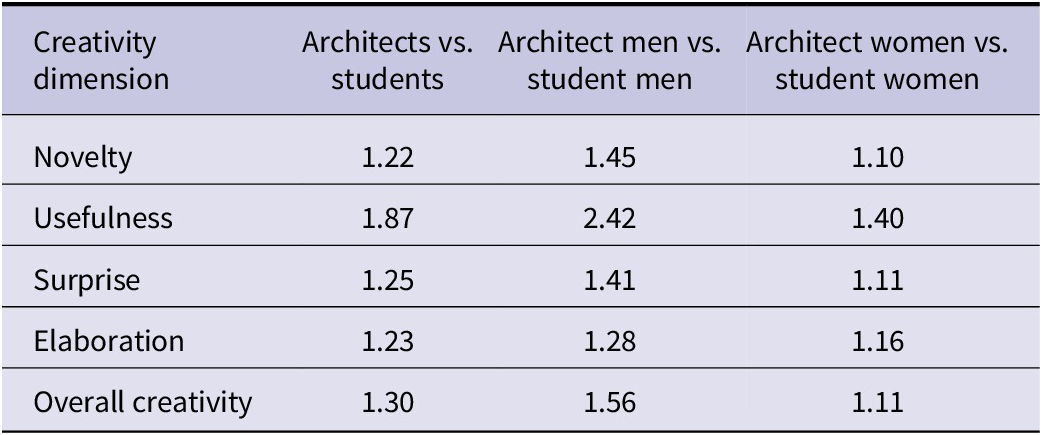
To complement the nonparametric analyses, Cohen’s d effect sizes were calculated for the principal group comparisons (Table 3). All architect–student comparisons yielded large Cohen’s d values, for the full sample and within the women and men subgroups. The largest values were observed for Usefulness.
Cohen’s d values for the principal expertise-related comparisons across the creativity dimensions

Table 3. Long description
The table consists of four columns and six rows including the header. The columns are labeled Creativity dimension, Architects vs. students, Architect men vs. student men, and Architect women vs. student women.
* Novelty: Architects vs. students 1.22, Architect men vs. student men 1.45, Architect women vs. student women 1.10.
* Usefulness: Architects vs. students 1.87, Architect men vs. student men 2.42, Architect women vs. student women 1.40.
* Surprise: Architects vs. students 1.25, Architect men vs. student men 1.41, Architect women vs. student women 1.11.
* Elaboration: Architects vs. students 1.23, Architect men vs. student men 1.28, Architect women vs. student women 1.16.
* Overall creativity: Architects vs. students 1.30, Architect men vs. student men 1.56, Architect women vs. student women 1.11.
A note at the bottom states that Cohen’s d values are reported for principal group comparisons and all values represent large effects.
Note: Cohen’s d values are reported for the principal group comparisons corresponding to the study’s research questions. According to conventional benchmarks, all values represent large effects.
Expertise differences in creativity outcomes
Mann–Whitney U tests compared students and architects across the full sample and separately within the men and women subgroups.
Expertise differences across participants
Architects received significantly higher scores than students across all five creativity dimensions (Table 4). The largest difference was observed in Overall Creativity (U = 67.0, p < .001, d = 1.33) and Usefulness (U = 44.0, p < .001, d = 1.82), followed by Surprise (U = 74.5, p < .001, d = 1.24). These findings indicate substantial expertise-related differences across all five dimensions instead of being limited to a single aspect of creativity.
Expertise differences on creativity dimensions – experts versus novices

Table 4. Long description
The table consists of six columns: Creativity dimension, Sig. (significance), U statistic, Students M D N (median), Architects M D N (median), and Z. All dimensions show a significance level of .001 with three asterisks, indicating p is less than or equal to 0.001.
* Novelty: U statistic 82.5, Students M D N 2.00, Architects M D N 3.66, Z 3.80.
* Usefulness: U statistic 44.0, Students M D N 2.00, Architects M D N 3.84, Z 5.91.
* Surprise: U statistic 74.5, Students M D N 2.00, Architects M D N 3.67, Z 4.01.
* Elaboration: U statistic 66.0, Students M D N 2.00, Architects M D N 3.00, Z 4.53.
* Overall creativity: U statistic 67.0, Students M D N 2.00, Architects M D N 4.00, Z 4.31.
In all dimensions, architects scored higher medians than students.
*** p ≤ 0.001.
Expertise differences within gender groups
Architects also received significantly higher scores than students across all five creativity dimensions within both the men and women subgroups (Table 5). The largest differences were observed in Usefulness, where men experts scored significantly higher than men novices (U = 8.0, p < .002, d = 2.03), and women experts scored significantly higher than women novices (U = 14.5, p < .007, d = 1.57). The expertise-related pattern was therefore present in both gender groups, although the estimates should be interpreted cautiously because each comparison involved only 10 participants per expertise level.
Mann–Whitney U results comparing architects and students within the men and women subgroups

Table 5. Long description
The table consists of seven columns: Comparison, Sig. (significance), U, Novice M D N (median), Expert M D N (median), and Z-score. It is divided into five main rows representing creativity metrics.
* Novelty: For S m versus A m, Sig. is .028, U is 21.00, Novice M D N is 2.00, Expert M D N is 3.33, and Z-score is 3.05. For S w versus A w, Sig. is .031, U is 21.50, Novice M D N is 2.00, Expert M D N is 4.17, and Z-score is 2.57.
* Usefulness: For S m versus A m, Sig. is .002, U is 8.00, Novice M D N is 2.00, Expert M D N is 3.84, and Z-score is 4.77. For S w versus A w, Sig. is .007, U is 14.50, Novice M D N is 2.00, Expert M D N is 3.84, and Z-score is 3.69.
* Surprise: For S m versus A m, Sig. is .004, U is 13.50, Novice M D N is 2.00, Expert M D N is 3.34, and Z-score is 3.71. For S w versus A w, Sig. is .043, U is 23.00, Novice M D N is 2.34, Expert M D N is 3.84, and Z-score is 2.27.
* Elaboration: For S m versus A m, Sig. is .018, U is 19.00, Novice M D N is 1.84, Expert M D N is 3.00, and Z-score is 3.10. For S w versus A w, Sig. is .005, U is 14.00, Novice M D N is 2.00, Expert M D N is 3.00, and Z-score is 3.69.
* Overall creativity: For S m versus A m, Sig. is .01, U is 16.00, Novice M D N is 2.00, Expert M D N is 3.17, and Z-score is 3.38. For S w versus A w, Sig. is .013, U is 17.00, Novice M D N is 2.84, Expert M D N is 4.17, and Z-score is 3.05.
Note: S m equals men students; S w equals women students; A m equals men architects; A w equals women architects. Single asterisk indicates p is less than .05 and double asterisk indicates p is less than .01.
*p < .05 **p < .01.
Note: Sm = men students; Sw = women students; Am = men architects; Aw = women architects.
Gender differences in creativity outcomes
Exploratory Mann–Whitney U tests compared women and men across the full sample and separately within the student and architect groups.
Gender differences across expertise levels
No statistically significant differences between women and men were found for any creativity dimension when expertise levels were combined (all p > .05). Women received marginally higher ratings for Novelty and Surprise. In contrast, men received slightly higher ratings for Usefulness and Elaboration. These descriptive tendencies provided no inferential evidence of systematic gender-related differences. However, nonsignificant results do not establish equivalence, and smaller differences may not have been detected in this sample.
Gender differences within each expertise level
No significant differences in creativity scores were found between men and women designers within either the novice or expert groups (all p > .05). Women students received slightly higher descriptive ratings on most dimensions, and women architects received slightly higher Novelty ratings. However, none of these differences reached statistical significance. Accordingly, the analyses provided no inferential support for systematic gender-related differences within either expertise level. These findings should nevertheless be interpreted cautiously because each comparison involved only 10 participants per group.
Correspondence analysis results
Correspondence analysis explored the relative profiles of the expertise and gender groups across the five creativity dimensions. The six expertise and gender groups and the five creativity dimensions are represented in Figure 2. Mean scores for each group-dimension combination were converted into relative profiles, each summing to 1, allowing comparison of the relative distribution of creativity dimensions across groups.
Correspondence analysis of creativity dimensions across expertise and gender groups (A = architects, S = students, Am = architect men, Aw = architect women, Sm = student men, Sw = student women). Shorter distances indicate more similar relative profiles; spatial proximity does not represent statistical significance or absolute performance.

Figure 2. Long description
A scatter plot titled Judges Score for A, S, Am, Aw, Sm, and Sw. The horizontal axis is Dimension 1 (75.3 percent) ranging from negative 0.06 to 0.06. The vertical axis is Dimension 2 (22.0 percent) ranging from negative 0.04 to 0.04. Dashed black lines intersect at the origin (0,0), dividing the plot into four quadrants.
Blue dots represent Categories:
* Novelty is in the top-left quadrant at approximately (-0.05, 0.01).
* Usefulness is in the top-right quadrant at approximately (0.03, 0.03).
* Overall Creativity is near the center-left at (-0.015, -0.005).
* Surprise is in the bottom-left quadrant near the vertical axis at (-0.005, -0.018).
* Elaboration is in the bottom-right quadrant at (0.045, -0.019).
Red dots represent Groups:
* A (Architects) is in the top-left quadrant near the center at (-0.005, 0.01).
* Am (Architect men) is in the top-right quadrant at (0.035, 0.027), close to Usefulness.
* Aw (Architect women) is in the bottom-left quadrant at (-0.042, -0.004).
* Sw (Student women) is in the bottom-left quadrant at (-0.028, -0.006), close to Overall Creativity.
* S (Students) is in the bottom-right quadrant near the center at (0.008, -0.018), close to Surprise.
* Sm (Student men) is in the far bottom-right quadrant at (0.062, -0.035), furthest from the other groups.
In correspondence analysis, the plotted axes are latent dimensions derived from the chi-square distances among these relative profiles, instead of predefined creativity variables (Greenacre, Reference Greenacre2017). Dimension 1 explained 75.3% of the total variance and Dimension 2 explained 22.0%; together, the first two dimensions captured 97.3% of the total variance. The remaining 2.7% was represented by subsequent dimensions not displayed in the two-dimensional map.
Figure 2 presents the relationships between the expertise and gender groups and the creativity dimensions. Shorter distances indicate more similar relative profiles, while points near the center approximate the overall profile. These distances are descriptive and do not constitute tests of statistical significance or differences in absolute creativity scores.
The figure showed a broader separation between the architects and students than among the gender-defined subgroups. The architect and student categories occupied different quadrants of the map, suggesting different relative profiles across the five creativity dimensions.
Architects (A) were positioned among Novelty, Overall Creativity, and Surprise, whereas students (S) were located nearer to Surprise and Elaboration. This configuration indicates different relative balances across the dimensions.
The combined subgroup positions showed further descriptive variation. Architect men (Am) were nearest to Usefulness, student men (Sm) to Elaboration, and architect women (Aw) and student women (Sw) nearer to Novelty, Overall Creativity, and Surprise. These positions describe relative profiles only and should not be interpreted as evidence of distinct gender-specific strategies or statistically significant gender differences.
Overall, the correspondence analysis represents architectural creativity as a profile across multiple dimensions. The separation between architects and students was more pronounced than the differences among the gender-defined subgroups, a pattern consistent with the expertise comparisons reported above.
Discussion
Expertise differences in creativity outcomes
Expertise differences across participants
Architects received significantly higher ratings than students across all five creativity dimensions. Cohen’s d values for the overall architect–student comparisons ranged from 1.22 to 1.87, indicating substantial expertise-related differences across the creativity dimensions. This pattern is consistent with research linking design expertise to accumulated domain knowledge, structured problem representation, and the capacity to develop and evaluate more effective solutions (Ahmed et al., Reference Ahmed, Wallace and Blessing2003; Atman et al., Reference Atman, Adams, Cardella, Turns, Mosborg and Saleem2007; Lawson and Dorst, Reference Lawson and Dorst2013; Casakin and Levy, Reference Casakin and Levy2020). It also complements evidence that design training and experience are associated with differences in both domain-specific and domain-general creativity (Teng et al., Reference Teng, Wang, Lu, Qiao and Hao2022).
The largest difference was observed for Usefulness, followed by Overall Creativity. This pattern suggests that the expertise-related advantage was especially evident in developing ideas into solutions that addressed functional requirements and task constraints. Architectural creativity requires not only originality but also the evaluation, refinement, and integration of ideas into coherent outcomes. The prominence of Usefulness may therefore reflect experts’ greater capacity to coordinate exploration with functional evaluation while integrating novelty and practicality as complementary design considerations (Sarkar and Chakrabarti, Reference Sarkar and Chakrabarti2011; Cropley and Kaufman, Reference Cropley and Kaufman2012; Lloyd-Cox et al., Reference Lloyd-Cox, Pickering and Bhattacharya2022).
In the present study, Usefulness should be interpreted as the judges’ assessment of the extent to which a completed outcome addressed functional requirements and task constraints. The design artifacts were not coded separately for specific architectural features; consequently, the current analyses cannot determine which particular spatial, functional, or representational properties led to the higher Usefulness ratings among architects. The two outcomes shown in Figure 1 are provided for illustration only and do not constitute qualitative case comparisons. Establishing how rated usefulness is manifested in specific design properties would require systematic visual or content analysis across the full set of design outcomes.
The expertise-related differences were not limited to Overall Creativity but extended across Novelty, Usefulness, Surprise, and Elaboration. This supports a multidimensional account in which creative expertise is expressed through complementary qualities of the design outcome and cannot be reduced to a single global increase in creativity. From a design cognition perspective, expertise may support the coordination of generative and evaluative requirements, including originality, functional adequacy, unexpectedness, refinement, and holistic solution quality. Previous research indicates that novice and experienced designers differ in problem scoping, information use, and the organization of their search solutions (Ahmed et al., Reference Ahmed, Wallace and Blessing2003; Atman et al., Reference Atman, Adams, Cardella, Turns, Mosborg and Saleem2007). Novices may also have greater difficulty in moving beyond early representations, as fixation-related behaviors can restrict exploration during the initial stages of design (Jia et al., Reference Jia, Jiang, Qi and Hu2024). These mechanisms may partly explain the lower student ratings, although the present study focused on completed outcomes and did not examine the underlying design processes.
One might expect novice designers to show an advantage in Novelty because extensive domain knowledge can sometimes increase reliance on familiar solutions (Teng et al., Reference Teng, Wang, Lu, Qiao and Hao2022). The present results did not show this pattern, as architects received higher Novelty ratings than students. This finding is consistent with the double-edged role of expertise outlined in Section 2.2. Prior knowledge may constrain exploration when familiar approaches dominate the search, but expertise can also provide strategic knowledge and a richer repertoire from which designers can explore new possibility spaces and construct novel, task-appropriate solutions (Yang et al., Reference Yang, Quan and Zeng2022; Ormerod & Gross, Reference Ormerod and Gross2024). Empirical research similarly indicates that greater design experience or training can be associated with higher domain-specific originality (Teng et al., Reference Teng, Wang, Lu, Qiao and Hao2022). Conversely, novice designers are not necessarily free from fixation; limited domain knowledge and reliance on early or self-generated representations may also restrict their exploration and the novelty of resulting solutions (Miao et al., Reference Miao, Jiang, Hu and Qi2023; Jia et al., Reference Jia, Jiang, Qi and Hu2024). Because the present study assessed completed outcomes and did not examine the design processes that generated them, this interpretation remains tentative and should be tested directly using process-oriented methods.
Expertise differences within gender groups
The same expertise-related pattern was observed within both gender subgroups: men and women architects received significantly higher ratings than men and women students across all five dimensions. The corresponding Cohen’s d values were large for both subgroup comparisons, ranging from 1.28 to 2.42 among men and from 1.10 to 1.40 among women. The association between expertise and creative performance was evident within both gender groups, although the estimates require caution because each subgroup at each expertise level was small.
Together with the nonsignificant gender comparisons within expertise levels, these findings identify expertise as the more prominent grouping variable associated with creative performance in this sample. However, they do not demonstrate that gender is unrelated to creativity or that the magnitude of the expertise advantage was equivalent between women and men, because no formal interaction effect was tested. This cautious interpretation is consistent with meta-analytic evidence showing that gender differences in creative performance and potential are generally small and context-dependent (Hora et al., Reference Hora, Badura, Lemoine and Grijalva2022; Abdulla Alabbasi et al., Reference Abdulla Alabbasi, Thompson, Runco, Alansari and Ayoub2025).
The findings address a different level of analysis than studies of gender-related academic achievement or collaborative design behavior (Milovanovic and Gero, Reference Milovanovic, Gero, Eriksson and Paetzold2019; Crowther and Briant, Reference Crowther and Briant2022). While those studies concern academic progression or team behavior, our study examined individually produced outcomes under common task and assessment conditions. The results also align with prior work emphasizing the role of structured training and ideation ability in the development of design expertise (Cross, Reference Cross2004; Casakin and Levy, Reference Casakin and Levy2020).
Accumulated design knowledge may support the generation, development, and evaluation of coherent solutions, although prior knowledge can also constrain creativity when familiar approaches dominate the search (Yang et al., Reference Yang, Quan and Zeng2022).
Usefulness produced the largest differences within the gender subgroups, indicating that expertise was particularly associated with transforming ideas into functionally viable solutions that addressed design requirements and constraints (Sarkar and Chakrabarti, Reference Sarkar and Chakrabarti2011; Cropley and Kaufman, Reference Cropley and Kaufman2012; Fiorineschi and Rotini, Reference Fiorineschi and Rotini2021). This pattern supports the view that creative expertise involves balancing originality with practical design considerations.
Gender differences in creativity outcomes
The gender analyses were exploratory and based on small subgroups. Their nonsignificant results do not establish equivalence between women and men, and the corresponding Cohen’s d values should be regarded as preliminary estimates.
Gender differences across expertise levels
No statistically significant differences were found between women and men across the five creativity dimensions in this sample. Although women received higher descriptive ratings on some dimensions, these tendencies were not statistically significant. The descriptive tendencies should therefore not be interpreted as evidence of systematic gender-related differences in creative performance.
The literature on design creativity and gender is similarly mixed and context-dependent. The present findings are consistent with research showing that average gender differences in creative performance are generally small and vary across domains, tasks, and assessment conditions (Abraham, Reference Abraham2016; Hora et al., Reference Hora, Badura, Lemoine and Grijalva2022; Taylor et al., Reference Taylor, Said-Metwaly, Camarda and Barbot2024). This interpretation is further supported by design-specific research reporting no statistically significant gender effect on assessed creative outcomes under common task conditions (Koronis et al., Reference Koronis, Chia, Kang Kai Siang, Silva, Yogiaman and Raghunath2019) and by a recent review emphasizing the limited and inconsistent nature of evidence concerning gender and design creativity (Souto et al., Reference Souto, Fadel and Spinillo2024). Meta-analytic evidence also indicates that gender differences in creative performance and creative potential are generally small and vary across domains, tasks, and assessment conditions (Hora et al., Reference Hora, Badura, Lemoine and Grijalva2022; Abdulla Alabbasi et al., Reference Abdulla Alabbasi, Thompson, Runco, Alansari and Ayoub2025).
Within the present design context, expertise provided a more consistent framework for interpreting variation in creative outcomes than gender. This does not exclude possible gender-related or contextual influences, but it indicates that accumulated design knowledge and experience were more closely associated with the observed differences.
Gender differences within each expertise level
No statistically significant differences between women and men were found within either expertise group. These findings suggest that creative performance was broadly comparable for the women and men represented at the same level of expertise. Together with the novice–expert differences observed within the two gender subgroups, this pattern identifies accumulated design knowledge and experience as the more prominent variables of creative performance (Cross, Reference Cross2004; Lawson and Dorst, Reference Lawson and Dorst2013; Teng et al., Reference Teng, Wang, Lu, Qiao and Hao2022; Tollestrup et al., Reference Tollestrup, Laursen and Vesti2023).
From a design cognition perspective, the findings are consistent with an expertise-based approach, in which creative performance develops through the acquisition, organization, and application of domain knowledge rather than being attributable to stable gender-specific characteristics. However, the small subgroup sizes limit the strength of this conclusion, and smaller differences may not have been detected. For design education, the findings support the development of expertise-related creative problem-solving abilities while ensuring equitable access to instructional resources. They do not support the assumption that women and men require different approaches to creativity instruction.
Multidimensional creativity profiles and their implications
Our contribution through the correspondence analysis is consistent with approaches that conceptualize design creativity in terms of multiple complementary outcome qualities (Han et al., Reference Han, Forbes and Schaefer2021; Chaudhuri and Dhar, Reference Chaudhuri and Dhar2024). Viewed from this configurational perspective, the distinction between the architect and student profiles suggests that expertise-related creativity may involve differences not only in performance in individual dimensions but also in the relative configuration of creative qualities of the design outcomes. The profiles extend the univariate findings by indicating that expertise-related creativity can be considered in terms of how originality, functional adequacy, unexpectedness, refinement, and holistic creative quality are combined. Our interpretation aligns with design expertise in the organization and application of domain knowledge, and differences in creative performance (Teng et al., Reference Teng, Wang, Lu, Qiao and Hao2022; Casakin and Levy, Reference Casakin and Levy2023).
The gender subgroup profiles provide a different type of insight. Their descriptive variation indicates that relative configurations of creativity dimensions may vary even when inferential comparisons provide no evidence of systematic gender differences. Such variation should be interpreted as exploratory subgroup-level heterogeneity and not as evidence of stable gender-specific creativity profiles or differences in overall creative ability. This interpretation is consistent with evidence that gender-related findings in creativity depend on the domain, dimensions, tasks, and assessment conditions examined (Hora et al., Reference Hora, Badura, Lemoine and Grijalva2022; Souto et al., Reference Souto, Fadel and Spinillo2024).
Whether different multidimensional outcome configurations correspond to different patterns of idea generation, evaluation, and refinement during designing needs to be explored further. Findings from recent work by Rawlings et al. (Reference Rawlings, Chetwynd-Talbot, Husband, Nuttall, Quinn, Taggart and Roome2025) and Zangeneh Soroush and Zeng (Reference Zangeneh Soroush and Zeng2026) support connections between the generative and evaluative components of creativity and identify distinct, recursively related cognitive states during creative design activity. Examining outcome profiles together with process measures could clarify whether these relationships vary with expertise.
Study limitations
Several limitations should be considered when interpreting the findings. First, the relatively small sample size limits the generalizability of the findings to broader populations. The sensitivity analysis indicated that the study was primarily capable of detecting large effects; smaller and more context-dependent gender-related differences may therefore have remained undetected. The absence of statistically significant gender differences should not be interpreted as evidence of equivalence and should be examined in future studies with larger, more diverse samples. Since the sample included only participants who identified as women or men, the findings cannot be generalized to nonbinary or gender-diverse designers.
Second, the sample was limited to architectural design, and the findings may not generalize to other design disciplines, professional settings, or creative domains. Third, creativity was assessed using a single design task conducted in a controlled setting. Although this enhanced control and comparability, the task did not reproduce the complexity of professional practice, including client interaction, collaboration, iterative feedback, and extended project development. The findings, therefore, reflect creativity under constrained individual-task conditions instead of the full range of processes characteristic of professional design.
Fourth, although the overall inter-rater reliability was acceptable, agreement varied across creativity dimensions. This reflected differences in how expert judges interpreted specific qualities of the design outcomes (Hu et al., Reference Hu, Boggess and Shepley2023). In particular, Usefulness showed lower agreement than the other dimensions, suggesting that assessing functional adequacy may involve greater interpretive variability in open-ended architectural design tasks. Findings concerning this dimension should be interpreted more cautiously than those for dimensions with higher agreement.
Fifth, the correspondence analysis was exploratory and based on aggregated group profiles. Spatial proximity in the correspondence map does not constitute a statistical test of group differences and should not be interpreted as evidence of stable gender-specific creativity profiles.
Finally, this study assessed completed outcomes but did not analyze the design process itself. Although the Consensual Assessment Technique provides an established basis for evaluating creative outcomes (Yin et al., Reference Yin, Han, Huang, Zuo and Childs2021), combining outcome assessment with protocol analysis, semantic analysis, or natural language processing could clarify how designers generate, evaluate, and refine ideas.
Conclusions and future research
This research investigated how expertise and gender relate to differences in the creativity of design outcomes. Across the five creativity dimensions assessed, expertise was more consistently associated with creative performance than gender. However, due to the sample size, the gender analyses were exploratory and should be interpreted cautiously.
The findings support a multidimensional approach to creative expertise. Architects received higher ratings than students for Novelty, Usefulness, Surprise, Elaboration, and Overall Creativity, indicating that the expertise-related differences involved multiple qualities of the design outcomes. The correspondence analysis further suggested descriptive differences between architects and students in the relative profiles of these creativity ratings. The broad pattern of expertise-related differences was evident among women and men. Although the correspondence analysis showed descriptive subgroup variation, these configurations do not establish stable or statistically significant gender-specific profiles. Within the present design context, expertise therefore provided the more consistent framework for interpreting variation in creative outcomes.
For design education and professional development, the results support emphasizing capabilities that help designers integrate originality, functionality, surprise, and refinement. These implications remain provisional and require replication with larger and more diverse samples. Future research should investigate creativity longitudinally, across different design disciplines. Following designers through education and professional practice could help distinguish expertise development from age or cohort effects and clarify how multidimensional creativity profiles change with experience.
Expanding creativity assessment beyond controlled experimental tasks to include real design situations could also contribute to a better understanding of how expertise, gender, and contextual conditions are associated with design creativity. Such an approach would bridge the gap between theoretical insights and practical applications in professional and educational settings. Future studies could combine consensual outcome ratings with systematic visual coding or computational analysis of design artifacts.
Combining outcome-based assessment with protocol analysis, semantic analysis, and natural language processing could further reveal how designers generate, evaluate, and refine ideas. Our findings suggest that creativity should be represented as a multidimensional construct rather than a single, undifferentiated score. For example, AI systems for creativity assessment or design support could model Novelty, Usefulness, Surprise, Elaboration, and Overall Creativity separately, while also examining how these dimensions combine into expertise-related profiles. Since these constructs are domain-specific (Fu et al., Reference Fu, Zhong, Shen and Chen2026), such systems should combine domain-related outcome scores with process data to provide richer information for training and validation intended to identify or support creative design activity.
Acknowledgments
The authors would like to thank Dr. Vijayakumar Nanjappan for assistance with the statistical calculations.
Competing interests
The authors declare none.
Data availability
Data from this study will be made available on request.
Funding statement
This research was supported by the Israel Science Foundation (Grant no. 798/22). Part of J.S.G.’s time was supported by the US National Science Foundation (Grant no. 1929896).
We acknowledge the use of Grammarly (v1.2.220.1800) and ChatGPT 5.2 tools for text editing.






 Open access

