Antimicrobial stewardship programs (ASPs) are an increasingly prevalent service in hospitals; they aim to assure optimal antimicrobial prescribing. A critical component of an ASP is measuring the impact of ASP interventions on antibiotic use and clinical outcomes. Determining the impact of an ASP involves documenting process measures by which an ASP intervention directly results in a medication change (eg, a decrease in antibiotics). Outcome measures including hospital length of stay (LOS), 30-day mortality, hospital-acquired Clostridioides difficile infection (HA-CDI), and infection treatment failure are reflective of overall patient care that can be impacted by ASP recommendations.Reference Barlam, Cosgrove and Abbo1
The Infectious Diseases Society of America/Society for Healthcare Epidemiology of America stewardship guidelines emphasize the importance of assessing outcomes in specific populations to better understand the clinical impact.Reference Barlam, Cosgrove and Abbo1 Integrating an ASP into the care of high-risk patients in the intensive care units (ICUs) and oncology wards is imperative because antimicrobial use in these units is high, as are the unintended consequences of antimicrobials including multidrug-resistant infections and HA-CDI.Reference Suwantarat, Logan and Carroll2– Reference Tsai, Chu and Hsu4 However, concerns about unintended consequences of narrowing or discontinuing antimicrobial therapy in these critically ill patients can limit stewardship efforts.Reference Ting, Paquette and Ng5–Reference Robilotti, Holubar, Seo and Deresinski7
Despite the growing number of pediatric ASPs,Reference McPherson, Lee and Terrill8 data on the impact of ASPs on pediatric clinical outcomes are scarce, especially for high-risk children in ICUs or oncology wards.Reference Smith, Gerber and Hersh9, Reference Newland, Gerber and Weissman10 Thus, we sought to determine the clinical impact of our well-established prospective-audit-with-feedback ASP at a free-standing children’s hospital on these high-risk pediatric patients.Reference Goldman, Lee and Hersh11, Reference Newland, De Lurgio and Hedican12
Methods
Study setting
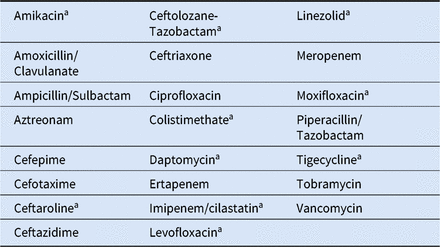
Children’s Mercy Kansas City is a 354-bed free-standing, nonprofit, academic, pediatric medical center that provides comprehensive primary and tertiary care in 40 pediatric subspecialties for a 5-state, 100-county region. The center has ~15,000 admissions annually. On March 3, 2008, a prospective-audit-with-feedback ASP was implemented that focused on improving appropriateness of antibiotic use in children who had received a broad-spectrum antibiotic for 2 consecutive calendar days. The program was led by an infectious diseases physician and 2 infectious diseases clinical pharmacy specialists, who reviewed clinical data and provided recommendations to the primary medical team. ASP recommendations were broadly categorized into 4 areas: (1) stopping antibiotic therapy, (2) modifying the antibiotic type, (3) modifying the antibiotic dosage and/or duration, and (4) obtaining an infectious diseases consultation. An ASP review was triggered only if the patient was receiving an ASP-monitored antimicrobial for 2 calendar days (Table 1).
Antimicrobial Stewardship Program Monitored Antimicrobials

a Requires preauthorization.
Sample population and data sources
For this retrospective cohort study, patients who received an ASP review between March 3, 2008, and March 2, 2017, and were considered high risk were eligible. High-risk patients included those receiving care from the medical teams in the neonatal ICU (NICU), the hematology/oncology ward (H/O), or the pediatric ICU (PICU). High-risk patients could be reviewed by the ASP team more than once during their hospital admission. For this study, all ASP reviews that occurred for a high-risk patient were included. Patients aged >17 years were excluded. Data for these high-risk patients were extracted from our ASP repository, including antibiotic(s) prescribed, antibiotic indication, dose of antibiotic(s), length of therapy, and recommendations made by the ASP. For ASP reviews resulting in a recommendation, provider agreement or disagreement with the recommendation was documented.Reference Goldman, Lee and Hersh11, Reference Lee, Goldman and Yu13, Reference McCulloh, Queen and Lee14
Additional clinical characteristics were abstracted from the electronic medical record (EMR) and the pediatric health information system (PHIS) database. EMR data included select clinical and demographic characteristics such as patient age, race/ethnicity, gender, discharge diagnosis codes, all medication administrations, Clostridioides difficile (C. difficile) testing, and mortality. The classification of complex chronic care conditions, medical service line, and 30-day readmission were based on data from the PHIS. The PHIS is an administrative database that contains patient-level billing data from >50 nonprofit, tertiary-care, pediatric hospitals in the United States. These hospitals, including Children’s Mercy Kansas City, are affiliated with the Children’s Hospital Association (Mission, KS). Data quality and reliability are assured through a joint effort between the Children’s Hospital Association and participating hospitals. The data warehouse function for the PHIS database is managed by Truven Health Analytics (Ann Arbor, MI). Data are deidentified at the time of data submission and data are subjected to a number of reliability and validity checks before being included in the database. Using internal patient identifiers, the ASP repository and EMR data were merged with the data obtained from the PHIS. This study was reviewed and approved by Children’s Mercy Hospital’s Institutional Review Board.
Primary outcomes
Three primary outcomes were evaluated among all patients in this study: HA-CDI, all-cause mortality during the patients’ current hospitalization, and 30-day readmission. Cases of HA-CDI were defined as having a positive stool sample (ie, positive GDH and toxin antigen screen or if only GDH was positive, then confirmatory positive toxin PCR) and the patient was treated for HA-CDI (ie, metronidazole, per-oral vancomycin, or fidaxomicin) within 24 hours of a positive result. Testing that occurred within the first 48 hours of admission were excluded to help ensure that only HA-CDIs were identified. Readmission was defined as all-cause 30-day readmission, which implies that there was no restriction on the underlying reason for the readmission.
Secondary outcomes
Two secondary outcomes were evaluated on a subset of the high-risk cohort: hospital length of stay (LOS) and treatment failure among high-risk patients diagnosed with ventilator-associated tracheitis (VAT). The comparison of LOS was restricted to patients with a single ASP review because the relationship between LOS and ASP review characteristics (eg, any recommendations, agreement with recommendations, etc) was difficult to attribute when >1 ASP review had been completed. The diagnosis of VAT was specifically evaluated for the following reasons: (1) VAT is a commonly encountered and reviewed antibiotic indication in this high-risk population; (2) frequent recommendations are made by our ASP team in regard to the treatment of VAT; and (3) the recommended treatment for VAT is either no antibiotics or a short course of antibiotics (5 days). Only children reviewed by the ASP because they were receiving an antibiotic(s) prescribed for VAT were included. Children receiving antibiotics for concurrent indications (eg, pneumonia, bacteremia, or urinary tract infection) were excluded from this subset. VAT treatment failure was defined as initiating a course of antibiotics for the indication of VAT within 14 days following the completion of the initial VAT treatment course. The LOS was defined as the number of hours between the patients’ admission and discharge from the hospital, converted to days.
Statistical analysis
All outcomes, with the exception of LOS, were modeled as binary. The frequency distribution of these outcomes were compared across clinical service categories, complex chronic condition (CCC) status, indication for treatment, by ASP recommendation type (eg, recommended conversion from intravenous to oral administration, stop recommendation, etc), and combining all recommendations into an “any recommendation” category. The frequency of the outcomes was also compared based on whether the provider agreed with recommendations. For the bivariate analysis unadjusted proportions and Fisher exact P values are reported. Comparisons of LOS were performed using the Mann-Whitney U test.
Multivariable generalized linear models were performed to examine the relationship between ASP recommendations and each outcome after adjusting for clinical service and indication for treatment. Because all ASP reviews and outcomes had a known date/time, the data were structured in a multiple time-to-event format. The outcome was assumed to not have occurred if either (1) the patient had subsequent ASP review or (2) the patient had been discharged. Similar analytic approaches have frequently been used to examine how modified exposures may affect outcomes that can occur more than once.Reference Gill, Zou, Jones and Speechley15–Reference Kennedy, Kasl and Vaccarino17 The patient identifier was used to specify the R-side random effect, and the compound-symmetry covariance matrix was employed. List-wise deletion was performed for instances in which data were missing. All analyses were completed using SAS version 9.4 software (SAS Institute, Cary, NC).
Results
ASP reviews and recommendations
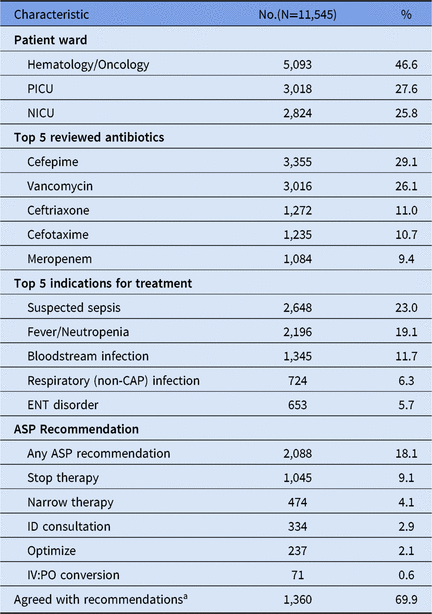
In total, 11,804 ASP reviews among high-risk patients were identified, representing 7,414 unique encounters. Reviews of high-risk patients accounted for 42.7% of all ASP reviews performed during the study period. Also, 259 reviews of high-risk patients were excluded due to incomplete data, resulting in a final analytic sample of 11,545 ASP reviews (7,329 encounters). The high-risk patients had a median age of 3.4 years (interquartile range, 0.2–9.4 years), 12% were of Hispanic ethnicity, 16% were African American, 55% were male, and 90.4% were classified as having a complex chronic condition.
The ASP reviews among H/O patients were most common (46.6%), followed by patients in the PICU (27.6%) and the NICU (25.8%) (Table 2). The most frequently reviewed drugs were cefepime (29.1%), vancomycin (26.1%), and ceftriaxone (11.0%). The most frequent indications for antimicrobial use were suspected sepsis (23%) and fever with neutropenia (19.1%).
Clinical Characteristics of High-Risk ASP Reviews
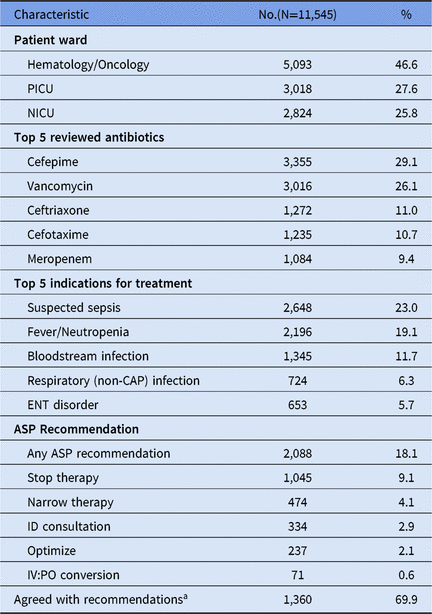
Note. PICU, pediatric intensive care unit; NICU, neonatal intensive care unit; CAP, community-acquired pneumonia, ENT, ear, nose, and throat; ASP, antimicrobial stewardship program; ID, infectious diseases; IV:PO, intravenous to oral drug administration.
a Among those with ASP recommendations.
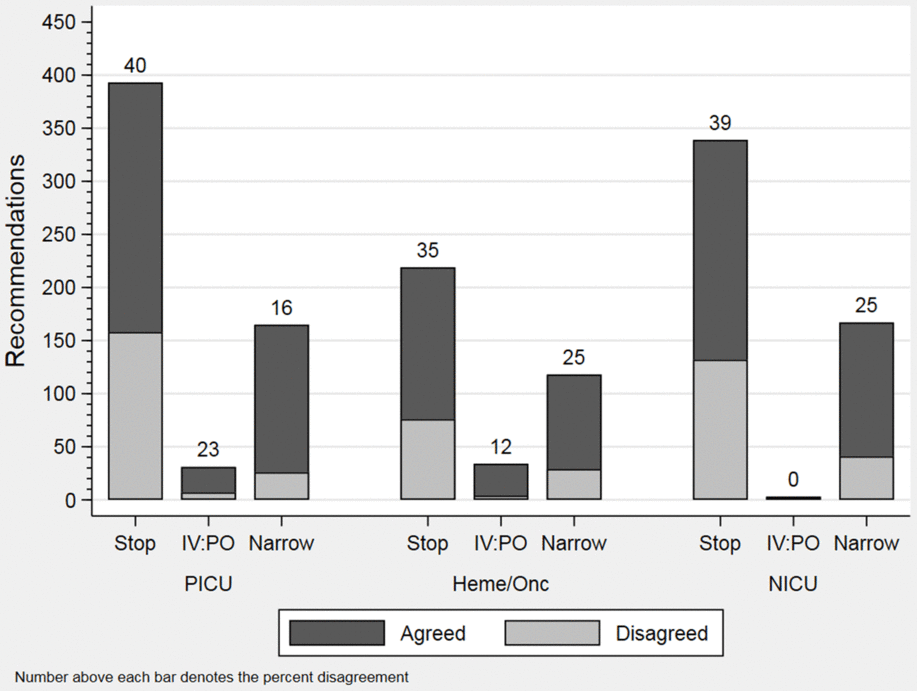
Overall, the ASP team provided recommendations on 2,088 reviews of high-risk patients (18.1%). A trend analysis showed that the likelihood of receiving a recommendation during the study time period remained stable. These recommendations were made in 1,768 unique patients who received 1 or more ASP recommendations. The most frequent recommendation was to stop therapy (50.1%). Overall, provider disagreement with ASP recommendations occurred in 31% of cases. Disagreement was defined as follows: at the time of an ASP recommendation, the medical team did not agree or agreed but did not adhere to the ASP recommendation. Disagreement with ASP most commonly occurred when the recommendation was to stop an antimicrobial (Fig. 1). A significant increase in disagreement with an ASP recommendation was observed during the study period from 29.6% to 41.0% (P = .001).
Antimicrobial stewardship program recommendations by clinical service and rates of agreement.

Primary outcomes
In total, 356 patients (4.8%) who underwent at least 1 ASP review died during their hospitalization (Table 3). In patients for whom an ASP recommendation was given, the odds of mortality was significantly lower (adjusted odds ratio [aOR], 0.72; 95% confidence interval [CI], 0.54–0.96; P = .023) (Table 3). Overall, readmissions occurred in 2,608 high-risk patients (23.3%) reviewed by ASP. A stop recommendation was not associated with increased odds of 30-day readmission (aOR, 0.98; 95% CI, 0.82–1.17; P = .842). HA-CDI occurred in 88 cases (1.2%) among this high-risk cohort. Agreement with an ASP recommendation did not increase the odds of acquiring HA-CDI (aOR, 01.59; 95% CI, 0.35–7.30; P = .544).
Adjusted Odds of Mortality, HA-CDI, and 30-Day Readmission

Note. HA-CDI, hospital-acquired Clostridium difficile infection; ASP, antimicrobial stewardship program.
a Among patients with ASP recommendations.
Secondary outcomes
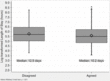
Of the 1,768 patients with 1 or more ASP recommendations, 831 (47.0%) had a single ASP review during their hospitalization. Among these 831 patients, the LOS for agreement with ASP recommendations was significantly shorter compared to cases in which disagreement occurred (10.2 days vs 12.5 days; P = .021) (Fig. 2).
Hospital length of stay in high-risk children with a single ASP review with recommendation.

In total, 412 VAT cases were included in the comparison of ASP recommendation with treatment failure and treatment duration. Of these cases, 45 (11.0%) experienced treatment failure, thus requiring reinitiation of antibiotic therapy within 14 days of completing their original treatment. The ASP recommended stopping therapy in 99 cases (24.0%) and optimizing therapy in 65 cases (15.8%). The medical team agreed with the ASP recommendation in 60% of these cases. No statistically significant differences in VAT treatment failure were observed when comparing any recommendation versus no recommendation (8.51% vs 13.00%; P = .157) or agreement versus disagreement of an ASP recommendation (10.58% vs 7.14%; P = .595). The mean duration of treatment was 1.16 days shorter for VAT patients, with an agreed-upon stop recommendation compared to VAT with no recommendation (4.60 vs 5.76; P =.007). Those experiencing treatment failure received a longer antimicrobial treatment course than those patients without treatment failure (6.42 days vs 5.61 days; P =.033).
Discussion
Although ASPs are increasingly an integrated part of hospital care, data on the impact of ASP on high-risk pediatric patients (eg, those in the ICU or oncology ward) are limited. This study yielded several important findings. First, ASP recommendations that frequently included stop therapy in high-risk pediatric patients did not result in worse clinical outcomes. Second, in patients with a single ASP review during their hospitalization, agreement with an ASP recommendation was associated with shorter LOS. And third, ASP recommendations can result in shorter antibiotic durations when treating common high-risk infections such as VAT without an increase in the treatment failure rate.
Unique challenges and barriers are encountered by ASPs in addressing appropriate use of antibiotics among ICU and oncology patients.Reference Timsit, Bassetti and Cremer18, Reference Wolf, Sun and Tang19 Broad-spectrum antimicrobial use is high, and prompt initiation of appropriate antimicrobials is critical in these vulnerable patients. Durations of antimicrobial therapy are often not clearly defined in high-risk children. Underlying immunocompromised conditions modify both the inflammatory response to infection and the response to treatment.Reference Abbo and Ariza-Heredia20 However, the undesired consequences of broad-spectrum antimicrobial use is also more frequent, including infection with multidrug-resistant pathogens and HA-CDI.Reference Trubiano, Worth, Thursky and Slavin3, Reference Tsai, Chu and Hsu4, Reference Kim, Shaklee and Smathers21, Reference Logan, Gandra and Mandal22 Thus, stewardship efforts are extremely important in this population both to minimize the unnecessary use of antimicrobials and to optimize the antimicrobials being used.
Previously, we noted ~22% disagreement by our general pediatric medical team with ASP recommendations at our hospital, compared to 30% disagreement observed among the team treating this high-risk pediatric cohort.Reference Goldman, Lee and Hersh11 Hesitation by physicians to de-escalate or stop antimicrobials because of disease severity, especially in high-risk patients, can be challenging for ASP teams.Reference Aizawa, Suwa and Higuchi23 Thus, demonstrating that stewardship efforts, including the recommendation to stop therapy, do not result in increased morbidity or mortality is important. A recent systematic review and meta-analysis of audit with feedback in the ICU setting, using mortality as the outcome, did not identify an increased risk of death with ASP prospective audit with feedback.Reference Lindsay, Rohailla and Taggart6 Our results corroborate previous reports in high-risk populations that have shown that ASPs do not result in higher mortality or readmissions.Reference Lindsay, Rohailla and Taggart6, Reference Aizawa, Suwa and Higuchi23 Additionally in our study, patients with a single ASP review and agreed upon recommendations had a shorter LOS, which further highlights the potential benefits of the ASP.
Further collaboration with high-risk providers is critical to developing strategies for de-escalation and discontinuation of antimicrobials when detriment supersedes benefit for specific diagnoses. In this study, agreement with ASP recommendations for VAT did not result in more treatment failures nor did an extended course of antimicrobials protect against treatment failure. In fact, VAT patients who experienced treatment failure actually had significantly longer durations of antimicrobial therapy. Previous research has demonstrated that a longer course of antibiotics for VAT is not clinically beneficial and results in the acquisition of multidrug-resistant pathogens.Reference Tamma, Turnbull, Milstone, Lehmann, Sydnor and Cosgrove24 Despite this finding, VAT remains a common diagnosis accounting for nearly 20% of all cases for which ASP is intervening with limited success. Recommendations to stop or modify antimicrobial therapy for VAT treatment was disagreed upon 40% of the time.
The evaluation of clinical outcomes associated with ASP recommendations in high-risk pediatric patients is limited. Demonstrating the impact of ASPs to high-risk patient providers is important. Specifically, it is important to share the clinical impact of modifying or stopping antimicrobial therapy in appropriate situations on these patients. Although the obstacles of stewardship in high-risk patients are clear, advances in diagnostics, biomarkers, and new antimicrobials further iterates opportunities for ASP in ICU and immunocompromised patients.Reference Lawrence and Kollef25 Identifying new strategies to enhance communication between ASP and high-risk providers is needed. Patel et alReference Patel, Saiman, Duchon, Evans, Ferng and Larson26 found that creation of a nonpunitive atmosphere when working with NICU teams and providing customized feedback was effective in enhancing ASP in the neonatal setting. Coordinating ASP efforts with existing quality initiatives may prove to be an efficient and effective strategy to minimize redundancy with ongoing safety work.Reference Cantey and Patel27
Our study has several limitations. Our results are limited to a single center and thus may not be generalizable. The study was retrospective in nature and cases of VAT were based on the medical provider’s clinical diagnosis of VAT rather than a strict clinical definition.Reference Dallas, Skrupky, Abebe, Boyle and Kollef28 Thus, inclusion of cases that were not truly VAT may have occurred. The approach used to define HA-CDI using both test results and treatment for HA-CDI could have failed to detect true cases; however, we did perform validation on 35 cases and found our approach to have 100% sensitivity and specificity. ASP recommendations and agreement were entered into an electronic data capture form manually, with potential for data entry errors. However, given our large sample size, limited data entry errors likely would not influence the results. Our high-risk patients are heterogeneous given that we included hospitalized children from the H/O ward, the NICU, and the PICU. We elected to group all patients in this high-risk cohort given their overall high use of antibiotic use and underlying case complexity. Further studies to assess each group individually and to focus on specific subpopulations such as cardiac ICU and bone marrow transplant patients may provide further insight into specific unit-based ASP recommendations and outcomes and will contribute to a better understanding of why disagreements between prescribers and ASP occur.
In conclusion, the ASP recommendation for pediatric high-risk patients in this study was frequently to stop antimicrobial therapy. Medical providers disagreed with ASP recommendations in nearly one-third of cases. However, when ASP recommendations were made, patients did not have an increased likelihood of worse hospital outcomes. Further work is needed to enhance stewardship efforts in high-risk pediatric patients, including further demonstrations of how ASPs can directly impact clinical outcomes.
Author ORCIDs
Jennifer L. Goldman, 0000-0001-6628-8949
Acknowledgments
We would like to acknowledge the entire Children’s Mercy Kansas City ASP Team for their contribution to the program.
Financial support
This work was supported by the Kansas City Area Life Sciences Institute Blue KC Outcomes research grant.
Conflicts of interest
All authors report no conflicts of interest relevant to this article.