Introduction
Antipsychotics are commonly used. In 2014, enough antipsychotic medicine was dispensed in Australia for 1% of the population to take one standard dose on each day of the year (Commonwealth of Australia, 2015). The rate of dispensing of antipsychotic medicines was higher among older people compared to younger adults (27,043 prescriptions dispensed per 100,000 people aged 65 year or over compared to 17,844 prescriptions dispensed per 100,000 people aged 18–64 years) (Australian Commission on Safety and Quality in Health Care and National Health Performance Authority, 2015). Between 2000 and 2011, the rate of use of atypical antipsychotics increased by 218% while use of typical antipsychotics decreased by 61%, resulting in a large overall increase in the rate of use of antipsychotic medicines over this 12 year time period (Stephenson et al., Reference Stephenson, Karanges and McGregor2012). The large increase in the use of antipsychotics is likely to be for indications other than schizophrenia or psychoses because the prevalence of these conditions did not change significantly over this study period (Stephenson et al., Reference Stephenson, Karanges and McGregor2012). Results from another study suggested that, based on the population prevalence of schizophrenia and dementia in different age groups, the high rate of atypical antipsychotic use in older people is likely to be for the management of the behavioral and psychological symptoms of dementia (BPSD) (Hollingworth et al., Reference Hollingworth, Siskind, Nissen, Robinson and Hall2010).
When antipsychotics are used in the management of schizophrenia or other psychoses, treatment guidelines recommend monotherapy for nearly all patients (Psychotropic Expert Groups, 2013). Treatment guidelines indicate that dual therapy may be used for 1–2 weeks when swapping from one antipsychotic to another, or for patients who are resistant to treatment with appropriate doses of a single antipsychotic agent(Psychotropic Expert Groups, 2013) after two separate antipsychotics have been trialed (Galletly et al., Reference Galletly2016). There is a paucity of good quality evidence to support use of more than one antipsychotic agent in the management of schizophrenia or other psychoses (Galletly et al., Reference Galletly2016). In Australia, risperidone is the only antipsychotic agent approved for use in the management of BPSD (Australian Medicines Handbook, 2016), so use of more than one antipsychotic for the management of BPSD represents off-label prescribing. Despite not being recommended in guidelines, antipsychotic polypharmacy (use of more than one antipsychotic concurrently) is frequent among people with serious mental illness. A systematic review of 147 studies that assessed the prevalence of antipsychotic polypharmacy found that a median of 20% of patients taking antipsychotics used two or more concurrently (Gallego et al., Reference Gallego, Bonetti, Zhang, Kane and Correll2012a). The median age of patients included in this systematic review was 41 years (Gallego et al., Reference Gallego, Bonetti, Zhang, Kane and Correll2012a). In a cross-sectional study of older Finnish patients with dementia, the prevalence of antipsychotic polypharmacy was 8%, and increased to 13% in those with dementia combined with a history of psychiatric disorders (Taipale et al., Reference Taipale, Koponen, Tanskanen, Tolppanen, Tiihonen and Hartikainen2014). In a cohort study of 298,847 German people aged 65 years and over who initiated antipsychotics, 3.6% of participants initiated therapy with more than one antipsychotic agent (Schmedt et al., Reference Schmedt2016). Schizophrenia, bipolar disorder, and other psychoses were present in less than 30% of patients who initiated antipsychotic polypharmacy; dementia (62%) and depression (38%) and pain (33%) were the most common comorbidities in the elderly antipsychotic polypharmacy initiators in this study (Schmedt et al., Reference Schmedt2016). An Australian study reported that 36 out of 321 (11%) elderly hospital inpatients using atypical antipsychotics used more than one agent concurrently (Tiller et al., Reference Tiller2008). Participants of this study were inpatients of old-age psychiatrists participating in a survey on prescriber attitudes toward atypical antipsychotic use, so the representativeness of the sample and generalizability of results to the wider older Australian population is unclear. Another Australian study, involving 89 patients with BPSD discharged from three psychogeriatric inpatient units, found that four patients (4.5%) were dispensed dual antipsychotics at discharge (Restifo et al., Reference Restifo, Lemon and Waters2011). Among Australian aged care facility residents who use antipsychotic medicines, prevalence of dual antipsychotic use ranges from 3.5% (Nishtala et al., Reference Nishtala, McLachlan, Bell and Chen2010) to 4.5% (Snowdon et al., Reference Snowdon, Day and Baker2005). We located no studies that assessed the prevalence of antipsychotic polypharmacy in older Australians at the population level.
Antipsychotics are associated with a number of side effects, and the risk of some increases with antipsychotic polypharmacy (Gallego et al., Reference Gallego, Nielsen, de Hert, Kane and Correll2012b). Antipsychotic polypharmacy has been associated with increased risk of hyperprolactinemia and increased use of anticholinergic medicines to manage the extrapyramidal side effects of antipsychotic medicines (Gallego et al., Reference Gallego, Nielsen, de Hert, Kane and Correll2012b). The risk of metabolic adverse effects, including weight gain, diabetes, or dyslipidemia associated with antipsychotic polypharmacy is less clear, with some studies showing increased risk but others showing no risk or reduced risk of metabolic adverse effects with the use of more than one antipsychotic agent (Gallego et al., Reference Gallego, Nielsen, de Hert, Kane and Correll2012b). When single antipsychotics are used, the risk of serious adverse events is high. Antipsychotics have been associated with increased risk of hip fracture (Pratt et al., Reference Pratt, Roughead, Ramsay, Salter and Ryan2011), pneumonia (Pratt et al., Reference Pratt, Roughead, Ramsay, Salter and Ryan2011), and death (Pratt et al., Reference Pratt, Roughead, Ryan and Salter2010) in elderly people. Antipsychotics have also been associated with prescribing cascades (Pratt et al., Reference Pratt2013;Hashimoto et al., Reference Hashimoto, Hashimoto, Ando, Kimura, Nagase and Arai2015;Takeuchi et al., Reference Takeuchi, Kajiyama, Ishiguro and Uyama2015), where medicines are initiated to manage adverse events associated with the antipsychotic. This is problematic, because initiation of a new medicine to manage adverse events associated with antipsychotics places patients at risk of additional adverse events associated with the new medicine (Kalisch et al., Reference Kalisch, Caughey, Roughead and Gilbert2011).
The aim of this study was to analyze antipsychotic use in elderly Australians, focusing on the prevalence of antipsychotic polypharmacy and the frequency of prescribing cascades to manage adverse events associated with antipsychotics.
Methods
A cross-sectional study was conducted using administrative claims data from the Australian Department of Veterans’ Affairs (DVA). The DVA administrative claims database contains details of all prescription medicines, medical, allied health services, and hospitalizations provided to veterans for which DVA pay a subsidy. DVA maintain a client file, which includes data on gender, date of birth, date of death, and family status. Medicines are coded according to the World Health Organization (WHO) Anatomical Therapeutic Chemical (ATC) classification (World Health Organization Collaborating Centre for Drug Statistics Methodology, 2004. Available from: http://www.whocc.no/atcddd/ [cited 2004 Feb 4]) and the Schedule of Pharmaceutical Benefits item codes (Australian Government Department of Health and Ageing). Hospitalizations are coded according to the WHO International Classification of Diseases – 10th Edition, Australian Modification (National Centre for Classification in Health, 2000). The median age of the DVA treatment population is 80 years, and 62% of those aged 70 years and older are women.
The study period was 1 March 2014 to 30 June 2014, with a 12-month run-in period (1 March 2013–28 February 2014). Veterans who were eligible to receive all DVA subsidized health services for at least one year prior to the study start date, who were alive at the end of the study period and who were dispensed at least one antipsychotic medicine (ATC code N05A, not including prochlorperazine (N05AB04) or lithium (N05AN01)) during the study period were included. For all study participants, we determined their age, gender, and location of residence (living in the community vs. residential aged care facility/nursing home) at study start (1 March 2014), and the number of different prescribers for antipsychotic medicines dispensed during the study period. We also determined the number of study participants with a mental health–related hospital admission in the run in period, and the number of participants who consulted a psychiatrist during the study period or in the year prior as a marker of indication for use of the antipsychotics. Diagnoses for use of medicines are not recorded in the data set, and although risperidone is the only antipsychotic subsidized for BPSD, off-label use of other antipsychotics for BPSD may occur. We hypothesized that study participants who had a mental health–related hospital admission or consulted a psychiatrist were more likely to be using antipsychotic for the management of schizophrenia or other psychoses, rather than for the management of BPSD.
We identified the number of participants who were co-dispensed anticholinergic medicine indicated for the management of extrapyramidal side effects during the study period (benztropine, benzhexol, or biperiden; ATC codes N04AA01, N04AA02, N04AC01). We also identified the number of participants in the study who were co-dispensed a medicine for the treatment of hyperprolactinemia during the study period (bromocriptine, cabergoline, or quinagolide; ATC codes G02CB01, N04BC01, G02CB03, N04BC06, G02CB04). The number of participants co-dispensed an oral diabetes medicine during the study period was also identified (ATC code A10B). We also determined how many participants had been monitored for the metabolic effects associated with antipsychotics, by identifying the number who received a glycosylated hemoglobin (HbA1c) test during the study period or in the 6 months prior.
We determined the number of participants who were using dual antipsychotics during the study period. Dual antipsychotic use was defined in two ways. First, if a participant was dispensed two or more antipsychotics during the study period, which had been prescribed on the same day, this was defined as dual use. Second, we used exposure duration estimates to determine if a participant was taking two or more antipsychotics at the same time during the study period. Prescription duration is not recorded in the claims data, so we estimated the duration of each prescription as the time within which 75% of patients obtained a refill dispensing. If duration estimates overlapped for only one month, this was considered to be switching. Where duration estimates overlapped for more than one month, then this was considered to be dual use. The type and combination of antipsychotics dispensed to participants on dual therapy was determined. We also determined the number of participants on dual therapy who had both antipsychotics prescribed by the same doctor and the number of participants on dual antipsychotics who were new antipsychotic users when dual therapy was started (defined as no claims for any antipsychotics in the 12 months prior to study start).
Results were stratified by antipsychotic dual users and those dispensed only one antipsychotic at a time. Statistical comparisons were made to compare differences between groups. Wilcoxon–Mann–Whitney test was used for ordinal variables, the χ 2 test and Fishers exact test was used for binary variables. All analyses were undertaken using SAS for windows, V9.1.3 SP4 (SAS institute, Cary, North Carolina, USA).
Ethics approval was received from the University of South Australia Human Research Ethics Committee and the DVA Human Research Ethics Committee.
Results
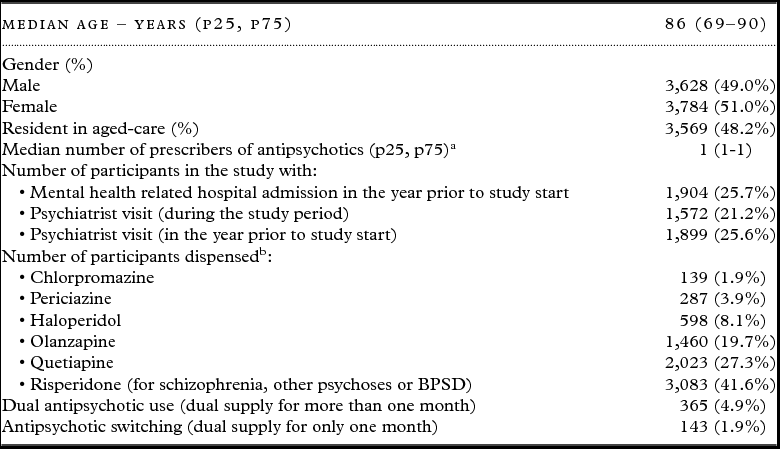
There were 7,412 veterans who met the inclusion criteria for the study. Study participants had a median age of 86 years and just over half were women. Nearly half were resident in aged care (Table 1). Most study participants had antipsychotics prescribed by only one doctor during the study period, one in four had a mental health–related hospital admission in the year prior to study start and a quarter had seen a psychiatrist in the year prior to study start (Table 1). Risperidone was the most frequently dispensed antipsychotic, dispensed to 41.6% of study participants, followed by quetiapine (27.3% of participants) and olanzapine (19.7%) (Table 1). Three quarters of those dispensed risperidone (n=2,327) received supply on dispensing codes specifically for BPSD.
Demographics of study population dispensed at least one antipsychotic medicine (ATC code N05A, not including prochlorperazine (N05AB04) or lithium (N05AN01)) during the study period (n=7,412)

aFor antipsychotics dispensed during the study period.
b Antipsychotics dispensed to less than 1% of the study population not presented. Risperidone is the only antipsychotic available for BPSD in Australia; results presented here are for all use (i.e. BPSD, schizophrenia, and other psychoses combined).
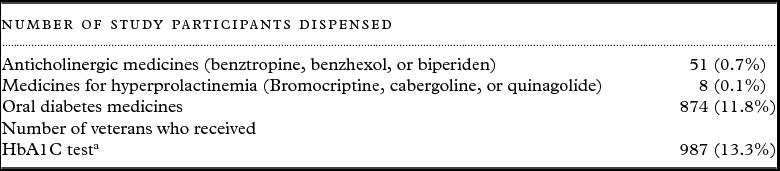
Less than 1% of participants were dispensed anticholinergic medicines indicated for the management of antipsychotic-associated extrapyramidal movement disorders (Table 2). Medicines for the management of hyperprolactinemia were dispensed to only 0.1% of the study population. Thirteen percent of study participants received an HbA1c test (Table 2).
Management and monitoring of antipsychotic associated adverse events among study participants (n=7412)

aDuring the study period or in the 6 months prior.
Five hundred and eight study participants had overlapping supply of different antipsychotics during the study period. For 143 of these patients, the dual supply lasted for only one month which is likely to represent switching rather than dual use. The remaining 365 patients (4.9% of the study population) used more than one antipsychotic for two or more consecutive months. Of these 365 dual users, 18% (n=67) had the antipsychotics prescribed on the same day while the remainder were taking two different antipsychotics at the same time which had been prescribed on different days. Eight percent of dual antipsychotic users (n=32) were new users of antipsychotics. Twenty eight (7.7%) of the 365 participants dispensed dual therapy received a long-acting injectable antipsychotic in combination with an oral antipsychotic.
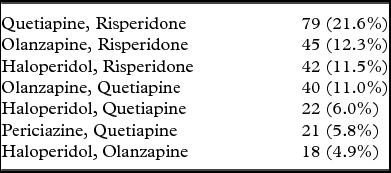
The most common antipsychotic used in dual use was risperidone. Risperidone was most often used with quetiapine (22% of dual antipsychotic users) (Table 3).
Common combinations dispensed to study participants on dual antipsychotics (n=365)

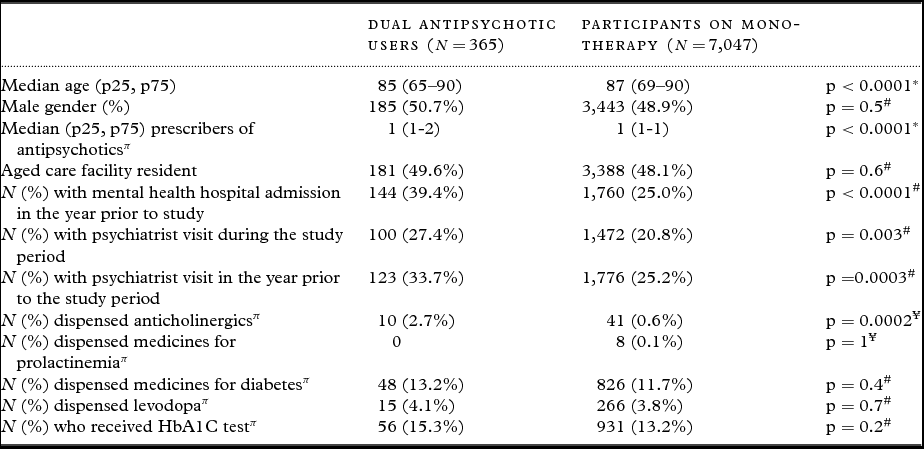
Dual antipsychotic users were slightly younger than those on monotherapy and had more antipsychotic prescribers (Table 4). A higher proportion of dual antipsychotic users had a recent mental health hospital admission or psychiatrist visit compared to those on monotherapy, and those on dual therapy were more likely to receive a blood test to monitor lipids or blood glucose (Table 4).
Characteristics of study participants dispensed dual antipsychotics versus those dispensed antipsychotic monotherapy

*Wilcoxon–Mann–Whitney test; #χ 2 test; ¥Fishers exact test; πDuring the study period.
Discussion
Our study shows that antipsychotic polypharmacy occurred in 1 in 20 Australian veterans. Multiple antipsychotic dispensing on the same day, a scenario which is likely to represent intentional antipsychotic polypharmacy, was rare. Given the risk of serious adverse events associated with the use of antipsychotic medicines in elderly people, the likelihood of increased risk of adverse events associated with dual antipsychotic use and the lack of evidence for the use of multiple antipsychotics in elderly people, dual use should be avoided in the elderly.
Prescribing cascades, where additional medicines are prescribed to manage the adverse effects of the antipsychotic medicine, were not common in our elderly study population. Only 0.7% of the study population was dispensed anticholinergic medicines to manage extrapyramidal side effects, and only 0.1% were dispensed medicines to manage hyperprolactinemia. Extrapyramidal side effects and hyperprolactinemia occur in more than 1% of antipsychotics users (Australian Medicines Handbook, 2016), so the low prevalence of use of medicines to manage these side effects suggests that non-drug management options were used for many participants in our study.
In our study, antipsychotic polypharmacy was associated with having multiple prescribers of antipsychotics. Prior research has shown that the risk of using inappropriate combinations of medicines, including two or more medicines from the same class, increased with increasing number of prescribers (Tamblyn et al., Reference Tamblyn, McLeod, Abrahamowicz and Laprise1996). Our results support these findings. It is possible that some of the cases of antipsychotic polypharmacy identified in our study were unintentional because the antipsychotics were prescribed by different doctors who may have been unaware that another antipsychotic had already been prescribed by a different doctor. Our findings highlight the importance of good continuity of care and communication, particularly when patients have multiple prescribers, to ensure that antipsychotic therapy is not unintentionally duplicated.
Although we were unable to determine the indication for use of all antipsychotics in our study, it is likely that a large amount of use was for BPSD given the age of the study population and high proportion of aged care facility residents. Other Australian research has shown that antipsychotics are frequently used in the aged care setting, and that use in this setting is frequently for BPSD. A study which analyzed antipsychotic use among Australian aged care facility residents who received medication reviews found prevalence of use was 23% and psychiatric illness and dementia were the most common reasons for antipsychotic use (Nishtala et al., Reference Nishtala, McLachlan, Bell and Chen2010). In this study, the odds of using antipsychotics were highest in elderly people with psychosis and with BPSD (Nishtala et al., Reference Nishtala, McLachlan, Bell and Chen2010). An earlier study of antipsychotic use in Australian residential aged care facilities, conducted in 2003, found that two thirds of participants used antipsychotics for dementia or other cerebral disease, without a diagnosis of schizophrenia, bipolar disorder or other psychoses (Snowdon et al., Reference Snowdon, Day and Baker2005). In this study, risperidone, olanzapine, and haloperidol were the most frequently dispensed antipsychotics to aged care facility residents with dementia but not psychoses (Snowdon et al., Reference Snowdon, Day and Baker2005); showing a high level of off-label use because risperidone is the only antipsychotic indicated for BPSD. Three quarters of people dispensed risperidone in our study received it on dispensing codes that indicated supply was specifically for BPSD. Because diagnoses are not recorded in the DVA prescription claims dataset, we were unable to determine the indication for use of the other antipsychotics in our study. Although risperidone is the only antipsychotic approved for BPSD in Australia, off-label use of other antipsychotics for BPSD occurs. Given the age of our study population and the high prevalence of use in aged care facility residents, it is likely that BPSD was a more common indication for antipsychotic use than schizophrenia or other psychoses. We did not consider the duration of use of antipsychotics in our study population; however, in 2015 the indication for use of risperidone in BPSD was amended to restrict use to patients with moderate to severe Alzheimer's dementia only, for periods of up to twelve weeks (Australian Government Department of Health, 2015). In addition, although risperidone is the only antipsychotic indicated for the management of BPSD in Australia, results of our study, where quetiapine and olanzapine were also commonly dispensed, suggests that significant off-label use of antipsychotics for BPSD is occurring.
The prevalence of antipsychotic polypharmacy in our study (5%) was lower than the prevalence reported in a systematic review, where up to 20% of participants reported dual use (Gallego et al., Reference Gallego, Bonetti, Zhang, Kane and Correll2012a). This difference may be due to the older age of our study population where the median age was 86 years; compared to a median age of 41 years for study participants in the systematic review, an age group where use is more likely to be for schizophrenia or other psychoses and for which dual use may be appropriate in some cases. Prevalence of dual antipsychotic use in our study was comparable to other Australian studies involving aged care facility residents only, where 3.5% (Nishtala et al., Reference Nishtala, McLachlan, Bell and Chen2010) to 4.5% (Snowdon et al., Reference Snowdon, Day and Baker2005) of aged care facility residents used more than one antipsychotic concurrently.
There are several limitations to our study. First, the study was conducted using prescription claims data and we cannot be certain that medicines dispensed to patients were actually taken. It may be that some patients dispensed antipsychotics did not actually take the medicine, and that some patients dispensed dual antipsychotics did not take both. However, we used a 4 month study period for the study because prior research using the same data-set has shown that this is the optimal time period to capture actual drug use by patients (King et al., Reference King, Purdie and Roberts2001). In addition, diagnoses are not included in the claims data used for this study. Based on the age of our study population and based on results from other studies of antipsychotic users of similar age (Nishtala et al., Reference Nishtala, McLachlan, Bell and Chen2010;Snowdon et al., Reference Snowdon, Galanos and Vaswani2011), it is likely that the majority of study participants dispensed antipsychotics were using them to manage BPSD or other dementia symptoms; however we cannot be sure how many study participants were dispensed antipsychotics to manage schizophrenia or other psychoses. In addition, although we assessed the number of study participants who were dispensed medicines and who received tests related to the management of antipsychotic adverse effects (like diabetes medicines and HbA1c tests) we were unable to determine whether this was actually related to antipsychotic use or if the patient had diabetes unrelated to antipsychotic use. Our study population was limited to Australian veterans; however, results are likely to be applicable to other Australians of similar age and disability (Australian Institute of Health and Welfare (AIHW), 2002). The Australian veteran population differs to international veteran populations, particularly because war widows and widowers are included in the Australian DVA population. Further research is required to determine whether results of our study are applicable to international populations.
Conclusions
Dual antipsychotic use was more common in patients with multiple antipsychotic prescribers, highlighting the need for better continuity of care and communication between prescribers. Our study has identified a high level of use of antipsychotics in aged care facility residents, where use is more likely to be for BPSD than schizophrenia or other psychoses, and a high level of use of antipsychotics which are not indicated for the management of BPSD. Our results show that antipsychotic polypharmacy occurred in one in 20 elderly persons, indicating that there is room for improvement in antipsychotic use in elderly patients.
Conflict of interest
None.
Description of authors’ roles
LMKE designed the study, participated in data analysis, and wrote the manuscript. NLP and EER contributed to design of the study and critically revised the manuscript for important intellectual content. MK participated in data analysis and critically revised the manuscript for important intellectual content. All authors read and approved the final manuscript.
Acknowledgments
LMKE is supported by an NHMRC-ARC Dementia Research Development Fellowship (Grant identification number APP1101788). EER is supported by an NHMRC Senior Principal Research Fellowship (Grant identification number APP1110139). The contents of the published material are solely the responsibility of the individual authors and do not reflect the views of NHMRC. The research was funded by the Australian Government Department of Veterans’ Affairs (DVA) as part of the delivery of the Veterans’ Medicines Advice and Therapeutics Education Services (Veterans’ MATES) project. DVA reviewed this manuscript prior to submission, but played no role in the design, execution, analysis or interpretation of data, or writing of the paper.