1. Introduction
Considering the exquisite preservation of the fossils they yield, some Upper Jurassic plattenkalks of western Europe are considered as Konservat-Lagerstätten. Abundant and diverse Upper Jurassic floras, faunas and ichnofaunas were discovered in these palaeontological sites. Since they yielded the first Archaeopteryx during the 19th century, the plattenkalks of southern Germany have become extremely famous (e.g. Eichstätt-Solnhofen, Nusplingen, Wattendorf; Berry, Reference Berry1918; Barthel et al. Reference Barthel, Swinburne and Conway Morris1994; Dietl & Schweigert, Reference Dietl and Schweigert2004; Fürsich et al. Reference Fürsich, Mäuser, Schneider and Werner2007 a; Rauhut et al. Reference Rauhut, Tischlinger and Foth2019). In France, rare Upper Jurassic palaeontological sites yielding exceptionally preserved fossils are the lithographic limestone of Canjuers in Var (southeastern France; e.g. Ginsburg, Reference Ginsburg1973; Roman et al. Reference Roman, Atrops, Arnaud, Barale, Barrat, Boullier, Debroin, Gill, Michard, Taquet and Wenz1994; Peyer et al. Reference Peyer, Charbonnier, Allain, Läng and Vacant2014), Cerin and Orbagnoux in Ain (eastern France; e.g. Saporta, Reference Saporta1873; Barale et al. Reference Barale, Bernier, Bourseau, Buffetaut, Gaillard, Gall and Wenz1985; Bernier et al. Reference Bernier, Barale, Bourseau, Buffetaut, Gaillard, Gall and Wenz2014; Nel et al. Reference Nel, Nel, Krieg-Jacquier, Pouillon and Garrouste2014) and Crayssac in Lot (southwestern France; Hantzpergue & Lafaurie, Reference Hantzpergue and Lafaurie1994; Mazin et al. Reference Mazin, Hantzpergue, Bassoullet, Lafaurie and Vignaud1997). Based on the exceptional fossilization conditions of remains, these sites present wider diversities of taxa and better-preserved specimens than those from coeval outcrops showing a more ‘standard’ preservation. All these Konservat-Lagerstätten are crucial for understanding coastal and lagoonal palaeoecosystems during the Kimmeridgian–Tithonian interval.
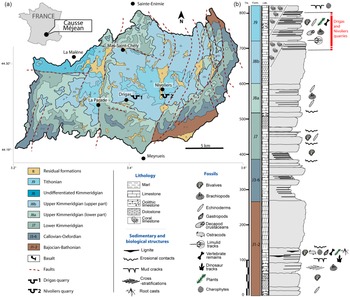
Here we report remains of a new fossil ecosystem from the Upper Jurassic lithographic limestone of the Causse Méjean plateau (southern France). Since the 1980s, the Upper Jurassic plattenkalks of this area have been known from local and amateur naturalists to yield rare fossils. However, the plattenkalks of the Causse Méjean remained undersampled and poorly known from a palaeontological point of view until 2003. At that time, we started a project of palaeontological prospection and sampling in order to produce a scientific collection of reference in two quarries of the Hures-La Parade municipality, at Drigas and Nivoliers (Fig. 1a). Following these surveys, Moreau et al. (Reference Moreau, Fara, Gand, Lafaurie and Baret2014, Reference Moreau, Baret, Lafaurie and Chateau-Smith2016) published the first palaeontological studies of this area, describing abundant limulid trackways from the Drigas quarry, and marine algae as well as terrestrial plants from the Nivoliers quarry. However, the Causse Méjean fossil assemblages represent a diverse ecosystem that yields much more than just ichnofossils and plants. The numerous and exquisitely preserved specimens collected over the last two decades now document a rich and exquisitely preserved vertebrate and invertebrate fauna. We provide here the first inventory of the fauna, the flora and the ichnofauna of the Drigas and Nivoliers quarries. Based on new biostratigraphic data, we also discuss the age of the deposits. Sedimentological, petrological, mineralogical and palaeontological analyses are used to reconstruct the depositional environment of the Upper Jurassic lithographic limestone of the Causse Méjean.
Geological context of the Causse Méjean. (a) Geological map of the Causse Méjean and location of the Drigas and the Nivoliers quarries; modified after Brouder et al. (Reference Brouder, Gèze, Macquar and Paloc1977) and Gèze et al. (Reference Gèze, Pellet, Paloc, Bambier, Roux and Senaud1980). (b) Simplified stratigraphic section of the top part of the Causse Méjean and stratigraphic location of the Drigas and the Nivoliers quarries; modified after Dörfliger et al. (Reference Dörfliger, Le Strat, Garden, Blaise, Izac and Desprats2006). Form. – formation; Lith. – lithology; Thi. – thickness (in metres).

2. Geographical and geological setting
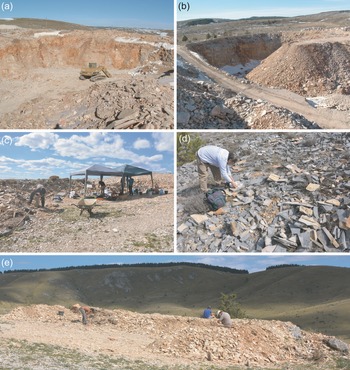
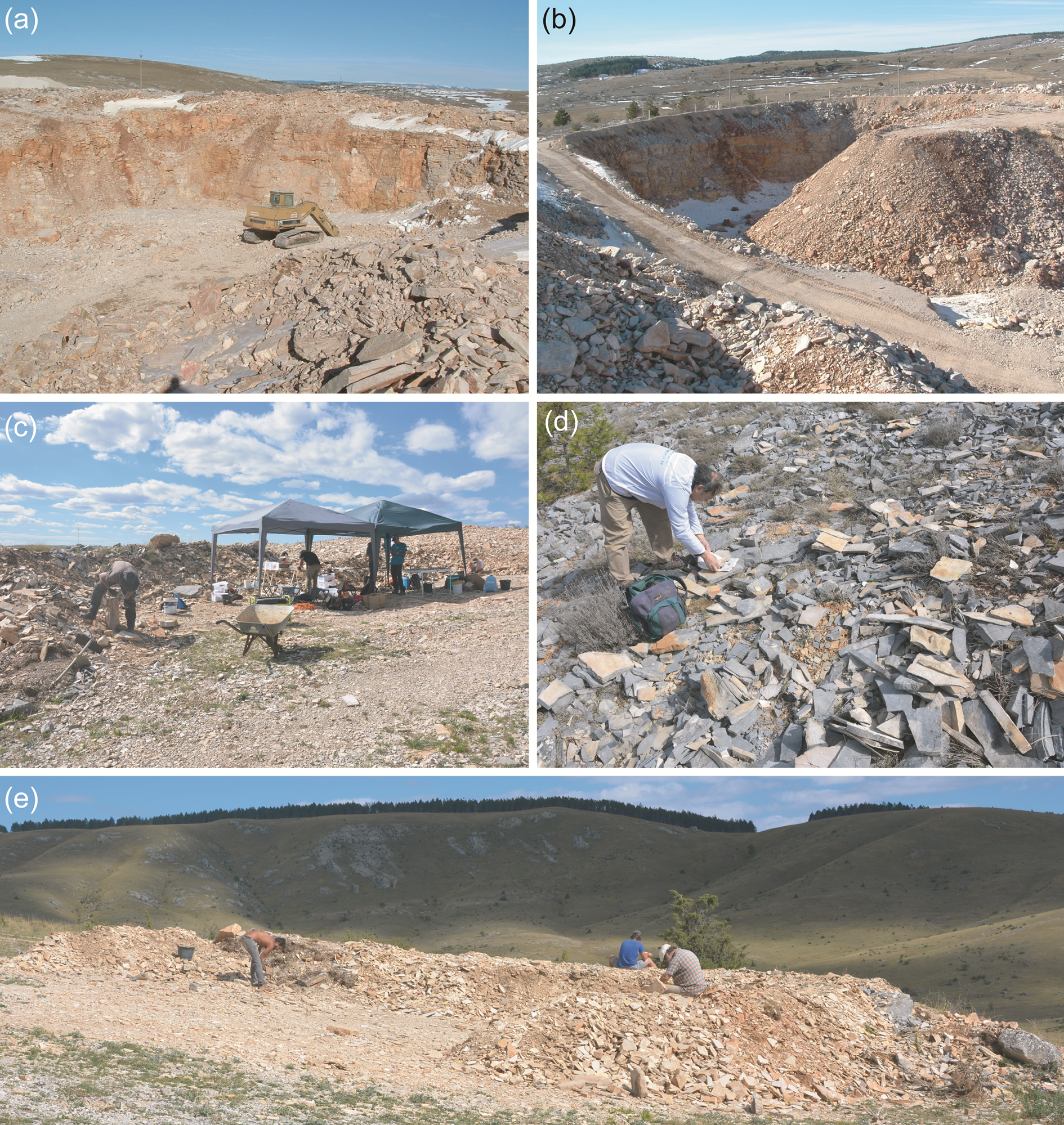
The Causse Méjean is a limestone plateau located in the northern part of the Causses Basin in the Massif Central (southern France; Fig. 1a). This 1000-m-high plateau is delimited by the Gorges du Tarn in the north and the Gorges de la Jonte in the south. Sedimentary deposits composing the top of the plateau are Middle–Upper Jurassic in age (Brouder et al. Reference Brouder, Gèze, Macquar and Paloc1977; Gèze et al. Reference Gèze, Pellet, Paloc, Bambier, Roux and Senaud1980; Fig. 1b). The material presented here was collected from two quarries dug at the top of the plateau, in the Upper Jurassic lithographic limestone. They are located at Drigas and Nivoliers, 5 km and 9 km east of La Parade, respectively (Fig. 1a). The Drigas quarry (also called the ‘Croux quarry’; Fig. 2a, b) was opened in 1979 and is now partially filled in. The Nivoliers quarry was opened in 1986 and is now completely filled in (Fig. 2c–e). In both quarries the Kimmeridgian–Tithonian strata were exploited (Fig. 1a, b). On the Causse Méjean, the lower Kimmeridgian (J7) is 60–130 m thick, and consists of limestone and marly limestone, commonly dolomitized. Its base is locally fine-grained (‘lithographic’). The upper Kimmeridgian strata are divided into two units: J8a and J8b (Brouder et al. Reference Brouder, Gèze, Macquar and Paloc1977). J8a is 80–100 m thick, corresponds to white bioclastic limestone, and is locally lithographic and partially dolomitized. J8b is 120 m thick, and composed of grey dolostone and rare coral limestone or local white-to-pink sublithographic limestone (Brouder et al. Reference Brouder, Gèze, Macquar and Paloc1977). The lower Tithonian (J9) is 120 m thick and consists of white-to-pink lithographic to oolithic limestone (Brouder et al. Reference Brouder, Gèze, Macquar and Paloc1977). Locally, the lower Tithonian consists of yellowish clayey limestone and marl yielding charophytes (Brouder et al. Reference Brouder, Gèze, Macquar and Paloc1977).
General view of the quarries exposing the Kimmeridgian–Tithonian lithographic limestone from the Causse Méjean. (a, b) Drigas quarry in 2005: (a) view to the NE and (b) view to the west. (c–e) Collecting of ex situ specimens at Nivoliers during the last excavation (2020).
3. Material and methods
3.a. History of the discoveries and palaeontological content
After the discovery of the first fossil fishes during the 1980s, the Upper Jurassic lithographic limestone of the Causse Méjean was regionally known to yield a few fossils. However, information about these first discoveries is very poor and scattered, as contextual data on only two historical specimens collected in the Drigas quarry have reached us. The first specimen is a pycnodont fish (Thiollierepycnodus) and the second is a small rhynchocephalian (Kallimodon). The pycnodont fish was discovered fortuitously in the 1980s by the quarryman Guy Bonicel. It is composed of two opposed limestone slabs: one of the slabs is housed in a private collection (coll. François Boulot) and the other is housed in the collection of the Association Paléontologique des Hauts Plateaux du Languedoc (APHPL, Lozère). The rhynchocephalian specimen was discovered by Jean-Yves Boutin while prospecting a sector of the quarry that is now totally filled. This specimen was figured by Sciau (Reference Sciau1993, Reference Sciau1998) and later by Bousquet & Vianey-Liaud (Reference Bousquet and Vianey-Liaud2001), but it has never been described. It was temporarily housed in Canada in a private collection before it was donated to the public palaeontological collection of the Musée de Millau et des Grands Causses (MMGC; Aveyron, southern France).
During the 1990s, Gérard Lafaurie assembled a private collection of marine invertebrates and terrestrial plants he had discovered at Drigas and Nivoliers. Pending donation to a public institution, these specimens remain temporally housed in his private collection. In order to be as exhaustive as possible, the present synoptic study includes one specimen from his private collection (Cycadopteris sp.).
In 2003, the growing palaeontological interest of the lithographic limestone of the Causse Méjean led two of us (J-DM and LB) to initiate a systematic sampling of fossil specimens in both quarries in order to build the first scientific reference collection for this area (all specimens being housed in the APHPL collections).
Since 2014, fieldwork sessions were organized by the APHPL (Fig. 2c–e). All specimens sampled over the last two decades in the Drigas and Nivoliers quarries are now housed in the APHPL collection. This collection is currently the most important in terms of abundance (more than 200 specimens) and diversity of fossil specimens from the Upper Jurassic lithographic limestone of the Causse Méjean.
The present study also includes two specimens of fishes that are housed in the Préhistorama Museum (Rousson, Gard) and one specimen of fish housed in the public collection of the Musée du Gévaudan (Mende, Lozère). In addition, the only known coelacanth specimen reported here from the Upper Jurassic lithographic limestone of the Causse Méjean is currently housed in the private collection of Eric Dupré (see Section 5.a.3).
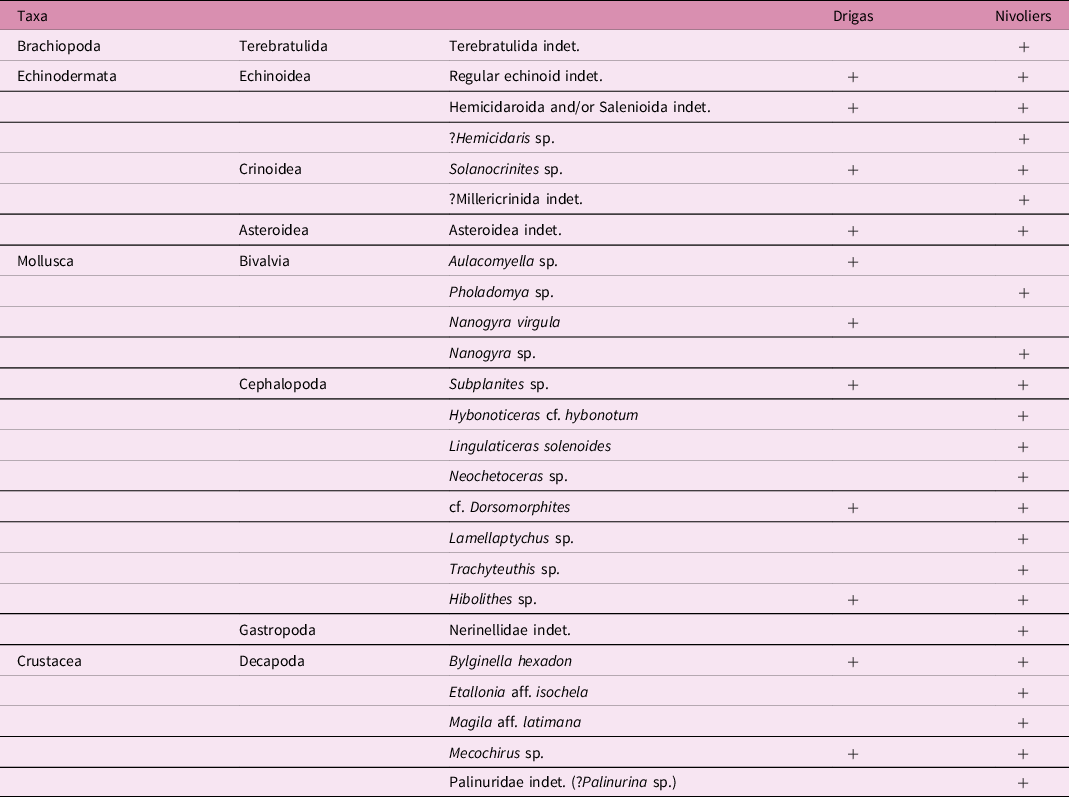
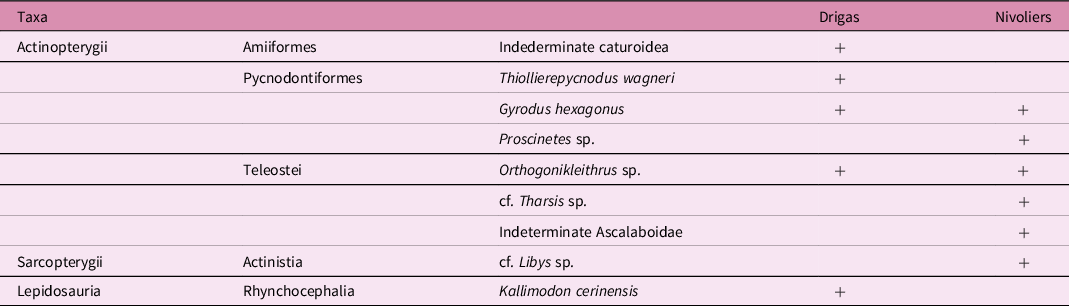
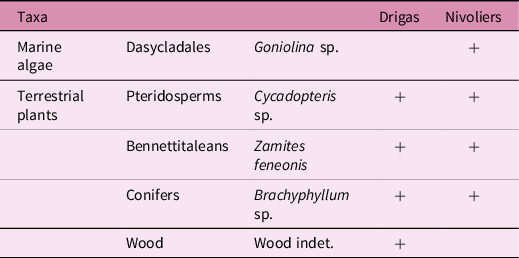
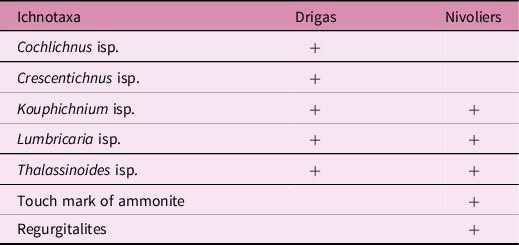
It was possible to stratigraphically position fossils in the Drigas quarry (Moreau et al. Reference Moreau, Fara, Gand, Lafaurie and Baret2014), although most samples are from isolated blocks produced by quarry activities. As the Nivoliers quarry had already been filled at the time of this study, specimens from this locality could not be assigned to specific stratigraphic levels. Limestone blocks were split into slabs with hammers and chisels to obtain hand specimens as complete as possible. Fossils are strongly flattened, not abundant, dispersed and isolated, rarely forming dense accumulations. They consist of complete to incomplete and fully disarticulated to articulated organisms. These two quarries yielded very similar palaeontological assemblages. Marine organisms include algae, bivalves, brachiopods, cephalopods, echinoderms, decapod crustaceans and fishes. Terrestrial organisms consist of plant macroremains and a single rhynchocephalian. Ichnofossils are represented by dwelling and crawling traces of marine invertebrates, as well as coprolites and regurgitalites. Complete lists of taxa and ichnotaxa are given in Tables 1–4.
List of fossil invertebrates from the upper Kimmeridgian to lower Tithonian lithographic limestone of the Causse Méjean.

List of fossil vertebrates from the upper Kimmeridgian to lower Tithonian lithographic limestone of the Causse Méjean.

List of algae and terrestrial plants from the upper Kimmeridgian to lower Tithonian lithographic limestone of the Causse Méjean.

List of invertebrate tracks, coprolites and regurgitalites from the upper Kimmeridgian to lower Tithonian lithographic limestone of the Causse Méjean.

3.b. Mineralogy and petrology
In order to characterize the depositional environments of the two studied quarries, sedimentological, petrographic and mineralogical analyses were conducted on rock samples from both localities. For four samples (three from Nivoliers, one from Drigas), standard polished thin-sections were prepared for both optical microscopy and mineralogical analyses. X-ray diffraction (XRD) analyses were performed on samples previously crushed manually in an agate mortar until a powder with particles < 40 μm (sieve control) was obtained. Analyses were carried out at the LMDC laboratory of Toulouse, with a Bruker D8 Advance diffractometer using a copper X-ray tube, equipped with a vertical theta/theta goniometer and a LynxEye XE-TTM high-speed linear detector. A motorized anti-scattering knife was used. Diffractograms were acquired in approximatively 2 hours 40 minutes per sample, at 40 kV and 40 mA, from 4° to 70° 2θ with an interval of 0.02° 2θ. Mineral identification and quantification were carried out using both DIFFRACplus Eva v4 and DIFFRACplus Topas v5 (Bruker-AXS softwares) with the 2015 ICDD PDF database. Rietveld mineralogical modelling calculations were used for quantification (e.g. Bish & Post, Reference Bish and Post1993). The Rietveld refinement parameters used in this study are the same as those described in Trincal et al. (Reference Trincal, Charpentier, Buatier, Grobety, Lacroix, Labaume and Sizun2014). Mineralogical quantification precision was obtained by multiplying the goodness-of-fit (GOF) by the standard deviation provided by the Topas software, as recommended by Taylor & Hinczak (Reference Taylor and Hinczak2003). Scanning electron microscope (SEM) micrographs were taken using a JSM-IT100 at the Biogéosciences laboratory, University of Bourgogne Franche-Comté (Dijon).
3.c. Photogrammetry
In order to produce photogrammetric three-dimensional (3D) reconstructions of fossil tracks, the software Agisoft PhotoScan Professional 1.2.4 was used to align and combine multiple digital photographs taken by a Nikon D5200 camera coupled with an AF-S NIKKOR 18–105 mm f/3.5–5.6G ED camera lens. The same software was used to produce 3D-photogrammetric digital elevation models (DEM) in false colours.
4. Sedimentology, petrology and mineralogy
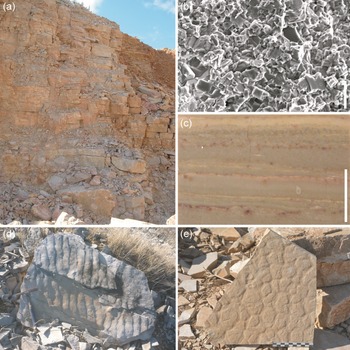
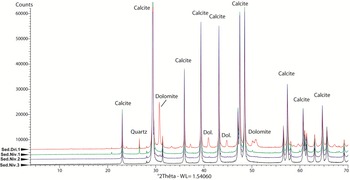
In the Drigas and Nivoliers quarries, the stratigraphic sections are composed of homogeneous, micritic, thinly laminated limestone, with fine-grained texture (mudstone), conchoidal fractures and sharp edges (Fig. 3a). Mineralogical analyses confirm the abundance of calcite (81.2–97.8%; Fig. 4; Table 5). Dolomite appears as the second main mineralogical component (2.2–18.0%; Table 5). SEM analyses reveal that calcite microcrystals are about 1–5 μm in size (Fig. 3b). These features allow the term ‘lithographic limestone’ to be used (Bernier et al. Reference Bernier, Barale, Bourseau, Buffetaut, Gaillard, Gall and Wenz2014). The very fine and homogeneous texture is explained by the extreme scarcity of bioclastic microremains and detrital elements. Locally, in transverse section, the Drigas and Nivoliers limestone displays thin laminites easily distinguishable by their reddish colour, which stands out in contrast to the white/beige colour of the micrite (Fig. 3c). The surface of limestone slabs is flat, commonly undisturbed by ripple marks and bioturbations (except for the few layers bearing abundant Cochlichnus and Kouphichnium). Rare ripple marks are reported at the top of the sedimentary column at Nivoliers. They consist of asymmetric ripple marks bearing small mollusc and echinoderm debris (Fig. 3d). Some surfaces of limestone slabs with evidence of microbial mats have been identified in both quarries (Fig. 3e). They display polygonal shapes reminiscent of analogous structures reported in the plattenkalk of Cerin and interpreted as petee structures (Bernier et al. Reference Bernier, Gaillard, Gall, Barale, Bourseau, Buffetaut and Wenz1991). Such reticulate patterns of microbial filaments result from wind activity and slope gravity leading to undulated and wrinkled surfaces (Bernier et al. Reference Bernier, Gaillard, Gall, Barale, Bourseau, Buffetaut and Wenz1991). There is no evidence of emerged surfaces in either of the two quarries.
Sedimentological and petrological features of the Kimmeridgian–Tithonian lithographic limestone from the Causse Méjean. (a) Limestone exposed in the Drigas quarry in 2003. (b) SEM micrograph showing micrite microcrystals. (c) Polished section of limestone showing thin, horizontal and parallel laminites. (d) Ripple marks, Nivoliers quarry; length of hammer: 28 cm. (e) Microbial mats showing polygonal shapes, Nivoliers quarry. Scale bars: (b) 10 μm; (c) 5 mm; and (e) 10 cm.

X-ray diffractograms of the lithographic limestone from Drigas and Nivoliers. Dol. – dolomite; WL – wavelength.

Mineralogical estimations. Niv – Nivoliers; Dri – Drigas.

5. Body fossils
5.a. Marine organisms
5.a.1. Algae
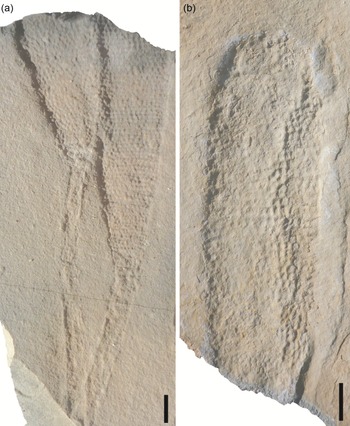
Marine algae are rare and are only represented by the dasycladale genus Goniolina at the Nivoliers quarry (Moreau et al. Reference Moreau, Baret, Lafaurie and Chateau-Smith2016). They consist of isolated fragments of thalli. The thallus is longer than wide and consists of a central, well-developed, elongated, peduncle-like axis, up to 7 mm in diameter, bearing a distal head (Fig. 5). This axis is unbranched to twice-branched. The most proximal part of the axis is always absent. The longest – although incomplete – peduncle-like fragment is 80 mm long. The distal head of the thallus is oblong, up to 93 mm long and up to 32 mm in diameter. The surface of the distal head shows isodiametric lodges with a hexagonal pattern. Lodges form horizontal alignments up to 2.5 mm wide. Lodges are isometric along the entire length of the head. In European Kimmeridgian/Tithonian plattenkalks, the genus is uncommon. The gross morphology of the specimens from the Causse Méjean is close to that of Goniolina janeti from the uppermost Kimmeridgian strata of Cerin (Bernier et al. Reference Bernier, Barale, Bourseau, Buffetaut, Gaillard, Gall and Wenz2014).
Marine algae (Dasycladales) from the Kimmeridgian–Tithonian lithographic limestone of the Causse Méjean. (a) Goniolina sp., thalli with two elongated, peduncle-like axes bearing distal heads; Nivoliers, APHPL_NIV6. (b) Goniolina sp., isolated distal head; Nivoliers, APHPL_ NIV31. All scale bars: 1 cm.

5.a.2. Echinoderms
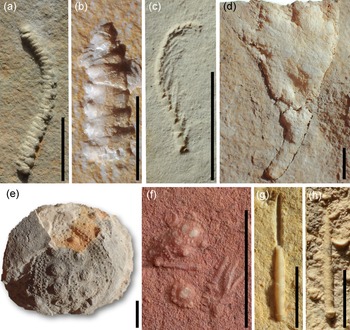
Echinoderm remains mainly consist of arm fragments of comatulid crinoids (Fig. 6a, b). The alternation of two kinds of ossicles and their non-parallelepiped shape is well visible on some isolated arms (Fig. 6b). These arms are similar to those of Solanocrinites from the Kimmeridgian of Cerin (Bernier et al. Reference Bernier, Barale, Bourseau, Buffetaut, Gaillard, Gall and Wenz2014). Stalked crinoid remains from the Nivoliers quarry include a distal end of an arm showing pinnules and a single and strongly altered calyx (Fig. 6c–d). Asterids are represented by some isolated and indeterminable ossicles, as well as fragmentary articulated specimens. By contrast with other echinoderm remains, echinoids are rare (Fig. 6e–h). The only known complete test can be referred to ?Hemicidaris sp. (Fig. 6e). Some isolated spines of echinoids are also present in the assemblage. The proportions (about 2 cm in length and up to 2.0 mm in diameter) are consistent with an assignment to Hemicidaroida or Salenioida (e.g. Pseudosalenia) (Fig. 6g, h). Such regular echinoids were reported from the Upper Jurassic lithographic limestone of Canjuers (Roman et al. Reference Roman, Vadet and Bouillier1991; Roman, Reference Roman1994) and Cerin (Bourseau et al. Reference Bourseau, Bernier, Barale, Buffetaut, Gaillard, Gall, Roman and Wenz1994).
Echinoderms from the Kimmeridgian–Tithonian lithographic limestone of the Causse Méjean. (a, b) Arm fragments of the comatulids Solanocrinites sp.; Nivoliers, APHPL_NIV33 and APHPL_NIV42, respectively. (c) Distal end of a crinoid arm showing pinnules, ?Millericrinida indet.; Nivoliers, APHPL_NIV37. (d) Crinoid calyx, ?Millericrinida indet.; Nivoliers, APHPL_NIV43. (e) Echinoid, ?Hemicidaris sp.; Nivoliers, APHPL_NIV44. (f) Regular echinoid indet.; Nivoliers, APHPL_NIV46. (g, h) Isolated spines of echinoids, Hemicidaroida and/or Salenioida indet.; Nivoliers, APHPL_NIV36 and APHPL_NIV39 respectively. All scale bars: 1 cm.

5.a.3. Brachiopods and molluscs
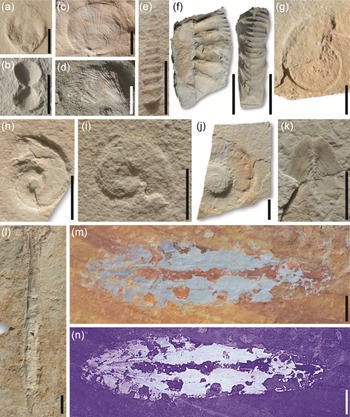
Brachiopods consist of rare terebratulids from the Nivoliers quarry (Fig. 7a). Most specimens are poorly preserved and strongly compressed. Bivalves are commonly found as isolated shells and not abundant. Most specimens are undeterminable. Similarly to bivalves from the Kimmeridgian of Cerin (Bernier et al. Reference Bernier, Barale, Bourseau, Buffetaut, Gaillard, Gall and Wenz2014), the majority of specimens are preserved in butterfly position (Fig. 7b). A single bedding plane from the Drigas quarry shows an accumulation of six shells. Shells are longer than high, 21–31 mm long, 19–24 mm high, very flattened and have a subovoid outline, subcentral and small beaks, and fine and dense rounded radial ribs (Fig. 7c). They are ascribed to Aulacomyella sp. (Fig. 7c). Aulacomyella is a bivalve whose mode of life remains under debate, but this genus could have been either an epibenthic recliner adapted to cope with soft substrate or a pseudoplanktic organism living attached to floating algae that sank to the sea floor after death (Fürsich et al. Reference Fürsich, Werner, Schneider and Mäuser2007 b). A few specimens of Nanogyra sp. were collected at Nivoliers, and a single specimen of Nanogyra virgula was found in the Drigas quarry (Fig. 7d). At Nivoliers, a single specimen of Pholadomya sp. was discovered at the top of the section. Gastropods are rare and consist of small, narrow turriculate forms reported from the Nivoliers quarry (Fig. 7e). Some of these specimens can be assigned to Nerinellidae indet. (Kollmann, Reference Kollmann2014).
Brachiopods, bivalves and cephalopods from the Kimmeridgian–Tithonian lithographic limestone of the Causse Méjean. (a) Terebratulida indet.; Nivoliers, APHPL_NIV63. (b) Bivalve preserved in butterfly position; Nivoliers, APHPL_NIV67. (c) Aulacomyella sp.; Drigas, APHPL_DRI6. (d) Bivalve, Nanogyra virgula; Drigas, APHPL_DRI7. (e) Gastropod, Nerinellid; Nivoliers, APHPL_ NIV71. (f) Ammonite, fragment of cf. Dorsomorphites, Nivoliers, APHPL_NIV48. (g) Ammonite, Neochetoceras sp.; Nivoliers, APHPL_NIV55. (h, i) Ammonite, Lingulaticeras solenoides; Nivoliers, APHPL_NIV49 and APHPL_NIV51. (j) Ammonite, Hybonoticeras cf. hybonotum; Nivoliers, APHPL_NIV53. (k) Aptychus Lamellaptychus; Nivoliers, APHPL_NIV50. (l) Belemnite, Hibolithes sp.; Drigas, APHPL_DRI5. (m, n), Coleoid, Trachyteuthis sp.; (m) photograph taken under natural light and (n) ultraviolet light; Nivoliers, APHPL_NIV60. Scale bars: (a–l) 1 cm; (m, n) 3 cm.
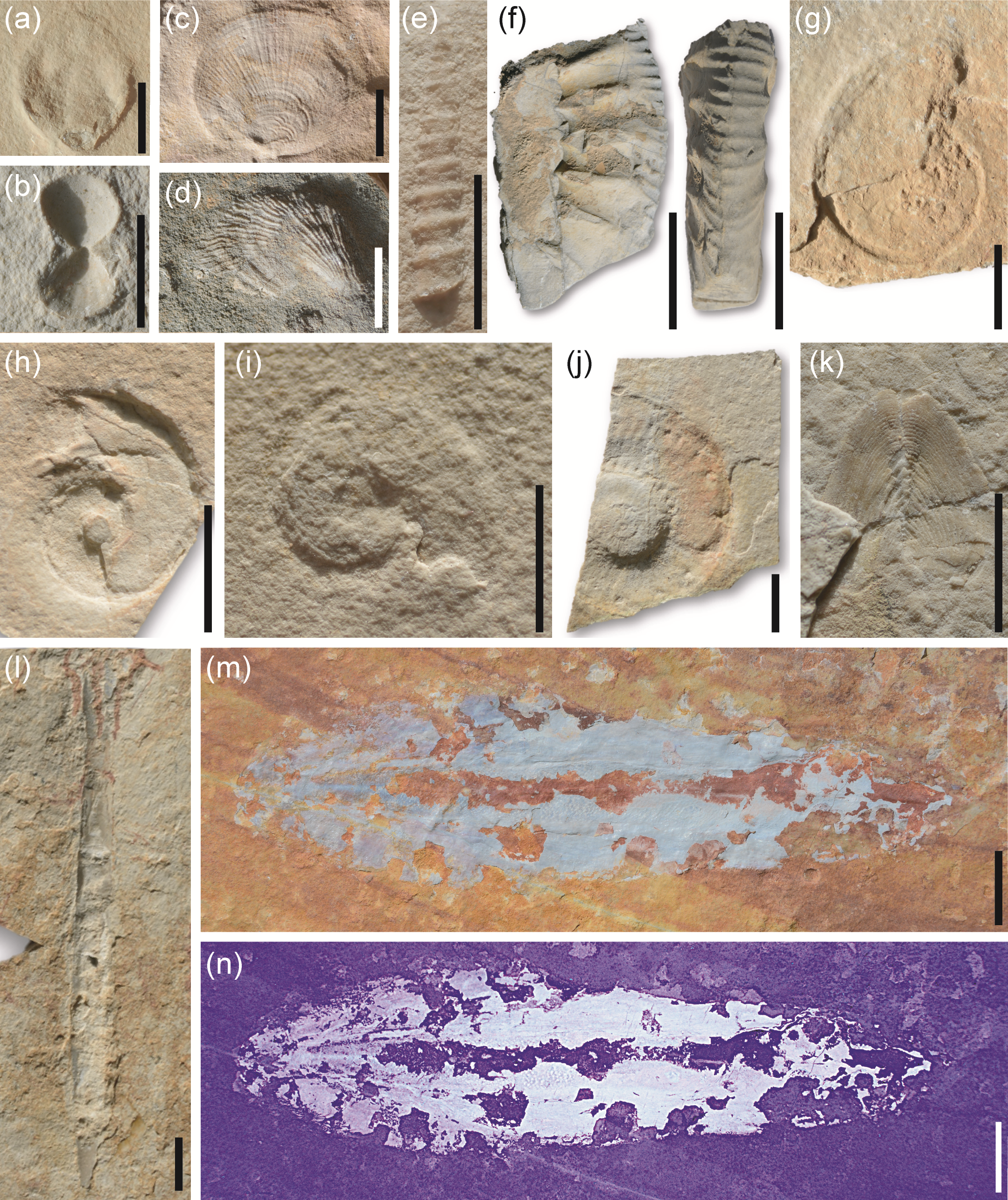
The most abundant cephalopod remains are ammonites (Fig. 7f–k). They are very poorly preserved, mostly as crushed external moulds. Specimens are tentatively assigned to Hybonoticeras cf. hybonotum (Fig. 7j), Lingulaticeras solenoides (Fig. 7h, i), cf. Dorsomorphites (Fig. 7f), Neochetoceras sp. (Fig. 7g) and Subplanites sp. Rare and isolated aptychi also occur; they are ascribed to Lamellaptychus related to Neochetoceras. Belemnites are represented by rare rostra ascribed to the genus Hibolithes (Fig. 7l).
The most remarkable cephalopod remain is a coleoid gladius from Nivoliers, here identified as Trachyteuthis sp. (Fig. 7m, n, in ventral view). The gladius, preserved on two slabs, was retrieved from a float block. Nevertheless, we were able to identify the better-preserved specimen as the upper slab, based on the morphology of the bioturbations preserved on the surface of the slabs. The gladius was embedded with the dorsal facing up. The upper (outer, dorsal) gladius laminae adhered to the upper slab and the lower (inner, ventral) laminae adhered to the lower slab. Neither of the dorsal gladius surface and the ventral gladius surface are therefore visible. The total length of the figured, rather compacted specimen is at least 285 mm, as most of the anterior part is not preserved. Because of its relative poor preservation, the outer margins of the gladius could only be imperfectly outlined. Slightly before halfway along the gladius, the maximum width is estimated at c. 80 mm (i.e. c. 28% of the total gladius length). A barely perceptible line in the posterior part of the gladius is tentatively interpreted as the inner asymptote of the hyperbolar zone. The ratio of hyperbolar zone length to total gladius length is therefore c. 0.45. The width continuously decreases anteriorly. Growth increments are not visible. The gladius is distinctly multilayered and exhibits circular depressions close to the median axis. These depressions most certainly correspond to the negative relief of the granules on the dorsal surface. The granulated area does not reach the lateral gladius margin but presumably reaches the anterior and posterior margins of the gladius. There is no evidence for a median keel, although a spindle-shaped depression accompanied by a marginal elevation is barely detectable.
Based on a hyperbolar zone length/gladius length ratio of c. 0.45 and a relatively arcuate anterior part, this gladius can be confidently assigned to the genus Trachyteuthis. Fuchs et al. (Reference Fuchs, Engeser and Keupp2007) thoroughly investigated the gladius morphology of Trachyteuthis and proposed an emended diagnosis for this taxon. Among specimens from the Upper Jurassic plattenkalks of Germany (Nusplingen and Solnhofen), these authors distinguished three morphospecies (Trachiteuthis hastiformis, T. nusplingensis and T. teudopsiformis). The specimen described here invites a comparison with T. hastiformis. Indeed, even though they are imperfectly preserved as negative reliefs, the dorsal granules appear coarse and irregular and are therefore reminiscent of those observed in T. hastiformis. Another diagnostic feature of T. hastiformis is a gladius median field displaying a spindle-shaped elevation on the dorsal side or, vice versa, a spindle-shaped depression accompanied by a marginal elevation on the ventral side. Noteworthy, in strongly compacted specimens from Germany, this structure is flattened and difficult to discern (Fuchs et al. Reference Fuchs, Engeser and Keupp2007). Such a structure was only tentatively identified in the specimen figured here in ventral view (Fig. 7m, n). The poor preservation of the latter unfortunately prevents a firm identification of this feature. Furthermore, the hyperbolar zone length/gladius length ratio is close to that documented for T. hastiformis by Fuchs et al. (Reference Fuchs, Engeser and Keupp2007).
According to Fuchs et al. (Reference Fuchs, Engeser and Keupp2007), morphologic differences between T. nusplingensis and T. hastiformis are small and therefore difficult to determine in poorly preserved specimens. Trachyteuthis nusplingensis lacks the spindle-shaped elevation and exhibits a fine and regularly arranged granulation throughout the whole gladius length. In our opinion, such characteristics do not match those of the specimen from Nivoliers. Finally, T. teudopsiformis significantly differs from the specimen described here in having a gladius median field with a pronounced median keel, a narrow granulation, posteriorly restricted to the keel, as well as a sharply pointed anterior gladius end (Fuchs et al. Reference Fuchs, Engeser and Keupp2007).
In conclusion, due to its preservation and following the taxonomic recommendations of Fuchs et al. (Reference Fuchs, Engeser and Keupp2007, p. 588), we prefer not to assign the present specimen to any of the morphospecies described from the neighbouring Upper Jurassic plattenkalks of Germany. Based on the geographic distribution of occurrences provided by Fuchs et al. (Reference Fuchs, Engeser and Keupp2007), this appears to be the first record of Trachyteuthis in the Jurassic System of France.
5.a.4. Crustaceans
The crustacean fauna includes penaeoid shrimps, glypheoid lobsters and ghost shrimps (Figs 8, 9) that present close affinities with those from the Upper Jurassic plattenkalks of Germany (Garassino & Schweigert, Reference Garassino and Schweigert2006; Charbonnier & Garassino, Reference Charbonnier and Garassino2012; Schweigert et al. Reference Schweigert, Garassino and Pasini2016; Odin et al. Reference Odin, Charbonnier, Devillez and Schweigert2019) and France (Bernier et al. Reference Bernier, Barale, Bourseau, Buffetaut, Gaillard, Gall and Wenz2014).
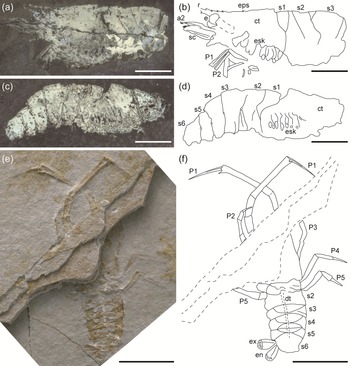
Decapod crustaceans from the Kimmeridgian–Tithonian lithographic limestone of the Causse Méjean. (a–d) Penaeid shrimp, Bylginella hexadon, subcomplete specimens in lateral views (a, c) under ultraviolet light and (b, d) interpretative line drawings; Nivoliers, (a, b) APHPL_NIV78 and (c, d) APHPL_NIV80. (e, f) Mecochirid lobster, ?Mecochirus sp., subcomplete, ventral view, natural light and interpretative line drawing; Nivoliers, APHPL_NIV79. Abbreviations: a2 – antennal; ct – carapace; dt – digestive tract; e – eye; en – uropodal endopod; ex – uropodal exopod; eps – epigastric spine; esk – endophragmal skeleton; P1–P5 – pereiopods 1 to 5; r – rostrum; sc – scaphocerite; s1–s6 – pleonal somites 1–6. All scale bars: 1 cm. Photographs: Philippe Loubry.

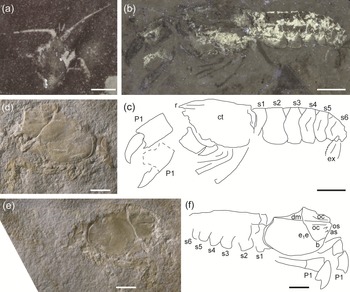
Decapod crustaceans from the Kimmeridgian–Tithonian lithographic limestone of the Causse Méjean. (a) Achelatan lobster, probable larval stage of Palinuridae (?Palinurina) under ultraviolet light; Nivoliers, APHPL_NIV76. (b, c) Axiid ghost shrimp, Etallonia aff. isochela, left lateral view, ultraviolet light and interpretative line drawing; Nivoliers, APHPL_NIV75. (d–f) Axiid ghost shrimp, Magila aff. latimana, part and counterpart, natural light, and interpretative line drawing; Nivoliers, APHPL_NIV77. Abbreviations: as – antennal spine; b – antennal groove; ct – carapace; dm – dorsal midline; e1e – cervical groove; ex – uropodal exopod; oc – orbital carina; os – orbital spine; P1 – pereiopod 1; s1–s6 – pleonal somites 1–6. All scale bars: 5 mm. Photographs: Philippe Loubry.

Although the penaeoid shrimps are represented by several specimens, only two allowed a detailed description (Fig. 8a–d). The carapace is subrectangular, smooth, with a straight dorsal margin bearing one median epigastric tooth; a sinuous, rimmed posterior margin; a curved ventral margin narrowing anteriorly; and a deep ocular incision. The rostrum (distal tip broken) is elongate and straight, with at least five dorsal teeth and one ventral tooth. The pleon is composed of subrectangular somites 1–5, equal in length, bearing rounded pleura. The somite 6 is subrectangular but longer than somites 1–5. The somites 1–6 are smooth and locked to each other by mid-lateral hinges. The telson is not preserved. The cephalic appendages are only preserved on specimen APHPL_NIV78 (Fig. 8a, b) with a short eyestalk bearing a large eye, and fragments of antennae with laminate, slender scaphocerite and the fragment of multi-articulated flagellum. The thoracic appendages (pereiopods 1–5) are partially preserved, lacking the distal extremities. The pleonal appendages are not preserved.
Based on Schweigert et al. (Reference Schweigert, Garassino and Pasini2016), who revised the rich penaeoid fauna from the Upper Jurassic Solnhofen lithographic limestones (Germany), the studied specimens can be assigned to the penaeid shrimp (Penaeidae) Bylginella hexadon, having a straight rostrum with 5–6 dorsal teeth, one ventral tooth and one median epigastric tooth. The occurrence in the Kimmeridgian–Tithonian of the Causse Méjean enlarges the palaeobiogeographic distribution of this species, so far restricted to the Solnhofen area, pointing to the similarity between the studied decapod assemblage and the rich decapod fauna of Solnhofen.
The glypheoid lobsters (Glypheoidea) are represented by a single specimen (Fig. 8e, f) with very poorly preserved carapace and cephalic appendages. The pleon has subrectangular somites 1–5, equal in length, with a smooth tergal surface. The somite 6 is subrectangular but longer than somites 1–5, and has a smooth tergal surface. The thoracic appendages are composed of subchelate, elongate pereiopods 1, partially preserved pereiopods 2 and achelate pereiopods 3–5, almost equal in length. The pereiopod 1 shows an elongate propodus bearing one strong, sharp distal tooth on its ventral margin, and a strong and elongate dactylus. The uropodal endopod and exopod bear a strong median longitudinal carina. The latter also bears a rounded diaeresis. Both uropods are fringed by setae.
The lack of the main morphological characters – such as the carapace, the pleura of somites 1–5 and the telson – does not allow us to establish a precise systematic assignment of the studied specimen. However, its very elongate subchelate first pereiopods are characteristic of mecochirid lobsters (Mecochiridae). This character is not sufficient to establish a generic assignment, being shared by all members of the family. The age of the specimen could point to Mecochirus, which is a common genus in the Upper Jurassic lithographic limestones in Germany (Garassino & Schweigert, Reference Garassino and Schweigert2006) and in France (Bernier et al. Reference Bernier, Barale, Bourseau, Buffetaut, Gaillard, Gall and Wenz2014).
The achelatan lobsters (Achelata) are represented by a single, poorly preserved specimen (Fig. 9a). Only the long flagella of the antennae and the short flagella of the antennulae help to assign the studied specimen to the Achelata. The shape of the antennae with thick articles and elongate flagellum narrowing distally allows its assignment to spiny lobsters (Palinuridae). It can be compared with the coeval Palinurina (Kimmeridgian–Tithonian Solnhofen lithographic limestones, Germany). The reduced body size and the re-investigation of the fossil species Palinurina tenera by Haug & Haug (Reference Haug and Haug2016) suggest that the studied specimen could represent a larva or a post-larval juvenile.
The ghost shrimps (Thalassinidea) are represented by two relatively well-preserved specimens (Fig. 9b–f). The first specimen (APHPL_NIV75) has a subcylindrical carapace with a slightly vaulted dorsal margin and a slightly sinuous and rimmed posterior margin (Fig. 9b, c). The rostrum is very short and spineless. The cephalic region shows at least two apparently spiny cephalic carinae. The pleon exhibits subrectangular somites 1–5, decreasing in size distally, with rounded pleura. The somite 2 is larger than somite 1 and somites 3–5. The somite 6 is subrectangular and longer than somites 1–5. All the pleonal somites show smooth terga and pleura. The telson is not preserved. Among the thoracic appendages, the pereiopod 1 is subchelate and stronger than the others, which are all poorly preserved. The pereiopod 1 is composed of: (1) a subsquare propodus, with a thin longitudinal lateral carina in the dorsal region and a very short index (fixed finger) at the distal margin; and (2) a strong, thick pointed dactylus (mobile finger), slightly curved downwards, and with a thin median longitudinal carina. The uropodal exopod is preserved only by its serrated outer margin.
Based upon the diagnosis provided by Förster (Reference Förster1977) and Garassino & Schweigert (Reference Garassino and Schweigert2006), the studied specimen is assigned here to Etallonia (Axiidae) because of its strong subchelate first pereiopod. According to Garassino & Schweigert (Reference Garassino and Schweigert2006), Schweigert (Reference Schweigert2009) and Schweitzer et al. (Reference Schweitzer, Feldmann, Garassino, Karasawa and Schweigert2010), this genus, known to date only from the Upper Jurassic Series (Oxfordian–Tithonian), includes six species, which have been described based upon the shape of the first pereiopod since usually the carapace and pleon are poorly preserved. Based upon the shape of the first pereiopod (index with smooth inner margin), we tentatively assigned the specimen to Etallonia isochela, well known in the Kimmeridgian Stage of Battle (Sussex, United Kingdom; Woodward, Reference Woodward1876) and Bure (Lorraine, France; Breton et al. Reference Breton, Carpentier, Huault and Lathuilière2003; Carpentier et al. Reference Carpentier, Breton, Huault and Lathuilière2006).
The second specimen (APHPL_NIV77) presents a subcylindrical carapace, laterally flattened, with a rimmed posterior margin. The rostrum is not preserved (Fig. 9d–f). The cervical groove is deep, strongly inclined forwards and joined ventrally to a very concave antennal groove, delimiting a short cephalic region and wide cardiac and branchial regions. The cephalic region shows one straight spiny orbital carina and strong orbital and antennal spines. The gastric and cardiac regions are covered by small uniformly arranged granules. The antennal region is smooth. The branchial region is covered by small uniformly arranged granules in the dorsal part, and by small scaly incisions in the ventral part. The pleon has subrectangular somites 1–5, equal in length, with rounded pleura. The somite 6 is subrectangular and longer than somites 1–5. The telson is not preserved. The pereiopod 1 shows a stocky and short chela, partially preserved.
Based upon the diagnosis provided by Förster (Reference Förster1977) and Garassino & Schweigert (Reference Garassino and Schweigert2006), the specimen is assigned to Magila (Axiidae) because of its deep cervical groove, strongly inclined forwards, and its straight orbital carina (named ‘antennal carina’ by Garassino & Schweigert, Reference Garassino and Schweigert2006). According to Garassino & Schweigert (Reference Garassino and Schweigert2006), only two species – Magila latimana and M. desmarestii – from the Upper Jurassic Solnhofen lithographic limestones (Germany) are coeval with the studied specimen. We tentatively assign the specimen to M. latimana based upon the deep cervical groove strongly inclined forwards, the straight antennal carina and the serrate margin of the uropodal exopod. This specimen from the Causse Méjean could therefore represent the first report of this species out of Germany, enlarging its palaeogeographic distribution.
5.a.5. Fishes
Fish remains are relatively rare at Drigas and Nivoliers, with more or less complete specimens ranging from fully disarticulated to articulated skeletons. Several groups can be identified among actinopterygians, including pycnodontiforms, a possible amiiform and basal teleosteans. In addition, a coelacanth (Sarcopterygia: Actinistia) is present in the fish assemblage from Nivoliers. The few fish taxa recognized at Drigas and Nivoliers are all present in the renowned Upper Jurassic plattenkalks of western Europe (e.g. Cerin, Canjuers, Solnhofen area).
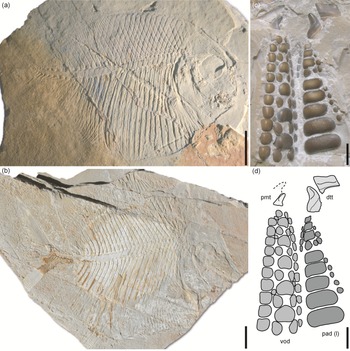
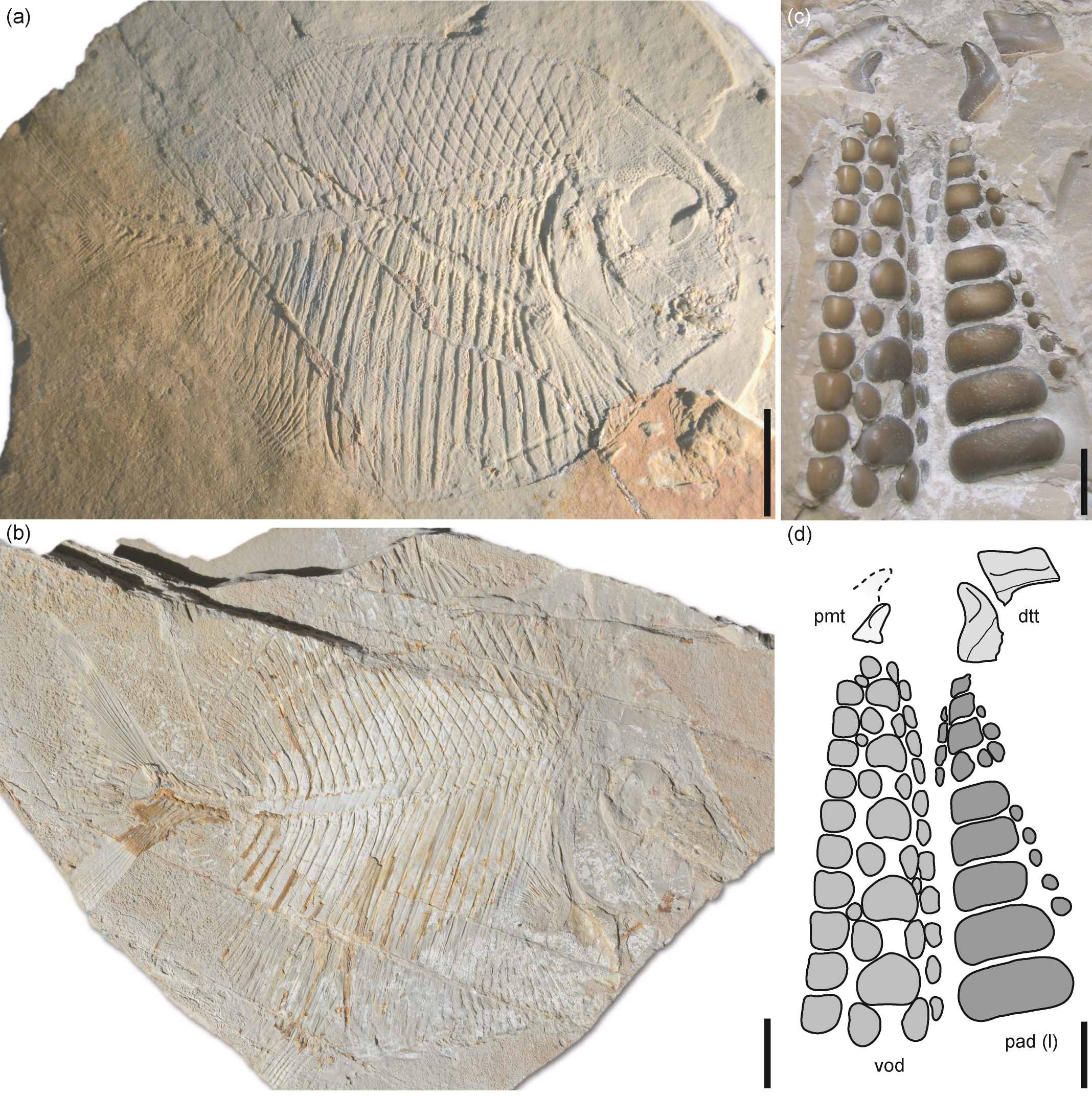
Pycnodontiform fishes are represented by three taxa: Gyrodus hexagonus (Gyrodontidae), Thiollierepycnodus wagneri and Proscinetes sp. (Pycnodontidae). Gyrodus hexagonus is known by two specimens from Drigas and Nivoliers. The latter locality yielded the best preserved specimen, which is a nearly complete small fish (standard length: 111 mm) with a sub-hexagonal body outline (Fig. 10a). It shows all the skeletal and dental features of the taxon, such as strongly tuberculated dermal bones, styliform premaxillary and dentary teeth, well ornamented crushing teeth, complete squamation (imbricate pattern sensu Nursall, Reference Nursall, Arratia and Viohl1996) consisting of reticulated rhombic scales, falcate dorsal and anal fins, and deeply forked caudal fin (Lambers, Reference Lambers1991 a; Nursall, Reference Nursall, Arratia and Viohl1996; Poyato-Ariza & Wenz, Reference Poyato-Ariza and Wenz2002; Kriwet & Schmitz, Reference Kriwet and Schmitz2005). Thiollierepycnodus wagneri is represented by a single, nearly complete specimen (part and counterpart) (standard length: c. 180 mm) from Drigas (Fig. 10b). This specimen shows a number of features indicating that it unambiguously belongs to this taxon, including the two autapomorphic characters noted by Ebert (Reference Ebert2020): (1) ventral extremity of the post-coelomic bone with two well developed anterior and posterior extensions; and (2) reduced bar-like flank scales extending to the posterior region of the body, near to the caudal peduncle, but not overlying the pterygiophores of the dorsal and anal fins. Other relevant features are: (1) snout prognathous; (2) caudal fin double-emarginated in distal contour, with angle between dorsal and ventral edges being 105°; and (3) complete body scales restricted to the anteroventral region of the body. Interestingly, the occurrence of Thiollierepycnodus wagneri, so far only known from two localities (Cerin and Wattendorf; Saint-Seine, Reference Saint-Seine1949; Ebert, Reference Ebert2020), supports a late Kimmeridgian – early Tithonian age for the Causse Méjean plattenkalk series. The third pycnodontiform taxon, Proscinetes sp., is known by an incomplete and disarticulated specimen from Nivoliers; only a few cranial elements are preserved, including toothed bones (Fig. 10c, d). The premaxillary/dentary teeth are incisiform and the vomerine dentition shows the typical alternation of one large tooth and two smaller teeth in the main row (Poyato-Ariza & Wenz, Reference Poyato-Ariza and Wenz2002).
Fishes from the Kimmeridgian–Tithonian lithographic limestone of the Causse Méjean. (a) Pycnodontiform, Gyrodus hexagonus, complete specimen, Nivoliers, Préhistorama Museum collection. (b) Pycnodontiform, Thiollierepycnodus wagneri, nearly complete specimen; Drigas, APHPL_DRI1. (c, d) Pycnodontiform, Proscinetes sp., dentition of a disarticulated skull, (c) photograph and (d) interpretative sketch; Nivoliers, APHPL_NIV26. Abbreviations: ddt – dentary teeth; pad (l) – prearticular dentition (left); pmt – premaxillary teeth; vod – vomerine dentition. Scale bars: (a, b) 2 cm; (c, d) 1 cm.
A fully disarticulated specimen from Drigas may belong to a caturoid amiiform based on the following combination of characters: absence of ossified centra; preural haemal and neural spines near the caudal peduncle region strongly inclined to a nearly horizontal orientation; haemal spines of the caudal region laterally broadened (caturoid synapomorphy); short dorsal fin; and small, rounded ‘amioid’ scales without ganoine (Lambers, Reference Lambers1994; Grande & Bemis, Reference Grande and Bemis1998; Martín-Abad, Reference Martín-Abad2017).
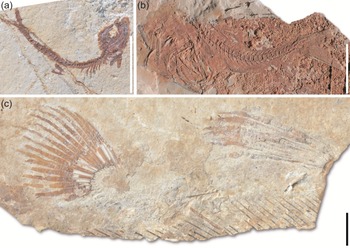
Basal teleosts are the most common fossil fishes at Drigas and Nivoliers but are often incomplete and partly disarticulated. However, some of the specimens can be assigned to orthogonikleithrids (Orthogonikleithrus sp.) and ascalaboids (cf. Tharsis sp.). As well as their general morphology and small size (c. 6 cm in total length), specimens referred to Orthogonikleithrus (Fig. 11a) are characterized by the relative position of their dorsal, pelvic and anal fins (Arratia, Reference Arratia1987, Reference Arratia1997; Konwert, Reference Konwert2016). A few larger specimens (c. 10 cm in total length) are assignable to cf. Tharsis sp. (Fig. 11b) based on key features such as the number and arrangement of infraorbital 1 and preopercular sensory canals, and the strong inclination of neural and haemal spines of the last caudal vertebrae (Arratia et al. Reference Arratia, Schultze and Tischlinger2019).
Fishes from the Kimmeridgian–Tithonian lithographic limestone of the Causse Méjean. (a) Basal teleost, Orthogonikleithrus sp., complete specimen; Drigas, APHPL_DRI2. (b) Basal teleost, cf. Tharsis sp., complete specimen; Nivoliers, APHPL_NIV27. (c) Coelacanth, cf. Libys sp., incomplete specimen (dorsal portion of the trunk with anterior and posterior dorsal fins); Nivoliers, private collection of Eric Dupré. All scale bars: 2 cm.

A single fragmentary articulated specimen from Nivoliers indicates the presence of coelacanths in the Causse Méjean plattenkalk (Fig. 11c). This specimen consists of the dorsal portion of the trunk, with both dorsal fins and about 30 neural spines being preserved. The first and second dorsal fins have 7 and 26 rays, respectively. These rays are segmented transversally, except at their base. Denticles are present on the rays of the first dorsal fin. The basal plate of the second dorsal fin is deeply forked. The scales bear numerous tiny denticles. The high number of second dorsal fin rays suggests that the Nivoliers coelacanth might belong to the genus Libys (up to 25 rays; Lambers, Reference Lambers1991 b) rather than to Coccoderma (14 rays; Lambers, Reference Lambers1991 b) or Undina (up to 21 rays; Saint-Seine, Reference Saint-Seine1949; Lambers, Reference Lambers1991 b).
5.b. Terrestrial organisms
5.b.1. Land plants
Fossil plants consist of quite rare macro-foliar remains (Fig. 12a–f). Plants are preserved only as impressions on limestone bedding planes. The preservation of details in these impressions is quite variable. Cuticles are never preserved and no cellular details are evident. While terrestrial plants from Nivoliers were described by Moreau et al. (Reference Moreau, Baret, Lafaurie and Chateau-Smith2016), those from Drigas are listed here for the first time (Table 3). The terrestrial floras from Drigas and Nivoliers are similar. The land plants include vegetative remains ascribed to bennettitaleans (Zamites), conifers (Brachyphyllum) and pteridosperms (Cycadopteris). Woods are extremely rare in the Nivoliers quarry. They consist of small fragments preserved as impressions.
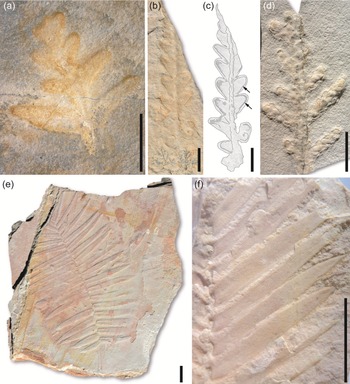
Terrestrial plants from the Kimmeridgian–Tithonian lithographic limestone of the Causse Méjean. (a) Pteridosperm, Cycadopteris sp., fragment of pinna bearing opposite pinnules; Nivoliers, APHPL_NIV4. (b, c) Pteridosperm, Cycadopteris sp., fragment of pinna bearing sub-opposite to opposite pinnules that show a marginal fold (black arrows), (b) photograph and (c) interpretative sketch; Drigas, private collection of Gérard Lafaurie. (d) Conifer, Brachyphyllum sp., leafy stems with helically arranged, scale-like leaves; Nivoliers, APHPL_NIV1. (e) Bennettitalean, Zamites feneonis, pinnate leaves bearing elongated and alternately arranged leaflets; Drigas, APHPL_DRI8. (f) Bennettitalean, Zamites feneonis, detail of the lanceolate leaflets showing a slightly contracted base and an acute apex; leaflets bear thin and parallel veins; Drigas quarry; APHPL_DRI9. All scale bars: 5 mm.

Cycadopteris sp. is represented only by fragments of pinnae (Fig. 12a–c), the largest of which is 200 mm long. The pinna consists of a rachis bearing sub-opposite to opposite pinnules that are oval or circular. They display a marginal fold (Fig. 12c) and are attached by a broad base to the rachis, which is up to 9 mm wide. The pinna rachis is rarely visible, and the veins cannot be distinguished. Remains ascribed to Cycadopteris sp. are only poorly preserved.
Remains ascribed to Brachyphyllum sp. consist of slender, up to 10 cm long and 12 mm wide leafy axes (Fig. 12d). They bear tiny helically arranged, rhombic leaves that are nearly as broad as long. They are appressed to the stem, abaxially convex and partially overlapping. The leaf apex forms a small blunt tip, curved inwards to the stem axis.
Specimens assigned to Zamites feneonis consist of well developed pinnate leaves (Fig. 12e, f); the longest complete leaf is 25 cm long. The rachis is up to 1 cm wide. Leaflets are elongated and sub-oppositely to alternately arranged in one plane along the rachis. They are inserted at up to 90° to the rachis, and are consistently spaced. Depending on the specimens, leaflets overlap slightly or not. Leaflet length reaches a maximum in the centre of the leaf. Leaflets are lanceolate, up to 75 mm long and up to 10 mm wide, with nearly parallel margins. The base of the leaflets is slightly contracted and seems to be symmetrical. In some specimens, the leaflets have an acute apex, curving slightly distally. Leaflet surfaces show persistent, thin, parallel veins, present along the entire length of the leaflets (Fig. 12f). This bennettitalean represents the main component of the terrestrial flora of the Causse Méjean.
Brachyphyllum, Cycadopteris and Zamites were reported in coeval lithographic limestone of western Europe (e.g. Canjuers, Cerin and Solnhofen; Barthel et al. Reference Barthel, Swinburne and Conway Morris1994; Frickhinger, Reference Frickhinger1994; Bernier et al. Reference Bernier, Barale, Bourseau, Buffetaut, Gaillard, Gall and Wenz2014; Peyer et al. Reference Peyer, Charbonnier, Allain, Läng and Vacant2014).
5.b.2. Reptiles
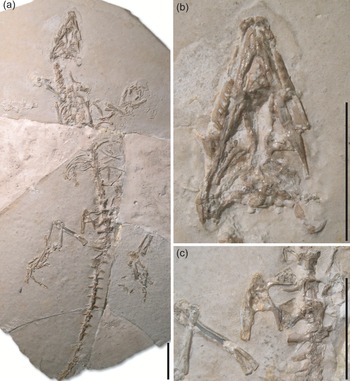
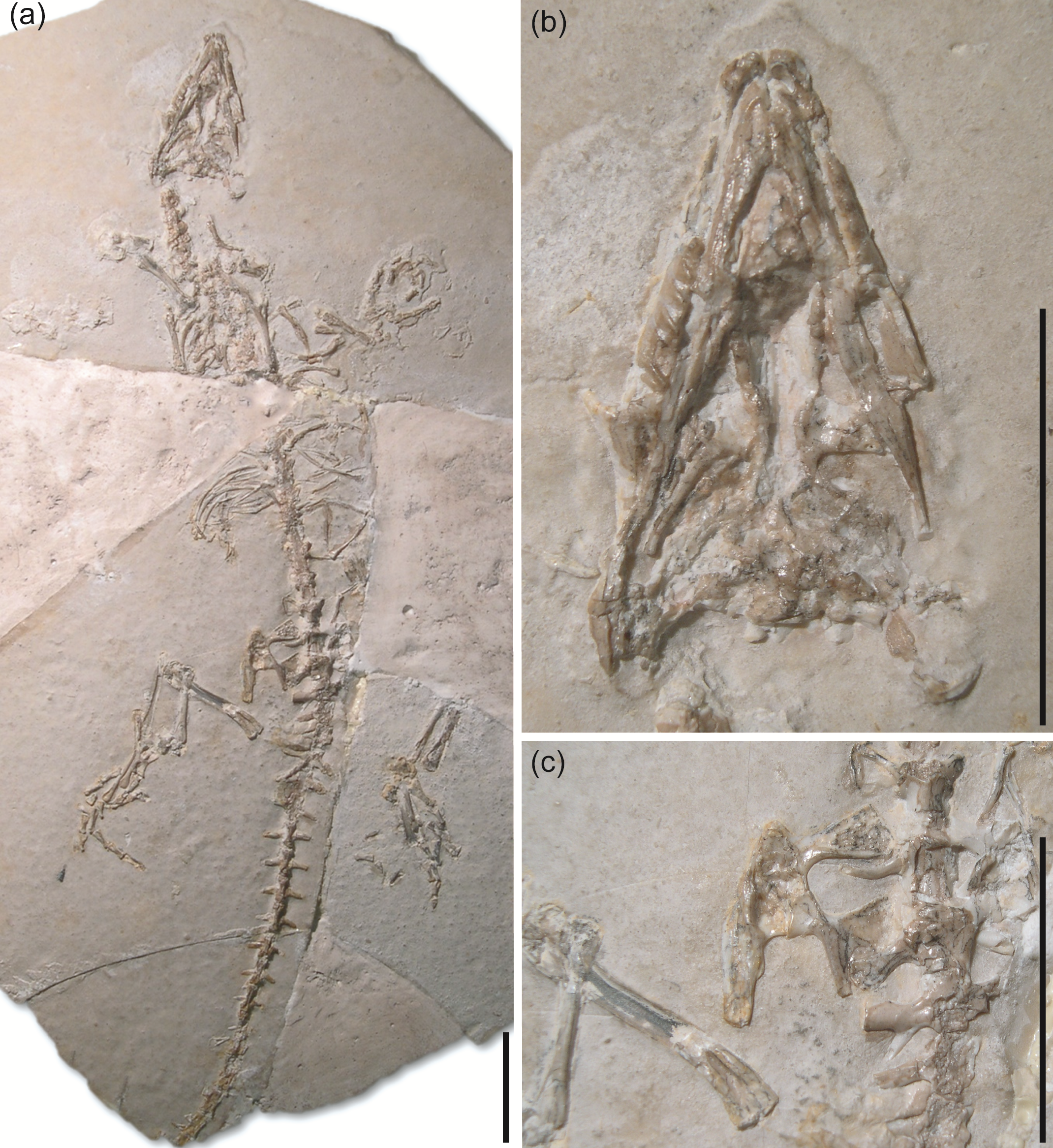
To date, only one tetrapod specimen has been found in the lithographic limestone of the Causse Méjean. This specimen (MMGC 2017.65.133) comes from the Drigas quarry and consists of a nearly complete, slightly disarticulated skeleton of a rhynchocephalian, attributable to Kallimodon based on skull shape, dental features, and body and limb proportions (Cocude-Michel, Reference Cocude-Michel1963; Fig. 13a–c). The specimen is 215 mm in preserved length (but the distal portion of the tail is missing), with a 30-mm-long skull (including lower jaw). The triangular, moderately elongated skull is exposed in ventral aspect, showing the teeth of the premaxillary, maxillary and palatine in occlusal view. Posteriormost maxillary teeth are larger than anterior teeth, with a well developed posterolingual flange. The limbs are relatively short, especially when compared with Homoeosaurus, another sphenodontian well represented in the Upper Jurassic plattenkalks of western Europe (Cocude-Michel, Reference Cocude-Michel1963). The shape, orientation and development of the posterior process of the second sacral rib allow us to assign MMGC 2017.65.133 to Kallimodon cerinensis rather than to K. pulchellus (Cocude-Michel, Reference Cocude-Michel1963; Rauhut & López-Arbarello, Reference Rauhut and López-Arbarello2016).
Terrestrial vertebrate from the Kimmeridgian–Tithonian lithographic limestone of the Causse Méjean. (a–c) Rhynchocephalian, Kallimodon cerinensis, nearly complete specimen preserved in ventral view, overview of (a) the limestone slab; (b) skull; and (c) pelvic region; Drigas, MMGC_2017.65.133. All scale bars: 2 cm.
6. Trace fossils
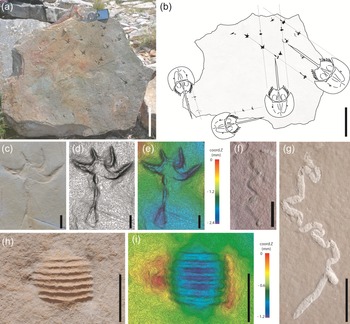
Although surfaces of limestone slabs are flat and commonly undisturbed by bioturbations, some layers show abundant invertebrate tracks (Fig. 14). They mainly consist of trackways of limulids ascribed to Kouphichnium isp. (Fig. 14a–e). Ichnofossils also include Crescentichnus, Cochlichnus (Fig. 14f) and some Thalassinoides.
Invertebrate traces from the Kimmeridgian–Tithonian lithographic limestone of the Causse Méjean. (a–b) Limulid trackways, Kouphichnium isp., (a) photographs and (b) interpretative sketch; Nivoliers. (c–e) Tracks of the sixth appendage (or ‘pusher traces’) showing an anterior part consisting of the four triangular or digit-like marks and an elongated posterior part with a bifid extremity; (c) photograph, (d) digital elevation model without colour and (e) digital elevation model in false colours, Drigas, APHPL_I49. (f) Cochlichnus isp.; Drigas, APHPL_I33. (g) Lumbricaria isp.; Nivoliers, APHPL_NIV84. (h, i) Touch mark of ammonite; (h) photograph and (i) digital elevation model in false colours; Nivoliers, APHPL_NIV87. Scale bars: (a, b) 20 cm; (c–i) 1 cm.
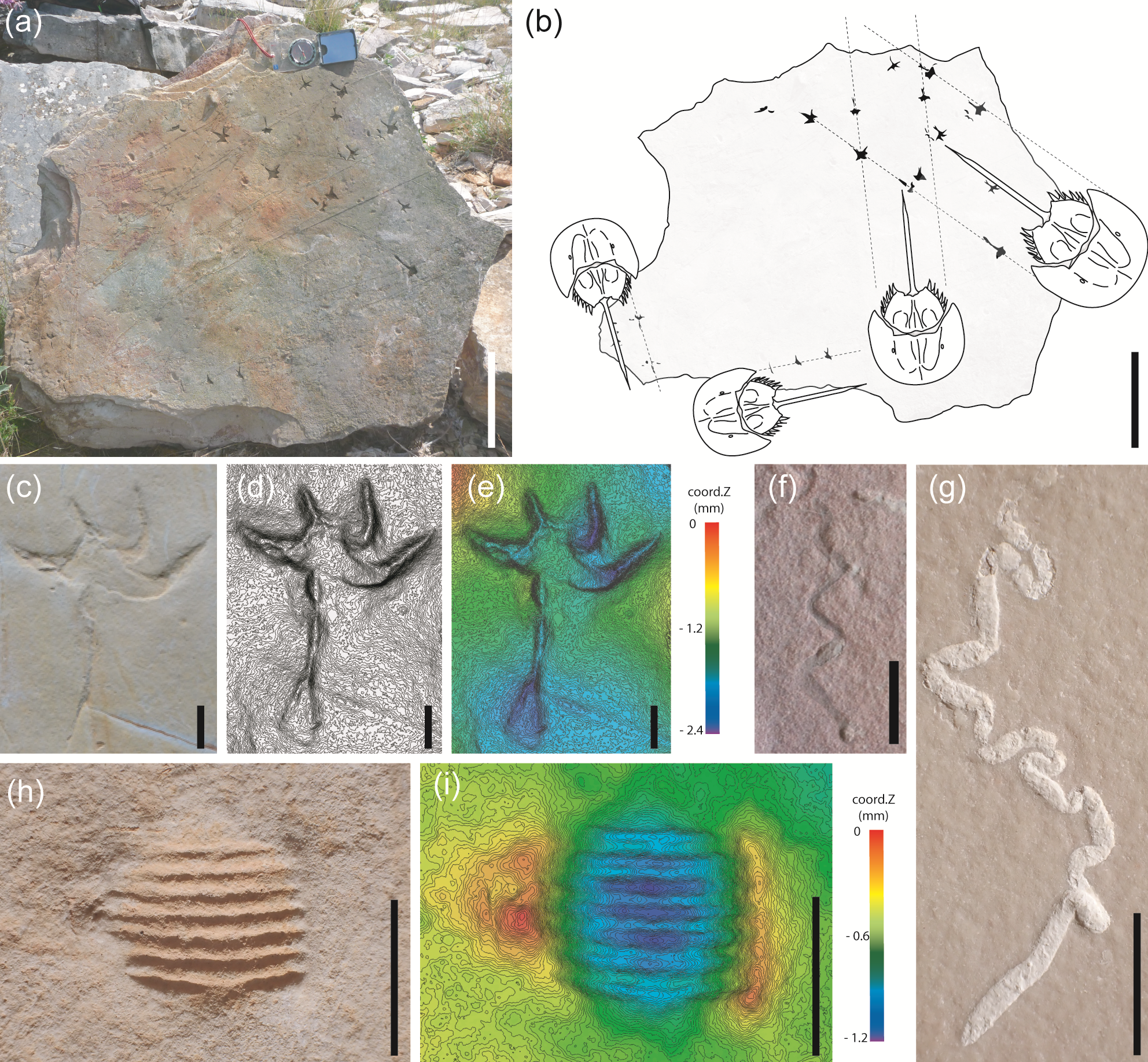
Kouphichnium isp. trackways are mainly composed of tracks of the sixth pair of appendages (pusher limbs or ‘pushers’) that are used by the animal to propel its body during locomotion. Internal and external trackway widths are up to 188 mm and up to 262 mm, respectively. Right and left pusher traces of a same step are opposite (Fig. 14a, b). Pairs generally form a repetitive motif on each step. Strides have a wide range of values (26–334 mm). The anterior part of individual pusher imprints comprises the four triangular or digit-like marks of the pusher blades (Fig. 14c–e). The posterior part of the pusher trace is an elongated and thin furrow made by the tarsus. The extremity of the furrow is generally bifid as it corresponds to the imprint of the pretarsus (Fig. 14c–e). The ichnogenus Kouphichnium is present in both Drigas and Nivoliers (Table 4). Although they are mentioned at Nivoliers for the first time, Moreau et al. (Reference Moreau, Fara, Gand, Lafaurie and Baret2014) published a detailed study of tracks from the Drigas quarry. Kouphichnium is clearly more abundant at the latter locality. Moreau et al. (Reference Moreau, Fara, Gand, Lafaurie and Baret2014) reported a total of 146 pusher traces (including 61 isolated traces) and 13 trackways found on various floating limestone slabs. The biometric analysis conducted on Kouphichnium from Drigas illustrated the gigantism of the Upper Jurassic limulids from Lozère (up to 84 cm in length; Moreau et al. Reference Moreau, Fara, Gand, Lafaurie and Baret2014).
At Drigas, Crescentichnus isp. occurs as isolated, simple crescent-shaped shallow mounds (positive hypichnia) that are about 10 cm wide and 6 cm long. One specimen shows some striation along the crescent. These traces exhibit neither transverse lineations in the posterior medial portion, nor associated scratch marks on a median posterior ridge. This type of ichnofossil was usually assigned to Selenichnites until this ichnogenus was entirely revised by Romano & Whyte (Reference Romano and Whyte2015), who erected Crescentichnus for the morphology described here. Although the corresponding tracemakers should be considered with caution (Romano & Whyte, Reference Romano and Whyte2015; Romano & Taylor, Reference Romano and Taylor2019), these types of traces from Drigas are most probably the result of limulid prosomas impinging on the sediment surface.
Cochlichnus isp. burrows are rarely isolated (Fig. 14f) and form large accumulations. Burrows are horizontal, thin, unbranched, unlined, unornamented, sinusoidal, cylindrical in cross-section and up to 3 mm in diameter. Diameter is constant along the total length of the burrow. The longest specimen is 50 mm long. Amplitude is up to 7 mm wide, whereas wavelength is up to 14 mm long. Cochlichnus is particularly abundant in Unit 1 of the Drigas quarry (Moreau et al. Reference Moreau, Fara, Gand, Lafaurie and Baret2014). Cochlichnus is interpreted as grazing trails (pascichnia; Buatois et al. Reference Buatois, Mángano, Wu and Zhang1996). Tracemakers are either annelid worms, nematodes or larvae of dipteran insects (Hasiotis, Reference Hasiotis2004).
A single ammonite touch mark was reported at Nivoliers (Fig. 14h, i). It consists of an 11-mm-long 13-mm-wide ventral impression of the shell that displays a series of seven straight and parallel rib marks. Such a trace was made by an ammonite shell briefly touching the sediment surface (Lomax et al. Reference Lomax, Falkingham, Schweigert and Jiménez2017). Laterally, the mark shows small positive reliefs that correspond to the sediment that was ejected during the impact of the shell on the sea floor (Fig. 14h, i).
At Nivoliers, surfaces of limestone slabs bear whitish, elongated, convoluted, cylindrical coprolites ascribed to Lumbricaria (Fig. 14g). Producers of such faecal strings were tentatively interpreted as cephalopods, fishes, holothurians and worms (Hunt & Lucas, Reference Hunt and Lucas2012; Knaust & Hoffmann, Reference Knaust and Hoffmann2020).
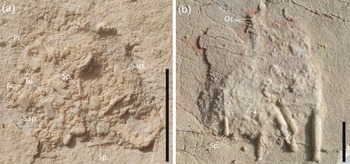
The palaeontological assemblage from Nivoliers also includes fossiliferous heaps composed of a mixture of echinoderm remains, such as ossicles of comatulids, as well as interambulacral plates (some on them showing perforated and crenulated tubercles) and spines of echinoids (Fig. 15a–b). It suggests that they correspond to partially digested food or regurgitation of fishes. Regurgitalites including echinoderm remains (e.g. Peyer et al. Reference Peyer, Charbonnier, Allain, Läng and Vacant2014; Ebert et al. Reference Ebert, Kölbl-Ebert and Lane2015) may have been produced by durophagous fishes such as pycnodontiforms. Similar fossils are well known in the Upper Jurassic lithographic limestone from Canjuers (Peyer et al. Reference Peyer, Charbonnier, Allain, Läng and Vacant2014), Cerin (Thomas, Reference Thomas2009) and Solnhofen (Frickhinger, Reference Frickhinger1994; Ebert et al. Reference Ebert, Kölbl-Ebert and Lane2015). Fishes fed on diverse echinoderms (crinoids, echinoids, as well as asterids) then spat out non-digested skeletal remains.
Possible regurgitalites from the Kimmeridgian–Tithonian lithographic limestone of the Causse Méjean. (a) Possible regurgitalite, fossiliferous heap composed of echinoid remains (Hemicidaroida indet.) including fragments of Aristotle’s lantern (Ar.), plates (Pl.) with perforated and crenulated tubercles (Tu.), spines (Sp.) and micro-spatulate spines (S.sp.); Nivoliers, APHPL_NIV45. (b) Regurgitalite, fossiliferous heap composed of a mix of echinoderm remains including ossicles (Os.) of comatulids as well as plates (Pl.) and spines (Sp.) of echinoids; Nivoliers, APHPL_NIV34. All scale bars: 1 cm.

7. Discussion
7.a. Age of the lithographic limestone of the Causse Méjean
Brouder et al. (Reference Brouder, Gèze, Macquar and Paloc1977) proposed a late Kimmeridgian age for the lithographic limestone from Drigas. Moreau et al. (Reference Moreau, Fara, Gand, Lafaurie and Baret2014) tentatively assigned a late Kimmeridgian – early Tithonian age to the lithographic limestone from this quarry for the following reasons: (1) Brouder et al. (Reference Brouder, Gèze, Macquar and Paloc1977) could not justify their proposal with biostratigraphic evidence; and (2) the occurrence of rare ammonites attributed to Subplanites sp. at the top of the quarry.
In the area of the Nivoliers quarry, Brouder et al. (Reference Brouder, Gèze, Macquar and Paloc1977) proposed that the limestone that overlies the upper Kimmeridgian dolostone is Tithonian in age. Although the ammonite taxa Hybonoticeras hybonotum, Lingulaticeras solenoides, Neochetoceras and Dorsomorphites suggest an early Tithonian age, the dasycladale Goniolina suggests a late Kimmeridgian age (Granier & Deloffre, Reference Granier and Deloffre1994). Accordingly, the age of the Upper Jurassic plattenkalk of the Causse Méjean lies within the late Kimmeridgian – early Tithonian interval.
7.b. Taphonomic and palaeoenvironmental implications
Lithological features of the limestone from the Causse Méjean (homogeneous, micritic, thinly laminated with a fine-grained mudstone texture), as well as the near absence of ripple marks, suggest slow-moving or stagnant waters and therefore very low-energy conditions. Many biostratinomic arguments support the hypothesis of a low-energy environment: fossil remains are never size-sorted, always isolated, rarely forming accumulations; dasycladale algae and skeletal remains of fishes and reptiles are usually articulated and very well preserved; and bivalves remain articulated after death. Transport distance between the main habitats of organisms and the burial site was short and the burial rapid. As observed in several contemporaneous plattenkalks (e.g. Bernier et al. Reference Bernier, Barale, Bourseau, Buffetaut, Gaillard, Gall and Wenz2014; Peyer et al. Reference Peyer, Charbonnier, Allain, Läng and Vacant2014), microbial mats quickly covered dead organisms and prevented remains from being destroyed by oxidation and/or scavenging.
The mixed palaeontological assemblages, showing the co-occurrence of terrestrial remains such as plants (bennettitaleans, conifers and pteridosperms) and vertebrates (rhynchocephalians) with numerous marine organisms (all other taxa identified) clearly indicate that the depositional environment was a nearshore marine setting. This is also supported by the co-occurrence of the horizontal invertebrate traces Kouphichnium isp. and Cochlichnus isp., which are characteristic of environments very proximal to the coastline (Gastaldo et al. Reference Gastaldo, Gibson and Gray1989).
Extant dasycladale algae live in the euphotic zone and mainly grow in habitats protected from storms and ground waves; they live in warm-temperate and tropical seas, with an optimal growth temperature of 25–27°C (Berger & Kaever, Reference Berger and Kaever1992). The presence of Goniolina sp. suggests a very shallow environment (Olivier et al. Reference Olivier, Pittet, Werner, Hantzpergue and Gaillard2008). The presence of this green alga might also indicate considerable variations in salinity, as some extant dasycladales grow in hypersaline or brackish waters (Flügel, Reference Flügel2013).
Both lithological features and fossil content suggest a calm, protected and shallow-marine environment such as a lagoon partially or occasionally open to the sea. The lagoon was probably protected by the local contemporaneous reefs mentioned by Brouder et al. (Reference Brouder, Gèze, Macquar and Paloc1977) and Gèze et al. (Reference Gèze, Pellet, Paloc, Bambier, Roux and Senaud1980). As suggested by the rare layers with asymmetric ripple marks (Fig. 3d), the lagoon was probably occasionally impacted by higher-energy events such as storms. Fishes from Drigas and Nivoliers illustrate diverse ecological niches, suggesting that most of them are allochthonous to parautochthonous and were transported or trapped away from their habitats. Open-water fishes and reef-dwelling fishes were probably washed in the lagoon during storms or during strong tides and died due to the unsuitable lagoonal conditions (warm temperatures, high salinity and oxygen-depleted water mass). Alternatively, some fresh carcasses may also have reached the lagoon. All the echinoids from Drigas and Nivoliers are regular. The fine carbonate mud of the original bottom of the Causse Méjean lagoon was different from the hard substrate on which they commonly lived. They probably lived on the nearest coral reefs and were also carried into the lagoon by currents during high-energy events or by predators (such as pycnodont fishes). Ammonites from the lithographic limestone of the Causse Méjean probably did not tolerate the rather hostile conditions of lagoonal waters either.
Emerged supratidal zones or islands were close. The terrestrial flora suggests that the Upper Jurassic coastal area of the Causse Méjean was inhabited by a sub-arborescent to arborescent vegetation of bennettitaleans (e.g. Zamites), conifers (e.g. Brachyphyllum) and pteridosperms (e.g. Cycadopteris). As noted by Moreau et al. (Reference Moreau, Baret, Lafaurie and Chateau-Smith2016), similar floras have been described from the Upper Jurassic Lagerstätten of Canjuers (Peyer et al. Reference Peyer, Charbonnier, Allain, Läng and Vacant2014), Cerin (Bernier et al. Reference Bernier, Barale, Bourseau, Buffetaut, Gaillard, Gall and Wenz2014) and Solnhofen (Barthel et al. Reference Barthel, Swinburne and Conway Morris1994; Frickhinger, Reference Frickhinger1994). The late Kimmeridgian – early Tithonian flora from the Causse Méjean displays xerophytic adaptations to hot and dry conditions of the coastal environments. For example, similarly to extant sclerophytes that are adapted to dry environments, the leaflets of Zamites were strongly sclerotized in many cases (Barale & Doludenko, Reference Barale and Doludenko1994). In Cycadopteris, the reduction of dry air circulation is ensured by the marginal fold along the lobe of the pinnules, protecting internal spaces bearing stomatal apparatuses (Barale, Reference Barale1997). The latter are protected by hairs (Barale, Reference Barale1982, Reference Barale1997), probably forming a barrier to invasion by pathogens and dust, limiting mechanical damage to stomata and water loss. Cycadopteris is considered to have been a halophyte, tolerating habitats with a strong marine input, such as salt marshes (Barale & Doludenko, Reference Barale and Doludenko1994; van Konijnenburg-van Cittert, Reference van Konijnenburg-van Cittert2008). Brachyphyllum displays xerophytic adaptations (e.g. fleshy shoots, short and small leaves pressed against the axis, thick cuticle and sunken stomata apparatuses limiting water loss) that are typically those of floras from tropical climates with cyclically dry seasons (Thévenard et al. Reference Thévenard, Gomez and Daviero-Gomez2005). The leafy axis of this conifer was adapted to withstand intense sunlight and coastal environments exposed to desiccant conditions.
7.c. Palaeobiogeographic implications
The composition of the fauna, flora and ichnofauna, as well as the depositional environment of the Upper Jurassic lithographic limestone of the Causse Méjean, show strong similarities to coeval Lagerstätten of Germany, such as Solnhofen (lower Tithonian; Barthel et al. Reference Barthel, Swinburne and Conway Morris1994; Frickhinger, Reference Frickhinger1994), Nusplingen (upper Kimmeridgian; Dietl & Schweigert, Reference Dietl and Schweigert2004) and Wattendorf (upper Kimmeridgian; Fürsich et al. Reference Fürsich, Mäuser, Schneider and Werner2007 a). Such analogies are also observed in the French plattenkalks of Canjuers (lower Kimmeridgian; Peyer et al. Reference Peyer, Charbonnier, Allain, Läng and Vacant2014) and Cerin (Kimmeridgian–Tithonian; Bernier et al. Reference Bernier, Barale, Bourseau, Buffetaut, Gaillard, Gall and Wenz2014). During late Kimmeridgian time, the Causse Méjean was located about 300 km east of Canjuers and Cerin at a palaeolatitude of around 30° N, on the southern edge of the Massif Central that constituted a large island (in the southern part of modern France; Enay et al. Reference Enay, Mangold, Cariou, Contini, Debrand-Passard, Donze, Gabilly, Lefavrais-Raymond, Mouterde and Thierry1980; Dercourt et al. Reference Dercourt, Gaetani, Vrielynck, Barrier, Biju-Duval, Brunet, Cadet, Crasquin and Sandulescu2000). During early Tithonian time, this island became progressively connected to the emerged land of the Armorican Massif (in present-day northwestern France; Enay et al. Reference Enay, Mangold, Cariou, Contini, Debrand-Passard, Donze, Gabilly, Lefavrais-Raymond, Mouterde and Thierry1980; Dercourt et al. Reference Dercourt, Gaetani, Vrielynck, Barrier, Biju-Duval, Brunet, Cadet, Crasquin and Sandulescu2000). Fossils from Drigas and Nivoliers indicate that coastal biotas of lagoonal palaeoecosystems of the southern Massif Central were similar to those of the southeastern Rhenish Massif and southwestern Bohemian Massif (present-day central Europe) during Late Jurassic time. Thus, the flora, fauna and ichnofauna from the Causse Méjean extend the palaeogeographical distribution of the Solnhofen-type biota westward. Canjuers, Cerin, the Solnhofen area and the Causse Méjean were all influenced by waters of the Mediterranean Tethys (Dercourt et al. Reference Dercourt, Gaetani, Vrielynck, Barrier, Biju-Duval, Brunet, Cadet, Crasquin and Sandulescu2000; Billon-Bruyat et al. Reference Billon-Bruyat, Lécuyer, Martineau and Mazin2005). The Crayssac plattenkalk (lower Tithonian; Mazin et al. Reference Mazin, Hantzpergue, Bassoullet, Lafaurie and Vignaud1997) differs from these sites by its peculiar depositional environment (coastal mudflat) and fossil assemblage (consisting mostly of ichnofossils); furthermore, its position in the Aquitaine Basin suggests an influence by waters from both the opening North Atlantic Ocean and the Mediterranean Tethys (Dercourt et al. Reference Dercourt, Gaetani, Vrielynck, Barrier, Biju-Duval, Brunet, Cadet, Crasquin and Sandulescu2000; Billon-Bruyat et al. Reference Billon-Bruyat, Lécuyer, Martineau and Mazin2005).
8. Conclusions
-
- The collecting organized in the upper Kimmeridgian – lower Tithonian lithographic limestone of the Causse Méjean over the last two decades revealed two exceptional palaeontological sites without any equivalent in the Causses Basin. The fossil assemblages they yield show the co-occurrence of diverse marine and terrestrial organisms.
-
- Based on ammonites, the limestone excavated at Drigas and Nivoliers is considered late Kimmeridgian – early Tithonian in age.
-
- Based on the exquisite preservation of many fossils, the Drigas and Nivoliers quarries can be regarded as Konservat-Lagerstätten. The fine mudstone texture, the low hydrodynamic conditions, the limited transport, the presence of microbial mats preventing remains from oxidation and/or scavenging, and the rapid burial contributed to the exceptional preservation of the Late Jurassic biota from the Causse Méjean.
-
- The palaeontological content and the lithological features demonstrate that the depositional environment was a calm, protected and shallow-marine environment such as a lagoon partially or occasionally open to the sea. Evidence suggests that most of the preserved invertebrates and vertebrates were not autochthonous to the lagoon, but were swept in during storm events from the open sea or from nearby reef environments.
Acknowledgements
We address our sincere thanks to Jacques Fages, the owner of the Drigas quarry, who gave permission for palaeontological sampling. We thank André Baret, the mayor of the Hures-La Parade municipality as well as Eric Dupré and Xavier Ory, who gave their agreements for palaeontological sampling in the Nivoliers quarry. We thank Claude Barbini, Benjamin Bourel, Nathalie Coquel Poussy, Simon Courivaud, Alain Jacquet, Ethan Jean, Dorian Meyrueis, Jean-Luc Meyrueis, Alexandre Van Elst, Matthieu Van Elst and Jean-Marie Vayssier for their help with the excavation during the summer of 2020. We are greatly indebted to the Mazel family who kindly donated their specimens to this study. We thank François Boulot for information about the discovery the Thiollierepycnodus from Drigas. We thank Jean-Yves Boutin for information concerning the discovery of the rhynchocephalian. We thank Pascal Neige and Rober Weis for discussions about belemnites, Gloria Arratia, Martin Konwert and Hugo Martín Abad for discussions about fishes, and Bruno Guy for discussions and information about specimens deposited in the Préhistorama Museum (Gard, southern France). We thank Rachel Almalric and Ghislaine Rabier (Musée de Millau et des Grands Causses) for providing access to the Kallimodon specimen. We thank Emilie Steimetz (Biogéosciences laboratory, University of Bourgogne Franche-Comté, Dijon) for her technical contribution during SEM investigations (MorphOptics service of the GISMO platform). We would like to express our gratitude to Günter Schweigert and to an anonymous reviewer for their constructive and thoughtful reviews of the manuscript. This publication is a contribution to a research project led and funded by the Association Paléontologique des Hauts Plateaux du Languedoc (APHPL, Mende, Lozère).
Declaration of interest
The authors have no known conflict of interest.