Introduction
Subglottic stenosis is not a homogeneous clinical entity. It has multiple distinct aetiologies that demonstrate disparate rates of long-term tracheostomy dependence. The subglottic region, situated approximately one centimetre below the glottis, constitutes the boundary of the upper and lower airways, and represents the junction between two embryonic buds or growth centres.
In subglottic stenosis, the contribution of co-morbid illnesses is critical to treatment strategies.Reference Gelbard, Francis, Sandulache, Simmons, Donovan and Ongkasuwan1 Although most cases are not autoimmune, subglottic stenosis has been reported in some patients with granulomatosis with polyangiitis (Wegener's granulomatosis) and relapsing polychondritis. Granulomatosis with polyangiitis is a necrotising vasculitis that can involve the subglottis in approximately 3–9 per cent of cases.Reference Pagnoux, Stubbe, Lifermann, Decaux, Pavic and Bérezné2, Reference Holle, Gross, Holl-Ulrich, Ambrosch, Noelle and Both3 Obstruction can occur secondarily to acute inflammation and may require urgent tracheostomy. Awareness of this manifestation and prompt diagnosis allows one to initiate the appropriate treatment, which is important as the upper airway manifestation of granulomatosis with polyangiitis tends to be more refractory to systemic therapy.Reference Langford, Sneller, Hallahan, Hoffman, Kammerer and Talar-Williams4–Reference Aries, Hellmich, Voswinkel, Both, Nölle and Holl-Ulrich6 Relapsing polychondritis is a rare, systemic disease, with an episodic and progressive nature, resulting from cartilaginous destruction. Diffuse airway involvement and tracheomalacia are considered to be common manifestations of relapsing polychondritis, occurring in up to 21 per cent of cases, while lesions localised in the subglottis are rare.Reference Hong and Kim7
The management of adult subglottic stenosis is complex. Numerous approaches have been described, including: transoral laser microsurgery; cold steel scar resection followed by balloon dilatation; nitinol stents; and dilatation interventions with the local application of mitomycin C.Reference Watters and Russell8–Reference Martinez Del Pero, Jayne, Chaudhry, Sivasothy and Jani11 Repeated endoscopic procedures are recommended in patients with severe autoimmune disease that do not allow open surgery or when other co-morbidities contraindicate open surgery.Reference Halmos, Schuiringa, Pálinkó, van der Laan and Dikkers12 Systemic treatment remains mandatory but has a minimal effect on autoimmune subglottic stenosis. Laryngotracheal resection is reserved for those patients in whom endoscopy failed and in whom the disease is in the quiescent phase, with no risk of restenosis or anastomosis dehiscence.Reference Taylor, Clayburgh, Rosenbaum and Schindler13 The therapeutic strategy depends on the degree of inflammatory activity and the degree of airway narrowing.Reference Gluth, Shinners and Kasperbauer14–Reference Solans-Laqué, Bosch-Gil, Canela, Lorente, Pallisa and Vilardell-Tarrés16 Hoffman et al. was the first to describe intralesional injection of methylprednisolone acetate into the stenotic segment, followed by microsurgical lysis of the stenotic ring and serial dilatation with Maloney bougies or a Fogarty catheter balloon in granulomatosis with polyangiitis cases.Reference Hoffman, Thomas-Golbanov, Chan, Akst and Eliachar17 This non-invasive method has been widely described in the literature.Reference Wolter, Ooi and Witterick9, Reference Schokkenbroek, Franssen and Dikkers15, Reference Hoffman, Thomas-Golbanov, Chan, Akst and Eliachar17–Reference Nouraei, Obholzer, Ind, Salama, Pusey and Porter19
The authors hypothesised that dilatation, a minimally invasive treatment, is adequate and effective as a first-line procedure in the treatment of dyspnoea in subglottic stenosis cases of unclear origin or in systemic diseases with no standardised protocol. This study, which presents a single institution's experiences, aimed to assess the outcomes of intralesional long-acting corticosteroid injection plus dilatation for subglottic stenosis in granulomatosis with polyangiitis and relapsing polychondritis patients versus non-autoimmune patients with idiopathic and traumatic subglottic stenoses.
Materials and methods
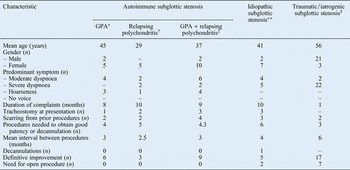
The study comprised 45 patients with subglottic stenosis (25 males (55.6 per cent) and 20 females (44.4 per cent)) who underwent intralesional long-acting corticosteroid injection plus dilatations at the Department of Otolaryngology, Head and Neck Surgery, Poznan University of Medical Sciences (a tertiary referral centre), between January 2005 and December 2012. The study population was composed of 12 patients with autoimmune subglottic stenosis, 9 with idiopathic subglottic stenosis and 24 with traumatic subglottic stenosis. Only patients with clinical symptoms of subglottic stenosis and subglottic involvement confirmed by flexible bronchoscopy and three-dimensional computed tomography imaging were included in the study. The characteristics of the three subgroups are presented in Table I. In 4 of the 45 patients, the granulation tissue from the subglottic space was sampled, but there were no specific histopathology findings, except inflammation.
Characteristics of patients treated for subglottic stenosis with dilatations and steroid injections

*n = 7; †n = 5; ‡n = 12; **n = 9; §n = 24. GPA = granulomatosis with polyangiitis
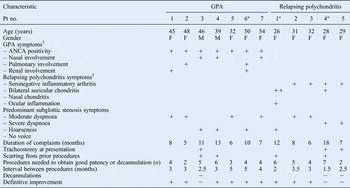
Seven patients met the European League Against Rheumatism (‘EULAR’) classification criteria for the diagnosis of granulomatosis with polyangiitis. The detailed data are presented in Table II. Anti-neutrophil cytoplasmic antibody positivity was found in all patients, with both cytoplasmic and perinuclear patterns. Nasal involvement, pulmonary involvement and renal involvement were reported in three, two and two patients, respectively, but none developed saddle nose deformity or severe renal or pulmonary failure. Granulomatosis with polyangiitis was localised only to the subglottis in one patient (number five). All patients received systemic treatment according to the schedule outlined by the rheumatologist; this included prednisone combined with methotrexate, cyclophosphamide and rituximab.
Detailed data of patients treated for granulomatosis with polyangiitis and relapsing olychondritis

*The subglottic stenosis associated complaints were the first symptoms, and preceded those associated with spreading of the condition. †Symbols indicate symptom severity, with ‘+’ being least and ‘+++’ being most severe. GPA = granulomatosis with polyangiitis; Pt no. = patient number; F = female; M = male; ANCA = anti-neutrophil cytoplasmic antibody; + = present/yes; − = absent/none
Relapsing polychondritis was diagnosed in five patients according to McAdam's criteria (Table II). Seronegative inflammatory arthritis was diagnosed in four patients, bilateral auricular chondritis in two and ocular inflammation in one, while none developed nasal chondritis. In 2 patients, hoarseness and dyspnoea were observed 5 and 18 months (patient numbers 1 and 4, respectively) before typical auricular deformation onset. All of the patients were given systemic treatment based on a high dose of corticosteroids and weekly methotrexate as soon as the final diagnosis was made.
The subglottic stenosis and derivative symptoms, such as hoarseness, cough and restricted upper airway patency (ranging from mild dyspnoea to respiratory distress), were the common denominators of the whole group. In all patients, stenosis was classified as Cotton 3 or Cotton 4 at presentation.
Local treatment of subglottic stenosis involved the injection of 1–1.2 ml of methylprednisolone acetate (40 mg/ml) into the submucosa of a stenotic segment, followed by serial dilatation with Maloney bougies or a Fogarty catheter balloon, inflated to a pressure of 4–6 atm. The follow-up time ranged from 24 to 88 months, with a median of 76 months.
Definitive improvement was defined as good airway patency for more than 24 months, with no need for further procedures. Clinical, demographic and procedural data were recorded. The Fisher exact test, Mann–Whitney U test, and Yates corrected chi-square test were used to test for significance.
The main predictor variable was the aetiopathogenesis of the subglottic stenosis (autoimmune subglottic stenosis vs idiopathic subglottic stenosis vs traumatic subglottic stenosis). Tracheostomy at presentation, and severity and duration of complaints were additional predictor variables. The main outcome variables were the possibility of decannulation in tracheotomised patients and definitive improvement of airway patency. Age, gender, scarring from prior procedures, number of dilatations needed to obtain good patency and decannulation, with endoscopy as a sole procedure, were the variables of interest.
Results
The comparison of autoimmune versus idiopathic versus traumatic subglottic stenoses was performed in terms of gender, predominant syndrome, need for tracheostomy, scarring from previous procedures, number of dilatations needed to obtain good patency of the airway and final treatment outcomes.
Men often suffered from traumatic subglottic stenosis (87.5 per cent of cases), while women were more likely to suffer from autoimmune (83.3 per cent) and idiopathic (77.8 per cent) subglottic stenoses; this gender-based difference was significant (Pearson chi-square p < 0.0001).
The most common predominant symptom was severe dyspnoea, which occurred in 64.4 per cent of patients, of which 75.9 per cent had traumatic subglottic stenosis. In patients with autoimmune subglottic stenosis, moderate dyspnoea was the most common symptom (50.0 per cent), followed by hoarseness and severe dyspnoea (33.3 per cent and 16.7 per cent, respectively). In patients with idiopathic subglottic stenosis, severe and moderate dyspnoea occurred in 55.6 per cent and 44.4 per cent, respectively. In patients with traumatic subglottic stenosis, severe dyspnoea and moderate dyspnoea occurred in 91.7 per cent and 8.3 per cent, respectively (Pearson chi-square p = 0.0001).
Only patients with autoimmune (3 out of 12) and idiopathic (3 out of 9) subglottic stenosis had tracheostomy at presentation; none of the 24 traumatic subglottic stenosis patients had tracheostomy at presentation (Pearson chi-square p = 0.0164). The need for tracheostomy in the first two groups was combined with a long duration of complaints (granulomatosis with polyangiitis patient number 3 and relapsing polychondritis patients 4 and 5 had durations of 11, 18 and 7 months, respectively) and subsequent worsening of dyspnoea, with no final diagnosis or implementation of treatment.
Scarring after previous treatment was noted in 20 per cent of patients; it was more pronounced in the autoimmune (4 out of 12) and idiopathic (3 out of 9) groups than in the traumatic (2 out of 24) subglottic stenosis group (Pearson chi-square p = 0.1122). When considering the autoimmune and idiopathic groups together, 15.6 per cent of patients had scarring after previous treatment versus 4.4 per cent from the traumatic group; this result is closer to significance (Yates corrected chi-square p = 0.0858, Fisher exact test p = 0.0610). This finding is of practical importance, as there were multiple previous attempts to obtain tissue samples in the majority of scarring cases (six out of seven), the results of which did not contribute anything. Scarring from prior procedures both in granulomatosis with polyangiitis and relapsing polychondritis cases was identical, with a rate of 16.7 per cent. The mean number of procedures needed to obtain good patency or decannulation in the autoimmune subglottic stenosis patients was 4.3. Definitive improvement was obtained in six out of seven granulomatosis with polyangiitis patients and in three out of five relapsing polychondritis patients. Taking into consideration the scarring from previous procedures, improvement was made in two out of four patients with scarring and in seven out of eight with no scarring; this variable had a strong negative influence on the number of requisite dilatations and on the final outcome.
Definitive improvement in patients treated by dilatations and steroid injections occurred in 68.9 per cent of cases. In the autoimmune subglottic stenosis group, prominent improvement was observed in all but three of the patients with a tracheostomy (9 out of 12) in whom decannulation was not achieved. In the idiopathic and traumatic subglottic stenosis groups, improvement occurred in 5 out of 9 and in 17 out of 24 cases, respectively (Pearson chi-square p = 0.6071). The number of procedures needed to obtain the improvement did not differ significantly, although it was higher in the idiopathic than in the autoimmune and traumatic subglottic stenosis groups (6, 4.3 and 3 procedures, respectively).
An open procedure was needed in 20 per cent of all patients. In the idiopathic and traumatic subglottic stenosis groups, the results were 4.4 per cent and 15.6 per cent respectively (Pearson chi-square p = 0.1172). Nine patients from the autoimmune group did not need further treatment, and three tracheotomised patients were not suited to an open procedure. In the idiopathic group, two out of three tracheotomised patients were decannulated, five out of nine declared a significant improvement, two others underwent a successful open procedure, and a further two patients with stable dyspnoea refused open surgery.
Discussion
In the presented analysis, the comparison between subglottic stenoses of different aetiologies – autoimmunological, idiopathic and traumatic – was performed with special regard to the feasibility of non-invasive treatment by means of dilatation and steroid injections in granulomatosis with polyangiitis and relapsing polychondritis patients. To our knowledge, there is only one study, by Hseu et al., which has compared the effectiveness of dilatations in distinct subglottic stenosis entities.Reference Hseu, Benninger, Haffey and Lorenz20 That study, based on 92 adults, showed that although patients often show symptomatic improvement after endoscopies, recurrence rates remain high.
Subglottic stenosis is an uncommon but significant complication of granulomatosis with polyangiitis, which occurred more frequently in women and in younger patients.Reference Pagnoux, Stubbe, Lifermann, Decaux, Pavic and Bérezné2, Reference Holle, Gross, Holl-Ulrich, Ambrosch, Noelle and Both3, Reference Martinez Del Pero, Jayne, Chaudhry, Sivasothy and Jani11 Subglottic stenosis is rarely isolated at presentation and is seldom the only manifestation of granulomatosis with polyangiitis.Reference Peters, Salama and Ind21 Subglottic stenosis develops slowly and insidiously, and symptoms, particularly in the early stages, are often confused with those of adult onset asthma. The clinical course of subglottic stenosis may proceed independently to systemic granulomatosis with polyangiitis activity, and does not necessarily correlate with laboratory scores as in systemic disease.Reference Holle, Gross, Holl-Ulrich, Ambrosch, Noelle and Both3 In patients with childhood-onset granulomatosis with polyangiitis, 3 out of 14 who had stenosis at presentation went on to develop secondary stenosis while receiving immunosuppressant medication; 4 others developed laryngotracheobronchial disease even though cyclophosphamide, azathioprine methotrexate or mycophenolate were administered.Reference Fowler, Beach, Krakovitz and Spalding22 Within our series, although autoimmune subglottic stenosis was the predominating symptom, none of the patients required a new tracheostomy or developed another stenosis.
In relapsing polychondritis, symptomatic airway compromise is found in 25 per cent of patients at onset, and up to 50 per cent develop it during the course of disease.Reference Kent, Michet and Luthra23 Dyspnoea is the first airway-related manifestation; cough, hoarseness or stridor are less frequent.Reference Hong and Kim7, Reference Ernst, Rafeq, Boiselle, Sung, Reddy and Michaud24 Patients with airway involvement are often diagnosed with bronchial asthma, amyloidosis or acute laryngitis.Reference Hong and Kim7 In our sample, there were statistical differences in terms of symptom severity between the subglottic stenosis aetiologies. In autoimmune subglottic stenosis patients, the most common symptom was moderate dyspnoea, followed by hoarseness, while in idiopathic and traumatic subglottic stenoses patients, the most common symptom was severe dyspnoea. In one patient with granulomatosis with polyangiitis, hoarseness and dyspnoea were observed five months before renal and lung failure. Two relapsing polychondritis patients were initially diagnosed with idiopathic subglottic stenosis 5 and 18 months, respectively, before typical auricular deformation onset.
Subglottic stenosis management requires a multidisciplinary approach, with both rheumatological and otolaryngological expertise involved.Reference Holle, Gross, Latza, Nölle, Ambrosch and Heller25, Reference Jordan, Verma, Siddiqui, Morrison and D'Cruz26 One of the largest cohorts of granulomatosis with polyangiitis patients was presented by Gluth et al.Reference Gluth, Shinners and Kasperbauer14 Out of 27 patients, 40.7 per cent underwent tracheostomy, 44.4 per cent had carbon dioxide laser resection and dilation, 48.1 per cent required multiple surgical procedures, 11.1 per cent had persistent tracheostomy, and 25.9 per cent had open laryngotracheal reconstruction followed by successful decannulation. Other authors have confirmed that granulomatosis with polyangiitis patients have greater rates of tracheostomy, but they can be decannulated after surgery at a rate that is similar to patients with non-autoimmune stenosis, although there is an increased need for dilations after open airway reconstruction.Reference Wolter, Ooi and Witterick9, Reference Taylor, Clayburgh, Rosenbaum and Schindler13, Reference Wester, Clayburgh, Stott, Schindler, Andersen and Gross27, Reference Xie, Shah, Shah and Sandhu28 According to the literature, this group can be successfully managed with minimally invasive surgery, and only those who do not respond to endoscopic procedures should be treated by disease-tailored open procedures.Reference Nouraei and Sandhu29
In the presented sample, treated only by dilatations and steroid injections, definitive improvement was achieved in 68.9 per cent of patients, with no differences between the autoimmune, idiopathic and traumatic subglottic stenosis groups (75 per cent, 56 per cent and 71 per cent, respectively). However, it is clear that granulomatosis with polyangiitis and relapsing polychondritis patients gained the greatest benefit. In autoimmune subglottic stenosis cases, prominent improvement was observed in patients diagnosed early, without the earlier need for urgent tracheostomy. In idiopathic subglottic stenosis cases, we were able to decannulate one out of three patients, and open surgery was feasible in the remaining two. Tracheostomy at presentation was more frequent in the autoimmune and idiopathic subglottic stenosis groups than in the traumatic subglottic stenosis group, probably because of the much longer duration, discreet complaints and the unclear cause of dyspnoea, and the further rapid disease course of autoimmune stenosis. In traumatic subglottic stenosis cases, the clear cause of dyspnoea, rapid disease course and well-defined treatment recommendations allowed timely dilatations to be undertaken.
Endoscopic surgery is safe and post-operative complications are rare.Reference Allen, Lee, Meyer, Hillel and Merati30 However, the best results with dilatation and steroid injections were achieved when these endoscopic techniques had been performed prior to other forms of surgery, which may produce extensive scar formation.Reference Hoffman, Thomas-Golbanov, Chan, Akst and Eliachar17 Within our series, scarring after previous treatment was observed in 20 per cent of patients; it was more pronounced in the autoimmune and idiopathic groups than in the traumatic subglottic stenosis group. We believe that sampling of smooth mucosa does not provide reliable information, but escalates the risks of bleeding, scarring and producing synechiae; thus biopsy should only be performed when granulation tissue is present. In the relapsing polychondritis group, the results for endoscopic treatment were significantly improved by the immediate administration of intravenous methylprednisolone after stenting. Others have confirmed that early medical intervention can prevent and delay the irreversible destruction of cartilage.Reference Hong and Kim7
• Subglottic stenosis management is complex; no standardised therapeutic protocol has been established for relapsing polychondritis and granulomatosis with polyangiitis
• Subglottic stenosis should be considered in granulomatosis with polyangiitis or relapsing polychondritis patients presenting with dyspnoea
• Treatment should initially be conservative; the strategy depends on the degree of inflammatory activity and airway narrowing
• Dilatation is adequate and effective as a minimally invasive treatment for subglottic stenosis of unclear origin or in systemic diseases
• Granulomatosis with polyangiitis and relapsing polychondritis patients have better improvement rates than patients with traumatic or idiopathic subglottic stenoses
Our study has numerous potential limitations. These include the small number of patients from the single centre, and the different clinical entities, with subglottic stenosis as the only common denominator. This design allows a comparison of treatment efficacy between the most common and carefully studied traumatic subglottic stenosis and the rare and still uncharted autoimmune subglottic stenosis. However, assessment of the single treatment modality was performed in a very heterogeneous sample. Another limitation concerns the schedule of endoscopic procedures and medication. Although the dilatations were planned in advance at regular intervals, and all of the patients with granulomatosis with polyangiitis and relapsing polychondritis were administered immunosuppressant medication, there were derogations from the pattern observed for individual patients as mean intervals between procedures differed. For unclear reasons, in some patients, the dyspnoea intensified and they required more frequent treatments. This inconsistent number and frequency of procedures hinders the rating and objectivity in the final assessment of the value of dilatation with steroid injection in granulomatosis with polyangiitis and relapsing polychondritis patients.
Conclusion
Every subglottic stenosis of unclear origin, especially if isolated, should give rise to suspicion, and requires diagnostics toward granulomatosis with polyangiitis and relapsing polychondritis. Proper and rapid diagnosis will allow for timely treatment, which is crucial to maintain airway patency. Non-invasive treatment and minimised airway manipulation during episodes of systemic disease activity is important. The sampling of smooth mucosa is less informative and potentially risky because of granulation and scar formation. Based on the presented experience, granulomatosis with polyangiitis and relapsing polychondritis patients gained the greatest benefits from dilatations. Even if there is a need to repeat procedures, these are not burdened with complications, and do not provoke scarring in the subglottic region or adverse long-term sequelae.