Depression is highly prevalent among childbearing-aged women (Kessler et al., 2003). The rate of major and minor depression in the first 3 months postpartum is approximately 19% (7% major depression; Gavin et al., 2005). This prevalence is of even greater concern because children of depressed mothers are at risk for a variety of poor outcomes including behavior problems, social skill deficits, cognitive challenges, and later psychopathology (Goodman & Gotlib, 2002; Radke-Yarrow & Klimes-Dougan, 2002). One hypothesized route for the transmission of risk is parenting. Children of depressed mothers are exposed to negative maternal affect and behaviors, including hostility, withdrawal, and inconsistent parenting (Goodman & Gotlib, 1999). These children may therefore experience lower levels of positive affect and higher levels of negative affect in their interactions with their mothers. Important functions of early supportive relationships, including attachment and the development of self-control, are also likely to be disrupted in children of depressed mothers (Goodman & Brumley, 1990). An essential question, unanswered in the literature, is whether successful treatment for maternal depression is sufficient to improve parenting and child outcomes.
Depression and Parenting
The association between maternal depression and parenting is well documented. Depressed mothers have repeatedly been found to be significantly less sensitive parents than nondepressed mothers, to show greater negativity and less positive affect in their interactions with their children, and to be poor disciplinarians (for reviews, see Downey & Coyne, 1990; Gelfand & Teti, 1990; Lovejoy, Graczyk, O'Hare, & Neuman, 2000). There is also evidence that these parenting deficits mediate the effects of maternal depression on adverse child outcomes. Such mediating effects have been shown for insecure attachment (Coyl, Roggman, & Newland, 2002), intellectual and social competence (Goodman & Brumley, 1990; NICHD Early Child Care Research Network [NICHD-ECRN], 1999), and psychopathology (Bifulco et al., 2002).
Less research directly addresses the question of whether changes in depressive symptoms are accompanied by changes in parenting behavior during the first year. Indirect evidence that a reduction in depressive symptoms may result in improved parenting is available from several sources. First, chronic depression results in lower maternal sensitivity than depression at a single point in time (NICHD-ECRN, 1999). Second, current mood is correlated with parenting among depressed mothers (e.g., Kochanska & Kuczynski, 1991). Third, past depressive symptoms do not predict maternal responsiveness as well as do current depressive symptoms (Crockenberg & Leerkes, 2003). Fourth and finally, remission of maternal depression with treatment has recently been linked to improved child outcomes in middle childhood and adolescence (Weissman et al., 2006). These studies raise the hopeful possibility that successful treatment for depression may lead to improved early parenting and infant outcomes as well. In contrast, there is also evidence that young children of depressed parents continue to show problems after the depressive symptoms remit (Lee & Gotlib, 1991). Furthermore, postpartum depression can predict negative child behavior years later, even after accounting for the effects of later depression (Hay, Pawlby, Angold, Harold, & Sharp, 2003; Murray et al., 1999). These data suggest that recovery from depression per se may not reverse developmental processes that are already under way. It is possible that early recovery would be most effective in this regard, as pathways to negative outcomes become harder to change over developmental time (Sroufe, 1997).
Maternal Depression and Infant Emotionality
A series of studies by Field and her colleagues have shown a broad range of deficits in infants of depressed mothers. These include poor behavioral state regulation, fewer positive and more negative facial expressions of emotion, and greater fussiness (Field et al., 1988; Field, Healy, Goldstein, & Guthertz, 1990; Pickens & Field, 1993). Along with these behavioral differences, this group has also extensively documented differences in biological markers of emotion and of coping processes between infants of depressed mothers and those of nondepressed mothers (see Field, 2002, for a review). The generalizablility of this pattern of findings may be limited, however, because participants in this program of research were overwhelmingly young, unmarried, and poor (Murray, 1997).
In middle-class samples of depressed mothers, the evidence for depression effects on infant emotionality is thinner and more mixed. Many of these studies have utilized the still face situation in which, following a baseline play period, mothers are intentionally unresponsive to the infant for a fixed period (still face perturbation) and then respond normally again (reunion; see Adamson & Frick, 2003; Tronick, Als, Adamson, Wise, & Brazelton, 1978). Several of these studies have found no infant differences in positive or negative affect in response to the still-face perturbation or the reunion (Moore, Cohn, & Campbell, 2001; Rosenblum, McDonough, Muzik, Miller, & Sameroff, 2002; Stanley, Murray, & Stein, 2004). Other studies have shown mixed results. For example, one recent study found that past, but not present, depressive symptoms were related to infant responding (Forbes, Cohn, Allen, & Lewinsohn, 2004). Another study found “small” smiles in the baseline (pre-still face) episode distinguish babies of depressed and well mothers, but found no differences in negative affect, or in responses to the still face or reunion episodes (Segal et al., 1995). An earlier study using different methods also found a reduced positive affect in children of depressed mothers in some interactive contexts but not others (Cohn, Campbell, Matias, & Hopkins, 1990). These null and mixed findings, and the fact that most studies use a single method to assess infant emotions, leave as an open question how broadly maternal depression affects young infant emotionality in population samples.
Depression and Parent Perceptions of the Child
In addition to its influences on parenting and on child behavior, depression may affect parents' perceptions of their children. There is a long-standing controversy over whether depressed mothers' reports of their children's behavior problems reflect distorted or accurate perceptions (Conrad & Hammen, 1989; Najman et al., 2000; Richters, 1992). Some researchers have argued that there is no difference in accuracy between depressed and nondepressed mothers' perceptions, but that negative maternal reports reflect a real difference in their children's problem behavior (Boyle & Pickles, 1997). Other researchers have claimed that the negative reports of depressed mothers are distorted by bias (Renouf & Kovacs, 1994). It is also possible for both of these assertions to be true. Children of depressed mothers may have more problems than children of well mothers, and depressed mothers may also perceive view their children more negatively than do objective observers (Fergusson, Lynskey, & Horwood, 1993).
In one sense, however, the accuracy of negative perceptions of the child may be relatively unimportant. Parents' negative views of children are correlated with children's views about themselves (Garber & Martin, 2002). This link could be direct, when children believe their parents' evaluations (Radke-Yarrow, Belmont, Nottelman, & Bottomly, 1990), or indirect, if negative parent attributions for child behavior lead to negative parenting, which then influences the child's sense of self-worth (Garber & Martin, 2002). Either process could cause such appraisals to be self-fulfilling over time, and could be responsible for the fact that maternal reports predict child functioning after accounting for the predictive value of objective observers' reports (Clarke-Stewart, Allhusen, McDowell, Thelen, & Call, 2003). Thus, depressed mothers' negative views of their children may constitute a risk in and of themselves. It is therefore important to test whether these views change following treatment.
Finally, even if negative parent perceptions did not contribute to the development of child behavior problems, they might contribute to the maintenance of such problems. Radke-Yarrow (1998) has found behavior problems to be more stable in children of depressed parents than in children of nondepressed parents. It may be that parent perceptions are one mechanism contributing to this stability.
Intervention for Depressive Symptoms
Some promising interventions for maternal depression target the parent–infant relationship directly, or include a parenting component in the treatment (Cicchetti, Rogosch, & Toth, 2000; Field et al., 2000; Gelfand, Teti, Seiner, & Jameson, 1996). Evidence is extremely meager, however, as to whether symptom-relieving treatment for depression per se results in improved parenting or in better infant functioning. Among the few reported treatment studies for depression in the postpartum period, one recent report directly addresses this question (Murray, Cooper, Wilson, & Romaniuk, 2003). This study was large in scale (193 depressed participants), with three different therapeutic treatments and a no-treatment control, and measured both immediate and long-term parenting and child outcomes. Results were not encouraging. For a few measures of children's problems, there were indications of improvement immediately after treatment and at 18 months. However, “the majority of outcomes failed to show any benefit of the study interventions” (Murray et al., 2003, p. 425). These included null findings on maternal sensitivity, behavior management, child attachment, and cognitive outcomes (Murray et al., 2003).
The Murray et al. (2003) intervention study was exemplary. However, it did not include a nondepressed control group. Such control groups can add important information to intervention studies, particularly when few or no differences are observed in children of depressed mothers (treated and untreated) following the intervention trial. A nondepressed control group can address possible alternative explanations. One such explanation is that normal developmental changes, even over a brief period, may temporarily obscure both treatment and depression effects. In addition, null or weak effects may result from low validity and lack of sensitivity in the outcome measures. Finally, where treatment effects are observed, only a healthy comparison group can determine whether that improvement is sufficient to restore depressed parenting to typical levels, or whether still more improvement is needed.
The present study follows from a second recent study, which also employed an experimental design in evaluating treatment for major depression in the postpartum period. Mothers were randomly assigned to either a waitlist condition or to interpersonal psychotherapy (IPT), a manualized 12-week psychotherapeutic treatment (Stuart & O'Hara, 1995). Results (based on completer and intent-to-treat analyses) showed that the treatment was effective. Treated mothers showed significant decreases in their depressive symptoms, relative to the waitlist control group. After the 12 weeks, significantly fewer of the treated mothers were classified as still meeting full DSM-IV criteria for major depressive episode (15%) than were waitlist controls (69%). In addition, treated mothers reported significant improvements in their relationships with their partners on the Dyadic Adjustment Scale (O'Hara, Stuart, Gorman, & Wenzel, 2000).
In this report, the same sample was used. The efficacy of the treatment for this sample having been established, a second question could be asked. Does effectively treating a group of depressed mothers also help their infants? The design includes a nondepressed control group, and employs both observations and maternal report. The first goal of the study was to test the effects of treatment in the first year on parenting and infant emotionality. In addition, the sample was followed over time, after mothers in the waitlist group also received treatment. The second goal of the study was to test whether children of depressed mothers who have received treatment continue to be at risk over time, and whether recovery at the time of treatment moderates that risk. The third and final goal of the study was to see whether depressed mothers' early formed views of their infants as difficult might continue to predict negative child outcomes, despite the intervening receipt of treatment.
Method
Participants
Participants were recruited from birth records in four Iowa counties. Women agreeing to participate who were at least 18 years old, and who were either married or living with a partner at least 6 months, were screened for depression using the Inventory to Diagnose Depression (IDD; Zimmerman & Coryell, 1987). Those who scored above a cutoff criterion were then interviewed by telephone using the Structured Clinical Interview (SCID) for DSM-IV (Spitzer, Williams, Gibbon, & First, 1992), and the Hamilton Rating Scale for Depression (Hamilton, 1967). A total of 246 women met criteria for major depressive episode in the postpartum period. One hundred thirty-six women agreed to participate; 16 of these women participated as training cases and 120 women were enrolled in the treatment trial. Of these, 39 were experiencing their first episode of major depression whereas 81 had a prior depression history. With respect to onset of depressive episodes, approximately one-third began during pregnancy, one-third in the first month postpartum, and one-third between the second and sixth month postpartum. A control group of 56 women (from an eligible sample of 100 women) drawn from the same population but below the IDD screening cutoff (and experiencing no other psychiatric disorders) were enrolled in the study along with their infants and served as the control group. (For more information about the sample and recruitment procedure, see O'Hara et al., 2000.)
Consistent with the area's population, participants were nearly all European American and tended to be well educated (M = 15 years, SD = 2.0), and two-thirds were employed outside the home. Education was related to depression (depressed M = 14.7 years, nondepressed M = 15.7; t = 3.10 p < .01) and so was controlled in all analyses. Mothers averaged 30.6 years of age (SD = 4.5). Nondepressed mothers (M = 31.6 years) were older than depressed mothers (M = 30.1 years). However, because age did not predict outcomes above chance levels (one significant correlation in 19 measures), maternal age was not covaried.
Study design
Half of the women experiencing depression were randomly assigned to receive 12 weeks of IPT, and half were assigned to a waitlist control group. IPT is a short-term, time-limited psychotherapy that understands depression from a biopsychosocial perspective and specifically addresses problems that are interpersonal in nature, including interpersonal conflicts (particularly with the spouse and intimate others), social role transitions (as in the transition to motherhood), and loss and grief (Klerman, Weissman, Rounsaville, & Chevron, 1984; Stuart & Robertson, 2003). During the treatment phase of the study only, mothers were instructed not to use any psychotropic medication or enroll in any other psychotherapeutic treatment. Treatment began when children were approximately 6 months old (M = 6.1 months, SD = 0.7). The first infancy visit was also conducted at this time. At treatment onset, or at study enrollment for waitlist and nondepressed control groups, mothers and their infants were visited at home. The presence (or, for the nondepressed group, the absence) of a major depressive episode was again confirmed, using the SCID and Hamilton measures. Mothers and infants then participated in a series of videotaped tasks designed to measure infant emotionality and parenting.
After treatment for the intervention group, or after 12 weeks for the other groups, mothers and their infants were again visited in their homes (child age M = 9.1 months, SD = 0.8). Differences between the treatment and waitlist control groups at the second infancy visit therefore provide experimental evidence of effects of treatment on parenting or on child behavior. Participants in the waitlist were then provided with IPT treatment for 12 weeks.
Approximately 18 months following the end of the treatment phase of the study (child age M = 2.4 years, SD = 0.2), mothers reported on their children's temperament, behavior problems, and attachment relationships. This enables a test of the long-term effects of depression in the postpartum period, using the comparisons between the depressed groups and the nondepressed controls. In addition, because an effective treatment does not work equally well for everyone, we divided the sample into those who had recovered at the end of therapy (based on scores of 7 or lower on the Hamilton) and those who had not. Comparing these groups provides another means of testing whether effective treatment is associated with a reduction in the long-term effects of maternal depression. Note that the first part of the study is experimental in design: improvements in parenting or child outcomes for treated mothers can be directly attributed to treatment. The second part of the study is correlational and tests only whether recovery with treatment is associated with better outcomes. All waitlist mothers were offered therapy for ethical reasons. However, seven mothers declined treatment.
Infancy measures
Observational measures were coded from videotapes of the home visits by coders who were blind to the depression and treatment status of the mothers. In addition to standard emotionality assessments described below, these home visits included several naturalistic mother–child interactive tasks, designed to mirror daily life. At 6 months there were eight tasks: mother busy in the kitchen, a snack time, free play with toys, free play without toys, caregiving (a diaper change), another mother busy episode (preparing for a bath and a clothing change), bath, and gift. Total elapsed time was about 44 min. At 9 months a ninth task was added, in which mother filled out a questionnaire, and simultaneously prevented the child from playing with a plant placed on the floor, for a total interactive time of 48 min.
Parenting measures
Responsiveness
Maternal responsiveness was measured using two methods: global ratings based on Ainsworth's system (Ainsworth, Bell, & Stayton, 1971), and a microscopic coding system developed by Kochanska (1998). Global ratings of maternal sensitivity (accurate reading of child signals), acceptance (warmth vs. hostility), and cooperation (following the child's lead vs. intrusive interference) were made separately for each mother–child interactive task, so that eight sets of ratings were made at 6 months, and nine sets of ratings were made at 9 months. Microscopic codes were assigned in these same interactions, by an independent coding team. Each infant signal requiring a response, whether a bid for interaction, cry, or physiological sign, was identified. Mothers were then scored for the quality of their response to each infant behavior. These individual judgments were based on the promptness of the response, as well as the same aspects of quality used in the global ratings.
For global responsiveness, three coders each trained with a senior coder (graduate student who had previously used this system). For all coders, reliability κ values were .70 or higher for sensitivity, cooperation, and acceptance, with overall κ values averaging .76. The three scores were positively correlated, and were therefore averaged in each context. Responsiveness also cohered across contexts, and so a single aggregate global responsiveness score across all contexts was created at 6 months and again at 9 months. For microscopic responsiveness codes, the κ reliability averaged .72 for identification of bids and .68 for maternal responses. Weighted responsiveness scores were created and averaged across all response categories (Kochanska, 1998). Finally, a single responsiveness composite was made by averaging the global and microscopic scores at 6 months and again at 9 months.
Parenting stress
At the two infant ages, mothers completed the Parenting Stress Index, a questionnaire measure. The child domain measures mothers' perceived problems because of child characteristics, such as hyperactivity, demandingness, and mood. The parenting domain measures mothers' perceived stress as a parent, including factors such as self-perceived incompetence, role restriction, isolation and low spousal support (Abidin, 1995). The depression subscale was omitted, as it was expected to be higher in depressed mothers as a reflection of diagnostic category, rather than parenting stress.
Infant emotionality measures
Observed
Infants' expressed emotions were measured with four different observational methods that, in aggregate, tap positive and negative emotional responses across a broad range of situations. In naturalistic mother–child interactions, positive affect and negative affect were coded at 30-s intervals, over a range of activities and an extended period of time, using all of the mother–child interactions described above. In the still-face paradigm, children's positive affect (smiling) and negative affect (fussing) were observed in 3-s intervals before, during, and after a deliberate perturbation of the mother–child interaction. Standard interactions were designed to tap fear, discomfort, anger, and pleasure (based on Lab-Tab; Goldsmith & Rothbart, 1994). As examples, masks were used to elicit fear, water sprayed in the child's face was used to elicit discomfort, a gentle body restraint was used to elicit anger, and a peek-a-boo game used to elicit pleasure. In all, three episodes were used for positive affect and nine for negative affect. Multiple variables indicating children's facial, vocal, and bodily signs of negative or positive affect were coded and aggregated. Finally, atypical reactions to the standard assessments were measured, by recording positive responses to the negative affect episodes, and negative responses to the positive affect episodes (for more detail about the methods and coding of the observational measures, see Forman et al., 2003).
For all methods, reliability was based on at least 15 cases, and coders continued to meet and code together following reliability, to prevent coder drift. For naturalistic interactions, κ values averaged .70. For the still-face paradigm, intraclass correlations of fussing and of smiling totals across intervals averaged .95. For standard assessments, κ values averaged .87. For atypical reactions, κ values averaged .85.
To limit the number of analyses, data were aggregated to create composite measures at the two infant ages. For positive emotionality, all four 6-month measures were positively related, with five of six correlations significant (mean r = .26), and all four 9-month measures were positively and significantly correlated (mean r = .36). Therefore at each age, the four measures were standardized and aggregated to form a single observed infant positive emotionality measure. For negative emotionality, the 6-month still-face measure was not significantly related to any other measure. The other three measures were all positively and significantly correlated (mean r = .22). At 9 months, all negative affect measures were positively related, with five of six correlations significant (mean r = .24). Therefore, the still-face measure was omitted from the 6-month negative emotionality composite, but all four measures were standardized and combined in the 9-month measure.
Maternal report
Infant emotionality was also assessed by maternal report. At both infant ages mothers were given the Infant Behavior Questionnaire (IBQ), a 94-item survey of temperament (Rothbart, 1981). Mothers rated the frequency of specific behaviors in particular situations on a scale from 1 = never to 7 = always. For this report we used a single scale, smiling and laughter, for positive emotionality. For negative emotionality we used the standardized mean of two scales, distress to novelty and distress to limitations. These scales correlated positively at both infant ages (r = .43 at 6 months, r = .38 at 9 months, both ps < .001).
Follow-up at 18 months after treatment
Follow-up measures were obtained by maternal report at 18 months after the end of treatment. Mothers were mailed questionnaire measures of child emotionality, attachment security, and child behavior problems. For the attachment measure a trained graduate student provided detailed instructions and was available by telephone to answer questions about the sorting procedure.
Child temperament
Mothers rated their children's temperament, using the Child Behavior Questionnaire (CBQ; Rothbart, Ahadi, Hershey, & Fisher, 2001). This measure taps three broad dimensions of child temperament: extraversion/surgency, which includes scales tapping several aspects of pleasure, as well as activity and (reversed) shyness; negative emotionality, which includes discomfort, fear, anger, and sadness scales, and effortful control, which taps qualities such as behavioral self-control, attention-focusing, and interest. For this report we include the two broad dimensions of extraversion/surgency and negative emotionality, because they parallel the infant emotionality dimensions assessed earlier.
Attachment security
Mothers rated their children's attachment security, using Waters' Attachment Q-Set (AQS). Using 90 cards with descriptors of individual child behaviors, they placed each card on a continuum from “most like my child” to “most unlike my child.” The security score is the correlation between each mother's sort and a prototype sort (Waters & Deane, 1985).
Child behavior problems
Mothers completed the Child Behavior Checklist/2–3 (Achenbach, 1992). Scores on the individual scales were aggregated to create scores for total internalizing problems and total externalizing problems.
Participant attrition during the treatment phase of the study
Of our initial participants, 156 out of 176 (89%) completed the first part of the study. There was no significant difference in attrition between the depressed mothers and nondepressed controls, nor between depressed mothers assigned to treatment or waitlist conditions. Dropouts were compared to completers for all time first variables. There were no significant differences. There was a trend for maternal education, such that subjects with incomplete data tended to have less education (M = 14.32 years) than study completers (M = 15.12 years; p < .10).
Participant attrition during the posttreatment follow-up
Attrition was higher between the treatment phase and the 18-month follow up. Of the 156 completers at infancy age, 140 (90%) provided data on attachment security, which was obtained through telephone calls, but only 104 (67%) also returned complete data on temperament and behavior problems at the follow-up. There were no significant differences between dropouts and study completers in their initial assignment to waitlist or control conditions, nor in their recovered or unrecovered status following treatment. Subjects with incomplete data did not differ from study completers on any of the infancy age parenting or child emotionality variables, nor in their distribution across depressed and nondepressed groups. There was again a trend for maternal education, such that subjects with incomplete data tended to have less education (M = 14.69 years) than study completers (M = 15.26 years; p < .10).
Results
The results are organized in three sections. The first contains depression and treatment effects on measures of parenting. The second contains depression and treatment effects on child emotionality. The third section reports the results of the follow-up, including depression and recovery effects on child outcomes at age 2, as well as links between early parent perceptions and the follow-up measures. Analyses compare the nondepressed group with the combined depressed treated and waitlist groups (testing depression effects) or compare the depressed treated group with the depressed waitlist group (testing treatment effects during the first phase of the study), or compare the depressed recovered group at the end of treatment with the depressed nonrecovered group at the end of treatment (testing recovery effects in the follow-up phase). The recovery groups included mothers who received immediate treatment and those who received treatment after a 12-week delay.
Early parenting
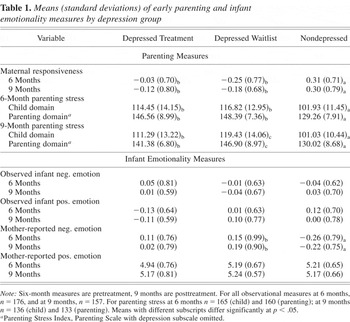
Means for all infancy age measures are in Table 1. Prior to analyzing the parenting measures, an umbrella multivariate analysis of covariance (MANCOVA) test was performed. Three measures (maternal responsiveness, and parenting stress in the child and parenting domains) × two times (before and after treatment) were the within-subjects measures, and depression group (treated, waitlist, or nondepressed) was the between-subjects measure. Maternal education and child gender were included as covariates. A significant overall multivariate effect of Time × Measure × Group, exact F (4, 238) = 3.68, p < .01, led us to proceed with tests on the individual variables at the two infant ages. Repeated-measures analyses of variance (ANOVAs) yielded significant main effects of depression group on responsiveness, F (2, 151) = 10.14, p < .001, and on the parenting stress measures for the child domain, F (2, 125) = 25.80, p < .001, and the parenting domain, F (2, 120) = 70.55, p < .001. There were also significant Group × Time interactions on both parenting stress measures.
Means (standard deviations) of early parenting and infant emotionality measures by depression group

Effects of depression on early parenting
The effects of depression on parenting were evaluated with follow-up tests of the ANOVAs, with a planned contrast between the nondepressed control group and the two depressed (treatment and waitlist) groups. Mothers in the depressed groups were significantly less responsive to their infants at both times than were mothers in the nondepressed control group: at 6 months, t (173) = 3.79, p < .001; at 9 months, t (154) = 3.50, p = .001; effect size, partial η2 = .11. In addition, mothers in the depressed groups reported more parenting stress than mothers in the nondepressed control group. This was true both for the child domain, t (162) = 6.36, p < .001, at 6 months, and t (133) = 6.24, p < .001, at 9 months; partial η2 = .27, and the parenting domain, t (157) = 13.40, p < .001, at 6 months, and t (130) = 6.24, p < .001, at 9 months; partial η2 = .52.
Treatment effects
Post hoc comparisons among the three groups also enabled us to determine whether there was an effect of treatment on parenting, and if so, whether that effect was sufficient to bring treated mothers to the level of the nondepressed mothers on parenting measures. Comparisons that are significant at the .05 level according to Tukey's honestly significant difference are indicated in Table 1. There was no effect of treatment on maternal responsiveness.1
There was a tendency for those mothers in the intervention group whose depression began more recently to be more responsive to their children following treatment (for length of current episode, r = −.24, p < .10).
Infant emotionality
Prior to analyzing the infant emotionality measures, an umbrella MANCOVA test was performed. Four measures (the observed positive emotionality composite, the observed negative emotionality composite, mother-reported positive emotionality, and mother-reported negative emotionality), × two times (before and after treatment), were the within-subjects measures, and group (treated, waitlist, and nondepressed) was the between-subjects measure. Maternal education and child gender were included as covariates.
A significant overall multivariate effect of measure by group, Exact F (6, 252) = 2.34, p < .05, led us to proceed with tests of depression and treatment groups on the individual variables at the two infant ages. Repeated-measures ANOVA follow-up tests were conducted for the individual child emotionality measures. Mothers' reports of child negative emotionality showed a significant effect of depression group, F (2, 130) = 4.18, p < .05. There were no significant group effects on other variables, nor were there any Group × Time interactions.
Effects of depression on infant emotionality
Differences between depressed and nondepressed mothers' reports of child negative affect were evaluated with follow-up tests of the ANOVAs, using a planned contrast between the nondepressed control group and the two depressed (treatment and waitlist) groups. Mothers in the depressed groups reported significantly more child negative affect at both times than did mothers in the nondepressed control group. The planned contrasts were significant: at 6 months t (163) = 2.75, p < .01, at 9 months t (136) = 2.22, p = .05, partial η2 = .05. There were no depression effects on observed emotionality measures.
Effects of treatment on infant emotionality
There were no significant effects of treatment group on any of the infant emotionality measures.
Response to treatment and outcomes in infancy
An experimental comparison of the treatment and control groups on child outcome measures is a conservative test of whether effective treatment brings a benefit to children, because not all mothers responded to the treatment. Before concluding that the impact of treatment was limited, we therefore tested whether recovery with treatment was associated with child outcome measures. We also tested whether changes in depressive symptoms, for mothers receiving treatment, were associated with changes in child outcomes.
Recovery with treatment
We compared responders in the treatment group to the control and waitlist groups at 9 months, to see if there were more substantive treatment effects for this subgroup. These more liberal analyses did not add to our obtained findings. Again, the only significant differences between treatment responders and waitlisted mothers were in parenting stress, and again the levels for (recovered) treated mothers were still significantly below those for nondepressed mothers.
Change in symptoms
Using recovery as a predictor, it was still possible that we missed subtle effects of change in depression, because of the low power of the dichotomous test, or to the failure to consider change at the upper and lower range of symptoms. We therefore also tested whether changes in symptoms, using continuous variables created by subtracting posttreatment from pretreatment scores on the Hamilton Scale and the Beck Depression inventory, were associated with changes in child outcomes. The two measures of symptom change were highly correlated (r = .77, p < .001) and so, were combined. Again, there were significant associations only for changes in parenting stress, this time only in the child domain (r = .45, p < .005), with no effect of changes in symptoms on changes in maternal responsiveness or in any child emotionality measures.
Follow-up at 18 months after treatment
Because effects of treatment may increase or diminish over time, we followed our sample 18 months after the end of treatment. Children whose mothers had recovered with treatment were exposed to shorter durations of maternal major depression over this period (for children of recovered mothers, M = 6.6 weeks, for nonrecovered, M = 17.3 weeks, t = 3.69, p < .001). The follow-up was a correlational analysis of the sequelae of treated depression in the first year. If treated depression was still associated with lower child functioning over time, relative to our nondepressed group, this would be evidence that our treatment alone was not sufficient to protect children from adverse outcomes. In contrast, if improvement and nonimprovement at the end of treatment led to different child outcomes, this would be evidence that successful treatment of depressed mothers is associated with a long-term benefit for their children.
Prior to analyzing the follow-up measures, an umbrella MANCOVA test was performed. There were five within-subjects measures (temperament scales indexing extraversion/surgency and negative emotionality, internalizing behavior problems, externalizing behavior problems, and attachment security), and a reconfigured depression group (in which women were designated as recovered with treatment, treatment nonresponders, or nondepressed control) was the between subjects measure. As before, maternal education and child gender were included as covariates.
There was a significant multivariate effect of group on the follow up measures, Exact F (10, 188) = 3.27, p < .005. One-way ANOVA follow-up tests on the individual measures showed significant effects of depression group on security of attachment, child negative emotionality, internalizing behavior problems, and externalizing behavior problems (see Table 2).
18-Month follow-up measures by depression group

Treated depression and 18-month child outcomes
Differences were evaluated with follow-up tests of the ANOVAs, using a planned contrast between the nondepressed control group and the two depressed (recovered with treatment and nonrecovered) groups. Children of treated depressed mothers, compared with children in the nondepressed control group, were significantly lower in attachment security, t (137) = 3.77, p < .001, partial η2 = .10, and higher in negative affect, t (105) = 3.79, p < .001, partial η2 = .09. They also had more internalizing and externalizing behavior problems than did children of nondepressed controls: for internalizing, t (105) = 4.71, p < .001, partial η2 = .12; for externalizing, t (105) = 3.86, p < .001, partial η2 = .10. Because means for all groups were in the normal range, we also inspected the raw data for cases in which total problems were at or above the cutoff for clinical concern. Of the six children who met this criterion, all were children of depressed mothers.
All follow-up measures were obtained through maternal report. We therefore tested whether bias because of current depression might be responsible for the differences in child outcomes. To do this, we repeated our follow-up tests, excluding from analysis the 15 mothers in our depressed group who were experiencing either major depression or subclinical depressive symptoms at 18 months posttreatment. All the significant differences between nondepressed mothers and mothers treated for depression remained significant. Thus, reporting bias because of current depression cannot account for the results.
Recovery at the end of treatment and child outcomes
Post hoc comparisons among the three groups also enabled us to determine whether successful treatment was associated with better long-term child outcomes, and if so, whether that effect was sufficient to bring children of recovered mothers to the level of the nondepressed mothers on outcome measures. There were no significant effects of recovery with treatment on child outcome measures.2
Because not all mothers who got well with treatment stayed well, we also tested whether, within our depressed groups, cumulative exposure to depression during the follow-up period related to our child outcome measures. Total weeks of maternal major depression were uncorrelated with attachment, emotionality, and externalizing behavior, but there was a significant impact of cumulative exposure on internalizing behavior problems (r = .29, p < .05).
Relations among pretreatment and follow-up measures
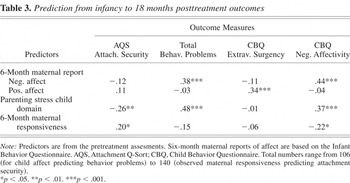
Table 3 presents correlational analyses linking 6-month (pretreatment) measures and the follow-up measures. Because at 9 months some mothers had and some had not received treatment, only the earlier measures were used. There were no significant links from early observed emotionality measures to mother-reported outcomes. Of particular interest was whether mothers' early views of their children predict their reports at age 2, and whether this stability of maternal perceptions might contribute to negative outcomes experienced by children of depressed mothers. In fact, mothers who viewed their children as high in negative affect, and who reported high parenting stress in the child domain (which includes perception of the child as difficult), continued to report high child negative affect and also reported more behavior problems nearly 2 years later.
Prediction from infancy to 18 months posttreatment outcomes

We also compared the separate longitudinal relations for depressed and nondepressed mothers, using Fischer's test for the difference in correlations from independent samples. There was only one significant difference. Maternal reports of child positive affect protected children against the development of behavior problems for children of nondepressed mothers only. However, with the inclusion of observed affect, over 20 correlations were compared. One significant finding is not more than would be expected by chance.
Discussion
This report describes the first large-scale study in the United States, testing the impact on very young children of a manualized psychotherapeutic treatment for mothers' depressive symptoms. At the time this project began, the only comparable work was being conducted in England (Murray et al., 2003). Consistent with that study's overall pattern of results, treating mothers' depression did not appear sufficient to protect their children from the negative effects of having a depressed parent.
Effects of depression
There were significant and enduring effects of maternal depression in the postpartum period on parenting and on mothers' perceptions of their children, both currently and later. It is important to note that participants in this prospective study were not seeking treatment, but were screened from the community. In contrast to studies of depression among mothers selected for elevated risk because of poverty, or teen parenthood, or both, they are more representative of depressed mothers in the population at large. As might be expected with a community sample of mothers who received treatment, a relatively small proportion of mothers in the depressed group were actively depressed 18 months later. At the time the follow-up questionnaires were mailed, 14% of the depressed group mothers met full criteria for a major depressive episode.
Despite the relatively high level of functioning, the implications of early maternal depression for children were neither minor nor fleeting. Depressed mothers were observed to be significantly less responsive to their infants than were nondepressed mothers. They also experienced more parenting stress and they rated their infants' temperaments as more negative. It is important to acknowledge that there were no findings for observed measures of child emotionality. It is therefore possible that the infants are doing better than their mothers appear to believe.
Eighteen months following treatment, these mothers continued to rate their children as high in negative temperament, as less securely attached, and as higher in behavior problems than did the mothers who had not been depressed postpartum. Although the means for behavior problems in the children of depressed mothers were well within the normal range, a mean difference of approximately .75 standard deviations may mean that these children are more likely to develop clinical problems later. Consistent with this concern, all children with total problem scores at or above the clinical cutoff were children of mothers from the depressed groups.
Effects of treatment
Of even greater concern, however, was that a psychotherapeutic treatment, demonstrated to be effective at relieving the symptoms of depression (O'Hara et al., 2000), had no significant impact on deficits in maternal responsiveness. Furthermore, treatment did not improve mothers' reports of their children's temperament, either in the short or long term, nor did it improve mothers' reports of child behavior problems or of the quality of the mother–child relationship. Finally, although treatment did significantly reduce reported levels of parenting stress, it did not bring parenting stress down to the level experienced by nondepressed mothers. Taken together, these results clearly indicate that treating the mother's depression, even successfully, is not in itself sufficient to change the mother–child relationship, or the mother's negative view of her child.
Why does the mother's view of her infant not improve? Her view of parenting stress improves somewhat. Also, according to previous reports with this sample, her view of her depressive symptoms and her view of her other relationships both improve substantially following treatment (O'Hara et al., 2000). One possible explanation is that IPT treatment leads to improvement only in targets of the therapy, but not nontargets, as the mother–infant relationship is not a central focus of this manualized treatment. A second possible interpretation is cognitive. The mother's relationship with her child was formed at a time when she was depressed and thus the entire relationship early on was in the context of depression. This contrasts with other important relationships whose more positive histories may have made it easier for her to imagine or to recreate a more positive relationship with recovery. This suggested mechanism may explain the contrast between the current findings and a recent study finding that remission in maternal depression with treatment was accompanied by improvement of child behavior problems and clinical symptoms in a sample of children ages 7 to 17 (Weissman et al., 2006).
Support for this possibility comes from the fact that mothers' early experience of their children as emotionally negative, and of parenting the child as stressful, significantly predicted later reports of negative temperament and behavior problems, although observational measures of child negative affect did not. Other researchers have also provided evidence that parents' views of their children tend to be unrealistically stable over time (e.g., Saudino & Cherny, 2001). Of interest, there were no differences between nondepressed and depressed mothers in the prediction from early negative views of the child to later maternal reports. The process underlying stability of parent perceptions may be common across normative and clinical samples. The problem is that those original perceptions were significantly more negative among depressed mothers.
In addition, although ongoing exposure to depression was significantly reduced for children whose mothers recovered with treatment, it was not zero. Perhaps the definition of “success” in treatment could be argued, particularly from the point of view of the child. Finally, the lack of improvement is also consistent with a simple genetic transmission hypothesis, or with biological risk caused by prenatal stress. Improvement in mother's symptoms would not automatically change the child's physiology.
Clinical implications
An important implication of this study is that parenting interventions should be included in treatment protocols for depressed mothers of very young children. A variety of interventions that target parenting techniques and women's perceptions of their infants, along with treatment for depression, have shown initial promise (e.g., Cicchetti et al., 2000; Gelfand et al., 1996). Given the prevalence of depression and its implications for children's development, more research on interventions employing such combined treatments urgently needs to be done.
Many mothers who seek help with infant sleep problems, colic, and other parenting challenges experience high levels of depressive symptoms, and helping these mothers to feel effective as parents may help improve their depressed mood as well. For example, in a recent report, intervention for infant sleep problems significantly improved mothers' depressive symptoms, among those mothers with high pretreatment scores on the Edinburgh Postnatal Depression Scale (Hiscock & Wake, 2002). Thus, treatment of parenting may reinforce the primary goal in treating depressed mothers of infants. Finally, according to a recent study, children whose mothers experienced depression before their birth, but not in the child's lifetime, have better outcomes than children directly exposed to depressed mothers (Kim-Cohen, Moffitt, Taylor, Pawlby, & Caspi, 2005). Prevention of depression in prospective mothers may also serve a protective function for their children.
Another implication is that therapy should begin earlier and end later to diminish the likelihood that an impaired relationship with the infant will form and persist. Note, however, that the Murray et al. (2003) study did begin at a much earlier infant age and the results were similar. It may be that 12 sessions of IPT delivered on a weekly basis is not sufficient to affect parenting among depressed mothers. For example, in many trials it is common for IPT to be delivered in 16–20 sessions (Elkin et al., 1989). In the clinical literature (Stuart & Robertson, 2003) there is a strong suggestion that IPT might be more effective if sessions were spread out in time over as much as a year. This approach might have the advantages of preventing relapse and continuing to address cognitive and interpersonal issues that do not resolve quickly. Further research should address these questions.
Policy implications
A recent position statement of the Canadian Paediatric Society (2004) includes a recommendation that, when a mother who complains about her child's sleep or other behavior problems turns out to be depressed, “… interventions for the depression of the mother should take priority over behavioural therapy for the child.” Although elsewhere in the document they recommend continuing to carefully monitor the child, this statement may be read by pediatricians as suggesting that removing the depression will often be sufficient to solve the child's problem as well. In the United States, similar assumptions may be held by the insurers whose practices often shape access to treatment. An implication of the current findings is that intervention programs that target both maternal depression and parenting, and focus both on both behavior and cognitions, will be important to assure optimal outcomes for infants and their mothers.
Strengths and weaknesses of the study
This study had several notable strengths. The treatment was effective, and the initial sample was large enough to detect effects of treatment on a variety of outcomes. Observations were included along with maternal reports, and a nondepressed control group was included in the design. This helped us to show, for example, that even in the case of the significant positive impact of IPT treatment in reducing parenting stress, treated mothers still experienced more stress in parenting than did nondepressed mothers.
The recruitment of a community sample is also a strength, because it closely represents the conditions to which children are exposed. However, this also resulted in a heterogeneous depression group, in which few mothers were experiencing a single focal depressive episode, postpartum in origin. The fact that more recently depressed mothers tended to be more responsive to their infants following therapy means that a treatment group specific to this subtype of postpartum depression might have had a more positive impact on children. However, depression is a chronic, recurring illness. Consistent with the makeup of our sample, major depression in the postpartum period is similar in severity, cause, and prognosis to depression at other times in women's lives (O'Hara, 1997).
There were weaknesses of the study as well, including attrition at the 18-month assessment. The resulting loss of power makes it possible that subtle effects of treatment would be detected with a larger sample. We also had no untreated control group at follow-up, for ethical reasons. This means we are unable to determine whether children of treated mothers might have experienced a long-term benefit relative to children of untreated mothers, even if such a benefit did not bring them to the level of children of well mothers. We were also unable to compute change scores from infancy to the follow-up, as different measures were used at the two times.
Follow-up data were obtained through maternal report. Although this allows us to examine the consistency of parents' perceptions over time, it limits what we can conclude about child behavior, particularly in the absence of an effect on observed emotionality in infancy. Depressed parents' reports about their children have both objective and subjective components (e.g., Fergusson et al., 1993). We believe even the subjective component of these reports is of concern, because perceptions influence parents' behavior (Garber & Martin, 2002). Nevertheless, our methods do not allow us to examine empirically the subjective and objective components of the follow-up measures. Future treatment outcome research should be designed to address this issue. Finally, fathers were omitted from the design. Although our treated participants reported improved relationships with their partners (O'Hara et al., 2000), it is still possible that the men in these mothers' lives may contribute to the stability of negative child outcomes. More investigation is needed of depressed women's life circumstances that may contribute to continuing family problems after their symptoms remit.