


I.
In most common-law and civil-law jurisdictions (including those with significantly different legal traditions, for example, the United States, Germany, and France), even reasonable mistakes of law generally do not excuse. That is, the fact that one was ignorant of the content or requirements of some law, L, generally does not excuse violations of L. One will still be subject to whatever liability attaches to violation of L. Many have argued that this doctrine is mistaken. In particular, many have argued that if an individual's ignorance or false belief is blameless, if she held the false belief reasonably, then she ought to be able to use that ignorance as an excuse for violating the law.Footnote 1
It is much harder to find defenders of the doctrine, despite its prevalence.Footnote 2 Pragmatic considerations are occasionally offered on its behalf, but these are generally not impressive. One such argument is that it is difficult for a court or legal authority to determine what an individual actually knew about the law prior to violation and that this epistemic difficulty provides a practical consideration against allowing ignorance as an excuse. But that is true for all mental-state elements of crimes, and an affirmative burden could be placed on the person arguing for the excuse to prove that she was in fact ignorant.
A second argument sometimes made is that there would be widespread abuse of the excuse, particularly because of the difficulty of knowing the law, given the complexity of modern legal systems. But, first, this is dubious as an empirical claim, and it could be constrained by setting the standard for “reasonable” ignorance relatively high (so that one would have substantial duties to inquire about the law if one were contemplating taking certain kinds of actions). Second, whether this constitutes abuse depends on the appropriateness of giving the excuse, so this response is question begging. A third suggestion sometimes made is that we want to give people incentives to learn and inquire about the law. But having a “reasonable ignorance” excuse would incentivize this more effectively if a way of arguing reasonable ignorance was to demonstrate that one had made serious efforts to learn what was legally required.
In this paper, I want to consider a more direct kind of justification for the doctrine, one that attempts to identify something more immediately normatively objectionable about being ignorant of the law. In particular, I want to consider an argument with this basic structure:
-
(1) Blameless nonmoral ignorance often provides an excuse for actions performed only because of that ignorance.
-
(2) The reason that blameless nonmoral ignorance provides an excuse does not extend to blameless moral ignorance.
-
(3) Blameless legal ignorance is—at least in this respect—like blameless moral ignorance, not like blameless nonmoral ignorance.
-
(C) The reason that blameless nonmoral ignorance provides an excuse does not extend to blameless legal ignorance.
In this argument and throughout the rest of the paper, I understand “blameless” in this context as equivalent to “procedurally and epistemically faultless,” so that the person is not ignorant as a result of recklessness, negligence, or other forms of belief mismanagement.
I take premise (1) to be uncontroversial, although I discuss it briefly in Section II. Premise (2) is controversial, but one can make the case for it, supported by the work of Nomy Arpaly, Elizabeth Harman, and Pamela Hieronymi. I do that in Section III below. Section IV of the paper focuses on candidate attempts to support premise (3).
Importantly, the conclusion (C), even if accepted, does not directly establish that it is normatively appropriate for people to be held accountable for blameless mistakes of law. What it does, instead, is undercut one motivation for thinking otherwise—namely, what we can call the parity thesis: if blameless nonmoral ignorance excuses, then blameless legal ignorance should excuse as well.
One thing worth noting at the outset: most of the discussion regarding blameless moral ignorance and blameless factual ignorance has been about whether one gets off a moral hook—whether one is excused, morally speaking, for acting as one did as a result of one's ignorance. The doctrine that mistakes of law do not excuse is about whether one has a legal excuse. These might not be so far apart, since it is plausible that we are not permitted to sanction or punish a person legally unless certain moral-culpability conditions are satisfied. This is at least true in the criminal law context, or so we might suppose. Additionally, the objection to the doctrine that mistakes of law do not excuse is typically raised as a moral objection: it is morally inappropriate to have a legal system in which mistakes of law do not excuse.
II.
If I act from or in ignorance of some nonmoral/nonlegal fact, so that my so acting is explained by my ignorance (roughly: if I had not been ignorant, I would not have acted in this way), this will in some cases provide an excuse, or at least a partial excuse, so that either I am not morally or legally culpable at all, or my culpability is lessened. Not every factual mistake I make will get me off the moral or legal hook, but some will. In particular, if my ignorance was blameless (reasonable, nonculpable), it seems that my ignorance will and should excuse my conduct. Consider, for example, the following case:
Coffee: Adam is bringing coffee to Brianne. Unbeknownst to him, the sugar dish has been emptied and filled with arsenic. He puts a spoonful of what he believes to be sugar but is in fact arsenic into Brianne's coffee. She drinks the coffee and dies.
Adam has a false nonmoral factual belief: that what is in the sugar dish is sugar. Assuming that he is not culpable for having this false belief, his ignorance will provide him with a moral excuse. Furthermore, we would expect that Adam's false belief (if reasonable rather than reckless or negligent) will also make it so that he has committed no crime, typically by making it so that he does not satisfy the requisite mens rea element.
So, in cases of actions done from nonmoral ignorance, it is commonly accepted that a person is morally culpable for the action only if she is culpable for the ignorance from which she acts. This is not quite right. Take ignorance to be lack of true belief. One can be ignorant of a fact, F, in one of several ways:
Unexamined: cases in which a person is ignorant because she has never thought about the issue (and so has no beliefs about or only has unexamined “implicit” beliefs about F).
Mistaken: cases in which a person is ignorant because, though she has thought about the issue, she has come to have false beliefs about F (she believes that not-F when in fact, F).
Uncertain: cases in which a person is ignorant because, though she has thought about the issue, she does not know what to believe (she does not believe that F or that not-F).
Given this, it is not true that actions done from nonculpable nonmoral ignorance always excuse. In particular, the ignorance may be nonculpable, but one may be aware that one is ignorant, as in many Uncertain cases, in which case it may be impermissible to act, given that one is aware that one is ignorant.Footnote 3
III.
So, ignorance sometimes excuses in the nonmoral case. One important question that has received some attention recently is whether the same considerations apply in cases of moral ignorance—ignorance of moral facts. In early work on the topic, Michael Zimmerman defends the view that the cases are similar: in cases of actions done from moral ignorance, a person is culpable for the action just in case she is culpable for the ignorance from which she acts.Footnote 4 Gideon Rosen follows Zimmerman,Footnote 5 defending what we might call the Ignorance Thesis:
Ignorance Thesis: Whenever an agent acts from ignorance, whether factual or moral, he is culpable for the act only if he is culpable for the ignorance from which he acts.
As suggested above, this thesis is too strong. One important question is: What is the explanation of why there is an excuse in Coffee, given that there is not always an excuse? This question is also relevant to assessing the Ignorance Thesis: Does the excuse from blameless nonmoral ignorance extend to blameless moral ignorance as well?
There are a number of responses to Zimmerman and Rosen on the question of whether blameless moral ignorance exculpates. Some of the most powerful responses are those that argue that action that stems from false moral beliefs, even blamelessly held false moral beliefs, not only is not excused but can be the ground or source of an action's blameworthiness. Consider, for example, Arpaly, who argues that an action is blameworthy only if the action resulted from the agent's caring inadequately about what is morally significant—where this is not a matter of de dicto caring about morality but de re caring about what is actually morally significant.Footnote 6 Hieronymi argues that “[w]e are fundamentally responsible for a thing. . . because it reveals our take on the world and our place within it—it reveals what we find true or valuable or important.”Footnote 7 Harman argues that “[b]eliefs (and failures to believe) are blameworthy if they involve inadequately caring about what is morally significant,” and that “[b]elieving a certain kind of behavior is wrong on the basis of a certain consideration is a way of caring about that consideration.”Footnote 8
The central suggestion for these views, often called “quality of will” views, is that there is a big difference, at least in some cases, between nonmoral ignorance and moral ignorance: the latter often constitutes a kind of morally blameworthy failure or reveals a morally blameworthy worldview, such that actions that stem from this ignorance are not excused. On these views, false moral belief constitutes the basis of moral blameworthiness, even as this ignorance explains the agent's actions. (For this reason I refer to these views as “constitutivist” views about the relationship between moral ignorance and moral responsibility.)
What if this moral ignorance or this false moral worldview is one that is itself held despite significant and reasonable efforts on the part of the agent? Hieronymi suggests that this is not enough:
[D]emands that one manage a thing cannot fall upon those without the capacity to manage it. . . . The conclusion to draw, though, is not that demands must adjust until those to whom they apply are capable of satisfying the demand, but rather that the demands apply only to those able to partake in the activity in question, whether well or poorly. . . moral demands stand, unyielding, in the face of an inability to meet them. . . the reactions we have, when we regard one another as responsible. . . need not include a commitment to the claim that their target could have avoided wrongdoing by trying harder.Footnote 9
Harman is similarly unmoved:
We are morally obligated to believe the moral truths relevant to our actions (and thus not to believe false moral claims relevant to our actions), and we are often blameworthy for failing to meet these moral obligations, even if we have not been guilty of mismanagement of our beliefs, and even if our ignorance is not motivated. Wrong actions that result from false moral beliefs are not thereby blameless; indeed, they may be loci of original responsibility. While both the beliefs and the actions are blameworthy, the actions are not blameworthy because the beliefs are blameworthy. Rather, the actions and the beliefs are blameworthy for similar reasons.Footnote 10
On these views, moral ignorance, even if not the result of negligence or recklessness or other failures of belief management, can be the appropriate foundation of moral blameworthiness because this ignorance can constitute or reveal something that is itself blameworthy: a failure to care about what is in fact morally significant.
Note that nothing similar can be said about instances of nonmoral ignorance and actions that stem from such ignorance. Adam's ignorance regarding the contents of the sugar dish does not constitute or reveal a failure to care about what is in fact morally significant, assuming that his ignorance does not stem from recklessness or negligence on his part. In recent work, Harman makes this idea explicit, arguing that the correct explanation of why someone like Adam is blameless does not extend to blameless moral ignorance.Footnote 11 Harman notes that there are two different things that someone might say to explain Adam's blamelessness:
Blameworthiness Requires Some Psychological Ground: A person is blameworthy for behaving in a certain way only if either there is a way of behaving such that (a1) she believed she was behaving in that way, and (a2) behaving in that way is morally wrong; or (b) she violated some procedural moral obligations regarding the management of her beliefs.
Blameworthiness Requires Moral Knowledge: A person is blameworthy for behaving in a certain way only if either there is some way of behaving such that (c) she believed she was behaving in that way, and (d) she knew that behaving in that way is morally wrong; or she violated some procedural moral obligations regarding the management of her beliefs.Footnote 12
Given a case like Adam's, his blamelessness could be explained by his failure to satisfy either of these candidate necessary conditions for blameworthiness. He does not satisfy either of the two disjuncts of the first condition. And he does not satisfy both of the conjuncts of the second condition. Harman argues that the first condition, which is strictly weaker than the second condition, is the one that explains Adam's blamelessness. So one suggestion is that all we learn from the fact that nonmoral ignorance sometimes excuses is that something like Blameworthiness Requires Some Psychological Ground is true. We cannot generalize from those cases to establish that Blameworthiness Requires Moral Knowledge.
When we turn, then, to some of the classic cases where individuals are ignorant of the moral facts, we see that if they are off the hook, it is not because they fail to satisfy Blameworthiness Requires Some Psychological Ground. Consider, for example, the Ancient Slaveholder, who holds slaves, but at a time when (we are to suppose) no one—neither slaveholders nor slaves—questioned the morality of slavery; it was just taken for granted as a morally acceptable cultural practice.Footnote 13 The Ancient Slaveholder satisfies the first disjunct of Blameworthiness Requires Some Psychological Ground, because when he takes actions such as physically harming or restraining his slaves, he knows both that he is behaving in those ways and that those ways of behaving are in fact morally wrong. This does not yet establish that the Ancient Slaveholder is blameworthy, as this is just a necessary condition on blameworthiness. But it does mean that the grounds of excuse apparently available to those, like Adam, who act out of nonmoral ignorance will not be available to the Ancient Slaveholder. It is true that the second purported necessary condition on blameworthiness would excuse the Ancient Slaveholder, but (the argument goes) we do not yet have any reason to accept this second purported necessary condition on blameworthiness. We cannot get there, for example, simply through noting that someone like Adam is intuitively excused.
There might be things to say to motivate Blameworthiness Requires Moral Knowledge. I want to leave that aside for the purposes of this paper. What I want to consider is whether, if we focus just on Blameworthiness Requires Some Psychological Ground, we find that agents who make mistakes of law—who are ignorant of legal facts—typically fail to satisfy this condition, perhaps grounding an excuse and undermining claims of blameworthiness. I consider a few arguments that attempt to make the case that legal ignorance cases, like moral ignorance cases, do satisfy this condition for blameworthiness and thus cannot be excused in the same way that nonmoral ignorance cases can be excused.
IV.
Let us return to premise (3):
(3) Blameless legal ignorance is—at least in this respect—like blameless moral ignorance, not like blameless nonmoral factual ignorance.
In considering premise (3), it is important to get a good test case. In particular, we should consider a case in which the person acts from legal ignorance and what they do is not itself seriously immoral (so that they would be behaving in a way that is morally wrong, regardless of the legal facts). So, for instance, we should avoid cases like the one that Yaffe uses in discussing mistake of lawFootnote 14 :
Marital Rape: A man, Williams, has nonconsensual sex with his wife, falsely believing that there is a marital exemption from rape in the jurisdiction in which he lives.
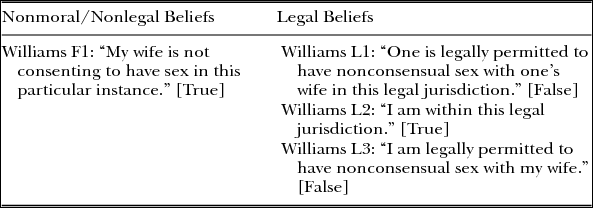
It is plausible that in this case Williams is both morally blameworthy and deserves punishment because he forced another person to have sex with him, objectionably taking the legal reasons he believed he had to exhaust the moral reasons present. At any rate, it might seem that if we are trying to make a case for blameless legal ignorance not excusing, this is not going to be a helpful kind of case to start with, since there seem to be many reasons not to excuse Williams.
Better, instead, to begin by focusing on crimes that are considered mala prohibita (“bad because prohibited”); these are prohibited by statute but are not inherently or independently immoral. Other crimes are considered mala in se (“bad in themselves”); these are considered inherently and independently immoral. Michael Travers and Dan Kahan argue that blameless legal ignorance should excuse in mala prohibita cases but not mala in se cases.Footnote 15 It certainly seems that these cases are, at any rate, harder ones for the defender of the doctrine that blameless legal ignorance should not excuse.
So let us consider such a case, familiar from this literature:Footnote 16
Child Care: Battersby entered into a contract to house and take care of a couple's children five days a week, with the children returned to their parents on the weekends. Battersby did not have a license to provide foster care. A statute required a person to be licensed if caring for children for money for more than thirty consecutive days. In Battersby's case, a court ruled that for the purposes of the statute, Friday and Monday are consecutive days—in effect, the court ruled that thirty consecutive weekdays of care required a license.
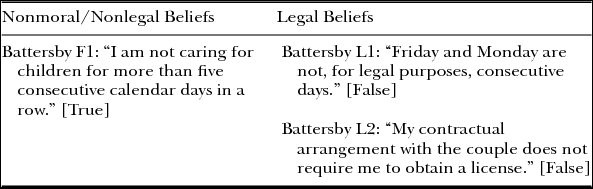
The case can either be set up so that in Battersby's case itself, the court ruled (for the first time, explicitly) that this is what the law is, or it could be set up so that a previous court had already ruled this, unbeknownst to Battersby. Either way, the important stipulation for our purposes is that Battersby is blameless in her legal ignorance.
So the initial question is: Does Battersby satisfy the necessary condition argued for above for blameworthiness?
Blameworthiness Requires Some Psychological Ground: A person is blameworthy for behaving in a certain way only if either there is a way of behaving such that (a1) she believed she was behaving in that way, and (a2) behaving in that way is morally wrong; or (b) she violated some procedural moral obligations regarding the management of her beliefs.
Intuitively, it seems that Battersby does not satisfy the condition. By stipulation, she does not satisfy the second disjunct, clause (b). What about the first disjunct, (a1) and (a2)? It seems that there is no way of behaving such that Battersby believed she was behaving in that way and that way of behaving is morally wrong. In particular, it is hard to see what the behavior is that she has engaged in that is morally wrong. Caring for children for more than thirty consecutive weekdays? Caring for children for more than thirty consecutive weekdays without a license? Neither of these ways of behaving seems morally wrong. Both ways definitely seem different from, for example, the actions that the Ancient Slaveholder is engaged in: beating people, massively and brutally restricting their freedom through coercive means, breaking up families, and so on.
But what about this suggestion: although caring for children for more than thirty consecutive weekdays without a license may not seem wrong if we leave considerations of legality aside (it is, obviously, not malum in se), it is morally wrong in a jurisdiction in which it is against the law. Why might it be morally wrong? Behind this suggestion is a more general idea: once a type of activity is illegal, it is also thereby immoral.
There are several different routes by which one might defend such a view. They all share the common aim of showing that all law has an important kind of moral standing, not just a subset of laws that make illegal conduct that is anyway immoral (the mala prohibita crimes). Perhaps more precisely, the suggestion is that at least for certain kinds of legitimate lawmaking, all of the laws thus enacted are such that we have at least a pro tanto moral duty to obey them. Many have connected legitimacy and moral obligation to obey the law in this way. A. John Simmons states that “state legitimacy is the logical correlate of various obligations, including subjects’ political obligations.”Footnote 17 Ronald Dworkin asserts that “[a] state is legitimate if its constitutional structure and practices are such that its citizens have a general obligation to obey political decisions that purport to impose duties on them.”Footnote 18 These views suggest that if Battersby is in a jurisdiction in which the laws are made legitimately, then Battersby did behave in a way that is morally wrong when she cared for the children for more than thirty consecutive weekdays without a license.
A related kind of view would suggest that we need not focus only on legitimacy, that there might be other norms of political morality such that if institutions enact law while embodying those norms—such as norms of political equality, compromise, toleration, and so on—then the law that results also carries with it a moral obligation to obey it, so that if one violates the law, one behaves in a way that is morally wrong. Consider, for example, Jeremy Waldron's views regarding the “dignity” of legislation:
I want us to see the process of legislation—at its best—as something like the following: the representatives of the community come together to settle solemnly and explicitly on common schemes and measures that can stand in the name of them all, and they do so in a way that openly acknowledges and respects (rather than conceals) the inevitable differences of opinion and principle among them.Footnote 19
Waldron suggests that law made in this way has a kind of standing, a kind of dignity, that makes it worthy of respect and—we might suggest—makes violation of the law morally objectionable. Again, this would suggest that Battersby does behave in a way that is morally wrong when he acts in violation of the law (for simplicity, let us assume it is statutory law enacted by a legislation with the right kind of “dignity”).
I think this is the best kind of case for defending the view that even blameless ignorance of the law should not excuse.Footnote 20 Of course, to make good on this defense, one must defend the connection between legal and moral obligation, presumably via some argument about political legitimacy, political equality and equal respect, and so on. That is one difficulty, and it is significant. The main difficulty with these positions, however, is that arguments of this kind seem to support a moral obligation to inquire into what the law is (perhaps the requirement here is very significant and potentially taxing) and perhaps to do one's best not to violate the law. They suggest that knowing what the law is has moral significance and that we should make sincere and significant efforts to avoid violating the law.
But return to Battersby, who, we are supposing, has done all of this: she has consulted with many people and has done her due diligence and yet she still gets the law wrong. It may be true that she satisfies the aforementioned necessary condition on blameworthiness, Blameworthiness Requires Some Psychological Ground. But this is just a necessary condition. And, importantly, it seems that Battersby does not satisfy this other plausible necessary condition on blameworthiness:
Blameworthiness via False Belief: Actions resulting from a false belief are blameworthy only if (a) the agent violated some procedural moral obligations regarding the management of her beliefs in coming to have the false belief; or (b) the mere possession of the false belief constitutes or reveals a failure to care about what is in fact morally significant.
Again, this condition would be another ground on which Adam would be excused: his false belief about the contents of the sugar bowl does not constitute or reveal a failure to care about what is in fact morally significant. And on the other side, the Ancient Slaveholder does satisfy this condition (unlike the moral knowledge condition): his false beliefs about the moral rights of people, including slaves, constitutes or reveals a failure to care about something that is in fact morally significant. One of the main things that Arpaly, Harman, and Hieronymi suggest is that it is not enough merely to care about acting in accordance with morality, so that one cares about what is morally important in a de dicto sense. One can be blameworthy just for failing to care about what is in fact morally important in a de re sense.
But this is less plausible in the case of law and legality. This is apparent when we consider someone like Battersby. What is the argument that the mere possession of the false belief about the licensing rule constitutes or reveals a failure to care about what is in fact morally important? We stipulate above that Battersby cares greatly about following the law in general, that she took appropriate steps to investigate what the law is in this particular instance, and that she did not violate any procedural moral obligations regarding the management of her beliefs about the law. In what sense, then, does her false legal belief constitute or reveal a failure to care about what is morally important? It seems that the arguments from legitimacy and dignity of law require us to care about following the law in general and to investigate our legal obligations to a reasonable and perhaps significant degree, but it is harder to see that the relevant kind of moral significance is transmuted to every particular way of behaving that is against the law simply in virtue of its being the law, so that violations of law always constitute or reveal a failure to care about what is in fact morally significant.
It is certainly possible to resist the “strict liability” approach to getting it right, morally speaking, that Arpaly, Harman, and Hieronymi endorse. On their views, the mere fact that somebody tried really hard to get it right, or got it wrong through no fault of their own, is not sufficient to provide an excuse. These views are controversial. And so some might reject the (b) condition of Blameworthiness via False Belief. I do not argue that point here. What I want to suggest is that whatever its plausibility in the case of getting it right about morality, it is much harder to make a similar case with respect to getting it right with respect to legality, even if we grant that we have a general pro tanto moral obligation to obey the law. It is much harder to claim that it is constitutive of acting in a blameworthy way, or that one acts in a way that reveals or constitutes a failure to care about what is in fact morally significant, when all one does is—through no fault of one's own—act based on ignorance of what the law actually is.
One way of supporting this thought is to look at the relative moral attractiveness of the respective agents. Think of Battersby, compared to the Ancient Slaveholder, in terms of the actions they take on a regular basis or the actions they are likely to take. Or think of Battersby compared to the member of the organized crime syndicate who was raised with the false moral belief that only family members matter morally. It is notable that here it does not seem to matter how difficult it would be for the individual to get things right.Footnote 21 It might be very difficult to get it right for all three of these agents and arguably through no fault of theirs in terms of the management of their beliefs.Footnote 22 Still, the motivation for going with a constitutivist or strict-liability view with respect to getting it wrong morally speaking simply does not seem present with respect to getting it wrong legally speaking.
Accordingly, it seems that premise (3) is false: legal ignorance is different from moral ignorance in this regard. Even if we grant that Battersby satisfies Blameworthiness Requires Some Psychological Ground, she does not satisfy another plausible necessary condition on blameworthiness: Blameworthiness via False Belief.
It is worth noting, however, that this account provides a candidate explanation for why blameless legal ignorance with respect to mala in se legal violations should generally not be excused. Someone like Williams (the person with the false legal views with respect to the permissibility of marital rape) satisfies both Blameworthiness Requires Some Psychological Ground and Blameworthiness via False Belief. He possesses false beliefs—at least the belief that the legal reasons exhaust the relevant moral reasons, but perhaps others as well—that do reveal or constitute a failure to care about what is in fact morally significant. And for this reason, even if his legal ignorance is blameless and even if his moral ignorance is blameless, we may conclude that he is still blameworthy for actions taken from those beliefs. This conclusion is not irresistible, of course. One will find it plausible to the extent that one finds the general Arpaly, Harman, and Hieronymi constitutivist picture plausible.
V.
Many who object to the doctrine that mistakes of law do not excuse do so on what looks like grounds of parity with cases of nonmoral ignorance. If blameless nonmoral ignorance excuses, why should blameless legal ignorance not excuse as well? After all, knowing the law seems to be similar to knowing other kinds of nonmoral facts, at least in many instances.
If we are focused on cases like Battersby and other mala prohibita cases of blameless legal ignorance, it seems that this basic suggestion is correct. At the very least, the strategy that some take regarding the nonexcuse of blameless moral ignorance will not extend to bar excuse with respect to all cases of blameless legal ignorance.
In those cases in which it does seem that blameless legal ignorance does not excuse, this will be, I suggest, because the legal ignorance was affecting only the agent's prudential perspective on performing the action, not the agent's moral perspective. (They will be acting “from” or “in” ignorance only in this sense.) Such agents will usually still satisfy the necessary conditions Blameworthiness Requires Some Psychological Ground and Blameworthiness via False Belief.
What we learn, then, is that the normative case for not excusing blameless mistakes of law might be supported by the case for not excusing blameless mistakes of morality, but only for a subset of the blameless mistakes of law—namely, those mistakes of law that constitute or reveal a failure to care about what is in fact morally significant. This subset will often align with those instances in which the mistakes of law concern mala in se violations, although there is no reason to expect that it will do so perfectly. The details of particular cases will matter.


