Absent pulmonary valve is a rare congenital defect of the right ventricular outflow tract. Most cases seem to be isolated malformations or associated with tetralogy of Fallot.
The Notch signalling pathway controls cell fate decision during development. It substantially affects differentiation, proliferation, and apoptotic programmes leading to controlled organ formation and morphogenesis. A dysfunction of the ligands of the Notch signalling pathway can contribute to severe malformations. Mutations of Jagged 1 (JAG1, MIM+601920, 20p12), a cell-surface ligand for the Notch transmembrane receptor, can be associated with a cardiac phenotype, the tetralogy of Fallot, and also with multiple system disorders including severe cardiac, liver, eye, and skeletal abnormalities – namely, the Alagille syndrome (MIM 118450), which is an autosomal-dominantly inherited defect with incomplete penetrance and highly variable expression.Reference Turnpenny and Ellard 1 The first functional results of a large kindred segregating tetralogy of Fallot indicated that mutations leading to decreased expression of JAG1 (exon 6, Gly274Asp) could specifically affect the sensitive developing heart.Reference Lu, Morrissette and Spinner 2
We report the case of a European Caucasian family with several individuals showing Alagille syndrome and being affected by a truncating frameshift mutation within Exon 12 of the JAG1 gene. Our index patient was an infant girl with tetralogy of Fallot, absent pulmonary valve, and Alagille syndrome.
Case presentation
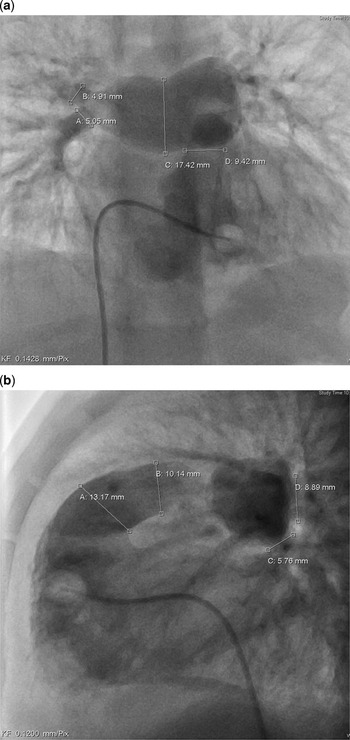
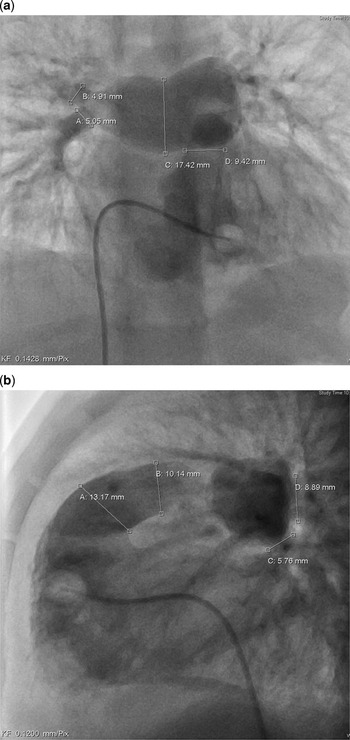
In the female patient, pulmonary stenosis and a large ventricular septal defect had already been diagnosed prenatally. Postnatal echocardiogram revealed an absent pulmonary valve with pulmonary regurgitation II°–III°, moderate pulmonary stenosis, a large malaligned ventricular septal defect, and right ventricular hypertrophy. Cardiac catheterisation at 8 months of age demonstrated secondary pulmonary hypertension (mean pulmonary artery pressure 39 mmHg) and a left-to-right shunt of 38% (Qp/Qs 1.62), see Figure 1. Clinical workup revealed butterfly vertebrae and no clinical signs of impaired liver function, but revealed elevated levels of transaminases, within 2.5× of the upper limit of normal.
( a ) Right ventricular angiography, frontal view: stenoses of the branch pulmonary arteries (diameter right superior pulmonary artery 4.9 mm, right inferior pulmonary artery 5.0 mm) with a dilated main pulmonary artery (diameter 17.4 mm) and a stenotic pulmonary valve annulus (diameter 9.4 mm) with regurgitation into the right ventricle. ( b ) Right ventricular angiography, lateral view: regurgitation II°–III° over the absent pulmonary valve into the right ventricle.
Already two members of this Caucasian family were affected by Alagille syndrome.
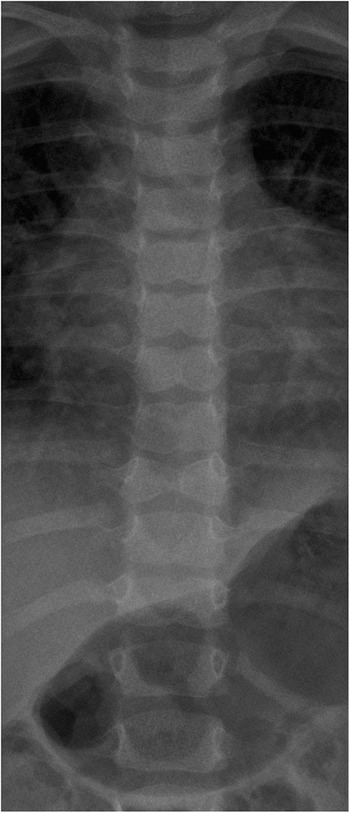
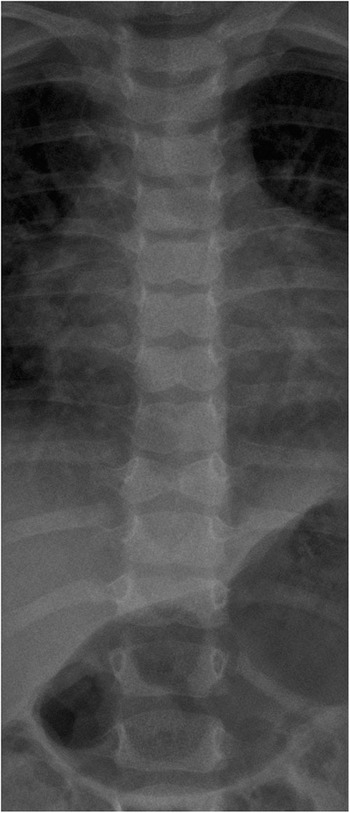
The patient’s 5-year-old sister had undergone successful surgical repair of a ventricular septal defect, a persisting foramen ovale, and stenosis of the right and left pulmonary arteries at 2 years and 5 months of age. Further clinical features included butterfly vertebrae (see Fig 2). At present, the patient is treated with ursodeoxycholic acid.
Spine radiograph, anterior–posterior view: the 9th thoracic vertebra has a butterfly shape as sign for abnormal vertebral segmentation.
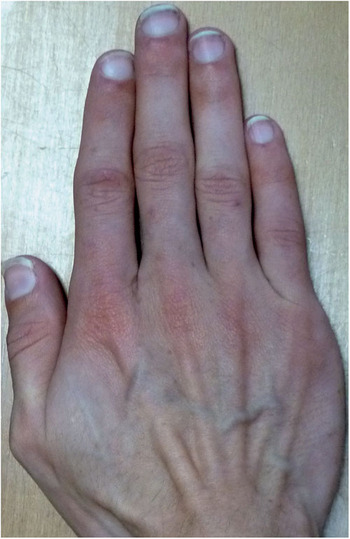
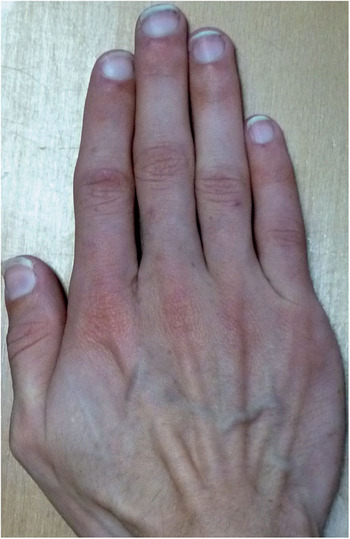
The 24-year-old father was diagnosed with Alagille syndrome at 1 month of age due to conjugated hyperbilirubinaemia. Owing to deteriorating liver function, he underwent living-donor liver transplantation at the age of 5 years. He was also diagnosed with peripheral pulmonary stenosis and a small ventricular septal defect, which was not haemodynamically relevant and resolved spontaneously. He showed shortening of the distal phalanges, which is common in Alagille syndrome (see Fig 3).
Right hand with typical shortened distal phalanges.
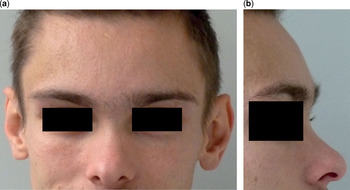
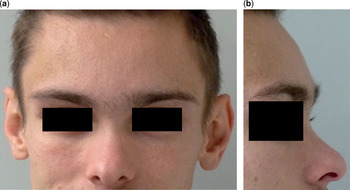
Facial characteristics of Alagille syndrome include a broadened and prominent forehead, hypertelorism, upslanting palpebral fissures, a depressed nasal bridge, an elongated nose with a bulbous tip, malformed ears, a prominent mandible, and a pointed chin. Several of these facial features were present in the affected patients (see Fig 4).
Facial characteristics of Alagille syndrome. ( a ) Frontal view: prominent broad forehead, malformed ears. ( b ) Lateral view: depressed nasal bridge, bulbous tip of the nose.
The 25-year-old mother is unrelated and healthy.
Results
Clinical course
The patient underwent corrective heart surgery at 9 months of age. Complete agenesis of the pulmonary valve and pulmonary stenosis (pulmonary valve annulus 6 mm in diameter) were confirmed intra-operatively. The ventricular septal defect was closed using a pericardial patch. Despite a coronary anomaly with the right coronary artery originating from the left anterior descending coronary artery, a valved xenograft conduit (Contegra®, 14 mm; Medtronic Inc., Fridley, MN, United States of America) was implanted between the right ventricle and the pulmonary artery. No interventions such as reduction or plication were necessary at the pulmonary arteries.
The post-operative course was uneventful. The last follow-up echocardiogram at the age of 15 months demonstrated a sufficient pulmonary valve function, no residual ventricular septal defect, resolving right ventricular hypertrophy, and good biventricular function.
Genetic analysis
Genetic analysis of the JAG1 gene on chromosome 20 in all the affected family members showed a frameshift mutation that had not yet been recorded in genetic databases.
A heterozygous insertion of two bases – CA – was detected within exon 12 of the JAG1 gene, which is composed of 26 exons. This frameshift mutation creates a premature stop codon at amino acid position 498 already before the end of exon 12 (c.1462_1463insCA). The insertion is located in the EGF-like domain 7 and results presumably in an aberrant gene product with loss of function.
Discussion
We describe a family of Caucasian origin with variable expressivity of Alagille syndrome. Absent pulmonary valve is rare and can be found in isolated form or in association with tetralogy of Fallot, which, in turn, can occur in combination with Alagille syndrome.Reference McElhinney, Krantz and Bason 3
JAG1 gene and clinical features
The JAG1 gene consists of 26 exons and encodes the Jagged-1 protein, which is a ligand of the Notch receptor. The Notch signalling pathway is critical for cardiovascular development. It orchestrates the morphogenesis of cardiac chambers and valves and plays a crucial role in the formation of the cardiac outflow tract.Reference de la Pompa and Epstein 4 Current literature suggests that the diminished endothelial expression of Jagged-1 in the pulmonary vasculature leads to signalling defects between endothelial and smooth muscle cells resulting in peripheral pulmonary stenosis.Reference High, Lu and Pear 5
Mutations of the JAG1 gene can be found in up to 94% of all Alagille patients.Reference Warthen, Moore and Kamath 6 The expression of Alagille syndrome is extremely variable between and also within affected families.Reference Guegan, Stals, Day, Turnpenny and Ellard 7 Cardiovascular anomalies have been recorded in up to 94% of patients. Thus far, there is no correlation found between the location or type of the JAG1 mutation and the associated individual cardiac defect.Reference McElhinney, Krantz and Bason 3
Eldadah et al reported a family with tetralogy of Fallot caused by a JAG1 mutation, with no detection of gastrointestinal or skeletal anomalies but with characteristic facies in all and eye anomalies in one patient.Reference Eldadah, Hamosh and Biery 8 Gläser et al reported two truncating mutations within the 3′ coding region of JAG1, suggested to be causally related with familial non-syndromic tetralogy of Fallot.Reference Glaeser, Kotzot and Caliebe 9
Prognosis
Based on the current knowledge on the treatment of tetralogy of Fallot and absent pulmonary valve, our patient has a favourable prognosis. The majority of patients are expected to require re-interventions at the right ventricular outflow tract.Reference Alsoufi, Williams and Hua 10 In a cohort of 62 patients (mean age 1.4 years), overall survival was 93% after 5 years and 87% after 10 years. Freedom of re-operations at the right ventricular outflow tract was 89% after 5 years and 59% after 10 years.
Conclusion
Genetic mutations affecting the Notch signalling pathway are involved in the pathogenesis of tetralogy of Fallot and Alagille syndrome. Therefore, it is important to stratify patients with Notch signalling defects clinically and genetically in order to improve therapeutic approaches for right-heart defects associated with Alagille syndrome.
Acknowledgements
The authors thank Dr Daniel Wenning for contributing to the diagnosis and Dr Doreen Köhler for critical revision of the manuscript.
Financial Support
This work was supported by the Dietmar Hopp Foundation, St. Leon-Rot, Germany.
Conflicts of Interest
None.
Ethical Standards
This work is a retrospective case report. The authors assert that all procedures contributing to this work comply with the ethical standards of the German Data Protection Law and with the Helsinki Declaration of 1975, as revised in 2008. This project has been approved by the institutional Ethics committee of the Medical Faculty at Heidelberg University.