Secondary intra-abdominal infection, usually due to digestive tract or biliary tree affection, is a process associated with high morbidity and mortality (15). A wide range of mortality rates (up to 60 percent) have been reported for different series, depending on the cause and severity of the infection (11). The therapeutic approach to this process is mainly based on providing general support, early surgical intervention to control the focus of the infection, and appropriate antibiotic treatment (17). Initial antibiotic treatment is applied empirically and, in cases in which no biological samples are obtained at any time, the treatment will be continued or changed depending on the changing status of the patient.
The appropriateness of a given clinical intervention as an integral part of the healthcare process is a determining factor in the outcomes observed. The choice of an antibiotic drug will depend on the pathogens responsible and the results of the susceptibility testing and on the prevailing definition of appropriate antibiotic treatment. Some clinical outcomes, including resolution of the process, complications, adverse effects, the need for re-intervention, length of hospitalization, patient satisfaction, or even survival, will be influenced by the appropriateness of the initial empirical antibiotic treatment (2). Choosing an inappropriate antibiotic seems to increase the risk of in-hospital death (12). Adjusted in-hospital mortality as a measurement of clinical outcome has been reported to be an indicator directly related to quality of care (7).
The relationship between the appropriateness of antibiotic treatment and the clinical outcome for intra-abdominal infection, as a paradigm for acute disease and maximum severity, has not been evaluated in our environment. For this reason, we designed this study with the aims of (i) describing the frequency of inappropriate antibiotic therapy in initial empirical treatment for secondary intra-abdominal infection, and (ii) identifying the possible relationship between inappropriateness and some clinical outcomes or the use of services.
METHODS
A retrospective descriptive multicenter study of a cohort of patients diagnosed of community-acquired intra-abdominal infections between January 1, 1998, and December 31, 2000, in the Corporació Sanitària Parc Taulí and the Hospital del Mar, both of which are university hospitals located in northeast Spain. These hospitals serve populations of 400,000 and 250,000, respectively.
Patients
Potential patients with community-acquired intra-abdominal infections were identified through computerized patient records using ICD-9-CM codes. Inclusion criteria were age 18 years or older and at least one of the following: acute onset of community-acquired intra-abdominal infection requiring surgical intervention, peritonitis requiring surgical treatment, perforated appendicitis, appendicular abscess, perforated diverticulitis, gangrenous or perforated gallbladders, gangrenous bowel, perforated ulcer disease, or small-bowel perforations with intra-abdominal infection confirmed at surgery. Exclusion criteria were nosocomial infections (i.e., infections occurring after 3 days of hospital admission), peritonitis related to peritoneal dialysis or infected ascites, primary peritonitis or peritonitis secondary to infection at a remote site, peritonitis occurring after an elective operation with antibiotic coverage, and emergency intra-abdominal surgery without established peritonitis. Only the first hospitalization for each patient during the period was considered.
Sources of Information
Different hospital registers were used to obtain values for the different variables (between parentheses): the admissions log (date of birth, gender, dates of admission and discharge, codified main and secondary diagnoses, codified main and secondary procedures, destination at discharge), the pharmacy register (drug used, dates administered, dosage, daily dosage, means of administration), the microbiology laboratory register (sample origin, date of obtainment of sample, germs isolated, sensitivity analyses), the surgical register (date(s) of intervention, surgical procedures).
Appropriateness of Antibiotic Treatment
Initial empirical treatment was defined as that used during the first 48 hours after admission. Appropriateness of empirical treatment was based on the recommendations of the literature: (i) Appropriate when beta-lactamase-producing gram-negative bacteria and/or anaerobes were considered to be covered by the antibiotics used initially for empirical therapy according to the scientific literature (9;14); (ii) Inappropriate when at least one of the above bacteria was likely to be resistant to the antibiotics used initially for empirical therapy.
Clinical Outcomes Evaluated
The clinical outcome of each patient was classified as one of the following: (i) resolved with initial therapy, (ii) required second-line antibiotics, (iii) required re-operation, or (iv) in-hospital death. The following definitions were used: (i) Infection resolved with initial therapy, when no modification of the initial antibiotic therapy was undertaken during hospitalization, the administration of antibiotics was changed from parenteral to oral, triple therapy was changed to double therapy, or double therapy was changed to monotherapy without increasing the spectrum of activity; (ii) Infection requiring second-line antibiotics, when a parenteral drug was added or changed to broaden coverage; (iii) Infection resolved with additional surgical therapy, for example, wound debridement, intra-abdominal surgery, or percutaneous drainage; (iv) in-hospital death, when a patient died during hospitalization. Mortality was considered the primary outcome measure, whereas the others were considered secondary outcome measures. The length of stay (LOS) was also calculated as a measure of healthcare consumption.
Statistical Analyses
Comparisons of the outcomes between groups defined by the appropriateness of the initial empirical antibiotic therapy were performed using the Fisher's exact test or the Chi-squared test for categorical variables and the t-test or Mann–Whitney test for continuous variables. The relative risks and the difference of means were also calculated. Conditional logistic and linear regression analyses were used to assess the effect of appropriateness of the initial antibiotic therapy on the probability of in-hospital mortality, on the probability of failure to resolve with initial therapy, and on the mean logarithm of length of stay, adjusting for center and sociodemographic and clinical variables. Resulting coefficients of the logarithm of length of stay regression were re-transformed to the original scale. Specifically, severity was analyzed using the Charlson Index (3). Significance was set at 0.05 for all comparisons and used as a criterion to select variables for inclusion in the final models.
RESULTS
A total of 376 patients fulfilled the inclusion criteria. According to the definition of appropriateness, 51 cases (13.6 percent, 95 percent confidence interval, 10–17 percent) received inappropriate empirical antibiotic therapy.
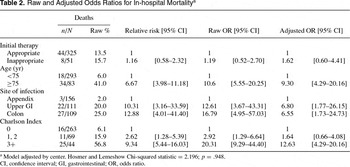
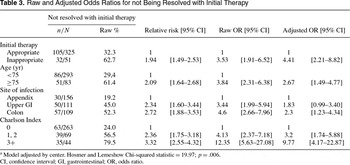
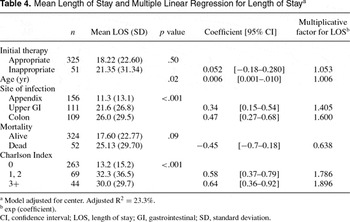
As shown in Table 1, the infectious process was resolved without changes to the initial empirical treatment in most patients, the antibiotic was changed without re-intervention in 12.2 percent, whereas 10.4 percent required a second abdominal intervention (with or without a change of antibiotics), and 13.8 percent died in the hospital. In the bivariate analysis, statistically significant associations were observed between inappropriate initial empirical antibiotic treatment and resolution of the infectious process with the initial antibiotic treatment, as well as between inappropriate therapy and the need for a second line of antibiotics, but not with other outcome variables defined. The mortality rate was 16.3 percent higher in those patients receiving inappropriate initial therapy than in those receiving appropriate initial therapy (13.5 percent vs. 15.7 percent), although this difference did not reach statistical significance. As shown in Table 2, after adjusting for the rest of the variables, infection of the upper gastrointestinal tract or colon, very advanced age, and greater comorbidity (Charlson index score ≥3) independently increased the probability of in-hospital death, although inappropriateness of initial therapy again failed to reach statistical significance. Similar results were obtained for not being resolved with initial therapy (Table 3). In this case, patients with inappropriate initial therapy presented a statistically significant odds ratio of 4.4 for not being resolved with initial therapy. Finally, when considering the LOS (Table 4), age increased the LOS by 0.6 percent for each additional year, nonappendicular lower gastrointestinal tract infection increased the LOS by 60 percent with respect to appendicular infection, and the presence of comorbidities increased LOS by approximately 80 percent as expressed by the Charlson score, although no association was observed between LOS and the appropriateness of empirical treatment.


DISCUSSION
According to our findings, approximately 14 percent of the patients studied received inappropriate antibiotic treatment. Inappropriate treatment involved a greater than fourfold risk of not being resolved with the initial treatment. Although greater risk of re-intervention or in-hospital death in cases of inappropriate empirical treatment was not statistically significant, worse clinical outcomes consistently were observed in the group of patients receiving inappropriate empirical treatment. Likewise, LOS was 5 percent greater in patients receiving inappropriate treatment. Although this difference is not considerable quantitatively, its impact cannot be ignored.
Mortality was 16 percent higher in patients receiving inappropriate empirical treatment, with a difference in absolute risks of 2.2 points. This finding means that one more death was observed for every six patients in the group receiving inappropriate empirical therapy than in the group receiving appropriate treatment. The adjusted model, however, showed that this estimation, although higher, did not reach statistical significance. In fact, in-hospital death seems to be the result of the interaction between severity of the disease or diseases diagnosed, other patient characteristics, and healthcare procedures. Secondary intra-abdominal infection that requires surgical intervention is an acute process with elevated risk of death in which the characteristics of the infection itself and the severity of the patient's condition might be the factors most clearly related to the probability of failure to resolve the process and, therefore, of death (4). Indeed, in the adjusted analysis of mortality, the coefficients estimated and their respective confidence intervals for the variables included corroborate this statement. Contrarily, the site of infection, used as an indicator of the type of germ involved and as a factor related to the severity of the infection, is clearly independently associated with the clinical outcomes evaluated, especially with regard to the colon. Advanced patient age is a sociodemographic characteristic often found in association with healthcare outcomes; as in this study, it usually has a negative impact, and this finding justifies the thorough evaluation of surgical risk, especially in elderly patients (18).
The criteria of appropriateness were based on evidence-based guidelines endorsed by the Infectious Diseases Society of America among others and agree with the protocols used in the infectious disease programs of the centers participating in the study (9;14). Some published studies of the appropriateness of empiric treatment in community-acquired infections have used a very similar definition of this concept (2;13), whereas others have defined it on the basis of the results of the microbiologic culture (10;13;16). The appropriateness criterion used is congruent with the initial clinical behavior in cases of suspected intra-abdominal infection and many other infections (8;19). For that reason, the analysis of clinical outcomes in relation to the appropriateness of treatment has been based on this definition. However, it is evident that some outcomes, such as death, re-intervention, or LOS, might also be influenced by the appropriateness of the entire course of treatment administered (empirical and specific), among other factors, so obtainment of cultures would be expected to lead to appropriate specific treatment and improved outcomes. In the cohort studied, cultures were obtained and antibiograms were available for slightly more than half of the patients. According to data not shown here, culture obtainment was associated significantly with a change to a second line of antibiotics and a longer LOS. In agreement with the results of this study, Mosdell et al. (16) evaluated the appropriateness of empirical treatment in a multicenter series of patients with peritonitis and found that 10 percent had been receiving inappropriate treatment. In their series, no cultures were done in 35 percent of the patients. Likewise, in a study of patients admitted to intensive care units for sepsis, 17 percent of patients were estimated to be receiving inappropriate empirical treatment, which was associated with in-hospital mortality, although not independently (10). In a study similar to ours in Germany, Krobot et al. reported 13 percent of patients with intra-abdominal infection received inappropriate initial therapy (13), and this situation was also associated with no clinical success.
Inappropriate empirical treatment might be explained to a certain extent by diagnostic doubt due to the presentation of the abdominal infection or by resistance to antibiotics. If that were the case, it would always be recommended to apply a systematic protocolized treatment that covers all of the possible bacteria as well as systematic obtainment of cultures for all possible infections, with two aims: in the first place, to reevaluate the appropriateness of the empirical treatment applied and study the changes necessary in each patient, and secondly, to redefine the most appropriate empirical guidelines in each center or area on the basis of the evidence provided by the evaluation of the patients attended in real conditions, in those for whom the inappropriate indication for antibiotics or the incomplete regimens applied for other infections might have generated resistance (1). In fact, Christou et al., in a study published in 1996 comparing two alternative empirical treatments for intra-abdominal infections, one covering a limited spectrum of pathogens and the other a wide spectrum, observed that wide-spectrum treatments led to less treatment failure, although the differences were not as great as expected (5).
The design of this study, applying a retrospective analysis of data from hospital databases, has enabled us to describe aspects of the healthcare procedures and selected outcomes in an efficient way, following homogeneous criteria, with highly reliable data for the variables analyzed. Nevertheless, the data analyzed did not include the severity of infection at admission based on validated scales that would allow the analysis of the clinical outcomes to be adjusted. This would be best approached through a prospective study. Another point that needs mentioning is that the inclusion criteria were based on the encoded diagnoses in the databases, which were recorded after the infection was confirmed; using inclusion criteria based on clinical criteria for suspected infection would provide a closer approximation to standard clinical practice. Finally, the definition of clinical outcomes that could be evaluated in this study was determined by their availability in these databases, although other outcomes that could be relevant for clinicians and for patients may also be important (6).
An evaluation of the appropriateness of use of any given technology should aim to identify the source of inappropriateness and to establish guidelines to ensure appropriate usage. Our results shed light on the relationship between the appropriateness of empirical antibiotic treatment and clinical outcomes and the use of services. Those results have enabled us to initiate the feedback process of information to professionals and the separate evaluation of the specific situations in which inappropriate treatment was administered.
In conclusion, this study used information routinely accessible from hospital databases to determine the percentage of inappropriate empirical antibiotic treatment for secondary intra-abdominal infection and reports a clear relation between inappropriate treatment and some clinical outcomes. The appropriateness of antibiotic treatment for a given infection, in light of the availability of clearly defined clinical guidelines, is an easily evaluated aspect of the quality of care.
POLICY IMPLICATIONS
Access to protocols or guidelines alone does not guarantee that patients will receive appropriate care. The appropriateness of care is essential for achieving the expected clinical outcomes and for ensuring the best use of available resources. Therefore, healthcare centers and public health administrations should promote and reward the evaluation of clinical practice to improve the quality of health care.
CONTACT INFORMATION
Marisa Baré, MD, PhD (mbare@cspt.es), Coordinator, Breast Cancer Screening Office/Epidemiology Department, UDIAT-CD, Corporació Sanitària Parc Taulí, Institut Universitari–Universitat Autònoma de Barcelona, Parc Taulí s/n, Sabadell, Spain, 08208
Xavier Castells, MD, PhD (xcastells@imas.imim.es), Associate Professor, Pediatrics, Obstetrics and Gynecology and Preventive Medicine Department, Universitat Autònoma de Barcelona; Chief, Evaluation and Clinical Epidemiology Department, Institut Municipal d'Assistència Sanitària, 25-29 Passeig Marítim, Barcelona, Spain, E-08003
Angel Garcia, MD (agarcias@hgc.es), Chief, Surgery Service, Corporació Sanitària Parc Taulí–Institut Universitari–Universitat Autònoma de Barcelona, Parc Taulí s/n, Sabadell, Spain, 08208
Marta Riu, BSc (mriuc@imas.imim.es), Support to research (Nurse), Evaluation and Clinical Epidemiology Department, Institut Municipal d'Assistència Sanitària, 25-29 Passeig Marítim, Barcelona, Spain, E-08003
Mercè Comas, BSc (mcomas@imas.imim.es), Support to research (Statistician), Evaluation and Clinical Epidemiology Department, Institut Municipal d'Assistència Sanitària, 25-29 Passeig Marítim, Barcelona, Spain, E-08003
Ma José Gil Egea, MD, PhD (35780@imas.imim.es), General Surgeon, Department of Surgery, Institut Municipal d'Assistència Sanitària, 25-29 Passeig Marítim, Barcelona, Spain, E-08003
This study has been carried out within the framework of the Network of Excellence IRYSS G03/202, supported by funds from the Instituto de Salud Carlos III.