1. Introduction
In the atomic and plasma communities, the bremsstrahlung spectrum (Totsuji Reference Totsuji1985; Hakopian Reference Hakopian1991; Jung & Jeong Reference Jung and Jeong1996; Jackson Reference Jackson1999; Riffert, Klingler, & Ruder Reference Riffert, Klingler and Ruder1999; Fujimoto Reference Fujimoto2004; Gould Reference Gould2006; Jung & Murakami Reference Jung and Murakami2009; Embréus, Stahl, & Fülöp Reference Embréus, Stahl and Fülöp2016) has received significant attention since the bremsstrahlung process is known as the one of the most basic atomic processes in plasmas. In dusty plasmas, the radiation processes have been extensively investigated to explore various plasma parameters since the collective interactions in complex plasmas are known to be ubiquitous in a variety of astrophysical and laboratory plasmas (Mendis & Rosenberg Reference Mendis and Rosenberg1994; Bouchoule Reference Bouchoule1999; Shukla & Mamum Reference Shukla and Mamum2002; Ramazanov et al. Reference Ramazanov, Dzhumagulova, Jumabekov and Dosbolayev2008, Reference Ramazanov, Dzhumagulova, Daniyarov, Omarbakiyeva, Kodanova and Dosbolayev2010; Shukla & Eliasson Reference Shukla and Eliasson2009). In most conventional complex plasmas, the plasma consists of a three-component complex plasma: thermal electrons, ions and negatively charged dust particles. In a previous work (Jung & Murakami Reference Jung and Murakami2009), the influence of electron temperature and density was investigated on the ion-dust grain bremsstrahlung process in dusty plasmas. However, the more relevant bremsstrahlung process, known as the electron-dust particle bremsstrahlung process, in terms of the effect of variable dust charge under the influence of ion temperature and density variations has not been investigated. Hence, in this work, we investigated the influence of variable dust change including ion temperature and density effects on the kinetic radiation process due to the interaction of electrons with dust particles in a three-component complex plasma.
In § 2, we derive the analytic expression for the bremsstrahlung radiation cross-section (BRCS). In addition, we discuss the effective interaction potential in complex plasmas. In § 3, we obtain the BRCS in complex plasmas. In § 4, we obtain the effective charge of dust particles in a complex plasma. Moreover, the influence of ion temperature and density on the electron-dust particle bremsstrahlung process is investigated. Finally, § 5 provides the conclusion.
2. Bremsstrahlung cross-section in complex plasmas
In the quantum Born analysis, the differential electron-dust particle bremsstrahlung cross-section (e-D-BCS) ${\textrm{d}^2}{\sigma _b}$ can be derived from the non-relativistic perturbation analysis (Gould Reference Gould2006)

where $\textrm{d}{\sigma _C}/\textrm{d}q$ is the differential elastic scattering cross-section per momentum transfer $\textrm{d}q$


$\boldsymbol{q}( = {\boldsymbol{k}_0} - {\boldsymbol{k}_f})$ is a vector for the momentum transfer with ${\boldsymbol{k}_0}$
 and ${\boldsymbol{k}_f}$
 being the initial and final state wave vectors of the projectile electron, respectively, $\hbar$
 is the Planck constant, ${v_0}$
 is the initial electron velocity and $V(\boldsymbol{r})$
 is the interaction potential between electrons and negatively charged dust particles. The integral $\int {{\textrm{d}^3}\boldsymbol{r}} \,{\textrm{e}^{ - \textrm{i}\boldsymbol{q}\boldsymbol{\cdot }\boldsymbol{r}}}V(\boldsymbol{r})[ = \tilde{V}(\boldsymbol{q})]$
 is the Fourier transform of $V(\boldsymbol{r})$
 . Here, $\textrm{d}{W_\omega }/\textrm{d}\varOmega$
 stands for the differential photon emission probability per unit differential sold angle $\textrm{d}\varOmega$
 for the direction of the radiation photon within the frequency interval $\textrm{d}\omega$


where $\alpha ( = {e^2}/\hbar c \cong 1/137)$ is the fine structure constant with e and c being the elementary charge and the speed of light, respectively, $\hat{\boldsymbol{e}}$
 is the photon polarization unit vector, ${\lambda _C}( = \hbar /{m_e}c)$
 is the Compton wavelength and ${m_e}$
 is the mass of the electron. By integrating over all directions of the bremsstrahlung photons and by summing over the photon polarization directions, the electron-dust particle bremsstrahlung radiation cross-section (e-D-BRCS) per frequency interval $\textrm{d}\omega$
 is then obtained by

where ${\beta _0} = {v_0}/c$ . In a complex plasma composed of singly charged ions, electrons and negatively charged dust particles, the equilibrium quasi-neutral condition (Vidhya Lakshmi, Bharuthram, & Shukla Reference Vidhya Lakshmi, Bharuthram and Shukla1993) is determined by ${n_{e0}} + Z{n_{d0}} = {n_{i0}} = {n_0}$
 , where ${n_{j0}}$
 is the equilibrium density of species j (= e, i, d for electrons, ions and dust particles, respectively), Z is the charge number of the dust particles and ${n_0}$
 is the plasma total density. The effective Debye length (Vidhya Lakshmi et al. Reference Vidhya Lakshmi, Bharuthram and Shukla1993) ${\lambda _{\textrm{eff}}}$
 in a three-component complex plasma is then found to be

where ${\lambda _{Dj}}{( = {k_B}{T_j}/4\mathrm{\pi }{n_{j0}}q_j^2)^{1/2}}$ is the Debye length of a particle j. The quantity ${({T_e}/{T_i} + {n_{e0}}/{n_0})^{ - 1/2}}$
 indicates a correction factor that reflects the influences of the temperature and density of electrons and ions on ${\lambda _{De}}$
 . The effective interaction potential ${V_{\textrm{eff}}}(r)$
 with charge $- Ze$
 in a three-component complex plasma is expressed in the Yukawa potential form with an effective Debye length ${\lambda _{\textrm{eff}}}$
 such as ${V_{\textrm{eff}}}(r) = (Z{e^2}/r)exp ( - r/{\lambda _{\textrm{eff}}})$
 . The Fourier transform ${\tilde{V}_{\textrm{eff}}}(q)$
 of the effective electron-dust particle interaction potential is determined by the lower cutoff ${r_L}$
 of the integration. Typically, the lower cutoff is given as ${r_L} = \max \{ a,{r_c}\}$
 where a is the spherical dust particle radius, ${r_c}( = Z{e^2}/{E_0})$
 is the distance of closest approach for the electron-dust collision and ${E_0}$
 is the kinetic energy of the electrons that are flowing past the dust particle. In the Born limit, we have $a > {r_c}$
 since ${E_0} > Z{e^2}/a$
 . Therefore, the lower cutoff of the integral for high-energy electron-dust particle encounters is given by the dust particle size, ${r_L} = a$
 . After some mathematical manipulation, the Fourier transformation ${\tilde{V}_{\textrm{eff}}}(q)$
 of the ion-dust particle interaction potential is then obtained by

Taking the limit as $a \to 0$ , the result is equivalent to the standard Fourier transform of the Yukawa potential for a screened point charge, i.e. the same as the conventional electron-ion bremsstrahlung case.
3. Bremsstrahlung radiation cross-section in complex plasmas
The e-D-BCS in a complex plasma is represented in the form

where ${\bar{E}_0}( = {E_0}/Ry = {m_e}v_0^2/2Ry)$ is the initial kinetic energy of the flowing electron scaled by the Rydberg constant $Ry( = {m_e}{e^4}/2{\hbar ^2} \approx 13.6\;\textrm{eV})$
 , ${a_0}( = {\hbar ^2}/{m_e}{e^2})$
 is the Bohr radius, ${\bar{\lambda }_{\textrm{eff}}}( = {\lambda _{\textrm{eff}}}/a)$
 is the effective Debye length scaled by the dust particle radius and $\bar{q}( = qa)$
 is the scaled momentum transfer. The validity of the Born approximation can be secured using the Massey parameter (Gould Reference Gould2006), ${\eta _M} = |V|/{E_0}$
 , where $|V|$
 is the magnitude of the interaction potential. For typical laboratory complex plasmas, the numerical parameters are known to be $Z \approx 100\sim 1000$
 , $a \approx 0.01\sim 1\;\mathrm{\mu }\textrm{m}$
 and ${\lambda _D}/a \approx 5\sim 100$
 (Bliokh, Sinitsin, & Yaroshenko Reference Bliokh, Sinitsin and Yaroshenko1995). The Born analysis (Weinberg Reference Weinberg2015) is therefore quite reliable for exploring the electron-dust bremsstrahlung process in a complex plasma because the Massey parameter ${\eta _M}$
 for the electron-dust interaction is usually less than 1. Additionally, the correction obtained by the Elwert--Sommerfeld factor (Gould Reference Gould2006) as the ratio of the absolute square of the final and the initial Coulomb s-wave functions at the surface of the dust particle becomes unity since the Coulomb focusing near $r \ge a({\gg} {a_0})$
 is negligible. Therefore, (3.1) is fairly reliable if the kinetic energy of the flowing electron $({E_0})$
 is greater than the interaction energy of the electron and dust particle at the surface of the dust particle $(Z{e^2}/a)$
 . We also show that the physical properties of the bremsstrahlung emission spectrum can be found from BRCS (Weinberg Reference Weinberg2015) expressed as ${\textrm{d}^2}{\chi _b}/\textrm{d}\bar{\varepsilon }\,\textrm{d}\bar{q} \equiv \hbar \omega (\textrm{d}{\sigma _b}/\hbar \,\textrm{d}\omega \,\textrm{d}\bar{q})$
 , where $\bar{\varepsilon }( = \varepsilon /Ry)$
 is the scaled photon energy and $\varepsilon ( = \hbar \omega )$
 is the photon energy. Then, after some mathematical manipulations, the scaled e-D-BRCS ${\bar{\chi }_{Z,\bar{\varepsilon }}}[ = ({\textrm{d}^2}{\chi _b}/\textrm{d}\bar{\varepsilon })/\mathrm{\pi }a_0^2]$
 for a fixed dust charge Z in three-component complex plasmas is found to be

where the quantities ${\bar{q}_{\min }}\{ ( = {q_{\min }}a) = (a/{a_0})[\bar{E}_0^{1/2} - {({\bar{E}_0} - \bar{\varepsilon })^{1/2}}]\}$ and ${\bar{q}_{\max }}\{ ({\equiv} {q_{\max }}a) = (a/{a_0})[\bar{E}_0^{1/2} + {({\bar{E}_0} - \bar{\varepsilon })^{1/2}}]\}$
 are the minimum and the maximum momentum transfer scaled by the dust radius, respectively. If the lower bound of the integration in (3.2) is used as ${\lambda _{\textrm{eff}}}$
 instead of the radius of the dust particle a in order to avoid the capture of the flowing electron by the target dust particle, the curly bracket in (3.2) is then replaced by $\{ \bar{q}{e^{ - 2}}{(1/\bar{\lambda }_{\textrm{eff}}^2 + {\bar{q}^2})^{ - 2}}[\bar{\lambda }_{\textrm{eff}}^{ - 2}{\sin ^2}(\bar{q}{\bar{\lambda }_{\textrm{eff}}}) + 2\bar{q}\bar{\lambda }_{\textrm{eff}}^{ - 1}\sin (\bar{q}{\bar{\lambda }_{\textrm{eff}}})\cos (\bar{q}{\bar{\lambda }_{\textrm{eff}}}) + {\bar{q}^2}{\cos ^2}(\bar{q}{\bar{\lambda }_{\textrm{eff}}})]\}$
 . Since the time scale of the bremsstrahlung process $({\sim} 2{\lambda _{\textrm{eff}}}/{v_0})$
 is generally shorter than that of the dust charging process $({\sim} {10^{ - 3}}\;\textrm{s})$
 , the dust charge is regarded as a constant charge in the electron-dust particle bremsstrahlung process. The e-D-BRCS with the lower bound ‘${\lambda _{\textrm{eff}}}$
 ’ will decrease to approximately 20 % of the e-D-BRCS with the lower bound ‘a’ because the change of the lower bound in the potential Fourier transform reduces the interaction range of the bremsstrahlung process. An excellent discussion (Khrapak, Klumov, & Morfill Reference Khrapak, Klumov and Morfill2008) shows the additional part of the electrostatic potential that includes the effects of plasma absorption and ion-neutral collisions. It was also found that, in the absence of ion flux on the surface of the dust particle, i.e. non-absorbing dust particles, the electrostatic potential only appears in the standard Debye--Hückel form. In this work, we only retain the Debye--Hückel interaction potential because we adopt the bremsstrahlung emission process owing to the scattering of electrons by non-absorbing dust particles. Investigation of the bremsstrahlung process by electrons and absorbing dust particles will be addressed elsewhere.
4. Effective charge of dust particles and ion temperature effect
The dust particle charge is known to be associated with the potential difference ${\varphi _d}$ between the particle potential ${\varphi _g}$
 and the plasma potential ${\varphi _p}$
 (Shukla & Mamum Reference Shukla and Mamum2002). It is also found that the orbital-motion-limited charging current ${I_j}$
 of species j is ${I_j} = 4\mathrm{\pi }{a^2}{n_i}{q_j}{({k_B}{T_j}/2\mathrm{\pi }{m_j})^{1/2}}(1 - {q_j}{\varphi _d}/{k_B}{T_j})$
 for ${q_j}{\varphi _d} < 0$
 and ${I_j} = 4\mathrm{\pi }{a^2}({n_j} - Z{n_d}){q_j}{({k_B}{T_j}/2\mathrm{\pi }{m_j})^{1/2}}exp ( - {q_j}{\varphi _d}/{k_B}{T_j})$
 for ${q_j}{\varphi _d} > 0$
 and $Z{n_d} \ll {n_i}$
 (Shukla & Mamum Reference Shukla and Mamum2002). From the condition ${I_e} + {I_i} = 0$
 and the quasi-neutral condition, the dust charge $( - Ze)$
 in the charging processes can be obtained with variables of the electron $({T_e})$
 and ion $({T_i})$
 temperatures by the relation ${({T_i}{m_e}/{T_e}{m_i})^{1/2}}(1 + Z{e^2}/a{k_B}{T_i})exp (Z{e^2}/a{k_B}{T_e}) - {n_{e0}}/{n_{i0}} = 0$
 since ${\varphi _d} ={-} Ze/a$
 . The analytic expression of the effective dust charge ${Z_{\textrm{eff}}}[ = {Z_{\textrm{eff}}}({\lambda _{De}},{\lambda _{Di}},{T_i},{T_e})]$
 is then obtained in terms of the Lambert W-function (Corless et al. Reference Corless, Gonnet, Hare, Jeffrey and Knuth1996) with variations of the electron Debye length ${\lambda _{De}}$
 , ion Debye length ${\lambda _{Di}}$
 and temperature ratio ${T_i}/{T_e}$


where the special function $W(x)$ stands for the Lambert W-function. For strongly coupled complex plasmas, the effective dust charge ${Z^{\prime}_{\textrm{eff}}}$
 is then found to be ${Z^{\prime}_{\textrm{eff}}} = (a{k_B}{T_e}/{e^2})W[{({m_i}/{m_e})^{1/2}}{\lambda _{Di}}/{\lambda _{De}}]$
 . In order to determine the charge of dust particles in a complex plasma with a radiation field, the interaction between radiation and dust particles must be considered. This is because the work function is known to be approximately 4 to 6 eV for the dust materials (Tielens Reference Tielens2005). However, the contribution of photoelectric ejection has been neglected because we assume that the bremsstrahlung photon density in the above effective dust charge ${Z_{\textrm{eff}}}$
 is small compared with the density of the electrons in a complex plasma. Moreover, the consequence of ion temperature on the e-D-BRCS process has not yet been investigated. If we include the influence of dust charge and ion temperature on the bremsstrahlung emission spectrum, the scaled e-D-BRCS ${\bar{\chi }_{{Z_{\textrm{eff}}},\bar{\varepsilon }}}$
 is given by

Hence, this equation is very useful for exploring the dust charging and ion temperature effects on the bremsstrahlung spectra in complex plasmas. Changes in the bremsstrahlung spectra including the ion-wake field (Kompaneets, Morfill, & Ivlev Reference Kompaneets, Morfill and Ivlev2009) will be discussed elsewhere.
We set $a = 0.1\;\mathrm{\mu }\textrm{m}$ and ${\lambda _D}/a = 50$
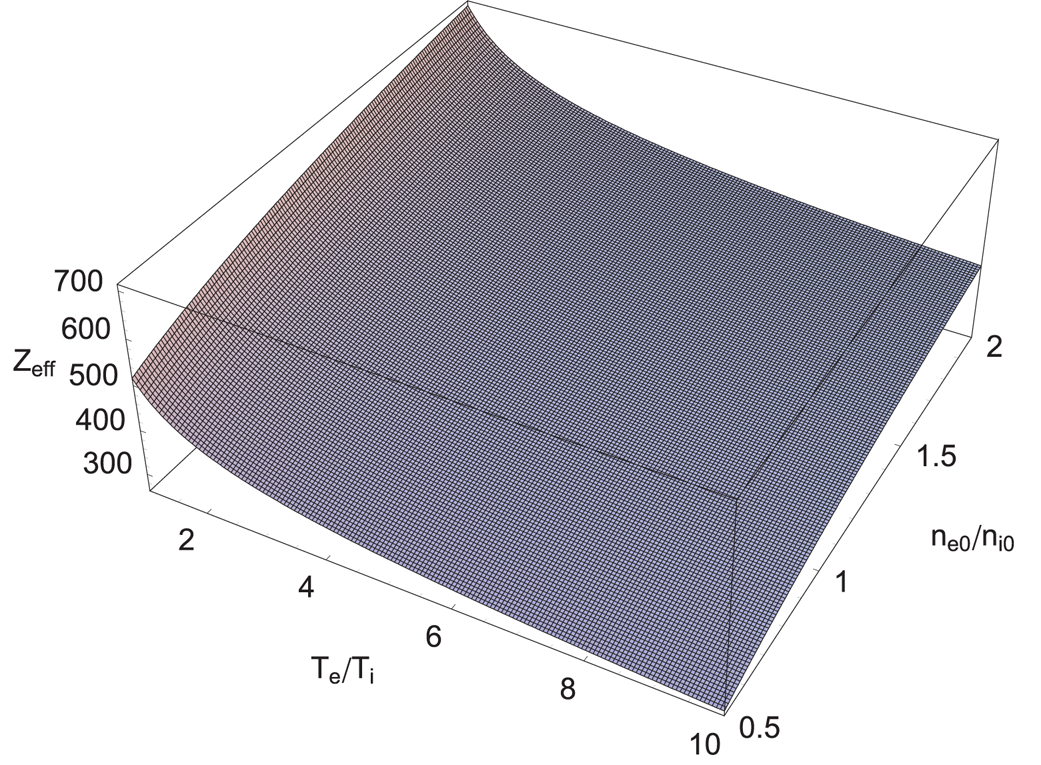
 to explore specifically the effects of ion temperature and density on the bremsstrahlung emission processes in complex plasmas. Figure 1 presents the surface plot of effective dust charge ${Z_{\textrm{eff}}}$
 with variations of ${T_e}/{T_i}$
 and ${n_{e0}}/{n_{i0}}$
 . It is shown that the effective dust charge ${Z_{\textrm{eff}}}$
 decreases as ${T_e}/{T_i}$
 increases, but increases as ${n_{e0}}/{n_{i0}}$
 increases. Therefore, the variable effective charge ${Z_{\textrm{eff}}}$
 (4.1) is very useful for investigating the appearances of the charge variation as well as the electron-dust bremsstrahlung process in complex plasmas, since the BRCS for the dust charged case is given as ${\bar{\chi }_{{Z_{\textrm{eff}}},\bar{\varepsilon }}} \propto Z_{\textrm{eff}}^2$
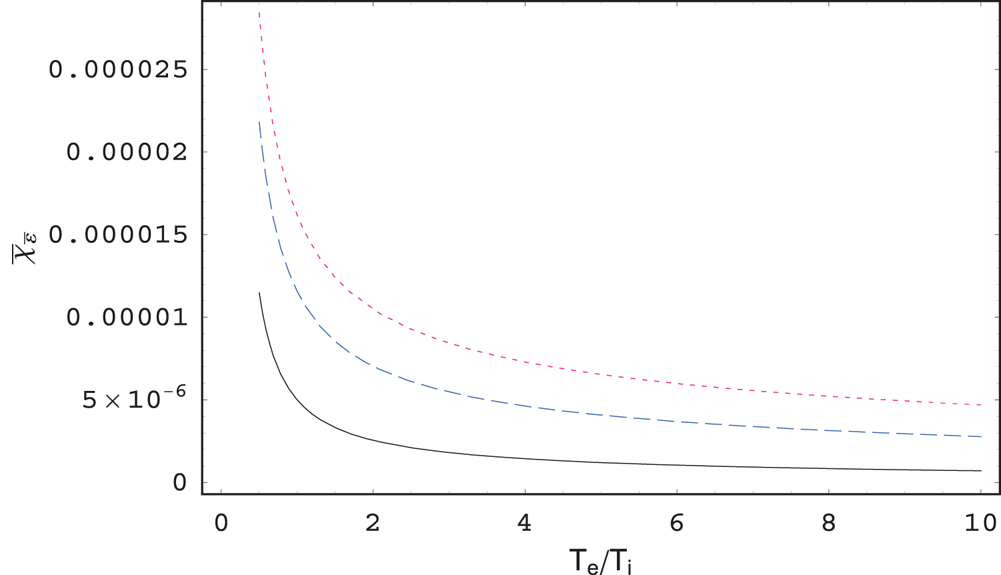
 . Figure 2 shows the change of e-D-BRCS ${\bar{\chi }_{\bar{\varepsilon }}}$
 with ${T_e}/{T_i}$
 for various values of ${n_{e0}}/{n_0}$
 . As shown, it is found that the cross-sectional area increases as the density ratio increases. Thus, we expect the bremsstrahlung emission power to be enhanced by the increase of electron density but suppressed by the increase of dust density since the charge neutrality condition is given by $Z{n_{d0}}/{n_0} = 1 - {n_{e0}}/{n_0}$
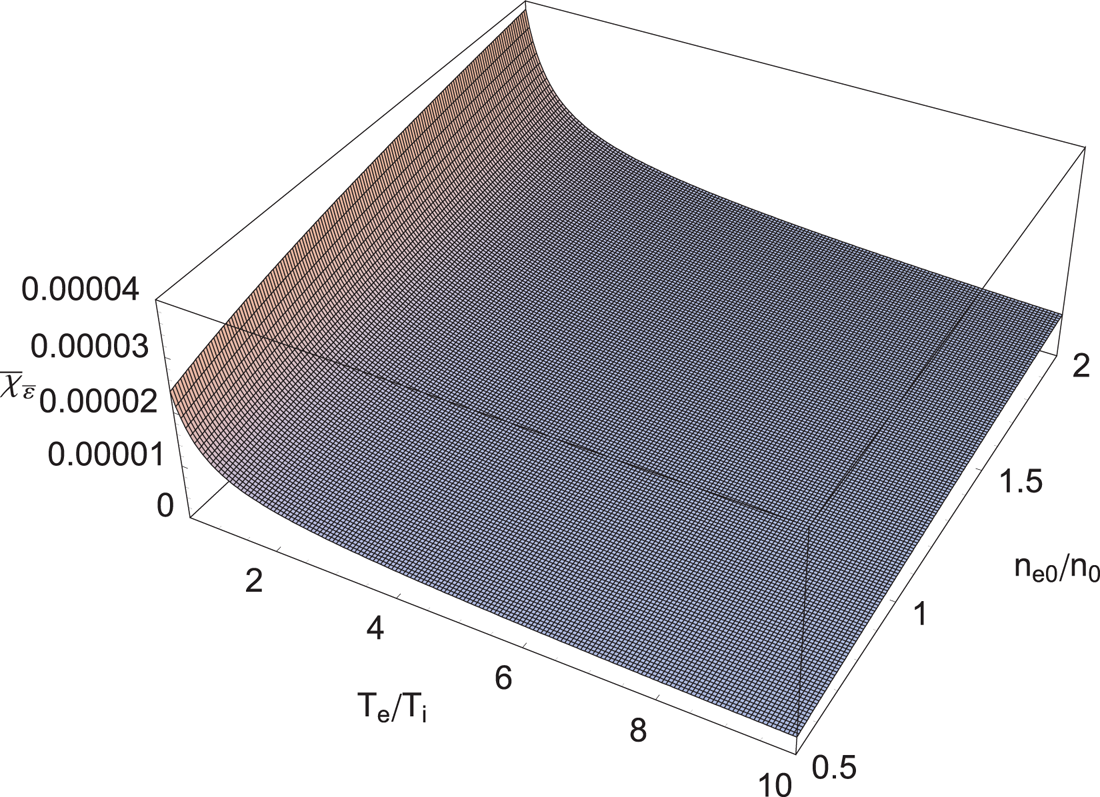
 . Figure 3 also shows a surface plot of the scaled e-D-BRCS ${\bar{\chi }_{\bar{\varepsilon }}}$
 with variations of ${T_e}/{T_i}$
 and ${n_{e0}}/{n_0}$
 . It can be seen from these figures that the density effect on the e-D-BRCS reduces as the temperature ratio increases. We therefore find that the density effect is more substantial in the lower electron temperature or higher ion temperature domains. Therefore, it can be expected that the bremsstrahlung emission power in one-temperature plasmas $({T_e}/{T_i} \approx 1)$
 , such as dust burning processes, is much stronger than in conventional complex plasmas $({T_e}/{T_i} \gg 1)$
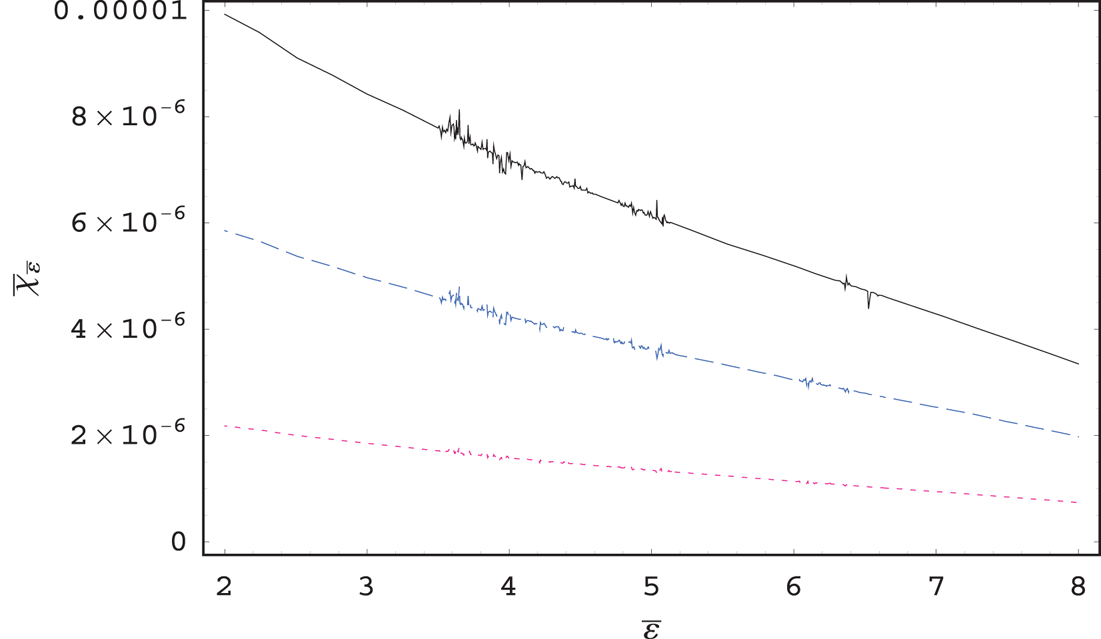
 due to the effect of ion temperature. Figure 4 depicts the electron-dust BRCS ${\bar{\chi }_{\bar{\varepsilon }}}$
 , scaled by $\mathrm{\pi }a_0^2$
 , with variation of the scaled bremsstrahlung emission energy $\bar{\varepsilon }$
 and the temperature ratio ${T_e}/{T_i}$
 . The effect of ion temperature on the e-D-BRCS ${\bar{\chi }_{\bar{\varepsilon }}}$
 is found to decrease with increasing bremsstrahlung emission energy. Also, the e-D-BRCS is significantly suppressed as the emission energy increases.
The surface plot of the effective dust charge ${Z_{\textrm{eff}}}$ with variables the temperature ratio ${T_e}/{T_i}$
 , and the density ratio ${n_{e0}}/{n_{i0}}$
 for ${k_B}{T_e} = 2.5\;\textrm{eV}$
 .

The scaled e-D-BRCS ${\bar{\chi }_{\bar{\varepsilon }}}$ with variables of the temperature ratio ${T_e}/{T_i}$
 for ${\bar{E}_0} = 10$
 and $\bar{\varepsilon } = 2$
 . The solid, dashed and dotted curves show the cases of ${n_{e0}}/{n_0} = 0.1$
 , ${n_{e0}}/{n_0} = 0.4$
 and ${n_{e0}}/{n_0} = 0.8$
 , respectively.

The surface scheme of the scaled e-D-BRCS ${\bar{\chi }_{\bar{\varepsilon }}}$ with variables of the temperature ratio ${T_e}/{T_i}$
 and the density ratio ${n_{e0}}/{n_0}$
 for ${\bar{E}_0} = 10$
 and $\bar{\varepsilon } = 2$
 .

The scaled e-D-BRCS ${\bar{\chi }_{\bar{\varepsilon }}}$ with variables of the scaled bremsstrahlung emission energy $\bar{\varepsilon }$
 for ${\bar{E}_0} = 10$
 and ${n_{e0}}/{n_0} = 0.3$
 . The solid, dashed and dotted curves show the cases of ${T_e}/{T_i} = 1$
 , ${T_e}/{T_i} = 2$
 and ${T_e}/{T_i} = 10$
 , respectively.

5. Conclusions
We studied the temperature effect on the spectrum of electron-dust particle bremsstrahlung radiation processes including variable dust charge in complex plasmas. We used the Born analysis to obtain e-D-BRCS in terms of bremsstrahlung radiation energy, collision energy, Debye length, dust charge, dust radius, ion temperature and plasma density. In this work, we found that the e-D-BRCS reduces with decreasing ion temperature or increasing electron temperature. We also found that the ion temperature influence is independent of the bremsstrahlung emission energy. Since the size of dust particle is much larger than the wavelength of photons of the UV and soft X-ray bremsstrahlung radiation, where the electron temperature is in the range of a few eVs in complex plasma, the bremsstrahlung radiation photons will be significantly absorbed. On the other hand, if the particle size is smaller than the wavelength of the bremsstrahlung emission, photon scattering will follow the Rayleigh scattering law. This absorption and scattering of the bremsstrahlung radiation then reduces the radiation intensity along the line of sight, causing dust particle extinction (Padmanabhan Reference Padmanabhan2001). We obtain the analytic expression of the variable dust charge ${Z_{\textrm{eff}}}\{ = (a{k_B}{T_e}/{e^2})[W[{({m_i}/{m_e})^{1/2}}({\lambda _{Di}}/{\lambda _{De}}){e^{{T_i}/{T_e}}}] - {T_i}/{T_e}]\}$ in terms of the Lambert W-function (Younsi & Tribeche Reference Younsi and Tribeche2008) in this work. Hence, we obtain the e-D-BRCS ${\bar{\chi }_{{Z_{\textrm{eff}}},\bar{\varepsilon }}}$
 with the analytic expression for the effective dust charge ${Z_{\textrm{eff}}}$
 in terms of the Debye length and the temperature ratio. We also found that the effective dust charge decreases with an increase of the temperature ratio ${T_e}/{T_i}$
 . Moreover, we have found that that the effective dust charge increases with an increase of the density ratio ${n_{e0}}/{n_{i0}}$
 . Additionally, we found that the e-D-BRCS increases as the electron-ion density ratio increases. We therefore found that both the temperature and the density of ions play an essential role in the electron-dust bremsstrahlung emission process. It is also interesting that the electron-dust particle bremsstrahlung emission process could be a candidate mechanism for terahertz radiation since they can produce coherent bremsstrahlung emission spectrum in the terahertz range when the flowing electrons encounter uniformly distributed charged dust particles. A detailed exploration of terahertz radiation from electron-dust particle bremsstrahlung radiation can be studied in future work. The results in this paper provide useful knowledge of the bremsstrahlung emission spectra of complex plasmas.
Acknowledgements
Editor Edward Thomas, Jr. thanks the referees for their advice in evaluating this article.
Funding
This research was carried out while two of the authors (M.-J.L. and Y.-D.J.) were visiting the National Institute for Fusion Science (NIFS) as visiting professors. One of the authors (Y.-D.J.) gratefully acknowledges Dr M. Rosenberg of UC San Diego for fruitful discussions on dynamic processes in complex plasmas. The work was supported by the National Research Foundation of Korea (NRF) grant funded by the Korean Government (NRF-2019R1A2C1003363).
Declaration of interest statement
Competing interests: The authors declare none.
Data availability
The data that support the findings of this study are available upon reasonable request from the authors.