In the fall of 1962, William F. Buckley Jr., intellectual dynamo of the new American right and founder of National Review magazine, was in the Portuguese colony of Mozambique. As Buckley would later relate, in the town of Laurenco Marques he had to cross a river “full of crocodiles and hippos” without the benefit of a bridge. Instead, “in a spirit of easy-going chaos,” four Africans pushed a small ferry across the river using “bamboo poles.” The entire operation consumed forty-five minutes. Buckley, while emphasizing his own ineptitude in manual labor, informed his readers that he could have readily reduced the voyage to half an hour using the same tools as the four black men. Still these men persisted, day after day, in pushing their little ferry across the river in the same chaotic manner. “They simply do not use their minds,” Buckley wrote, “and do not change their ways.” For Buckley, the moral of the river-crossing tale was clear: African backwardness justified European rule on the continent. Yet much of the “West,” enthralled by abstract notions of equality, had set itself on a “suicidal” course of decolonization. Portugal, with hard-headed good sense, did not give in to this idealistic egalitarianism. Instead, it dealt with Africans “as you would treat grown-up children,” Buckley noted with satisfaction.Footnote 1
That Buckley should have been in Africa at all may be surprising. While historians have increasingly framed the civil rights movement era in transnational and international terms, they have often viewed the new conservative movement in the United States as provincial.Footnote 2 Scholars routinely portray African Americans as transnational activists, and American elites as cosmopolitan figures attuned to global opinion.Footnote 3 Yet historians are significantly less likely to see white opponents of the civil rights movement in this broader context. Despite a burgeoning scholarship on the New Right, if white conservatives in the 1950s and 1960s had transnational identities and loyalties, we have heard very little about them.Footnote 4 Though some historians have emphasized the uses that segregationists made of anticommunism to discredit the civil rights movement, and important new work traces links between the segregationist right and global white supremacy, the transnational thinking of the leading mainstream intellectuals of postwar conservatism is still underexplored.Footnote 5 Even as many conservative intellectuals attempted to distinguish themselves from southern segregationists, they drew on a broader tradition that assumed the superiority of a transnational, white, Western civilization.Footnote 6 Leading conservatives such as Buckley located the sources of this supposed superiority not only in culture or political institutions, but also in racial capacities. As such, they came to believe that movements of black liberation threatened Western civilization in the postwar era.
This article argues that many conservative white intellectuals saw the civil rights movement in the United States and decolonization in Africa as constituent parts of a global threat to Western civilization. They embraced identities not only as anticommunist cold warriors or protectors of the American Constitution, but as defenders of a transnational, white, Western civilization endangered by black empowerment. A distinctive discourse developed around this identity, and conservative white intellectuals deployed it in the pages of National Review to resist the changes sweeping across their own nation and sub-Saharan Africa. In the transnational crucible of black liberation, conservative intellectuals resurrected a discourse of civilizational superiority and flirted with scientific racism, speculating that white supremacy was rooted in biology. In many cases, the transnational character of this discourse was embodied in the lives of National Review contributors, as Buckley used the magazine to provide an American platform for European conservatives to promote their defense of Western civilization.Footnote 7 Their overlooked rhetoric sheds new light on conservative responses to both the civil rights movement and African decolonization, and uncovers some of the surprising intellectual genealogies of contemporary white supremacist thought.
Popular narratives of twentieth-century white American racial ideology have often described a rapid eclipse of scientific racism under the dual assault of intellectual innovation and geopolitical events. Anthropologists such as Franz Boas provided more subtle ways to think about human difference, and the horrors of the Holocaust discredited race science. The civil rights movement then dealt a fatal blow to overtly white supremacist ideologies.Footnote 8 As real as these changes were, the pages of National Review reveal white intellectuals in the 1960s conflating race and civilization in terms that would have been familiar to popular early twentieth-century white supremacist thinkers such as Madison Grant and Lothrop Stoddard.Footnote 9 In the midst of a global struggle for black liberation, National Review not only defended existing hierarchies, but embraced the beating heart of white supremacist thinking: political behavior as a function of racial characteristics, and civilization as a fruit of whiteness. If scientific racism was no longer acceptable in the 1960s, the flagship journal of the conservative movement did not receive the memo.
In the standard narrative of Buckley's political thought, early embarrassing expressions of racial prejudice are superseded by a more mature and egalitarian Buckley in later years.Footnote 10 Scholars have made much of Buckley's excommunication of the John Birch Society from the conservative movement. In the typical account, Buckley is the responsible and respectable conservative standing up to the extremists. While capturing a real change in Buckley's tone, these stories fail to account for the central role racism played in Buckley's thought, and the troubling persistence of scientific racism in the pages of National Review. The resurgence of white supremacist ideology in the era of Donald Trump was not so surprising, for respectable intellectuals of the New Right had never fully discarded it.
In the civil rights era, National Review was the leading voice of the New Right, shaping a generation of conservative thought after its creation in 1955. At the center of the magazine's success was founder William F. Buckley Jr., a public intellectual extraordinaire. His syndicated column was carried by hundreds of newspapers across the country, making him one of the most widely read political commentators of the period.Footnote 11 He was erudite and witty, an indefatigable author, and host of his own long-running and Emmy-winning television show, The Firing Line. He was also something of a provocateur. He ran for mayor of New York City in 1965, garnering a respectable vote total in a quixotic campaign that helped broadcast his conservative message and turn him into a quasi-celebrity.Footnote 12 In terms of sheer influence, no other conservative journal of the time came close to Buckley's National Review, making it a particularly fruitful site for exploration of conservative thought.Footnote 13
This article traces the links between conservative conceptions of sub-Saharan Africa and the American civil rights movement between 1955 and 1968. The first section explores National Review’s early thought before the wave of rapid decolonization in 1960. Buckley asserted that whites in both Africa and the United States had the right to rule by virtue of their ostensibly more advanced civilizational development. At the same time, Buckley and his stable of writers attempted to distinguish themselves from the violent segregationist right, presenting National Review as a more respectable outlet of conservative intellectual thought. Even as such positioning appeared to imply a moderating of racial views, developments in Africa seemed to many National Review writers to vindicate the magazine's formative assumptions of white superiority. The second section examines the independence of Congo in 1960 as a turning point. As violence engulfed the country, National Review’s rhetoric became more strident and more insistent about a fundamental gulf between white, Western civilization and African savagery. The third section shows how National Review then began to host discussion of scientific racism and used events in Africa as a lens through which to read the civil rights movement in the United States, an object lesson in the dangers of black liberation. When violent uprisings spread across American cities in the later 1960s, National Review knew what they meant: it was the savagery of Africa brought to America's shores. These associations reveal that the intellectual thought of the new American conservatism had a transnational and racist character that has yet to be sufficiently examined.
ENTITLED TO POWER, 1955–1960
In its first five years of publication, National Review exhibited two conflicting tendencies. On the one hand, it carefully argued that whites in both the United States and Africa rightfully held power and ought to continue to do so for the foreseeable future. On the other hand, it criticized the segregationist hard right and urged whites on both continents to exercise their power in a responsible and paternalistic fashion. Two of Buckley's editorials during these years, one on the American South, the other on South Africa, illuminate these trends.Footnote 14 By attempting to distinguish itself from the racist right while crafting a more respectable language of white rule, National Review sought to carve out an intellectual space for the defense of American segregation and European colonialism.
William F. Buckley published the most infamous editorial of his career in 1957. In it, Buckley argued that white southerners had a right to rule, even at the cost of violence, because they were more advanced than African Americans. Despite the notoriety of the editorial among contemporary scholars, they have overlooked its transnational implications. “Why the South Must Prevail” compared white southerners’ position to that of the British in Kenya. For Buckley, as the British had been justified in putting down the Mau Mau rebellion, so white southerners were justified in taking antidemocratic measures if necessary to maintain their civilization.Footnote 15 Linking such disparate events together as part of the same phenomenon only made sense if one assumed that decolonization and the civil rights movement were component parts of a broader threat to Western civilization.
Buckley's editorial was a response to the Eisenhower administration's efforts to protect the voting rights of African Americans. In the spring of 1956, the administration proposed a new voting rights bill targeted at southern states. Title IV of the bill empowered the Attorney General to initiate civil lawsuits on behalf of victims facing schemes to deprive them of their right to vote. Defendants in such cases would not have the benefit of trial by jury. Southern senators cried foul. They successfully inserted a jury trial amendment into Title IV, as they watered down what became the Civil Rights Act of 1957 into a toothless measure.Footnote 16 National Review viewed the Eisenhower administration's legislation as a threat to white leadership in the South, and rallied to the defense of southern senators.
For Buckley, the important point was that jury trials enabled local white sentiment in the South to take precedence over official law. The guarantee of jury trials allowed local communities to “modify or wave the law” when necessary. Such flexibility was especially important in black-majority areas. If the law and voting rights in these areas were enforced according to strict constitutional principles, black rule would result. “The central question that emerges” in light of this fact, Buckley wrote,
is whether the White community in the South is entitled to take such measures as are necessary to prevail, politically and culturally, in areas in which it does not predominate numerically? The sobering answer is Yes – the White community is so entitled because, for the time being, it is the advanced race.Footnote 17
While hedging about the precise cause of racial superiority, Buckley left no doubt that racial identity was directly linked to fitness for self-government.
It is easy enough to read this as a typical example of parochially American racism. Yet Buckley placed the rule of white southerners in a much broader context. While “ever-so-busy egalitarians” prattled on about equality, the real question was “whether the claims of civilization supersede those of universal suffrage,” Buckley wrote. Crucially, he then looked outside the United States to drive home his point. “The British believe they do, and acted accordingly, in Kenya, where the choice was dramatically one between civilization and barbarism.” Buckley allowed that the battle between civilization and barbarism in the South was less “dramatic” than in Kenya, but nonetheless similar because of the “important qualitative differences” in the cultures of white and black southerners. “[C]ivilized standards” were more important than democracy. Indeed, sometimes the civilized minority had to be willing to pay “the terrible price of violence” to protect civilization from an “atavistic” majority.Footnote 18 As the British had done in Kenya, southern whites should be prepared to use violence in defense of their way of life.Footnote 19 This rhetoric only hinted at what would become a more overt feature of Buckley's thought in future years: the very real possibility of a “race war” to rescue Western civilization once and for all.
What makes Buckley's defense of white southerners so informative is that he found their justification beyond American law and the United States Constitution. He cast them not as particularly American subjects, but as racial and civilizational subjects whose status in those domains as such legitimated their rule. The extremism of Buckley's rhetoric about violence must not overshadow what his words accomplished. By drawing on the example of a European colonial power, he united the American South and decolonizing Africa together in a common project of civilizational defense.
Events in South Africa soon gave Buckley occasion to defend violence in fact rather than in theory. On 21 March 1960, thousands of black South Africans left their passes at home and gathered at a police station in Sharpeville in a defiant act of political protest. A part of the apartheid system, pass laws restricted black mobility and invited police harassment as black South Africans were required to have their identification papers with them at all times. Police opened fire indiscriminately on the crowd, killing dozens of men, women, and children. The shootings made headlines around the world and led to swift global condemnation, including criticism from the United States government. The mainstream American press portrayed the police action as unwise at best, and cast the embattled white South African government as an oppressive and anachronistic regime. Time magazine bluntly labeled the incident a “massacre.”Footnote 20
One month after the shooting, Buckley wrote an editorial defending white South Africans’ position. Buckley did not arrive at his defense without some moral qualms. “The Afrikaners are surely wrong in what they are doing,” Buckley wrote, “but what they are doing is understandable.” He urged readers to consider the assumptions white South Africans held. They had no intention of leaving the country. It belonged to them, as it had to their ancestors. But if they were to stay they were resolved to do so “on their own terms.” This meant the perpetuation of apartheid, for “they believe South Africa will become uninhabitable for white men the moment there is the least relinquishment of the color bar.”Footnote 21
Rather than challenging these assumptions, Buckley implicitly validated them. He admitted that “the use of machine guns to enforce the passbook regulations is a barbaric recourse,” but, after all, white South Africans “understood those machine guns to be firing in the defense of the homeland.” Such equivocal language appeared to withhold his full moral endorsement, but Buckley was really maneuvering toward justifying “the terrible price of violence” he had theorized about in 1957. Not unlike supposedly moderate defenders of lynching in the American South, Buckley framed the violence as a necessary evil. In the end, he bluntly declared his allegiances: “The whites are entitled, we believe, to pre-eminence in South Africa.”Footnote 22 Despite their “barbaric” action, despite being “surely wrong” in their policies, their right to rule remained unscathed. This was a curious prerogative indeed. What was the nature of this entitlement? In no place in the column did Buckley discuss the Cold War, communism, or other international events. These were unusual omissions for a magazine that frequently used anticommunist rhetoric. But in this case Buckley wished to make his point about the enduring links between race and civilization perfectly clear. He described and endorsed white South Africans’ entitlement as a function of their racial and civilizational stature, just as he had done for whites in the American South.
In both editorials, Buckley readily pointed out deficiencies in the behavior of the respective white populations. White southerners had to avoid the temptation to “exploit the fact of Negro backwardness” for their own ends, and white South Africans’ use of a “perpetual menial class” of poor blacks made them less deserving of “sympathy” than they would be otherwise.Footnote 23 This veneer of evenhandedness and deliberation made Buckley's voice unique. He was not blind to the failures, and indeed atrocities, of white rule. But he endorsed it nonetheless. From the American South to South Africa, whites had to do right by the black populations they ruled. This meant rejecting self-serving oppression and racism, but it also meant hardheaded realism about whites’ superior civilizational progress. In Buckley's thought, giving up white rule would be a grave setback for Western civilization.
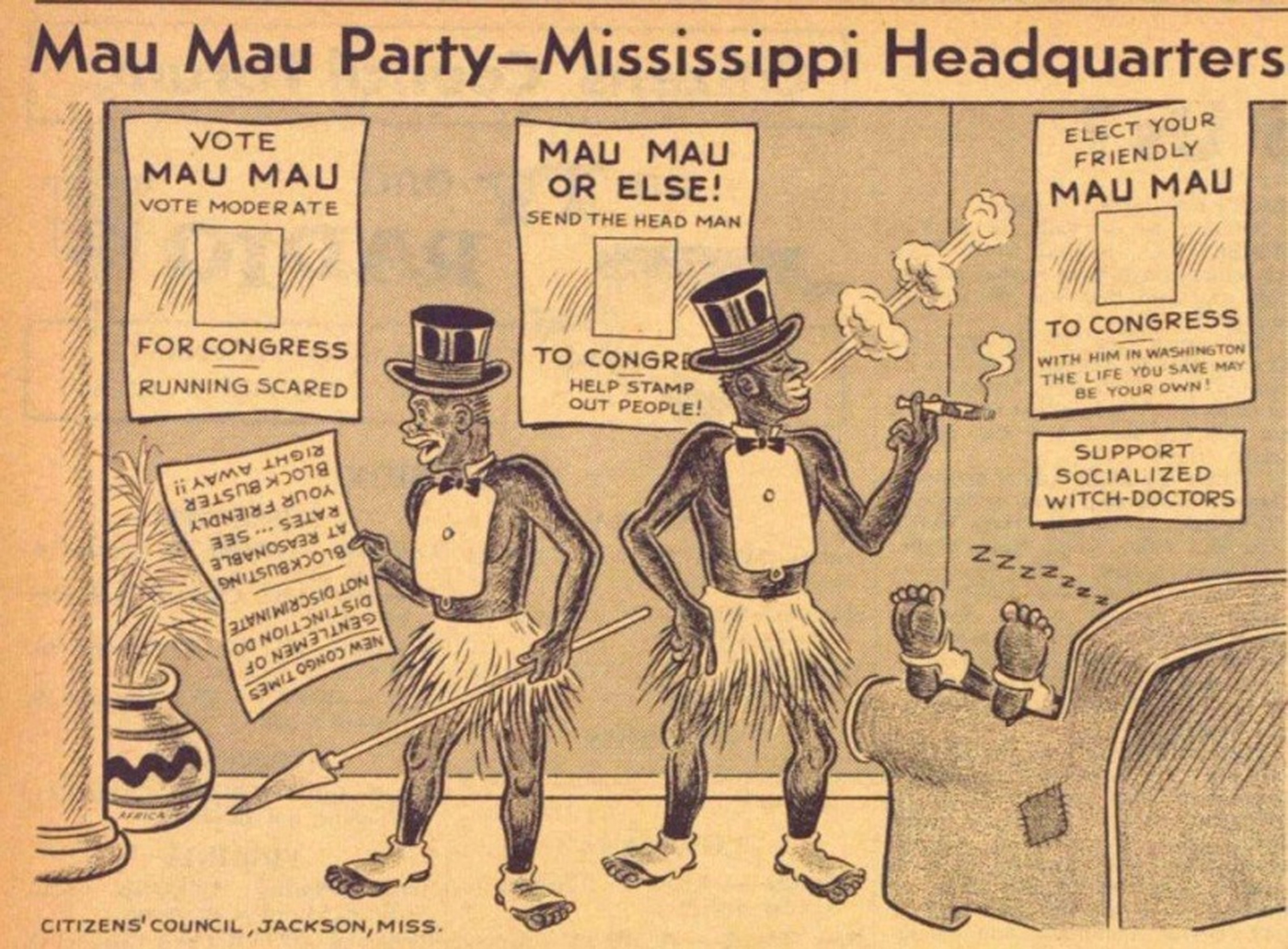
This open, if qualified, defense of segregation and apartheid set National Review apart from the mainstream press. Despite sensationalism and stereotypes in their coverage of the civil rights movement and decolonization, mainstream American news organizations tended to be broadly sympathetic toward both, provided they remained nonviolent. Where National Review saw a grand Western civilization, much of the mainstream press frequently portrayed both southern segregation and European colonialism as retrograde systems.Footnote 24 National Review’s occasional willingness to praise black activism and criticize white extremists also differentiated it from the southern segregationist right that embraced racism more openly and connected events in Africa and the United States in the most demagogic possible terms.Footnote 25 Yet an examination of segregationist literature reveals that the difference between it and National Review was often one of tone more than of substance. In December 1958, the segregationist Citizens’ Council newspaper published a political cartoon comparing political mobilization among black Mississippians to the Mau Mau rebellion in Kenya (see Figure 1). The image attempted to convey the patent absurdity of black empowerment; the figures in the cartoon were illiterate and ridiculous. They had some of the trappings of civilization (top hats and pieces of a tuxedo; one proudly smoked a cigar) but their supposedly natural savagery showed through – they wore grass skirts and one held a spear. Beneath the farce loomed more threatening possibilities: a poster on the wall read, “MAU MAU OR ELSE!” Was violence on the horizon? The lesson for Citizens’ Council readers was meant to be obvious: giving in to black demands in Mississippi invited chaos and civilizational retreat.Footnote 26
Citizens’ Council, December 1958, 4.

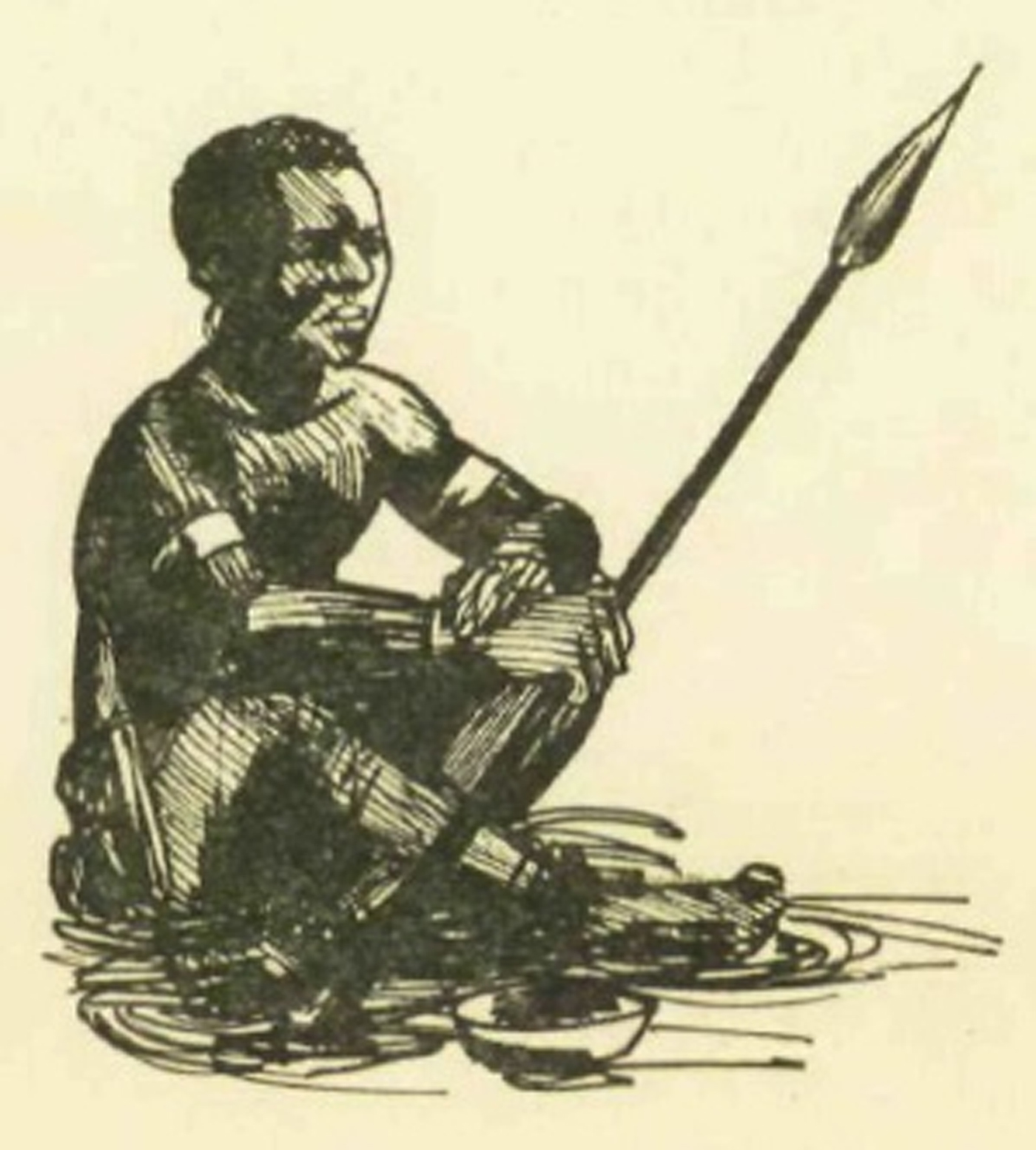
National Review would have never dreamed of publishing such crude and demagogic cartoons. Yet Buckley had already made the same comparison between Mau Mau and African Americans in slightly more polite terms. The linkage itself spoke volumes, however civilly it might be stated. Africa in National Review’s imagination can be characterized by a cartoon the magazine used repeatedly in the 1960s to accompany articles about events on the continent (see Figure 2). In the image, an African sat cross-legged on the ground. His facial expression was open to numerous interpretations. Some viewers may have even seen a certain nobility in the man's visage. Yet he appeared barely clothed, and held a spear in his hand. The image did not convey the blatant racism of the Citizen's Councils, but it portrayed Africans as stereotyped primitives still in need of white rule.
“It's All Quite Simple,” National Review, 1 July 1961, 417.

National Review embraced the logic of racial paternalism, portraying whites as civilizing tutors for African Americans. Such racial paternalism, far from being benign, was a common feature of white supremacist thought in the United States and around the world. Amid the school desegregation controversies of the 1950s, National Review contributor Richard Whalen wrote, “The Negro, too, is a Southerner, deeply conservative and suspicious of change. Generations of coexistence as an inferior … have bred caution and good-natured fatalism into the Negro.” Most southern blacks, Whalen wrote hopefully, would continue to accept the status quo put forth by white leadership.Footnote 27 The sense that blacks in the American South had come to share some of the cultural traits of their white neighbors would be revisited in the pages of National Review in future years. Amid sweeping racial changes across the globe, the magazine held out hope that Western civilization had rubbed off on black Americans more than black Africans due to a longer history of contact. It was one possible bright spot in what was, for Buckley and his cohort, an otherwise bleak picture of civilizational retreat across the globe.
During the 1950s, National Review defended white rule in Africa and the United States while attempting to differentiate itself from the worst excesses of the racist right wing. While taking the superiority of white civilizational achievement for granted, the magazine was not afraid to praise certain aspects of African American activism while criticizing violent white responses. It also left open to interpretation the cause of supposed African backwardness. At times, National Review even portrayed Africans positively. A 1958 article described black Africans as possessors of “entrepreneurial drive” that was hindered not by their innate abilities but by their leaders’ failure to implement conservative economic policies.Footnote 28 As late as February 1960, an article described black South Africans as “years behind the European” but affirmed that the cause was “environmental and not racial.”Footnote 29 Though far from robust expressions of confidence in human equality, such characterizations were broadly sympathetic. But these positive portrayals sat uneasily alongside Buckley's harsher language and would struggle to survive the turmoil of the 1960s.
THE CONGO CRISIS, 1960–1961
The year 1960 proved to be decisive for both the American civil rights movement and the course of decolonization in Africa. As sit-ins spread across the American South and a vast swath of colonies across Central and West Africa gained independence, National Review attempted to make sense of the changes sweeping across the world. The violence accompanying Congo's transition to independence profoundly affected National Review’s commentary. More hopeful visions of Africa's future under Western tutelage gave way to dark warnings of civilizational retreat and African primitivism. This rhetoric did not stay, as it were, in Congo, but rather became available for deployment elsewhere. It would shape National Review’s coverage of race, the civil rights movement, and African decolonization for the remainder of the decade.
Less than two weeks before the transfer of sovereignty, the Austrian conservative and longtime National Review contributor E. v. Kuehnelt-Leddihn declared that Congo's chances as an independent nation were “poor” despite Belgium's “enlightened” rule over the colony. Though the Belgians had done “excellent” and “selfless” work in Congo, he claimed, it remained “one of the most primitive regions in Africa.” He urged the West not to forget that “Central Africans are rarely capable of thinking in the abstract; reason has not yet replaced the effervescence of sentiment with all its unpredictable oscillations.” Not only that, despite all the sacrifices Belgium had made to transform the “jungle dweller to modern man,” the Congolese seemed ungrateful. Yet there was one bright spot. The army was a model of what paternalistic leadership could accomplish. The European officers “genuinely like their men and are loved by them in return,” Kuehnelt-Leddihn declared. In less than three weeks, these men would revolt against their supposedly beloved officers, showing how quickly the assumptions of racial paternalism could come crashing down.Footnote 30
Even by the standards of European colonialism in Africa, Belgium's rule over Congo had been extractive in the extreme. Belgium maintained enough effective control of the vast colony to remove its valuable natural resources, but had made little effort to build the institutional structures needed for an independent state. Moreover, King Leopold's atrocity-laden rule in the late nineteenth century had left ample cause for grievance on the part of Congolese people. While Congolese nationalists demanded rapid change after independence, Belgian administrators hoped the transition would be more symbolic than substantive. As Congolese troops mutinied against their white officers and the revolt spread, Belgium deployed troops to the country it had ostensibly just granted independence. On 11 July, the resource-rich Katanga region declared its secession, backed by the Belgian government and mining interests. In short order the United Nations, the Soviet Union, and the United States were drawn into the conflict. Just months after independence, Congo had become a Cold War crisis.Footnote 31
National Review was militantly anticommunist, and it remarked upon the Cold War implications of the Congo crisis regularly. The magazine excoriated American leaders for weakness in the face of communism and their failure to support Katanga's secession.Footnote 32 The United States’ rhetorical support for African decolonization brought National Review’s defense of Western civilization into conflict with America's stated Cold War policy. This was frustrating to Buckley and other contributors because they believed that hardheaded realism about the superiority of Western civilization would do more to win the Cold War than naive efforts to gain hearts and minds in decolonizing Africa. Yet a significant minority of National Review’s commentary had nothing to do with the Cold War. Instead, the magazine embraced what can fairly be called a civilizational panic as it described violence against whites in salacious detail. Communism as such was destructive, but what made it so dangerous in this instance was its ability to capitalize on the chaos sown by the reversion to “savagery” occurring in Congo. “We should not blame barbarians if they act like barbarians,” declared Frank S. Meyer. The fault lay with the West, which had renounced its “responsibilities for raising them to civilization.” The result would be “Soviet domination, Communist slavery.”Footnote 33
As violence broke out in the weeks after independence, William F. Buckley deplored Congo's “plunge into barbarism” and asked, “Will the jungle take over?” This question, working on both literal and metaphorical levels, expressed National Review’s fear that Congo was transforming from an outpost of Western civilization to a vacuum of barbarism that would enable a communist takeover.Footnote 34 Buckley argued that the American public was not receiving an accurate picture of these events. Western reporters were “too deeply saturated with our hypocritical egalitarian optimism to tell us the truth about the Congo.” What was this truth? The truth of the “savage ferocity” of black attacks on white civilians in Congo. Buckley quoted a Belgian report describing rapes of Belgian women and children in lurid detail. His use of these episodes reflected his belief that the violence in Congo was not fundamentally political, but racial and civilizational. And Belgians were not the only victims. “What the black savages are doing to each other in scores of villages and smaller cities is beyond the imagination of civilized men. Poison, hideous torture, obscene mutilation, cannibalism are routine,” Buckley declared.Footnote 35
Buckley's palpable outrage about the violence that did occur, as well as his wild and unsubstantiated claims of grotesque atrocities such as cannibalism, reflected his consistent bias toward white rule. When the apartheid government in South Africa gunned down protestors, Buckley had labeled the action “barbaric” but sadly necessary. For Buckley, white violence was in defense of civilization; black violence was primitive. The Congo crisis exposed these assumptions with particular force. While Buckley reacted with uninhibited outrage to the violence against whites, his magazine declared that Belgian colonialism, responsible for the deaths of millions of Congolese, was benign and enlightened.
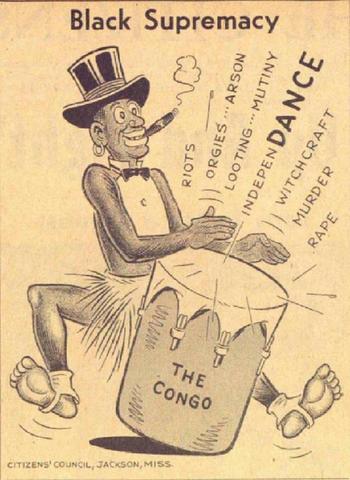
The Congo crisis also brought National Review closer to the less respectable confines of the segregationist right in the United States. A cartoon published in the Citizens’ Council newspaper in July 1960 offered a commentary on recent events in Congo (see Figure 3). Once again, the newspaper presented a ridiculous figure in a mixture of Western and stereotypically tribal dress as a warning of the fruit of “Black Supremacy.” Reflecting Congo's violent transition to independence, the figure banged a drum labeled “The Congo.” Emanating from the drum was every manner of disorder, including “orgies,” “riots,” “rape,” and “witchcraft.” Independence had been reformulated to “indepenDANCE,” in an unsuccessful bid for humor that played on stereotypes of African primitivism. National Review never published such crude images. But in the summer of 1960, the border between its rhetoric and that of hardline segregationists was thin indeed. A month after this cartoon appeared in the Citizens’ Council, Richard Whalen wrote an article for National Review that used the same phrase. “Western journalists and diplomats watched in dismay as Independ-DANCE called down a dark orgy of rape and pillage,” Whalen declared.Footnote 36 These associations with Citizens’ Councils demagoguery, only hinted at in the pages of National Review after the Congo crisis, were quite direct behind the scenes. In 1958, Buckley had personally reached out to the head of the Jackson, Mississippi Citizens’ Council to gain access to its 65,000-member mailing list.Footnote 37 The links were also ideological. One of the key intellectual leaders of the segregationist right was also a longtime National Review contributor. From his perch as editor of the Richmond News Leader, James Jackson Kilpatrick became a relentless “salesman for segregation,” with arguments built to appeal to a broader conservative audience beyond the South.Footnote 38 Buckley saw in Kilpatrick a figure whose intellectual sophistication could help him transcend the divide between segregationist and nonsegregationist conservatives. Though Kilpatrick's commentary in the pages of National Review was often more circumspect than in other venues, its very presence was a reminder that the magazine was – despite its claims of distinction – operating along a continuum of white supremacist thought.Footnote 39
Citizens’ Council, July 1960, 2.

As the rising wave of decolonization loomed in the spring of 1960, one of National Review’s key contributors, James Burnham, had tried to make sense of it all.Footnote 40 While liberals in the West bandied about words like “nationalism” and “democracy” to describe the course of Africa, Burnham argued that the movement toward decolonization was essentially “racist.” Burnham ridiculed the idea of nationalisms based on colonially imposed borders. Instead, the conflict was “an upsurge of black men against white men.” This was not a battle to claim the ideals that Western liberals kept blabbering on about. It was a blunt struggle for property and power. “The whites of Africa, like the African (and Harlem) blacks, know well enough the real nature of the African revolt. They cannot afford the Liberal–egalitarian illusions. Their careers, possessions, homes, and quite possibly their lives are at stake,” Burnham wrote. At times, the connections that National Review made between Africa and the United States came in just these cryptic forms. Two words in parentheses joined African Americans with black Africans as joint possessors of semi-secret knowledge. Presumably, African Americans possessed this knowledge because their struggle, too, was a crudely destructive grasp for power.Footnote 41
If it was not immediately obvious why black demands for power were illegitimate, readers had only to imbibe National Review’s assumptions about the African past. On multiple occasions, Burnham casually dismissed the idea that Africa had a meaningful past before European arrival, as when he said of Angola, “there was nothing, historically speaking: no nation, no civilization, nothing but scattered, warring, exceedingly primitive tribes.”Footnote 42 In a very real sense, for National Review African history only began when Europeans imposed their rule. Decolonization in this light was not liberation; it was merely absurd, representing the abject retreat of civilization. As Burnham wrote in another column in January 1961, “What we see, if we are willing to look, is ourselves – men of the West – fleeing headlong … our weapons spiked or abandoned, our homes looted, our property smashed or stolen, our women raped, our children brutalized.”Footnote 43 This frantic mixing of racial, sexual, and civilizational panic aptly demonstrated just how shattering the events of 1960 were from National Review’s perspective.
In the spring of 1961 the magazine published a “Letter from the Congo” by English journalist Anthony Lejeune to take stock of what independence had wrought. “A visit to post-independence Congo is the finest cure I know for Liberal ideas,” Lejeune wrote. “Millions of tribesmen … have slipped back in less than one terrible year to much the same condition of savagery in which Stanley found them.” Heaping praise on Belgium for its enlightened colonial rule, Lejeune wrote that its only mistake was to give in to the “Liberal clamor” and grant independence to people unready to exercise it. “All over Africa, Christian civilization is in retreat because nobody seems any longer to believe in it.” Lejeune wanted to impress upon his readers that they had something precious worth defending. “We should fall down on our knees and thank God for Wimbledon and Yonkers, for Wigan and Flatbush, for our world of clean water and honest policemen … Never forget how close the jungle is and the beasts that prowl there.”Footnote 44
Lejeune's commentary revealed how much the events of the previous year had hardened National Review’s tone. Whether it was genetic destiny or not hardly mattered; Lejeune's assertion that millions of Congolese had reverted to a condition of “savagery” because of the withdrawal of white sovereignty was crudely racist. More than that, his comparison of human beings to beasts lurking in the jungle conveyed a siege mentality that could readily be deployed elsewhere. William F. Buckley was prepared to do just that. He concluded that “the Congo has proved” that “black Africans … tend to revert to savagery.” The West needed to dispense with idle talk of “liberation” and instead stand up and defend itself, or “we will turn one after another additional area of Africa into Congos.”Footnote 45 And the problem was not merely the course of Africa. “The jungle” seemed to stalk Western civilization itself, its ravages closer at hand than many wanted to believe.
DEFENDING CIVILIZATION, 1960–1968
In the aftermath of Congolese independence, not only did commentators write in more unguarded terms than ever before about the supposed savagery of black Africans, but for the first time National Review began hosting explicit discussions of scientific racism and applied the implications to both Africa and the United States. Even as Buckley and his intellectual allies continued to cast themselves as antiracists, they began to openly discuss the possibility of a genetic inheritance shaping events in Africa and the American South. The new turn to scientific racism reflected National Review’s darkening tone as it responded to increasing racial tensions in the United States with frames of civilizational crisis informed by African events.
In the fall of 1960 National Review contributor Willmoore Kendall reviewed a recently published book, The Negro in American Civilization, by Nathaniel Weyl, the economist turned race science enthusiast. In a glowing review, Kendall declared that the book established once and for all that “we – not merely ‘we’ in America but ‘we’ in the West – do have a ‘Negro problem,’ the mishandling of which may be the instrument we shall use to destroy ourselves.” At its root, the “problem” was one of black inferiority, Kendall claimed. He had a litany of complaints. “Negroes … just plain do chalk up lesser scores on intelligence tests than whites. They just plain do learn less than whites … They just plain do commit fantastically more crimes … and more violent crimes.” Because these statistics appeared to result from “biological inheritance,” Kendall declared, they could be expected to repeat themselves “to the next and the next generation.” What was the solution to this dismal picture? “Could it be,” Kendall asked, that “we shall never do justice to the Negroes in our midst, nor the Negroes to themselves, save as we all recognize that, as a group, they may have a lesser capacity than the rest of us for civilizational achievement?”Footnote 46 Never had National Review put the question so bluntly. Here was scientific racism in explicit form. With its dark warnings about the “Negro problem” as an instrument of destruction to “the West,” the review perfectly captured the growing sense that the respective challenges to the racial order in Africa and the United States were constituent parts of a global threat to white, Western civilization.
A month later, National Review published an article by Weyl for the first time. He went on to write more than a dozen articles and reviews for the magazine through the 1960s and 1970s. At the same time, he was a key contributor to Mankind Quarterly, the journal of the International Association for the Advancement of Ethnology and Eugenics. The IAAEE was the key organizational locus for the small race science community of the 1960s, bringing leading scientific racists on both sides of the Atlantic together.Footnote 47 Some of them also came together to write in National Review. When the magazine wanted a favorable review of Weyl's next book on race and genetics, it welcomed A. James Gregor, secretary of the IAAEE, to do the honors.Footnote 48
Weyl was not the only longtime contributor to embrace the questions raised by scientific racists. In 1964 the sociologist Ernest Van Den Haag wrote an extensive article in National Review urging his fellow intellectuals to consider the possibility of the “genetic inferiority of Negroes.” Hedged and qualified throughout, Van Den Haag claimed he was not arguing for this proposition, but only pointing out that there was strong evidence in its favor that ought not to be dismissed. He urged his readers to “draw your own” conclusions.Footnote 49 With such mealy-mouthed phrasing National Review imagined it inoculated itself against the charge of racism. But Van Den Haag's admirers told the story. His work was appreciated by the likes of the Citizens’ Councils and the IAAEE. It is telling that this kind of commentary emerged in National Review, not in the immediate aftermath of Brown v. Board or at the height of Massive Resistance, but in the 1960s as growing black empowerment on two continents upset conservative intellectuals’ assumptions about the superiority of white, Western civilization.Footnote 50
When the historian I. A. Newby accused National Review of hosting scientific racism in its pages, the magazine indignantly replied in defense of authors such as Nathaniel Weyl. As National Review contributor Arnold W. Green put it, Weyl had merely argued that blacks on average were “less gifted mentally” than whites and “that this disparity is partly of genetic origin.”Footnote 51 National Review believed it was grossly unfair to label such views racist. Unfair or not, the magazine's commentary did not go unnoticed by leading scientific racists. Robert Gayre, editor of Mankind Quarterly, identified Buckley's views as “very close to our position.”Footnote 52
National Review’s discussion of genetic inferiority was underwritten by its bleak view of black radicalism in the mid- to late 1960s. As civil rights activists turned toward increasingly militant tactics and violence flared on the nation's streets, National Review applied its rhetoric of civilizational defense to the American scene. In the spring of 1964 Buckley labeled the civil rights movement “Black Madness,” an American echo of Burnham's earlier assumption that African liberation was absurd.Footnote 53 He wrote that the civil rights movement was “ludicrously named.” It was rather “the Negro revolt, which springs in part from the universal conditions of our epoch.”Footnote 54 For Buckley, the civil rights movement was not a characteristically American phenomenon. It was rather one of a series of black revolts occurring across the globe. Ironically, his insistence on a global framing for these events brought his thought close to that of many African American activists. From W. E. B. Du Bois's identification of a global color line and Marcus Garvey's Universal Negro Improvement Association, to Martin Luther King's late-career struggle for human rights and Black Panthers’ efforts to ally with liberation movements around the world, black activists consistently identified white supremacy as a global problem. Buckley embraced its global nature, but where African Americans saw global oppression, Buckley saw a transnational civilization worth defending at any cost.
Buckley applied this logic to the growing racial tensions in American cities. In a column titled “Maccabees and the Mau Mau,” he warned that tensions between Jewish and African American residents of New York were reaching a breaking point in the summer of 1964. “What is happening, or is about to happen – let us face it – is race war.”Footnote 55 A month later, when a police officer shot a black teenager and riots broke out in Harlem, Buckley had no patience for those who accused the police of brutality. He reminded his readers what was at stake. “The line between civilization and chaos is at all times, but above all in a revolutionary age such as ours is, narrow and precarious,” Buckley warned. Just below the veneer of civilization lurked “wild, dark passions” that could suddenly explode in “mob frenzy and violence in our streets.” Americans had to recognize that at times the border between civilization and chaos narrowed to a “Thin Blue Line.” Then “the last defense must rest in the rude but disciplined hands of men with nightsticks and guns.”Footnote 56 For Buckley, police brutality was a phrase not to be written without ironic quotes around it. As in his defense of southern whites’ prerogative to resort to violence in 1957, as in his justification of the Sharpeville massacre in 1960, Buckley in the late 1960s would defend (the overwhelmingly white) American police forces as protectors of Western civilization against the threat of black liberation.
As large urban uprisings intensified in the second half of the decade, National Review viewed them through the lens of African decolonization. In August of 1965, beginning less than a week after President Johnson signed the Voting Rights Act into law, six days of rioting and violence in the Watts neighborhood of Los Angeles left dozens dead. Will Herberg, author of the influential book Protestant, Catholic, Jew, described “thousands of Negroes running wild, burning, destroying, looting.” What had gone wrong? “After all, Los Angeles is not the Congo – or is it?” Herberg's insinuating question was more than just a rhetorical device. Congo, written about obsessively by National Review, was precedent and subtext for understanding racial conflict in the United States. The foundation of any society, Herberg declared, was “internal order.” But even in the best of times the bonds of order were only “a thin surface layer of civilization holding down a veritable hell of aggression, anarchy and chaos.” With those bonds sundered, “hell breaks loose – whether it is in the Congo or in Los Angeles, whether it is Negroes or whites who do the devil's work.”Footnote 57
Herberg's sop to the colorblind possibilities of chaos appeared to illustrate countervailing trends toward moderation in National Review. Yet there was no shortage of white violence in these years that the magazine might have taken umbrage at. From the torching of Freedom Rider buses to rioting in Oxford, Mississippi and the bombing of 16th Street Baptist Church in Birmingham, National Review observed many incidents of white violence and either declined to comment on them or deemed them unfortunate. But in no case did Buckley and other writers find Congo a fitting note of comparison, and in no case did they describe the incidents as evidence of a disintegrating social order.Footnote 58 Black violence, in particular, provoked a rhetoric of civilizational collapse rooted in a transnational understanding of rapidly changing racial and colonial relationships.
By the fall of 1966 National Review contributor Frank S. Meyer described African American activists with the blunt rhetoric previously applied to Africa. For Meyer, the cause of disorder on American streets was not “poverty” but “barbarism.” He granted that “solid Negroes” wanted “law and order” as much as anybody, but “criminal elements” bent on “pillage” had produced “a climate of terror on a scale never before seen in American society.” At the same time, Meyer excoriated the “egalitarian myth” that refused to consider that some groups might have lower average intelligence.Footnote 59 Meyer's claims, unhinged from the reality of the nation's long history of white terrorism, only made sense on white supremacist terms. For National Review, black violence was racial, primitive, and senseless, while white violence was historically conditioned and purposeful. By the summer of 1967, Buckley wrote that Americans faced “a long siege with no end in sight.”Footnote 60 Despite the long tradition of lawless white supremacist violence in the United States, only an upsurge in black violence provoked Buckley into a rhetorical posture that cast Western civilization as besieged.
Buckley's dark speculations came through clearly in a public debate between him and African American essayist James Baldwin in Cambridge, England, in 1965. Debating the proposition “The American Dream is at the Expense of the Negro,” the two men sparred over the meaning of American history and the contemporary movement for black liberation. Baldwin pleaded for whites to make room for African Americans in their “system of reality.” The American Dream did not need to be at the expense of the “Negro” if white Americans would only recognize their shared history and humanity with their black neighbors. If, on the other hand, exclusion and oppression persisted, frustrated young African Americans would revolt. “And if that happens,” Baldwin concluded, “it is a very grave moment for the West.”Footnote 61 Buckley's response combined many of the thoughts he had expressed in the pages of his magazine in its first decade of publication. He floated the idea that blacks might have innately inferior capacity for achievement. And he assumed a gulf between black demands and the principles of Western civilization. Then, in a bizarre and chilling conclusion, Buckley warned that if made to choose between the American Dream and black demands, white Americans would embark on a race war to defend their civilization. And they would do so, he told his British audience, with confidence in the rightness of their cause, just as the British had done in their fight against the Nazis a generation before.Footnote 62
This overlooked moment revealed William F. Buckley's views with more clarity than perhaps even he intended. His meandering response, personal attacks, and vague intimations of black inferiority communicated contempt for Baldwin. That it would even occur to him to compare the British experience of World War II with white Americans’ experience of the civil rights movement spoke volumes about his mindset. By concluding with an unhinged comparison that placed African Americans in a position analogous to the Nazis, Buckley revealed his clash-of-civilizations mindset in its most unvarnished form. It was fitting that Buckley would make these overwrought charges on a global stage, for he had never been simply defending the American Constitution or a parochial vision of national exceptionalism. He acted as the guardian of a transnational, white, West.
CONCLUSION
A transnational context of black liberation shaped the development of the New Right in the United States. In the 1950s and 1960s, events such as the Congo crisis molded the character of conservative thought and made white conservative intellectuals more hostile to the civil rights movement. It was not inevitable that many conservatives would come to see the civil rights movement as a destructive force threatening Western civilization. But international events placed what might have been seen as a quintessentially American quest for liberty in a more sinister context. In a moment of colonial upheaval, Buckley and other National Review writers framed African Americans not primarily as American subjects but as racial subjects whose actions aligned with broader currents of revolutionary black liberation. As such, whiteness, the West, and notions of what constituted traditional American ideals became symbiotic components inextricably forged together in the fires of transnational turmoil.
As for William F. Buckley, far from being held back by his public defense of transnational white supremacy, he went from strength to strength. National Review continued to increase its circulation and in 1967 Time magazine featured Buckley on its cover. He won an Emmy for his television show, and in 1991 President George H. W. Bush awarded him the Presidential Medal of Freedom.Footnote 63 Meanwhile, his magazine continued to dabble in racism. When Scribner's published the English-language edition of The Camp of the Saints in 1975, National Review featured a glowing review of the book. Jean Raspail's apocalyptic story of a refugee invasion from the global South into the white Western world was gleefully dehumanizing, comparing people of color to animals and insects. But this did not bother the reviewer, Dartmouth's Jeffrey Hart. “Raspail is to genocide what Lawrence was to sex,” he declared. “Raspail brings his reader to the surprising conclusion that killing a million or so starving refugees from India would be a supreme act of individual sanity and cultural health.” The resort to genocide was not really racist, Hart concluded; it was merely a healthy “Western self-preference” that was necessary for the survival of its civilization.Footnote 64 In the pages of National Review, even genocide could not remove the presumption of civilization from the white West.
While the change in American conservatism from overt racist reaction to more subtle colorblind racism in the 1970s and beyond was real enough, scholars have overstated the magnitude of the change, and underestimated the degree to which conservative thought continued to conflate race and civilization, color and capacity.Footnote 65 In ways not so different from the mainstream of early twentieth-century thought, many white conservatives continued to imply that racial identity and fitness for self-government were somehow connected to one another. Into the twenty-first century, National Review repeatedly faced embarrassing separations from prominent contributors who went on to openly embrace the racist right.Footnote 66 These flirtations with racist thought provided fertile ground for white supremacist ideals to continue to ferment, even in the pages of the flagship magazine of American conservatism. During the 2016 election campaign, National Review rebuked the rebranded white supremacist movement known as the “alt-right” but exhibited little awareness of its own role in nurturing it. Now, in a new era of global crisis and populist resurgence in the United States and Europe, the ideal of a transnational, white, Western civilization worth defending at all costs may be ascendant once again.