Patent foramen ovale and atrial septal defect are forms of congenital cardiac malformation providing abnormal pathways for harmful haemodynamics between two atria. Atrial septal defect is one of the most common types of congenital heart disease,Reference Hoffman and Kaplan 1 and patent foramen ovale can be identified in up to 40% of the population by echocardiography. Some of them survive all their life without any treatment. However, some has experienced times of strokes or transient ischaemic attacks that are related to damaged heart atrial function.Reference Lechat, Mas and Lascault 2 – Reference Wahl, Krumsdorf and Meier 4 Therefore, occlusion may not be necessary for all patients with patent foramen ovale or atrial septal defect, as some may suffer from its complications, including peripheral embolism, thrombosis, and arterial hypertension.Reference Cottens, Van De Bruaene, Troost, Willems, Moons and Budts 5 , Reference Moake and Ndinjiakat 6 Moreover, if the patients are troubled with coronary artery disease, arrhythmia, or diabetes, the patent foramen ovale or atrial septal defect may lead to a higher incidence of major cardiovascular complications. Patients are only considered to receive an intervention in cases of cryptogenic stroke or thrombotic attacks. For patients who need interventions, percutaneous closure is an alternative to traditional surgical approach. A meta-analysis made by Tang et alReference Tang, Zeng, Li, Cao and Huang 7 indicated that patients who received transcatheter occlusion for atrial septal defect had comparably better outcomes. Thus, the benefits of percutaneous closure for congenital heart disease have been recognised, and doctors have started to make efforts to provide a better prognosis for such children.
Amplatzer (AGA Medical, Golden Valley, Minnesota, United States of America), CardioSEAL/STARFlex (NMT Medical, Boston, Massachusetts, United States of America), Bio-star (NMT Medical), Helex (Gore and Associates, Flagstaff, Arizona, United States of America), Premere (St. Jude Medical, St Paul, Minnesota, United States of America), and some others have all been used in percutaneous closure in the past several years.Reference Berger, Ewert and Bjornstad 8 – Reference Zahn, Wilson, Cutright and Latson 14 Among them, the Amplatzer and CardioSEAL/STARFlex have similar indications for patent foramen ovale or atrial septal defect treatment separately. However, no general agreement has been reached with regard to the superiority among the two types of occluders. Thus, on the basis of meta-analysis, a performance test was conducted between the two most commonly adopted types of occluders.
Therefore, the objective of this meta-analysis is to compare the safety, efficacy, and incidence of recurrent thrombotic events between patients with patent foramen ovale or atrial septal defect receiving transcatheter occlusion using the Amplatzer device and the CardioSEAL/STARFlex device.
Methods
Search strategy
We searched PubMed, EMBASE, the Cochrane Central Register of Controlled Trials, and World Health Organization clinical trials registry centre using a highly sensitive and highly specific search strategy. The search keywords included “patent foramen ovale”, “persistent foramen ovale”, “PFO”, “atrial septal defect”, “ASD”, “amplatzer”, “CardioSEAL”, and “STARFlex”. The search was updated in May, 2011. The language restriction was used only for English published papers.
Study selection
Citations initially selected by systematic search were first retrieved as title and/or abstract and preliminarily screened. Potentially relevant reports were then retrieved as complete manuscripts and assessed for compliance with inclusion and exclusion criteria.
The inclusion criteria were as follows: patients identified as having atrial septal defect or patent foramen ovale by transthoracic echocardiography or transesophageal echocardiography or angiography; a controlled study; the comparison study contained the Amplatzer group and the STARFlex group, or the Amplatzer group and the CardioSEAL group, or both, and the study might have had other device groups, but these group data would not be included into this meta-analysis; contained at least one of the outcomes of recurrent thrombotic events, as well as efficacy and safety evaluation; the patient population enrolled suffered at least one cryptogenic stroke or a thrombotic event.
The exclusion criteria were as follows: total sample size smaller than 15; comparison not focused on recurrent thrombotic events, as well as on the efficacy and safety of the devices; the same cohort being studied in other study; the use of non-standard types of devices; studies with a mix of patent foramen ovale and atrial septal defect cases.
Data collection and quality assessment
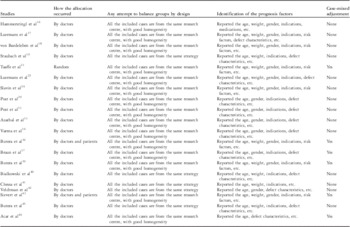
The eligibility of the reports at the title and/or at the abstract level was independently assessed by two investigators (Yifei Li, Chuan Wang), with a third reviewer (Kaiyu Zhou) determining the divergences together; studies that met the inclusion criteria were selected for further analysis. The quality assessment was completed by the two investigators independently according to the quality assessment guidelines of non-randomised controlled interventions study by Deeks et al.Reference Deeks, Dinnes and D'Amico 15 The main contents were as follows: method of group assignment – assignment made by the doctors carrying out the studies with the patients’ consent, combining the two methods; each group was balanced at baseline according to the design of the studies – subgroups had been made by age, weight, types of atrial septal defects, and the diameter of the patent foramen ovale and atrial septal defect; description of the factors that could influence the prognosis – information of the patient, including the gender, age, weight, patent foramen ovale and atrial septal defect, as well as the indications for transcatheter treatment; reducing the bias of studies, including stratified sampling and subgroup analysis.
Evaluation indicators for efficacy, safety, and recurrent thrombotic event
The efficacy was measured by the residual shunt rate of patent foramen ovale and atrial septal defect at early term (observational time after intervention <1 month), middle term (observational time after intervention <6 months and >1 month), and long term (observational time after intervention >6 months). The safety was measured by the indicators for device embolisation and new-set atrial fibrillation. What was most important in evaluating for patent foramen ovale and atrial septal defect treatment was the rate of recurrent thrombotic events, including the rate of the thrombus formation on the device, the recurrent rate of stroke, and the recurrent rate of transient ischaemic attacks. We used these indicators to evaluate the two kinds of devices, and provided creditable evidence for choice.
Statistical analysis
The results of the selected studies were analysed using the statistical free software Revman 5.1.1 published by the Cochrane library. The Q test was conducted on the research effect size to evaluate heterogeneity. If the research effect size was not heterogeneous (I2 < 50%), count data were analysed using a fixed effects model (Peto's method). If the research effect size was heterogeneous (I2 ≥ 50%), the random effect model was used. A p-value < 0.05 indicated a statistically significant difference. Combined odds ratio and 95% confidence interval were recorded. Measurement data were analysed using the weighted mean difference and 95% confidence interval. The funnel plot was used to evaluate the publication bias. When the figure was symmetric, the data were no bias of publication. However if the figure was asymmetric, the bias of publication existed. The sensitivity analysis was made by larger sample size studies’ subgroup analysis – studies with both device groups’ sample size >15.
Results
Study evaluation
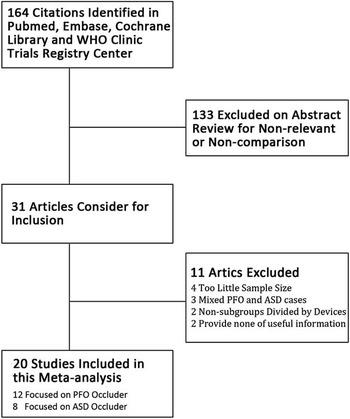
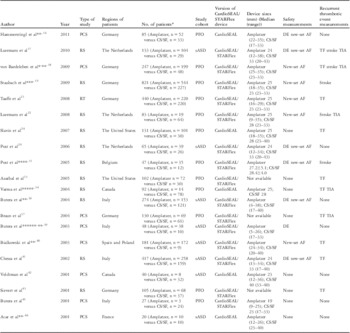
A total of 164 citations were retrieved by the aforementioned method. After reading the titles and abstracts, 133 citations were excluded according to the selection criteria, and only 31 studies were identified initially.Reference Hammerstingl, Bauriedel and Stusser 16 – Reference Acar, Saliba, Bonhoeffer, Sidi and Kachaner 46 Among them, 11 studies were excluded after reading the entire articles,Reference Becker, Frings and Schröder 20 , Reference Hildick-Smith, Behan, Haworth, Rana and Thomas 23 , Reference Mareedu, Shah, Mesa and McCauley 25 – Reference Aslam, Iliadis and Blankenship 28 , Reference Alaeddini, Feghali, Jenkins, Ramee, White and Abi-Samra 30 , Reference Ilkhanoff, Naidu, Rohatgi, Ross, Silvestry and Herrmann 32 , Reference Krumsdorf, Ostermayer and Billinger 35 , Reference Anzai, Child and Natterson 38 , Reference Krumsdorf, Keppeler, Horvath, Zadan, Schrader and Sievert 44 including three articles with both patent foramen ovale and atrial septal defect cases.Reference Becker, Frings and Schröder 20 , Reference Krumsdorf, Ostermayer and Billinger 35 , Reference Anzai, Child and Natterson 38 Finally, 20 controlled studies for patent foramen ovale and atrial septal defect were enrolled into the meta-analysis (Fig 1).Reference Hammerstingl, Bauriedel and Stusser 16 – Reference Staubach, Steinberg and Zimmermann 19 , Reference Taaffe, Fischer and Baranowski 21 , Reference Luermans, Post, Plokker, Ten Berg and Suttorp 22 , Reference Slavin, Tobis, Rangarajan, Dao, Krivokapich and Liebeskind 24 , Reference Post, Suttorp, Jaarsma and Plokker 29 , Reference Post, Van Deyk and Budts 31 , Reference Azarbal, Tobis, Suh, Chan, Dao and Gaster 33 , Reference Varma, Benson and Warr 34 , Reference Butera, Carminati and Chessa 36 , Reference Braun, Gliech and Boscheri 37 , Reference Butera, De Rosa and Chessa 39 – Reference Sievert, Horvath and Zadan 43 , Reference Butera, Bini, Chessa, Bedogni, Onofri and Carminati 45 , Reference Acar, Saliba, Bonhoeffer, Sidi and Kachaner 46 Among these 20 articles, 12 studies were focused on patent foramen ovaleReference Hammerstingl, Bauriedel and Stusser 16 , Reference von Bardeleben, Richter and Otto 18 , Reference Staubach, Steinberg and Zimmermann 19 , Reference Taaffe, Fischer and Baranowski 21 , Reference Luermans, Post, Plokker, Ten Berg and Suttorp 22 , Reference Slavin, Tobis, Rangarajan, Dao, Krivokapich and Liebeskind 24 , Reference Post, Van Deyk and Budts 31 , Reference Azarbal, Tobis, Suh, Chan, Dao and Gaster 33 , Reference Varma, Benson and Warr 34 , Reference Braun, Gliech and Boscheri 37 , Reference Sievert, Horvath and Zadan 43 , Reference Butera, Bini, Chessa, Bedogni, Onofri and Carminati 45 and eight on atrial septal defect.Reference Luermans, Post, ten Berg, Plokker and Suttorp 17 , Reference Post, Suttorp, Jaarsma and Plokker 29 , Reference Butera, Carminati and Chessa 36 , Reference Butera, De Rosa and Chessa 39 – Reference Veldtman, Razack and Siu 42 , Reference Acar, Saliba, Bonhoeffer, Sidi and Kachaner 46 A total of 3462 atrial septal defect patients were included, consisting of 2152 patients in the Amplatzer group – 1474 with patent foramen ovale and 678 with atrial septal defect – and 1310 patients in the CardioSEAL/STARFlex group – 810 with patent foramen ovale and 500 with atrial septal defect. There was only one randomised controlled study. The quality of all the articles was acceptable, with the factors that might influence the prognosis and the method of allocation described in detail. Table 1 shows the basic characteristics of the included studies and Table 2 shows the quality evaluation of these studies; all the studies met the inclusion criteria.
Flow diagram of study selection process. ASD = atrial septal defect; PFO = patent foramen ovale; WHO = World Health Organization.

Main characteristics of the included studies.

AF = atrial fibrillation; ASD = atrial septal defect; CS/SF = CardioSEAL/STARFlex; DE = device embolisation; PCS = prospective cohort study; PFO = patent foramen ovale; RS = retrospective study; RT = randomised trial; sASD = secundum atrial septal defect; TF = thrombus formation on the device; TIA = transient ischaemic attacks
*Focused on the influences of atrial septum aneurysm
**The median data of device size were not available
***Only comparison of new-set AF between devices had been made
****Only the form of data as mean ± standard deviation for the used devices were provided
*****Only 25 millimetre Amplatzer devices and 28 millimetre CardioSEAL/STARFlex devices were used for occlusion
******The article only included young children <5 years
Main quality evaluation of the included studies.

The quality of all the articles were passable
Publication bias
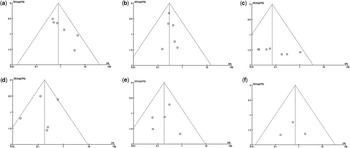
Funnel plots were used to evaluate the publication bias of the included studies. Each dot represents a study, and the distance between each dot and the vertical line suggests the bias in each study. The absence of any asymmetric distribution suggested no publication bias. However, asymmetric distribution existed, which indicated that publication bias existed. Funnel plots were used to identify the efficacy, safety, and recurrent thrombotic events in patients with patent foramen ovale and atrial septal defect separately. The results showed that there was no publication bias in these evaluated studies, with a symmetric triangle figure (Fig 2a–c for patent foramen ovale and d–f for atrial septal defect).
Funnel plot of the included trials: ( a ) for residual shunt evaluation of patent foramen ovale, ( b ) for safety evaluation of patent foramen ovale, ( c ) for recurrent thrombotic event evaluation of patent foramen ovale, ( d ) for residual shunt evaluation of atrial septal defect, ( e ) for safety evaluation of the atrial septal defect, and ( f ) for recurrent thrombotic event evaluation of the atrial septal defect. X-axis represents the effect estimate for each study under the outcome. Y-axis represents standard error (log (effect estimate)). Each dot represents a study, and the distance between each dot and the vertical line suggests bias in each study. The absence of any asymmetric distribution suggested no publication bias. SE = standard error; OR = odds ratio.

Efficacy evaluation
Early-term residual shunt rate
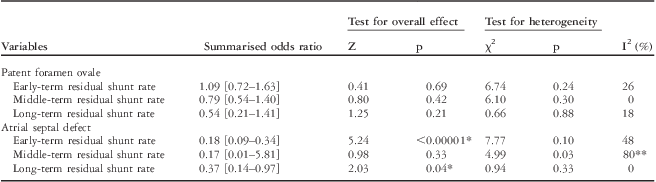
Early-term residual shunt rate was calculated within a month after the intervention procedure, and the ones with a moderate to large residual shunt need an extra treatment or observation. For patent foramen ovale occluder evaluation, among the 1011 patients in six studies, 127 (12.56%) had residual shunts, consisting of 79 in the Amplatzer group (12.95%) and 48 in the CardioSEAL/STARFlex group (11.97%). There was no significant difference in the early-term residual shunt rate between the Amplatzer group and the CardioSEAL/STARFlex group for patent foramen ovale (odds ratio = 1.09, 95% confidence interval = 0.72–1.63, p = 0.69). There was no heterogeneity across studies (I2 = 26%), which was analysed by the fixed effects model. For atrial septal defect occluder evaluation, among the 457 patients in five studies, 79 (17.28%) had residual shunts, consisting of 14 in the Amplatzer group (5.65%) and 65 in the CardioSEAL/STARFlex group (31.10%). The early-term residual shunt rate was significantly lower in the Amplatzer group than the CardioSEAL/STARFlex group for atrial septal defect (odds ratio = 0.18, 95% confidence interval = 0.09–0.34, p < 0.00001). There was no heterogeneity across studies (I2 = 48%), which was analysed by the fixed effects model (Table 3).
Summary of meta-analysis data of residual shunt evaluation for patent foramen ovale and atrial septal defect.

*Suggested significant difference between Amplatzer and CardioSEAL/STARFlex evaluation
**Suggested significant heterogeneity among the enrolled studies, using the random effects model for meta-analysis
Middle-term residual shunt rate
Middle-term residual shunt rate was calculated between 1 and 6 months after the intervention procedure, and referred to a moderate to large residual shunt requiring extra treatment or observation. For patent foramen ovale occluder evaluation, among the 673 patients in six studies, 58 (8.62%) had residual shunts, consisting of 33 in the Amplatzer group (7.71%) and 25 in the CardioSEAL/STARFlex group (10.20%). There was no significant difference in the middle-term residual shunt rate between the Amplatzer group and the CardioSEAL/STARFlex group for patent foramen ovale (odds ratio = 0.79, 95% confidence interval = 0.45–1.40, p = 0.42). There was no heterogeneity across studies (I2 = 18%), which was analysed by the fixed effects model. For atrial septal defect occluder evaluation, among the 320 patients in two studies, 22 (6.88%) had residual shunts, consisting of five in the Amplatzer group (2.79%) and 17 in the CardioSEAL/STARFlex group (12.06%). There was no significant difference in the middle-term residual shunt rate between the Amplatzer group and the CardioSEAL/STARFlex group for atrial septal defect (odds ratio = 0.17, 95% confidence interval = 0.01–5.81, p = 0.33). There was heterogeneity across studies (I2 = 80%), which was analysed by the random effects model (Table 3).
Long-term residual shunt rate
Long-term residual shunt rate was calculated between 6 and 24 months after the intervention procedure, and referred to a moderate to large residual shunt requiring extra treatment or observation. For patent foramen ovale occluder evaluation, among the 544 patients in four studies, 19 (3.49%) had residual shunts, consisting of nine in the Amplatzer group (2.74%) and 10 in the CardioSEAL/STARFlex group (4.63%). There was no significant difference in the long-term residual shunt rate between the Amplatzer group and the CardioSEAL/STARFlex group (odds ratio = 0.54, 95% confidence interval = 0.21–1.41, p = 0.21). There was no heterogeneity across studies (I2 = 0%), which was analysed by the fixed effects model. For atrial septal defect occluder evaluation, among the 308 patients in two studies, 22 (7.14%) had residual shunts, consisting of 12 in the Amplatzer group (6.35%) and 10 in the CardioSEAL/STARFlex group (8.40%). The long-term residual shunt rate was significantly lower in the Amplatzer group than the CardioSEAL/STARFlex group (odds ratio = 0.37, 95% confidence interval = 0.14–0.97, p = 0.04). There was no heterogeneity across studies (I2 = 0%), which was analysed by the fixed effects model (Table 3).
Safety evaluation
Embolisation of the device
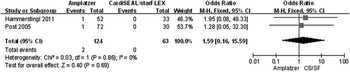
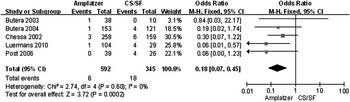
Because of pressure difference between left and right atria and the special structure of atrial septal and the unstable structure of foramen ovale, the device might migrate to distal vessels. For patent foramen ovale occluder evaluation, among the 187 patients in two studies, embolisation of the device occurred in two (1.07%) patients, both in the Amplatzer group (1.61%) and none in the CardioSEAL/STARFlex group. There was no significant difference in the rate of device embolisation between the Amplatzer group and the CardioSEAL/STARFlex group for patent foramen ovale (odds ratio = 1.59, 95% confidence interval = 0.16–15.59, p = 0.69; Fig 3). There was no heterogeneity across studies (I2 = 0%), which was analysed by the fixed effects model. For atrial septal defect occluder evaluation, among the 937 patients in five studies, embolisation of the device occurred in 24 (2.56%) patients, consisting of six in the Amplatzer group (1.01%) and 18 in the CardioSEAL/STARFlex group (5.21%). The rate of device embolisation was significantly lower in the Amplatzer group than the CardioSEAL/STARFlex group for atrial septal defect (odds ratio = 0.18, 95% confidence interval = 0.07–0.45, p = 0.0002; Fig 4). There was no heterogeneity across studies (I2 = 0%), which was analysed by the fixed effects model.
Forest plot for the embolisation of the device for patent foramen ovale. Overall, no significant difference was found for embolisation of the device with the Amplatzer compared with the CardioSEAL/STARFlex, with a summarised odds ratio of 1.59 (95% CI = 0.16–15.59, p = 0.69). No heterogeneity was detected (p = 0.86, I2 = 0%). CI = confidence interval; CS/SF = CardioSEAL/STARFlex; df = degrees of freedom.

Forest plot for the embolisation of the device for atrial septal defect. Overall, a significantly lower risk of embolisation of the device with the Amplatzer compared with CardioSEAL/STARFlex was found, with a summarised odds ratio of 0.18 (95% CI = 0.07–0.45, p = 0.69). No heterogeneity was detected (p = 0. 60, I2 = 0%). CI = confidence interval; CS/SF= CardioSEAL/STARFlex; df = degrees of freedom.

New-set atrial fibrillation
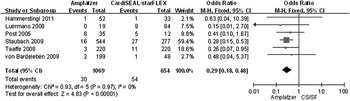
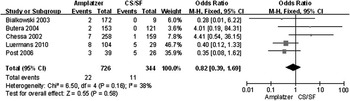
Atrial fibrillation is the most common type of arrhythmia related to device implantation, and is a subsequent risk for neurologic events. For patent foramen ovale occluder evaluation, among the 1723 patients in six studies, new-set atrial fibrillation occurred in 84 (4.88%) patients, consisting of 30 in the Amplatzer group (2.81%) and 54 in the CardioSEAL/STARFlex group (8.26%). The rate of new-set atrial fibrillation was significantly lower in the Amplatzer group than the CardioSEAL/STARFlex group for patent foramen ovale (odds ratio = 0.29, 95% confidence interval = 0.18–0.48, p < 0.00001; Fig 5). There was no heterogeneity across studies (I2 = 0%), which was analysed by the fixed effects model. For atrial septal defect occluder evaluation, among the 1070 patients in five studies, new-set atrial fibrillation occurred in 33 (3.84%) patients, consisting of 22 in the Amplatzer group (3.03%) and 11 in the CardioSEAL/STARFlex group (3.20%). There was no significant difference in the rate of new-set atrial fibrillation between the Amplatzer group and the CardioSEAL/STARFlex group for atrial septal defect (odds ratio = 0.82, 95% confidence interval = 0.39–1.69, p = 0.58; Fig 6). There was no heterogeneity across studies (I2 = 38%), which was analysed by the fixed effects model.
Forest plot for new-set atrial fibrillation of patent foramen ovale. Overall, a significantly lower risk of new-set atrial fibrillation with the Amplatzer compared with CardioSEAL/STARFlex was found, with a summarised odds ratio of 0.29 (95% CI = 0.18–0.48, p < 0.00001). No heterogeneity was detected (p = 0.97, I2 = 0%). CI = confidence interval; CS/SF = CardioSEAL/STARFlex; df = degrees of freedom.

Forest plot for new-set atrial fibrillation of atrial septal defect. Overall, no significant difference of new-set atrial fibrillation with the Amplatzer compared with CardioSEAL/STARFlex was found, with a summarised odds ratio of 0.82 (95% CI = 0.39–1.69, p = 0.58). No heterogeneity was detected (p = 0.16, I2 = 38%). CI = confidence interval; CS/SF = CardioSEAL/STARFlex; df = degrees of freedom.

Recurrent thrombotic event evaluation
Thrombus formation on the device
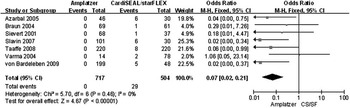
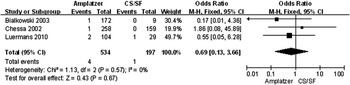
Thrombus formation on the device might damage the device and surgical removal of the thrombus would result in injury to the patients. Moreover the thrombus on device was a risk for thrombus embolisation of distal vessels especially for the neural system. For patent foramen ovale occluder evaluation, among the 1221 patients in seven studies, thrombus formation on the device occurred in 29 (2.29%) patients, consisting of none in the Amplatzer group and 29 in the CardioSEAL/STARFlex group (5.75%). The rate of thrombus formation on the device was significantly lower in the Amplatzer group than the CardioSEAL/STARFlex group (odds ratio = 0.07, 95% confidence interval = 0.02–0.21, p < 0.00001; Fig 7). There was no heterogeneity across studies (I2 = 0%), which was analysed by the fixed effects model. For atrial septal defect occluder evaluation, among the 731 patients in three studies, thrombus formation on the device occurred in five (0.68%) patients, consisting of four in the Amplatzer group (0.75%) and one in the CardioSEAL/STARFlex group (0.51%). There was no significant difference in the rate of thrombus formation on the device between the Amplatzer group and the CardioSEAL/STARFlex group (odds ratio = 0.69, 95% confidence interval = 0.13–3.66, p = 0.67; Fig 8). There was no heterogeneity across studies (I2 = 0%), which was analysed by the fixed effects model.
Forest plot for thrombus formation on the device for patent foramen ovale. Overall, a significantly lower risk of thrombus formation on the device with the Amplatzer compared with CardioSEAL/STARFlex was found, with a summarised odds ratio of 0.07 (95% CI = 0.02–0.21, p < 0.00001). No heterogeneity was detected (p = 0.46, I2 = 0%). CI = confidence interval; CS/SF = CardioSEAL/STARFlex; df = degrees of freedom.

Forest plot for thrombus formation on the device for atrial septal defect. Overall, no significant difference was found for thrombus formation on the device with the Amplatzer compared with the CardioSEAL/STARFlex, with a summarised odds ratio of 0.69 (95% CI = 0.13–3.66, p = 0.67). No heterogeneity was detected (p = 0.57, I2 = 0%). CI = confidence interval; CS/SF = CardioSEAL/STARFlex; df = degrees of freedom.

Stroke
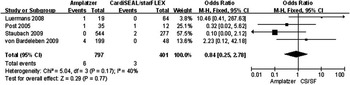
Stroke was an indicator for treatment of patent foramen ovale, and the purpose of intervention was to prevent its recurrence. Owing to the possibility of recurrence, it is important that this measure be evaluated. All the included studies focused on patent foramen ovale, and thus this remained an important problem affecting the prognosis of such patients. Among the 1193 patients in four studies, nine (1.13%) had a recurrent stroke after treatment, consisting of six in the Amplatzer group (0.75%) and three in the CardioSEAL/STARFlex group (0.74%). There was no significant difference in recurrent stoke rate between the Amplatzer group and the CardioSEAL/STARFlex group (odds ratio = 0.84, 95% confidence interval = 0.25–2.78, p = 0.77; Fig 9). Thus, there was no statistical difference in recurrent stroke after treatment between the Amplatzer group and the CardioSEAL/STARFlex group. There was no heterogeneity across studies (I2 = 40%), which was analysed by the fixed effects model.
Forest plot for stroke of patent foramen ovale. Overall, no significant difference of stroke was found for the Amplatzer compared with CardioSEAL/STARFlex, with a summarised odds ratio of 0.84 (95% CI = 0.25–2.78, p = 0.77). No heterogeneity was detected (p = 0.17, I2 = 40%). CI = confidence interval; CS/SF = CardioSEAL/STARFlex; df = degrees of freedom.

Transient ischaemic attacks
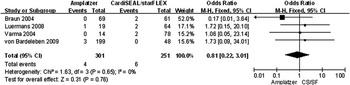
Transient ischaemic attacks are also an indicator for treatment of patent foramen ovale, and the purpose of intervention is to prevent its recurrence. It had more possibilities to re-attack patients and it was considered as a measurement for device evaluation, as it could predict a worse thrombus event. It has been measured only in the patent foramen ovale patient population; however, it may not be an important indication or index for atrial septal defect treatment and evaluating prognosis. Among the 552 patients in four studies, 10 (1.81%) had transient ischaemic attacks after treatment, consisting of four in the Amplatzer group (1.33%) and six in the CardioSEAL/STARFlex group (2.39%). The recurrent transient ischaemic attack rate suggested no significant difference between the Amplatzer group and the CardioSEAL/STARFlex group (odds ratio = 0.81, 95% confidence interval = 0.22–3.01, p = 0.76; Fig 10). There was no heterogeneity across studies (I2 = 0%), which was analysed by the fixed effects model.
Forest plot for transient ischaemic attacks of patent foramen ovale. Overall, no significant difference of transient ischaemic attacks was found for the Amplatzer compared with CardioSEAL/STARFlex, with a summarised odds ratio of 0.81 (95% CI = 0.22–3.01, p = 0.76). No heterogeneity was detected (p = 0.65, I2 = 0%). CI = confidence interval; CS/SF = CardioSEAL/STARFlex; df = degrees of freedom.

Finally, sensitivity analysis had been done by a larger sample size subgroup analysis, and every analysis confirmed in both direction and magnitude of statistical significance the findings of the overall analysis.
Discussion
Whether patent foramen ovale is a kind of congenital heart disease remains a debate, although atrial septal defect is one of the most common types of congenital heart disease. Patent foramen ovale usually closes automatically over the years. However, even automatic close haven't been done, both of them just remain a little change of haemodynamics interatrials, providing little damage in their young period. However, with age, they may result in severe thrombotic events, including migraine, stroke, transient ischaemic attacks, and paradoxical thrombus embolisation.Reference Webster, Chancellor and Smith 47 – Reference Paciaroni, Agnelli and Bertolini 49 Percutaneous occlusion has been proved to be effective in preventing thrombotic events and is better than surgical repair.Reference Quek, Hota, Tai, Mujumdar and Tok 50
The first percutaneous transcatheter closure of patent ductus arteriosus was performed by Porstmann in 1968.Reference Porstmann, Wierny and Warnke 51 Since then, much work has been done to improve the percutaneous transcatheter technique. Since the early 1990s, nearly 10 types of devices have been developed for patent foramen ovale and atrial septal defect closure.Reference Rahman, Djer and Lefi 52 – Reference Thaman, Faganello and Gimeno 55 Studies on the efficacy and safety of each type therefore began. Results of those studies showed that under certain indications each type of device provided good prognosis and caused few complications.Reference Tomar, Khatri, Radhakrishnan and Shrivastava 56 – Reference Sadiq, Kazmi, Rehman, Latif, Hyder and Qureshi 58 Recently, some researchers focused on the comparison between different types of devices to determine which type can provide the best outcome for patent foramen ovale and atrial septal defect. However, still no consensus has been made. The fact that Amplatzer and CardioSEAL/STARFlex are the most frequently used devices worldwide necessitates assessment of their performances. Furthermore, as new materials and devices are driving interventional technique forward, the occluders now possess growing importance in transcatheter treatment for congenital heart disease. Thus, all problems concerning the occluders should be treated seriously.
To the best of our knowledge, this is the first meta-analysis comparing the efficacy and safety of the Amplatzer and CardioSEAL/STARFlex for patent foramen ovale and atrial septal defect, under a situation that lacks randomised controlled trials and a large sample size cohort study. Therefore, the level of the evidence of this comparison between the Amplatzer and CardioSEAL/STARFlex is elevated, and thus leads to some evidence-based medicine progress in this field.
The persistence of left-to-right shunting was associated with factors related to the type of occluder used and the morphology of the septum. Complete closure depends on the growth of the endothelium to cover the device and the septum, known as endothelialisation.Reference Han, Gu and Titus 59 Although little is known with regard to what influences the endothelialisation process, flattening of the device and stabilisation of the interatrial septum promote such process. Therefore, different occluders have been developed and modified in order to facilitate patent foramen ovale and atrial septal defect closure.
The Amplatzer showed lower residual shunt than CardioSEAL/STARFlex for atrial septal defect occlusion in this meta-analysis, but there was no statistical difference between the two types of occluders for patent foramen ovale occlusion. Early residual shunt rate in the Amplatzer group (12.95%) and the CardioSEAL/STARFlex group (11.97%) for patent foramen ovale occlusion both exceeded 10%, which may be associated with incomplete endothelialisation. However, early residual shunt rates have been calculated in the Amplatzer group (5.65%) and the CardioSEAL/STARFlex group (31.10%) for atrial septal defect occlusion. Therefore, the Amplatzer occluder could complete its endothelialisation process more quickly with a more regular defect edge of the atrial septal defect, and showed a perfect complete closure rate of about 5%. Although the Amplatzer occluder might encounter difficulties to integrate the patent foramen ovale edge completely leaving a higher residual shunt rate at early period. The middle-term residual shunt rates of the two groups were both lower than that of the early results, which can be explained by the ongoing process of endothelialisation, and fixed occluder position during the contraction and dilation of the heart. However, the comparison in patent foramen ovale and atrial septal defect evaluation provided no significant difference. In the long term, the residual shunt rate decreased further. A significant difference was found only in atrial septal defect occlusion, meaning that the Amplatzer performed better for atrial septal defect occlusion. However, in the early and long-term results for atrial septal defect occlusion the Amplatzer occluder has its advantages for complete occlusion with its special structure and perfect endothelialisation. Both types of occluders are suitable for percutaneous closure of patent foramen ovale and atrial septal defect with acceptable residual shunt rate, yet the Amplatzer occluder can benefit the patients more with its higher complete closure rate for atrial septal defect occlusion.
Embolisation is the most common complication that may be related to the size of the device used and usually occurs in the main pulmonary artery.Reference Dogan, Ozdemir, Narin, Akilli, Gulec and Gok 60 Once the device embolised, two different options are available: (1) retrieve the device by a gooseneck snare or a basket catheter,Reference Shirodkar, Patil, Pinto and Dalvi 61 (2) refer the patient to the surgeon.Reference Amanullah, Siddiqui, Khan and Atiq 62 Arrhythmia is another common complication, especially the new-set atrial fibrillation represents a higher incidence among all types of arrhythmia, which is reported to be associated with age and the design of the occluder.Reference Pieculewicz, Przewlocki and Wilkolek 63 The average incidence is about 0.7–19%, without a relative fixed incidence.Reference Montgomery, Semder, Mendes, Fredi and Piana 64 It is also a risk factor for thrombus formation and a second treatment of medication or surgery.Reference Taniguchi, Akagi and Ohtsuki 65
The Amplatzer showed significantly lower incidence of embolisation than CardioSEAL/STARFlex for atrial septal defect occlusion. In the evaluation of patent foramen ovale occlusion, the Amplatzer and CardioSEAL/STARFlex reported almost the same incidence for device embolisation, and the incidence rates are lower than that of atrial septal defect occlusion. The diameter of the atrial septal defect is usually larger than that of patent foramen ovale, which leads to a more unstable attachment for atrial septal defect occluder. Moreover, atrial septal defect results in faster residual shunt, which may increase the risk of occluder migration. Therefore, in atrial septal defect occlusion, the Amplatzer occluder shows its advantages on attachment to atrial septal by its double-disk structure. Patent foramen ovale's smaller diameter improves the stability of the CardioSEAL/STARFlex occluder, resulting in almost the same incidence of device embolisation compared with the Amplatzer occluder. The rate of new-set atrial fibrillation in the Amplatzer group (2.81%) was significantly lower than the CardioSEAL/STARFlex group (8.26%) for patent foramen ovale occlusion. However, for atrial septal defect occlusion, no such significant difference has been found. It should be noted that the incidence of new-set atrial fibrillation was at a low level around 5%, and thus all of them were acceptable in clinical practice. Although both types are safe for percutaneous closure by the previous individual studies, according to this meta-analysis the Amplatzer occluder, which has a lower incidence of device embolisation for atrial septal defect and new-set atrial fibrillation for patent foramen ovale, showed its advantages for guaranteeing the patients’ safety for both patent foramen ovale and atrial septal defect occlusion.
Thrombotic events pose a great threat to patients with patent foramen ovale and atrial septal defect, which can be effectively prevented by percutaneous closure, as reported in many previous studies.Reference Khositseth, Cabalka and Sweeney 66 Percutaneous closure can also improve the symptoms of migraine. Many factors are associated with the recurrence of thrombotic events, such as anticoagulation therapy, age, weight, and gender. The thrombus formation on the device calls for more efficient anticoagulation therapy or surgical removal; otherwise, it can compromise the prognosis, or even cause lethal stroke or transient ischaemic attacks in old patients.Reference Canpolat, Yorgun and Ates 67 – Reference Reiss, Schuett, Maleszka, Kleikamp, Schenk and Gummert 69 According to this meta-analysis, the rate of thrombus formation of the Amplatzer was significantly lower than that of the CardioSEAL/STARFlex for patent foramen ovale occlusion, which was not found for atrial septal defect occlusion; moreover, the whole incidence was lower for atrial septal defect occlusion than patent foramen ovale. It is suggested that patent foramen ovale's higher thrombus formation rate was due to its higher residual shunt rate and slower blood flow interatrial. The same reason goes for why the Amplatzer performed better in patent foramen ovale occlusion than the CardioSEAL/STARFlex. However, re-attack events such as stroke and transient ischaemic attacks showed no significant difference (0.75% versus 0.74% and 1.33% versus 2.39%, p > 0.05). All the included studies for stroke and transient ischaemic attacks concentrated on patent foramen ovale, and this indicated that stroke and transient ischaemic attacks are not serious indications for atrial septal defect treatment or an important index for evaluating the prognosis of atrial septal defect. It is also suggested that the Amplatzer occluder is safer for preventing thrombus formation and recurrent thrombotic events for patent foramen ovale occlusion.
In this study, the Amplatzer occluder had better outcomes than the CardioSEAL/STARFlex, with higher efficacy and safety, and lower incidence of recurrent thrombotic events both in patent foramen ovale and atrial septal defect. Therefore, it is strongly suggested that doctors should pay more attention to the Amplatzer device in practice, given its better outcomes. However, it should also be noted that the type of device is only one factor of multiple factors affecting the prognosis. Therefore, the best clinical decision should be made on behalf of individual situation.
The limitations of this meta-analysis are only English publications were included; and no randomised controlled trial comparing the Amplatzer device and the CardioSEAL/STARFlex device was included. Further design of randomised controlled trials on comparison of different devices for transcatheter occlusion for patent foramen ovale and atrial septal defect on efficacy, safety and recurrent thrombus event is needed. More studies on evaluating the early-term efficacy of percutaneous closure of patent foramen ovale and atrial septal defect are still necessary.
Conclusion
The Amplatzer device and the CardioSEAL/STARFlex device are the most frequently used devices for the closure of patent foramen ovale and atrial septal defect in the world. Although many studies compared the two devices on the efficacy and safety for patent foramen ovale and atrial septal defect, no consensus has been reached. This meta-analysis, for the first time, demonstrated the efficacy, safety, and incidence of recurrent thrombotic events in transcatheter occlusion for patent foramen ovale and atrial septal defect separately using the Amplatzer device and the CardioSEAL/STARFlex device. It suggests that the Amplatzer device is better than the CardioSEAL/STARFlex device for both patent foramen ovale and atrial septal defect patients in terms of the efficacy, safety, and lower incidence of recurrent thrombotic events. It is recommended that the Amplatzer device be considered more in practice for such patients in definite indication. This analysis should be considered as a line of evidence, and be incorporated with the specific situation of the patient to make the most appropriate decision for the individual.
Acknowledgements
We thank Mingtian Wei, Jin Chen (West China Medical School of Sichuan University, Sichuan, China), and Yiting Li (School of Natural Resource and Environment, University of Michigan, Ann Arbor, United States of America) for the assistance in editing the article.