Introduction
Epistaxis is a common cause of admission to hospital; it is thought that 60 per cent of individuals will suffer from the condition at some time in their life, with 6 per cent requiring some form of medical intervention.Reference Shehab, Sperling, Kegler and Budnitz1, Reference Elahi, Parnes, Fox, Pelz and Lee2 In some emergency departments, epistaxis has been reported to make up approximately 1 per cent of all admissions to the unit.Reference Smith, Siddiq, Dyer, Rainsbury and Kim3 Of all the risk factors implicated, the use of anticoagulants (specifically warfarin) and antiplatelet drugs (specifically aspirin and clopidogrel) appears to correlate well with subsequent requirement for nasal packing, admission, increased hospital stay and surgical intervention.Reference Smith, Siddiq, Dyer, Rainsbury and Kim3–Reference Hollowell, Ruigómez, Johansson, Wallander and García-Rodríguez5
The use of anticoagulant and antiplatelet medication has steadily increased in recent years.6 Anticoagulant drugs (e.g. warfarin) are used most commonly for the prevention of secondary complications of atrial fibrillation (AF), most notably cerebrovascular accidents (CVAs).6 They are also commonly used following pulmonary embolism (PE) and deep vein thrombosis (DVT), and in patients with metallic heart valves. In clinical trials, warfarin reduced the annual risk of first ischaemic stroke by 70 per cent and reduced mortality by 33 per cent, at the cost of a small increase in serious bleeding (from 1 per cent to 1.3 per cent per annum).Reference Laupacis, Boysen, Connolly, Ezekowitz, Hart and James7 Antiplatelet drugs (aspirin and clopidogrel) are now common agents used in the primary and secondary prevention of cardiovascular disease, and used as dual therapy in patients undergoing coronary artery stenting.Reference Sardella, Mancone, Biondi-Zoccai, Conti, Canali and Stio8
As a result of an ageing population and a consequent increase in antiplatelet and anticoagulant use, the incidence of epistaxis is likely to continue rising, with admitted patients being more likely to be taking such medication.Reference Matheson9, Reference Stafford and Singer10 There is only one set of previously published guidelines (now over nine years old) detailing the management of anticoagulant and antiplatelet medication in epistaxis patients.Reference Choudhury, Sharp, Mir and Salama11
The treatment algorithm presented in the present study resulted from a joint, collaborative effort between the otolaryngology and haematology departments at University Hospital Southampton NHS Foundation Trust, and contains many updated and revised recommendations which were validated through a two-audit cycle.
Materials and methods
We included in the study 100 adult patients who presented to the ENT department at the University Hospital Southampton NHS Foundation Trust with epistaxis requiring admission.
The first audit included 50 patients presenting between 30 September 2010 and 9 February 2011. Data were collected retrospectively through examination of in-patient notes, and included the following: date of admission and discharge (and duration of in-patient stay); type of nasal packing and duration; use of anticoagulant or antiplatelet medication and whether this was discontinued; period of cessation of the anticoagulant or antiplatelet medication; discharge advice; specialist advice requested during in-patient stay; and use of procoagulants. Patients were also assessed for the following outcome measures whilst in-patients and up to at least six weeks post-discharge: embolic events; length of hospital stay; surgical intervention for epistaxis; re-bleeding during admission or following discharge; and readmission or requirements for nasal packing following discharge. This outcome information was collected via examination of the in-patient notes together with a telephone call to the patient six weeks after discharge. The patient was specifically asked whether they had been admitted to any hospital or had required any consultations for any further epistaxis episodes or embolic events.
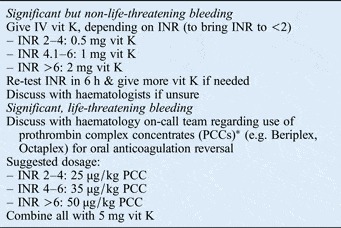
Following analysis of the first audit data, a treatment algorithm was produced with the input of the otolaryngology and haematology departments at the University Hospital Southampton NHS Foundation Trust (Figure 1 and Table I).
University Hospital Southampton NHS Foundation Trust treatment algorithm for epistaxis patients taking anticoagulant and antiplatelet medication. AF = atrial fibrillation, DVT = deep venous thrombosis; CVA = cerebrovascular accident; PE = pulmonary embolus; INR = international normalised ratio

Protocol for reversal of anticoagulant medication in significant bleeding

*Prothrombin complex concentrates are pooled plasma products which contain factors II, IX and X; some also contain factor VII. They are much more effective than fresh frozen plasma in restoring coagulation to normal, but may be associated with an increased risk of thrombosis. The PCC dosages above refer to the factor IX content of the concentrate. Although there is some evidence for a fixed dose of Beriplex, further studies are needed for confirmation. At the present time, the above PCC dosages are considered reasonable. Vit K = vitamin K; IV = intravenous; INR = International Normalised Ratio; h = hours
Following implementation of the protocol, the second audit was conducted, also including 50 patients and running between 19 November 2011 and 13 February 2012. This audit ran prospectively and collected the same data as in the first audit, including the outcome measures listed above.
Results were collated and analysed using Excel 2009 spreadsheet software (Microsoft, Redmond, Washington, USA), with statistical analysis performed using SPSS version 20 software (IBM, Armonk, New York, USA). Statistical significance was evaluated using Fisher's exact test and the Mann–Whitney U test; a p value of less than 0.05 was considered statistically significant.
Results
One hundred patients (64 males and 36 females; age range, 11–99 years; mean age, 72 years) were included in the study. The two patient groups assessed in the two audits were well matched in terms of age and type of anticoagulant or antiplatelet medication (p = 0.208).
The majority of included patients were admitted with anterior nasal packing (83 per cent), with the remainder requiring posterior packing (11 per cent). A small proportion received no nasal packing (6 per cent).
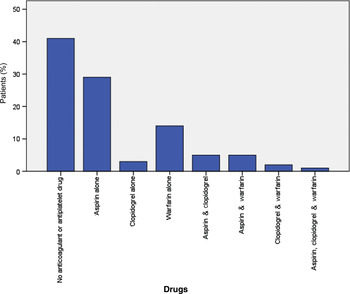
In the first audit, 64 per cent of patients (n = 32) were taking some form of anticoagulant or antiplatelet medication, compared with 52 per cent (n = 26) in the second audit. The anticoagulant and antiplatelet drugs taken comprised aspirin, clopidogrel and warfarin (Figure 2); the commonest medication regime was aspirin alone (29 per cent). In the first audit, aspirin was withheld in 13 of 18 patients (72 per cent) taking the drug, dropping to 5 of 21 patients (24 per cent) in the second audit (p = 0.004). The number of patients in whom clopidogrel was withheld also reduced (albeit statistically insignificantly because of low numbers), from 6 of 8 patients (75 per cent) in the first audit to 1 of 2 patients (50 per cent) in the second audit. During the second audit, when clopidogrel was stopped cardiology advice was sought; in contrast, no such formal advice was sought during the first audit.
Anticoagulant and antiplatelet medication in study patients.

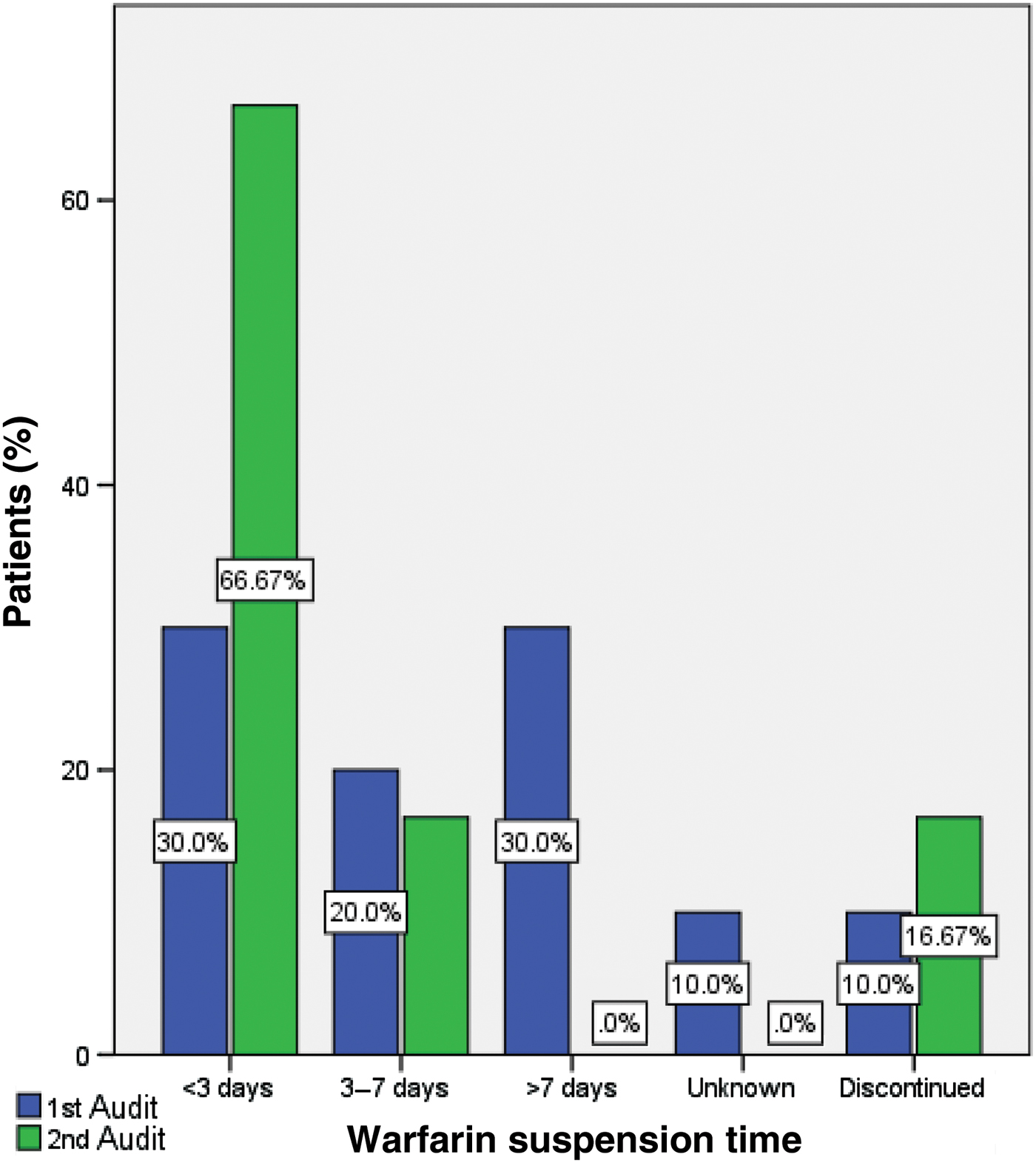
Warfarin was withheld for varying lengths of time (Figure 3). During the first audit period, 7 of 10 patients (70 per cent) had the drug stopped for more than 3 days. During the second audit, this figure dropped to 4 of 12 patients (33 per cent) (this difference was statistically insignificant due to low numbers). Encouragingly, no patients in the second audit period had their warfarin withheld for more than 7 days, compared with 3 of 10 patients (30 per cent) in the first audit period (p < 0.05).
Warfarin suspension time during the two audits.

Procoagulants were used in eight patients during the first audit period (i.e. vitamin K, tranexamic acid and platelets), compared with only one patient during the second audit (p = 0.031); this latter patient was not taking any anticoagulant or antiplatelet drugs, and suffered recurrent bleeding with nasal packing in situ.
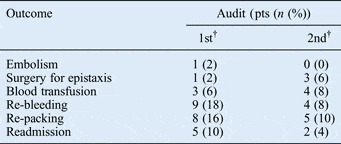
Outcome measure data are shown in Table II. Implementation of the treatment algorithm in the second audit period did not result in significantly increased rates of re-bleeding, re-packing, blood transfusion, surgical intervention or readmission (p > 0.05). One patient in the first audit period developed an embolic phenomenon, but no such complications were observed in the second audit period.
Outcome resultsFootnote *

* During admission and up to six weeks post-discharge. †Total patients, n = 50. Pts = patients
Discussion
Anticoagulant and antiplatelet drugs are now standard treatment for the prophylaxis and prevention of many embolic and cardiovascular diseases, including transient ischaemic attacks (TIAs), CVAs, DVTs and AF. One of the main drawbacks of the use of such drugs in this group of patients is the increased incidence of haemorrhage, with epistaxis being the most common manifestation. With an ageing population and the common use of such blood-thinning agents, it is likely that the incidence of this problem will only increase.Reference Matheson9, Reference Stafford and Singer10 The routine withholding of such medication in an attempt to control epistaxis remains a common practice in the UK. However, this practice is not evidence-based, is often unnecessary, and can be associated with significant morbidity. The current study highlights the importance of having a validated treatment algorithm in place for the management of antiplatelet and anticoagulant medication in epistaxis patients.
In this study, 58 per cent of all patients were taking some form of anticoagulant or antiplatelet medication, a comparable proportion to other studies.Reference Smith, Siddiq, Dyer, Rainsbury and Kim3 Prior to implementation of the presented algorithm, it was common practice in our department to stop all antiplatelet medication in patients admitted with epistaxis. Indeed, this was the case for 72 per cent of patients taking aspirin and 75 per cent of those taking clopidogrel. Following implementation of the new guidelines, these figures dropped to 24 and 50 per cent, respectively. The difference did not quite reach statistical significance in the case of clopidogrel, due to the relatively low number of patients taking this drug. Of aspirin and clopidogrel, the latter is the more important drug to continue as it is commonly used nowadays in cases of coronary stenting and recent myocardial infarction events. As such, the patient is placed at significant risk if these drugs are discontinued abruptly and without formal cardiology input.Reference Metzler, Huber, Kozek-Langenecker, Vicenzi and Münch12
According to our proposed guidelines, in the presence of relative indications for warfarin use (e.g. AF or a single DVT with no complications), warfarin is withheld only whilst nasal packing is in situ. In the presence of absolute indications (e.g. metallic heart valves, recurrent DVTs or PE), it is continued unless the International Normalised Ratio (INR) is grossly above the therapeutic range, in which case it is stopped temporarily until the INR has been restored to within the therapeutic range.
In the second audit period, four patients had an absolute indication for warfarin (one had factor V Leiden deficiency, two had recurrent TIAs and DVTs, and one had a cardiac metallic stent). Of these four patients, three had their warfarin withheld due to a high INR, with the drug restarted once the INR had fallen to the normal range; the remaining patient continued with warfarin whilst nasal packing was in place. All other patients on warfarin within the second audit period had the drug withheld only whilst packing was in place. This contrasted with the first audit period, during which warfarin administration was stopped in a haphazard fashion and restarted at varying intervals; in many cases (30 per cent), this was after more than 7 days, and in some patients (10 per cent) no discharge plan for restarting warfarin was put in place. Within the first audit period, 10 per cent of patients had their warfarin discontinued permanently without any specialist input, as it was thought that the risks of bleeding outweighed the benefits of continued medication. In the second audit period, 17 per cent of patients had their warfarin discontinued following advice from either the cardiology or haematology departments. This practice of formal consultation with the cardiologists and haematologists was non-existent during the first audit period, and therefore constituted a definite improvement. Overall, within the second audit period there was a reduction in the number of patients whose warfarin was withheld; the greatest reduction was amongst patients whose warfarin was withheld for more than 7 days.
On analysis of warfarin reversal, we noted that two patients in the first audit were given 10 mg of vitamin K (one had a history of recurrent PEs with thrombophilia, while the other had a left ventricular thrombus), thereby significantly increasing their risk of embolic complications. In contrast, no warfarin reversal was used in the second audit. The only time a prothrombotic agent (i.e. tranexamic acid) was used during the second audit period was in an attempt to control a secondary haemorrhage developing after endoscopic sinus surgery in a young patient, who eventually required endoscopic sphenopalatine artery ligation. Overall, there was a significant reduction in prothrombotic drug use in the second audit compared with the first.
In our second audit period, a significantly higher number of patients with epistaxis continued with their anticoagulation and antiplatelet medication, and this had no statistically significant detrimental effect on outcome measures including requirement for surgery, blood transfusion, re-bleeding, re-packing or readmission. Routine withholding of such medication would have put these patients at increased risk of embolic complications, whereas, by using the treatment algorithm, this risk was avoided.
To our knowledge, there has been only one previous publication, nine years ago, by Choudhury et al., presenting guidelines on the management of anticoagulant and antiplatelet medication in epistaxis patients.Reference Choudhury, Sharp, Mir and Salama11 Our new treatment guidelines, however, differ from these earlier guidelines in several important aspects.
Firstly, our guidelines were conceived as a joint, collaborative effort between our hospital's otolaryngology and haematology departments, and have been validated via a completed audit cycle.
Secondly, Choudhury et al. suggested that all epistaxis patients taking warfarin should have this continued where possible unless their INR was outside the therapeutic range, in which case it should be withheld or reversed.Reference Choudhury, Sharp, Mir and Salama11 Our guidelines utilise a risk stratification strategy and recommend that, in patients who have a relative indication for warfarin (i.e. AF with no history of thrombotic complications, or single DVT), warfarin should only be stopped whilst nasal packs are in situ. In this patient group, stopping warfarin for a short period will have little detrimental effect, but may reduce the risk of further bleeding requiring more nasal packing or surgery during the in-patient episode. Indeed, this is borne out in our results, which show that the number of patients in this group requiring re-packing or suffering re-bleeding actually decreased following the introduction of our treatment algorithm, without any associated increase in embolic events.
Thirdly, our treatment algorithm recommends the continuing use of antiplatelet medication where at all possible, while Choudhury et al. recommended the withholding of all antiplatelet medication in patients admitted with epistaxis.Reference Choudhury, Sharp, Mir and Salama11 Antiplatelet drugs (especially clopidogrel) are very important in the management of high risk embolic and cardiovascular disease, and withholding them can place patients at significantly increased risk. The algorithm implemented within our study reflects this principle. Indeed, the importance of avoiding routine discontinuation of antiplatelet medication was highlighted in the first audit period when an epistaxis patient suffered a myocardial infarction after their aspirin and clopidogrel had been withheld following admission. In the second audit period, following guideline implementation, no embolic events were documented.
• There is little current guidance on managing epistaxis patients taking anticoagulant and/or antiplatelet drugs
• Routine suspension of such medication is common in the UK
• This is not evidence-based, is often unnecessary and risks significant morbidity
• A treatment algorithm is proposed, validated by a completed audit cycle
• This protocol could standardise management and reduce morbidity
We emphasise that our proposed treatment algorithm is merely a set of clinical guidelines and not a ‘blanket’ directive, meaning that each case still needs to be assessed individually. Nevertheless, we believe that our treatment algorithm would help standardise the management of oral anticoagulant and antiplatelet therapy in epistaxis patients, and would also act as a point of reference for the clinician and a useful resource for ENT departments UK-wide, for what can sometimes be very challenging cases.
Finally, our study reinforces the importance of being pro-active in seeking formal specialist haematological and/or cardiological input when dealing with this group of epistaxis patients.
Conclusion
This study introduces a treatment algorithm validated through a two-audit cycle, for the management of oral anticoagulant and antiplatelet therapy in epistaxis patients. In our department, the use of this algorithm resulted in continuation of the majority of antiplatelet medication, and a reduction of the time period for which anticoagulant medication was withheld, thereby reducing embolic risk in the longer term without compromising epistaxis control.
Implementation of this treatment algorithm would help standardise the management strategy for epistaxis patients taking anticoagulant or antiplatelet drugs, and should reduce morbidity associated with unnecessary routine discontinuation of such medication in epistaxis patients. Further validation of this protocol through a national audit would be desirable.