

Introduction
CLPG is the abbreviation for the goat callipyge gene, where the word ‘callipyge’ is derived from the Greek terms calli-, meaning beautiful, and -pyge, meaning buttocks. In 1983, a sheep farmer identified one Poll Dorset ram (Solid Gold) that exhibited extreme muscle hypertrophy, particularly in the hindquarters, 3–8 weeks postnatally. Offspring from this ram expressing muscle hypertrophy in the hindquarters are called the callipyge phenotype (Cockett et al., Reference Cockett, Jackson and Shay1994). The callipyge phenotype is inherited in a non-Mendelian mode referred to as polar overdominance, in which only heterozygous individuals inheriting the callipyge allele from the paternal side (paternal heterozygote) exhibit the phenotype. Compared with normal lambs, in addition to the muscular hypertrophy in the hindquarters, callipyge lambs have thinner subcutaneous, intramuscular and peripheral fat, lower feed intake, superior feed efficiency, reduced wool weight and length and poorer meat tenderness (Koohmaraie et al., Reference Koohmaraie, Shackelford, Wheeler, Lonergan and Doumit1995; Cockett et al., Reference Cockett, Jackson and Snowder1999; Abdulkhaliq et al., Reference Abdulkhaliq, Meyer, Thompson, Holmes, Forsberg and Davis2002).
The predicted locus of the callipyge allele was mapped to the distal end of ovine chromosome 18 (Cockett et al., Reference Cockett, Jackson and Shay1994; Freking et al., Reference Freking, Keele and Beattie1998; Fahrenkrug and Freking, Reference Fahrenkrug, Freking, Rexroad, Leymaster, Kappes and Smith2000; Shay et al., Reference Shay, Berghmans and Segers2001). Further studies identified the mutation, a single A→G base change, giving rise to polar overdominance of the callipyge phenotype located intergenic to the two imprinted genes DLK1 and GTL2 (Freking et al., Reference Freking, Murphy and Wylie2002). This mutation is the only difference between CLPG and normal sheep (Smit et al., Reference Smit, Segers and Carrascosa2003).
The Chinese indigenous goat breeds and Boer show obvious differences in meat production performance, the cause of which is not well understood. Given the significant effects of CLPG mutation on sheep meat production and the sequence conservation of the imprinted genes, this study cloned a DNA sequence corresponding to part of the sheep CLPG region, detected the polymorphism in the fragment, and analysed its relationship with some production traits in Inner Mongolia Alashan White cashmere goats.
Materials and methods
Animal and sample collection
Blood samples (10 ml, taken from the jugular vein, using anticoagulant citrate dextrose (ACD) as the anticoagulant and stored at −20°C) were collected from 63 Boer goat does, 70 Laiwu Black goat does and 40 Lubei White×Boer Hybrid goat does from the Laiwu Black Goat Conservation Base, Laiwu City, Shandong Province, PR China, and from 29 Lubei White goat does from the Binzhou Animal Husbandry Bureau. Ear tissue (0.5 cm×0.5 cm) was collected from 115 white cashmere goats from Alashan, in the Inner Mongolia Autonomous Region, PR China. Data regarding the sex, age, birth weight, weaning weight and cashmere yield of the white cashmere goats were individually recorded.
Genomic DNA extraction
Genomic DNA from blood and ear tissues was extracted by the normal phenol–chloroform method and detected on 0.8% agarose gel and using an ultraviolet spectrophotometer to determine its purity and concentration, then stored at −20°C.
Primer design
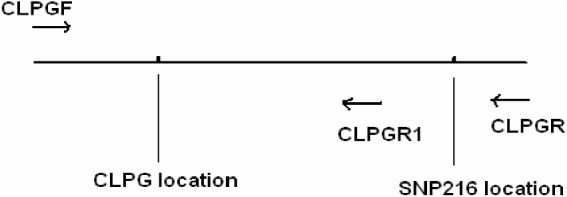
As shown in Table 1, primers (CLPGF, CLPGR, CLPGR1) used to clone gCLPG genomic DNA were designed according to ovine (GenBank accession no. AF401294) and porcine (GenBank accession no. AY401294) CLPG sequences using DNAMAN 5.2.2 and Oligo 6 software. The locations of the primers are shown in Fig. 1.
Locations of primers used in the present study.

Nucleotide sequence, annealing temperature of primers and fragment size

PCR amplification
Polymerase chain reaction (PCR) was performed by mixing 50–100 ng goat genomic DNA, 2 μl of dNTPs (10 mM, TaKaRa, Dalian, China), 1.5 μl MgCl2 (25 mM), 0.5 μl (20 μM) each of forward and reverse primers, 0.2 μl of rTaq DNA polymerase (5 U/μl, TaKaRa) and 2.5 μl of 10×rTaq buffer, and run on a Mastercycler gradient (Eppendorf, Germany) according to the following program: 95°C for 3 min, then 30 cycles of 95°C for 30 s, annealing for 45 s, and 72°C for 45 s, followed by a final extension of 7 min at 72°C.
SSCP analysis
PCR products (2 μl) were mixed with 8 μl buffer containing 98% formamide, 0.025% bromophenol blue, 0.025% xylene cyanol, 20 mM EDTA (pH 8.0) and 10% glycerol. This solution was centrifuged, denatured at 98°C for 10 min and chilled in ice for 10 min. The samples were separated by running electrophoresis with 12% neutral polyacrylamide gel (acrylamide:bisacrylamide=29:1) at 120 V for 10–15 h at 4°C. The gels were stained with silver nitrate.
Restriction fragment length polymorphism (RFLP) analysis
The appropriate amount of PCR product was mixed with 0.5 μl of the restriction enzyme Sfi I (5 U/μl, 5′-GGCCNNNN/NGGCC-3′, TaKaRa) and 1 μl 10×M buffer in a 10 μl volume and incubated at 50°C for 3 h, and then separated on a 12% polyacrylamide gel. The gels were stained with silver nitrate to identify genotypes.
Statistical analysis
The Hardy–Weinberg equilibrium test of the single-nucleotide polymorphism (SNP) in five goat populations was performed using the χ2 test in POPGENE. Analysis of least-square means of birth weight, cashmere yield and body weight gain from birth to weaning was performed using the General Linear Model procedure in SAS (Version 8.2).
The following models were used for analysis of cashmere yield, birth weight and body weight gain from birth to weaning in Alashan White cashmere goat does.
Model for cashmere yield analysis:

where Y ijkl is the cashmere yield, μ the population mean, G i the fixed effect of the ith genotype (i=1, 2), W j the fixed effect of the jth weight (j=1, 2, …, 26), R k the fixed effect of the kth ram (k=1, 2, …, 14), S l the fixed effect of the lth sex (l=1, 2), and e ijkl the random residual effect of each observation.
Model for birth weight or weight gain from birth to weaning:

where Y ikl is the birth weight or body weight gain from birth to weaning, μ the population mean, G i the fixed effect of the ith genotype (i=1, 2), R k the fixed effect of the kth ram (k=1, 2, …, 14), S l the fixed effect of the lth sex (l=1, 2), and e ikl the random residual effect of each observation.
Results
Goat CLPG sequence
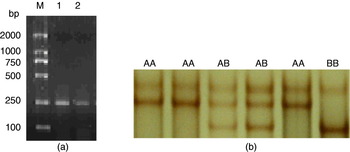
Using primer CLPGF/CLPGR, a DNA fragment of goat CLPG with a size of 250 bp was amplified (Fig. 2). This amplification product band is specific and can be used for further analysis. After recovering, cloning and sequencing, alignment of this sequence with the corresponding region of ovine and porcine CLPG showed 96.04% and 88.65% identity, respectively.
(a) PCR amplification from goat CLPG gene (1.5% agarose). Lanes: M, DNA DL2000 marker; 1 and 2, amplification product of CLPG gene. (b) SSCP analysis. (See online for a colour version of this figure.)

Polymorphism identification
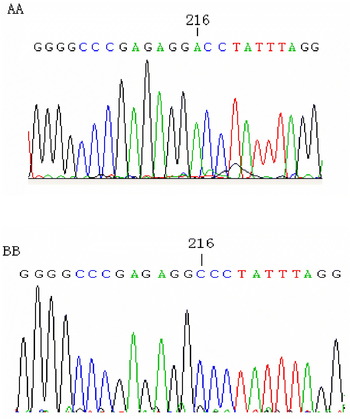
The 250 bp fragment was used to scan for polymorphism using the single-strand conformation polymorphism (SSCP) approach. As shown in Fig. 2b, three genotypes were distinguished: AA (bands 1, 2 and 5), AB (bands 3 and 4) and BB (band 6). After sequencing and alignment, it was found that the polymorphism shown in Fig. 2b is not caused by the A→G transition in the CLPG site; however, at site 216, the nucleotides of the AA and BB genotypes were A and C, respectively (Fig. 3). In addition, 75 individuals with the three genotypes in Fig. 2a were checked with the primer pair CLPGF/CLPGR1 and PCR-SSCP analysis, but no polymorphism was found (Fig. 4). These proved that the polymorphism in the 250 bp fragment was caused by A→C transversion at site 216, and this transversion was named after its site (SNP216).
Sequencing of genotypes AA and BB of SNP216 in goat CLPG. (See online for a colour version of this figure.)

Genotyping of 159 bp fragments of goat CLPG using the PCR-SSCP method. (See online for a colour version of this figure.)

Detection of SNP216
A→C transversion at site 216 changes the recognition site of restriction endonuclease Sfi I and this polymorphism can be detected with the PCR-RFLP method. As shown in Fig. 5b, three genotypes were detected: AA (bands 4, 5 and 6), AC (bands 1, 2 and 3) and CC (band 7), which correspond to genotypes AA, AB and BB in Fig. 2b, respectively. In total, 63 Boer, 70 Laiwu Black, 40 Lubei White×Boer, 29 Lubei White and 115 Alashan White cashmere goats were genotyped. The result indicate that allele A is dominant in four of the goat populations, the exception being the Lubei White, and at site SNP216 the Boer goat, Laiwu Black goat, Lubei White goat and Lubei White×Boer goat populations were all in a state of Hardy–Weinberg equilibrium (P>0.05). The Alashan White cashmere goat population deviated from Hardy–Weinberg equilibrium (P<0.01; see Table 2).
(a) Amplification of goat CLPG site SNP216. Lanes: M, DL2000 marker; 1,2, individuals. (b) RFLP detection of the goat CLPG site SNP216. Lanes: M, DL2000 DNA marker; 1, 2 and 3, AC; 4, 5 and 6, AA; 7, CC. (See online for a colour version of this figure.)

Genotype and allelic frequencies of CLPG SNP216 in five goat populations

Analysis of the association between SNP216 and production performance
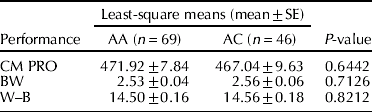
Analysis of least-square means of birth weight, cashmere yield and body weight gain from birth to weaning (see Table 3) showed that these variables presented no significant differences among the different genotypes (P>0.5).
Least-square means of two genotypes at SNP216 of the CLPG in Inner Mongolia Alashan White cashmere goat

CM PRO, cashmere product; BW, birth weight; W–B, weight gain from birth to weaning.
Discussion
CLPG is a muscle hypertrophy phenotype existing in Poll Dorset sheep that is caused by a single nucleotide mutation, the frequency of mutation being rather low. Wu et al. (Reference Wu, Shi, Zhang and Jian2006) investigated the mutation site in Australian Dorset sheep, German Merino sheep and the first and second filial offspring of Dorset×Xinjiang fine wool sheep, but did not find the mutation.
Wang et al. (Reference Wang, Li, Zhou, Li and Guo2007) found a C→T mutation at 82 bp upstream from the CLPG site and found that it was related to the double muscular character in Boer goats. This study cloned a 250 bp fragment of the CLPG region and analysed the polymorphism. This sequence shares a high degree of homology with ovine and porcine CLPG genes. We did not find the mutant nucleotide corresponding to ovine CLPG mutation in the 75 goats tested, which may indicate that the CLPG mutation did not exist in these five goat populations, or the mutation rate is very low. This study identified the polymorphism (SNP216) 147 bp downstream from the CLPG site, which is also located downstream from the SNP site discovered by Wang et al. (Reference Wang, Li, Zhou, Li and Guo2007). The phenomenon that allele A was the dominant allele in the Boer goat population is similar to the gene frequency distribution reported by Wang et al. (Reference Wang, Li, Zhou, Li and Guo2007); its significance, however, requires further investigation.
At site SNP216, allele A is dominant in four of the goat populations, the exception being the Lubei White goat population. Also, except for the Alashan White cashmere, the other four goat populations were in a state of Hardy–Weinberg equilibrium, which may indicate that in the former this site is affected by selection.
It is noted that the CC genotype was not found in the 115 Alashan White cashmere goats and 40 Lubei White×Boer goats, and the genotype frequency was lower in Boer goats, Laiwu Black goats and the Lubei White goat population. Association analysis results between SNP216 and production performance indicate that the cashmere yield, birth weight and body weight gain from birth to weaning among the different genotypes were not different. We need to carry out further investigations to identify whether this mutation site affects the goat production performance in a population segregating at this site.
Acknowledgements
This work was supported by Chinese National Programs for High Technology Research and Development (863 Program; no. 2007AA10Z153).