INTRODUCTION
An estimated 1–2 million sport- and recreation-related mild traumatic brain injuries (mTBIs) occur in US children and adolescents annually (Bryan et al., Reference Bryan, Rowhani-Rahbar, Comstock and Rivara2016); the total number attributable to all injury mechanisms is larger still. The most prevalent mTBI symptoms are non-specific and can be categorized into physical/somatic, cognitive, emotional and fatigue/sleep domains (Sady, Vaughan, & Gioia, Reference Sady, Vaughan and Gioia2014). Vision disturbances are also common, with at least one positive vision finding in 69% of adolescents examined (Master et al., Reference Master, Scheiman, Gallaway, Goodman, Robinson, Master and Grady2016). Although most children recover within 4 weeks, a substantial portion (15–50%) experience post-concussion syndrome (PCS), where symptoms persist for months to years and may result in long-term sequelae, impaired quality of life and academic difficulties (Baker et al., Reference Baker, Leddy, Darling, Rieger, Mashtare, Sharma and Willer2015; Barlow, Reference Barlow2016; Rabinowitz et al., Reference Rabinowitz, Li, McCauley, Wilde, Barnes, Hanten and Levin2015; Russell et al., Reference Russell, Selci, Black and Ellis2019).
In addition to injury-related characteristics, constitutional factors have been associated with PCS, including pre-existing neurodevelopmental and psychiatric disorders (Grubenhoff et al., Reference Grubenhoff, Currie, Comstock, Juarez-Colunga, Bajaj and Kirkwood2016; Guerriero et al., Reference Guerriero, Kuemmerle, Pepin, Taylor, Wolff and Meehan2018; Hutchinson et al., Reference Hutchinson, Comper, Csenge and Richards2014; Lumba-Brown et al., Reference Lumba-Brown, Yeates, Sarmiento, Breiding, Haegerich, Gioia and Timmons2018b; McCauley et al., Reference McCauley, Wilde, Miller, Frisby, Garza, Varghese and McCarthy2013; Ponsford et al., Reference Ponsford, Cameron, Fitzgerald, Grant, Mikocka-Walus and Schonberger2012). Of these, learning (LD) and attention deficit/hyperactivity (ADHD) disorders are particularly important given the 9.7 and 11% lifetime prevalences in US children, respectively (Altarac & Saroha, Reference Altarac and Saroha2007; Visser et al., Reference Visser, Danielson, Bitsko, Holbrook, Kogan, Ghandour and Blumberg2014). Further, youth with ADHD have demonstrably higher rates of intracranial injuries/concussions than the general population (Brehaut et al., Reference Brehaut, Miller, Raina and McGrail2003; Kang, Lin, & Chung, Reference Kang, Lin and Chung2013; Tai, Gau, & Gau, Reference Tai, Gau and Gau2013), rendering this an important area of investigation.
Given the widespread distribution of these disorders and their potential impact on recovery, prior studies have examined associations between a history of LD and/or ADHD and prolonged pediatric concussion recovery using heterogeneous methods and achieving mixed results. Although a handful of studies reported associations for LD (Ponsford et al., Reference Ponsford, Willmott, Rothwell, Cameron, Ayton, Nelms and Ng1999; Zemek et al., Reference Zemek, Barrowman, Freedman, Gravel, Gagnon and McGahern2016) or ADHD (Aggarwal et al., Reference Aggarwal, Ott, Padhye and Schulz2020; Mautner et al., Reference Mautner, Sussman, Axtman, Al-Farsi and Al-Adawi2015; Miller et al., Reference Miller, Gill, Kuhn, Rocque, Menendez, O’Neill and Johnston2016; Wojcik, Reference Wojcik2014), others did not (Eisenberg et al., Reference Eisenberg, Andrea, Meehan and Mannix2013; Ellis et al., Reference Ellis, Cordingley, Vis, Reimer, Leiter and Russell2017; Fehr et al., Reference Fehr, Nelson, Scharer, Traudt, Veenstra, Tarima and Walter2019; Howell et al., Reference Howell, Potter, Kirkwood, Wilson, Provance and Wilson2019; Kontos et al., Reference Kontos, Elbin, Sufrinko, Marchetti, Holland and Collins2019; Lau, Collins, & Lovell, Reference Lau, Collins and Lovell2012; Morgan et al., Reference Morgan, Zuckerman, Lee, King, Beaird, Sills and Solomon2015; Nelson et al., Reference Nelson, Tarima, LaRoche, Hammeke, Barr, Guskiewicz and McCrea2016). Failure to detect associations may be attributable to the fact that many studies examined self-reported LD and/or ADHD as potential covariates, rather than primary exposures of interest, included modest numbers of affected subjects (range: 6–44), and/or employed univariate analyses without accounting for important confounding variables (Cook et al., Reference Cook, Iaccarino, Karr and Iverson2020a; Eisenberg et al., Reference Eisenberg, Andrea, Meehan and Mannix2013; Ellis et al., Reference Ellis, Cordingley, Vis, Reimer, Leiter and Russell2017; Fehr et al., Reference Fehr, Nelson, Scharer, Traudt, Veenstra, Tarima and Walter2019; Howell et al., Reference Howell, Potter, Kirkwood, Wilson, Provance and Wilson2019; Kontos et al., Reference Kontos, Elbin, Sufrinko, Marchetti, Holland and Collins2019; Lau et al., Reference Lau, Collins and Lovell2012; Morgan et al., Reference Morgan, Zuckerman, Lee, King, Beaird, Sills and Solomon2015; Nelson et al., Reference Nelson, Tarima, LaRoche, Hammeke, Barr, Guskiewicz and McCrea2016).
Importantly, few pediatric studies specifically examined mTBI symptom trajectories throughout recovery (Henry et al., Reference Henry, Elbin, Collins, Marchetti and Kontos2016; Ledoux et al., Reference Ledoux, Tang, Yeates, Pusic, Boutis and Craig2019; Yeates et al., Reference Yeates, Taylor, Rusin, Bangert, Dietrich, Nuss and Jones2009), and to our knowledge, none modeled trajectories in children with LD or ADHD. Understanding the symptom load experienced over time provides important information independent of recovery time, which may allow clinicians to tailor treatments and accommodations when they may be most impactful. To address these gaps, we investigated the hypotheses that pediatric patients with pre-existing LD and/or ADHD experience longer concussion recovery times with greater symptom burdens and more protracted trajectories than those without.
METHODS
Study Design
We assembled a retrospective cohort of patients aged 5–17 years who presented to a Children’s Minnesota Concussion Clinic, an interdisciplinary practice encompassing neurosurgical, rehabilitation, and psychology services, with mTBI from April 1, 2018 to March 31, 2019 (Martin et al., Reference Martin, Petersen, Sesma, Koolmo, Ingram, Slifko and Linabery2020). Patients were referred to the urban concussion program by internal or community emergency departments/providers, or self-referral. We defined mTBI as a provider-diagnosed concussion based on clinical presentation in accordance with previously described criteria: mild, non-penetrating brain injury directly or indirectly caused by a biomechanical force, with associated transient neurological or functional disturbance (Gioia, Reference Gioia and Collins2006; Voss et al., Reference Voss, Connolly, Schwab and Scher2015); the terms mTBI and concussion are used interchangeably. More complicated mTBI (with positive neuroimaging findings) were followed by the neurosurgical service, not the concussion clinics. Patients were excluded if (1) their chief complaint was not attributable to mTBI, (2) they presented >90 days post-injury (per standard clinic policy) or (3) their parent/legal guardian did not consent to research. We intended to examine those with pre-existing autism spectrum disorders (ASD) separately; however, all patients with ASD (n = 15) also had LD and/or ADHD and the sample size did not permit subgroup analysis. Similarly, the number of patients with other neurodevelopmental (e.g., speech/language) disorders but no LD/ADHD (n = 8) precluded separate analysis; these patients were ultimately excluded. Importantly, sensitivity analyses placing those with other neurodevelopmental disorders in the reference group yielded results consistent with those reported herein. Patients were not included/excluded based on other neurological disorders.
The Institutional Review Board approved the study. Parents/legal guardians provided written consent for the inclusion of their child’s data in research studies at initial institutional encounters and annually thereafter. A waiver of consent was granted for this chart review study.
Because there are no definitive mTBI diagnostic tests available, medical providers made diagnoses based on clinical presentation (positive history of a head injury, symptom profile and exam results) (Lumba-Brown et al., Reference Lumba-Brown, Yeates, Sarmiento, Breiding, Haegerich, Gioia and Timmons2018a, Reference Lumba-Brown, Yeates, Sarmiento, Breiding, Haegerich, Gioia and Timmons2018b). Thus, querying symptoms and testing functional performance were employed as methods for monitoring recovery (Institute of Medicine (IOM) & National Research Council (NRC), 2014; Lumba-Brown et al., Reference Lumba-Brown, Yeates, Sarmiento, Breiding, Haegerich, Gioia and Timmons2018a, Reference Lumba-Brown, Yeates, Sarmiento, Breiding, Haegerich, Gioia and Timmons2018b). Eligible patients were included from initial clinic visits through discharge (i.e., full resolution of injury-related symptoms), or until patients elected to discontinue treatment. Providers collected patient demographics, medical history, injury-related characteristics, symptoms, and testing results at every visit using a standardized electronic medical record (EMR) template (Gioia, Reference Gioia and Collins2006). EMR data were abstracted into a REDCap database by trained abstractors (Harris et al., Reference Harris, Taylor, Thielke, Payne, Gonzalez and Conde2009). Standard data (e.g., out of range and other logic) checks were applied and inaccurate values were corrected.
Primary exposure variables included a personal history of provider-diagnosed LD or ADHD, respectively. Patients were classified as exposed based on histories collected at initial clinic visits. Using the Acute Concussion Evaluation (ACE) questionnaire section on Risk Factors for Protracted Recovery to structure the in-person interview (Gioia, Reference Gioia and Collins2006), concussion clinic providers specifically asked parents and older patients whether or not patients had a history of LD or ADHD. Most diagnoses were subsequently confirmed by medical record documentation; otherwise provider documentation of reported (pharmaceutical, psychologist or psychiatrist) treatment or accommodation (Individualized Education Program, IEP) for the disorder was used to corroborate the few remaining diagnoses.
Potential covariates, shown in Table 1, were selected a priori based on previously established associations and clinical insights (Aggarwal et al., Reference Aggarwal, Ott, Padhye and Schulz2020; Broshek et al., Reference Broshek, Kaushik, Freeman, Erlanger, Webbe and Barth2005; Catroppa et al., Reference Catroppa, Anderson, Morse, Haritou and Rosenfeld2008; Eisenberg et al., Reference Eisenberg, Andrea, Meehan and Mannix2013; Grubenhoff et al., Reference Grubenhoff, Currie, Comstock, Juarez-Colunga, Bajaj and Kirkwood2016; Guerriero et al., Reference Guerriero, Kuemmerle, Pepin, Taylor, Wolff and Meehan2018; Hutchinson et al., Reference Hutchinson, Comper, Csenge and Richards2014; Scopaz & Hatzenbuehler, Reference Scopaz and Hatzenbuehler2013). In regression models, injury mechanism was collapsed into three categories (sport-related, motor vehicle-related, or other) based on the expected increased injury severity in those involved in motor vehicle crashes and the differences in sport-related versus non-sport-related concussions described by others (Haarbauer-Krupa et al., Reference Haarbauer-Krupa, Arbogast, Metzger, Greenspan, Kessler, Curry and Master2018; Seiger, Goldwater, & Deibert, Reference Seiger, Goldwater and Deibert2015). Sensitivity analyses were performed, wherein various categories were modeled with no material impact on results.
Patient characteristics stratified by pre-existing LD and ADHD exposure statusa

ADHD: attention deficit/hyperactivity disorder; IQR: interquartile range; LD: learning disorders; LOC: loss of consciousness; NH: non-Hispanic.
a 35 patients had both LD and ADHD.
b Learning disorders included dyslexia (n = 17), auditory processing (n = 6), dysgraphia (n = 3), dyscalculia (n = 2), phonetic (n = 1), and other/unspecified disorders (n = 42); 1 patient reported more than one LD. Other/unspecified disorders included other language-related (n = 7) and other reading-related (n = 5) disorders.
c Calculated via Wald Chi-square tests, unless otherwise specified.
d Race/ethnicity was determined based on self-report by patient/parent. When race/ethnicity was evaluated as a potential confounder, it was collapsed into the mutually exclusive categories: NH White, NH Black, Hispanic, and Other/Refusal.
e When injury mechanism was evaluated as a potential confounder, it was collapsed into the mutually exclusive categories: sport- or recreation-related, motor vehicle-related, and others.
f Included patient- or parent-reported history of provider-diagnosed anxiety disorder and/or depression, as confirmed by medical record documentation, or if the diagnosis could not be located in their record, documentation of reported treatment. This variable was not included in multivariable regression models due to concerns about overlapping etiologies/overadjustment.
g Acute symptom score reflects symptoms experienced immediately following injury.
h Presenting vision symptom score reflects vision symptoms reported at first clinic visit.
i Calculated via Kruskal–Wallis H-test.
Time to symptom resolution, time to return to school/academics without accommodations, and time to return to physical activity without restrictions were examined as primary outcome variables. Symptom resolution was defined as patient- and/or parent-reported date of return to baseline conveyed to providers at the final visit. Dates for return to school and physical activity without accommodations were determined and recorded by providers at discharge, following graded return to learn/play protocols, if patients demonstrated achievement of baseline function (e.g., vestibular, oculomotor testing). Date of injury was defined as time 0 and length of recovery variables were calculated accordingly.
To assess concussion symptom trajectories, providers evaluated the presence of acute (first visit) and contemporary concussion symptoms (all visits) using a 28-factor verbal symptom questionnaire (Supplementary Table 2) adapted from the ACE, an inventory previously validated in children and adolescents (Collins, Lovell, & McKeag, Reference Collins, Lovell and McKeag1999; Gioia, Reference Gioia and Collins2006; Lovell, Reference Lovell1996; Pardini et al., Reference Pardini, Stump, Lovell, Collins, Moritz and Fu2004). Providers recorded positive responses from patients and/or parents/guardians if it was clear that symptoms arose after the head injury. Symptom scores reflect sums of symptoms reported at each visit.
Vision symptoms were examined separately given the high prevalence of post-injury vision disturbances and underrepresentation of ocular-motor symptoms in standard post-concussion symptom scales (Lumba-Brown et al., Reference Lumba-Brown, Ghajar, Cornwell, Bloom, Chesnutt, Clugston and Gioia2019; Master et al., Reference Master, Scheiman, Gallaway, Goodman, Robinson, Master and Grady2016). Vision symptom scores were measured at each visit using the self-administered 15-item written Convergence Insufficiency Symptom Survey (CISS), previously validated in pediatric populations, where each symptom is ranked from 0 (never experience) to 4 (always experience) (Borsting et al., Reference Borsting, Rouse, Mitchell, Scheiman, Cotter, Cooper and London2003; Rouse et al., Reference Rouse, Borsting, Mitchell, Cotter, Kulp and Scheiman2009; Scheiman, Reference Scheiman2011). Patients/parents were instructed to include only symptoms that presented or increased post-injury to identify symptoms ascribable to concussion. Vision symptom severity scores were generated via the CISS scoring algorithm.
Statistical Analysis
Distributions of demographic, injury, and clinical characteristics were compared across exposure subgroups via two-sample t-tests, Kruskal–Wallis tests, and Chi-square tests. Symptom distributions were compared using multivariable logistic regression to produce odds ratios adjusted for age group and sex (aORs) and corresponding 95% confidence intervals (CIs).
Time to recovery
To examine differences in recovery times across strata of neurodevelopmental conditions, we constructed Kaplan–Meier curves and compared median recovery times via log-rank tests of significance, measures that account for expected recovery for censored patients. Patients that had not recovered within the study period or 180 days following injury were administratively censored at their last visit to help ensure non-informative censoring. Thus, our Kaplan–Meier curves represent those with ongoing mTBI symptoms. Multivariable Cox proportional hazard models were generated to estimate the hazard of prolonged recovery in those with pre-existing neurodevelopmental disorders relative to those without. Strong clinically established confounders (age, sex) were included in all models (Lumba-Brown et al., Reference Lumba-Brown, Yeates, Sarmiento, Breiding, Haegerich, Gioia and Timmons2018b). Only those candidate covariates (Table 1) identified as confounders in a forward iterative selection process were also included for adjustment (Grayson, Reference Grayson1987; VanderWeele, Reference VanderWeele2019). Final models for the three recovery outcome variables were produced for LD (including age group, sex, injury mechanism, time to first visit) and ADHD (age group, sex), respectively. The proportional hazard assumption was verified for all models. Adjusted hazard ratios (aHRs) and 95% CIs were inverted to estimate risk of prolonged recovery.
Recovery trajectories
Marginal mean differences in concussion and vision symptoms across a 90-day recovery period were estimated by fitting linear mixed-effects regression models with an identity link function and Gaussian distribution. Time was modeled as a piecewise linear covariate with a knot at 7 days post-injury; this time point was chosen a priori based on previously reported inflection points (Ledoux et al., Reference Ledoux, Tang, Yeates, Pusic, Boutis and Craig2019; Yeates et al., Reference Yeates, Taylor, Rusin, Bangert, Dietrich, Nuss and Jones2009). Time variables were modeled as random effects to account for repeated measures within individuals. Because their inclusion significantly improved fit (P < 0.005), time variables were included as random intercepts and slopes in final models. Covariates were selected as described above for concussion symptom (age group, sex, injury mechanism) and vision symptom severity (age group, sex) models and included as fixed effects. Neurodevelopmental condition-by-time interaction terms with joint F-tests of significance (2 degrees of freedom) were used to evaluate differences in recovery trajectories. Administrative censoring at 90 days ensured the validity of the linearity assumption and adequate sample sizes in subgroups.
Statistical analyses were performed via SAS Enterprise Guide software, Version 7.1 (SAS Institute Inc., Cary, NC, USA) using all available data. Statistical significance was defined as two-sided P < 0.05 unless otherwise specified, and Bonferroni corrections were made for multiple comparisons.
Results
During the 1-year study period, 798 unique patients were seen in the Children’s Minnesota Concussion Clinics. Of those, 88 did not meet inclusion criteria and 30 did not consent to research, resulting in a final analytic cohort of 680 patients (Fig. 1).
Flow diagram outlining subject inclusion/exclusion. ADHD: attention deficit/hyperactivity disorder; LD: learning disorder; mTBI: mild traumatic brain injury.
a 35 patients had both LD and ADHD.

Patients ranged in age from 5 to 17 years (median (IQR): 13 (11–15)) and 47% were male. The most common injury mechanisms included sport-related (53%), fall (26%), being struck or hitting head (14%), and motor vehicle accidents (10%). Importantly, 10% had confirmed pre-existing LD (n = 70) and 16% had confirmed pre-injury ADHD (n = 107; Table 1); 5% had both conditions (n = 35), although this sample size did not permit separate analysis. Patients had a median of 2 (IQR: 1.5–3) standard clinic visits. In all, 95 patients were lost to follow-up before discharge, with nonwhite patients more commonly lost to follow-up (P = 0.02), but no differences observed by exposure group (Supplementary Table 1).
A number of symptoms were observed more frequently in those with LD and/or ADHD (e.g., ear symptoms, frequent awakenings, irritability) compared to patients without either condition, but these differences were not statistically significant after accounting for multiple comparisons with an adjusted significance threshold of P < 0.002 (Supplementary Table 2). Interestingly, symptoms commonly associated with LD and ADHD (e.g., decreased attention/concentration, difficulty reading) were nearly equivalently distributed across the affected and unaffected subgroups.
Time to Recovery
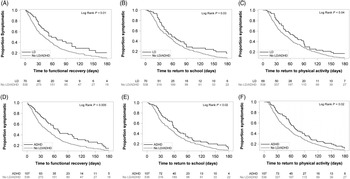
Median times to symptom recovery were 58 (IQR: 29–141) and 68 (30–155) days in patients with LD and ADHD, respectively, compared to 43 (18–90) days in those without LD/ADHD (Fig. 2, Table 2). Those with pre-existing LD and ADHD also took significantly longer return to academics and physical activity compared to their unaffected peers. Accordingly, those with LD had significantly higher risk of delayed symptom recovery (aHR = 1.63, 95% CI: 1.16–2.29), return to school (1.47, 1.08–2.00), and return to physical activity (1.50, 1.10–2.04) compared to those without LD/ADHD (Table 3). Similarly, those with ADHD were at a significantly increased risk of delayed symptom recovery (1.69, 1.28–2.23), return to school (1.52, 1.17–1.97), and return to physical activity (1.55, 1.19–2.01).
Kaplan–Meier curves demonstrating mTBI recovery: (A) symptom resolution in LD and (D) ADHD subgroups versus no LD/ADHD; (B) return to physical activity in LD and (E) ADHD; (C) return to school in LD and (F) ADHD. All Kaplan–Meier analyses were administratively censored at 180 days to ensure adequate sample sizes. ADHD: attention deficit/hyperactivity disorder; LD: learning disorder; mTBI: mild traumatic brain injury.

Median recovery time (in days) across strata of pre-existing neurodevelopmental conditions from Kaplan–Meier analyses.

ADHD: attention deficit/hyperactivity disorder; IQR: interquartile range; LD: learning disorders.
a Calculated via log-rank tests.
Adjusted hazard ratios for prolonged recovery by pre-existing neurodevelopmental condition from multivariable Cox regression models.

ADHD: attention deficit/hyperactivity disorder; CI: confidence interval; aHR: adjusted hazard ratio; LD: learning disorders.
aHR adjusted for binary age category (5–11, 12–17 years), sex, injury mechanism (sport-related, motor vehicle-related, other), and time to first clinic visit from date of injury (days). Any confounding by prior concussion history was accounted for by adjusting for age and sex.
bHR adjusted for binary age category and sex. Any confounding by mechanism of injury and prior concussion history was accounted for by adjusting for age and sex.
Recovery Trajectories
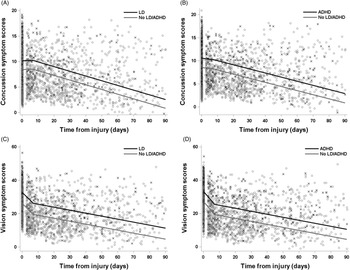
Patients with LD had, on average, 1.65 additional concussion symptoms (95% CI: 0.53–2.78) and a 6.39-point higher vision symptom score (3.25–9.53; Fig. 3, Table 4) immediately following injury and throughout recovery relative to the reference group. Similarly, patients with ADHD experienced an additional 2.06 concussion symptoms (1.13–3.00) and a 6.06-point higher vision score (3.44–8.69) throughout recovery.
Concussion and vision symptom trajectories following mTBI: concussion symptoms in those with (A) LD and (B) ADHD versus no LD/ADHD, and vision symptoms in those with (C) LD and (D) ADHD. “Xs” represent predicted symptom scores in affected individuals, “Os” represent predicted scores in unaffected patients. ADHD: attention deficit/hyperactivity disorder; LD: learning disorder.

Symptom counts/scores for global concussion and vision symptoms over the first 90 days of recovery from multivariable linear mixed-effects models.a

ADHD: attention deficit/hyperactivity disorder; CI: confidence interval; LD: learning disorders.
a Models inclusive of all variables shown in table.
b Time was modeled as a piecewise linear covariate with knot at 7 days.
c Modeled as random effects (slopes and intercept).
d Calculated via F-test with 2 degrees of freedom to test overall significance.
There was no evidence of differences in concussion (LD: P interaction = 0.07; ADHD: P interaction = 0.70) or vision symptom recovery trajectories (LD: P interaction = 0.08; ADHD: P interaction = 0.60), after accounting for baseline differences in mean symptom scores. The absence of significant interactions suggested that symptom trajectory curves for the affected and unaffected groups were parallel, with equivalent slopes for each segment of the linear function, but different y-intercepts. In final models, pre-existing neurodevelopmental condition (LD or ADHD), older age group (12–17 years old), female sex, and injury mechanism were independently associated with increased concussion symptom load across the 90-day recovery period (Table 4). In examining trajectories, symptom loads decreased throughout recovery with minimal symptom reduction occurring within the first 7 days (LD: 0.01 symptoms/day, 95% CI: −0.11–0.09; ADHD: −0.04, 95% CI: −0.14, 0.05) and a steeper reduction occurring after 7 days (LD: −0.09, 95% CI: −0.11, −0.08; ADHD: −0.09, 95% CI: −0.10, −0.07).
Similarly, neurodevelopmental condition, older age group, and female sex were each associated with increased vision symptom scores throughout recovery. Interestingly, vision symptom trajectories showed sharper recoveries during the first 7 days (LD: −0.94 points/day, 95% CI: −1.57, −0.31; ADHD: −1.10, 95% CI: −1.72, −0.48) followed by more modest recoveries thereafter (LD: −0.18, 95% CI: −0.21, −0.14; ADHD: −0.18, 95% CI: −0.22, −0.14).
Sport-Related Concussion
Because athletes with sport-related injuries were examined separately in other reports, we re-ran all models in those with sport-related concussions (n = 348; Supplementary Tables 3–5). Given that only 26 individuals were affected with LD in this truncated dataset, results did not achieve statistical significance; however, aHRs for the time to recovery outcomes and the average vision symptom severity score change were similar in magnitude to those above. The average change in symptom severity score was somewhat attenuated, however (0.82, 95% CI: −0.94, 2.59; P = 0.36). Models examining patients with pre-existing ADHD (n = 47) generated results that were nearly identical in magnitude and statistical significance to those presented above.
DISCUSSION
In this clinic-based retrospective study of 680 pediatric patients with mTBI, pre-existing LD and ADHD were each associated with protracted time to full symptom recovery, return to academics, and return to physical activity after adjusting for important confounders. Additionally, this is the first study to our knowledge to model differences in recovery trajectories in a longitudinal manner in children/adolescents with and without pre-existing LD and ADHD. We report that LD and ADHD were each associated with higher mean concussion and vision symptom scores throughout recovery. While we did not detect differences in the slopes of the concussion and vision symptom recovery trajectories, respectively, between exposure subgroups, it is unclear whether there is a true lack of variation or merely insufficient power to detect intergroup divergence in trajectories, particularly during the first seven days post-injury.
Although ADHD and LD are thought to confer increased risk for prolonged recovery following concussion, empirical results have been mixed. Less than half of prior reports provided evidence supporting this hypothesis (Aggarwal et al., Reference Aggarwal, Ott, Padhye and Schulz2020; Mautner et al., Reference Mautner, Sussman, Axtman, Al-Farsi and Al-Adawi2015; Miller et al., Reference Miller, Gill, Kuhn, Rocque, Menendez, O’Neill and Johnston2016; Ponsford et al., Reference Ponsford, Willmott, Rothwell, Cameron, Ayton, Nelms and Ng1999; Wojcik, Reference Wojcik2014; Zemek et al., Reference Zemek, Barrowman, Freedman, Gravel, Gagnon and McGahern2016), whereas others did not (Eisenberg et al., Reference Eisenberg, Andrea, Meehan and Mannix2013; Ellis et al., Reference Ellis, Cordingley, Vis, Reimer, Leiter and Russell2017; Fehr et al., Reference Fehr, Nelson, Scharer, Traudt, Veenstra, Tarima and Walter2019; Howell et al., Reference Howell, Potter, Kirkwood, Wilson, Provance and Wilson2019; Kontos et al., Reference Kontos, Elbin, Sufrinko, Marchetti, Holland and Collins2019; Lau et al., Reference Lau, Collins and Lovell2012; Morgan et al., Reference Morgan, Zuckerman, Lee, King, Beaird, Sills and Solomon2015; Nelson et al., Reference Nelson, Tarima, LaRoche, Hammeke, Barr, Guskiewicz and McCrea2016). For example, in a case-control study of 294 children aged 4–18 years seen in a multidisciplinary concussion clinic, Miller et al. (Reference Miller, Gill, Kuhn, Rocque, Menendez, O’Neill and Johnston2016) observed that those with a history of ADHD (n = 14) had 3.87-fold increased odds of prolonged recovery from sport-related mTBI after adjustment for sex (95% CI: 1.13, 13.24), which is in good agreement with results presented herein.
Similarly, in a retrospective cohort of 227 adolescents aged 13–19 years seen in a specialty concussion clinic, Aggarwal et al. (Reference Aggarwal, Ott, Padhye and Schulz2020) reported that those with ADHD (n = 20) had a 2.27-fold increased hazard for prolonged recovery after controlling for sex, race/ethnicity, age, education, history of migraine, LD, prior concussions, injury mechanism, and insurance type (95% CI: 1.35, 3.70). In contrast, Aggarwal et al. (Reference Aggarwal, Ott, Padhye and Schulz2020) did not detect different median recovery times in those with pre-existing LD (n = 19) versus those without (18 vs. 14 days; P = 0.24), whereas we observed a significantly longer recovery time in those with LD (58 vs. 43 days; P = 0.01). These divergent results implicate important differences in study designs and populations, including a smaller cohort and fewer patients with LDs, use of complete case analysis, and different age range studied by Aggarwal and colleagues. Notably, while not significant, the aHR of 1.35 described by Aggarwal et al. (Reference Aggarwal, Ott, Padhye and Schulz2020) falls within the confidence interval of our estimate (1.16–2.29), suggesting the estimates are compatible.
In the largest study to date, Zemek et al. (Reference Zemek, Barrowman, Freedman, Gravel, Gagnon and McGahern2016) examined risk factors for persistent post-concussion symptoms (PPCS) at 28 days post-injury in a multicenter emergency department cohort of 1,701 youth aged 5–17 years, including 179 with LD and 190 with ADHD. In their univariate analysis, they found patients with LD had 1.5-fold greater odds of PPCS than their unaffected counterparts (95% CI: 1.0, 2.1; P = 0.03), while those with ADHD had a non-significant 1.2-fold greater odds (95% CI: 0.9, 1.8; P = 0.23). Although that study evaluated a somewhat different research question and population than the current study, and odds ratios were not adjusted for confounding, their results suggest that children with LD may require longer recovery periods following concussion.
Other pediatric studies did not detect associations between pre-existing LD and/or ADHD and protracted concussion recovery (Eisenberg et al., Reference Eisenberg, Andrea, Meehan and Mannix2013; Ellis et al., Reference Ellis, Cordingley, Vis, Reimer, Leiter and Russell2017; Fehr et al., Reference Fehr, Nelson, Scharer, Traudt, Veenstra, Tarima and Walter2019; Howell et al., Reference Howell, Potter, Kirkwood, Wilson, Provance and Wilson2019; Kontos et al., Reference Kontos, Elbin, Sufrinko, Marchetti, Holland and Collins2019; Lau et al., Reference Lau, Collins and Lovell2012; Morgan et al., Reference Morgan, Zuckerman, Lee, King, Beaird, Sills and Solomon2015; Nelson et al., Reference Nelson, Tarima, LaRoche, Hammeke, Barr, Guskiewicz and McCrea2016). These null results may reflect the true absence of an association. However, the failure to detect an association could be explained by the modest numbers of affected children (range: 2–44) included, resulting in reduced statistical power, the failure to account for differential differences in the distribution of important confounders (e.g., sex and age) through multivariable analysis, or the application of heterogeneous methods for identifying/defining LD and/or ADHD. The current study was conducted in an effort to address some of these methodologic limitations.
Importantly, these clinically meaningful results may provide actionable information for providers by informing accurate recovery expectations and guiding optimal mTBI management. A mismatch between parents’ and/or patients’ expectations and actual lived recovery experience may cause additional stress, while provision of accurate recovery information has been shown to alleviate stress and improve recovery times (Ponsford et al., Reference Ponsford, Willmott, Rothwell, Cameron, Kelly, Nelms and Curran2002). Ponsford et al. (Reference Ponsford, Willmott, Rothwell, Cameron, Kelly, Nelms and Curran2002) demonstrated in a controlled study of 202 young adults with mTBI that individuals provided with evidence-based recovery information in the week following injury reported fewer symptoms and lower stress at 3 months post-injury. Similarly, our results could be used to tailor educational information offered to patients with LD and ADHD beginning at the initial consultation.
Through the use of longitudinal trajectories, we demonstrated that children with LD or ADHD experienced a consistently higher symptom load across the recovery period compared to those without, as opposed to other possible patterns of symptom recovery (e.g., equivalent symptom loads during the initial recovery period followed by higher symptom loads thereafter for the LD/ADHD group) or simply an extended recovery with an equivalent symptom load. These findings may support the use of alternative normative data in evaluating the presence of lingering symptoms during recovery, such as those provided by Cook et al. (Reference Cook, Sapigao, Silverberg, Maxwell, Zafonte, Berkner and Iverson2020b). They may also support the early initiation of targeted therapies and continual assessment of accommodations throughout recovery in affected patients. With earlier identification of pre-existing LD/ADHD and recognition of longer expected recovery times, clinicians may initiate additional rehabilitation therapies (e.g., occupational, physical, psychological, speech) more quickly to support recovery (Broglio et al., Reference Broglio, Collins, Williams, Mucha and Kontos2015). The information may also be provided to school personnel to aid them in tailoring the return to the stimulating academic environment, which may be particularly important in those with existing education plans (McCrory et al., Reference McCrory, Meeuwisse, Aubry, Cantu, Dvorak, Echemendia and Turner2013). With a majority of children with LD (76%) and ADHD (56%) reporting existing IEPs in the current study, multidisciplinary collaboration between families, schools and providers may be especially beneficial in ensuring academic success.
Although the biological underpinnings of LD, ADHD, and concussions are not fully understood, the considerable overlap in their pathophysiologies could explain the increased and extended symptomology observed in the current study. Potential mechanisms by which neurological processes may be jointly affected by LD or ADHD and mTBI may include disruption of cognitive functioning (e.g., altered executive functioning, information processing, working memory) (Matthews, Nigg, & Fair, Reference Matthews, Nigg and Fair2014; Sharp & Jenkins, Reference Sharp and Jenkins2015; Smith-Spark et al., Reference Smith-Spark, Henry, Messer, Edvardsdottir and Ziecik2016), aberrant neuronal signaling (e.g., glutamate, GABA) (Elia et al., Reference Elia, Ungal, Kao, Ambrosini, De Jesus-Rosario, Larsen and Hakonarson2018; Giza & Hovda, Reference Giza and Hovda2014; Guerriero et al., Reference Guerriero, Giza and Rotenberg2015; Huang et al., Reference Huang, Wang, Zhang, Chen and Wu2019; Institute of Medicine (IOM) & National Research Council (NRC), 2014; Li et al., Reference Li, Yin, Sun, Zhang, Zhang, Wang and Xiong2017; Maltezos et al., Reference Maltezos, Horder, Coghlan, Skirrow, O’Gorman, Lavender and Murphy2014; McEntee & Crook, Reference McEntee and Crook1993; Medin et al., Reference Medin, Jensen, Skare, Storm-Mathisen, Hvalby and Bergersen2019; Miller et al., Reference Miller, Thomas, Gerhardt, Glaser and Banerjee2013; Moretto et al., Reference Moretto, Murru, Martano, Sassone and Passafaro2018; Riedel et al., Reference Riedel, Platt and Micheau2003; Romeu-Mejia, Giza, & Goldman, Reference Romeu-Mejia, Giza and Goldman2019; Swanson et al., Reference Swanson, Volkow, Newcorn, Casey, Moyzis, Grandy, Posner, Schmidt and Reith2005), and/or cytokine-mediated inflammation (Anand et al., Reference Anand, Colpo, Zeni, Zeni and Teixeira2017; Donfrancesco et al., Reference Donfrancesco, Nativio, Di Benedetto, Villa, Andriola, Melegari and Di Trani2020; Donzis & Tronson, Reference Donzis and Tronson2014; Dunn, Nigg, & Sullivan, Reference Dunn, Nigg and Sullivan2019; Elia et al., Reference Elia, Ungal, Kao, Ambrosini, De Jesus-Rosario, Larsen and Hakonarson2018; Giza & Hovda, Reference Giza and Hovda2014; Institute of Medicine (IOM) & National Research Council (NRC), 2014; Kumar, Reference Kumar2018; Nitta et al., Reference Nitta, Savitz, Nelson, Teague, Hoelzle, McCrea and Meier2019; Romeu-Mejia et al., Reference Romeu-Mejia, Giza and Goldman2019; Zheng & Chen, Reference Zheng and Chen2018). Thus, it is reasonable that mTBI may exacerbate pre-existing cognitive deficits caused by LD or ADHD in an additive or multiplicative manner. While the current study provides initial information regarding differences in recovery times between children with and without LD and ADHD, additional investigation is needed to determine whether the increased symptomology and recovery times are attributable to synergistic interaction between the neurodevelopmental condition and mTBI, as previously demonstrated for depression by Preece and Geffen (Reference Preece and Geffen2007).
Relatedly, pre-existing internalizing disorders were observed more frequently in patients with LD and ADHD than in those without (Table 1). Because they have also been associated with prolonged recovery (Martin et al., Reference Martin, Petersen, Sesma, Koolmo, Ingram, Slifko and Linabery2020), we conducted a post hoc sensitivity analysis to investigate their effects on concussion recovery (Supplementary Tables 6–11). Examining those with internalizing disorders (n = 176) generated estimates comparable in magnitude to the overall results, albeit with reduced power due to smaller sample sizes. Conversely, estimates were attenuated in those with no known internalizing disorders (n = 504), suggesting that LD and ADHD may have a greater influence on recovery in the presence of internalizing disorders. Care should be taken in interpreting these results, however, as (1) they may not be robust (since reclassifying a handful of patients as affected/unaffected generated inconsistent findings) and (2) they may be impacted by surveillance bias, as those with LD or ADHD may be monitored more closely for anxiety and depression. We conclude that a larger prospective cohort study is needed to better understand the joint effects of neurodevelopmental and internalizing disorders on pediatric concussion recovery.
Another outstanding question is the effect of ADHD treatment on pediatric mTBI recovery outcomes. Although this has not been explicitly examined to our knowledge, there is some indirect evidence suggesting stimulant medications may provide a degree of protection (Chien et al., Reference Chien, Chien, Liu, Wu, Chang and Wu2019; Huang et al., Reference Huang, Huang, Sun, Lin and Hou2016; Mikolajczyk et al., Reference Mikolajczyk, Horn, Schmedt, Langner, Lindemann and Garbe2015; Neurobehavioral Guidelines Working Group, Reference Warden, Gordon, McAllister, Silver, Barth, Bruns and Zitnay2006). For example, Mikolajczyk et al. demonstrated a reduced risk of hospitalization for brain injuries in children/adolescents with ADHD on stimulant medications (Mikolajczyk et al., Reference Mikolajczyk, Horn, Schmedt, Langner, Lindemann and Garbe2015). Additionally, randomized controlled trials have collectively demonstrated cognitive benefits of methylphenidate in TBI recovery (Chien et al., Reference Chien, Chien, Liu, Wu, Chang and Wu2019; Huang et al., Reference Huang, Huang, Sun, Lin and Hou2016). In post hoc analyses, we did not detect differences in recovery times or symptom trajectories in patients taking prescribed stimulant medications (n = 49) versus their unmedicated peers; however, our estimates may be confounded by ADHD severity (e.g., those with greater ADHD severity may be more likely to use medications). Additional studies examining ADHD severity are needed to more fully examine the impact of stimulants on mTBI outcomes.
Our study has limitations that should be considered in interpreting the results. The composition of our tertiary clinic population may be qualitatively different than the general population of children at risk for mTBI. Our population did not include those managed via primary care and those not seeking treatment, who may have faster recovery. Instead, our population reported a greater prevalence of pre-existing conditions and other PCS risk factors compared with other studies (Aggarwal et al., Reference Aggarwal, Ott, Padhye, Meininger and Armstrong2019). Further, our population was not limited to athletes, who may be unique in their baseline fitness, neurocognition, symptoms, motivation to return to play, and access to acute care (D’Lauro et al., Reference D’Lauro, Johnson, McGinty, Allred, Campbell and Jackson2018; Tomczyk et al., Reference Tomczyk, Mormile, Wittenberg, Langdon and Hunt2018). These ideas are supported by the observation that our reference group’s median recovery time (43 days) was longer than those reported previously (range: 14–22 days) (Aggarwal et al., Reference Aggarwal, Ott, Padhye, Meininger and Armstrong2019; Mautner et al., Reference Mautner, Sussman, Axtman, Al-Farsi and Al-Adawi2015). We anticipate that differences between our clinical population and the general population could impact the generalizability of the absolute measures of association (e.g., median recovery times, symptom scores) but are not expected to impact relative measures (e.g., aHRs).
In addition, ascertainment of pre-existing, provider-diagnosed LD/ADHD and symptoms were based on self- and/or parent report, which may have resulted in misclassification. For example, some patients affected by LD or ADHD, particularly younger children, may not have been diagnosed prior to concussion, and thus would have been sorted into the no LD/ADHD reference group. As reported diagnoses were confirmed using medical records or presence of concurrent treatment for the disorder, we expect any misclassification to be in the direction of under-ascertainment, which would dilute any true effects by rendering the LD/ADHD and reference groups more similar, likely biasing our results toward the null. While screening would be inappropriate for identifying pre-existing LD/ADHD in the context of a current concussion, due to the potential of misclassification due to the overlap in symptomatology, future prospective cohort studies screening for these disorders prior to concussion would provide added support.
The net effects of symptom reporting bias (e.g., symptom exaggeration, underreporting, poor/differential recall) are more difficult to predict, as they may be based on an individual’s desire to either expedite or delay return to school and/or sports, and are therefore non-differential in theory. In the context of ADHD, in particular, symptom over-reporting or positive illusory bias could impact these results (Kaufman & Bush, Reference Kaufman and Bush2020). However, multiple data sources were used in combination to assess recovery in our clinical setting. In addition to the child’s self-reported symptoms, clinical assessment (e.g., balance testing, vestibular/oculomotor testing), measures we would not expect to be impacted by these biases, along with parental reports, which may also be vulnerable to bias, were considered in evaluating recovery.
Non-injured children and adolescents with LD and ADHD report more concussion-like symptoms and display reduced neurocognition at baseline than their unaffected peers (Iverson et al., Reference Iverson, Silverberg, Mannix, Maxwell, Atkins, Zafonte and Berkner2015; Moran et al., Reference Moran, Wallace, Murray and Covassin2019; Zuckerman et al., Reference Zuckerman, Lee, Odom, Solomon and Sills2013). Although quantitative neurocognitive data were not available to evaluate patients in the pre-injury versus recovery periods, a portion of the variation in symptom load/recovery observed herein could potentially be attributable to the pre-existing condition, as suggested by others (Iverson et al., Reference Iverson, Silverberg, Mannix, Maxwell, Atkins, Zafonte and Berkner2015). This source of bias is expected to be minimal in our population, however, as parents/patients were asked to report only symptoms arising post-injury, and experienced clinical providers worked diligently to parse out new, mTBI-related symptoms at each visit. This assumption appears reasonable based on the even distribution of symptoms commonly associated with ADHD and LD (e.g., decreased attention/difficulty concentrating, difficulty reading) across exposure subgroups (Supplementary Table 2). Further, each patient served as their own control in our longitudinal analysis, where injury-related symptoms were modeled over time within individuals. Importantly, regardless of the attribution of symptoms, results presented herein can help direct recovery care.
Despite these limitations, this study has important strengths, including a standardized EMR template to ensure high data quality and completeness. The volume of our clinical study population with its sizable proportion of patients diagnosed with the pre-existing conditions under study permitted the use of multivariable regression models to control for confounding. Further, symptom loads were examined over an extended, clinically-relevant recovery period; this natural history of mTBI symptomology has not been previously investigated in youth with LD and ADHD in this manner. Lastly, results presented herein can be immediately put into clinical service, as described above.
CONCLUSIONS
Our results support the hypothesis that pre-existing LD and ADHD are risk factors for prolonged recovery and increased symptomology in youth following mTBI. Providers can manage recovery expectations for affected patients following mTBI accordingly and consider the timely introduction of additional therapies as appropriate.
SUPPLEMENTARY MATERIAL
To view supplementary material for this article, please visit https://doi.org/10.1017/S1355617721000229
CONFLICTS OF INTEREST
The authors have nothing to disclose.
FINANCIAL SUPPORT
All phases of this study were supported by a grant from the Children’s Minnesota Internal Research Grant Program.