Introduction
Antibiotics have been used in ruminant nutrition to vastly improve the feed utilization rate and livestock growth (Brown et al., Reference Brown, Uwiera, Kalmokoff, Brooks and Inglis2017). However, there is a debate about their use in animal diets due to the increased risk of residual chemicals in meat and milk products, enhancing the development of resistant generations of bacteria (Morsy et al., Reference Morsy, Soltan, Sallam, Alencar and Abdalla2016). In recent decades, there has been a growing interest in utilizing natural additives that do not represent actual risks to public health (Aguiar et al., Reference Aguiar, Cottica, Boeing, Samensari, Santos, Visentainer and Zeoula2014). Beehive products and some plant extracts are common opportunities in this regard, as they have several phenolic compounds having antimicrobial properties (Okamoto et al., Reference Okamoto, Taniguchi, Kunikata, Kohno, Iwaki, Ikeda and Kurimoto2003). Accordingly, there has been great interest in the investigation of beehive products including honey, royal jelly (RJ), pollen, bee venom and propolis (Seven et al., Reference Seven, Aksu and Tatli Seven2012).
Royal jelly is a hive (Apis mellifera L.) secretory component of nourishment for bee eggs, larvae and adult queens. It consists of considerable quantities of proteins, amino acids, including essential amino acids, and chemicals that act like the hormone testosterone have been detected in a relatively low quantity (Pasupuleti et al., Reference Pasupuleti, Sammugam, Ramesh and Gan2017). Royal jelly exhibits a variety of pharmacological functions including antimicrobial, antioxidant and immunomodulating activity, as well as possible growth stimulating merits (Ramadan and Al-Ghamdi, Reference Ramadan and Al-Ghamdi2012). Also, trans-10-hydroxy-2-decanoic acid stimulates the in vitro differentiation of nervous stem cells into neurons (Hattori et al., Reference Hattori, Nomoto, Fukumitsu, Mishima and Furukawa2007). Moreover, the polyphenolic content of RJ has several antioxidant properties (Liu et al., Reference Liu, Yang, Shi and Peng2008). El-Nekeety et al. (Reference El-Nekeety, El-Kholy, Abbas, Ebaid, Amra and Abdel-Wahhab2007) concluded that RJ improved the superoxide dismutase activity in male Sprague–Dawley rats and has a protective effect against oxidative stress in a dose-dependent manner. Pan et al. (Reference Pan, Xu, Chen, Chen, Jin, Zhu, Hu, You, Chen and Hu2018) suggested that RJ significantly reduced the levels of plasma total cholesterol and low-density lipoprotein-cholesterol in rabbits.
Milk composition can be modified significantly through compositional variations in the diet of dairy animals, thus giving the opportunity to respond to market preferences and human health benefits (Lock and Shingfield, Reference Lock, Shingfield, Kebreab, Mills and Beever2004). Moreover, previous trials reported an improvement in the reproductive performance of Awassi ewes supplemented with RJ, including a higher proportion of ewes showing oestrus, shorter days to the first oestrus post-partum and improved pregnancy rate (Husein and Kridli, Reference Husein and Kridli2002), but there are no data regarding the impacts of RJ on milk composition in lactating ewes. To the best of the current authors' knowledge, this is the first report that elucidates the influence of RJ supplements on milk composition and serum antioxidant activity in dairy ewes. Therefore, the present work attempted to investigate the possible effects of RJ supplements on milk composition and serum antioxidant activities in Ossimi ewes during the early stage of lactation.
Materials and methods
Animals, experimental design and management
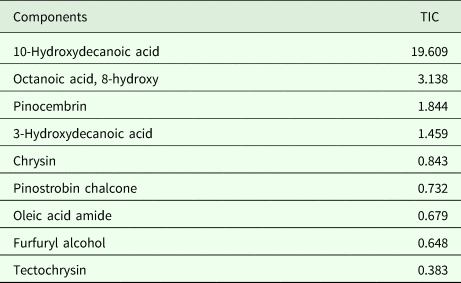
The current study was performed over 4 weeks under the temperate conditions of the winter season (average temperature 23 ± 1.2 °C). Thirty-six multiparous (2nd, 3rd, 4th parities) Ossimi ewes (38 ± 1.5 kg body weight [BW]) were chosen from the experimental farms of the Nuclear Research Center, Egypt. The animals were monitored during late pregnancy and assigned randomly 3 days after lambing to one of two experimental groups, each consisting of 18 ewes. The first group (CON) received the basal diet with no supplements, while the second experimental group (RJ) was fed the same diet but supplemented with a single bolus of RJ every 2 days (soft gelatine capsules; 1000 mg/animal) before the morning feeding. Although Husein and Kridli (Reference Husein and Kridli2002) suggested that 250 mg of oral RJ is a sufficient daily dose for breeding Awassi ewes, 1000 mg/animal as a single oral dose every 2 days (i.e. 500 mg/animal daily dose) was used in the current work in an attempt to ensure the long-lasting effect of the RJ supplements during a relatively short experimental period (4 weeks). The crude RJ was collected and prepared by the Pharco Company (Royal Jelly 1000 mg, Pharco Pharmaceuticals, Egypt). This commercial bolus was prepared from raw RJ collected during April. At this time, the chemical composition of RJ is more stable and homogeneous. Ewes were housed in a free stall and provided with shaded slatted floors and concrete-surfaced yard (4.5 m2 and 3.5 m2/ewe, respectively). In order to measure the daily feed intake of each animal, ewes were individually fed the recommended diet for 3 consecutive days in each week. Before and after lambing, the basal diet was given as a well-mixed ration (NRC, 2007). The concentrate mixture consisted of yellow maize, soybean, cotton seed cake, wheat bran, sugar beet bulb and a vitamin pre-mix (Lek Veterina, Beltinci, Slovenia). Chemical composition analysis of the diet was performed on a dry matter basis (AOAC, 1990). The chemical composition includes crude protein (176.8 g/kg DM), fat (28.7 g/kg DM as ether extraction), crude fibre (155.0 g/kg DM), ash (60.1 g/kg DM) and net energy (6.32 MJ/kg). The alfalfa hay, rice straw and concentrate were in a ratio of 35 : 20 : 45. Using gas chromatography-mass spectrometry (Shimadzu QP 2010 Plus, Japan), the chemical composition of RJ (Table 1) was determined as described by Cardenia et al. (Reference Cardenia, Rodriguez-Estrada, Baldacci, Savioli and Lercker2012). The gas chromatography column was a Zebron™ (ZB-1; ZB-5MSplus Capillary GC; Phenomenex Inc., California, USA) methyl polysiloxane (30 m × 0.25 mm i.d. × 0.25 µm film thickness). The main flavonoid components were: Chrysin, Pinocembrin, Tectochrysin and Pinostrobin chalcone. Animals were weighed weekly to determine possible changes in BW.
The chemical composition (major flavonoids and fatty acids) of royal jelly

TIC, the ion current generated depends on the characteristics of the compound concerned and expressed as percentages.
Milk yield and composition
All ewes were checked daily for clinical signs of mastitis, such as fever, painful reactions or glandular changes. In order to estimate daily milk yield, lambs were separated from their dams at 16.00 h and hand milked at 08.00 h the next morning (de Bie et al., Reference de Bie, Berger, Thomas, Thomas and Porter2000). This practice was continued for 3 consecutive days each week throughout the experiment. Hand milking was carried out by two expert milkers with the same level of expertise. Milk samples (c. 100 ml) were collected from each ewe on a weekly basis. The milk samples were protected by the 2-bromo-2-nitropropane-1,3 diol product (Sigma-Aldrich, Inc. Germany) to detect the milk gross composition: protein, fat, total solids and lactose contents by a milk analyser (MilkoScan 6000; Hillerød, Denmark).
Blood haematological, biochemical and antioxidant parameters
Before the morning feeding and on a weekly basis, two blood samples (3 ml each) were taken from each ewe via the jugular vein (4 consecutive weeks). The first sample was drawn off into an ethylenediaminetetraacetic acid tube. In order to assess the haematological indices, an automated analyser (AL 820, AVL Medical Instruments, Schaffhausen, Switzerland) was utilized to estimate the red blood cell (RBC) count, haemoglobin content (Hb), total leucocytic count (TLC) and the differential leucocytes picture. The second sample, collected into a plain tube, was centrifuged (3000 rpm) to obtain the serum portion, then preserved at −20 °C. Using a Technicon DAX 72 autoanalyser and accompanying kits (TECHNICON Engineering Services, Inc, USA) serum total protein (g/dl), albumin (g/dl), cholesterol (mg/dl), triglycerides (mg/dl) and urea (mg/dl) concentrations were measured. The serum total antioxidant capacity (TAC; mmol/l) was evaluated using the protocol described previously by Benzie and Strain (Reference Benzie and Strain1996). Catalase activity was measured by the spectrophotometric method based on the decomposition of hydrogen peroxide (H2O2; Aebi Reference Aebi1984). Serum superoxide dismutase (SOD) activity was measured using the procedure described previously by Nandi and Chatterjee (Reference Nandi and Chatterjee1988). The SOD assay was performed in the Tsuchihasi extract of erythrocyte haemolysate. The concentrations of serum malondialdehyde (MDA; μmol/l) were estimated according to a previously described protocol (Karatas et al., Reference Karatas, Karatepe and Baysar2002). The MDA standard was prepared by dissolving 25 µl 1,1,3,3 tetraethoxypropane (TEP) in 100 ml of water to give a 1 mm stock solution. The working standard was prepared by hydrolysis of 1 ml TEP stock solution in 50 ml of 1% sulphuric acid and incubation for 2 h at room temperature. The thiol component of glutathione (GSH; μmol/l) was evaluated by high-performance liquid chromatography (HPLC) using the method of Jayatilleke and Shaw (Reference Jayatilleke and Shaw1993). Glutathione reference standards were purchased from Sigma Chemical Company (Sigma-Aldrich, Inc. Germany), dissolved in 75% methanol in stock (1 mg/ml) and diluted before applying to the HPLC.
Statistical analysis
All available data were interpreted using the repeated measures analysis of variance as a MIXED procedure of the SAS statistical system package, version 9.1 (SAS, 2003). The normality of the available data was confirmed by Kolmogorov–Smirnov test (P > 0.05). The model for repeated measures was defined as:

where y ijk = feed intake, milk composition and serum biochemical parameters, μ = overall mean, T i = fixed effect of treatment, Ewe (T i)j = random effect of ewe nested in treatment, Timek = fixed effect of time, (Time × T)ik = interaction of time and treatment, and e ijk = random error term. Akaike's information criterion (AIC; Akaike, Reference Akaike, Petrov and Csaki1973) and Bayesian Information Criterion (BIC) were used to estimate the relative goodness-of-test and to compare suggested models with the same fixed effects but different covariance structures. The smallest value for both criteria indicates the best fit. The following covariance structures were used: spherical compound symmetry (CS); unstructured (UN); heterogeneous first-order autoregressive [ARH(1)]. Among these, CS was the best due to having the smallest fitting criteria.
Results
Milk yield and composition in lactating ewes
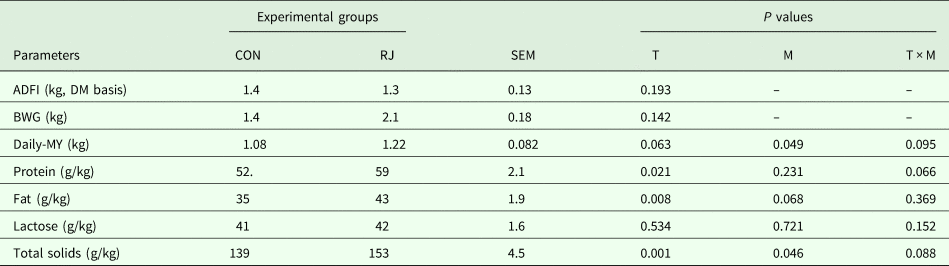
The influence of RJ on milk composition traits is presented in Table 2. Compared with the control treatment, the RJ group showed a non-significant increase in the average daily feed intake (ADFI) and DMY. Additionally, the RJ-supplemented ewes produced significantly higher milk protein, fat and total solids (P = 0.021, 0.008 and 0.001, respectively) compared with the control treatment. However, the RJ-supplemented ewes had non-significantly higher milk lactose percentage than the control treatment.
Feed intake and body weight changes, milk production and composition of lactating ewes supplemented with royal jelly
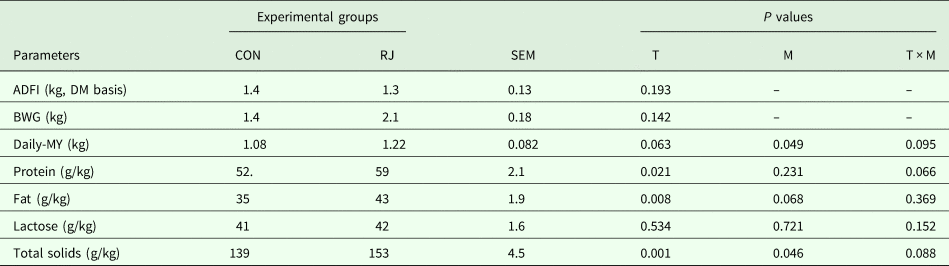
CON, control group; RJ, royal jelly-supplemented group; SEM, standard error mean; T, effects of treatment; M, effects of time; T × M, effects of treatment × time interaction; ADFI, average daily feed intake; BWG, body weight gain; Daily-MY, daily milk yield.
Blood haematological, biochemical and antioxidant parameters in lactating ewes
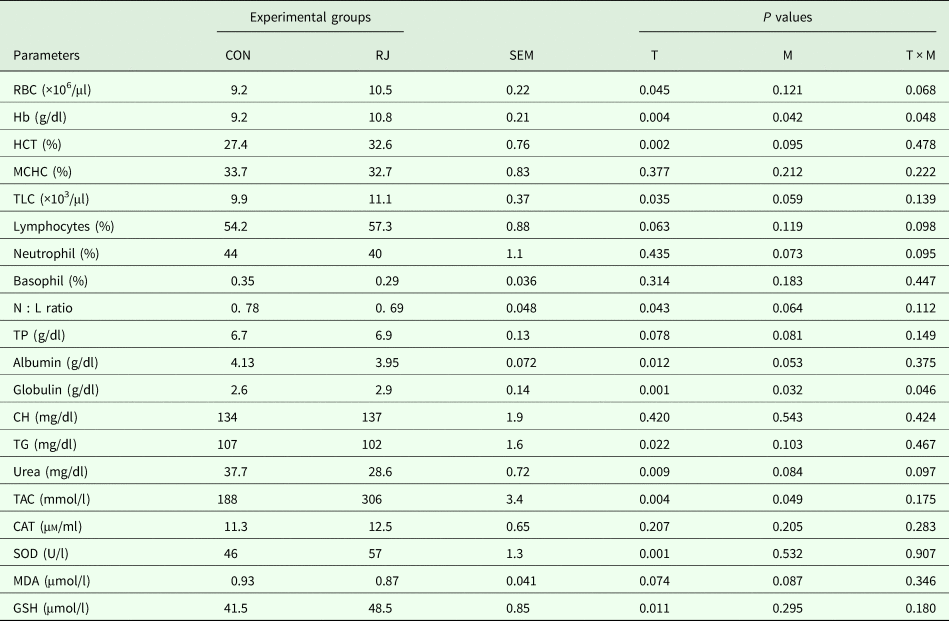
The influence of RJ on the blood haematological, biochemical and antioxidant parameters in Ossimi ewes is summarized in Table 3. The RJ group showed significantly higher RBC counts (P = 0.045), Hb contents (P = 0.004), HCT value (P = 0.002) and total leucocyte counts (P = 0.035), but lesser neutrophil to lymphocyte ratio (P = 0.043) when compared with the control treatment. Meanwhile, no considerable differences were reported on lymphocytes, neutrophil or basophil percentages between the CON and RJ group. The RJ group showed a significantly higher concentration of serum globulin (P = 0.001), but lower concentrations of serum albumin, triglycerides and urea (P = 0.012, 0.022 and 0.009, respectively) when compared with the control treatment. The RJ group showed significantly higher TAC (P = 0.004), SOD (P = 0.001) and GSH (P = 0.011) concentrations in the serum compared with the control treatment. However, no considerable variations were reported in the concentrations of serum catalase and MDA.
Blood haematological, biochemical and antioxidant parameters in lactating ewes supplemented with royal jelly
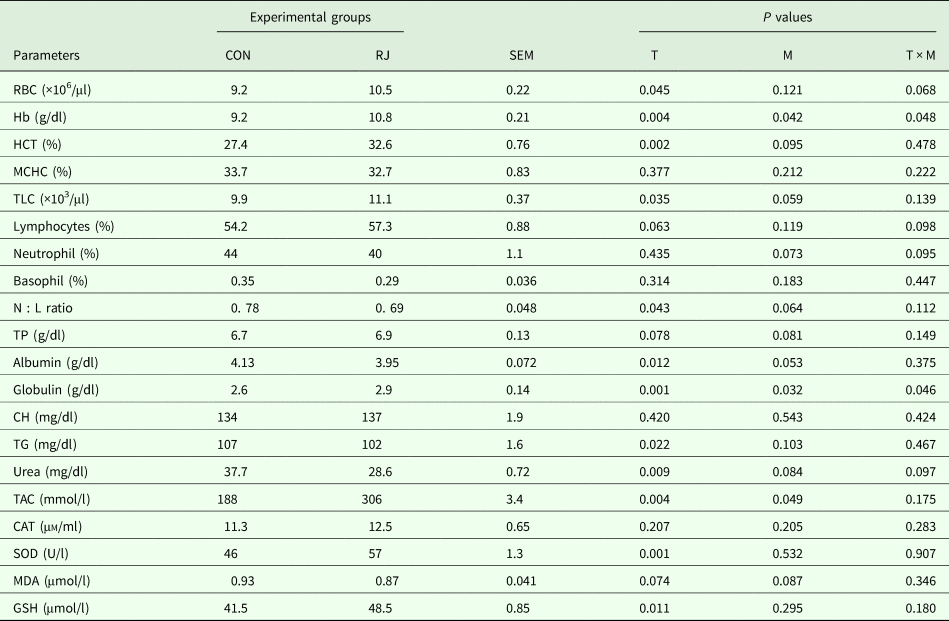
CON, control group; RJ, royal jelly-supplemented group; SEM, standard error mean; T, effects of treatment; M, effects of time; T × M, effects of treatment × time interaction; RBC, red blood cells; Hb, haemoglobin; HCT, haematocrit value; MCHC, mean corpuscular haemoglobin concentration; TLC, total leucocytes count; N : L, neutrophil to lymphocytes ratio; TP, serum total protein; CH, serum cholesterol; TG, serum triglycerides; TAC, total antioxidant capacity; CAT, catalase; SOD, serum superoxide dismutase activity; MDA, serum malondialdehyde; GSH, serum glutathione activity.
Discussion
Commercially, dietary RJ supplements are available in the form of soft gelatine capsules containing 1000 mg of natural product. Although the current trial reported non-significant increases in ADFI and milk yield in the RJ group, the contents of milk protein, fat and total solids were significantly improved. Similarly, Morsy et al. (Reference Morsy, Soltan, Sallam, Alencar and Abdalla2016) reported that propolis increased the milk yield and fat content of supplemented ewes compared with the control group. Moreover, both experimental groups in the current trial received comparable energy density in the diet (6.36 MJ/kg), with a possible mechanism for stabilizing energy metabolism in lactating RJ-supplemented animals. Considering that milk fat and protein contents are synthesized in the epithelial tissue of udder alveoli, the favourable effect of RJ may be attributable to its chemical constituents and in particular its major proteins, which play a pivotal function in cell membrane integrity (Tamura et al., Reference Tamura, Kono, Harada, Yamaguchi and Moriyama2009). Zhao et al. (Reference Zhao, Wang, Yang, Bu, Cui, Sun, Xu and Zhou2013) recorded that the rate of lipid peroxidation was elevated when the level of milk polyunsaturated fatty acids (FAs) is increased. Hence, the superior milk fat components in the RJ group support the hypothesis of a possible protective mechanism of phenolic compounds of RJ on plasma lipids, probably by capturing free radicals or binding with metal ions (Lindmark-Mansson and Akesson, Reference Lindmark-Mansson and Akesson2000). Furthermore, the improvement in serum antioxidant activities of supplemented ewes is considered as a confirmatory prospect. In contrast, Aguiar et al. (Reference Aguiar, Cottica, Boeing, Samensari, Santos, Visentainer and Zeoula2014) reported that propolis supplement increased lactose yield when compared with the control group, while milk fat and protein concentrations were not affected. Supplementation with RJ in the current research increased the proportion of milk solids significantly. Conflicting with the current results, Santos et al. (Reference Santos, Yoshimura, Machado, Matumoto-Pintro, Montanher, Visentainer, dos Santos and Zeoula2016) reported that the dietary propolis supplements did not improve the percentages of milk lactose and total solids in dairy cows.
The current study revealed that the RJ group did not show significant changes in BW of lactating ewes when compared with the CON group. In this context, Morsy et al. (Reference Morsy, Abdalla, Soltan, Sallam, El-Azrak, Louvandini and Alencar2013) stated that supplementing Santa Inês lactating ewes with propolis extract resulted in no significant variations in BW or body condition scores. Also, others have stated that concentrate supplementation during pregnancy and lactation of Santa Inês ewes did not affect the body condition score (Torreão et al., Reference Torreão, Rocha, Marques, Bezerra, Gottardi, Araújo, Souza Júnior and Oliveira2014).
In the current study, Ossimi ewes supplemented with RJ had significantly higher total leucocyte counts than that recorded in the CON group. The increased total leucocyte counts may indicate an improved immune system, whilst the significantly lower estimates of neutrophil to lymphocyte ratio in the RJ group may reflect an improvement in the welfare status of dairy ewes. Other researchers reported that the lower neutrophil to lymphocyte ratio is associated with lower inflammatory indices in the body (Choi et al., Reference Choi, Hong, Ahn, Park and Jeong2014). Further, previous authors have reported that beehive products increased the proliferation of leucocytes precursors of pluripotent stem cells in mice (Orsolić and Basić, Reference Orsolić and Basić2005). At a dose of 100 µg/ml, Vucevic et al. (Reference Vucevic, Melliou, Vasilijic, Gasic, Ivanovski, Chinou and Colic2007) stated that the FAs isolated from RJ (10-hydroxy-2-decenoic acid and 3–10-dihydroxydecanoic acid) modulate the immune response in rats (stimulate the proliferation of T cells). The current findings are in agreement with those reported by Morsy et al. (Reference Morsy, Abdalla, Soltan, Sallam, El-Azrak, Louvandini and Alencar2013), who demonstrated that Brazilian propolis supplements significantly increased TLC in dairy ewes. However, in contrast with the present results, they also recorded no considerable variation in the blood erythrocyte counts, Hb and haematocrit values. In the current trial, supplementing the RJ increased serum albumin and globulin, but decreased serum triglycerides and urea. Also, this may be attributed to the antihyperlipidemic properties of hydroxydecanoic acid, which is the main FA component in RJ (Izuta et al., Reference Izuta, Chikaraishi, Shimazawa, Mishima and Hara2009). In agreement with the current findings, a recent trial reported that supplementation of Santa Inês ewes with Brazilian propolis extract decreased serum triglycerides (Morsy et al., Reference Morsy, Abdalla, Soltan, Sallam, El-Azrak, Louvandini and Alencar2013). Kalafova et al. (Reference Kalafova, Hascik, Kacaniova, Petruska and Capcarova2015) reported that the inclusion of Slovakian propolis in broiler feeding tended to increase serum albumin level. However, Morsy et al. (Reference Morsy, Abdalla, Soltan, Sallam, El-Azrak, Louvandini and Alencar2013) recorded that supplementing lactating ewes with Brazilian propolis exerted no significant variations in serum albumin, cholesterol or urea, but increased serum total proteins and globulins significantly. Additionally, Koya-Miyata et al. (Reference Koya-Miyata, Arai, Mizote, Taniguchi, Ushio, Iwaki and Fukuda2009) mentioned that propolis extract mitigated hyperlipidaemia induced by high-fat-diets, through down-regulating mechanism in the expression of some genes associated with lipid metabolism. However, other trials noticed that the dietary supplementation of broilers with propolis induced a slight or no effect on the estimates of triglycerides (Kalafova et al., Reference Kalafova, Hascik, Kacaniova, Petruska and Capcarova2015).
Regarding the serum antioxidant profile, RJ-supplemented ewes had significantly greater serum TAC, SOD and GSH concentrations than that reported in the CON group. Royal jelly has been known to conserve tissue DNA, through the mechanism of reduced oxidative damage (Inoue et al., Reference Inoue, Koya-Miyata, Ushio, Iwaki, Ikeda and Kurimoto2003). In an experiment conducted on adult mice, the role of RJ in the protection of body tissues against oxidative stress has been confirmed (Kanbur et al., Reference Kanbur, Eraslan, Beyaz, Silici, Liman, Altinordulu and Atasever2009). Furthermore, the antioxidant capacity of RJ has been previously elucidated in various studies to confirm the scavenging ability against free radicals such as superoxide anion radicals (Nagai and Inoue, Reference Nagai and Inoue2004). Under the concept of high susceptibility of milk fat to oxidation, a recent trial suggested that beehive products, such as propolis, may limit the most deteriorating reactions which occur during the process of milk synthesis (Morsy et al., Reference Morsy, Soltan, Sallam, Alencar and Abdalla2016).
Conclusion
In conclusion, supplementation of RJ modulates the contents of milk proteins and total solids. Moreover, lactating ewes supplemented with RJ had superior blood haematological indices and serum antioxidant activity than that in the CON group. Considering that the current study is a preliminary trial, the action of RJ in lactating animals still needs additional investigation to determine the effective treatment duration, perfect dosage and mode of action.
Author ORCIDs
Mahmoud S. El-Tarabany, 0000-0002-9354-2209.
Financial support
This research received no specific grant from any funding agency, commercial or not-for-profit sectors.
Conflict of interest
The authors have no conflict of interest to declare.
Ethical standards
The experimental procedures of the current research were approved by the Committee of Nuclear Research Institute, Atomic Energy Authority, Egypt.