INTRODUCTION
The ancient Maya had a close affinity with the ocean and marine life for thousands of years, transporting marine shells and other sea creatures far inland to communities that would otherwise have no conception of the ocean's vast array of wildlife. Marine invertebrates, including gastropods, bivalves, and echinoderms like starfish and sea urchins, were valued by the Maya for their use as craft materials for ornaments and tools. Marine shell was a material without parallel at inland sites, for it was often thick, durable, easier to carve than stone, and occasionally boasted bright colors and patterns. Likewise, souvenirs from the sea were likely valued for their link to the watery underworld, since Maya mythos described a primordial sea where all life began and, eventually, ended (Tedlock Reference Tedlock1996). Access to marine species at inland sites was a rare opportunity to connect with this exotic realm.
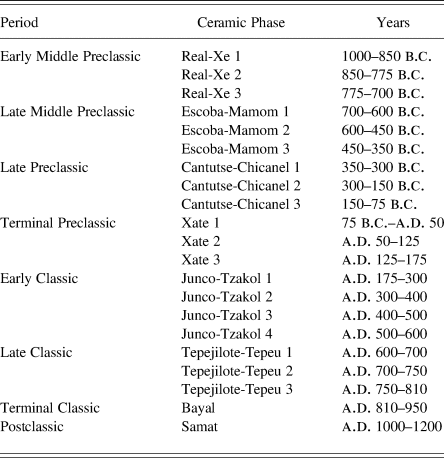
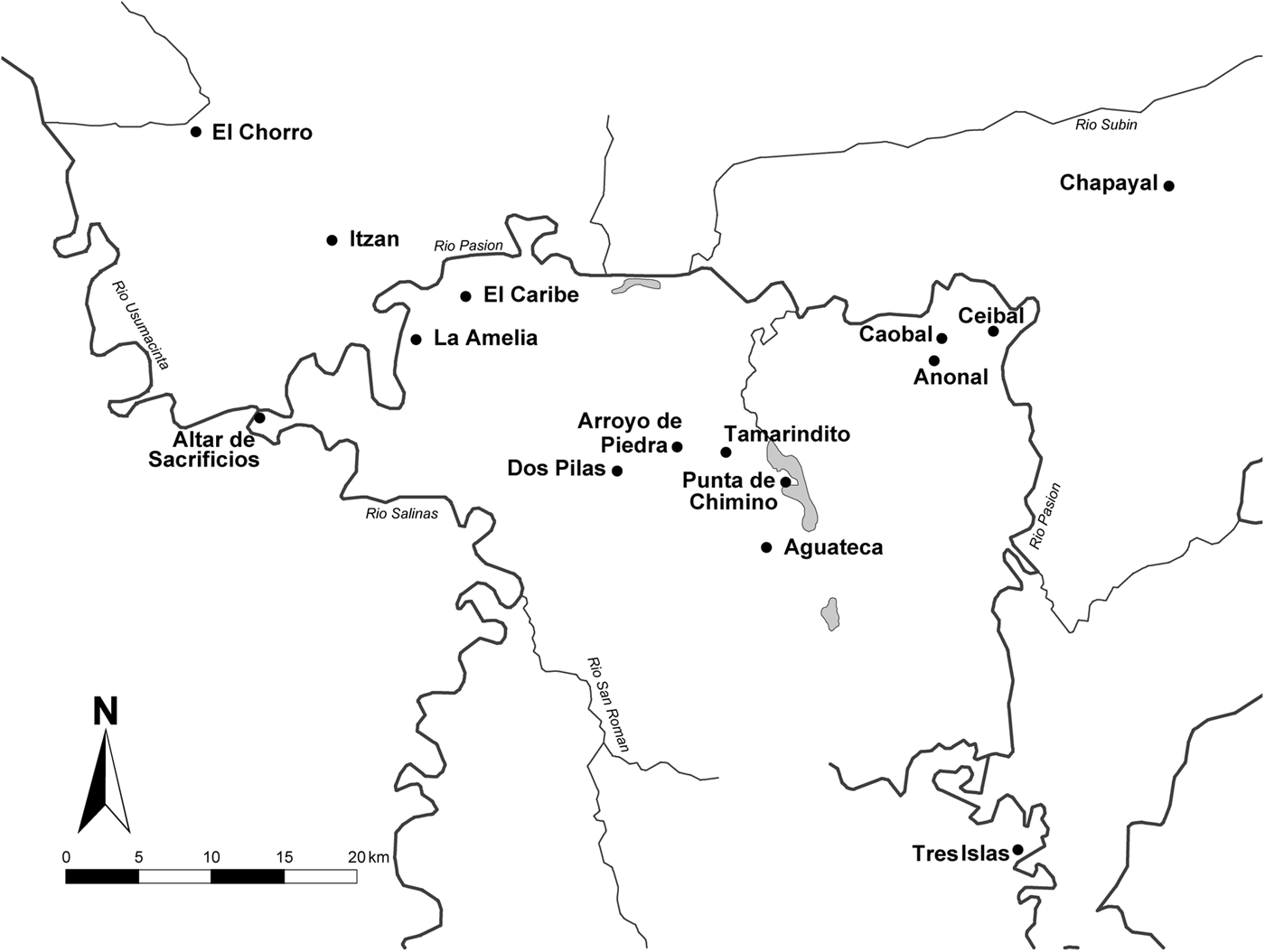
The archaeological site of Ceibal, Guatemala (Figure 1), provides an opportunity to assess the uses, values, and exchange networks of marine shells at an inland Maya site over a 2000 year span. Ceibal is located almost 150 kilometers from the nearest coast, and marine resources would have been difficult to acquire. The site was one of the earliest monumental ceremonial centers in the lowlands (Inomata et al. Reference Inomata, Triadan, Aoyama, Castillo and Yonenobu2013, Reference Inomata, MacLellan, Triadan, Munson, Burham, Aoyama, Nasu, Pinzón and Yonenobu2015, Reference Inomata, Triadan, MacLellan, Burham, Aoyama, Palomo, Yonenobu, Pinzón and Nasu2017a), and may have held the political and associated economic sway to obtain rare materials from distant lands, even very early in Maya history. Ceibal's long history, spanning the early Middle Preclassic through Early Postclassic periods (1000 b.c.–a.d. 1200; Table 1), allows for an assessment of changing economic and cultural practices associated with the use and transport of shells and other marine fauna across many generations.
Map of the southern Mesoamerica region. Sites that contain marine species discussed in the text are labeled. Map by the author.

The Ceibal chronology.

Several studies have previously examined marine shell use over time in the Maya area. Andrews's (Reference Andrews1969) monograph on marine shells in the Maya lowlands was one of the first extensive studies comparing marine shells and their uses across the Maya region. A number of site-specific marine shell studies have since been performed in Belize, including several investigations at Pacbitun (Healy et al. Reference Healy, Emery, Wagner, Hohmann, Stanchly, Healy and Emery2014; Hohmann Reference Hohmann2002, Reference Hohmann, Healy and Emery2014; Wagner and Healy Reference Wagner, Healy, Healy and Emery2014), as well as Blackman Eddy (Cochran Reference Cochran2009), Cerros (Hamilton Reference Hamilton1987), Chan (Keller Reference Keller and Robin2012), Frenchman's Cay (McKillop and Winemiller Reference McKillop, Winemiller and Emery2004), and K'axob (Aizpurúa and McAnany Reference Aizpuruia and McAnany1999). There have been fewer intensive marine shell studies in southern Mexico and Guatemala, with some significant exceptions, including Dzibilchaltun (Taschek Reference Taschek1994) and Oxtankah (Melgar Tisoc Reference Melgar Tisoc and Walker2016) in the Yucatan and Aguateca (Inomata and Emery Reference Inomata, Emery, Inomata and Triadan2014), Tikal (Moholy-Nagy Reference Moholy-Nagy1963, Reference Moholy-Nagy and Pohl1985, Reference Moholy-Nagy, Haynes and Ceci1989), and El Zotz (Gutiérrez Castillo Reference Gutiérrez Castillo2015) in Guatemala. Many of these studies have focused on the method of crafting used to manufacture shells into ornaments and ritual paraphernalia (e.g., musical instruments).
This study reports on the marine invertebrate analysis of the fauna excavated from the 2005–2015 field seasons at the site of Ceibal and its nearby subordinate community, Caobal (Figure 2). Taxa are compared over time and space at the two sites as a means of understanding which species were transported to the site over time, what particular purpose certain taxa served, and, in some cases such as burials, who were the destined recipients of these rare goods. Patterns observed at Ceibal and Caobal over time are compared to other reports of marine shells throughout the Maya lowlands in order to gauge the flow of marine invertebrate resources overland and the supply and demand of certain species for specific functions. By tracking these changing patterns over the course of two thousand years, this study aims to improve our knowledge of how and why shells were used and traded long distances as part of the broader Maya sociocultural system.
Map of the Pasión River region, including the sites of Ceibal and Caobal. Map courtesy of Jessica Munson (Munson and Pinzón Reference Munson and Pinzón2017:Figure 1).

THE HISTORY OF CEIBAL AND ITS EXCAVATIONS
Ceibal (formerly “Seibal”) is located in the central part of the southern Petén Department of Guatemala, on the shore of the Pasión River tributary leading to the larger Usumacinta River (Inomata et al. Reference Inomata, Triadan and Aoyama2017b). Eastward, access to the Caribbean Sea would have necessitated an overland trip through dense forest, perhaps assisted with partial river transport in some areas. Toward the north, canoe transport to Ceibal would have been possible from the Mexican Gulf Coast via the Pasión and Usumacinta river system, although it would have been a longer trip necessitating a journey through the Sierra del Lacandón region and river rapids. Both routes would have required negotiating with inhabitants encountered in the sites and polities along the way. Toward the west, Ceibal may have had overland trade connections with the Pacific coast through Chiapas in Mexico or across the southern Guatemalan highlands, although these, too, would have been long and potentially circuitous networks.
Although recent light detection and ranging studies at Ceibal have shown that the community may have extended far beyond the monumental epicenter (Inomata et al. Reference Inomata, Triadan, Pinzón, Burham, Ranchos, Aoyama and Haraguchi2018), most of the excavations have concentrated on epicenter Groups A and D, as well as the surrounding residential groups that lie within one kilometer of the site core. Like other Maya sites, many structures were rebuilt or expanded over the centuries, and so it is unknown how many of the structures and platforms were occupied at any given time, although ground-truth surveys and excavations around the epicenter and region surrounding the site suggest that Ceibal's peak populations may have occurred during the late Middle and Late Preclassic and again during the Late/Terminal Classic periods.
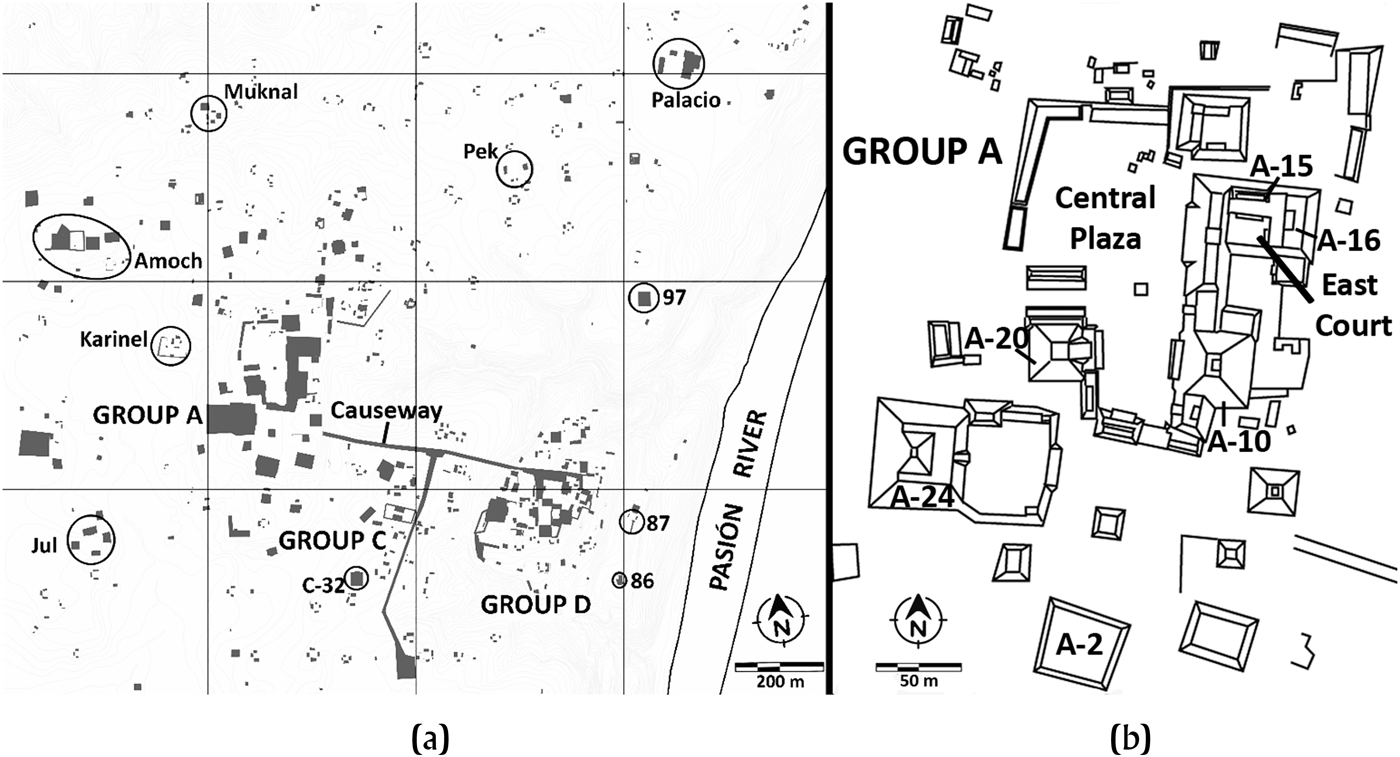
Ceibal's site history began in the Real-Xe ceramic phase of the early Middle Preclassic period (1000–700 b.c.; Inomata et al. Reference Inomata, Triadan, Aoyama, Castillo and Yonenobu2013, Reference Inomata, Triadan, MacLellan, Burham, Aoyama, Palomo, Yonenobu, Pinzón and Nasu2017a). Although several contemporaneous sites have been excavated (i.e., Altar de Sacrificios, Tikal, and sites within and around the Belize River Valley, such as Pacbitun, Cahal Pech, and Blackman Eddy), demographics and trade connections from that time are still poorly understood due to limited archaeological evidence (Adams Reference Adams1971; Andrews and Hammond Reference Andrews and Hammond1990; Ball and Taschek Reference Ball and Taschek2003; Garber Reference Garber2004; Rice Reference Rice1976). Throughout the Middle Preclassic period, Ceibal's central core arose to boast a series of monumental construction projects, including a large Central Plaza (Group A; Figure 3) and surrounding structures with stone architecture (Inomata Reference Inomata2017; Inomata et al. Reference Inomata, Triadan, MacLellan, Burham, Aoyama, Palomo, Yonenobu, Pinzón and Nasu2017a, Reference Inomata, Pinzón, Palomo, Sharpe, Ortíz, Méndez and Román2017c). A series of ceremonial offerings were placed in the plaza during the Middle and Late Preclassic periods. The earliest of these included greenstone axe heads and obsidian cores, some arranged in cruciform patterns that suggested cultural ties with the Olmec region in the Gulf Coast (Aoyama et al. Reference Aoyama, Inomata, Triadan, Pinzón, Palomo, MacLellan and Sharpe2017a, Reference Aoyama, Inomata, Pinzón and Palomo2017b). Late Preclassic ceremonies (350–75 b.c.) increasingly included human skeletons, often with Sierra Red and other vessel offerings, and may have been sacrificed individuals (Inomata et al. Reference Inomata, Pinzón, Palomo, Sharpe, Ortíz, Méndez and Román2017c; Palomo et al. Reference Palomo, Inomata and Triadan2017). Many of these Preclassic deposits contained marine offerings.
(a) Map of the Ceibal archaeological site and (b) the Group A ceremonial core. Structures from Group A mentioned in the text are labeled. Map courtesy of the Ceibal-Petexbatun Archaeological Project.

Ceibal's population began to decline during the Early Classic period (a.d. 175–600), as did construction projects and ceremonial activity in the site's epicenter (Inomata et al. Reference Inomata, Triadan and Aoyama2017b, Reference Inomata, Pinzón, Palomo, Sharpe, Ortíz, Méndez and Román2017c). It is unclear what caused this decline, although it can be assumed that political and economic shifts across the lowland region were partly responsible. There is increasing evidence for a series of regional abandonments that took place during the Terminal Preclassic period, which some have posited could have been due to a period of drought occurring around the second century a.d. (Dunning et al. Reference Dunning, Wahl, Beach, Jones, Luzzadder-Beach, McCane and Iannone2014). At Ceibal, several of the residential groups around the central monumental core continued to be occupied, including the Karinel Group, located on a natural rise close to the ceremonial Group A core and Central Plaza (Triadan et al. Reference Triadan, Castillo, Inomata, Palomo, Méndez, Cortave, MacLellan, Burham and Ponciano2017).
During the Late Classic period (a.d. 600–810), Ceibal experienced a second, albeit slow, rise to political power. The Central Plaza was no longer used for extensive ritual caching, although it continued to be expanded and a number of large stone pyramids and stelae were constructed in and around its vicinity. Group D to the east, which previously had seen light occupation, grew to become a second acropolis and the likely residence of the ruling elite and their relatives (Bazy and Inomata Reference Bazy and Inomata2017). Several of the outlying residential groups were also expanded (Triadan et al. Reference Triadan, Castillo, Inomata, Palomo, Méndez, Cortave, MacLellan, Burham and Ponciano2017). Ceibal was a vassal center under Dos Pilas until the Terminal Classic period (a.d. 810–950), when it briefly became a local capital in its own right, before the entire center was abandoned as a result of regional unrest during the Terminal Classic collapse. A few of the outlying residential groups were reoccupied by small populations during the Postclassic period (a.d. 1000–1200), although the monumental Groups A and D were abandoned.
The first excavations at Ceibal began in 1964, under the direction of Gordon Willey of the Harvard Peabody Museum (Graham Reference Graham1990). About three dozen marine invertebrates were identified from the original Harvard excavations (Willey Reference Willey and Willey1978) and will be referenced in the present study. The second series of excavations at Ceibal was performed by the Ceibal-Petexbatun Archaeological Project (CPAP), starting in 2005, as an international collaborative effort under the direction of Takeshi Inomata and Daniela Triadan of the University of Arizona, Kazuo Aoyama of the University of Ibaraki, Japan, and Eric Ponciano, Victor Castillo Aguilar, Juan Manuel Palomo, and Flory María Pinzón of the Institute of Anthropology and History, Guatemala. Peripheral residential groups were excavated by Melissa Burham (Amoch, Jul, Muknal, and Pek Groups) and Jessica MacLellan (Karinel Group) of the University of Arizona (Figure 3). One of the objectives of the CPAP excavations was to examine Ceibal's Preclassic history, since the 1960s excavations had focused mainly on the uppermost Late and Terminal Classic period strata. The shells in the present study therefore cover the two millennia span the site was occupied.
HISTORY AND EXCAVATIONS AT CAOBAL
Caobal was a minor ceremonial center located about four kilometers to the west of Ceibal (Figure 2; Munson Reference Munson2012; Munson and Inomata Reference Munson and Inomata2011; Munson and Pinzón Reference Munson and Pinzón2017). Excavations at Caobal were conducted by Jessica Munson and the CPAP during 2008 and 2009. Like Ceibal, Caobal had a Central Plaza surrounded by monumental structures, including one large main pyramid (Structure 1) on the east side. Other platforms and smaller structures surrounded this central group. Caobal was first established sometime in the Middle Preclassic period as an outlying village near Ceibal, perhaps toward the end of the Real-Xe phase. Its artifact record, including ceramic technology and obsidian sources (Aoyama and Munson Reference Aoyama and Munson2012), parallels that of Ceibal over time, suggesting the two sites shared close sociocultural ties. Like Ceibal, there is comparatively little Early Classic-period material at Caobal relative to the Preclassic and later Classic phases, suggesting Caobal's population also declined at that time. Caobal experienced a resurgence of activity during the Late and Terminal Classic periods, but was permanently abandoned thereafter, likely when Ceibal's elite epicenter was abandoned.
METHODS
Invertebrate material in this study comes from a variety of contexts, including the fill and floors of both large structures (pyramids and the palace at the site epicenter) and residences (households of patio groups), middens around these structures, plazas and patio areas, and excavations in and around causeways. The majority of excavation units used a 0.25-in. screen mesh, although project archaeobotanist Hiroo Nasu (Graduate University for Advanced Studies, Japan) performed soil flotation on several lots across the site.
Analysis of the invertebrate remains was conducted at the CPAP laboratory in Guatemala City, Guatemala, and at the Florida Museum of Natural History's Environmental Archaeology Program Zooarchaeology and Invertebrate Zoology Collections, in Gainesville, Florida. Sea urchin spine identifications were made at the Smithsonian Tropical Research Institute Naos Marine Biology Laboratories in Panama City, Panama, with assistance of lab director Harilaos Lessios. All specimens were identified to the lowest taxonomic rank possible. Taxonomic terminology was checked with the Darwin Core glossary of standards to make sure all terms were currently accurate, with assistance from the Integrated Taxonomic Information System (2018) and the World Register of Marine Species (2018).
In light of the many discussions regarding the advantages and disadvantages of different invertebrate quantification techniques, particularly shells (Claassen Reference Claassen2000; Giovas Reference Giovas2009; Mason et al. Reference Mason, Peterson and Tiffany1998), this study uses a combination of two techniques. The primary method is an estimation of the minimum number of individual (MNI) animals. Both gastropods and bivalves were counted based on the greatest number of overlapping segments of the same part. Differences in size, if visible, were also taken into consideration when assessing MNI. The only exceptions to this quantification strategy were the modified mollusk ornaments and beads, likely made from gastropods, which were counted as individual specimens in order to quantify the number of ornaments/beads. Unidentified mollusk specimens are therefore overrepresented compared to other categories of taxa. Specimen weights were not used as a means of comparing taxa due to differences in shell preservation and density.
At present, there is no specific typology that Maya archaeologists follow when classifying shell artifacts. Some terms are more common than others, and while there is a general consensus over what certain terms mean in the literature (Emery and Aoyama Reference Emery and Aoyama2007; Freidel et al. Reference Freidel, Masson and Rich2017; Garber Reference Garber1989; Healy et al. Reference Healy, Emery, Wagner, Hohmann, Stanchly, Healy and Emery2014; Hohmann Reference Hohmann2002, Reference Hohmann, Healy and Emery2014; Taschek Reference Taschek1994), there is no rigid definition, in part because the forms themselves may vary. For example, the term “shell tinkler” is generally used to refer to modified olive shells that would have hung from a band or belt, although the term can sometimes be used to refer to similar ornaments made from other shell species. Most shell artifacts found at Ceibal were broken or partial ornaments, and are described by the shell species and shell part (e.g., cut spire, cut interior whorl, or perforated valve) rather than by a specific artifact term. Identifiable ornaments are often pierced olive shells or small gastropods of other species, such as Atlantic marginella shells. Only olive shells are referred to as tinklers in this study, since in every case they had at least one perforation hole in the center body and were likely worn as a dangling ornament. All other pierced shells are referred to as beads, including carved rounded shell ornaments with a hole in the center, likely made from large gastropods.
Invertebrate specimens are compared in the following sections on the basis of chronology, location, and specific context. Contexts in this study were broken down into three categories: burials, caches/ceremonial deposits, and midden/fill. Midden and fill contexts are grouped in this study because the ancient Maya frequently used secondary midden material to build structures and plazas. Chronological information is based on a combination of ceramic typology as well as radiocarbon dates tested throughout both Ceibal and Caobal (Inomata et al. Reference Inomata, MacLellan, Triadan, Munson, Burham, Aoyama, Nasu, Pinzón and Yonenobu2015, Reference Inomata, Triadan, MacLellan, Burham, Aoyama, Palomo, Yonenobu, Pinzón and Nasu2017a; Munson Reference Munson2012). The excavating archaeologists determined the nature of specific contexts, on the basis of the specimen provenience, associated materials, and, in some cases (e.g., termination rituals), comparison with similar contexts reported from other sites.
CHRONOLOGICAL OVERVIEW OF RESULTS
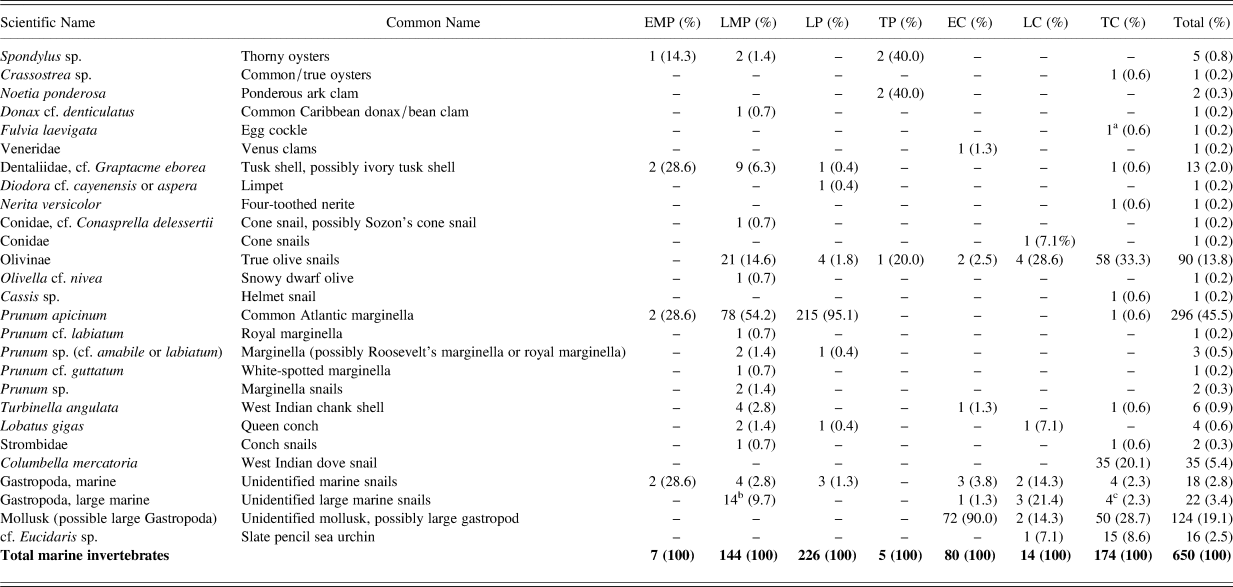
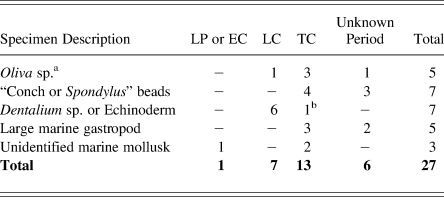
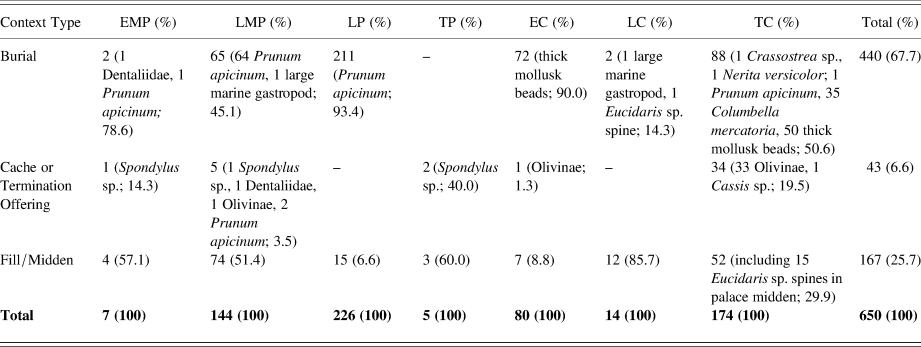
The following section reviews the marine invertebrate results over time at both Ceibal and Caobal, following the seven major periods of Ceibal's history (Tables 2 and 3). Specimens identified in the original 1960s excavations (Table 4, based on Willey Reference Willey and Willey1978), primarily of Late and Terminal Classic origin, are also discussed but are not included in the overall tallies. Some species, such as the true olive (referred to as Olivinae in this study, due to the recent division of its genera to Americoliva and Oliva) and large gastropods, are found throughout Ceibal's history, especially the two peaks of Ceibal's political power during the late Middle Preclassic period (700–350 b.c.) and Terminal Classic period (a.d. 810–950). These two periods had the greatest taxonomic diversity. Other species appear to be period- or even case-specific, such as the Atlantic marginella (Prunum apicinum) and tusk shells (Dentaliidae, cf. Graptacme eborea, previously Dentalium eboreum) that appear mainly during the Preclassic, and West Indian dove snails (Columbella mercatoria) and sea urchins (cf. Eucidaris sp.) in the later Classic periods. The majority (67.7 and 84.2 percent at Ceibal and Caobal, respectively) of shells were found in burial deposits (Table 5), although many remains, particularly fragmented specimens, were found in fill and midden material throughout the sites (25.7 and 15.8 percent at Ceibal and Caobal, respectively). Of the specimens at Ceibal, 6.6 percent were found in caches, with five caches occurring in the Preclassic and two in the Classic phases (Table 5). No caches containing marine taxa were recovered from Caobal.
Total number of marine invertebrate specimens at Ceibal over time. Percentages based on total for each chronological period. EMP, Early Middle Preclassic (1000–700 b.c.); LMP, Late Middle Preclassic (700–350 b.c.); LP, Late Preclassic (350–75 b.c.); TP, Terminal Preclassic (75 b.c.–a.d. 175); EC, Early Classic (a.d. 175–600); LC, Late Classic (a.d. 600–810); TC, Terminal Classic (a.d. 810–950).

a Postclassic period (Samat phase).
b Includes six large gastropod pieces (finished ornaments and cut pieces) spread throughout one large midden in the Jul Group.
c Context of one shell is unknown, found on or near the surface but likely Terminal Classic (Bayal phase).
Total number of marine invertebrate specimens at Caobal over time. Percentages based on total from each chronological period. LMP, Late Middle Preclassic (700–350 b.c.); LP/TP/EC, Late Preclassic through Early Classic (350 b.c.–a.d. 600); LC/TC, Late Classic and Terminal Classic (a.d. 600–950).

Summary of marine invertebrates at Ceibal reported by Willey (Reference Willey and Willey1978). Willey (Reference Willey and Willey1978) also reported a missing shell (S-3092) with “incision or scoring” marks that was lost after excavation, but it is not known if this was a marine shell. LP or EC, Late Preclassic through Early Classic (350 b.c.–a.d. 600); LC, Late Classic (a.d. 600–810); TC, Terminal Classic (a.d. 810–950).

a Although these olives were identified as Oliva sp., it is likely many belong to the genus now identified as Americoliva.
b Tepejilote or Bayal (“B-T”).
Marine invertebrates at Ceibal by context type. Species identifications listed for burial and cache/termination offerings. Terminal Classic fill includes one Postclassic Fulvia laevigata. EMP, Early Middle Preclassic (1000–700 b.c.); LMP, Late Middle Preclassic (700–350 b.c.); LP, Late Preclassic (350–75 b.c.); TP, Terminal Preclassic (75 b.c.–a.d. 175); EC, Early Classic (a.d. 175–600); LC, Late Classic (a.d. 600–810); TC, Terminal Classic (a.d. 810–950).

Early Middle Preclassic: Real-Xe Phase (1000–700 b.c.)
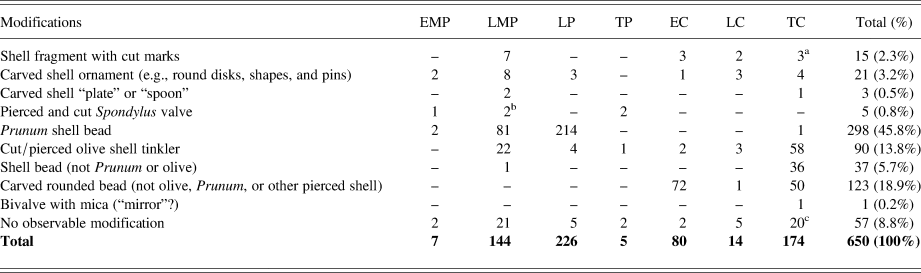
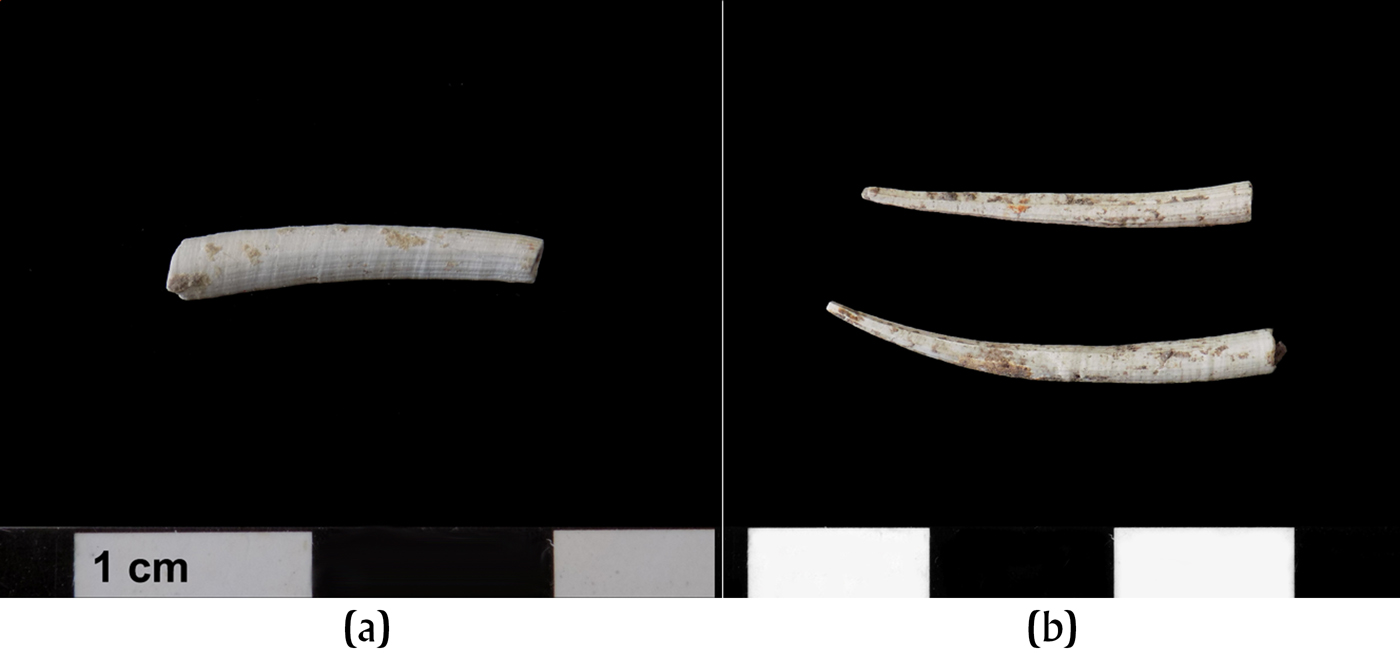
Seven modified marine shells were recovered from Real-Xe contexts at Ceibal, all from the site ceremonial core. No shells were recovered from Real-Xe contexts at Caobal. Those found at Ceibal came from two areas in the core: the Group A Central Plaza (five shells) and the Group A East Court (two shells). Four shells (a tusk shell and two unidentified marine gastropod fragments) were found in plaza fill, while three (a tusk shell, an Atlantic marginella shell, and a Spondylus valve) were found in special burial and cache contexts. All shells date to the third phase of the Real-Xe ceramic period (775–700 b.c.), and all appear to have been modified (Table 6), although this is not clear on the tusk shells, since the ends are broken (Figure 4). All seven may have been ornaments.
Tusk shells (Dentaliidae, cf. Graptacme eborea) at Ceibal: (a) tusk shell with dorsal end broken, found in the fill of the Group A East Court plaza, dating to the Real-Xe 3 phase (775–700 b.c.); (b) two tusk shells with dorsal end tips intact, from a fill deposit in the Karinel Group dating to the Escoba-Mamom 2 phase (600–450 b.c.). Photographs by the author.
Anthropogenic modifications on the Ceibal marine fauna. EMP, Early Middle Preclassic (1000–700 b.c.); LMP, Late Middle Preclassic (700–350 b.c.); LP, Late Preclassic (350–75 b.c.); TP, Terminal Preclassic (75 b.c.–a.d. 175); EC, Early Classic (a.d. 175–600); LC, Late Classic (a.d. 600–810); TC, Terminal Classic (a.d. 810–950).

a Includes the large gastropod found in the Karinel Group without definitive context, but likely Bayal phase.
b Shattered/cut valves, but surface scraping and evidence of perforating suggest they had been worn.
c Includes a Postclassic Fulvia laevigata fragment and 15 sea urchin spines.
Two shells were found in two different burials beneath the Central Plaza, including a tusk shell in Burial 130 (recovered through flotation of the soil in and around the skeleton), and a punctured Atlantic marginella shell in Burial 136. The individual buried with the tusk shell was only about a month old (Palomo et al. Reference Palomo, Inomata and Triadan2017), whereas Burial 136 included a young adult male interred with several ceramic vessels containing the remains of burned offerings (Palomo Reference Palomo, Pinzón and Inomata2014:166; Palomo et al. Reference Palomo, Inomata and Triadan2017; Pinzón Reference Pinzón, Aguilar and Inomata2012:14).
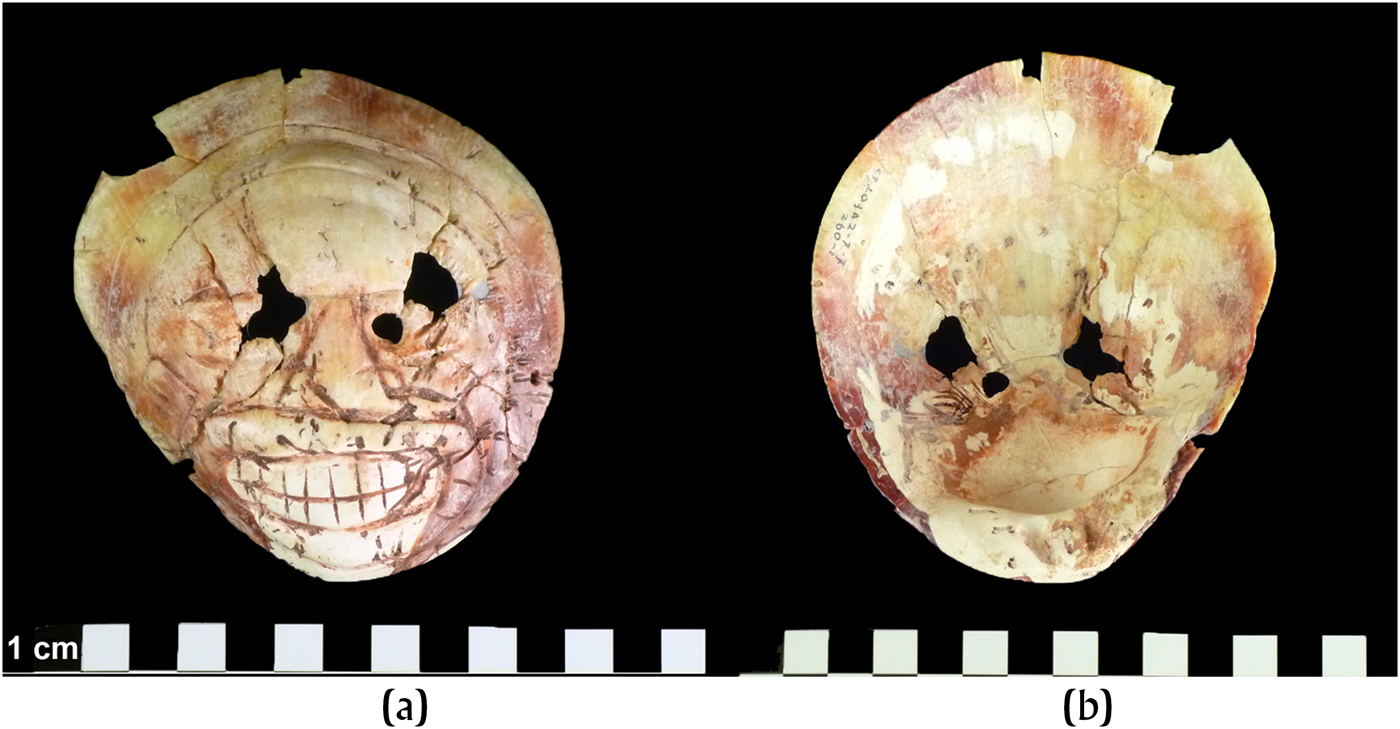
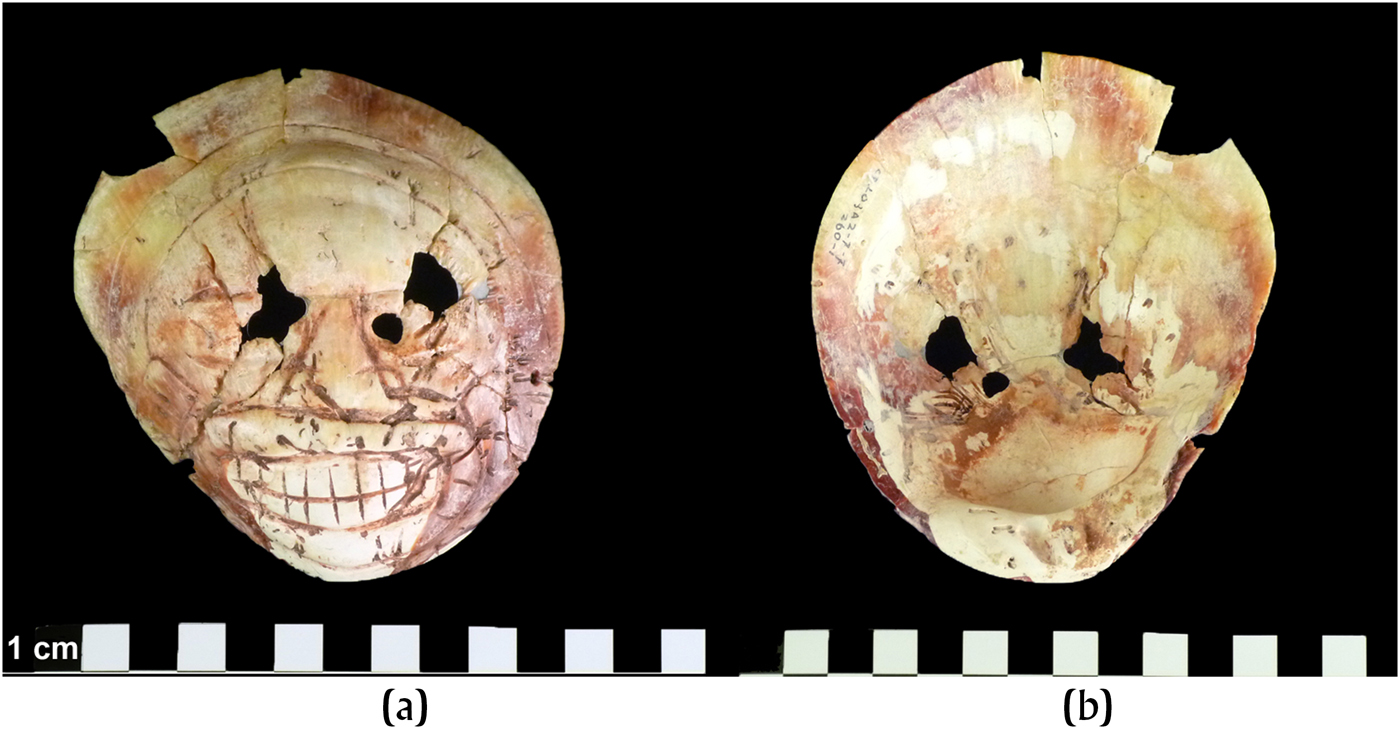
In addition to the two burials, a ritual deposit (Cache 108) was also found in the Central Plaza, containing a single valve of a Spondylus shell, or thorny oyster (Figure 5). It is impossible to identify this oyster as belonging to either the Atlantic or Pacific varieties based on physical attributes, both because the shell has been heavily modified and because secure identifications of even unmodified Spondylus are difficult. The valve's thorns and part of its exterior surface had been removed, in order to incise what appears to be the visage of a desiccated human head (Inomata et al. Reference Inomata, Pinzón, Palomo, Sharpe, Ortíz, Méndez and Román2017c). The shell has several perforations, suggesting it may have been worn, possibly upside-down and emblematic of a trophy skull.
(a) Exterior and (b) interior views of a thorny oyster (Spondylus sp.) valve found in Cache 108 in the Group A Central Plaza and dating to the Real-Xe 3 phase (775–700 b.c.). The valve may have been carved to resemble a desiccated human head, and was possibly worn upside-down. Photographs by the author.
Late Middle Preclassic: Escoba-Mamom Phase (700–350 b.c.)
The Mamom phase had the greatest diversity of marine invertebrate taxa of any time in Ceibal's history, with at least 11 different species, nine of which were gastropods. At least 15 unidentifiable shells were also gastropods, while three specimens could not be identified as either gastropod or bivalve. Marine shells were found in five different areas of the site, including the Central Plaza (84 specimens), the Group A East Court (18 specimens), the Structure A-24 platform (12 specimens), the Karinel residential group (19 specimens), and the Jul residential group (11 specimens). A slight majority of the shells (74 specimens, or 51.4 percent of the period) were found in midden or fill deposits, and the rest were directly associated with human burial and cache contexts.
The most common shell taxon from this period was the Atlantic marginella (54.2 percent), all of which were modified into beads with a small hole in the central body region. Olive shells were also common throughout the site (14.6 percent), and these were all modified as well, usually with a crosswise cut to remove the spire and one or two holes in the body region, either in the center or near the anterior end. Interestingly, all but one olive shell was found in secondary midden or fill material in contexts scattered across the site, suggesting they were not a prized cache or burial item at this time, and were more likely used until they were eventually discarded. Fragments of unidentifiable worked gastropod shell made up the third most common shell type recovered across the site (12.5 percent).
Expanding on a pattern begun in the Real-Xe period, several burials of individuals of varying age and sex were placed in the Central Plaza along with marine shells. Atlantic marginella beads were placed with several plaza burials, including Burial 146 (17 shells) and multi-individual Burial 153 (47 shells). The interred individuals were juveniles or subadults in all discernable cases. Burial 146 was a child of about 3–5 years of age with the Atlantic marginella shells found alongside two mostly-intact ceramic vessels, four obsidian cores aligned in a cruciform arrangement, and a piece of pyrite and greenstone (Palomo and Jerez Reference Palomo, Jerez and Palomo2013:9, 21). The shells were found with the pyrite and greenstone near the center of the deposit. Burial 153 contained the remains of four individuals laid out in a cruciform formation, including three children and one young adult. They were found alongside several other burial goods consisting of green stone beads, a green stone axe head, and five obsidian cores (Pinzón and de Muylder Reference Pinzón and de Muylder2014:10, 21). At least 47 pierced Atlantic marginella were found near the northernmost child.
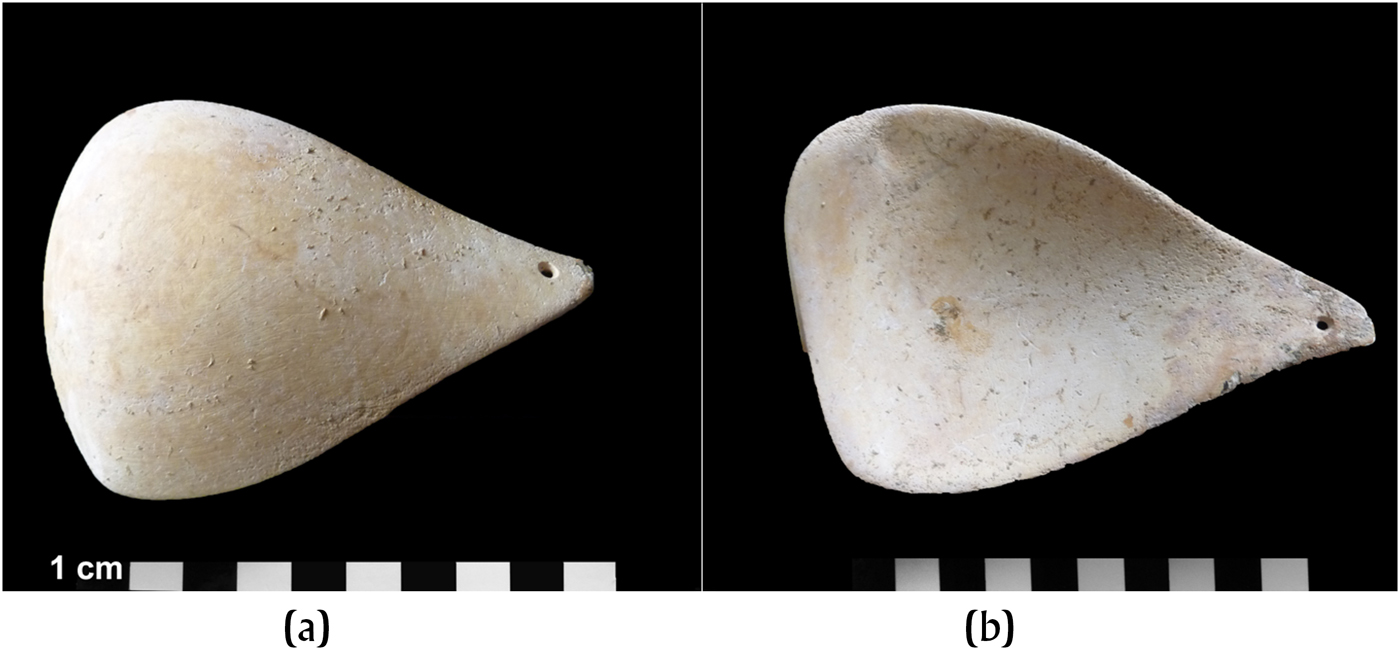
Two adult male burials also contained carved marine shell ornaments. One of these was Burial 104, an articulated adult male found in the northern part of the Central Plaza that had a large, unidentifiable gastropod “spoon” or “plate” (Figure 6) found among numerous other burial items arrayed around the upper torso and head, including obsidian blades and at least four large river clam valves (Unionidae, at least three Megalonaias nervosa; Aoyama et al. Reference Aoyama, Inomata, Pinzón and Palomo2017b; Palomo et al. Reference Palomo, Inomata and Triadan2017). A hole at the end of the shell plate suggests its use was ornamental. The second was Burial 126, found in the Jul residential group. This adult male individual was interred within a carved-out cavity in the underlying limestone bedrock (Burham Reference Burham, Aguilar and Inomata2012; Palomo et al. Reference Palomo, Inomata and Triadan2017). The burial was covered by a dense deposit of artifactual material, likely the remains of a midden. Some artifacts, including an upturned ceramic vessel, could be immediately associated with the burial, but the rest, mostly broken ceramic sherds and apple snail (Pomacea flagellata) fragments, could not be conclusively attributed to the interment. Among the midden material were several carved and polished gastropod shell fragments, as well as two interior whorls from large West Indian chank shells (Turbinella angulata). One large Prunum species, possibly a white-spotted marginella (Prunum guttatum), was found with the remains and had been pierced in an identical fashion to the smaller Atlantic marginella.
(a) Exterior and (b) interior views of an unidentified large gastropod placed in Burial 104 in the Group A Central Plaza, dating to the Escoba-Mamom 3 phase (450–350 b.c.). The shell has been carved into a flat “plate” and was possibly used as an ornament. Photographs by the author.
Several caches containing shell objects were also found in the Group A ceremonial core. Among these were a second possible Spondylus pectoral in the Central Plaza (Cache 149). Unlike the “skull” pectoral of Cache 108, this shell had been cut in a seemingly haphazard fashion and fragmented, although most of the valve was still present. Two olive and Atlantic marginella shell beads were found in a possible termination deposit located in an area of the Central Plaza that contained carbon fragments and ash (Pinzón Reference Pinzón, Aguilar and Inomata2012:10). Numerous olive tinklers and Atlantic marginella shell beads were found in the fill of the Structure A-24 platform near the Central Plaza as well as elsewhere at the site, although these do not appear to have been associated with burials or caches. Further away from the Central Plaza, a small tusk shell was found in a vessel cache (Cache 135) behind the East Court platform, which would later become the site of the Terminal Classic-period palace. Tusk shells were also found in various parts of the fill of the East Court, as well as the Karinel residential group (Figure 4b).
Regarding the construction fill and secondary (possibly even tertiary) midden contexts at Ceibal, it is likely the shells found in these locations were either intentionally discarded (for instance, broken ornaments or worked shell debitage) or were accidentally left behind or lost, although the latter is impossible to prove in any instance. For example, the broken and eroded interior whorl fragments of West Indian chank shells were found in two residential groups (Jul and Karinel) and the Group A Central Plaza, and two similarly-sized eroded cores of two queen conch shells were found in the Karinel and Group A East Court patios, suggesting they may have served a similar function (perhaps as musical instruments or material for shell-crafting) before being discarded. Olive shell tinklers and broken fragments of unidentified gastropod ornaments, similarly, were found scattered in fill throughout the site.
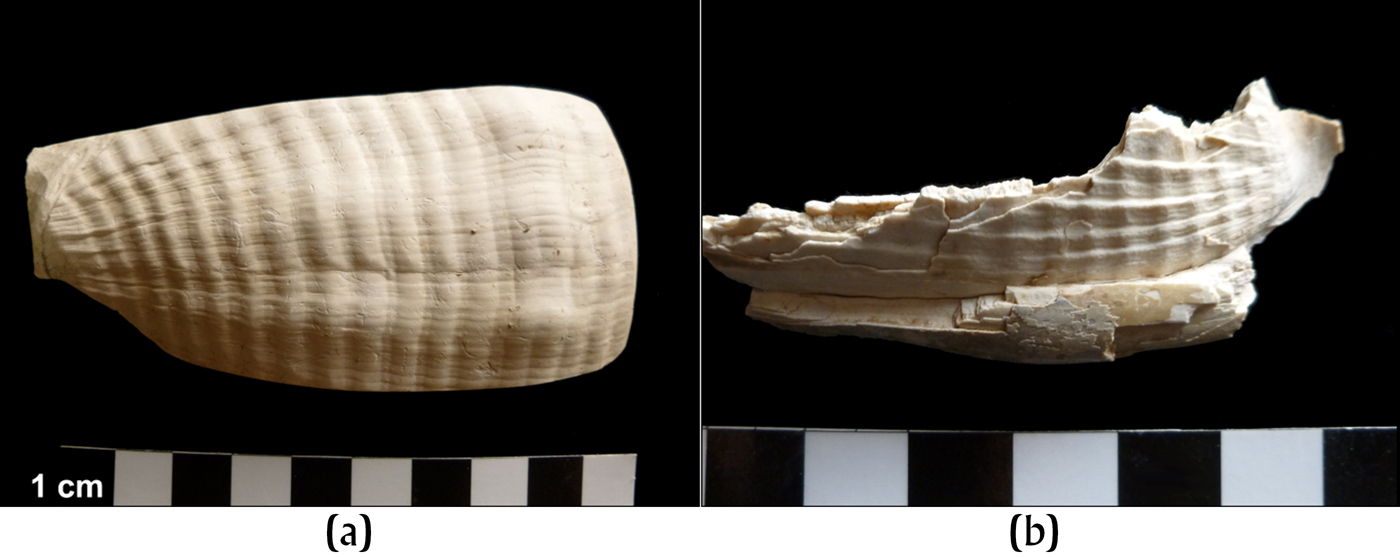
Marine shells were most common at Caobal during the Mamom period. These included 16 Atlantic marginella beads found with Burial AN4 in Structure 2 in the central ceremonial complex. The sex and age of the individual could not be determined due to poor preservation (Munson Reference Munson2012:299). Remains of a large, shattered helmet shell (Cassis madagascariensis, flammea, or tuberosa; Figure 7b) were found in the Mamom midden material that made up the fill of Structure 1 in the core. The helmet fragments had carved indentations and cut marks, indicating they were either debitage or the broken remains of a finished artifact.
Helmet (Cassis sp.) shells: (a) a carved helmet shell “plate” found in the Ceibal Group A Central Plaza near Structure A-20, dating to the Bayal phase (a.d. 810–950); (b) fragment of a helmet shell found in the fill of Structure 1 at Caobal, dating to the Escoba-Mamom 2 phase (600–450 b.c.). Photographs by the author.

Late and Terminal Preclassic: Cantutse-Chicanel (350–75 b.c.) and Xate (75 b.c.–a.d. 175) Phases
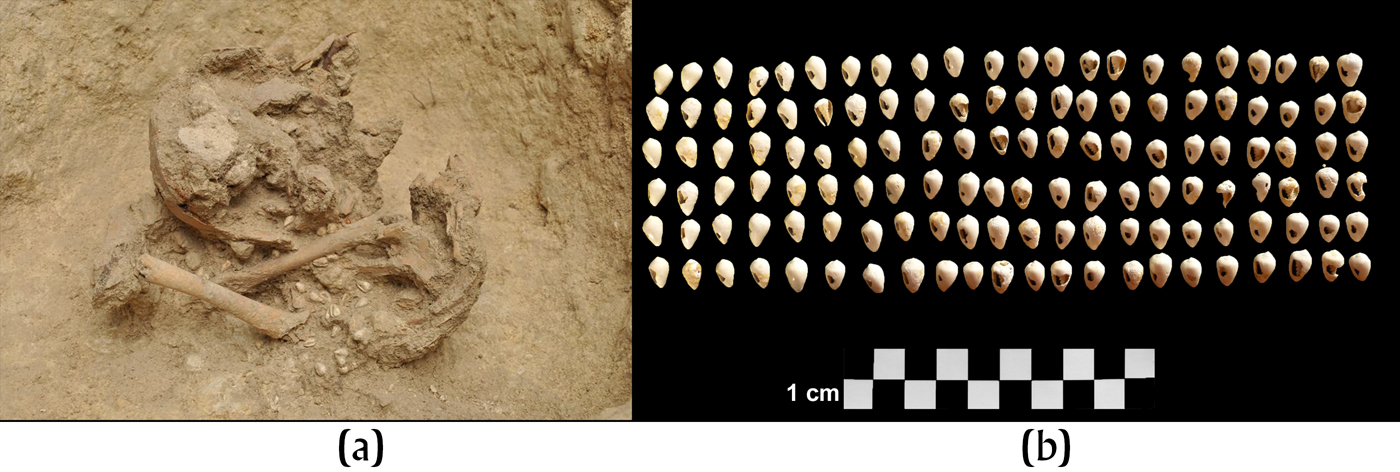
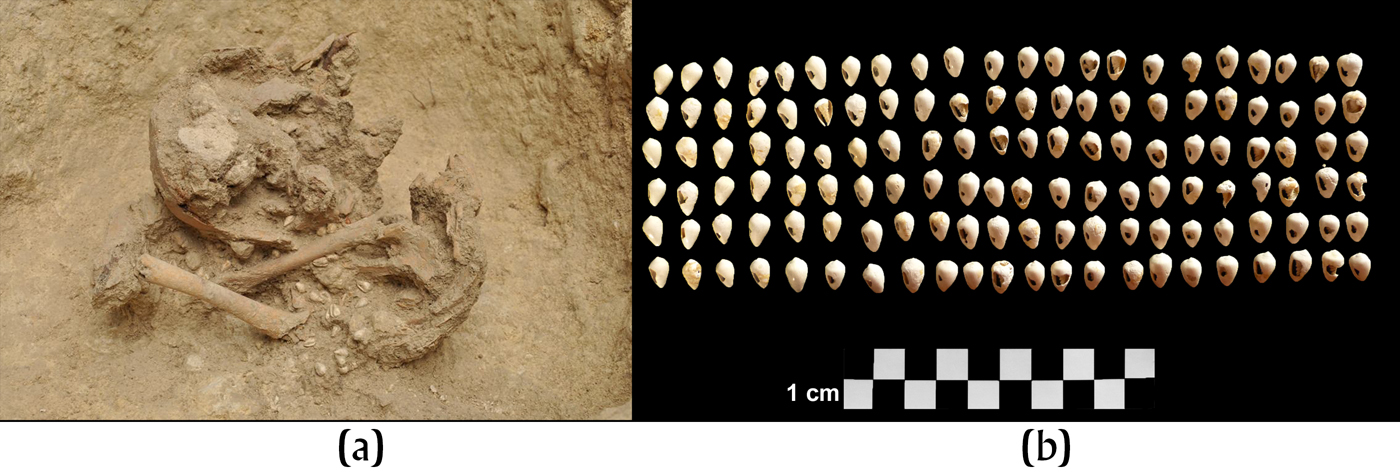
The Chicanel period had the greatest number of marine shells (226 specimens) out of any other time in Ceibal's history, although this was due to the high concentration of Atlantic marginella beads in the Central Plaza burials (215 beads, or 95.1 percent of all Chicanel marine invertebrates). With the exception of one Atlantic marginella bead found in the fill of the Structure A-24 platform, no marginella beads were found outside of the Central Plaza during this period. Seven individuals in six burial events had Atlantic marginella adornments (Burials 111, 113, 114, 127, 145, and 150), and, as in the Mamom period, these Chicanel burials were also young individuals with one exception, Burial 111. The latter was an adult male with a disarticulated, incomplete skeleton (Palomo et al. Reference Palomo, Inomata and Triadan2017). This individual had only five Atlantic marginella beads. Burial 113 had the most beads of any burial at Ceibal (at least 152 shells; Figure 8), and appeared to be a child of about four years of age (Palomo et al. Reference Palomo, Inomata and Triadan2017). The shells were found around the neck in the semblance of a collar, and some beads were found inside the mandible and mouth area. Burial 114 was close by, and contained a younger child of about two years with a collar of five beads found in and around the mouth. Burial 127 was a disarticulated but largely complete skeleton of a child of about three years. This child was placed in a large Sierra Red vessel with a plate covering the top, and was interred with 32 Atlantic marginella beads and one greenstone bead. Burial 145 was a dual burial containing two children between the ages of two and four buried with 11 Atlantic marginella beads, a clay bead, an obsidian core, and a biface blade (Palomo and Jerez Reference Palomo, Jerez and Palomo2013:9). Burial 150 was a disarticulated young adult individual lacking a cranium and possessing six marginella beads (Pinzón and de Muylder Reference Pinzón and de Muylder2014:8).
Burial 113, found in the Group A Central Plaza and dating to the Cantutse-Chicanel 1 phase (350–300 b.c.). (a) The burial with the remains of an Atlantic marginella (Prunum apicinum) shell collar in the lower center of the photo. Photograph by Flory Pinzón. (b) A subset of the Atlantic marginella bead collar, in which 152 beads were recovered. Photograph by the author.
All the non-Prunum shell taxa recovered from Chicanel contexts were found in fill and secondary midden deposits. As in the Mamom period, these appear to be mainly broken and/or discarded fragments of ornamental shells. Many specimens are similar to those in the Mamom fill contexts, including the exterior lip of a broken queen conch found in the fill near Structure A-20 and several olive tinklers (all fragmented and incomplete) found in the fill of the Karinel residential group, Structure A-12, and the Group A Central Plaza. A modified limpet (Diodora cf. cayenensis or aspera), the only one found at Ceibal, was found in the northern part of the Group A Central Plaza. It may have been part of an activity that took place in the plaza, but lack of any significant material evidence found associated with the limpet leaves its exact purpose unknown.
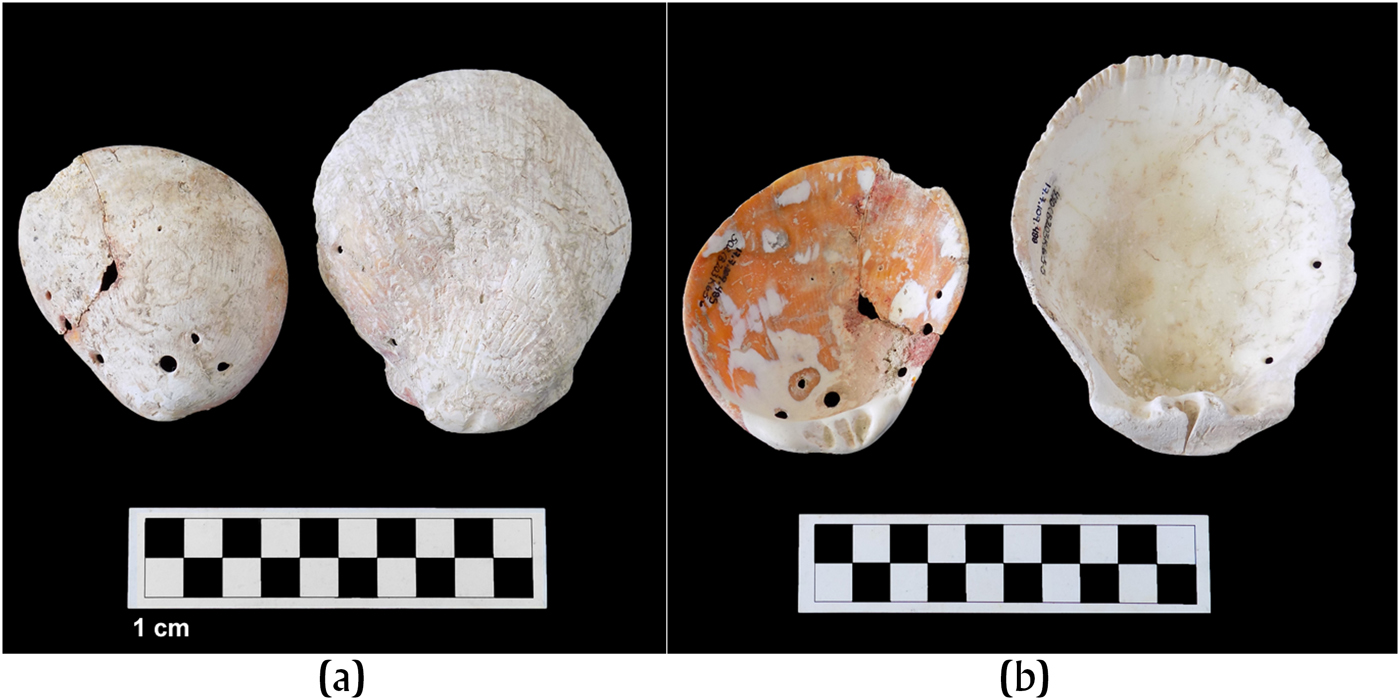
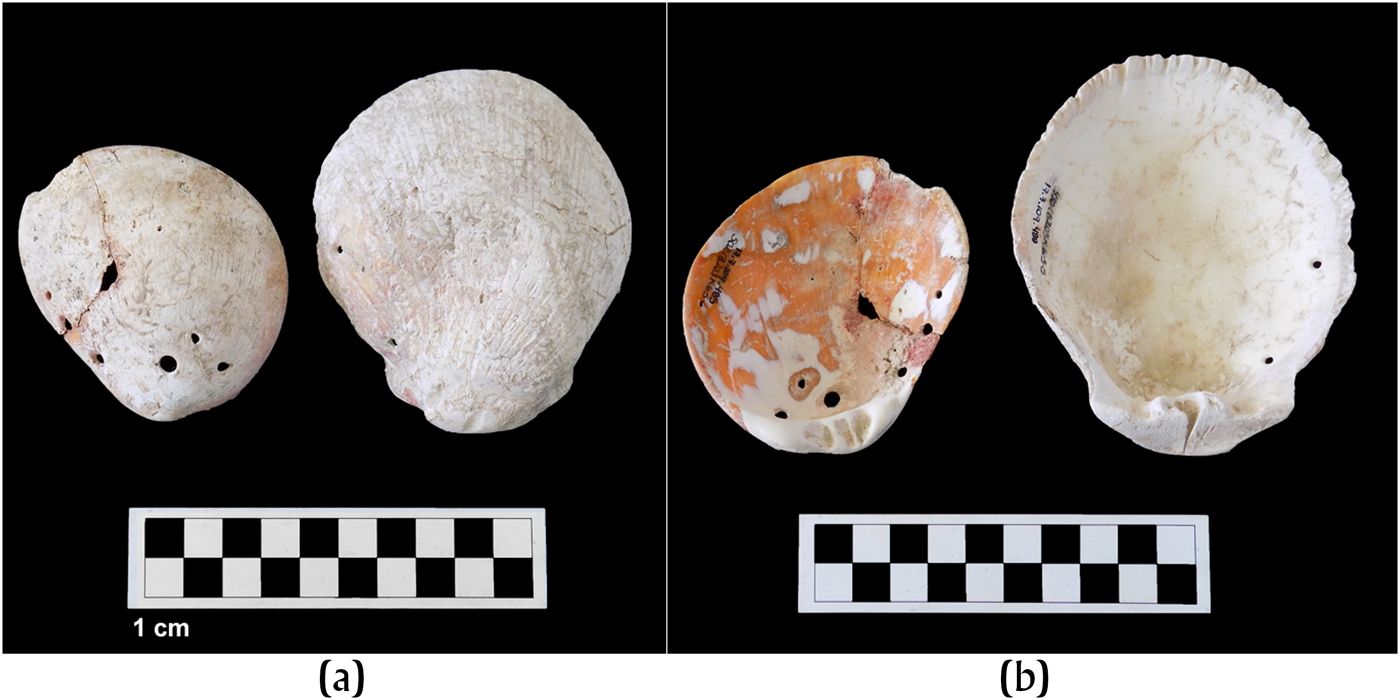
Only five shells could be definitively dated to the Xate period, all from the Central Plaza. These included two right-side valves of two ponderous ark clams (Noetia ponderosa) of different sizes found near one another in the plaza fill and lacking artifactual modifications. A cut olive shell fragment was also found in the fill near these clams, although there is no clear association. Two intact Spondylus valves were recovered in Cache 177 toward the west side of the plaza in front of Structure A-20 (Figure 9). The cache consisted of a burned cylindrical Polvero Negro vase capped by one Spondylus valve, with the second valve found inside along with a small greenstone bead (Pinzón Reference Pinzón, Pinzón and Inomata2015:8). The interior contents of the vessel were marked by a red mineral that is likely cinnabar.
(a) External and (b) internal views of two thorny oyster (Spondylus sp.) valves from Cache 177 in the Group A Central Plaza, dating to the Xate 2 phase (a.d. 50–125). The smaller valve on the left was found inside a burned cylindrical Polvero Negro vase and contains red pigment residue, possibly cinnabar, on the interior surface. The larger shell on the right served as a cap for the vessel. Both are perforated and may have been worn. Photographs by the author.
Very few marine shells were found at Caobal after the Middle Preclassic period, despite its significant Late and Terminal Classic expansion. A single Atlantic marginella bead was recovered in a mixed Late Preclassic/Early Classic fill deposit near the bedrock of Structure 8, although it was not associated with other artifacts that could identify its purpose or exact chronological period.
Early Classic: Junco-Tzakol Phase (a.d. 175–600)
Unlike all other periods of Ceibal's history, the majority of marine invertebrate taxa recovered from Junco period contexts were found in the residential groups, specifically the Karinel Group (78 specimens, or 97.5 percent). A shell necklace of 69 round white nacre beads made from a thick marine mollusk, likely a gastropod, was found in one young adult interment (Burial 165; MacLellan et al. Reference MacLellan, Cordero, Mejía, Burgos, Pinzón and Inomata2015:56). Even if these shell beads are considered as one individual (MNI = 1), the Karinel Group still has the majority of marine shells at the site during this period. Elsewhere in the Karinel Group, two more shell beads carved into rounded shapes (Figure 10b) were found with a young child of about four years of age (Burial 135; Palomo et al. Reference Palomo, Inomata and Triadan2017). A possible aquatic-themed ritual deposit (Cache 168; MacLellan and Cordero Reference MacLellan, Cordero, Pinzón and Inomata2014:77) in the Karinel Group contained an olive shell tinkler in addition to several small river stones and remains of various freshwater aquatic vertebrates. Cut and fragmented gastropod remains were also found scattered in the fill of the Karinel Group from this period.
Ornamental marine shell objects from Ceibal. (a) Gastropod “glyph” from the Karinel Group, Bayal phase (a.d. 810–950). (b) Two round mollusk beads, likely gastropods, found in Burial 135 in the Karinel Group, Junco-Tzakol 1 phase (a.d. 175–300). (c) Gastropod ornament found in the Group A Central Plaza, Cantutse-Chicanel 1 phase (350–300 b.c.). (d–f) Three views of a dense shell ornament, likely carved from a queen conch (Lobatus gigas) or similar-sized conch, found in the Group A East Court palace patio and dating to the Bayal phase. Photographs by the author.

There were only two marine shells found outside of the Karinel Group dating to the Early Classic period. These were a large interior whorl of a West Indian chank shell, exhibiting cut marks along multiple edges, and an unmodified venerid valve (Veneridae) from a ceremonial deposit scattered on top of Structure A-2, south of the Central Plaza. This latter deposit had experienced mixing with burials from later Classic phases, although the specific deposit from which the venerid came consisted largely of Junco 3 phase ceramic sherds.
Late Classic: Tepejilote-Tepeu Phase (a.d. 600–810)
A total of 14 marine specimens were recovered from Late Classic deposits at Ceibal from a variety of locations around the site, and included 13 marine shells and one sea urchin spine. Unlike the Early Classic period, only one marine shell was found in a residential group (Pek). Three shells were found in the Group D elite acropolis that, although lightly occupied before the Classic period, saw a significant expansion during the Late Classic period and likely held the residences and ceremonial structures of the ruling nobility and their family (Bazy and Inomata Reference Bazy and Inomata2017).
Most specimens from this time came from fill deposits, unlinked to special contexts. Four of the 14 marine taxa were olive shells, two of which were definitive tinklers while the other two were partial fragments. These were recovered in the fill of the Group A Central Plaza, the East Court, and the Structure A-24 platform. A heavily modified interior whorl of a queen conch, with numerous cut and scrape marks, was found in the fill of Group D (Structure D-104A). A small cone snail (Conidae) was found in the fill of Structure A-2.
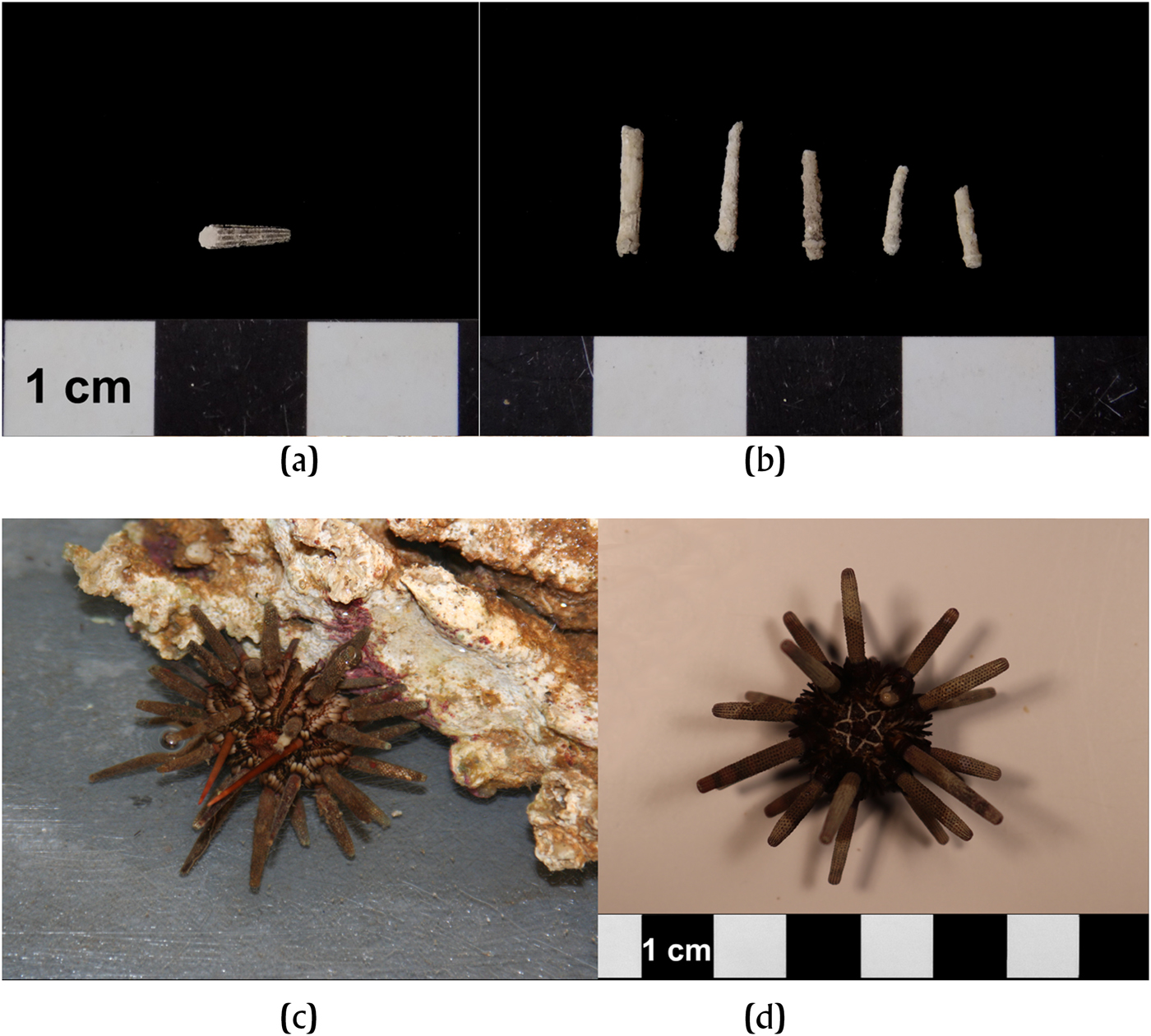
Two marine specimens from this period were found associated with burials. At Structure A-2, a partial sea urchin spine (cf. Eucidaris sp.), was recovered from the flotation sample taken from Burial 121 (Figure 11a). This interment contained a possible male individual of about 15 years buried under large limestone slabs, and whose grave offerings included a Belize Red tripod vessel that may have come from the Belize Valley or Maya Mountains area (Takeshi Inomata, personal communication 2016). Notably, Willey (Reference Willey and Willey1978:163) also reported six “Dentalium or echinoderm” beads from Structure D-29 in Group D from this period; while no photos exist of these artifacts, their description as “beads” suggests they were likely tusk shells, since echinoderm spines are solid.
Slate pencil sea urchins (Eucidaris sp.): (a) spine found near Burial 121 in Group A Structure A-2, dating to the Tepejilote-Tepeu 2 phase (a.d. 700–750); (b) five of 15 spines found in a midden behind the Group A East Court palace Structure A-16, dating to the Bayal phase (a.d. 810–950); (c) live Pacific slate pencil sea urchin (E. thouarsii); (d) modern Pacific slate pencil sea urchin. Note the size of the spines indicates this urchin is not much larger than the one from the palace midden. (c) Photograph courtesy of Harilaos Lessios. (a, b, d) Photographs by the author.

Burial 151 in the Pek Group, also a cyst-style interment covered by flat limestone slabs, is the second Late Classic-period burial with a marine specimen, specifically a cut marine gastropod fragment. The interred was an adult male, whose offerings also included a tripod vessel (Burham and Rodas Reference Burham, Rodas, Pinzón and Inomata2014:122).
Terminal Classic and Postclassic: Bayal (a.d. 810–950) and Samat (a.d. 1000–1200) Phases
A considerable number of marine invertebrates (174 specimens) was found in Ceibal's Terminal Classic levels, over half (50.6 percent) of which were found in burial contexts. Marine shells were found in five areas of the site, principally the Karinel residential group (90 shells, or 57.7 percent), as well as Structure A-20 on the west side of the Central Plaza, the Group A East Court, the Group D Central Plaza, and Structure D-6 in Group D. Over half (61.9 percent) of the shells that could be dated from the original Harvard excavations in the 1960s came from the Terminal Classic period, either in Group A or Group D (Table 4; Willey Reference Willey and Willey1978).
Three burials (Burials 152, 155, and 156) in the Karinel Group contained 49.4 percent of all the marine shells found at Ceibal during the Bayal period. Burial 152 was a child covered by limestone slabs that contained 35 pierced dove snail beads (Figure 12), along with 22 rounded beads made from a thick mollusk, possibly either a marine gastropod or thick Spondylus, similar in appearance but of a slightly different shape when compared to the beads from Early Classic Burial 165. Burial 152 also had 18 carved beads made from the metapodials of a large wild cat (puma or jaguar), a ceramic anthropomorphic whistle, and a Pabellon Molded bowl (MacLellan and Cordero Reference MacLellan, Cordero, Pinzón and Inomata2014:78). Burial 155 was another child burial found nearby, containing 28 similar thick mollusk beads and several vessel and figurine offerings. Burial 156 was found near the other two individuals, and was a child with a single Atlantic marginella bead, pierced in an identical manner to those from the Preclassic period. This burial also contained several vessel offerings.
Three sets of beads found intermixed in Karinel Group Burial 152: (a) Burial 152, dating to the Bayal phase (a.d. 810–950). The beads are visible in the center of the photo. Photograph by Jessica MacLellan. (b) Beads made from the metapodial of a large feline (top row), a thick mollusk (second and third rows), and West Indian dove snails (Columbella mercatoria, bottom three rows). Photograph by the author.

In the East Court, Structure A-15, a dual Terminal Classic cyst-style interment (Burial 108) contained a four-toothed nerite (Nerita versicolor) and a common/true oyster (Crassostrea sp.; Figure 13). It appears the burial originally contained an adult woman aged 35–50 years (Palomo et al. Reference Palomo, Inomata and Triadan2017), who, like the child burials of the Karinel Group, had multiple vessel offerings (Triadan Reference Triadan, Román, Inomata and Triadan2009:21). The burial was later disturbed by the addition of an intrusive deposit containing a subadult with a disarticulated cranium. The nerite and the oyster appear to have been deposited with the subadult. While the nerite is not modified, the interior of the oyster valve was filled with a fragile gray-gold translucent material that appears to be mica.
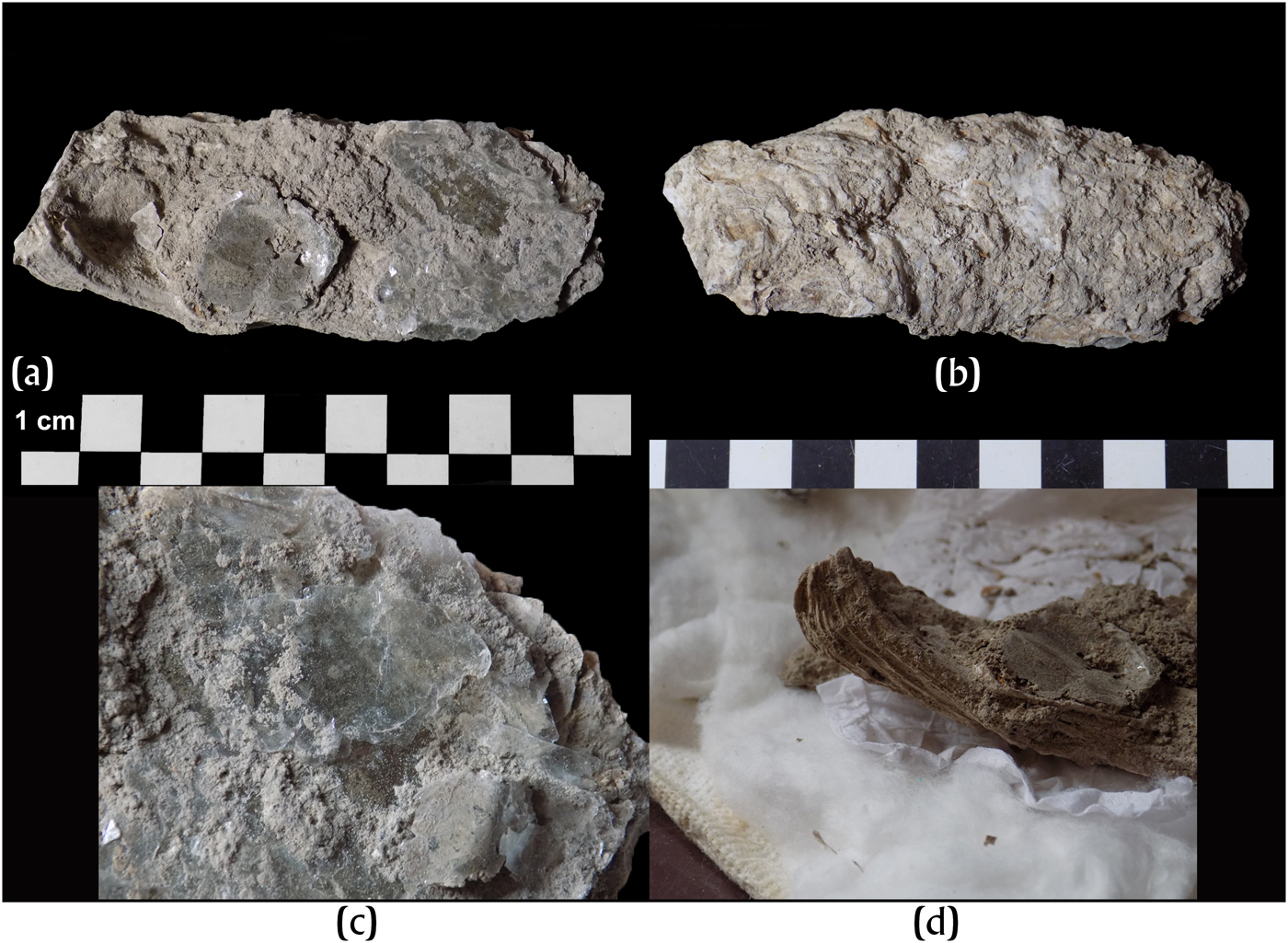
A common/true oyster (Crassostrea sp.) filled with thin sheets of mica, recovered from Burial 108 in the East Court and dating to the Bayal phase (a.d. 810–950): (a) interior and (b) exterior views of the shell; (c) close-up of the mica sheets inside the shell; (d) dorsal view of the valve umbo. Photographs by the author.

The other possible ceremonial materials found in the palace complex included the remains of over a dozen sea urchin spines recovered from the midden behind Structure A-16 (Figure 11b). This midden was, presumably, directly associated with the palace activity. Like the spine recovered from Late Classic Burial 121 in Structure A-2, these urchin spines were also recovered through soil flotation. The spines were intact enough to identify them as belonging to the slate pencil sea urchin genus (Eucidaris sp.), although they are not large enough to identify as the Atlantic or Pacific species (E. tribuloides or E. thouarsii, respectively; identification made with assistance from Harilaos Lessios, personal communication 2017). No other marine specimens, including fish, were found in the midden.
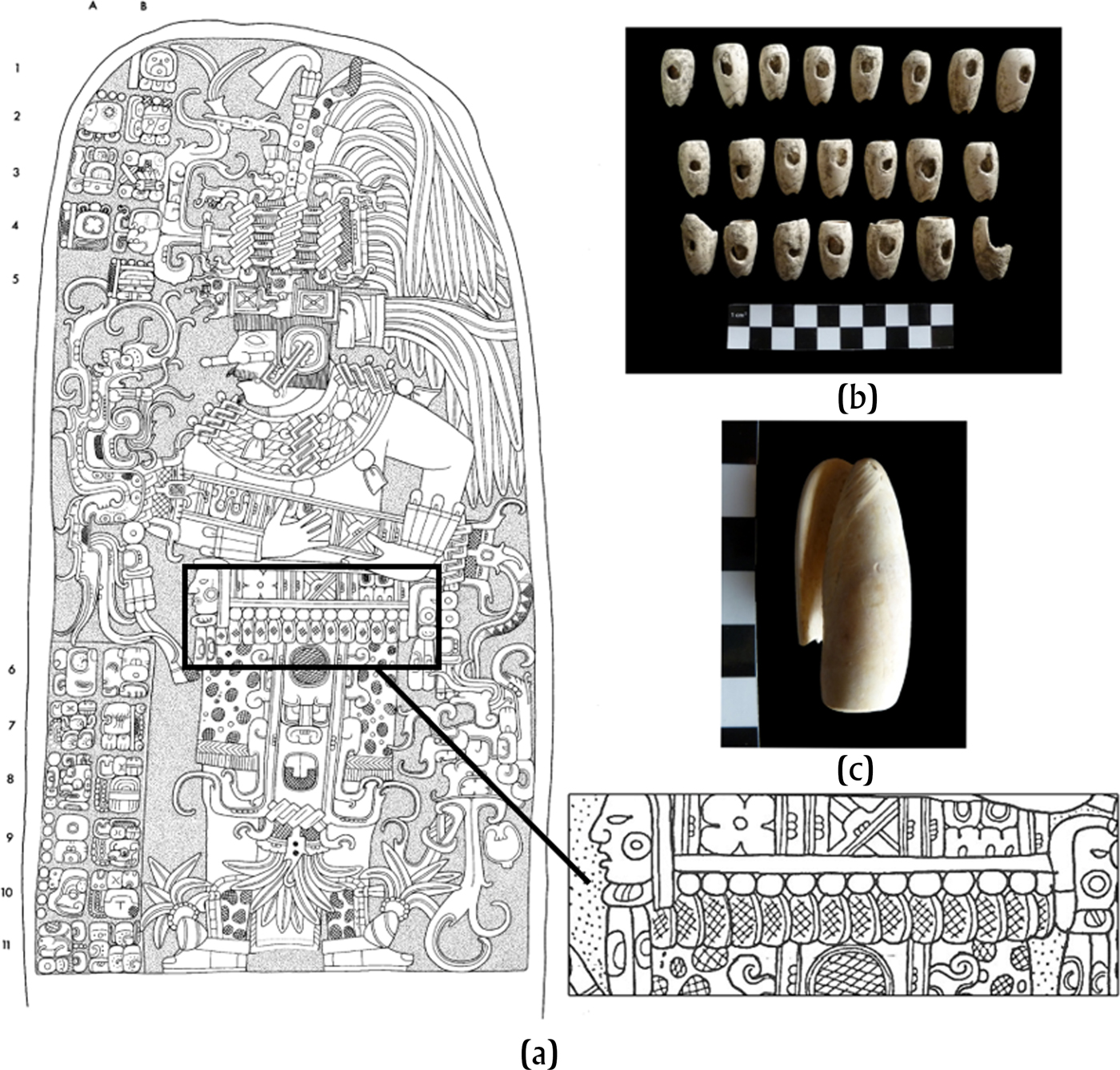
Olive shell tinklers made up the majority of shells that were identifiable to the level of subfamily (33.3 percent of all Terminal Classic invertebrates). Olive shell tinklers were found scattered throughout the Terminal Classic palace complex of the East Court, as well as in the burned remains of a termination deposit in front/east of Structure A-20 (Figure 14b; Inomata Reference Inomata2014; Ortíz and Román Reference Ortíz and Román2010). The latter deposit also included a large carved and smooth-edged shell plate that was tentatively identified as a cameo helmet (Cassis cf. madagascariensis; Figure 7a).
Example of olive shells (Olivinae) used as tinkler ornaments at Ceibal. (a) Ceibal Stela 10, depicting Terminal Classic Lord Wat'ul Chatel with an olive-shell-rimmed belt. Drawing by Ian Graham © President and Fellows of Harvard College, Peabody Museum of Archaeology and Ethnology, PM# 2004.15.6.17.10. (b) Olive shell tinklers from a termination deposit near the stairs of Structure A-20, dating to the Bayal phase (a.d. 810–950). (c) Olive shell tinkler from the platform of Structure A-24, dating to the Escoba-Mamom 2 phase (600–450 b.c.). Photographs by the author.

As in earlier periods, the broken and eroded interior whorls of large conch and chank shells, as well as broken exterior fragments of large gastropods exhibiting cut edges and incision marks, were found scattered in the fill throughout Ceibal, including monumental Groups A and D as well as the residential groups, particularly the Karinel Group. These included the interior whorl of a West Indian chank shell found in the Karinel Group, a heavily eroded interior whorl of what may be a large fighting conch or small queen conch found in the Group D Central Plaza, and scattered shell beads and a large bracelet-like ornament found in the Group A East Court (Figures 10d–10f). Willey (Reference Willey and Willey1978) also reported a dozen gastropod and mollusk fragments and ornaments from this period that could not be identified to species, including a pendant carved from a large gastropod with the incised illustration of a ballplayer on one side (S-1292; Willey Reference Willey and Willey1978:164).
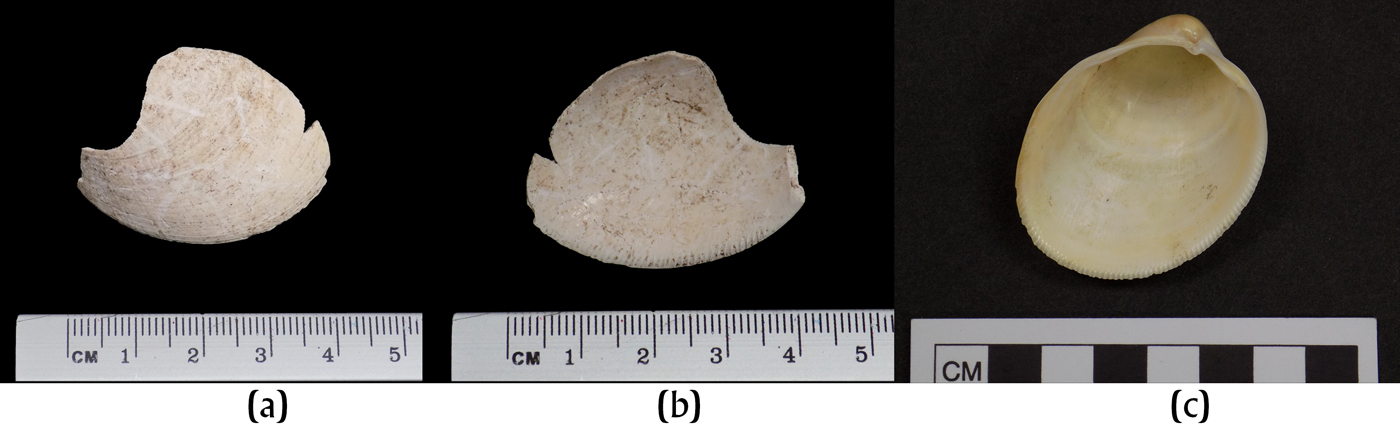
A single egg cockle valve (Fulvia laevigata, previously Laevicardium laevigatum; Figure 15), the only one found at the site, was recovered from the construction fill of Structure 97 at the site's periphery and was the only shell dating to the Samat phase, or Postclassic period (a.d. 1000–1200). This shell does not appear to have been modified, although it was only a partial valve.
(a) Exterior and (b) interior views of a partial egg cockle (Fulvia laevigata) valve from peripheral Structure 97, the only marine shell at Ceibal dating to the Samat phase (a.d. 1000–1200). (c) Modern egg cockle shell for comparison. Note diagnostic “teeth” along outer margin. Shell in (c) collected from Bocas del Toro, Panama, and courtesy of Aaron O'dea. Photographs by the author.

Only one marine shell could be definitively identified to the Classic-period contexts of Caobal: a single olive shell tinkler fragment, dating to a possible Terminal Classic deposit. The shell was found in the mixed structural collapse/fill material near the surface of Structure 1 in Caobal's ceremonial core.
UNDERSTANDING CEIBAL AND CAOBAL'S MARINE PATTERNS THROUGH TIME
The types and uses of marine invertebrate taxa at Ceibal changed over time in tandem with the known sociopolitical history of the site. There was a continuum of site development at Ceibal throughout the Middle Preclassic period, and the site is known to have become a significant ceremonial center in the southern lowlands by the Mamom period (Inomata et al. Reference Inomata, MacLellan, Triadan, Munson, Burham, Aoyama, Nasu, Pinzón and Yonenobu2015, Reference Inomata, Pinzón, Palomo, Sharpe, Ortíz, Méndez and Román2017c). The flow of marine goods imported to Ceibal increased over time, starting from the latter part of the Real-Xe ceramic phase and reaching a maximum during the late Mamom phase. Both the ceremonial core and outlying residential groups benefited from this trade, as is observed in the variety of shell objects recovered from this time, almost all of which were visibly modified and probably used as ornaments. There was also a continuity in certain shell species at the site during the Preclassic period, either because they were in demand for certain social functions, such as ritual-related regalia or burial goods, or because they were the most commonly chosen at the coastal settlements to be sent inland during the Preclassic phases. These included tusk shells, olive shells, and Atlantic marginella. There is strong evidence that the latter was increasingly in demand for use in burials, especially, but not exclusively, young individuals buried in both Ceibal and Caobal's central plazas. This practice reached a peak in the Late Preclassic period and abruptly broke off thereafter, starting in the Terminal Preclassic period when Ceibal's population and political might began to decline. It is also noteworthy that every olive and Atlantic marginella shell that had an intact or nearly-intact frame was pierced identically, a pattern that was observable for many centuries.
The start of the Classic period saw a considerable transition from the continuum of patterns observed throughout the Preclassic. During the Early Classic period, there was a shift in the abundance of marine taxa at the central ceremonial core to the outlying residential Karinel Group. Marine shells were used especially in child interments. This shift was accompanied by a change in the taxa and modified forms of shells, with carved thick round mollusk beads becoming popular, a trend that would continue throughout the rest of the Classic period. The shift in focus to the periphery at this time is in accord with the cessation of ceremonial construction projects at the site core, indicating that, while Ceibal was not abandoned at this time, most activities took place in the residential periphery.
Ceibal began to slowly rise to political prominence a second time in the Late Classic period, and marine shells and even a sea urchin spine appear at areas of the site that were likely occupied by the renewed elite class, particularly Group D and Structure A-2. By the Terminal Classic period, Group A's East Court becomes the site of a palace complex, where marine shells, mainly olive shells, and sea urchin spines were found, suggesting these taxa were in demand by the ruling elite. Other areas of the site also contain similar olive shells and are suggestive of their particularly high demand at this time, although they are not used as burial items; rather, burial offerings and adornments include thick round mollusk beads and dove snails, particularly in child burials on the periphery. It is noteworthy that the sole Postclassic shell species at Ceibal, an egg cockle, is found in no other time during the site's history and suggests coast-to-interior trade networks altered once more following the Terminal Classic collapse.
Caobal appears to mirror Ceibal's patterns on a reduced scale, perhaps a result of its smaller size and reduced political-economic role in relation to its larger neighbor. Caobal's marine taxa are the same as those found at Ceibal, including a late Middle Preclassic burial containing an Atlantic marginella beaded collar. Significantly, the only Classic-period specimen is an olive shell tinkler, which is also the most common Classic-period shell found at Ceibal. These patterns not only demonstrate that Caobal was part of the same exchange network as Ceibal, but that its inhabitants shared the same cultural views and engaged in the same ritual activities over time as at Ceibal.
UNDERSTANDING CEIBAL AND CAOBAL'S MARINE SPECIES FROM A REGIONAL PERSPECTIVE
Since the inhabitants of Ceibal and Caobal were located in the south-central Peten, they likely received marine taxa from indirect acquisition through trade with merchants or other sites, rather than direct retrieval from the coast (although the possibility of pilgrimages to the coast cannot be ruled out). The course of marine invertebrate trade to the Ceibal area was likely dictated by a combination of demand for certain species for particular activities by the inland inhabitants, as well as what was available and chosen for transport into the interior by merchants or inhabitants trading along the coast. While an in-depth analysis of the Maya marine exchange system is beyond the scope of this study, it is still important to consider specific patterns observed in the exchange and use of certain taxa over the centuries. The following section examines 10 of the most common and/or contextually unusual marine taxa found at Ceibal and compares these with what has been reported at other lowland Maya sites dating to the Preclassic and Classic periods as a means of gauging cultural uses and trade of certain taxa to the interior over time.
Atlantic Marginella (Prunum apicinum)
Atlantic marginella snail shells are usually white or pale-hued, and live in shallow muddy or sandy environments, including seagrass beds (Abbott and Morris Reference Abbott and Morris1995:244–245; Tunnell et al. Reference Tunnell, Andrews, Barrera and Moretzsohn2010:233). Atlantic marginella shell beads are found in 10 burials at Ceibal, including two burials containing multiple individuals, and in one burial at Caobal. Nine of the burials at Ceibal date to the Preclassic period and were found in the Central Plaza. The single Caobal burial also dated to the Preclassic period and was found near Caobal's ceremonial plaza. This pattern strongly suggests that Atlantic marginella bead collars were part of a culturally-recognized ritual. The one exception to this pattern was a single marginella bead found in a Terminal Classic residential burial in the Karinel Group. This shell may have been unrelated to the Preclassic burials, was part of intermixed material from underlying layers, or may even have been an instance of Terminal Classic inhabitants recognizing and consciously replicating a pattern they knew had once been commonplace during the Preclassic period.
Atlantic marginella were frequently placed in burials throughout the Maya lowlands during the Preclassic period. They are usually found near the neck or chest area of the deceased, and were likely collars. Elsewhere in Guatemala, Preclassic burials at Hamontun (Sharpe Reference Sharpe2016a:402) and Holtun (Katelyn Bishop, personal communication 2017) included Atlantic marginella. A Late Preclassic burial (Burial 13) at the site of Cerros in Belize included two Atlantic marginella, a species not commonly found at the site despite its immediate proximity to the coast (Hamilton Reference Hamilton1987; Sharpe Reference Sharpe2016a:402, 441). Marginella shells reported from the inland sites of Chan (Keller Reference Keller and Robin2012) in Belize and Chiapa de Corzo (Lee Reference Lee1969) in Mexico were also found in burial deposits. In each of these cases, the burials were found near the ceremonial cores of the sites. This pattern suggests Prunum shells may have been a common decorative item included with lowland burials during the Preclassic period, especially during the Late Preclassic. Middle Preclassic evidence from Ceibal shows that the practice of including Atlantic marginellas in burials began slowly with fewer shells; the first such burial happened to be the earliest elite individual, interred in the Central Plaza (Burial 136 dating to 775–700 b.c.).
We can only speculate on the significance of these shells outside of their use as personal adornment, but perhaps their association with the dead came from the widespread Mesoamerican belief in a watery afterlife realm, called Xibalba by the K'iche’ Maya of the Colonial period (Brady and Ashmore Reference Brady, Ashmore, Ashmore and Knapp1999; Tedlock Reference Tedlock1996). It was believed that this realm lay below the plane of the living, which was often represented by a cruciform arrangement aligning to the cardinal directions. This may be, in part, suggested by the two cruciform arrangements with which Atlantic marginella are associated during the Mamom period (Burial 146 with the four obsidian cores, in which the shell beads were located in the center, and Burial 153 with the four juvenile skeletons). A related hypothesis (Blume Reference Blume2011) is that, because a shell was commonly used for centuries to depict the concept of “zero” in Maya writing, the concept of “nothing” may have been linked to the notion of death.
It is also significant that many of these burials are younger individuals and, while not immediately apparent from the lack of obvious cut marks (Palomo et al. Reference Palomo, Inomata and Triadan2017), there is a possibility they were sacrificial victims, especially in the case of the individuals arranged in a cruciform pattern in Burial 153. Interment with Atlantic marginella beads may have been a means of marking an individual set for sacrifice, although the Prunum beads found in burials at other sites do not appear to accompany sacrificed individuals. At the site of K'axob in Belize, Preclassic child burials were interred with olive shell tinklers and other adornments, which were interpreted as possible markers of their identities and ages (Aizpurúa and McAnany Reference Aizpuruia and McAnany1999). It is possible the Atlantic marginella beads served a similar function in the Ceibal burials, but their unique arrangement across the center of the Central Plaza suggests they were not ordinary burials, and that they served a more public ceremonial function. At present, we can only conclude that Preclassic Prunum burials were a widespread cultural trend, the exact symbolic basis of which remains unknown.
It should be noted that Atlantic marginellas are found at Classic-period sites as well, and occasionally in burials. Examples include an unusual Late Classic burial at Pacbitun containing over 2,000 Atlantic marginella beads (Burial 1-1; Healy et al. Reference Healy, Emery, Wagner, Hohmann, Stanchly, Healy and Emery2014:129–130), a cluster of several dozen Prunum beads along with other abandoned ornaments and crafting tools in Aguateca Structure M7-22 (Inomata and Emery Reference Inomata, Emery, Inomata and Triadan2014), and two caches containing a total of 185 Atlantic marginella beads at Uaxactun (Kidder Reference Kidder1947:67). Their use was therefore widespread, although they seem to be found in higher quantities and in special deposits during the Classic period.
True Olives (Olivinae)
Olive shell tinklers are common during both Ceibal's Preclassic and Classic periods, reaching a peak during the Terminal Classic. Olive shells are common at sites throughout the Maya region in all time periods (Aizpurúa and McAnany Reference Aizpuruia and McAnany1999; Freidel et al. Reference Freidel, Masson and Rich2017; Keller Reference Keller and Robin2012; Moholy-Nagy Reference Moholy-Nagy and Pohl1985; Powis et al. Reference Powis, Stanchly, Healy, White, Awe and Longstaffe1999; Sharpe and Emery Reference Sharpe and Emery2015), and may have been selected for their durable, rounded shape and colorful surface that often has a zigzag pattern. When alive, many olive species burrow in sandy substrates, ranging from very shallow to fairly deep (~100 meters) waters (Abbott and Morris Reference Abbott and Morris1995:234–235; Tunnell et al. Reference Tunnell, Andrews, Barrera and Moretzsohn2010:231).
Having examined numerous examples of Atlantic and Pacific varieties of olives, and noting the remarkable degree of physical overlap between species when surface colorations and spires are absent, I have chosen to conservatively identify all shells in this study to the taxonomic level of subfamily (Olivinae). Olive shells of both Atlantic and Pacific varieties, however, have been identified at Chiapa de Corzo (Lee Reference Lee1969; Velázquez Castro et al. Reference Velázquez Castro, Maldonado and Lowe2015), Aguateca (Inomata and Emery Reference Inomata, Emery, Inomata and Triadan2014), and Pacbitun (Healy et al. Reference Healy, Emery, Wagner, Hohmann, Stanchly, Healy and Emery2014), indicating that they were being imported for the use of decorations from either coast. Furthermore, it is noteworthy that almost every olive shell at Ceibal lacked spires, and no loose spires were located, indicating the spires were likely removed prior to transport to the site and possibly at or near the coast by craft specialists. It is also possible, however, that the shell spires were missed during excavation due to the fact that most operations at the site used a ¼-inch screen. A finer-screen mesh may have recovered the small spires.
The only case of a “complete” olive with spire intact was recovered by the original Harvard University excavations in the 1960s, dating to the Late Classic period (specimen S-547; Willey Reference Willey and Willey1978:162). This shell is described as being 6.8 cm long, about twice as long as the olive shells recovered by the CPAP excavations. The large size and appearance in a photo (Willey Reference Willey and Willey1978:Figure 161) resemble characteristics of a tent olive (Oliva porphyria) from the Pacific Ocean. The same species was found at Aguateca during the Late Classic period (Inomata and Emery Reference Inomata, Emery, Inomata and Triadan2014) and Pacbitun during the Terminal Classic (Healy et al. Reference Healy, Emery, Wagner, Hohmann, Stanchly, Healy and Emery2014), which suggests this species was being imported from a Pacific source or sources during the latter part of the Classic period.
Olive shells appear frequently in Classic-period art. For example, Ceibal Stela 10 depicts the Terminal Classic Lord Wat'ul Chatel with an olive shell-rimmed belt cut in the same manner as the shells found at the site (Figure 14a). Similar decorative belts can be seen on Yaxchilan's Lintel 16 (Freidel et al. Reference Freidel, Masson and Rich2017) and Lintel 8, lining several of the garments of Copan lord Uaxaclajuun Ub'aah K'awiil on his many plaza stelae, and on various individuals in the Postclassic Dresden Codex (e.g., Dresden 26 and 27). Freidel and colleagues (Reference Freidel, Masson and Rich2017) have reviewed the symbolism of the olive shell, comparing art and archaeological sources, and deduced that, functioning as popular decorative items, olive shells seem to have had an association with death and perhaps the number zero, particularly in the Dresden Codex (Blume Reference Blume2011). There are multiple cases of olive shell tinklers carved into the likeness of a human skull, including the sites of Aguateca (Inomata and Stiver Reference Inomata and Stiver1998) and Mayapan (Andrews Reference Andrews1969), which support this perceived connection. Nonetheless, considering the frequency with which olive shells are found at Maya sites in both Preclassic and Classic periods and the diversity of contexts (burials, termination caches, primary middens, and construction fill) from which they are recovered, it would seem their appeal was primarily due to their durability, unusual colorations, and their ubiquity in habitats along the coastline, which are also reasons they are popular with shell collectors today.
West Indian Dove Snail (Columbella mercatoria)
The dove snail beads deposited with child Burial 152 (Figure 12) is unique since it is the only case of this shell species occurring at Ceibal. Furthermore, the arrangement of these shell beads in a pile near other piles of carved white mollusk (possibly gastropod) beads and puma/jaguar metapodial beads indicates that this was a specially planned deposit, and may have been part of a collar or other clothing item. Dove shells are naturally a mottled variety of different colors on a white base, usually ranging from pale to deep pink, yellow, orange, brown, and black. The shells recovered from the Ceibal burial have mostly lost their original color, but faded mottled and streaked brown markings are visible on the surfaces of a few shells.
Dove snails live in shallow waters (less than 100 meters), often in grass beds or near rocks and corals (Abbott and Morris Reference Abbott and Morris1995:217; Tunnell et al. Reference Tunnell, Andrews, Barrera and Moretzsohn2010:217). Dove snails are not common at Maya sites in the southern lowlands but, looking northward to the Yucatan, they have been found at Tulum (Barrera Rubio Reference Barrera Rubio, Chase and Rice1985) and Chichen Itza (Osorio Reference Osorio, Laporte, Arroyo and Mejía2005), including 32 beads from the latter found at the Los Estucos structure near the site core, dating to the Late or Terminal Classic period. A single dove snail was recovered from Trinidad de Nosotros in the Peten (Thornton Reference Thornton, Foias and Emery2012) and a few dove snail beads, with spires attached, were found from possible Early Classic deposits at Tikal (Laporte and Ponce de León Reference Laporte and Ponce de León2004) and Xultun (Sharpe Reference Sharpe, Saturno and Beltrán2016b), but otherwise dove snails are generally lacking in Guatemala and Belize. The lack of dove snails in the southern Maya lowlands makes interpretation of the unusual bead deposit at Ceibal difficult until more shells are recovered elsewhere. Burial 152 and the other burials found in the Karinel structure where it was located are currently under study by the original excavator and bioarchaeologist (MacLellan and Palomo, respectively), and so future research may reveal more about the nature of this unique shell deposit.
Conch Shells (Lobatus gigas, Turbinella angulata, and Other Large Gastropods)
Large, cut and carved gastropod shells are found in various deposits throughout Ceibal's history (Figure 10). Many of these are unidentifiable beyond the level of simply “Gastropoda” due to lack of any clearly diagnostic characteristics. The thickness of many shells, however, indicates they likely belong to one of a few select species, particularly the queen conch and West Indian chank shell (although other species with thick interior whorls cannot be ruled out, including the horse conch, Triplofusus giganteus, the Atlantic triton, Charonia variegata, as well as the larger whelk species belonging to the family Buccinidae). Pacific correlates, including the Eastern Pacific giant conch (Lobatus galeatus), are also a possibility.
Nevertheless, the queen conch and chank shell are the only two definitively identified large conch-type shells at Ceibal, and these are also the most commonly identified large gastropods at other sites in the southern lowlands (Gutiérrez Castillo Reference Gutiérrez Castillo2015; Hamilton Reference Hamilton1987; Hohmann Reference Hohmann2002; Keller Reference Keller and Robin2012; McKillop and Winemiller Reference McKillop, Winemiller and Emery2004; Sharpe Reference Sharpe, Saturno and Beltrán2016b; Sharpe and Emery Reference Sharpe and Emery2015; Simmons and Graham Reference Simmons, Graham, Patton and Manion2016; Stanchly Reference Stanchly and Guderjan2016). From numerous examples in Maya lowland art (e.g., Kerr No. K531, K808, and K1373; Kerr Reference Kerr2018) and from a few intact modified shells (Inomata and Emery Reference Inomata, Emery, Inomata and Triadan2014), we know that many were used as trumpets for ceremonies and hunting expeditions. There are a few artistic representations alluding to their use as melee weapons for hand-to-hand combat (Kerr No. K500 and K728; Kerr Reference Kerr2018). Due to the number of cut marks on the large shells at Ceibal, the majority were also used as material for making ornaments, perhaps after their lives as trumpets in order to recycle valuable dense shell material. It is likely that the unidentified mollusk shell material used for the numerous round “mollusk” beads at Ceibal, such as those found in the Karinel Group burials, were made from these larger species of gastropods. Similar unidentifiable shell beads and other objects have been found throughout the Maya area and are usually presumed to be large gastropods (Hohmann Reference Hohmann2002; Keller Reference Keller and Robin2012; Moholy-Nagy Reference Moholy-Nagy and Pohl1985, Reference Moholy-Nagy, Haynes and Ceci1989).
It is notable that, despite Ceibal's significant Middle Preclassic population and diversity of marine shell imports, there are no identifiable fighting conchs (Strombus pugilis) at the site. These shells, often found intentionally fragmented with one or more perforations in each piece, are common at Middle Preclassic sites in the eastern Peten and Belize (Cochran Reference Cochran2009; Hansen Reference Hansen and Powis2005; Hohmann Reference Hohmann2002, Reference Hohmann, Healy and Emery2014; Keller Reference Keller and Robin2012; Sharpe Reference Sharpe, Saturno and Beltrán2016b). The fact that Ceibal lacks this popular shell species and its ornaments raises the possibility that, despite having access to some marine shells and similar ornaments found in Belize, the inhabitants of Ceibal were not involved as closely in the marine shell exchange network as other sites in the eastern Peten and Belize. Perhaps the inhabitants (or certain inhabitants with external connections, including possible early elites) were demanding particular shells, like margin and olive shells, for ornaments and special burials but were not demanding shells popular elsewhere, like the fighting conch, because they were either not aware of them or the fighting-conch trend simply did not extend as far as Ceibal. Another possibility is that the fighting conchs that were distributed inland came from a particular source to which Ceibal did not have access.
Helmet Shells (Cassis sp.)
Like conchs and chanks, helmets are another gastropod species with a shell that can reach a considerable size; the cameo (C. madagascariensis) and king (C. tuberosa) helmets can grow larger than 40 centimeters in length (Abbott and Morris Reference Abbott and Morris1995:199–200; Tunnell et al. Reference Tunnell, Andrews, Barrera and Moretzsohn2010:181). Yet, unlike conchs, they are rarely recovered at Maya sites. This may be due to an inability to distinguish them from conchs if only non-diagnostic thick shell fragments are recovered. Due to the unique surface grooves and inner and outer lip ridges along the aperture, however, fragments should be relatively identifiable. They are one of the three species found at both Ceibal and Caobal (Figure 7), the other two being Atlantic marginellas and olive shells, although the timing of appearance of helmets at both sites does not overlap (Middle Preclassic for Caobal, Terminal Classic for Ceibal). The Preclassic fragments at Caobal appear to be the debitage or remains of portions of shells worked near the lip edge, whereas the Terminal Classic shell at Ceibal was a smooth carved “plate” or “spoon” interred with a termination offering. Due to the individual morphological variability within each Cassis species, mainly resulting from differences in age/size, and the fragmented and modified nature of the shells recovered, the exact species of helmets could not be conclusively determined. The shell “plate” appears to be a large individual, possibly a cameo helmet.
Instances of helmet shells appearing at other Maya sites are limited to a single king helmet each at Blue Creek (Stanchly Reference Stanchly and Guderjan2016) and Lamanai (Wiewall and Stanchly Reference Wiewall and Stanchly2006) in Belize, two king and one unidentified helmet fragments at Cerros (Hamilton Reference Hamilton1987), a perforated helmet of unknown species from Tikal (Moholy-Nagy Reference Moholy-Nagy1963), and a cluster of flame (C. flammea) and cameo helmet fragments and artifacts from Aguateca (Inomata and Emery Reference Inomata, Emery, Inomata and Triadan2014). The latter were found in structures associated with the ruling elite (M7-22 and M7-32), and appear to have been the debitage of shell-crafting activities left behind before the site was attacked in the Late Classic period. One carved helmet shell “bowl” was recovered from a termination ritual as well, similar to the one found in the Terminal Classic deposit in front of Structure A-20 at Ceibal. Although impossible to confirm, due to Ceibal and Aguateca's proximity and historical ties, perhaps the shell at Ceibal was manufactured at Aguateca.
Tusk Shells (Dentaliidae)
Tusk shells are some of the earliest invertebrates to appear at Ceibal (Figure 4), including one in a Real-Xe-phase burial in the Central Plaza. Only one tusk shell was found in a Classic-period deposit, which was a context that had experienced considerable mixing with lower, earlier levels. All other tusk shells at Ceibal were found in the Preclassic plaza fill, with the exception of a small Mamom ceremonial deposit of a ceramic vessel (Cache 135) north of the East Court.
Tusk shells are commonly found throughout the Maya area, particularly from sites in Belize, suggesting most species transported inland belong to the Atlantic varieties. Many of these date to the Middle Preclassic period, such as those recovered from Pacbitun (Hohmann Reference Hohmann2002) and Chan (Angela Keller, personal communication 2018; Keller Reference Keller and Robin2012). Many Middle Preclassic tusk shells have been found in burials, suggesting they were imported frequently for this purpose. Middle Preclassic burials at Pacbitun were found to contain tusk shell jewelry (Spenard et al. Reference Spenard, Wagner and Powis2013; Powis et al. Reference Powis, Healy and Hohmann2009). An early Middle Preclassic burial of a woman at Cuello, coeval with the Real-Xe phase at Ceibal, was found with a six-stranded collar of tusk shells (Cuello Burial 174; Hammond et al. Reference Hammond, Clarke and Donaghey1995). A late Middle Preclassic midden at Cahal Pech's Tolok Group was found to contain tusk shells as well (Powis et al. Reference Powis, Stanchly, Healy, White, Awe and Longstaffe1999). Tusk shells do not appear to be used as burial items during the Classic period in the lowland Maya area, with the notable exceptions of an Early Classic burial at Tikal that contained 142 tusk shell beads (Mundo Perdido Burial 63; Laporte Reference Laporte, Laporte and Escobeco2005).
The vast majority of tusk shells are deep-water invertebrates whose habitat lies several hundred meters under the sea; however, the ivory tusk shell (Graptacme eboreum), which appears to be the species found at Ceibal and other sites (Keller Reference Keller and Robin2012; Laporte Reference Laporte, Laporte and Escobeco2005), is one of the few tusk shell species found in shallow depths accessible to humans (Abbott and Morris Reference Abbott and Morris1995:297–298; Tunnell et al. Reference Tunnell, Andrews, Barrera and Moretzsohn2010:388–391). While it is possible that ancient peoples could have collected deep-water tusk shells that happened to wash ashore, the fact that most of these shells appear to resemble the ivory tusk shell, and that they appear to be fairly common at Preclassic sites, indicates that they were probably collected directly from the ocean for the purposes of decoration.
Thorny Oyster (Spondylus sp.)
Spondylus shells were one of the most symbolically laden and economically valued shell taxa in the New World tropics (Freidel et al. Reference Freidel, Reese-Taylor, Mora-Marín, Masson and Freidel2002, Reference Freidel, Masson and Rich2017). The shell was commonly used for crafting ornaments, particularly beads, in both Central and South America, perhaps due to its colorful hues and thick, durable nacre. The Spondylus’s striking appearance, characterized by many rows of thick spines, may also have earned it favor. In the Maya area, artistic representations show that they were often worn by men as pectorals or by women as coverings around the pelvic area (Scherer Reference Scherer2015:114). Scherer (Reference Scherer2015:113–116) has speculated that the shell may have had several symbolic interpretations, including representations of the sun, blood, or the protective womb of the seed of life. The latter is often evidenced by the placement of one or more jade beads near or under a Spondylus valve in a cached deposit, representing the planting of a maize seed and continued life. At Ceibal, the Terminal Preclassic greenstone bead found with the Spondylus valves in Cache 177 (Figure 9; Pinzón Reference Pinzón, Pinzón and Inomata2015:8) may be an example of this.
Many examples of intact Spondylus valves are found in Classic-period burials and caches spread throughout the lowlands (Lomitola Reference Lomitola2012; Scherer Reference Scherer2015). Some sites have one or two valves, while the Tikal excavations have recovered over 2,000 so far (Maxwell Reference Maxwell1996:58, 137). The shells themselves are usually modified in some way: often the spines have been scraped off, they may exhibit evidence of incising and perforating, and occasionally they are painted. Classic-period Spondylus are frequently deposited with a suite of other artifacts, including greenstones, pyrite, “Charlie Chaplin” shell figurines, flint and obsidian blades, and other artifacts (Chase and Chase Reference Chase, Chase and Houston1998; Coe Reference Coe1990; Lomitola Reference Lomitola2012; Taschek and Ball Reference Taschek and Ball1999). The interiors of some valves are marked with cinnabar or similar red pigment (Geller Reference Geller2014; Helmke et al. Reference Helmke, Cheong, Healy and Jørgensen2015; Maxwell Reference Maxwell1996), like one of the two valves in Cache 177 at Ceibal. There was likely a particular significance to each of these sets of deposits. Preclassic Spondylus valves, while less common, have been discovered in caches at various sites, often in central plazas (Buttles Reference Buttles2002; McSwain et al. Reference McSwain, Johnson, Kosakowsky, Hammond and Hammond1991:185–186; Sharpe Reference Sharpe2016a).
The earliest Spondylus valve at Ceibal, the valve in Central Plaza Cache 108 that was carved to resemble a desiccated human head (Figure 5), may be the earliest Spondylus yet recovered at an inland Maya site, as it dates to the latter part of the Real-Xe phase (775–700 b.c.). Other Spondylus valves at Ceibal include the shattered Escoba-1-phase (700–600 b.c.) Spondylus, also found in the Central Plaza (Cache 149), and the two Terminal Preclassic valves with the greenstone bead in plaza Cache 177. The fact that all of these valves were found in roughly the same area of the Central Plaza suggests that there was a longstanding memory of this particular tradition, perhaps related to the idea of “planting” and the continuation of life. The tradition likely continued for many centuries due to it being part of a regional cultural practice. The caches at Ceibal began simply with a single valve but, by the Terminal Preclassic period, the inhabitants at Ceibal were engaging in a type of caching ceremony very similar to that of other contemporary sites, complete with jade beads and pigment-filled valves.
Common/True Oyster (Crassostrea sp.)
The discovery of a Crassostrea oyster that appears to have been filled with mica sheets (Figure 13) is of particular interest due to its potential cultural use as a reflective decorative object, and it also raises a number of questions. Is the shell of the Atlantic or Pacific variety of Crassostrea? Was the mica attached to the shell near where the shell itself was found, or was the artifact assembled at a different location? What was the source of the mica, and how does it adhere to the shell? What was the artifact—an ornament, a mirror, or perhaps both? Why was it buried with this particular subadult, near Ceibal's Terminal Classic palace? And, finally, why have no other mica-filled oysters been found in the Maya lowlands, or anywhere else?
Diagnostic portions of the Crassostrea shell that would allow it to be identified to the species level (the margin) have been eroded or obscured by the mica (the shell interior), and thus its source of origin cannot be identified. The shell may even be a fossil. Due to a remarkable degree of phenotypic plasticity resulting from broad ranges in habitat and resource acquisition behaviors, Crassostrea exhibit considerable intraspecies variation (Varela et al. Reference Varela, Beasley, Schneider, Sampaio, Marques-Silva and Tagliaro2007). Crassostrea oysters are rarely found in the Maya lowland interior sites, which would otherwise provide a clue as to which species were usually transported inland. Thornton and Emery (Reference Thornton and Emery2016) identified the Atlantic/eastern oyster, Crassostrea virginica, at the site of El Mirador, but the identification is tentative (Erin Thornton, personal communication 2018). C. virginica have also been identified at Tikal (Laporte and Ponce de León Reference Laporte and Ponce de León2004).
The source of the mica may be a clue to the shell's origin, however, since there is no known natural source of mica in the Maya lowlands. It is possible mica may have been mined from the Belizean Maya Mountains or Guatemalan highlands, but a source has not been discovered. The only significant sourcing study on mica in the Mesoamerica area has been the research performed on the large quantity of mica sheets found at Teotihuacan's Viking Group and Xalla Palace, which have been sourced to a known mica mine found near the archaeological site of Ejutla in Oaxaca (Manzanilla et al. Reference Manzanilla, Bokhimi, Tenorio, Jiménez-Reyes, Rosales, Martínez and Winter2017). Chemical source analysis of the mica from inside the Crassostrea shell at Ceibal might reveal it came from the same mine, and would therefore give credit to the possibility that it is a Pacific shell (C. corteziensis or possibly C. columbiensis), which would make it the only identified Pacific species at Ceibal. It is also worth noting that individuals buried with mica or similar reflective objects are rare in Mesoamerica. Two individuals at El Vivero and Paso de la Amada in the Soconusco area of southwest Mexico were found with mirrors on their foreheads made of mica sheets attached to a ceramic disk backing, but these dated to the Early Formative (Preclassic) period (Clarke Reference Clarke and Fowler1991:20–21) and likely had no association with the mica-filled oyster at Ceibal. Reflective objects and mirrors are believed to have served as markers of elite status and as possible implements of divination, allowing one to perceive an alternate, and perhaps supernatural, reality (Healy and Blainey Reference Healy and Blainey2011). The Ceibal oyster “mirror” may have served a similar function, considering it was found near the Terminal Classic palace.
Egg Cockle (Fulvia laevatum)
The only Postclassic-period marine shell found at Ceibal was a partial egg cockle valve (Figure 15). It was recovered in Structure 97, located on the Ceibal periphery along a ridge overlooking the Pasión River (Triadan Reference Triadan, Pinzón and Inomata2015). Egg cockles are common in muddy coastal shallows throughout the Caribbean, including Belize (Gischler Reference Gischler2003). A review of the published marine shell remains from across the Maya region reveals that remarkably few of these “common” coastal shells ever reached the interior. Egg cockles of the same species were identified at Tikal (Laporte and Ponce de León Reference Laporte and Ponce de León2004) but, as of this writing, it does not seem they have been found at any other site, or at least have not been identified (broken fragments could perhaps be confused with the ubiquitous freshwater apple snail, Pomacea flagellata). It can therefore be posited that egg cockles were not an important trade item during the Preclassic and Classic periods, but perhaps this changed during the Postclassic period. At present, less is known about Postclassic-period society and trade networks in lowland Guatemala in comparison to the centuries preceding the famous Terminal Classic “collapse.” A single egg cockle at Ceibal is not evidence in itself that the species held any significant value during this enigmatic period, but it is a clue that the shell taxa being imported inland at this time had changed when compared to millennia prior.
Sea Urchins (Echinoidea)
Sea urchins are rarely found at Maya sites, and the case of Ceibal, where at least two slate pencil urchins are found at two separate locations from two time periods (Figures 11a and 11b), is particularly unique. Takeshi Inomata (personal communication 2017) believes Structure A-2, the site of the single Late Classic sea urchin spine, may have held an important administrative role at Ceibal during the Early, and perhaps also Late, Classic period, prior to the construction of the palace at the East Court to the north. The presence of sea urchin spines in two different but important administrative structures on opposite sides of the Central Plaza during the Late and Terminal Classic periods indicates that these special invertebrates were likely used exclusively by the ruling elite during the Classic period, and that the elites had obtained these urchins on more than one occasion.
The exchange of sea urchins to inland sites in the Maya region appears to be limited to only one other site in Guatemala, Tikal, where three urchin remains, “both club-spined and needle-spined,” were reported in an Early Classic cache (Coe Reference Coe1990:370). The description is suggestive of the slate pencil sea urchin, although a definitive identification would require comparison with assistance of an expert and/or comparative urchin collection. Maxwell (Reference Maxwell2000) speculated whether the Tikal urchins were imported as foodstuffs or for bloodletting ceremonies, perhaps to mildly intoxicate the person shedding blood. If the Tikal urchins were of the slate pencil variety like those at Ceibal, they are neither toxic nor particularly nutritious even if they are edible, and their spines tend to be small and frequently blunted on the ends, making for poor piercing tools. In Belize, Bozarth and Guderjan (Reference Bozarth and Guderjan2004) reported a tentative “starfish or sea urchin” within a cache at Blue Creek. At Copan in Honduras, the fragmented remains of one rock boring urchin (Echinometra lucunter), an Atlantic species, were reported alongside numerous other marine offerings from the Late Classic 10L-26 royal tomb of Ruler 12, in the structure housing the Hieroglyphic Staircase (Beaubien Reference Beaubien and Emery2004:50). Due to the small size of the urchins at Ceibal (possibly only a few centimeters in diameter), they were likely imported as curiosities or souvenirs from the coast and may have been presented as gifts to the ruling elite. They may even have served as parts of costume paraphernalia.
CONCLUSION
Tracking Ceibal's marine shells over time, we see that even during the Middle Preclassic, a considerable quantity and diversity of shells were imported to the site, primarily (possibly exclusively) from the Atlantic coast. The majority of these shells were modified in some way, often as beads and ornaments. Several, including tusk shells and Atlantic marginella, were deposited in burials, while others, particularly Spondylus valves, were deposited in ceremonial caches. Other shells, like olive shell tinklers, were found in diverse deposits in both the epicenter and residential groups surrounding the site. These trends continued and, in some cases, intensified or altered over time. For example, Atlantic marginella were deposited by the hundreds in Central Plaza burials during the Middle and Late Preclassic period, and Spondylus valves were buried in ceremonial caches in the Central Plaza from the early Middle to Terminal Preclassic periods. The number of shells at Ceibal decreased significantly during the Early and Late Classic periods, with another increase in shell quantity and diversity occurring in the Terminal Classic period, when new and different invertebrate species (e.g., dove snails and sea urchins) were found in burials and special deposits.
This examination of over 2,000 years of marine invertebrate imports to the site of Ceibal reveals not only changes in taxonomic use over time, but also how Ceibal's marine taxa were both similar and, in some cases, remarkably different from other lowland Maya communities. Marine mollusk taxa that are commonly found at other Maya sites, including olive shells, conchs/chanks, and Spondylus, are also common at Ceibal. Temporal trends speaking to the supply and demand of certain taxa for specific functions, such as Atlantic marginella beads for burials in the Middle and Late Preclassic periods and modified Spondylus valves for elaborate plaza caches in the Terminal Preclassic and Early Classic period, are found at Ceibal just as they are elsewhere in the Maya area. The few marine shell taxa found at Ceibal's subordinate community, Caobal, also follow these trends on a much smaller scale.
Ceibal also has several unique invertebrate taxa, however, that are rarely or never found at other Maya communities. In some cases, this may be because they have not yet been discovered at other sites. Singular cases may, however, indicate special gifts given to individuals at Ceibal, or perhaps were taken directly from the sea by someone who lived at Ceibal, assuming such long-distance trips took place in the past. The mica-filled Crassostrea oyster and slate pencil sea urchin spines were found around the Terminal Classic palace structure; presumably, these were elite items gifted to individuals living in or associated with the palace. The partial egg cockle, however, is an unusual case since it is rarely found at Maya sites and is the only shell that dates to Ceibal's Postclassic period, suggesting that new types of shells may have been imported at this time.
All of Ceibal's identifiable taxa to the species level hail from the Atlantic Ocean, with the exception of one olive tinkler recovered during the 1960s excavations (Willey Reference Willey and Willey1978). This pattern is in accordance with many other sites in the southern lowlands. Based on the fact that many of Ceibal's species have been reported at archaeological sites in Belize, it is possible the primary shell exchange routes to the coast went eastward to the Caribbean. Another possible trade network is northward along the Usumacinta River, where canoe transport would have been possible. Evidence is lacking to support a northward route, but this is primarily due to a lack of marine shell studies at sites along this river, especially in the Mexican states of Chiapas and Tabasco. The one notable exception to the pattern of trade at Ceibal is the possible Pacific tent olive shell recovered by the Harvard excavations in the 1960s (Willey Reference Willey and Willey1978:162), which may indicate that Ceibal was receiving these Pacific olives for the use of ornaments just like the neighboring site of Aguateca during the Late Classic period.
The lack of certain taxa at Ceibal that are common elsewhere, such as the fighting conch during the Middle Preclassic period, and the lack of obvious debitage at the site, suggest the inhabitants of Ceibal were acquiring finished products and likely did not have full control over what they received. In the case of the fighting conch, for example, the fact that Ceibal did not receive this species meant that it was not a participant in the Middle Preclassic cultural activities that involved this popular shell ornament. Yet, in other time periods, Ceibal's inhabitants were able to acquire the appropriate shells that were necessary to perform other activities that were commonplace around the lowlands, such as the Terminal Preclassic/Early Classic ritual that involved depositing one or more Spondylus valves in a cache with cinnabar and greenstone. Thus, Ceibal's connection to certain trade networks and marine resources likely changed depending on political and economic trends elsewhere in the lowlands.
The analysis of the Ceibal marine invertebrates revealed two important dilemmas that must be addressed in Maya archaeology in order to obtain the most accurate identifications and interpretations possible. First, some marine taxa can only be recovered through fine-screening or flotation methods, as proved by the sea urchin spines in this study. One of the earliest Real-Xe tusk shells in this study was also found through flotation and would have been missed otherwise. Flotation tests at Ceibal were limited, and were usually performed on 4-L bags of soil taken from select lots; it is likely many tiny objects, including the rest of the sea urchins, were not recovered. Flotation, in general, is rarely performed in the Maya region because it requires significant time, attention, and a substantial water source. Yet this study has shown that, on occasion, the rewards of flotation and fine-screening provide intriguing information about tiny or easily-shattered organisms like echinoderms, which may actually be more common at Maya sites than previously believed.
Second, there is now an impressive amount of Maya marine invertebrate research published in both mainstream and gray literature, and a database to keep track and make interpretations about this information is needed now more than ever. This study only reviewed a few taxa most pertinent to Ceibal specifically; a much greater analysis is needed to determine broad regional and temporal trends throughout the Maya area. These trends could reveal shifting trade alliances, locations of shell ornament and tool manufacture, cultural similarities and differences in ceremonial and ritual activities, and more. Although sites like Ceibal and Caobal were far from the coast, inhabitants at these inland communities took effort to maintain their coastal connections, decorating the living and dead with reminders of the sea.
RESUMEN
Esta investigación examina dos mil años de intercambio de recursos marinos en el sitio maya de Ceibal, Guatemala. Ceibal está ubicado aproximadamente a 150 kilómetros de la costa de Belice, y fue habitado por una comunidad grande que abarcó desde el preclásico medio hasta el inicio del periodo postclásico (1000 a.C.–1200 d.C.). Ceibal proporciona una excelente oportunidad para evaluar los tipos de recursos marinos que fueron importados entre las tierras bajas de la parte sur del área maya a lo largo de varios siglos, y ofrece perspicacias en las redes comerciales, los usos de herramientas y ornamentos de concha, las creencias religiosas y los rituales, y otras actividades que usan las conchas y otros organismos marinos. Para el análisis e interpretación de las conexiones regionales socioculturales a través del tiempo en esta zona, los datos de los invertebrados marinos son comparados con los de otra comunidad subordinada adyacente a Ceibal, Caobal, y de la misma manera estos son comparados con los datos de investigaciones previas provenientes de otros sitios localizados en la parte sur de las tierras bajas de Mesoamérica. La mayoría de los taxones marinos de Ceibal son especies Atlánticas, al ser esto congruente con las tendencias en otras partes de Guatemala y Belice, este estudio sugiere que existieron vínculos fuertes entre las redes comerciales en la costa del este de Belice que persistieron durante varios siglos.
ACKNOWLEDGMENTS
The author would like to thank Takeshi Inomata, Daniela Triadan, and the entire Ceibal-Petexabtun Archaeological Project for the work done obtaining the marine shells in this study, as well as offering advice for various parts of the manuscript. Regarding shell identification assistance, the author thanks Kitty Emery, Irvy Quitmyer, and Nicole Cannarozzi of the Florida Museum of Natural History Environmental Archaeology Program, and John Slapcinsky of the Florida Museum Invertebrate Zoology Program. At the Smithsonian Tropical Research Institute, the author thanks Harilaos Lessios for assistance identifying the sea urchins, Aaron O'dea and Brigida de Gracias for providing the modern specimens for photos, and Felix Rodríguez and Richard Cooke for morphological information regarding the different Crassostrea and Spondylus species. The author is grateful for Miriam Domínguez's assistance with the Spanish translation of the abstract. Finally, the author greatly appreciated the enthusiastic advice, ideas, and recommendations from the four reviewers, which made for an informed and much clearer manuscript. This project was made possible with temporary export/import permits provided by the Guatemala Institute of Anthropology and History (Instituto de Antropología e Historia de Guatemala) and the Panama National Institute of Culture (Instituto Nacional de Cultura de Panamá), as well as funding from the National Science Foundation (Doctoral Dissertation Improvement Grant No. 1433043), the Sigma Xi Grant-in-Aid of Research, the Society for American Archaeology Dienje Kenyon Fellowship, and the University of Florida Latin American Studies Tinker Travel Grant.