Introduction
The human population of Ecuador, which is one of the most diverse countries on the planet (Lessmann et al. Reference Lessmann, Muñoz and Bonaccorso2014), has grown by 452% in 60 years, reaching 17 million inhabitants in 2019 (Instituto Nacional de Estadística 2019). This growth has resulted in the fragmentation of many natural ecosystems. The Ecuadorian coastal ecosystems are the most susceptible, due to their low resilience to human pressures (Ministerio del Ambiente de Ecuador 2015b), and Ecuador has experienced a high rate of deforestation; almost 19 000 km2 of natural forest were lost between 1990 and 2008, c. 70% of the loss being in the 1990 s, with an average annual net deforestation of 1292 km2 (Sierra Reference Sierra2013). The most affected areas are located in the coastal region, especially in dry forests, which are the most threatened forest type in the region (Manchego et al. Reference Manchego, Hildebrandt, Cueva, Espinosa, Stimm and Günter2018).
The dry forest is important as it provides the inhabitants of the area with wood products for structures and occasionally for market, resulting in the degradation of the forest structure, functionality and dynamics (Ministerio del ambiente del Ecuador 2012). The tropical forests of the Tumbesian region are characterized by a high degree of endemism (Espinosa et al. Reference Espinosa, de la Cruz, Luzuriaga and Escudero2012); they harbour 16 endemic mammals (Loaiza Reference Loaiza2013) and 39 endemic bird species (Bird Life International 2019). Endangered mammals such as the Sechuran fox (Pseudalopex sechurae Thomas) and the white-tailed deer (Odocoileus peruvianus Gray) are confined to the dry ecosystems, while the critically endangered white-fronted Ecuadorian capuchin monkey (Cebus aequatorialis Allen) frequently occurs in the dry forests (Guerrero-Casado et al. Reference Guerrero-Casado, Cedeño, Johnston and Szykman Gunther2020).
Dry forests in the Neotropics have traditionally been studied less than the neighbouring rainforests, with a ratio of approximately one study of dry forests per six of rainforests (Sanchez-Azofeifa et al. Reference Sanchez-Azofeifa, Quesada, Rodríguez, Nassar, Stoner and Castillo2005). Although this ratio increased slightly to one research paper on tropical dry forests per 4.5 on rainforests during 1997–2014, tropical studies that focus on dry ecosystems are still only 10% of the whole (Escribano-Avila et al. Reference Escribano-Avila, Cervera, Ordóñez-Delgado, Jara-Guerrero, Amador and Paladines2017). The Ecuadorian tropical dry forest in particular has been studied significantly less than the other Ecuadorian ecosystems (Escribano-Ávila Reference Escribano-Ávila2016). Moreover, scientific data from these forests are very skewed towards certain areas, while most areas remain completely unsurveyed (Escribano-Ávila Reference Escribano-Ávila2016). This paucity of data regarding the status, biodiversity and ecological processes of these dry forest systems, as well as the ecosystem services that they may provide to surrounding human communities, leaves researchers, conservationists and policy-makers ill-equipped to address the many threats facing this forest type.
Previous works have suggested that priority conservation areas should be established in the coastal region of Ecuador because of its low representatives in the protected areas (PAs), its high degree of threat, the huge land-use changes, its great diversity and its great vulnerability (Sierra et al. Reference Sierra, Campos and Chamberlin2002, Lessmann et al. Reference Lessmann, Muñoz and Bonaccorso2014, Cuesta et al. Reference Cuesta, Peralvo, Merino-Viteri, Bustamante, Baquero and Freile2017). In particular, the dry forests of the coastal region are the ecosystems with the poorest representation in the PAs at a national level (Sierra et al. Reference Sierra, Campos and Chamberlin2002).
Given that the accelerated rate of deforestation has resulted in PAs often becoming the last refuge for threatened species and natural ecosystem processes (Laurance et al. Reference Laurance, Carolina Useche, Rendeiro, Kalka, Bradshaw and Sloan2012), networks of PAs should be representative, encompassing all relevant biodiversity targets (Margules & Pressey Reference Margules and Pressey2000, D’Aloia et al. Reference D’Aloia, Naujokaitis-Lewis, Blackford, Chu, Curtis and Darling2019). Nevertheless, the declaration of a certain area as protected is affected by multiple factors, including its representativeness, the degree to which it is endangered, the species harboured in that area, community support (both local and international), aesthetic issues and the ecosystem services. The phenology of the ecosystems could also be considered as a determining factor; ecosystems differ in their phenology, features that may be influential for establishing conservation priorities. In this study, we tested the hypothesis that dry forests may be significantly underrepresented in Ecuador’s network of PAs when compared to evergreen forests. We particularly hypothesize that dry forests in Ecuador (deciduous and semi-deciduous forests) may be less protected owing to the fact that they are apparently of less conservation value (particularly during the dry season) than evergreen forests. In addition, we hypothesized that dry forests may be facing greater anthropogenic threats and degradation than evergreen forests. In order to address these questions, we compared the area devoted to the protection of dry (deciduous and semi-deciduous) forests and evergreen forests in the coastal region of Ecuador. We further compared their degree of fragmentation, vulnerability, connectivity, threat and fragility, with the aim of understanding the conservation status of these forest types and the relationship between forest type and degree of protection.
Methods
Study area
Our study area included the entirety of the coastal region of Ecuador, defined as the region located along the Pacific Ocean and west of the Andes mountain range, north of the Jubones River at 300 m above sea level and south of it at 400 m above sea level (Fig. 1) (Ministerio del Ambiente del Ecuador 2013). The ecosystems in the coastal region of Ecuador can be classified into dry and evergreen forest phenologies (Ministerio del Ambiente del Ecuador 2013). Dry or deciduous forests (sensu lato) have deciduous (sensu stricto) and semi-deciduous phenology, in which the dry periods last up to 8 months and 25–75% of tree and shrub species lose their leaves during the dry season (Prentice Reference Prentice1990). Evergreen forests (sensu lato), which include seasonal evergreen (Josse et al. Reference Josse, Navarro, Comer, Evans, Faber-Langendoen and Fellows2003) and evergreen forests (sensu stricto), refer to the types of vegetation with dry seasons (periods of low or no precipitation) that last less than 1 month per year and where more than 75% of tree and shrub species maintain foliage throughout the year (Ministerio del Ambiente del Ecuador 2013).
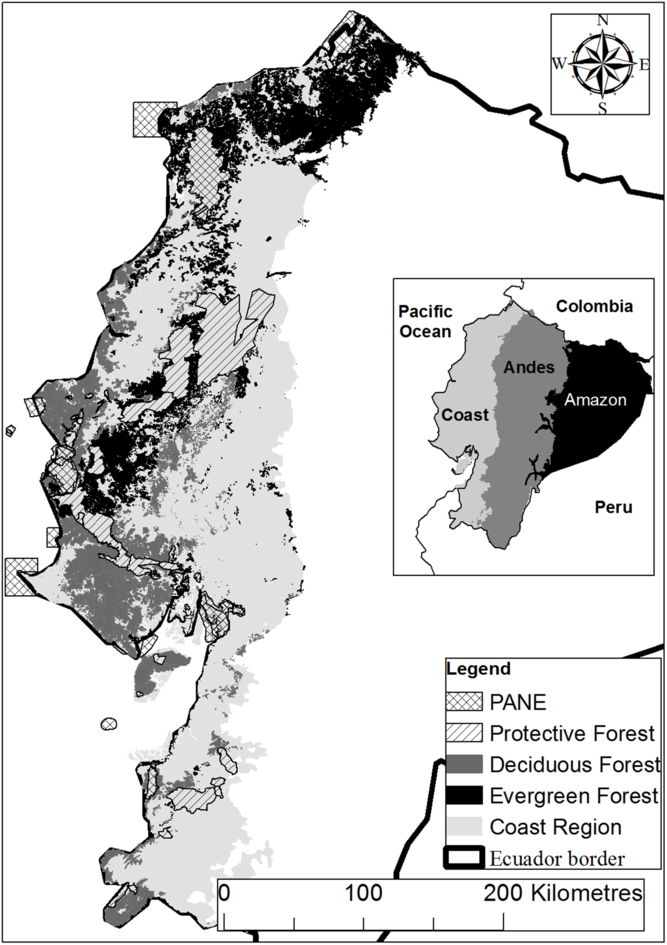
Map of the Ecuadorian coast showing dry forests, evergreen forests, Patrimonio de Areas Naturales del Estado (PANE) and protective forests.

The Ecuadorian state divides the natural spaces into protective forests (PFs) and PAs, with the latter being further subdivided. PFs are forests that are located in areas of rugged topography, in headwaters of watersheds or in areas that, owing to their climatic conditions (edaphic and hydric), are not suitable for agriculture or livestock and whose functions are to conserve water, soil, flora and fauna. There are 202 PFs in Ecuador, which cover an area of 2 425 002 ha, representing 9.72% of the national territory (Ministerio del Ambiente 2019). Thirty-nine of the 202 PFs are located in the coastal region, representing 19% of all PFs (Fig. 1).
Furthermore, the national system of PAs (Patrimonio de Areas Naturales del Estado (PANE)) is the group of natural areas that ensure the coverage and connectivity of important terrestrial, marine and coastal marine ecosystems, as well as cultural resources and main water sources (Ministerio del Ambiente del Ecuador 2016). The PANE covers the four regions of the country and consists of 56 PAs that extend over c. 20% of the area of Ecuador. However, distribution of the PANE areas is spatially uneven, and although the coastal region harbours 22 of them, these are relatively small, covering only 5% of the coastal region, which is significantly less than in the Andes (20.6%) and Amazon (23.2%) (Lessmann et al. Reference Lessmann, Muñoz and Bonaccorso2014). These PAs within the coastal region are focused on the largest patches of remaining vegetation (Fig. 1).
Analysis of ecosystem features
Various layers of geographical information obtained from the Ecuadorian Ministry of Environment were used to address our research question: biogeographic sectors; phenology; and ecosystems, PAs (PANE) and PFs (available at http://ide.ambiente.gob.ec/mapainteractivo). The first step was to overlay the layers of the ecosystems with the PAs and PFs in the littoral zone in order to assess correlations between phenology and protected status in Ecuador. This was done by grouping the ecosystems into dry or evergreen forests. We did not consider either mangroves or grasslands when making this calculation. Moreover, we calculated the proportion of the area with different land uses (classified as deciduous, evergreen, mangrove, intervention and others) included in the PANE areas and PFs separately.
The shapefile of the ecosystems also contains information concerning the fragmentation, connectivity, vulnerability, threat and fragility of each ecosystem, which were classified into different categories (e.g., high, medium, low) for each of these five indicators. The degree of fragmentation of each ecosystem was calculated using the number of patches, their mean size and the coefficient of variation among them (Ministerio del Ambiente de Ecuador 2015a) using the Patch Analysis Tool in ArcGIS and FRAGSTATS software (Elkie et al. Reference Elkie, Rempel and Carr1999, McGarigal et al. Reference McGarigal, Cushman and Neel2002). The fragmentation index of each ecosystem was ranked in four levels (very high, high, medium and low) according to the method of Jenks’ natural breaks (Ministerio del Ambiente de Ecuador 2015a). The connectivity was measured using Conefor 2.6 (Saura Reference Saura, Lafortezza, Chen, Sanesi and Crow2008) software by means of the Equivalent Connected Area Index (Ministerio del Ambiente de Ecuador 2017), which is defined as the area that should have a hypothetical and single continuous patch of forest (fully connected), corresponding to the same probability of connectivity as the set of patches of a habitat or ecosystem evaluated (Saura et al. Reference Saura, Gonzales and Elena-Roselló2011). The connectivity index was classified into four categories (high, medium, low and very low) also using Jenks’ natural breaks (Ministerio del Ambiente de Ecuador 2017). The vulnerability of each ecosystem was calculated by a combined weighted index using the number of species listed in CITES (CT), the number of endemic species (EN), the number of plants with a commercial value (CV) and the number of endangered plant species harboured according to the IUCN Red List for Ecuador (IUCN), together with the representativeness in Ecuador in terms of surface (RE) and in terms of conservation (RC) by means of PA, the fragmentation (FR) and the connectivity (CN) of the ecosystem. All of these variables were combined to obtain an overall vulnerability index (Ministerio del Ambiente de Ecuador 2015a) as follows:
 $${\rm{Vulnerability\,Species}} = \left( {{\rm{EN}} \times 0.6} \right) + \left( {{\rm{IUCN}} \times 0.2} \right) + \left( {{\rm{CT}} \times 0.24} \right) + \left( {{\rm{CV}} \times 0.4} \right)$$
 $${\rm{Vulnerability\,Landscape}} = \left( {{\rm{RE}} \times 0.23} \right) + \left( {{\rm{RC}} \times 0.24} \right) + \left( {{\rm{FR}} \times 0.29} \right) + \left( {{\rm{CN}} \times 0.24} \right)$$
 $${\rm{Vulnerability\,Index}} = \left( {{\rm{Vulnerability\,Species}} \times 0.45} \right) + \left( {{\rm{Vulnerability\,Landscape}} \times 0.55} \right)$$
The Vulnerability Index obtained was divided into three quantiles (high, medium and low).
The threat to the ecosystems was evaluated by another combined weighted index employing five variables: water resource use (WR), climate change impact (CC), forest exploitation (FE), extraction of natural resources (ENR) and the probability of land conversion (PC). Thus:
 $${\rm{Threat}} = \left( {{\rm{CC}} \times 0.11} \right) + \left( {{\rm{FE}} \times 0.12} \right) + \left( {{\rm{WE}} \times 0.11} \right) + \left( {{\rm{ENR}} \times 0.34} \right)$$
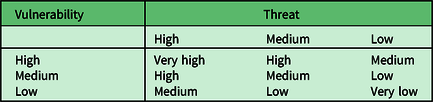
Finally, Vulnerability and Threat were combined to obtain five levels of fragility (very high, high, medium, low and very low; Table 1) (Ministerio del Ambiente de Ecuador 2015b). In these five indicators, no values were assigned to areas identified as non-natural ecosystems, such as crops, urban areas or intervening forests (for more details about the methodology, see Ministerio del Ambiente de Ecuador 2015a, 2015b, 2017).
The five categories of fragility according to the combination of the threat and vulnerability indices (Ministerio del Ambiente de Ecuador 2015a).

For each ecosystem, we calculated the percentage of fragmentation, connectivity, fragility, vulnerability and threat according to the area under each category. Finally, we compared the values for each category between deciduous and evergreen forests.
Results
Degree of protection
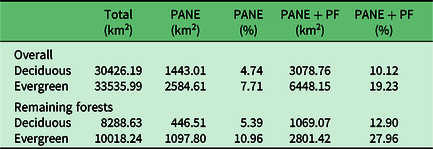
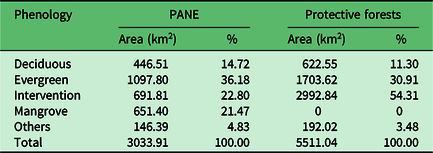
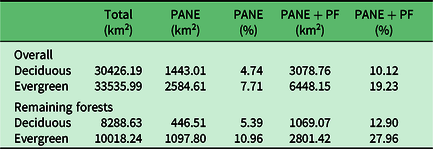
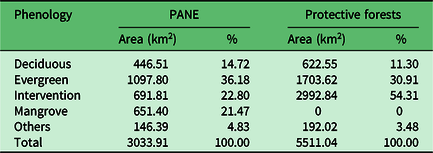
The remaining deciduous forests have less protection (12.90%) than evergreen forests (27.90%) (Table 2), and deciduous phenology is less represented in PFs (11.30%) and PANE areas (14.72%) than evergreen phenology and mangroves (Table 3). It can also be observed that the percentage of intervention is greater in PFs (54.31%) than in PANE areas (22.80%).
Areas and percentages protected by the Patrimonio de Areas Naturales del Estado (PANE) and protective forest (PF) according to phenology in the whole region (overall) and in the remaining forests of the Ecuadorian coastal region.
Percentages of forests by phenology within Patrimonio de Areas Naturales del Estado (PANE) and protective forests.
Analysis of ecosystem features
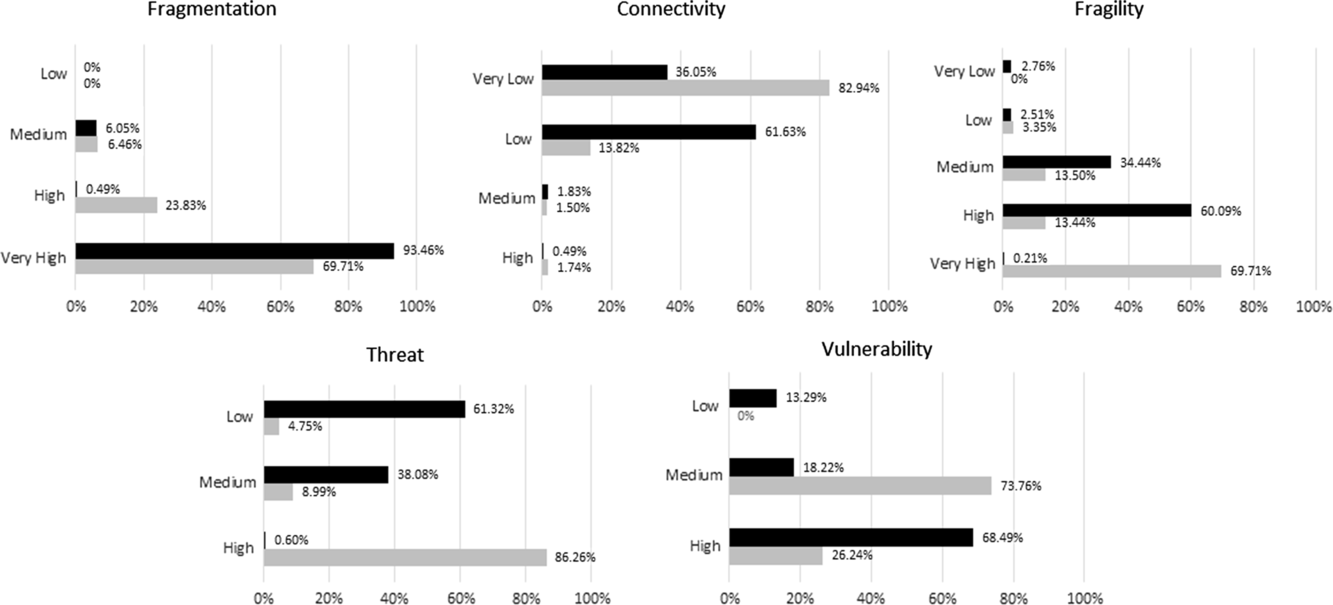
Among fragmentation, connectivity, threat, vulnerability and fragility, fragmentation is the most severe and widespread of all of the factors; both evergreen and deciduous phenologies show high to very high degrees of fragmentation covering the majority of the area. In addition, more than 80% of the area under deciduous ecosystems is classified as very low connectivity; 70% of the deciduous phenology is classified as very fragile compared to only 0.2% of the evergreen; and 86% of the area under deciduous ecosystems is classified as highly threatened as opposed to only 0.6% of the evergreen. However, the evergreen ecosystems showed higher values of vulnerability (Fig. 2).
Percentages of the area with the different degrees of fragmentation, connectivity, fragility, vulnerability and threat of the ecosystems in the coastal region of Ecuador according to their phenology: dry forests (grey) and evergreen forests (black).
Discussion
According to our data, the proportion of dry forests covered by PAs is much lower than that of the evergreen forests in this region. This bias could be attributed to the lower number of species that inhabit the dry forests (Sierra et al. Reference Sierra, Campos and Chamberlin2002), as well as its lower landscape value, particularly during the dry season.
The dry forest is one of the most threatened ecosystems in the Americas; specifically, the Tumbes-Piura dry forest ecosystem is critically endangered (Ferrer-Paris et al. Reference Ferrer-Paris, Zager, Keith, Oliveira-Miranda, Rodríguez and Josse2019). Despite the threat, it seems to receive less attention than the other Ecuadorian ecosystems. For instance, according to our calculations, despite the fact that the mangroves cover much less area than the deciduous forests, the PANE devotes more area to protecting mangroves than deciduous forests (Table 2). In addition, our results show that dry forests have a lower coverage of PAs than evergreen forests, even though these dry forests have a more critical conservation status, because more of their area is classified as having a high threat and very high fragility, as well as being highly fragmented with very little connectivity. Fragility is the most worrying indicator, since it encompasses the other parameters, and 70% of the area of dry ecosystems has very high levels of fragility (Fig. 2). This suggests that deciduous ecosystems are much more subject to anthropogenic pressures, and that the designation of remaining dry forests as PAs is necessary for their conservation. Nevertheless, the protection of dry forests could be insufficient to ensure the mitigation of deforestation, since in Ecuador this is still occurring within PAs (van der Hoek Reference van der Hoek2017). More comprehensive conservation strategies are needed to effectively reduce the deforestation rate. In particular, the PF is an ineffective conservation tool, since in the coastal region more than half of its area is classified as being subject to land use (Table 2).
It is important to recognize that the Vulnerability Index of the evergreen forests’ status is also worrisome, but the calculation of this parameter takes into account the number of endemic species, threatened species, species with a commercial value and species listed in CITES (Ministerio del Ambiente de Ecuador 2015b), values that are expected to be greater overall in evergreen forests. When considering conservation priorities, the deciduous forests are practically limited to the coastal region and, therefore, the loss of these remnant dry forests would lead to the extinction of this ecosystem in Ecuador.
In summary, deciduous forest systems face higher degrees of anthropogenic threat, yet receive much less official protection and fewer conservation interventions than evergreen forests in coastal Ecuador. While more than 80% of their original area has already been deforested (Sierra Reference Sierra2013), the remaining dry ecosystems in the coastal region of Ecuador are included in the Choco/Darien/Western Ecuador biodiversity hotspot (Myers et al. Reference Myers, Mittermeier, Mittermeier, da Fonseca and Kent2000) and harbour high levels of endemic species and others with constrained distributions (Sierra et al. Reference Sierra, Campos and Chamberlin2002, León-Yánez et al. Reference León-Yánez, Valencia, Pitman, Endara, Ulloa Ulloa and Navarrete2011). Despite their unique value in terms of biodiversity, anthropogenic factors continue to degrade these already highly threatened and fragile dry forests. Since the evergreen forests have received more attention from researchers and natural resources managers, conservation efforts should now be more focused on the preservation of the remaining dry ecosystems, protecting them as part of a more complex regional conservation plan in which sustainable exploitation by the local communities improves their income and preserves biodiversity (Escribano-Avila et al. Reference Escribano-Avila, Cervera, Ordóñez-Delgado, Jara-Guerrero, Amador and Paladines2017). This plan is vital to preventing continued anthropogenic habitat loss, partly due to a lack of protection, and the establishment of new PA networks should also ensure the connectivity of these ecosystems due to their high levels of fragmentation.
Acknowledgements
This work was carried out in the frame of the project Conservation Status and Threats of Wild Mammals in the Dry and Humid Tropical Forest in Manabí – Ecuador (AP-C1-2018-FCV0012), funded by the ‘Universidad Técnica de Manabí’.
Financial support
None.
Conflict of interest
None.
Ethical standards
None.