Sugar beet is a commercial row crop in north central and northwestern United States, including south Idaho and eastern Oregon. Weed management is one of the major challenges in sugar beet production (Carlson et al. Reference Carlson, Luecke, Khan and Dexter2007). Kochia competition is particularly troublesome in sugar beet, as kochia densities as low as 0.1 plant per meter of sugar beet row can cause a 10% sugar beet yield reduction (Schweizer Reference Schweizer1973), while greater kochia densities can cause >90% yield losses if left uncontrolled during the growing season (Weatherspoon and Schweizer Reference Weatherspoon and Schweizer1969).
Glyphosate-resistant (GR) sugar beets (Roundup Ready®) were rapidly adopted by growers following their release in 2007 and now represent more than 98% of total US sugar beet production (Kniss Reference Kniss2010). GR sugar beet was adopted so rapidly in part because of widespread weed resistance to the acetolactate synthase (ALS)-inhibiting herbicide triflusulfuron, as well as ineffective kochia control with other herbicides registered for use in sugar beet. Glyphosate provided excellent broad-spectrum weed control in GR sugar beet, including ALS-resistant kochia biotypes. Growers often rely on multiple (two to four) POST glyphosate applications for season-long weed control in sugar beet fields (Kemp et al. Reference Kemp, Taylor and Renner2009; Kniss Reference Kniss2010; Kumar and Jha Reference Kumar and Jha2015b; Wilson et al. Reference Wilson, Yonts and Smith2002). This practice potentially enhanced the risk of GR weed evolution in sugar beet production, with kochia being the first weed to evolve glyphosate resistance in sugar beet in the western United States (Heap Reference Heap2017). In addition, it is a common practice in the Treasure Valley of eastern Oregon and southern Idaho to use glyphosate to manage weeds during field preparations even when nonglyphosate resistant crops are grown in rotation.
Kochia, a monoecious C4 diploid (2n=18), is one of the most troublesome summer annual broadleaf weeds in the Great Plains and Mountain West regions of the United States (Eberlein and Fore Reference Eberlin and Fore1984; Forcella Reference Forcella1985; Friesen et al. Reference Friesen, Beckie, Warwick and Van Acker2009), both in cropland and noncropland. Kochia possesses several unique biological attributes, including early seedling emergence, rapid growth, tolerance to abiotic stresses, prolific seed production (>100,000 seeds per plant), low seed dormancy, low seed persistence (≤2 yr), and long-distance seed dispersal by the tumble nature of the mature plant (Baker et al. Reference Baker, Withrow, Brown and Beck2010; Christoffoleti et al. Reference Christoffoleti, Westra and Moore1997; Friesen et al. Reference Friesen, Beckie, Warwick and Van Acker2009; Kumar and Jha Reference Kumar and Jha2015a; Schwinghamer and Van Acker Reference Schwinghamer and Van Acker2008). The protogynous nature of kochia flowering enforces a high degree of outcrossing and pollen-mediated gene flow (Beckie et al. Reference Beckie, Blackshaw, Hall and Johnson2016; Stallings et al. Reference Stallings, Thill, Mallory-Smith and Shafii1995). Consequently, kochia possesses high genetic diversity within and among populations (Mengistu and Messersmith Reference Mengistu and Messersmith2002). All these biological traits prompt rapid development and spread of herbicide resistance in kochia.
Kochia has evolved resistance to several herbicide sites of action, including photosystem II (PS II) inhibitors (atrazine), ALS inhibitors (sulfonylurea and imidazolinone herbicides), and synthetic auxins (dicamba and fluroxypyr) in the northwestern United States (Heap Reference Heap2017). A majority of the GR kochia cases have been reported from wheat (Triticum aestivum L.)–fallow systems, with the first report from western Kansas in 2007 (Heap Reference Heap2017). GR kochia has been confirmed in 10 US states and 3 Canadian provinces (Heap Reference Heap2017). The rapid spread of GR kochia is a serious threat to the no-till, wheat-based crop rotations and GR crops such as corn (Zea mays L.), soybean [Glycine max (L.) Merr.], and sugar beet that are commonly grown in these regions.
EPSPS gene duplication (increased EPSPS gene copy number) confers glyphosate resistance in almost all GR kochia populations reported so far (Gaines et al. Reference Gaines, Barker, Patterson, Westra, Westra, Wilson, Jha, Kumar and Kniss2016). GR kochia populations with 3- to 15-fold increase in relative EPSPS gene copies have been documented from Montana, Colorado, North Dakota, South Dakota, and Kansas (Godar et al. Reference Godar, Stahlman, Jugulam and Dille2015; Kumar and Jha Reference Kumar and Jha2015a; Kumar et al. Reference Kumar, Jha, Giacomini, Westra and Westra2015; Wiersma et al. Reference Wiersma, Gaines, Preston, Hamilton, Giacomini, Buell, Leach and Westra2015). A cytogenetic study found that the EPSPS gene duplication in GR kochia possibly occurred due to an unequal crossover during meiosis, resulting in tandem gene duplication (Jugulam et al. Reference Jugulam, Niehues, Godar, Koo, Danilova, Friebe, Sehgal, Varanasi, Wiersma, Westra, Stahlman and Gill2014). The amplified copies were found to be stably inherited (Jugulam et al. Reference Jugulam, Niehues, Godar, Koo, Danilova, Friebe, Sehgal, Varanasi, Wiersma, Westra, Stahlman and Gill2014), and were not associated with any growth or reproductive fitness differences between GR and glyphosate-susceptible (GS) kochia (Kumar and Jha Reference Kumar and Jha2015a).
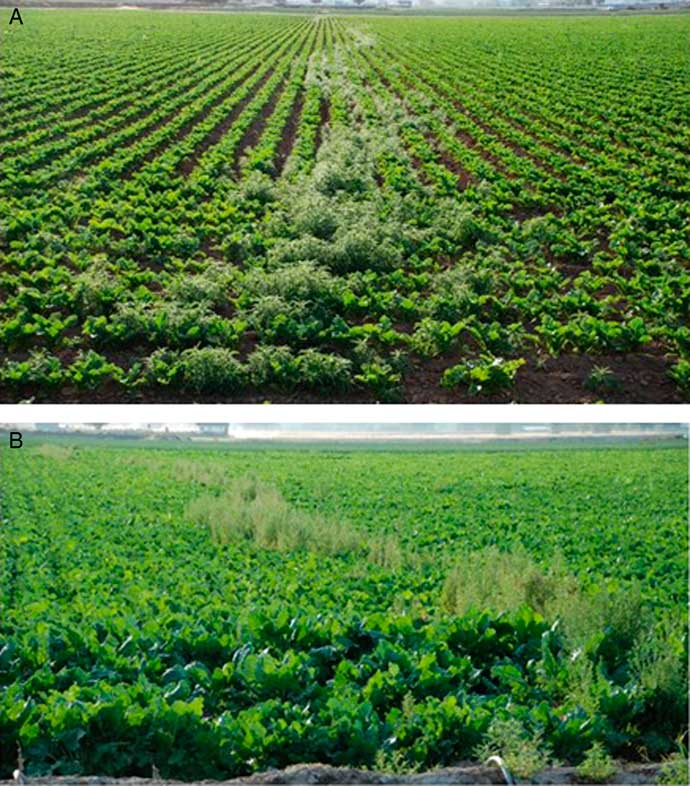
During the 2014 growing season, trails of kochia plants surviving repeated applications of glyphosate (870gaeha−1 each) were observed in sugar beet fields in the Treasure Valley of eastern Oregon and southwestern Idaho (Figure 1). Seeds from kochia plants that survived glyphosate applications were collected from those fields during the fall of 2014 just before sugar beet harvest. The main objectives of this research were to 1) confirm and characterize the glyphosate resistance levels in GR kochia accessions collected in 2014, 2) determine the relationship between the relative EPSPS gene copy number and levels of glyphosate resistance based on whole-plant dose response, and 3) conduct a subsequent survey to determine the distribution of GR kochia in sugar beet fields in eastern Oregon and southwestern Idaho.
A trail of kochia plants that survived multiple glyphosate applications (≥870 g ha−1 each) with no visual signs of injury in a glyphosate-resistant sugar beet field in June, 2014 (A) and August, 2014 (B) in eastern Oregon.

Materials and Methods
Plant Material
Putative GR kochia accessions were collected in fall of 2014 from sugar beet fields in eastern Oregon and southwestern Idaho. The sampled fields had been under crop rotations that included glyphosate-resistant corn–sugar beet rotation for >7 yr, with repeated glyphosate use (two to three applications per year) for weed control. A targeted sampling for putative GR kochia was also conducted near sugar beet piling grounds and ditch banks in eastern Oregon. At each site, seeds were collected from 8 to 10 randomly selected plants that survived at least two applications of glyphosate (≥870 gha−1 each). Seeds from each site were composited into a single sample, referred to as GR accession: ALA (44°00′23.92′′N, 116°59′07.93′′W), VAL (43°59′04.82′′N, 117°11′45.01′′W), and DB (44°09′11.06′′N, 116°56′34.10′′W) from eastern Oregon, and WIL from southwestern Idaho. The susceptible accession (GS) was obtained from a sugar beet field at the Kimberly Research and Experiment Station, Kimberly, Idaho and is known to be susceptible to glyphosate.
Field-collected seeds of each kochia accession were sown separately on the surface of 53- by 35- by 10-cm germination flats filled with a commercial potting mixture (VermiSoilTM, Vermicrop Organics, 4265 Duluth Avenue, Rocklin, CA) in a greenhouse at the Montana State University–Southern Agricultural Research Center (MSU-SARC) near Huntley, MT, in the fall of 2014. The greenhouse was maintained at 26/23±3 C day/night temperatures and with 16/8 h day/night photoperiods, supplemented by metal halide lamps (400 μmol m−2 s−1). A total of 100 seedlings from each accession were treated with a discriminate dose (1,260 g ae ha−1) of potassium salt of glyphosate (Roundup PowerMax®, Monsanto Company, St Louis, MO) when plants were 8 to 10 cm tall. Glyphosate along with 2% (w/v) ammonium sulfate was applied using a cabinet spray chamber (Research Track Sprayer, De Vries Manufacturing, RR 1 Box 184, Hollandale, MN) equipped with an even flat-fan nozzle tip (TeeJet 8001EXR, Spraying System Co., Wheaton, IL) calibrated to deliver 94 L ha−1 of spray solution at 276 kPa. None of the GS plants survived the glyphosate application, whereas >90% of GR plants survived. Twenty GR plants surviving the glyphosate treatment and 20 untreated GS plants were transplanted individually into 10-L pots containing the same potting mixture and allowed to grow in the greenhouse. Individual plants were covered with pollination bags (DelStar Technologies, Inc., 601 Industrial Drive, Middletown, DE 19709) to prevent pollen contamination. Progeny seeds from the selfed plants were harvested at maturity and bulked by accession for use in subsequent experiments.
Whole-Plant Glyphosate Dose-Response Assay
Experiments were conducted at the MSU-SARC, near Huntley, MT, during the summer of 2015, and repeated in the fall of 2015. Selfed seeds of GR and GS accessions were sown in germination trays filled with the commercial potting mixture as previously described. Single kochia seedlings were transplanted into 10-cm-diam pots (one plant per pot) containing the same potting mixture as the germination trays. The experimental design was a randomized complete block (blocked by accession) with 10 replications (pots). Actively growing 8- to 10-cm-tall kochia plants from each accession were sprayed with the potassium salt of glyphosate at doses of 0, 109, 218, 435, 870, 1,740, 2,610, 3,480, 4,350, 5,220, 6,960, 8,700, and 10,440 g ae ha−1. Ammonium sulfate at 2% (w/v) was included with all glyphosate treatments. Applications were made inside the cabinet spray chamber as previously described. Herbicide-treated plants were returned to the greenhouse and were watered as needed and fertilized [Miracle-Gro water soluble fertilizer (24-8-16), Scotts Miracle-Gro Products Inc., 14111Scottslawn Road, Marysville, OH] weekly to maintain good growth. Injury was visually assessed on a scale of 0 to 100 (0 being no injury and 100 being complete plant death) at 7, 14, and 21 d after treatment (DAT).
Shikimate Accumulation Assay
Experiments were conducted in fall 2015 and spring 2016 and were set up in a completely randomized design. Three plants (replications) per kochia accession were tested for shikimate accumulation using an in vivo leaf-disk assay (Shaner et al. Reference Shaner, Nadler-Hassar, Henry and Koger2005). Three technical replicates (5-mm-diam leaf disks) from each actively growing kochia plant (8 to 10 cm tall) per accession were sampled. The excised leaf disks were placed into a 96-well microtiter plate containing 7.7-mM ammonium phosphate and glyphosate (molecular grade) concentrations of 0, 100, or 1,000 μM. A 100-μM glyphosate (discriminating dose) was chosen to differentiate the shikimate accumulation between GR and GS kochia plants (Kumar et al. Reference Kumar, Jha, Giacomini, Westra and Westra2015). The samples were incubated in light for 16 h at room temperature, frozen (−20 C) and thawed (60 C), and subjected to the extraction procedure as described by Shaner et al. (Reference Shaner, Nadler-Hassar, Henry and Koger2005). Optical density was measured at 380 nm using a spectrophotometer (BioTekTM SynergyTM 2 Multi-Mode Microplate Reader, Winooski, VT). A shikimate standard curve was developed and the optical density values converted to shikimate accumulation (ng μL−1) by using the shikimate standard curve (Shaner et al. Reference Shaner, Nadler-Hassar, Henry and Koger2005). Shikimate accumulation was calculated by subtracting the amount accumulated in corresponding control (0-μM glyphosate) wells. Comparisons for shikimate accumulation between GR and GS kochia accessions at each glyphosate concentration were performed using the Student’s t test at P<0.05.
EPSPS Genomic Copy Number
Real-time quantitative polymerase chain reaction (qPCR) experiments on genomic DNA (gDNA) were conducted in fall 2015 at the MSU-SARC, near Huntley, MT, to determine the relative EPSPS genomic copy number in the kochia accessions tested, and experiments were repeated at least once. Young leaf tissue (100 mg) was sampled from three plants per accession when the plants reached 8 to 10 cm in height. The gDNA from each kochia sample was extracted and quantified using a previously established protocol (Kumar et al. Reference Kumar, Jha, Giacomini, Westra and Westra2015). The ALS gene was chosen as a reference gene because of the stability of ALS gene expression across kochia populations (Wiersma et al. Reference Wiersma, Gaines, Preston, Hamilton, Giacomini, Buell, Leach and Westra2015). Previously reported primer sequences specific to kochia EPSPS and ALS gene were used (Wiersma et al. Reference Wiersma, Gaines, Preston, Hamilton, Giacomini, Buell, Leach and Westra2015). Each qPCR reaction contained 2 µl of gDNA (2 ng μl−1) template, 1× Perfecta SYBR Green Supermix, and 250-nM each forward and reverse primer (Kumar et al. Reference Kumar, Jha, Giacomini, Westra and Westra2015). Each qPCR reaction was conducted with a final reaction volume of 12.5 µl on a 96-well PCR plate. The qPCR thermal profiles were 95 C for 15 min, 40 cycles of 95 C for 30 s, and 60 C for 1 min, followed by melt-curve analysis. Negative controls containing 10 µl of Mastermix, 250-nM each forward and reverse primer, and 2.5 µl of high-performance liquid chromatography water with no gDNA template were also included. The relative EPSPS gene copy number was calculated as 2-ΔCt (Ct refers to threshold cycle), where ΔCt=Ct, EPSPS–Ct, ALS. Each sample was run in triplicate to calculate the mean and standard error of the increase in relative EPSPS copy number. A correlation analysis between relative EPSPS gene copy number and glyphosate resistance levels (LD50 values) was performed using PROC CORR in SAS 9.3 (SAS Institute, Inc., SAS Campus Dr., Cary, NC 27513).
GR Kochia Survey
A random field survey was conducted during late summer of 2015 and 2016 to determine the distribution of GR kochia in Idaho and Oregon sugar beet and corn fields. The survey encompassed an area from Adrian, OR, to the south (43°44′29.07′′N, 117°04′17.82′′W) to the Oregon slope on the north (44°14′24.32′′N, 116°59′01.51′′W), to the east of Parma, ID (43°46′40.59′′N, 116°52′18.15′′W), and to the city of Vale, OR, (44°58′56.38′′N, 117°14′17.30′′W), on the west. The surveyed fields had received at least one glyphosate application, and glyphosate-surviving plants or those that emerged after the application were ≥30 cm tall at the time of sampling. Ten kochia plants (referred to as a population) were randomly chosen from each field and 5 to 10 branches were excised from each plant using a pair of scissors and separately placed in a Ziploc bag. The 10 bags from each field were placed in a larger Ziploc bag and placed in a cooler containing ice. The scissors were rinsed in deionized water between plants. Samples were subsequently stored in a freezer and later shipped overnight to Huntley, MT, for processing. The overnight shipping container included dry ice in order to keep the plant samples frozen. Samples were immediately placed in a freezer upon arrival in Huntley, MT, until they were processed for determination of EPSPS gene copy number as per the protocol previously described. We used the DNA marker for EPSPS gene duplication to detect GR kochia individuals in the survey populations (Gaines et al. Reference Gaines, Barker, Patterson, Westra, Westra, Wilson, Jha, Kumar and Kniss2016). Ten plants from each survey population were used to quantify the relative EPSPS gene copy number, as previously described.
Statistical Analyses
All data were subjected to ANOVA using PROC MIXED in SAS 9.3 to test the significance of the fixed effects, i.e., experimental run, accession, treatment (glyphosate dose in whole-plant dose-response and shikimate accumulation assays), and their interactions. Replication and interactions involving replication were random effects in the model. The residual analysis was performed using PROC UNIVARIATE to test homogeneity of variance, and all data met those ANOVA assumptions.
For whole-plant dose-response assays, visually-assessed injury (%) for each kochia accession was regressed over glyphosate dose using a three-parameter log-logistic model (Ritz et al. Reference Ritz, Baty, Streibig and Gerhard2015; Seefeldt et al. Reference Seefeldt, Jensen and Fuerst1995).
 $$Y\,{\equals}\,\left\{ {{D \mathord{\left/ {\vphantom {D 1}} \right. \kern-\nulldelimiterspace} 1}{\plus}{\rm exp}\,[B({\rm log}X\,{\minus}\,{\rm log}\,E]} \right\},$$
where Y refers to the response variable (% visual injury), D is the upper limit, B is the slope of each curve, E is the glyphosate dose required to cause 50% injury (referred to as LD50), and X is the glyphosate dose. Nonlinear regression parameter estimates, standard errors, I90 (glyphosate dose needed to cause 90% injury), and 95% confidence intervals for each accession were determined using the drc package in R software. The resistance index (referred as R:S ratio) for each GR kochia accession was estimated by dividing the LD50 value of a GR accession by the LD50 value of the GS accession.
Results and Discussion
Whole-Plant Glyphosate Dose Response
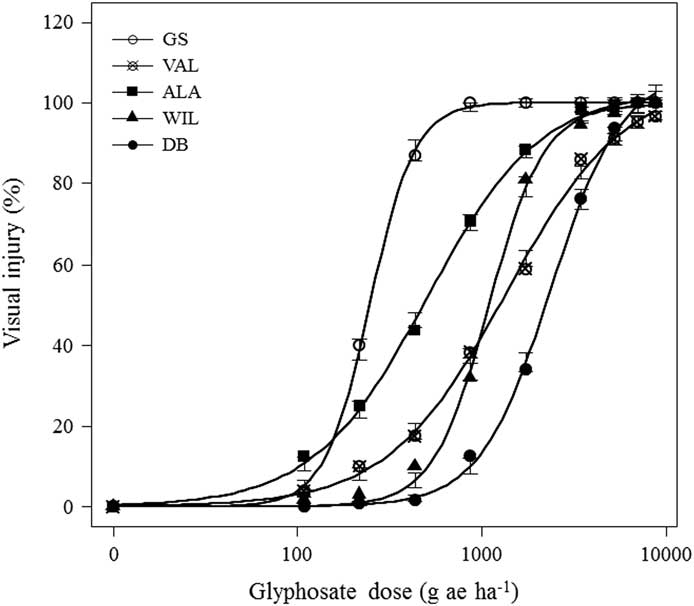
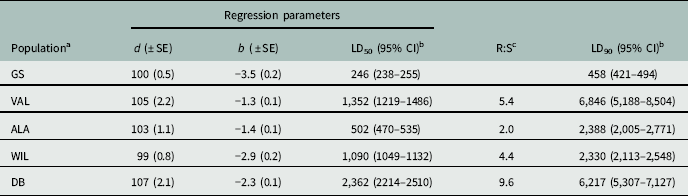
The interaction of experimental run with accession or glyphosate dose was not significant; therefore, data were pooled over runs. Evident from the lack-of-fit test, the three-parameter log-logistic model accurately described (P=0.431) the visual injury data for each accession. The LD 50 values for VAL, ALA, WIL, and DB accessions were 1,352, 502, 1,090, and 2,362gha−1, respectively, and were greater than the 246 gha−1 value obtained for the GS accession (Table 1; Figure 2). Based on the LD50 value, the ALA accession (although different from the GS accession) might not be claimed as GR; however, based on the curve shift, compared to the GS accession at the LD90 level (LD90 value of 2,388gha−1 for ALA accession), the ALA accession was more likely to be GR. The LD90 values indicated that 5 to 15 times more glyphosate was needed to obtain 90% injury of the four GR accessions relative to the GS. On the basis of visually assessed injury (LD50 values), the four GR kochia accessions exhibited R:S ratios of 2.0 to 9.6. The DB accession had a higher LD50 value than did the ALA, VAL, and WIL populations (Table 1). Overall, the resistance hierarchy of GR accessions was DB>VAL>WIL>ALA. The levels of resistance in these GR kochia accessions from sugar beet fields appear to be similar to those reported in populations that evolved in wheat–fallow fields. For instance, GR kochia populations from Montana wheat–fallow fields had R:S ratios ranging from 7.1 to 11.0 (Kumar et al. Reference Kumar, Jha and Reichard2014), while R:S ratios ranging from 4.0 to 5.3 have been documented from GR kochia populations collected from chemical fallow fields in western Kansas (Godar et al. Reference Godar, Stahlman, Jugulam and Dille2015). Similarly, GR kochia populations from southern Alberta, Canada had R:S ratios of 5.4 to 6.9 (Beckie et al. Reference Beckie, Blackshaw, Low, Hall, Sauder, Martin, Brandt and Shirriff2013). GR kochia populations from North Dakota, South Dakota, and Colorado had 13.8-, 6.8-, and 3.5-fold levels of resistance to glyphosate, respectively (Wiersma et al. Reference Wiersma, Gaines, Preston, Hamilton, Giacomini, Buell, Leach and Westra2015).
Visual injury response of glyphosate-resistant (ALA, DB, VAL, WIL) and glyphosate-susceptible (GS) kochia accessions collected in 2014 from Oregon and Idaho sugar beet fields treated with increasing doses of glyphosate. Symbols represent actual mean values, whereas solid lines represent predicted values. Vertical bars indicate standard errors of the mean values.

Regression parameter (Equation 1) estimates from the whole-plant dose response study based on visually assessed injury (%) of glyphosate-resistant (GR) and -susceptible (GS) kochia accessions treated with glyphosate.

a Abbreviations: GS, susceptible kochia accession from Kimberly Research and Experiment Station, Kimberly, Idaho; VAL, GR kochia accession from eastern Oregon; ALA, GR kochia accession from eastern Oregon; WIL, GR kochia accession from southwestern Idaho; DB, GR kochia accession from eastern Oregon; SE, standard error of mean; CI, confidence interval.
b LD50 is the effective glyphosate dose (g ha−1) required for 50% injury; LD90 is the effective glyphosate dose (g ha−1) required for 90% injury.
c R:S is calculated as a ratio of LD50 of a GR population to LD50 of the GS kochia accession.
Shikimate Accumulation
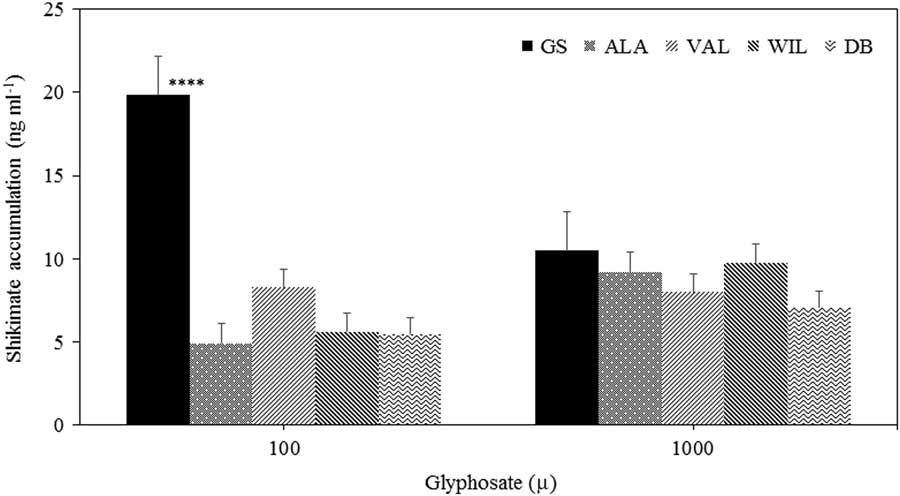
Shikimate accumulation in leaf discs of GR and GS kochia accessions is shown in Figure 3. At a discriminating dose of 100-μM glyphosate, the GS plants had a shikimate accumulation of 19.86 ngμL−1, which was 2.4- to 4.0-fold higher than the shikimate accumulated by GR plants of ALA, VAL, WIL, and DB accessions (Figure 3). However, there was no difference in shikimate accumulation between GR and GS kochia accessions at 1,000-μM glyphosate. Similarly, Godar et al. (Reference Godar, Stahlman, Jugulam and Dille2015) found that GR kochia accessions from western Kansas had 2.6- to 6.5-fold less shikimate accumulation compared with the susceptible accession, at 100-μM glyphosate concentration (Godar et al. Reference Godar, Stahlman, Jugulam and Dille2015). GR kochia accessions collected from Montana wheat–fallow fields accumulated 6- to 17-fold less shikimate than the susceptible accession (Kumar et al. Reference Kumar, Jha, Giacomini, Westra and Westra2015).
Shikimate accumulation in glyphosate-susceptible (GS) and glyphosate-resistant (GR) kochia accessions collected in 2014 from Oregon and Idaho. Vertical bars indicate standard errors of the mean values. The symbol (****) represents that the GS accession was significantly different from the GR accessions at P<0.05.

EPSPS Genomic Copy Number
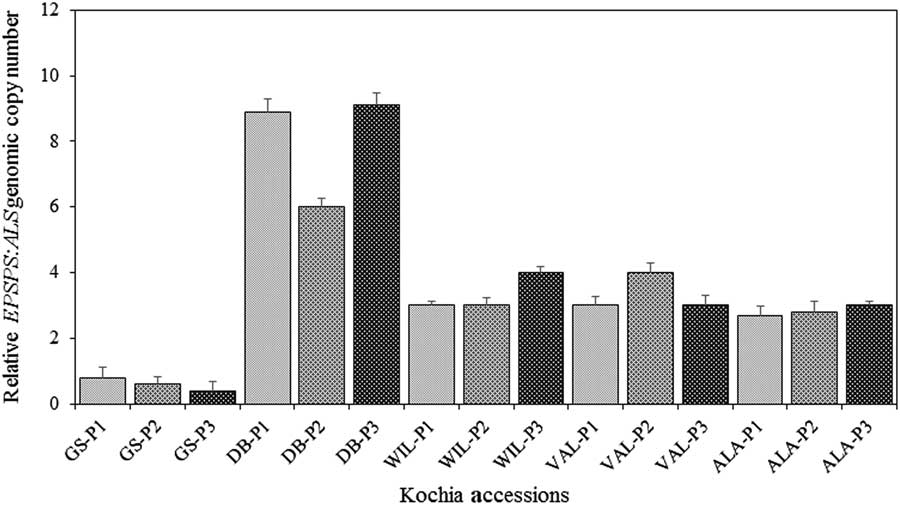
The qPCR assay revealed that kochia plants from DB accession had 6.0 to 9.1, plants from WIL and VAL had 3.0 to 4.0, and plants from ALA had 2.7 to 3.0 relative copies of the EPSPS gene (Figure 4), compared with 0.4 to 0.8 relative EPSPS gene copy number of the GS accession. Gaines et al. (Reference Gaines, Barker, Patterson, Westra, Westra, Wilson, Jha, Kumar and Kniss2016) also reported EPSPS gene copy numbers ranging from 2.5 to 10.2 in GR kochia populations collected from sugar beet fields in Montana, Wyoming, Colorado, and Nebraska. GR kochia populations from wheat–fallow fields in Colorado, Montana, and western Kansas had 2.5 to 13.0 EPSPS gene copies (Godar et al. Reference Godar, Stahlman, Jugulam and Dille2015; Kumar and Jha Reference Kumar and Jha2015a; Kumar et al. Reference Kumar, Jha, Giacomini, Westra and Westra2015; Wiersma et al. Reference Wiersma, Gaines, Preston, Hamilton, Giacomini, Buell, Leach and Westra2015).
Relative EPSPS:ALS genomic copy number determined in glyphosate-susceptible (GS) and glyphosate-resistant (GR) kochia accessions collected in 2014 from Oregon and Idaho. The designations -P1, -P2, and -P3 refer to the three plants that were used per accession for each qPCR run. Vertical bars represent standard errors of the mean values.

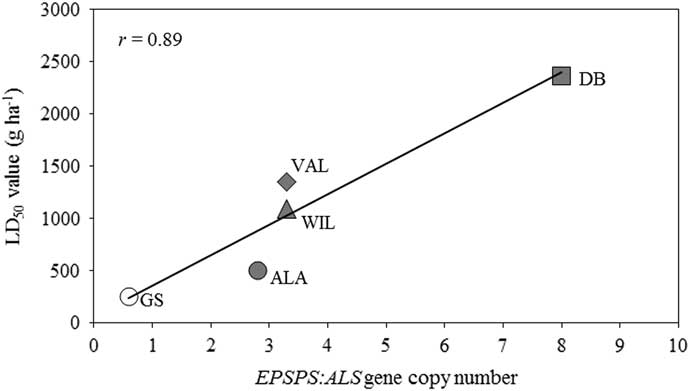
A strong linear relationship (r = 0.89) was observed between the relative EPSPS gene copy number and LD50 values of the GS and GR kochia accessions collected from sugar beet fields in this study (Figure 5). This indicates that 2.7- to 9.1-fold increase in the relative EPSPS gene copy number resulted in 2.0- to 9.6-fold levels of resistance (based on R:S ratios) to glyphosate in the GR accessions. However, it may be difficult to predict whether additional EPSPS gene copies >9.1 will continue to increase whole-plant glyphosate resistance levels (LD50 values) at a similar rate; it might be possible if we had individuals with very high copy numbers (Gaines et al. Reference Gaines, Barker, Patterson, Westra, Westra, Wilson, Jha, Kumar and Kniss2016). A similar linear relationship between the increased EPSPS gene copy number and glyphosate resistance levels has been documented in GR kochia populations collected from wheat–chemical fallow fields in western Kansas and Montana (Godar et al. Reference Godar, Stahlman, Jugulam and Dille2015; Kumar et al. Reference Kumar, Jha, Giacomini, Westra and Westra2015).
Correlation of relative EPSPS:ALS gene copy number with the amount of glyphosate needed for 50% injury (LD50 values) of glyphosate-susceptible (GS) and glyphosate-resistant (ALA, DB, VAL, WIL) kochia accessions collected in 2014 from Oregon and Idaho.

GR Kochia Survey
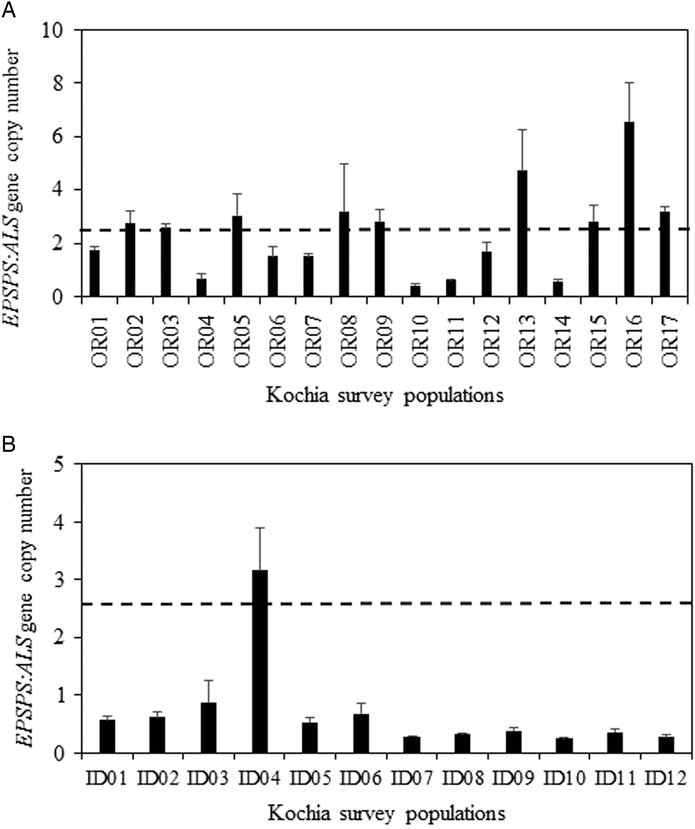
Out of the 17 kochia accessions collected from sugar beet fields during the random survey in eastern Oregon in 2015 and 2016, nine had EPSPS gene copy numbers ranging from 2.6 to 6.6 (Figure 6A), indicating that those populations have developed field-level resistance to glyphosate. All other accessions from Oregon had an EPSPS gene copy ≤1.8, indicating susceptibility to glyphosate. In contrast, there was only 1 out of 12 kochia accessions from the survey conducted in 2015 and 2016 in Idaho sugar beet fields that had 3.1 EPSPS gene copies and were resistant to glyphosate, whereas, all other accessions had <2.0 EPSPS gene copies, and were susceptible to glyphosate (Figure 6B). The EPSPS copy number can be accurately used to detect field-level glyphosate resistance in kochia, and individuals with >2.5 copies of EPSPS gene are considered to be GR (Gaines et al. Reference Gaines, Barker, Patterson, Westra, Westra, Wilson, Jha, Kumar and Kniss2016). According to a previously developed empirical model, an EPSPS copy number of approximately 3.0 is expected to provide 2.3- to 2.9-fold level of whole-plant glyphosate resistance (Gaines et al. Reference Gaines, Barker, Patterson, Westra, Westra, Wilson, Jha, Kumar and Kniss2016), which results in a low level of resistance that is often overlooked in the field. Nevertheless, continued selection with glyphosate in GR sugar beet fields may continue to select for kochia plants with high EPSPS gene copy numbers, if not managed proactively.
Relative EPSPS:ALS genomic copy number determined in kochia populations collected from sugar beet fields during the survey in 2015 and 2016 in Oregon (A) and Idaho (B). Vertical bars represent standard errors of the mean values. A gene copy number of 2.6 (indicated by dashed line) or higher was used to identify the population as being GR.

In summary, this publication is the first report of GR kochia in Idaho and Oregon. The four GR accessions collected in 2014 exhibited resistance levels of 2.0- to 9.6-fold, accumulated 2.4 to 4.0 times less shikimate compared with the GS accession, and had 2.7 to 9.1 EPSPS gene copies. The 2015 and 2016 survey results further suggested that approximately half of the kochia populations collected from sugar beet fields in eastern Oregon had low to high levels of glyphosate resistance, while GR kochia appeared to be less widespread in southwestern Idaho sugar beet fields.
The evolution of GR kochia is a threat to the long-term sustainability of GR sugar beet production in the United States. Furthermore, recent evolution of kochia accessions with multiple resistance to glyphosate and ALS inhibitors (Kumar et al. Reference Kumar, Jha, Giacomini, Westra and Westra2015), as well as to glyphosate, ALS, PS II, and dicamba (Varanasi et al. Reference Varanasi, Godar, Currie, Dille, Thompson, Stahlman and Jugulam2015), seriously limits herbicide options for controlling kochia. Triflusulfuron (an ALS inhibitor) and glyphosate were the only effective herbicides available for kochia control in sugar beet. Kochia resistance to ALS inhibitors is now widespread, so as GR kochia spreads within sugar beet growing regions, there will no longer be any herbicides registered for sugar beet that will control this weed. Pollen- and seed-mediated gene flow of kochia will allow rapid spread of herbicide-resistance alleles in other sugar beet producing areas in the region.
There may be a need for a community-based approach for area-wide (including roadsides, ditch banks, and waste areas) management of kochia. In sugar beet fields, where GR kochia is not yet a problem, as evident in the survey from Idaho, growers should proactively apply multiple (up to four) full-use rates of glyphosate (the maximum rate for any single application from crop emergence until the eight-leaf stage of sugar beet is 1,260 g ha−1, and from the eight-leaf stage to canopy closure is 870 gha−1 (total of 3,937 g ha−1 POST in-crop per season) to prevent kochia survivors that escape early application(s) or those that emerge late in the season. Weed control programs should employ a “zero seed tolerance” approach for glyphosate-survived kochia plants in sugar beet fields. Additionally, growers should manage the kochia seed bank in rotational crops such as corn, dry bean (Phaseolus vulgaris L.), onion (Allium cepa L.), potato (Solanum tuberosum L.), and wheat/barley (Hordeum vulgare L.) using diversified tactics, including alternative, effective herbicides with multiple sites of action. Based on the severity of the problem, there is an urgent need to develop and implement ecologically based weed control methods (tillage or stale seed bed, crop competition) that can help provide effective kochia control in sugar beet–based crop rotations in this region.
Acknowledgments
The authors thank sugar beet growers, extension agents, and crop consultants from eastern Oregon and southwestern Idaho for their valuable assistance in kochia seed collection. We also thank Ms. Anjani J. and Mr. Charlemagne A. Lim for their technical assistance in conducting the laboratory work.