The Republic of Serbia during the past 20 years has been going through a period of significant political and economic change. Nevertheless, today the Republic of Serbia is a candidate country for European Union (EU) membership, reflecting the significant progress made to date in structural and institutional reforms (1).
Population of the Republic of Serbia is approximately 7.2 million (2), and it has been on a steady decline during the past 20 years (by approximately half million). Unstable birth rate, negative natural increase rate, decreasing vital index, and increasing economic migration correlate with the aging of the population (3). The growing share of the population above 65 years of age (3), together with the growing unemployment rate, challenges the sustainability of the system, especially because of the escalated demand for health and social care and reduced productivity. Overall value of life expectancy in the Republic of Serbia in 2015 is 75.14 years of life (72.62 for males and 77.67 for females) (3).
Similar to the situation in developed countries, the major burden of illness is in noncommunicable diseases (3;4); three leading causes of the premature death in the Republic of Serbia in 2010 were ischemic heart disease (19.9 percent), stroke (18.8 percent), and cancers (approximately 18 percent). According to the same Global Burden of Disease Study, ischemic heart disease and cerebrovascular disease are also among the three leading causes of morbidity measured by disability-adjusted life-years (DALYs) (the third is low back pain). Although over the past decade a lot has been invested in a series of specific campaigns on healthy lifestyles, the three leading health risks (4) are still dietary risks, high blood pressure, and smoking.
METHODS
The study summarizes experiences and conclusions gained by the authors in their routine work at national and international level. Description of the healthcare system, its financing, and review of the current health technology assessment (HTA) practice were performed by a pragmatic, nonsystematic literature review that was based mostly on regulations and available reports from different international projects done in Serbia in the past 10 years
Healthcare System and Coverage within Compulsory Health Insurance
There are approximately 350 healthcare institutions, and one-third of them are for primary care (Community Health Centers), with two-thirds intended for secondary and tertiary levels of care (from general to highly developed gamma knife equipped hospital) (3). According to routinely collected statistical data (2) and several assessments done through World Bank (WB) consultancies (5), every fourth employee in healthcare institutions represents nonmedical staff (administrative or technical). Another structural specificity is the staff discrepancy (3); just 16 percent of all medical doctors are general practitioners (all others are specialists, 73 percent, or on-training specialists, 11 percent).
Healthcare institutions in the Republic of Serbia are majority-owned by the Ministry of Health (MoH) or municipal governments. The healthcare system is financed by compulsory health insurance contributions (6), so-called Bismarck model based on the principles of solidarity and equity. Both employers and employees are required to contribute 5.15 percent (7) of their payroll/wages.
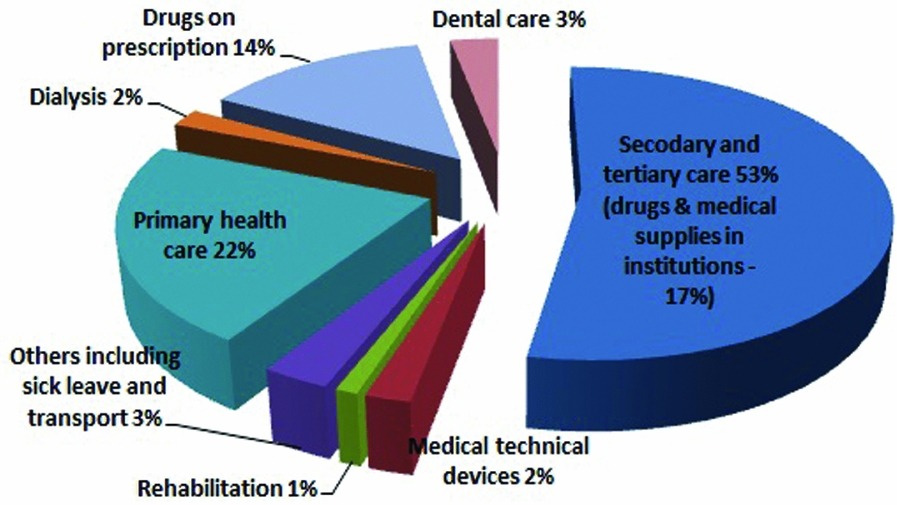
According to data published by the Chamber of Commerce and Industry of Serbia (8), the total healthcare expenditure in 2013 was over 10 percent of the gross domestic product (GDP), while in 2014, it was 9.91 percent of the GDP (5.8 percent public expenditures/government sector, and 4.1 percent private expenditure). Within the public sector, the predominant funder (8) is the National Health Insurance Fund (NHIF) with a share of 93.99 percent in 2013; the structure is shown in Figure 1 (9). Shown in purchasing power parity, total expenditures for health care per capita in 2014 amounted to US$ 605, of which only US$ 356 ranks to public expenditures (8).
Planned expenditures for health care, 2013 (9).

Regardless of the amount of available funds and the fluctuations in healthcare expenditure, basic benefit package, defined by the law, has remained the same for years. According to the Healthcare Law and Health Insurance law (6;10), compulsory health insurance includes (A) insurance covering diseases and injuries not related to work, and (B) insurance covering work-related injuries and diseases.
Entitlements deriving from compulsory health insurance refer to the right to health care as well as to the right to the salary for sick leaves longer than a month, and the right to the transportation costs related to the use of health care. Assessed in detail, the right to health care provided by compulsory health insurance (6) includes: services from preventive health care and early-stage diagnosis procedures; full medical treatment during pregnancy, delivery, and postnatal period; full medical treatment and rehabilitation of the sick and injured, medicines, and medical supplies; prevention and treatment of dental diseases for some population groups, and medical and medical technical devices. For certain types of services mentioned above (including prescription of some innovative or very expensive drugs), NHIF may ask for a prior consent of the first-instance medical commission.
NHIF offers a comprehensive package of health services to all employees, pensioners, self-employed, and farmers, paying contributions for themselves, their spouses, and their children. Due to limited funds, the Annual Health Care Plan of compulsory health insurance (9) defines the priorities that are fairly broadly defined as well: (i) prevention and control of chronic noncommunicable diseases (mainly ischemic heart disease, cancer, diabetes, mental health promotion); (ii) prevention and control of infectious diseases (primarily vaccine preventable diseases, HIV / AIDS, tuberculosis); (iii) health protection of vulnerable groups of population (women at reproductive age, infants, young children, school children and youth, the elderly, and the working population); and (iv) palliative care and care of people in the terminal stage of the disease.
HTA
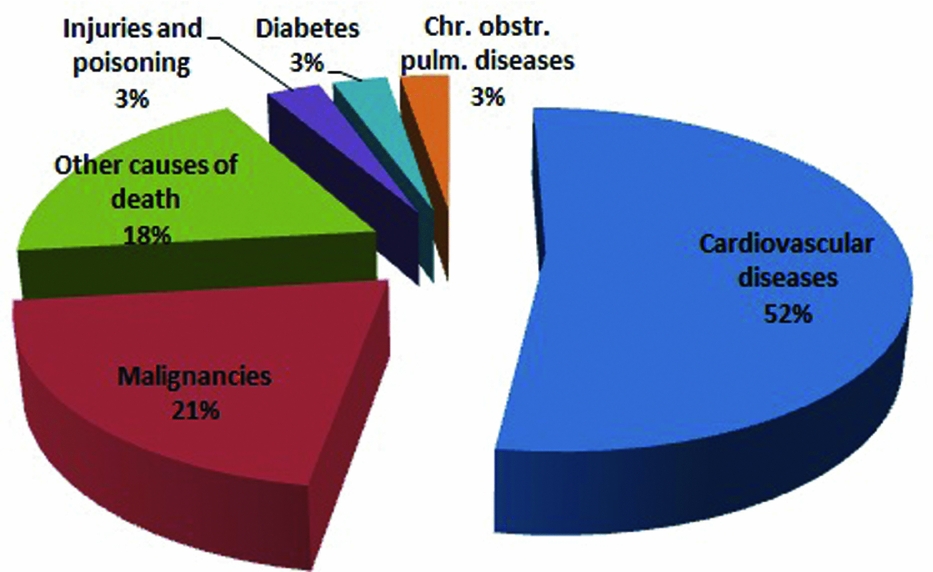
To address such a broad basic benefit package defined through the granted rights to health care and the growing (3;Reference Boričić, Vasić and Grozdanov11) burden of noncommunicable diseases (Figure 2) within a constrained fiscal space, the Republic of Serbia already started interventions to improve the healthcare financing system to prize quality and efficiency at both primary care and hospital levels. WB projects were crucial in driving the healthcare reforms. In 2012, the reform of provider payment systems started with an aim to promote incentives for greater efficiency at the primary care level (12). In that period, the transition to activity-based financing started for acute inpatient care using the Australian diagnosis-related groups system as well (4). Moreover, MoH has recognized a need to establish (5;12) transparent decision-making processes on the introduction of innovative drugs/technologies and their distribution in the healthcare system, and in that sense, has prioritized HTA as a component on both “Serbia Health Projects” supported by WB loans (5;12).
Deaths (in percentages) from leading noncommunicable diseases, the Republic of Serbia, 2015 (3).

Despite the good will and almost the entire decade of work on awareness raising and capacity building of HTA, it is still not routinely used in the decision-making process in Serbia, at least not in a systematic and systemic manner (especially criteria such as efficacy and cost-effectiveness).
Several articles of the Health Care Law (10) indicate the obligation to apply the HTA, but going deeper into their analysis, a huge difference can be seen between the widely accepted approach of HTA and the approach applied in Serbia. Job description of the HTA Committee established by MoH (10) is more about monitoring and coordination of the development and current use of health technologies in the Republic, than about affordability. Evidence of quality, safety, and efficiency of health technology is very often accepted as provided by the applicant.
Drugs and Medical Supplies
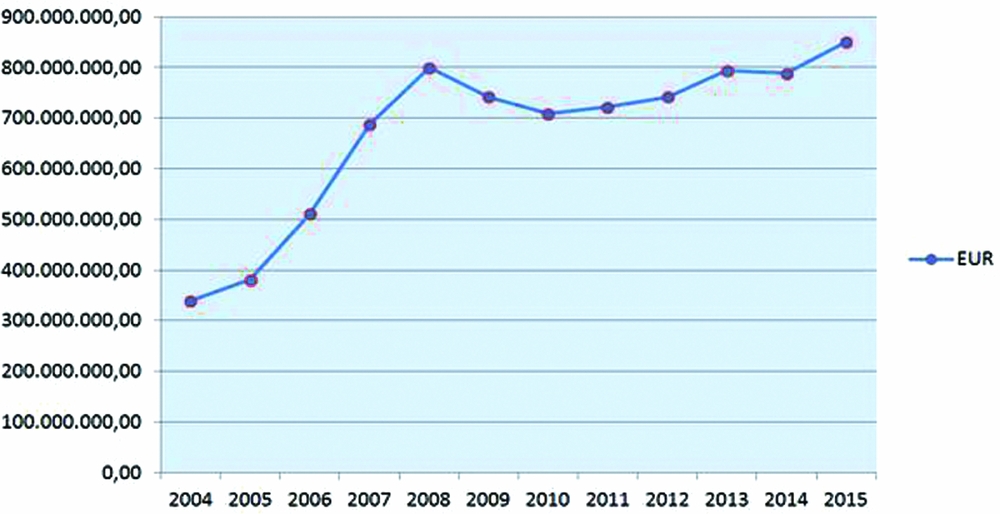
On the other hand, the situation with drugs is more precisely defined and considerably closer to the HTA process. Drug market in Serbia shows steady growth (8) and has increased almost 3 times (Figure 3) during the past 10 years. In 2015 (8), generic drugs accounted for 79 percent of the market (counted in packs) or 55 percent of the market (counted financially). During the same year (8), generics recorded growth of 9.4 percent, and innovative/original drugs 1.1 percent compared with the previous year. Marketing authorization process of drugs in the Republic of Serbia is harmonized with the EU regulative and done by the Agency for Drugs and Medical Devices (13), while pricing and reimbursement are set nationally (13). Drug prices on the market of the Republic of Serbia are under the state control and are regulated by the Decree on criteria for determining the price of medicines (14) usually issued twice a year. After the Government makes a decision on the maximum permitted wholesale price of the drug, the marketing authorization holder has the possibility to apply for drug to be prescribed and issued at the expense of the compulsory health insurance (Drug List).
Drug market in the Republic of Serbia (2004-2015) (8). EUR, Europe.

However, the regulations stipulate (15) that, in case of inclusion on the Drug List, NHIF again establishes the price of drug, based on the minimal price in the reference countries (Italy, Slovenia, and Croatia), as well as on the price of drugs that are already on the Drug List. In this way, any drug that is on the Drug List goes twice through the administrative procedure for determining the price. At the end, if the drug gets placed on Drug list, its final (third) price on the market is the price achieved in the process of centralized public procurement. That rule applies to all, generics and innovative/original drugs as well.
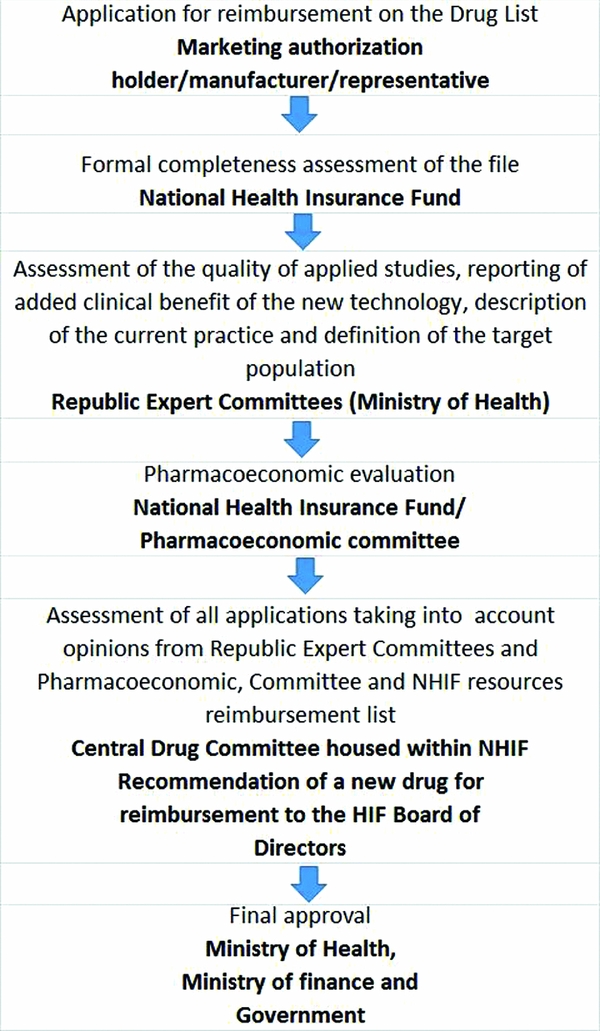
Central Drug Committee (CDC) housed within NHIF assesses all applications for inclusion of new pharmaceuticals on the reimbursement list, in accordance with the current Rulebook on Criteria for Listing of Reimbursement Medicines (Rulebook) (15). All members of the CDC are required to sign statement of Conflict of Interest; the entire process substantially corresponds to the procedure of HTA (15).
The key information required by the Rulebook (15) are evidence of safety and efficacy, together with a pharmacoeconomic assessment, cost/defined daily dose, and budget impact analysis. However, cost-effectiveness analysis is required, even though it is still not a routine part of assessment done by NHIF.
During the decision-making process, CDC takes into consideration advice from (i) approximately twenty Expert Committees (Established by MoH) composed of medical specialists, mostly professors from Academia, and (ii) the Pharmacoeconomic Committee belonging to the NHIF (Figure 4).
Application process for inclusion of new pharmaceuticals on the reimbursement list.

First-in-class medicines presenting novel mechanisms of action must demonstrate superior efficacy/safety and may not be priced higher than the lowest published wholesale price in Slovenia, Italy, or Croatia (15). New medicines within an existing therapeutic class may be added to the list if the evaluation shows no impact on the existing budget. Generics, depending on the order of entry, lower the price (10 to 30 percent) of the already listed drugs with the same international nonproprietary name (INN) (15). Namely, according to the Rulebook (15), a first generic could reach a maximum of 70 percent of the price of the original drug already listed, the a second generic with the same INN could have a maximum of 90 percent of the price of the first generic drug on the List. The same applies to the third and fourth generic drugs. The third one should have a maximum of 90 percent of the price of the second, and the fourth generic drug cannot be more than 90 percent of the price of the third generic with the same INN on the List. All other entries of the drugs with the same INN are based at the level of price of the fourth generic.
Although the regulations (15) allow the possibility of using managed entry agreements as one of the possible ways to enter the Drug List, such an option has never been used until this past autumn. In October 2016, based on the priorities defined by the Expert Committees, CDC adopted the proposal of the Drug List that encompasses twenty-three original/innovative drugs for new indications in four prioritized areas (children, transplantation, hematology, and oncology). For eighteen of these twenty-three drugs, special agreements were signed. Because the invisible pricing does not exist as an option, two types of agreements were implemented: (i) Cross Product (giving some percentage of discount on the drug already listed if the new drug enters the List) and (ii) Natural Rebate. It was the first time for Serbia to implement such a “tool” of budget control to enable patients access to certain very expensive medicines. Final approval of the Drug List is given by MoH, Ministry of Finance, and the Government (16).
DISCUSSION
The scope of work of the HTA Committee (MoH) is mostly related to the analysis of investment needs and covers introduction of capital investments all around the country. More often it solves the problem of planning healthcare services and systems rather than really dealing with technology assessment. There are no clear procedures with objective and verifiable criteria related to the effectiveness, cost-effectiveness, or budget impact, in the process of listing medical devices or healthcare services at NHIF or MoH.
The scope of work of CDC in NHIF is much closer to the concept of HTA, but it is focused only on drugs. CDC operates with limited resources in terms of its financing and expert capacity, with the operating concept of a very “rapid assessment.” Sometimes the Committee makes decision more expert-based than evidence-based (especially when it comes to the clinical effectiveness or cost-effectiveness).
In the process of decision making, there is no scope for inclusion of or input from civil society or patient group representatives. There are no criteria that specify the process of prioritization of either priority area or drugs inside them.
Despite the demographic data and high level of population needs related to the noncommunicable diseases, there are conditions that lead to the underutilization of drugs in classes important for delaying or preventing progression of disease (many of these medicines require substantial co-payment from patients (17;18) which, therefore, jeopardizes adherence to the treatment), for example, some antidiabetic drugs, statins (except for familial hyperlipidemia), drugs for chronic obstructive pulmonary disease, or some antidepressants with co-payment even up to 75 percent or 80 percent). There are no criteria that transparently define level of co-payment.
Some drugs that are noted by the National Institute for Health and Clinical Excellence as “not cost effective even at a zero price” (Reference Davis19) could be found in the Serbian Drug List without any additional social, ethical, or any other explanatory note (e.g., cetuximab for head and neck cancer or Bevacizumab for metastatic colorectal cancer) (20).
In a situation of lacking criteria (inclusion and exclusion, as well as needs prioritization), there is a danger that the story of special agreements, instead of increasing access to the medicines, will enable a shorter, lighter, and less transparent path to the Drug List.
Current mechanisms for listing medicines on the Drug List are not sufficient to meet requirements by the EU Transparency Directive (21) (e.g., reproducibility of decisions related to availability of objective information, such as inclusion and exclusion criteria as well as healthcare priorities based on the real population needs, etc.)
There is no specific form to start the Appeal against the decision of the CDC.
Inherited ways of distribution of funds collected by compulsory health insurance does not oblige use of principles of efficacy and cost-effectiveness. A large amount of data that are routinely collected remain unused, significantly burdening an already bureaucratized system. The lack of knowledgeable personnel in the area of health economics, together with the lack of clear and verifiable criteria for prioritization as well as for inclusion and exclusion of services in the basic package, together with broadly defined healthcare rights, also compromises the decision-making process.
CONCLUSIONS
In general, hand in hand with limited knowledge, there is suboptimal awareness of the role and benefits of HTA among Serbian decision makers. However, the growing pressure of the experts’ community, industry, and patients who are more and more informed but also involved in the decision-making process will soon create conditions needed for a transparent tool to support the decision process. Hopefully, there are significant opportunities to link with the growing HTA network in Europe and broader.
CONFLICTS OF INTEREST
The authors have nothing to disclose.