Introduction
The genus Fictor was proposed by Paramonov in Reference Paramonov1952, who placed Diplogaster vorax (Goodey, Reference Goodey1929), Diplogaster fictor (Bastian, 1865) and Diplogaster hessi (Steiner, Reference Steiner1914) under the genus after synonymization. Later, Andrássy (Reference Andrássy1984) reviewed the genus and placed it under the family Neodiplogastridae Paramonov, Reference Paramonov1952 with a key up to species level. However, Sudhaus & Fürst von Lieven (Reference Sudhaus and Fürst von Lieven2003) considered Fictor along with other diplogastrid genera under the same clade Diplogastridae Micoletzky, 1922 and listed 13 valid species under the genus. The earlier descriptions of most species of Fictor remained sketchy, with stomatal intricacies not elucidated until Fürst von Lieven & Sudhaus (Reference Fürst von Lieven and Sudhaus2000) described and illustrated the three-dimensional structure of the stoma of several diplogastrids, including Fictor stercorarius Bovien, Reference Bovien1937 and Fictor vorax (Goodey, Reference Goodey1929). Later, Khan et al. (Reference Khan, Bajaj, Sultana and Tahseen2008) described Fictor composticola with detailed scanning electron microscopic observations. Currently, 18 valid species are considered under the genus, with most of them lacking molecular characterization. In the present study, a new species Fictor platypapillata is described and illustrated based on light microscopy, scanning electron microscopic observations and molecular characterization. The phylogenetic analysis based on the 18S ribosomal DNA (rDNA) gene was done to clarify the position of the species within the genus and among the other closely related diplogastrid taxa, whereas the details of the stomatal armature were resolved using scanning electron microscopy (SEM). The taxonomy of the genus was updated along with the geographical distribution of the species and a list of valid species.
Materials and methods
Collection of insects
During the survey of nematodes of enriched habitats, five dung beetles, Oniticellus cinctus (Fabricius, Reference Fabricius1775) were collected from cowpats from a field in district Balrampur, Uttar Pradesh, India. The beetles were brought to the laboratory in plastic vials containing a small amount of dung. The vials were covered with a lid, which had fine holes for aeration.
Isolation of nematodes
The beetles were washed with distilled water 3–4 times and transferred in a fresh plastic vial containing acetone for 15 min to make them inactive. One individual was photographed for identification. The beetles were excised and placed on 1.5% nematode growth medium; the head, elytra and abdominal cavity were plated separately to analyse microhabitat specificity.
Light microscopy
The nematodes were taken from the culture, washed and fixed in 4% formaldehyde, and processed to anhydrous glycerine (Seinhorst, Reference Seinhorst1959). The dehydrated nematodes were mounted on glass slides using the wax ring method (De Maeseneer & D'Herde, Reference De Maeseneer and D’ Herde1963). Later, the nematodes were measured with an ocular micrometre, illustrated using a drawing tube and photographed using a Jenoptik digital camera ‘ProgRes’ (Jenoptik AG, Jena, Germany) attached to an Olympus BX–51 DIC microscope (Olympus Pte. Ltd., Japan).
SEM
For scanning electron microscopic observation, the method adopted by Mahboob et al. (Reference Mahboob, Chavan, Nazir, Mustaqim, Jahan and Tahseen2021) was followed with nematodes being fixed in SEM fixative for 24 h, post-fixed in 1% osmium tetra-oxide overnight, washed with buffer, dehydrated in ethanol grades and dried in a critical-point dryer using carbon dioxide. The dried nematodes were mounted on the stub on double-sided adhesive tape, coated with 10 nm gold and observed at 15 kV under a scanning electron microscope model Hitachi-4000 plus (Hitachi High Technologies (S) Pte. Ltd., Singapore).
Molecular characterization
For DNA extraction, five individuals from the culture of excised beetle and five nematodes collected from the sampling site were placed separately in a drop of water on a clean glass slide, covered with a glass coverslip and identified under an Olympus CX31 microscope. After identification, the nematodes were cut from the mid-body using a sharp blade and transferred to an Eppendorf tube containing 10 μl lysis buffer (Williams et al., Reference Williams, Schrank, Huynh, Shownkeen and Waterston1992) and incubated in a thermal cycler at 65°C for 45 min., followed by 95°C for 15 min. For DNA amplification, 5 μl DNA template was used in 20 μl polymerase chain reaction (PCR) reaction mix following the manufacturer's protocol (GeNei, Genei Laboratories Private Limited, Peenya, Bengaluru, Karnataka, India) (12.5 μl master mix, forward primer 1 μl, reverse primer 1 μl and molecular grade water 5.5 μl). The forward primer SSU18A-5′-AAAGATTAAGCCATGCATG′-3′and reverse primer SSU26R-5′-CATTCTTGGCAAATGCTTTCG-3′ were used for amplification of small subunit (SSU) 18S rDNA. The PCR cycles were programmed at 94°C for 2 min, followed by 35 cycles at 94°C for 30 s, 57°C for 45 s, 72°C for 3 min and final extension for 10 min at 72°C. Sequencing was done in both directions from Biokart India Pvt. Ltd. Bangalore.
Phylogenetic analysis
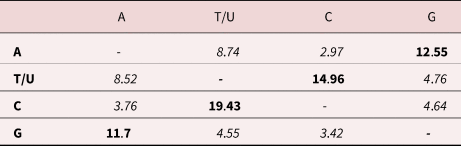
The obtained sequences of partial SSU 18S rDNA of F. platypapillata sp. n. were edited in chromatogram viewer (Chromas version 2.6.6, Technelysium Pty Ltd (www.technelysium.com.au)). A consensus sequence of both directions (forward and reverse) was generated in BioEdit version 7.2 (Hall, Reference Hall1999). The sequences of 836 and 779 bp of the strains of new species were submitted to GenBank with accession numbers MW621342 and MW621475, respectively. The sequences were aligned in MEGAX (Kumar et al., Reference Kumar, Stecher, Li, Knyaz and Tamura2018) using Clustal W alignment tool (Thompson et al., Reference Thompson, Gibson, Plewniak, Jeanmougin and Higgins1997). The ambiguously aligned regions were removed using the online version of Gblocks 0.91b (Castresana, Reference Castresana2000). The phylogenetic tree was constructed based on the Bayesian inference method using MrBayes version 3.1.2 (Huelsenbeck & Ronquist, Reference Huelsenbeck and Ronquist2001) and Minimum Evolution method (Rzhetsky & Nei Reference Rzhetsky and Nei1992) using MEGA X (Kumar et al., Reference Kumar, Stecher, Li, Knyaz and Tamura2018). For the analyses with the Bayesian inference method, the best model was selected under the Akaike Information Criterion (AIC) model selection criterion using jModelTest version 2.1.3 (Darriba et al., Reference Darriba, Taboada, Doallo and Posada2012) and online version PhyML 3.0. (Guindon et al., Reference Guindon, Dufayard, Lefort, Anisimova, Hordijk and Gascuel2010). The General Time Reversible (GTR) substitution model with a proportion of invariable sites and gamma-distribution rate variation across sites (GTR + I + G) were used for analysing the evolutionary history. The Akaike-supported model, log-likelihood, state frequency of nucleotides, substitution rate across the sites, proportions of invariable sites and the shape parameter of gamma distribution rate of variation were examined in the phylogenetic analysis. The values of the above parameters were as follows: log Likelihood (InL = –5467.9255); frequencies of nucleotide bases (freqA = 0.25, freqC = 0.19, freqG = 0.26, freqT = 0.28); General Time Reversible rates [R(AC) = 1.17, R(AG) = 2.36, R(AT) = 2.15, R(CG) = 0.60, R(CT) = 5.27, R(GT) = 1.00]; proportion of invariable sites (pinvar = 0.35); gamma distribution across the sites (shape = 0.58). The analysis was run with the Markov Chain Monte Carlo (MCMC) for 4 × 10⁶ generations. ‘Burn-in’ samples were discarded at every 1000 generations, and a consensus tree with a minimum 50% majority rule was used for analysis. For the analysis with Minimum Evolution method, the evolutionary distances were inferred using the Maximum Composite Likelihood model (the number of base substitutions per site and gamma distribution rate variation across sites). The consensus tree with minimum 60% majority rule was evaluated from 1000 bootstrap replicates (Felsenstein, Reference Felsenstein1985). Rhabditoides inermis was taken as an outgroup in both analyses and the tree was visualized and saved with FigTree 1.4.0 (Rambaut, Reference Rambaut2014). To estimate the probability of substitution rate among bases (Nei & Kumar, Reference Nei and Kumar2000), a substitution matrix (table 1) under the GTR + I + G model was computed using MEGA X (Kumar et al., Reference Kumar, Stecher, Li, Knyaz and Tamura2018).
Substitution matrix showing the probability of substitution among bases.

Note. Rates were estimated using the GTR + I + G model. Transitional substitution rates are bold and transversion substitutions are italic. (A = Adenine, T/U = Thymine/Uracil, C = Cytosine, G = Guanine).
Results
Fictor platypapillata sp. n.
Material examined
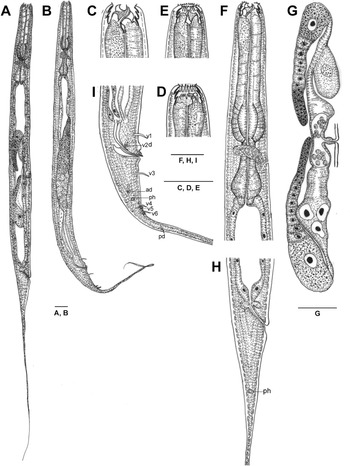
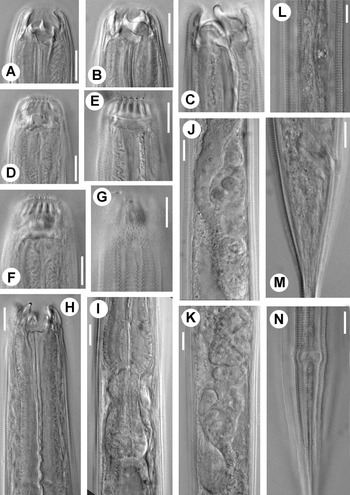
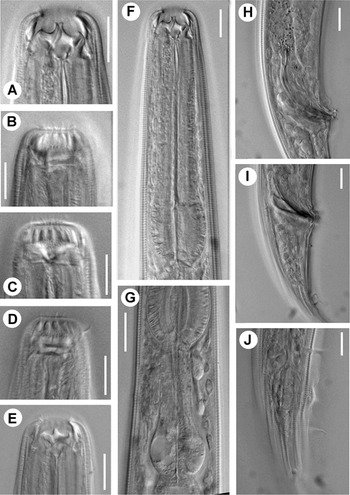
The type material representing 15 females and 15 males in good condition was examined (figs 1–5).
Fictor platypapillata sp. n.: (A) entire female; (B) entire male; (C, D) female anterior end; (F) female pharyngeal region; (G) female reproductive system; (H) female posterior region; (I) male posterior region. Scale bars = 25 μm (v = ventral, ad = antero-dorsal, ph = phasmid, pd = posterodorsal).

Fictor platypapillata sp. n. (female): (A) anterior end (α morph); (B, C) anterior end (β morph); (D–G) anterior end showing left subventral denticles, cheilostomal plates, warts on the wall of gymnostom and stegostom, respectively; (H) anterior pharyngeal region; (I) posterior pharyngeal region; (J, K) anterior and posterior genital branch; (L) vulval opening (ventral view); (M) posterior region; (N) posterior region (ventral view). Scale bars = 10 μm.

Fictor platypapillata sp. n. (male): (A–E) anterior end; (F) anterior pharyngeal region; (G) posterior pharyngeal region; (H–J) posterior region showing spicules, gubernaculum and genital sensilla. Scale bars = 10 μm.

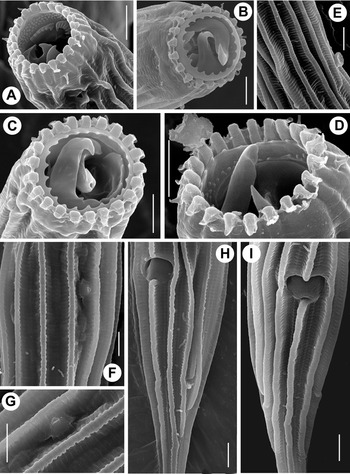
Fictor platypapillata sp. n. (female), SEM: (A–D) anterior end (en face view); (E–G) rudimentary vulva; (H, I) posterior region showing anal opening. Scale bars = 5 μm.

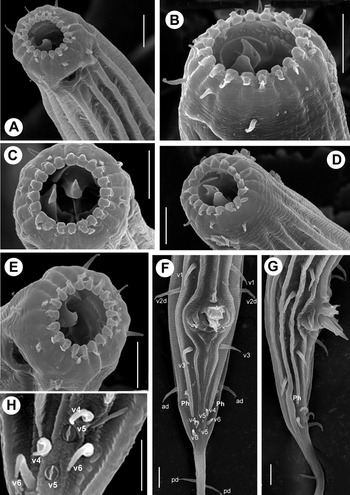
Fictor platypapillata sp. n. (male), SEM: (A, B, D) anterior end; (C, E) anterior end (en face view); (F, G) posterior region showing arrangement of genital sensilla and cloacal opening; (H) button-shaped genital sensilla. Scale bars = 5 μm.

Measurements
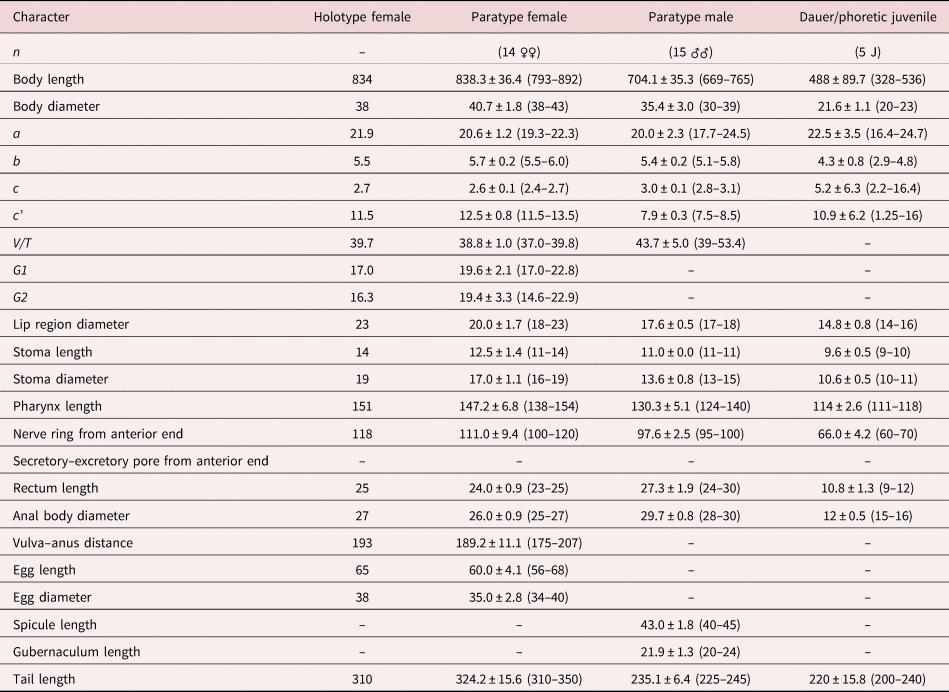
For measurements, see table 2.
Morphometric data of adult and dauer/phoretic juvenile of Fictor platypapillata sp. n. Measurements are in μm and in the form: mean ± standard deviation (range).

a = total body length/ body diameter, b = total body length/ pharynx length, c = total body length/ tail length, c' = tail length/anal body diameter, V/T = vulva percent with respect to total body length/ male gonad percent with respect to total body length, G1 = female anterior genital branch percent with respect to total body length, G2= female posterior genital branch percent with respect to total body length.
Description
Adult. Body medium-sized, almost straight upon fixation, tapering more towards the posterior end. Sexual dimorphism in anterior region, with males having similar stomal armature but females representing two morphs (α and β) showing difference in stomal armature. Cuticle transversely annulated, with 24–32 prominent longitudinal ridges. Lips six, low flattened, each bearing raised labial sensilla. Amphids with oblong aperture, located at mid-level of stoma. Stoma dimorphic, as long as wide or c. 8–9% of total pharyngeal length. Pharynx differentiated into c. 68–80 μm long anterior procorpus, leading to a strongly muscular metacorpus of c. 26–33 × 23–25 μm dimension, a short narrow 20–23 μm long isthmus, expanding posteriorly into a glandular, rounded terminal bulb of 20–23 × 19–23 μm dimension (fig. 1F). Nerve ring encircling isthmus at c. 72–78% of pharyngeal length. Secretory–excretory pore indiscernible. Cardia 4–5 μm long. Intestine granular with wide lumen. Rectum slightly smaller than anal body diameter. Rectal glands present. Anus crescent-shaped slit.
α morph. Female and male representatives having stoma with cheilostom cuticularized, divided into 20–22 closely placed filaments/plates; apex of each plate extending outside (fig. 2A). Proximal region of cheilostom relatively wider than distal region overlapping the anterior edge of gymnostom. Gymnostom as long as cheilostom, having conspicuous warts or denticles on the inner wall, arranged closely in 3–6 rows. Stegostom anisomorphic, rarely with warts or denticles on walls. Dorsal stegostomal wall having a large, claw-like, flattened tooth with a prominent subapical opening of dorsal pharyngeal gland and distinguishable post-dental ridge. Right subventral wall with a flattened, claw-like tooth nearly equal to dorsal one (fig. 3A). Left subventral wall with a serrated plate having six denticles, separated from a set of eight finger-like, slender denticles by a deep groove.
β morph. Stoma with cuticularized cheilostom having 20–22 spaced cheilostomal filaments/plates with apex of each plate projecting outward. Proximal region of cheilostom relatively wider than distal region. Gymnostom as long as cheilostom with anterior serrated margins and sparse warts on the wall. Stegostom anisomorphic with serrated anterior margins. Dorsal stegostomal wall having a large, cone-shaped tooth with hooked apical end and a prominent subapical opening of dorsal pharyngeal gland; right subventral wall with a slender, relatively larger conical tooth almost reaching the oral aperture, having hook-shaped apical end (fig. 4B); left subventral wall with a large (undivided) weakly denticulate plate with few irregular denticles on the edge. Posterior region of stegostom having scattered warts, not arranged in defined rows.
Female. Reproductive system didelphic, amphidelphic. Ovaries dorsally reflexed, reaching up to vulva, anterior on the right, posterior on the left side of intestine. Oocytes with prominent nuclei arranged in three tiers in the germinal zone, two tiers in growth and single tier in maturation zone. Each oviduct short, narrow, leading to pyriform or lobed spermatheca filled with large, rounded to amoeboid sperms. Uteri occasionally containing sperms. Vagina at right angle to longitudinal body axis, thin-walled without sclerotization, constituting 34–35% of the corresponding body diameter. Vulva equatorial, represented by small pore, vulval lips wrinkled, usually without protruded lips. Phasmids located at c. 1.4–1.6 anal body diameter posterior to anal opening. Tail with short conoid anterior part and long filiform posterior part.
Male. Similar to female in general morphology except the strongly arcuate body at posterior region and presence of four additional setose cephalic setae. Represented by only α morphs with 17–20 projecting cuticularized cheilostomal plates/filaments. Spicules slender, ventrally arcuate with fine tapering distal ends and rounded capitula. Gubernaculum wedge-shaped with attenuated arm at proximal region. Genital sensilla constituting eight pairs of setose and one pair of button-shaped sensilla arranged as two pre- and six post-cloacal pairs with configuration: v1, v2d/v3, ad, ph, v4–6, pd. v1 subventral, located at c. half of anal body diameter, anterior to cloacal opening; v2d ventro-sublateral, located at a level slightly anterior to cloacal lip; v3 subventral, located c. half of anal body diameter posterior to cloacal opening; ad lateral, located in between v3 and phasmid (ph); v4–6 closely placed, grouped in a triangular pattern with v4 and v6 setose, located at subventral side and v5 flattened, button-shaped located more or less ventrally in an oblique manner (fig. 5H). pd located 2.0–2.5 anal body diameter posterior to cloaca on subdorsal side closely posterior to the limit of conoid region of tail.
Dauer/phoretic juvenile. Body almost straight, abruptly tapering posterior to the anus. Cuticle with fine transverse striations and 12–16 longitudinal ridges. Lateral field not demarcated. Lip region continuous with amalgamated lips. Stoma as long as wide or slightly wider than long. Metastegostom with a large dorsal and a right subventral tooth and left subventral sector armed with a denticulate plate having 10–12 small denticles. Pharynx well-developed with a slender, 55–60-μm-long procorpus, an oblong metacorpus of 18–20 μm × 17–18 μm dimension, a narrow, 20–22-μm-long isthmus and a more or less rounded basal bulb of 16–17 μm × 15–16 μm dimension. Nerve ring encircling mid-region of isthmus. Secretory–excretory pore inconspicuous. Rectum shorter than anal body diameter. Tail long, filiform.
Type habitat and locality
Fictor platypapillata sp. n. was isolated from O. cinctus, collected from dung in district Balrampur (27°25′28″N, 82°10′57″E), Uttar Pradesh, India.
Type material
Holotype female, 14 paratype females and 15 paratype males on slides. Fictor platypapillata sp. n. NIT/dng/1–10 deposited in the Nematode Collection Laboratory, Department of Zoology, Aligarh Muslim University, Aligarh, Uttar Pradesh, India.
Etymology
The species name was designated based on flattened genital sensilla.
Diagnosis and relationships
Fictor platypapillata sp. n. can be characterized by the presence of two morphs (α and β) in females and morph α in males based on the structure of stoma; cuticle with 24–32 prominent longitudinal ridges; stoma with 20–22 cheilostomal plates in females and 17–20 plates in males; α morph with warts arranged linearly in 3–6 rows on gymnostomal wall, stegostom anisomorphic, rarely with warts on the walls, having flattened, claw-like dorsal as well as right subventral tooth and left subventral plate with denticles in group of 6 + 8 separated by a groove; β morph with sparse warts on gymnostomal walls, dorsal as well as right subventral tooth large, thick, conical with hook-shaped apices, left subventral plate weakly denticulate, stegostom having scattered warts not arranged in defined rows; vulva median, reduced, vulval lips radially wrinkled pore-like; males with arcuate spicules having rounded capitula and tapering distal ends; gubernaculum with curved attenuated proximal end and distal latero-ventral sleeve; genital sensilla with eight pairs of setose and one pair of flattened genital sensilla in v1, v2d/v3, ad, ph, v4–6, pd configuration; v5 flattened, button-shaped located at ventral side flanked by v4 and v6 and tail with short conoid anterior part and long filiform posterior part in both sexes.
Fictor platypapillata sp. n. differs from all congeners by demonstrating stomatal dimorphism with two morphs in females differing in structure of stomal armature and the presence of a pair of flattened button-shaped genital sensilla in male reported for the first time. Besides these differences, other differentiating features have been highlighted hereunder.
The new species comes closer to Fictor vorax Goodey, Reference Goodey1929 in most morphological characters but differs in females having small-sized (793–892 μm vs. 1380–1590 μm) body; smaller a (total body length/ maximum body width) (19.3–22.3 vs. 27.6–31.8) value; males with smaller (669–765 μm vs. 1100–1240 μm) body length; smaller a (17.7–24.5 vs. 27.5–31.0) value; greater number of longitudinal ridges (24–32 vs. 20); denticles (14 vs. 6–8) in the left subventral sector; secretory–excretory pore inconspicuous (vs. conspicuous); spicules with indistinguishable (vs. distinguishable neck in Fictor vorax apud Goodey (Reference Goodey1929)).
The new species differs from Fictor denticulatus Mahamood et al., 2006 in having females with smaller a (19.3–22.3 vs. 32.0–37.4) and c’ (total tail length/ anal body diameter) (11.5–13.5 vs. 18.2–23.0) values; secretory–excretory pore inconspicuous (vs. conspicuous); larger (23–25 μm vs. 14–17 μm) rectum; males with longer spicules (40–45 μm vs. 27–34 μm) and gubernaculum larger (20–24 μm vs. 14–18 μm) and proximally attenuated (vs. not attenuated gubernaculum in F. denticulatus apud Mahamood et al. (Reference Mahamood, Ahmad and Shah2006)).
Fictor platypapillata sp. n. differs from Fictor setosus Mahamood et al., 2006 in having smaller (793–892 vs. 534–758) females and larger (669–765 vs. 548–614) males; smaller c (2.4–2.7 vs. 3.5–5.0) value; labial sensilla papilliform (vs. setose); greater stoma length (11–14 μm vs. 4–6 μm); left subventral plate with 14 denticles (vs. eight denticles shown in fig. 4B); larger (23–25 μm vs. 15–17 μm) rectum; males with larger (40–45 μm vs. 30–33 μm) spicules and larger (20–24 μm vs. 15–16 μm) gubernaculum in Fictor setosus apud Mahamood et al. (Reference Mahamood, Ahmad and Shah2006)].
The present species differs from Fictor longicauda Yousuf & Mahamood, 2017 in having smaller a (19.3–22.3 vs. 29.6–38.6), b (5.5–6.0 vs. 6.2–7.5) and c’ (11.5–13.5 vs. 22.2–27.8) values; greater c (2.4–2.7 vs. 1.9–2.1) value; labial sensilla papilliform (vs. setose); larger (23–25 μm vs. 16–20 μm) rectum; males with larger (40–45 μm vs. 32–37 μm) spicules and larger (20–24 μm vs. 15–18 μm) gubernaculum; setose genital sensilla eight pairs (vs. nine pairs in F. longicauda apud Yousuf & Mahamood (Reference Yousuf and Mahamood2017)).
Fictor platypapillata sp. n. differs from Fictor suptilis Yousuf & Mahamood, 2017 in having smaller a (19.3–22.3 vs. 28.9–42.5) and c’ (11.5–13.5 vs. 21.4–28.6) values; left subventral plates with 14 (vs. 8–10) denticles, as shown in fig. 2F, and longer (23–25 μm vs. 13–20 μm) rectum than in F. suptilis apud Yousuf & Mahamood (Reference Yousuf and Mahamood2017).
Biology
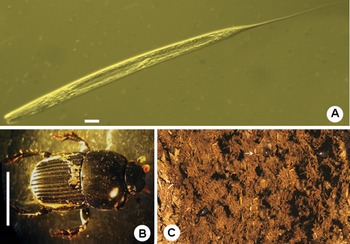
The phoretic juveniles and adults (50–60 in number) of F. platypapillata sp. n. were found to be associated with the mouthparts of dung beetle (O. cinctus) (fig. 6). Insects were collected from three-day-old cow pats. During the excision, several phoretic juveniles and adults were seen on the mandibles of the insects. Within 3–4 days, the number increased in the culture, with a 1:1 sex ratio of females and males. The females were dioecious, oviparous, with embryos hatching outside the body. Gravid females generally laid eggs in single-celled condition. Uterus usually accommodated 1–2 oval, smooth-shelled eggs measuring 56–68 μm × 34–40 μm in dimension.
Fictor platypapillata sp. n.: (A) dauer/phoretic larva; (B) insect host (Oniticellus cinctus); (C) adult O. cinctus along with other scarab beetles in dung. Scale bars: (A) 20 μm; (B) 5 mm; (C) 5 μm.

Emended diagnosis of the genus Fictor Paramonov, Reference Paramonov1952
Cuticle with transverse striations, punctated or non-punctated, faint longitudinal lines or prominent longitudinal ridges; amphidial apertures ovoid. Stoma monomorphic or dimorphic, slightly longer than wide or square-shaped; cheilostom divided into several plates, corresponding to simple or bifurcate cheilostomal filaments or rugae; gymnostom with anterior margins smooth or serrated; inner wall of gymnostom often with warts; stegostom anisomorphic, with or without serrated anterior margins; metastegostomal wall with a large, claw-like, flattened or elongated cone-like dorsal tooth and right subventral tooth claw-like, flattened or elongated cone-like; left subventral wall with a plate having variable number, shape and size of denticles. Pharynx differentiated into an anterior procorpus; a strongly muscular metacorpus; a short, narrow isthmus and a glandular, rounded to oval terminal bulb. Secretory–excretory pore often indistinguishable. Reproductive system didelphic, amphidelphic with dorsally reflexed ovaries; short, narrow oviducts; spermathecae with sperms of variable shapes and size. Vulva equatorial or pre-equatorial, elliptical with or without protruded lips; phasmids located at middle of the conoid part of tail. Tail with short conoid anterior part and long filiform posterior part. Males with slender, ventrally arcuate spicules with distinct capitula and fine tapering distal ends; gubernaculum wedge-shaped. Genital sensilla eight or nine pairs, papilliform, setose or flattened button-shaped.
Type species
Fictor vorax (Goodey, Reference Goodey1929) Paramonov, Reference Paramonov1952
Other species
Fictor agilis (Khera, Reference Khera1970) Sudhaus & Fürst von Lieven, Reference Sudhaus and Fürst von Lieven2003
Fictor brevispiculatus (Schuurmans Stekhoven & Teunissen, Reference Schuurmans Stekhoven and Teunissen1938) Sudhaus & Fürst von Lieven, Reference Sudhaus and Fürst von Lieven2003
Fictor composticola Khan R, Bajaj HK, Sultana R & Tahseen Q, Reference Khan, Bajaj, Sultana and Tahseen2008
Fictor denticulatus Mahamood M, Ahmad I & Shah AA , Reference Mahamood, Ahmad and Shah2006
Fictor faecalis (Weingärtner, Reference Weingärtner1955) Goodey, Reference Goodey1963
Fictor fictor (Bastian, 1865) Paramonov, Reference Paramonov1952
Fictor hessi (Steiner, Reference Steiner1914) Paramonov, Reference Paramonov1952
Fictor levidentus (Weingärtner, Reference Weingärtner1955) Sudhaus & Fürst von Lieven, Reference Sudhaus and Fürst von Lieven2003
Fictor longicauda Yousuf & Mahamood, Reference Yousuf and Mahamood2017
Fictor rarus (Völk, 1950) Goodey, Reference Goodey1963
Fictor setosus Mahamood M, Ahmad I and Shah AA , Reference Mahamood, Ahmad and Shah2006
Fictor shoshini Gagarin, 1995
Fictor similis (Bütschli, Reference Bütschli1876) Goodey, Reference Goodey1963
Fictor stercorarius (Bovien, Reference Bovien1937) Goodey, Reference Goodey1963
Fictor suptilis Yousuf & Mahamood, Reference Yousuf and Mahamood2017
Fictor tsalolichini (Gagarin & Lemsina, Reference Gagarin and Lemsina1982) Ebsary, Reference Ebsary1986
Fictor tumidus Gagarin, Reference Gagarin1998
Discussion
Geographical distribution
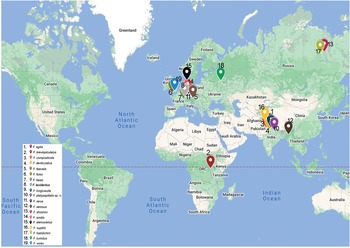
With 19 valid species, including F. platypapillata sp. n., the genus Fictor is widely distributed with species recorded from eight countries. However, most species (F. composticola, F. denticulatus, F. setosus, F. suptilis, F. longicauda and F. platypapillata sp. n.) have been described from India. The rest of the species were described from Central Africa, Germany, Russia, Switzerland and the UK (fig. 7).
Geographical distribution of the species of genus Fictor.

Habitat type
The genus Fictor, being r-strategist, prefers organically enriched habitats, with most species recorded from dung, compost, manure, rotten wood and decaying leaves. However, some of the species were also reported from humus, soil and sewage. Despite the fact that they share habitats with r-selected insect strategists, only two species – F. rarus (Völk, 1950) Goodey, Reference Goodey1963 and F. stercorarius (Bovien, Reference Bovien1937) Goodey, Reference Goodey1963 – were reported to be associated with insects.
Dimorphism in buccal cavity
Most of the species in Diplogastridae belonging to the genera Allodiplogaster, Koerneria, Neodiplogaster, Pristionchus, etc. exhibit dimorphism in the stoma (Sommer et al., Reference Sommer, Carta, Kim and Sternberg1996; Fürst von Lieven & Sudhaus, Reference Fürst von Lieven and Sudhaus2000; Susoy et al., Reference Susoy, Ragsdale, Kanzaki and Sommer2015). Several factors have been involved to induce dimorphism in the buccal cavity such as starvation due to overcrowding or competition and other environmental cues (Susoy et al., Reference Susoy, Ragsdale, Kanzaki and Sommer2015; Renahan & Sommer, Reference Renahan and Sommer2021). Dimorphism mainly reflects the difference in length and width ratio of the stoma and in the structure of the stomatal wall and associated armature (Fürst von Lieven & Sudhaus, Reference Fürst von Lieven and Sudhaus2000; Serobyan et al., Reference Serobyan, Ragsdale, Müller and Sommer2013). The individuals with wide stoma and conspicuous armature represent eurystomatous forms that are predators, while those having relatively narrow stoma with weaker armature represent stenostomatous ones, which thrive on bacterial food source. In all such instances, males are usually stenostomatous whereas females can be both steno- as well as eurystomatous. The stenostomatous individuals with narrow stoma possess dorsal sector armed with a prominent tooth; right subventral sector with cuticularized ridge or a minute denticle and left subventral sector armed with variable number of denticles. The eurystomatous individuals, on the other hand, exhibit a large claw-shaped dorsal tooth with a prominent gland orifice, a prominent right subventral tooth and left subventral plate bearing a row of variable number, shape and size of denticles. The stomatal dimorphism has been seldom observed in the species of Fictor, with the exception of the present species F. platypapillata sp. n., which demonstrates the presence of two distinct morphs (α and β) with approximately similar dimensions of the buccal cavity contrary to the traditional stenostomatous and eurystomatous forms. However, the two morphs conspicuously differ in metastegostomatal armature. The metastegostomatal armature of α morph with claw-shaped flattened dorsal and right subventral teeth and prominently denticulate left subventral plate, is more or less similar to that of eurystomatous forms. However, the males are represented by only the α morph, whereas females represent both α and β morphs, showing similar analogy to steno- and eurystomatous combination. The β morph exclusively represented by females, shows extra-large, cone-shaped dorsal and right subventral teeth almost reaching the level of oral aperture, with hooked apical ends, and left subventral wall with weakly denticulate plate. Such changes are largely environment-induced, which tend to minimize competition in conditions of resource depletion or in individuals switching to a new habitat. Similar instances of variation in lip region morphology and stomatal armature have been observed in species of Pristionchus (P. barbonicus, P. recemosae and P. sycomori), with five distinct morphs collected from the syconia of a fig. These multiple morphs of fig-associated Pristionchus are the result of polyphenism and not genetic polymorphism (Susoy et al., Reference Susoy, Herrmann and Kanzaki2016).
Feeding behaviour
The representatives of the genus appear to be omnivores generally feeding on bacteria, fungal hyphae, ciliates and often serving as predators to juveniles of other nematodes (Goodey, Reference Goodey1929; Fürst von Lieven & Sudhaus, Reference Fürst von Lieven and Sudhaus2000; Bajaj & Kanwar, Reference Bajaj and Kanwar2015). In F. platypapillata sp. n., the occurrence (in 1:1 ratio) of the two predatory morphs from a single genotype in a sexually dimorphic manner indicates polyphenism. The wide buccal cavity, cheilostomal rugae, large-sized movable teeth, conspicuous left subventral denticles indicated their predatory nature. A large number of slender rugae – that is, the extension of cheilostomal plates – seem to provide strength and offer firm grip to hold during predating. In most cases, it was observed that the flattened or thin-edged dorsal and right subventral teeth cut the body wall of the prey (Goodey, Reference Goodey1929; Bajaj & Kanwar, Reference Bajaj and Kanwar2015), but in the present species, the hooked apices of relatively robust, cone-shaped dorsal and subventral teeth indicate advance predatory efficiencies; however, due to their girth they do not seem to serve as scissors as reported by Bajaj & Kanwar (Reference Bajaj and Kanwar2015) but probably help in entangling and tearing the prey with greater thrust. The hooked apices of dorsal tooth with a distinct pharyngeal gland orifice was observed in predatory eurystomatous forms of Pristonchus pacificus, having the capability to prey the juveniles of nematodes and successfully entangle and puncture the cuticle, consuming the body contents (Wilecki et al., Reference Wilecki, Lightfoot, Susoy and Sommer2015). The rasping wall of stoma with a large number of denticles and the left subventral denticulate plates further help in crushing and cutting the chunks of prey into small pieces. The well-developed pharynx with a highly muscular oblong metacorpus shows rigorous pulsations to coordinate with greater frequency of bites during predation, as also observed by Bajaj & Kanwar (Reference Bajaj and Kanwar2015). This intraspecific disparity in adult stoma or polyphenism presumably reflects character displacement, which is conspicuously reflected in steno- and eurystomatous individuals and the five morphs of syconium-inhabiting species of Pristionchus. The structural changes in stoma facilitate the diet segregation within individuals of the same species to avoid fierce competition during resource constraints. Interestingly, although the two morphs of F. platypapillata sp. n. reflect the same feeding guild (predator), their prey selection may vary. The β morph with robust conical teeth may emerge as a more aggressive predator with greater ability to entangle or hook the agile prey, whereas α morph may work on the sluggish or weaker prey organisms. Thus, coexistence may be supported due to resource partitioning. Phenoplasticity during the course of evolution supplemented with developmental plasticity can lead to the appearance of multiple new, discontinuous features (Pfennig & Murphy, Reference Pfennig and Murphy2002) from a single genotype culminating into multiple ecological roles (Yeates et al., Reference Yeates, Bongers, De Goede, Freckman and Georgieva1993; West-Eberhard, Reference West-Eberhard2003).
Phylogenetic status
The blast analysis of F. platypapillata sp. n. indicated similarity with the taxa of different genera belonging to Diplogastridae – namely, Acrosticus Rahm, Reference Rahm1928, Butlerius Goodey, Reference Goodey1929, Demaniella Steiner, Reference Steiner1914, Diplogsteroides De Man, Reference De Man1912, Diplogastrellus Paramonov, Reference Paramonov1952, Diplogastriana Meyl, Reference Meyl1960, Fictor Paramonov, Reference Paramonov1952, Micoletzkya Weingärtner, Reference Weingärtner1955, Mononchoides Rahm, Reference Rahm1928, Myctolaimus Cobb, Reference Cobb1920, Neodiplogaster Paramonov, Reference Paramonov1952, Oigolaimella Paramonov, Reference Paramonov1952, Parapristionchus Kanzaki, Ragsdale, Herrmann, Mayer, Tanaka & Sommer, Reference Kanzaki, Ragsdale, Herrmann, Mayer, Tanaka and Sommer2012, Pristionchus Kreis, Reference Kreis1932, Paroigolaimella Paramonov, Reference Paramonov1952, Pseudodiplogasteroides Körner, Reference Körner1954, Rhabditolaimus Fuchs, Reference Fuchs1914, Tylopharynx De Man, Reference De Man1876, etc. Out of 18 genera, 33 species belonging to six closely related groups along with R. inermis (Schneider, Reference Schneider1866) Dougherty, Reference Dougherty1955 (outgroup) were selected for the analysis. The taxa of different groups were selected based on some degree of homology in the feeding apparatus – for example, a more or less wide buccal cavity having cheilostom with or without liplets or rugae; metastegostom armed with dorsal and right subventral wall having medium- to large-sized movable or immovable teeth; and left subventral sector with denticulate plate of variable shape and size. The sequences of 33 taxa under the genera Fictor, Oigolaimella, Micoletzkya, Mononchoides, Neodiplogaster, Parapristionchus, Rhabditoides (outgroup) and Tylopharynx were aligned along with 858 bp.
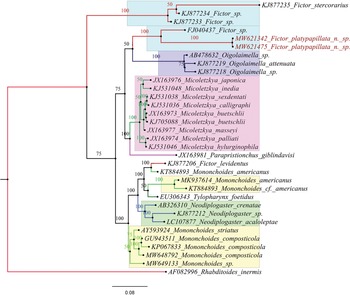
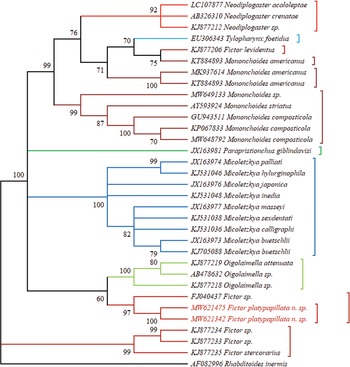
The tree topology was inferred using Bayesian inference (fig. 8), and minimum-evolution algorithms (fig. 9) revealed congruence, especially in the placement of the subordinate taxa of the genus Fictor. Although the species of different genera grouped together, into clusters, species of Fictor – namely, F. stercorarius (KJ877235) and Fictor sp. (KJ877234, KJ877233) – formed separate clusters, while the strains of F. platypapillata sp. n. (MW621342, MW621475) clustered with Fictor sp. (FJ040437) and F. levidentus occupied the position with M. americanus (KT884893), showing polyphyly in both analyses (figs 8 and 9). The new species formed a sister clade with species of Oigolaimella, supported with 50% and 60% posterior probability/bootstrap values, and F. stercorarius (KJ877235) along with Fictor sp. (KJ877234; KJ877233) clustered in a separate clade with well-supported 100% and 99% posterior probability/bootstrap values (figs 8 and 9), which differ on account of cuticular pattern (longitudinal ridges vs. longitudinal striations and punctations), shape and size of spicules (long and attenuated vs. relatively short and stout) and size, number and arrangement of genital sensilla (eight pairs vs. nine pairs with two precloacal pairs, v5 button-shaped and pd located far from the v4–v6 trio vs. three precloacals, no button-shaped sensilla and pd located at level of v6–8 trio in F. stercorarius). The placement of F. levidentus (Weingärtner, Reference Weingärtner1955) Sudhaus & Fürst von Lieven, Reference Sudhaus and Fürst von Lieven2003 is debatable, although it shares many morphological characteristics with species of Mononchoides and occupies the position close to M. americanus as reflected in both trees (figs 8 and 9). Due to insufficient information (poor description and illustration), the position of F. levidentus is not fully resolved and needs further revision.
Bayesian phylogenetic tree of F. platypapillata sp. n. was inferred based on SSU 18s rDNA in MrBayes version 3.1.2 (Huelsenbeck and Ronquist, Reference Huelsenbeck and Ronquist2001).The tree topology indicated the status of new species among the groups of infraorder Diplogastromorpha. The evolutionary history was computed using the GTR + I + G model. The values of the evolutionary parameters were as follows: InL = –5467.9255; freqA = 0.25, freqC = 0.19, freqG = 0.26, freqT = 0.28; R(AC) = 1.17, R(AG) = 2.36, R(AT) = 2.15, R(CG) = 0.60, R(CT) = 5.27, R(GT) = 1.00; pinvar = 0.35; gamma shape = 0.58. The consensus tree with 50% majority rule was used for analysis. Scale bar shows the number of substitutions per site.

Minimum-evolution phylogenetic tree of F. platypapillata sp. n. was inferred based on SSU 18s rDNA in Mega X (Kumar et al., Reference Kumar, Stecher, Li, Knyaz and Tamura2018). The tree topology showed congruence with the tree inferred using the Bayesian inference method. The bootstrap values with minimum 60% majority rule are reflected at the appropriate clade.

The genera Fictor and Oigolaimella show close relationships based on some morphological characters – namely, body size and appearance, oscillating movement, cuticular punctations and number, arrangement and size of genital sensilla. The species indicating close ancestral lineages between Fictor and Oigolaimella is F. composticola Khan, Bajaj, Sultana & Tahseen, Reference Khan, Bajaj, Sultana and Tahseen2008, which possesses cuticle with longitudinal and transverse striations and prominent punctations; three precloacal and six postcloacal papilliform genital sensilla, with the position of the v6–8 and pd similar to those of Oigolaimella longicauda.
The other major group with a well-supported (99–100%) posterior probability value splits along with the species of Mononchoides, Neodiplogaster and Tylopharynx, reflecting a degree of homology in the feeding apparatus (Fürst von Lieven, Reference Fürst von Lieven2002; Kanzaki, Reference Kanzaki2016). They all share some common characteristics in their feeding behaviour and possess stoma divided into anterior wide and posterior tubular part; cheilostom with rugae/filament and metastegostom well-armed with highly movable dorsal and right subventral teeth. Due to the qualitative similarities in the stomatal structures (Fürst von Lieven, Reference Fürst von Lieven2002), the placement of Mononchoides, Neodiplogaster and Tylopharynx genera remained more or less consistent with earlier studies (Kanzaki et al., Reference Kanzaki, Ragsdale, Susoy and Sommer2014, Reference Kanzaki, Giblin-Davis and Ragsdale2015, Reference Kanzaki, Liang, Chiu and Li2020; Kanzaki, Reference Kanzaki, Ragsdale, Herrmann, Mayer, Tanaka and Sommer2016; Slos et al., Reference Slos, Couvreur and Bert2018, and others).
Although based on a single gene marker of partial 18s rDNA, the tree topologies (figs 8 and 9) are mostly similar to those of previous studies conducted (Susoy et al., Reference Susoy, Ragsdale, Kanzaki and Sommer2015; Slos et al., Reference Slos, Couvreur and Bert2018) using two gene markers (18S and 28S rDNA). However, some disparity was observed in the position of Fictor species. Fictor stercorarius (KJ877235) with Fictor sp. (KJ877234, KJ877233) splits into a separate clade in the present study, while the group of F. stercorarius (KJ877235) with Sudhausia sp. splits with a sister clade of Pristionchus (Slos et al., Reference Slos, Couvreur and Bert2018) as well as with a clade containing Mononchoides, Neodiplogaster, Tylopharynx, Paroigolaimella, Eudiplogasterium and Sachsia (Susoy et al., Reference Susoy, Ragsdale, Kanzaki and Sommer2015). Further, along with the other group of Fictor, Oigolaimella splits with a sister clade Micoletzkya; however, in other phylogenetic analyses (Susoy et al., Reference Susoy, Ragsdale, Kanzaki and Sommer2015; Slos et al., Reference Slos, Couvreur and Bert2018), Oigolaimella splits into a separate clade. The above-mentioned differences in the phylogenetic analyses and slight differences in the posterior probability/bootstrap values may presumably be due to single/limited gene markers or short gene sequences.
On the genus Fictor Paramonov, 1952
The members of the genus Fictor can be differentiated from other members of the Diplogastridae by cheilostom divided into several rib-like plates with the apex of each plate surrounding the oral aperture; inner wall of gymnostom often with distinct warts; stegostom with robust, claw-like, flattened or elongated cone-like dorsal and right subventral movable teeth and left subventral sector with a prominent plate having a large number of distinct denticles. Besides the above armatures, there are several other intricate features of the stoma of the genus that cannot be resolved under LM. This would be the main reason behind the poorly described and illustrated species of the genus. The species of the genus are mainly differentiated based on some taxonomically important characteristics – namely, cuticular pattern, number of cheilostomatal plates, anterior edge of gymnostom and stegostom, shape, size and orientation of dorsal and right subventral teeth, shape, size and number of denticles (in left subventral sector of stegostom) and genital sensilla, shape and size of spicules, etc. As the phylogenetic analysis indicated, the genus splits into two major clusters that contain a combination of characters (longitudinal ridges vs. longitudinal striations and punctations), spicules (long and attenuated vs. relatively short and stout) and genital sensilla (eight pairs vs. nine pairs with two vs. three precloacals). This heterogeneity may vouch for the division of the genus into two species groups, which could provide better understanding and ease of identification. The polyphenism in F. platypapillata sp. n., in this context, indicates macroevolutionary maintenance of stomatal dimorphism and increased rates of morphological evolution, which would have facilitated greater genetic variation (Susoy et al., Reference Susoy, Herrmann and Kanzaki2016). However, the lack of stomatal dimorphism in other species of Fictor may presumably be due to canalization, which reduces the evolvability of affected traits, and the persistent canalization, which leads to macro-evolutionary stasis.
Financial support
This work was supported by the Science and Engineering Research Board (SERB), Department of Science and Technology, Government of India, New Delhi, India (grant number EMR/2017/000243).
Conflicts of interest
None.
Ethical standards
The authors assert that all procedures contributing to this work comply with the ethical standards of the relevant national and institutional guides on the care and use of laboratory animals.