For many elders in contemporary western Kenya, to be ‘Luyia’ is to say mulembe.Footnote 1 This word greets visitors by asking where they have been, where they are going, and entreating them to come and go in peace.Footnote 2 Some claim the very term ‘Luyia’ translates as ‘those sharing the same language’.Footnote 3 Language and an oral culture of interpellation have been central to forging a Luyia ethnic community. And yet, as an ethnic category, the Luyia did not exist prior to the 1930s. Precolonially, and well into the colonial period, the Luyia were instead multiple distinct and discrete communities. Divergent migratory routes into the competitive and complementary ecological niches of western Kenya both encouraged the development of diverse languages and political cultures, and built wider oral communities. In the early years of colonial rule, British practices of indirect rule encouraged local communities to reformulate kinship and recast their histories to contest chiefs imposed from outside. By the 1930s, however, a territorial crisis prompted local political thinkers to suppress their diverse origins and to begin imagining, for the first time, an enlarged ethnic polity in western Kenya. Naming this novel community the ‘Luyia’ in 1935, local cultural entrepreneurs sought to unite their diverse constituents through historical, political, and cultural work.
Writing in 1943, North Kavirondo District Commissioner F. D. Hislop pondered the future of the Luyia ethnic project: ‘the greatest difficulty in the above consummation is probably that of language’.Footnote 4 The linguistic diversity of this compact region overwhelmed missionaries and colonial administrators attempting to translate the Bible and to carve out governable units. With the foundation of the Luyia Language Committee in 1941, local cultural entrepreneurs set themselves up as amateur linguists, seeing linguistic work as a cultural tool for advancing their political agendas. However, controversies over orthography, pronunciation, and translation revealed the competing interests of missionaries and African linguists. Such struggles prompted some to guard their linguistic autonomy as jealously as they had their political autonomy against externally imposed chiefs, and also threatened the deep history of oral accommodation and flexibility in the region. Despite the failure of the protracted attempt to standardise one Luyia language, language work in colonial western Kenya revealed self-conscious and competitive linguistic cultures.
Writing African Languages
Benedict Anderson's Imagined Communities foregrounded the importance of technologies of writing and print-capitalism to the formation of political communities.Footnote 5 Although Anderson's model underestimated the importance of oral cultures and alternative forms of literacy, its attention to the written word encouraged historians to think more carefully about the transcription of African languages and the making of ethnic identities. Around the same time, scholars following the ‘invention of tradition’ school of thought began arguing that missionaries ‘created’ African languages as part of the ‘cultural package’ and ‘pedigrees that the new “tribes” required for acceptance’.Footnote 6 Following John Lonsdale's call to study the moral economy of African political communities, historians have more recently explored linguistic work not only as a colonial tool of conversion, discipline, and invention but also as a site of competition and imagination, a ‘crossroads’ where the interests of missionaries and competing African cultural brokers collided.Footnote 7 For Patrick Harries, missionary interventions into African languages had enduring consequences for languages of power and ethnic patriotism. While African linguists worked to mediate the terms of translation, Swiss missionaries in South-East Africa maintained control and ownership over the transcription of new languages and, by extension, the new identities they produced.Footnote 8 In other contexts, where missionaries proved less effective at controlling the process of standardisation, local partisans utilised transcription to discipline their constituents and to imagine new nations.Footnote 9 Whether through privileging missionary intervention or local patriotic work, such scholarship has insisted on the standardisation of written vernaculars as a necessary ingredient in the transformation of oral authority and the articulation of moral ethnicities.Footnote 10
This literature, however, suggests a form of script determinism in the imagining of African communities. As Dmitri van den Bersselaar found in the failure of the Union Ibo language in Nigeria, the creation of a written ‘ethnic’ language was not always successful or particularly necessary for the construction of local patriotisms.Footnote 11 From this perspective, the rigid insistence on written vernaculars as a badge of ethnic legitimacy obscures the dynamism, multiplicity, and cultural dissent of oral cultures. Similarly Ruth Finnegan argues, for the Limba of Sierra Leone, that linguistic diversity formed the essence of communal identity: ‘Limba was in fact variously spoken, in a number of dialects, some of which were barely mutually intelligible … in spite of their habit of contrasting their own various dialects, they still assumed that one thing that they all shared together … was the Limba language.’ For the Limba, as for the Luyia, comparative linguistic work generated a self-conscious oral tradition. Speakers compared terminologies, playfully mocked differences in pronunciation, and debated linguistic expressions. ‘Speaking’ in Limba culture was, according to Finnegan, ‘an essential constituent of social order and interchange’.Footnote 12 In his social history of the Asante, Tom McCaskie too observed the centrality of oral rather than written communication: ‘speaking and listening – the edifice of orality – has a significance in the Asante structuring of social reality that is so fundamental that its implications go to the heart of cultural practice’.Footnote 13 The dynamism of orality as a social practice bred communities defined not by a singular common language consecrated in the transcription of a standard written form by colonial missionaries, but rather by the ability of its people to communicate in person. Such orality allowed communities of diverse origins to debate morality and define civility in ways that were mutually intelligible and yet constantly reiterated their diversity.
In her 1983 linguistic study, Rachel Kanyoro declared that ‘Luyia is a non-existent language.’Footnote 14 And yet, like the Limba, Luyia patriots insisted on language as central to their formulations of community. Though the flexibility and immediacy of orality proved difficult to reproduce in the new ‘world on paper’, the technologies of writing penetrated and created new contexts for linguistic work.Footnote 15 While missionaries and African patriots alike worked to order their constituents through linguistic work, local concern over the creation of a standardised Luyia language revealed more the multiplicity of oral cultures and the political disputes among them, and tensions between the priorities of transcription and the dynamism of oral communication.
Linguistic Diversity in Western Kenya
The immense linguistic diversity among the communities north-east of Lake Victoria confounded early explorers, missionaries, and administrators. In 1906, one missionary linked this diversity to the lack of centralised political structures: ‘the multiplicity of territorial divisions, … the unsettled state of the country, have had their inevitable influence on the language. Bantu Kavirondo has no common language.’Footnote 16 Missionaries encountered a vast array of local spiritual terminology. The terms for ‘God’ were as varied as the religious systems: Nyasaye was common among southern dialects, Khakaba among the Wanga while the northern Bukusu prayed to Were. Early administrators noted the contrasting forms of political authority, from the Wanga nabongo king and the strong military leadership of the Bukusu omugasa, to the more amorphous authority of Logoli clan elders or weng'oma (‘the one of the drum’), referring to the practice of beating a drum to gather clan heads in times of war.Footnote 17 While colonial officials and missionaries interpreted this multiplicity as proof of an ‘unsettled’ political landscape, the variety of languages and political cultures in western Kenya reflected more the complex migrations, niche settlements, and social exchanges necessitated by varied environments.
Centuries of migrating settlers brought a plurality of linguistic influences to western Kenya.Footnote 18 In the 1930s, German anthropologist Gunter Wagner mapped migratory routes penetrating the region from all sides, carrying a variety of Bantu, Dholuo, and Maa language stocks.Footnote 19 In his 1949 history, Habari za Abaluyia, Makerere graduate and teacher at the Alliance High School, Joseph Otiende, used linguistic differences in pronunciation and vocabulary to support claims to divergent origins and patterns of interpenetration.Footnote 20
In some cases, diverse terminologies reflected not different meanings but rather defensive cultural practices. While the various terms of enyumba, indzu, and eshiribwa all translated as both lineage and the physical enclosure of the homestead, local communities used their unique vocabularies to identify and call together members of their extended clan networks.Footnote 21 The variety of terms for clan, from oluhia and olugongo to ibula and ehiri suggest, as Neil Kodesh has argued for the wider Great Lakes region, that ‘the ideology and practices of clanship developed along different lines in various settings'.Footnote 22 In other cases, common terms were found to contain different meanings or refer to entirely different concepts. Laama translated in many dialects as ‘to pray’, but in others as ‘to curse’, a grave theological challenge for missionary standardisers.Footnote 23 Such linguistic differences revealed the diversity of political thought and of local moral economies in western Kenya.
While linguistic diversity revealed multiple forms of social and political organisation, niche ecological settlements bred economic specialisation and interdependence that encouraged common languages of exchange and interaction. From a Logoli elder, Wagner traced a lengthy history of precolonial markets: ‘the people of many different tribes assembled there … And in those years everybody who wished to obtain anything he liked could go to that market’.Footnote 24 Gestures, common terms, and the increasing use of Kiswahili throughout the nineteenth century facilitated transactions among Luyia groups and with their Nandi and Luo neighbours.Footnote 25 From their new agricultural Bantu-speaking neighbours, Kalenjin-speaking pastoralists adopted a number of terms for cultivation and food production, including ‘beans’, ‘flour’, and ‘to weed’.Footnote 26 Bantu and Dholuo speakers shared terms for crops including beans, maize, and sorghum as well as for homestead and wooden hoe. Margaret Hay argued that these similarities between Bantu and Dholuo economic terms testified ‘to a close and prolonged contact’.Footnote 27 Multilingualism, code-switching, and extra-linguistic expressions all facilitated wider regions of mutual intelligibility without sacrificing cultural distinctiveness or political autonomy.
Missionaries, Language Work, and the Limits of Indirect Rule
The colonial preoccupation with the scientific categorisation of African peoples into primordial ‘tribes’ relied heavily on linguistic perceptions. Colonial officials in western Kenya lamented the difficulty of finding a ‘name’ for a people who spoke such ‘widely differing dialects of the same language’.Footnote 28 According to one administrator, the inhabitants of the region were named ‘Bantu of Kavirondo … for lack of a better term’.Footnote 29 Colonial administrators mapped the district of North Kavirondo ostensibly to contain all Bantu speakers northeast of Lake Victoria, and to separate them from their Dholuo-speaking southern neighbours. Within North Kavirondo, perceived dialect groupings guided mappings of administrative divisions.
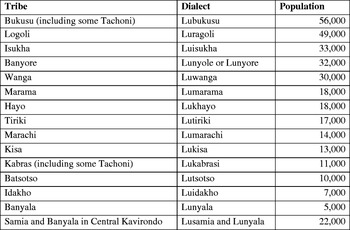
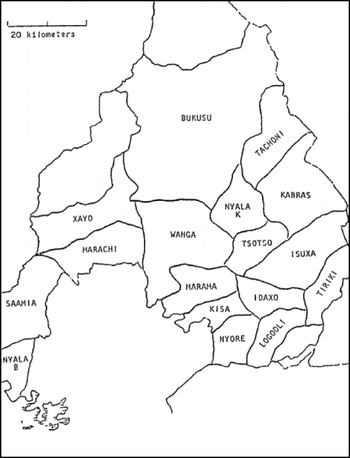
Tables (Fig. 1) reduced the complicated spectrum of dialects into neat columns of speakers. Other linguistic studies, however, contested this ordering by increasing the very number of dialects anywhere from 15 to 26.Footnote 30 Some colonial officials argued that the linguistic differences between Luidakho and Luisukha were insufficient to support claims to separate dialects. Other dialects, such as Tachoni, were completely elided by particular missionary groups, confused administrators, and competing local activists seeking to bolster demographic numbers, secure locations, and justify claims to political representation. What constituted a separate language or dialect was a deeply political question, complicated by the blurred and overlapping boundaries of communities (see Figs. 2 and 3).
Lee L. Appleby, ‘Sketch of Dialect Groups in North Nyanza’, c. 1942.

Map of locations in North Kavirondo.

Map of dialects in North Kavirondo.

While Luyia and European linguists disagreed on the terms of linguistic classification, all remarked on the influence of diverse migrations, the importance of speech, and the pattern of dialects becoming ‘progressively different from north to south’.Footnote 31 Linguistic diversity in North Kavirondo resisted colonial mappings and complicated language work from the earliest missionary publications.
Missionary ‘spheres of influence’ superimposed yet another layer of mapping onto this complicated linguistic picture. North Kavirondo was unique for the sheer number of missionary groups that gained footholds – up to ten by the 1920s - and for their geographically non-contiguous spread across the district. The most important – the American Quakers of Friends African Mission (FAM), the Anglican Church Missionary Society (CMS), the Protestant Church of God, and the Catholic Mill Hill Mission – all arrived at the turn of the century.
FAM missionaries were the first to establish a mission station at Kaimosi in 1902 and to begin work in a local language. Although based in a Lutiriki-speaking area, FAM focused on Luragoli as most of their early converts came from the populous Logoli region, publishing the first Luragoli reader in 1907.Footnote 32 By 1940, FAM had published over twenty educational and religious booklets in Luragoli. As FAM expanded its missions, it used Luragoli texts as means of conversion among Kabras, Banyala, Bukusu, and Tachoni populations.
Arriving from Uganda, CMS missionaries contrasted the relative ease of implementing a standard Luganda language policy in Uganda with the complex linguistic picture in North Kavirondo. In 1912, Reverend W. Chadwick began language work around the CMS mission stations at Butere and Maseno, creating a ‘union’ language called Luhanga. Although predominantly formed from Luwanga, the CMS persistently claimed that Luhanga amalgamated elements of Lumarama, Lukisa, Lutsotso, Lusamia, Lukhayo, and Lumarachi. By 1938, the CMS had completed a Luhanga translation of the New Testament and sponsored the writing of folktales.Footnote 33 According to Reverend Kilgour, over 63,000 copies of the Luhanga gospels circulated in the district.Footnote 34
Although FAM and the CMS dominated missionary publications, two other missions also produced important translations during this period. The Church of God mission arrived in Bunyore in 1905 and quickly produced a Lunyore orthography for religious and instructional texts. By 1929, the Church of God completed their translation of the Lunyore New Testament. The Roman Catholic Mill Hill Mission, unlike the others, produced materials in various dialects as they extended their sphere of influence, though focusing mostly on Luwanga prayer books, catechisms, and hymnals. The lack of coordination, non-contiguous geographic spread, and outright competition among these mission societies led to an abundance of language work and multiple orthographic systems.
Language policy existed at the intersection of three colonial enterprises: administrative communication and propaganda, mission proselytising, and education. In 1915, the CMS debated the relative value of choosing one dialect or promoting the use of Kiswahili as a lingua franca.Footnote 35 The vocal CMS Archdeacon W. E. Owen advocated the use of Kiswahili for official and educational purposes.Footnote 36 Administrators hoped the promotion of Kiswahili would curtail conflicts over discrimination and educational advantages in mixed schools.Footnote 37 However, Kiswahili also presented certain disadvantages. Many local intellectuals in Kenya were wary of Kiswahili, seeing it as a ‘political threat’ to their own linguistic and political work.Footnote 38 Many missionaries criticised Kiswahili for its connections to Islam. Muslim traders from the coast and pockets of Somali settlers led to the emergence of a small, but influential, Islamic community in western Kenya, particularly worrisome to missionaries as members of the Wanga royal family converted in the 1920s.Footnote 39 Despite its wide use in multi-ethnic schools, in urban centres, and in social exchanges that predated colonial rule, Kiswahili proved too risky in the eyes of colonial officials, who privileged ‘vernacular’ languages as part of theories of ‘adapted’ education.Footnote 40
With the rejection of Kiswahili, missionaries and administrators agreed in 1920 to work towards a ‘Union Version for the Bantu Kavirondo’.Footnote 41 It would take another twenty years before the Luyia Language Committee would be formed. While missionaries and converts at Tumutumu started work translating the Bible into standard Gikuyu as early as 1912 and the Luo Language Committee officially began its work in 1927, work on a standardised Luyia language did not gain momentum until well into the 1940s.Footnote 42 While the linguistic diversity of western Kenya certainly daunted missionaries, it was by no means unique. CMS Reverend Leonard Beecher, who gained a reputation for language work in central Kenya, pointed to similar levels of diversity in other parts of the colony: ‘as many and as varied forms exist in the Kikuyu tribal areas as appear to exist in Kavirondo’.Footnote 43 The relatively late process of creating one language in North Kavirondo reflected defensive linguistic traditions, the profusion of competing missionary groups, and the particularities of indirect rule in western Kenya.
In the early decades of colonial rule, political life in North Kavirondo fractured over internal struggles regarding chiefly authority and land rights. The Wanga, the only community with a recognised precolonial history of monarchy, provided the British with identifiable political authorities or, in the words of Mahmood Mamdani, ‘decentralised despots’ who they imposed over non-Wanga subjects.Footnote 44 Colonial officials consecrated this relationship in 1909 when they anointed Wanga Nabongo Mumia ‘paramount chief’. And yet, the limits of this form of governance soon became evident. The constituent communities of North Kavirondo had a long history of decentralised political life. From their very instalment, Wanga chiefs faced local opposition to their rule, ranging from uncoordinated and reactive confrontations to large scale mobilisations of civil disobedience. In the 1920s, the sporadic protests against Wanga chiefs transformed into a widespread anti-Wanga movement.Footnote 45
Anti-Wanga campaigns prompted local communities to reframe divergent accounts of the past, mobilise kinship networks, and invent mythical founding fathers. Whether through the reformulation of names or defence of linguistic difference, language proved a site of argument and political strategy for forwarding claims to cultural distinctiveness and political sovereignty. In Marama, a location fusing together 42 clans of diverse origins under the rule of Wanga Chief Mulama, clan heads invented a mythical common ancestor, Mulafu, to claim shared kinship.Footnote 46 Isukha leaders in the 1930s claimed their name also came from a founding ancestor to defend their historic right to a chieftaincy, despite the term's translation as ‘forward’ or ‘in front’.Footnote 47 Local representatives used the opportunity of the 1930 North Kavirondo Native Land Tenure Committee to secure their position as the rightful guardians of their community's customs, insisting on their specific terminologies of land tenure, political authority, and kinship.Footnote 48 This creative work reflected the centrality of language to larger political projects and formulations of community.
While, by the 1930s, the Wanga had outlived their political usefulness and were replaced by chiefs with greater local recognition, new threats emerged that prompted many of these same young activists to subsume their differences and imagine an enlarged ethnic polity in western Kenya. In 1931, the discovery of gold near Kakamega prompted British officials to reverse the 1930 Native Lands Trust Ordinance that declared land in the Native Reserves ‘for the use and benefit of the native tribes of the Colony for-ever’.Footnote 49 This territorial crisis prompted local political thinkers to consolidate their diverse practices of land tenure, to suppress recent internal debates over political authority, and to defend the boundaries of the reserve against British bureaucrats and incoming European miners. A year after the discovery of gold, representatives from North Kavirondo stood before the Kenya Land Commission and declared themselves representatives of ‘the tribe’: a tribe as yet unnamed.Footnote 50
Building on the new political consciousness sparked by the gold rush, young mission converts and teachers formed the North Kavirondo Central Association (NKCA) to create a new regional polity.Footnote 51 While these young cultural entrepreneurs embarked on a variety of social and political projects, first among them was the naming of their constituents. Although its origins remain contested, in all its translations Kavirondo was a derogatory and foreign-imposed name.Footnote 52 In a rare demonstration of unity, the disparate communities of North Kavirondo rejected the colonial epithet ‘Bantu of Kavirondo’ and campaigned for a locally articulated name.
As during anti-Wanga campaigns, naming proved a crucial terrain for defining and debating the political ethos of community. District Commissioner C. B. Thompson viewed this campaign as an assertive process arising from comparative patriotic work: ‘as their Nilotic brethren had a generic term Luo by which to call themselves, it behoved the Bantu to exhume from the past, or invent for the future, a name for themselves too’.Footnote 53 Heated debates over the early failed suggestions of Abakwe, people of the east, and Abalimi, a common term for agriculturalists or ‘common peasants’, point to the complex bargaining, and different political and social priorities at stake in the selection of a name.
In 1935, the NKCA seized the opportunity to name its constituents, announcing their candidate in a pamphlet entitled ‘Abaluhya – Kinship’.Footnote 54 A relatively common term, oluhia referred to the ‘fire-place on a meadow’, where the ‘old men of the clan community meet every morning’.Footnote 55 The oluhia served as a sort of assembly site for initiation rituals, political negotiations, and the burial of clan heads: it was a ‘microcosm … the place of practical everyday life’.Footnote 56 Unlike Kikuyu or Luo cultural entrepreneurs who drew their constituents in direct descent from a mythic founding father, NKCA writers instead chose a name that privileged a horizontal drawing together of disparate, autonomous clans into one discursive and political space. Much as Carol Summers has argued regarding young Ganda activists who rudely appropriated and reworked the concept of bataka from a hierarchical group of elders into ‘something close to a concept of universal citizenship’, the young men of the NKCA wrested the oluhia from the hands of their elders and reconfigured the term as an expression of common kinship.Footnote 57 Through relentless local campaigns and a narrow win in the Local Native Council (LNC), the NKCA propelled the ‘Luyia’ name to common currency by the late 1930s. According to Bethwell Ogot, the NKCA's pamphlet reflected not only the ‘beginning of Luyia cultural nationalism and the invention of the imagined Greater Luyia Community’, but also an important part of the ‘untold story’ of Kenyan nationalism.Footnote 58
The work of these young ethnic entrepreneurs gave renewed energies to the creation of one unified language. In 1940, the American Bible Society approached Reverend Leonard Beecher to conduct a ‘factual appraisal’ of languages in North Kavirondo. Beecher was at the time charged with creating an African broadcast using vernacular languages for the Information Office in Nairobi. Radios were becoming increasingly popular not only as a means of government propaganda but also as a vehicle for local political projects.Footnote 59 By 1941, the Information Office regularly broadcasted in Kiswahili, Kikamba, Dholuo, and Gikuyu.Footnote 60 In 1942, the North Kavirondo LNC voted 32 to 9 that all broadcasts should be in ‘luluhya’, a language as yet unwritten.Footnote 61
The Luyia Language Committee
The creation of the Luyia Language Committee in 1941 reflected not only missionary and colonial interests but moreover the social work of African cultural entrepreneurs. Language work in western Kenya was a site of contestation and creativity, where the different priorities of missionary linguists and African translators collided. The strongest initial advocates of a standard Luyia language emerged from a new generation of African graduates. The first Luyia graduates from the important Makerere College in Uganda returned to the district in the 1930s to high-ranking posts in government schools and on local boards.Footnote 62 At Makerere, these men had written extensively in the Makerere College Magazine on political developments and social change back in their home locations. After the disbanding of the NKCA at the outset of the Second World War, Makerere graduates returned to take up the Luyia ethnic project and promoted language work as a central tool for uniting the compatriots they had imagined from afar.
Foremost among these young Makerere graduates, W. B. Akatsa was an accomplished writer and emerging educational leader in the district. At Makerere, Akatsa won numerous prizes for his poetry and essays.Footnote 63 In 1941, he sent an open letter to the newly convened Luyia Language Committee entitled ‘An Appeal for Linguistic Unity among the Abaluhya’.Footnote 64 In this eloquent tract, Akatsa sketched an oral community of mutually intelligible speakers in western Kenya: ‘go where a Muluhya may in North Kavirondo, he is understood, and is at home, and speaks to his fellow Abaluhya in no other medium than his own particular dialect’. Rather than support any particular dialect, Akatsa appealed to the committee to call upon expert linguistic knowledge to settle the profusion of ‘Lu-whatever languages’ and create a ‘scientific’ uniform language. Fellow Makerere graduates and local teachers Ephraim A. Andere and Solomon Adagala echoed this technocratic disposition. Andere pushed for the ‘complicated and delicate’ work of linguistic consolidation to be conducted in conjunction with educational committees.Footnote 65 Adagala warned the committee not to rely on illiterate elders ‘who have no idea of the present day changes’, but rather to privilege teachers and other ‘intelligent members of our Community’.Footnote 66 The views of this small but influential cadre of teachers and leaders reflected a new political ethos that privileged technocratic skill, youth, and an urbane culture.
Throughout Kenya, language committees provided a common training ground for burgeoning political leaders. In 1947, all three nominations for the Legislative Council from western Kenya, Philip Ingutia, Paul Mboya, and B. A. Ohanga, played significant roles in their respective Luyia and Luo language committees.Footnote 67 The Kalenjin Language Committee similarly included future politicians Daniel arap Moi and Taita arap Towett.Footnote 68 Well into the 1960s, future Luyia politicians wrote of linguistic work as central to kinship and political development in the pages of the Abaluyia Makerere Students' Union's quarterly magazine, Muluyia, founded in the mid-1950s. For Luyia cultural entrepreneurs, linguistic work offered an opportunity to exercise their technocratic ethos and to forward their political agendas.
Although these Makerere graduates formed the avant-garde of Luyia language advocates, European missionaries provided the material backing and main personnel for the committee, positioning themselves as linguistic brokers in the consolidation of a Luyia language. Representatives of FAM, the Church of God, the Mill Hill Mission, and the CMS all attended the committee's first meetings on 4 April 1941, with CMS Archdeacon Owen at the helm. CMS missionary Lee L. Appleby became the only member dedicated to full-time linguistic work. Appleby brought a particular sensibility and set of experiences to this work. Throughout the 1930s, she had worked on Luhanga translations, passing her Luhanga exam in 1934.Footnote 69 As principal of the CMS Girls School in Butere, she experimented with Luhanga publications of folktales, concluding that previous Luhanga publications had failed to gain wide audience due to their ‘prosy style and Anglicised Luhanga’.Footnote 70 For her new Luhanga folktale publication, Appleby enlisted a young Wanga woman with very little English to write in the ‘real Luhanga’. For Appleby, linguistic work in Africa was about finding the ‘authentic’ African voice, unspoiled by modern education and ripe for conversion.Footnote 71
The Luyia Language Committee had a rocky beginning: their first meetings ended in the committee's resignation due to disagreements over orthography and the importance of each dialect.Footnote 72 Early discussions focused exclusively on Luhanga, Luragoli, and Lunyore. As Harries has argued of South-East Africa, standardisation was often less the consolidating process missionaries claimed and more an exercise in creating linguistic hierarchies, elevating one dialect over others.Footnote 73 While each mission vigorously defended the wide intelligibility of their own particular dialect, the non-contiguous spread of missionary work in western Kenya meant that ‘missions now overlap in the dialect areas. The size of the respective spheres of influence of the three missions could only be assessed by a census of their Church membership.’Footnote 74 Mission groups counted their numbers and mapped their converts to promote their own linguistic work and further their strategic positions within the district.
Other linguistic endeavours throughout Africa provided inspiration and direction. Beecher drew on his continuing work with the Gikuyu language to advocate the use of one central dialect: ‘In Kikuyu … we have refused to recognise any dialect but one.’Footnote 75 Beecher recommended that Appleby consult the work of Ida Ward on ‘Union Ibo’ in Nigeria as a blueprint for standardisation. As in North Kavirondo, the profusion of Ibo dialects, according to Ward, reflected ‘the smaller unit organisation of the Ibo people’.Footnote 76 She argued that ‘Union Ibo’, created for Bible translation in the early 1900s, failed to become a locally relevant language as it was ‘too randomly mixed’.Footnote 77 Ward recommended standardisation around one central dialect to ensure consistency and comprehensibility. Appleby quoted Ward's work to defend the elevation of one central dialect in pursuit of a ‘living language with nothing artificial about it’.Footnote 78
With these examples in hand, Beecher and Appleby steered the committee towards Luhanga, much to the frustration of Church of God and FAM missionaries. In an open letter, retired Paramount Chief Mumia defended Luhanga as the language of the district and he ‘unhesitatingly recommended Luhanga, as being the root and as it were mother language of all the rest’.Footnote 79 He further argued that the inhabitants of North Kavirondo never required interpreters in public or private life, referencing a long history of cultural interpenetration: ‘these tribes also were in frequent communication … about such matters as Dowry and Case shauris, which were matters of discussion and settlement between them’. While echoing Akatsa's emphasis on spoken culture and mutual intelligibility, Mumia privileged Luhanga as the natural mother tongue of the diverse communities his Wanga chiefs had briefly ruled.
Despite continuing concerns, Appleby worked towards an orthographic system based largely on Luhanga. The committee adopted the 1930 International Institute for African Languages and Culture Bantu orthography, following the models of Luganda and Kiswahili and avoiding diacritical marks.Footnote 80 Wagner suggested orthography should follow the most ‘progressive drift’: the unconscious change in natural language towards common usage.Footnote 81 The committee aimed to base their choices on the ‘actual pronunciation of the majority of people’.Footnote 82 However, standardising spelling proved controversial as did pronunciation (for example, the ‘k’ versus ‘kh’ distinction), the use of noun class prefixes, and the sounding of plosives. Standardised spelling threatened the oral distinctiveness of dialects, glossing over the importance of pronunciation and patterns of speech to political and cultural meaning. Kanyoro sketched the problems encountered with ‘emotive’ pronunciations: omurwi, a common term for ‘head’, if pronounced by Luragoli speakers translated as ‘anus’.Footnote 83 Differences in pronunciation and, what one scholar of Luyia linguistics describes as, ‘sound realizations’ were pervasive and self-conscious; speakers in western Kenya simultaneously drew together and set themselves apart through their ‘characteristic articulation’ of sounds.Footnote 84
In 1943, the committee produced a circular to test the appeal of their proposed orthography.Footnote 85 Written in Luhanga, the circular tabulated the differences among Luhanga, Lunyore, and Luragoli in pronunciation, spelling, and grammar, placing them alongside the proposed Luluyia orthography. Andere used his linguistically mixed students at Nyang'ori Primary School to test the committee's orthography against vernacular mission texts, by giving two Bukusu boys the Luragoli New Testament and the committee's circular to read. Despite being accustomed to Luragoli texts, both boys preferred the circular, finding they ‘understood it better and also it was easier to read’.Footnote 86 These students unconsciously highlighted a central tension of Luyia linguistic work: their Lubukusu dialect was indeed closer to the Luhanga used in the circular as Lubukusu and Luragoli represented the most distant dialects in the district.Footnote 87 But for the Logoli and others, as will be seen, this orthography proved troubling, both linguistically and politically. Standardising orthography imposed a linguistic hierarchy that threatened the flexibility of oral communications and revealed the instrumental use of language in competing political arguments. The committee accepted Appleby's orthography in March 1944 and publicised it widely through articles in the vernacular press, instructional booklets, and leaflets.Footnote 88 Luhanga, like Wanga political history, was thereby made ‘Luyia’.
Finding the Words: Translating Power and Dissent
Despite this orthographic victory for Appleby and Luhanga, the work of translation revealed the more complex bargaining between diverse local vocabularies and the priorities of missionaries. Appleby concluded that all terms would be accepted with two provisos: the committee would only recognise one spelling and would avoid publishing terms not widely known, using explanatory footnotes and Kiswahili or English terms where necessary.Footnote 89 The committee set to work translating grammars, dictionaries, and, most ambitiously, a Luyia Old Testament. In the late 1940s, the district social welfare officer headed a major literacy campaign, using pamphlets, articles, and film.Footnote 90 The CMS bookshop in Nairobi reported that of the 5,000 Luyia Readers published, 4,964 had been sold and that the Luyia Primers were very popular.Footnote 91
To find the words of this new language, Appleby convened meetings with elders throughout the district.Footnote 92 Despite the controversy these meetings often entailed, Appleby maintained a romantic vision of the work of translation. In an article for Bible Translator, Appleby mused about the leisurely pace necessary for accessing African cultural life.Footnote 93 She idealised the lack of local terms for ‘neighbour’, reminding ‘us of a society where people never just “happen” to live side by side’. Although Appleby repeated the necessity of a ‘large African contribution’ in translation work, much of this contribution came from only six Marama and Wanga elders from the CMS base. While the committee occasionally included representatives from the Samia, Batsotso, and Banyore, their input was limited and representatives from the numerous Bukusu and Logoli were rarely invited to attend meetings. This method of linguistic investigation risked being incomprehensible to wider audiences. For the tricky translation of ‘pray’, the committee eventually settled on saba despite its inadequate meaning of ‘to ask’. In the same vein, for the term ‘curse’ the committee ironically supported the use of laama despite its translation as ‘to pray’ in many dialects. With limited African input, translations often suppressed the divergent modes of thought that produced competing vocabularies. As Solomon Adagala had worried, the young intellectuals whose early political work had created the conditions for the consolidation of a Luyia language were now being sidelined in favour of the ‘illiterate elders’ of Appleby's romantic vision.
Language work offered a window into the processes by which colonial and missionary agents reconfigured ideals of domesticity, morality, and community into local terms. Appleby clearly aimed the 1947 First Luyia Grammar at the European community, whether missionary, settler, or administrator. As Derek Peterson argued in his analysis of successive Gikuyu dictionaries, translators embedded ideas of gender roles, power, and colonial subject-positioning in their lessons.Footnote 94 Translation exercises often focused on domestic values and moral conduct: texts instructed readers to translate such phrases as ‘that is a bad custom’ and ‘bread is good food’.Footnote 95 Appleby's translation exercises provided a glossary for missionaries to encode gendered domesticities and civilise their African converts through linguistic discipline.
While infusing grammar lessons with proper domestic behaviour, local gender terms proved difficult to match with the committee's ideas of gender relations. The committee used omukhasi for ‘woman’, yet its Luwanga translation referred specifically to a married woman.Footnote 96 The term ‘concubine’ also proved tricky as local words tended to imply the position of junior wife or voluntary relationships. In this case, the committee opted for the Kiswahili word. Many of the committee's earliest publications focused on nutrition, proper household conduct, and childcare, and encouraged African women to stay within the confines of the home.Footnote 97 The movement of women outside the district was a growing concern among missionaries, administrators, and African men seeking to control the social reproduction of the tribe. Achendanga obubi, translated as ‘she is living an evil life’, linked the immoral behaviour of obubi, often translated as ‘evil’, with chenda, the term for travelling outside the home. The committee created a lexicon of morality later mobilised by political associations in campaigns against errant women and runaway wives living in urban centres.Footnote 98 Through these translations, missionaries and African translators inscribed norms of domesticity and moral conduct into local vocabularies of gender and work.
A greater concern for Luyia standardisers emerged in the renderings of territory and political community. With no local terms for the compass points of North, South, East, and West, the committee settled on the strangely pidgin terms notsi and sautsi.Footnote 99 This ‘phonological’ adaptation proved quite common, particularly for terms related to the church, to education, and to government.Footnote 100 The translation of ‘nation’, central to readings of Proverbs, prompted debates over whether the term referred to a people or a territory.Footnote 101 Several translations considered implied vertical hierarchical understandings of community while others conflated tribe and nation, and contained more fixed geographical references. In 1943, Appleby chose lihanga to translate ‘nation’, defining the nation as those ‘taken collectively’. Wagner, however, translated lihanga as ‘the community of clans organised under the political rule of the Wanga chiefs’.Footnote 102 Choosing lihanga to render ‘nation’ problematically positioned the concept of nationhood as an extension of Wanga political hierarchy. These translations inscribed the local into biblical narratives. As ethnic associations like the NKCA regularly invoked religious examples in their political imaginings, quoting biblical verses at the outset of petitions and narrating biblical proverbs in public meetings, these translations contained important implications for the languages of patriotism.
Translation work revealed not only the attempt to infuse local terms with British morals but also the competing values within divergent dialects. Standardisers, whether missionary or African, were divided by self-interest. For supporters of a Luyia language, linguistic work provided a vehicle for uniting their constituents and disciplining their neighbours. And yet, Appleby's insistence on Luhanga and the committee's selective African membership alienated many of these early advocates. For dissenters, the Luyia language increasingly represented a threat not only to cultural distinctiveness and political sovereignty but also to the very oral community described by Akatsa and others as the essence of ‘being Luyia’.
Luyia Dissenters: Defending Linguistic Autonomy
Despite the early support of Makerere graduates and other local political thinkers, the work of the Luyia Language Committee prompted the dissent and eventual departure of many key African leaders, missionaries, and whole dialect groups. From orthography to translation, dissent arose from local representatives who sought to defend their linguistic autonomy and protect their cultural distinctiveness. The predominance given to Luhanga raised concerns for those who had fought against Wanga political domination. The proposed orthography failed to account for the importance of pronunciation and patterns of speech: mutual oral intelligibility did not ensure mutual comprehensibility when translated to the page. The most fervent voices of dissent emerged from the two largest linguistic groups: the southern Logoli and the northern Bukusu.
Although the Logoli produced the founding fathers of the NKCA, Luyia language work ignored their political importance and pitted their Quaker missionaries against the Anglican leaders of the committee. The timing of the Luyia Language Committee was indeed conspicuous: the CMS vigorously campaigned to commence the committee's work before FAM completed its Luragoli Old Testament.Footnote 103 Luragoli was a particularly distinctive dialect, especially in matters of pronunciation as already noted, and very early proved a challenge to the promotion of Luhanga as the dominant dialect.
When the committee's 1943 orthography sidelined Luragoli, Logoli teachers and politicians protested their cultural suppression under the weight of Luhanga. Although an early supporter of Luyia language consolidation, Solomon Adagala now denounced the committee's attempt ‘to force the whole of North Kavirondo … to turn to Luhanga’.Footnote 104 Adagala complained that the committee had ‘taken no steps to invite a Logoli member to join the Committee’.Footnote 105 A group of Logoli teachers from Kaimosi protested that the ‘majority system’ for determining spelling and word usage unfairly disadvantaged the Logoli: ‘all dialects should be taken into account and difficulties shared’.Footnote 106 In 1945, a Logoli soldier in the South East Asia Command wrote to the Information Office in Nairobi that Appleby was ‘trying to divide North Kavirondo’.Footnote 107 These protesters blamed denominational biases for internal disunity and the severing of the Logoli from linguistic and political development in the district.
These protests came at a time of political integration, as the two Logoli locations united under Chief Agoi in 1940. In these letters, teachers and politicians positioned themselves not only as the guardians of a distinctive Logoli cultural heritage, but also as progressive, educated, and urbane representatives of a larger civil society. The Maragoli Society, formed in the early 1940s to defend and promote Logoli cultural and political work, petitioned for the Luragoli language to ‘form a greater part of the unified language’, due to the numerical importance of the Logoli and FAM's reach across different dialect areas.Footnote 108 These were not protests against the principle of unification or the importance of literacy but rather demands for a reassessment of linguistic hierarchies.
Logoli opposition prompted the committee to remap North Kavirondo based on a complicated linguistic arithmetic.Footnote 109 In 1943, the committee published a memorandum distancing Luragoli from Luluyia, claiming it was closer to Gikuyu than to any Luyia dialect.Footnote 110 In 1946, the Kenya Advisory Committee of the BFBS in Nairobi granted that Luragoli was ‘clearly in a different linguistic category’.Footnote 111 The Luyia Language Committee collaborated with government bodies to undermine and isolate Luragoli language work. In 1949, the LNC emphasised that their ‘orthography grant’ was available only for the promotion of Luluyia and not ‘the Luragoli language which some people were trying to introduce as the lingua franca’.Footnote 112 Over protests from the Maragoli Education Board, the government insisted that ‘Luyia is suitable for use in Maragoli schools … and therefore school and adult development should not be retarded by the clamour of a Nationalistic minority.’Footnote 113 Appleby believed that if the committee published ‘enough attractive literature, with carefully chosen vocabulary, we will have the whole of Bantu Kavirondo with us except for a handful of Maragoli extremists’.Footnote 114 Despite this environment, FAM continued to publish in Luragoli, with the first complete Bible appearing anywhere in the district in 1951 – a version that remains an important vehicle for the expression of Logoli political thought and cultural production.Footnote 115 The exclusion of the populous and politically active Logoli dealt a serious blow to the legitimacy of the committee's work and encouraged the growth of a competitive linguistic culture.
Among the Bukusu, controversy over language consolidation only emerged as the translation of Luyia texts reached into the northern territories. Before the 1950s, the Luyia Language Committee barely acknowledged the distinctive nature of the Lubukusu dialect, despite the significant number of people who spoke it. Since the Catholic Mill Hill Mission used Luwanga texts in the area and the FAM used their Luragoli texts, the committee assumed Bukusu readers would easily adapt to any new orthography. In 1952, the committee conducted its first serious investigations into Lubukusu and the comprehensibility of their Luyia translations in the northern locations. Investigations by Appleby and her assistant Jared Isalu quickly revealed that differences in vocabulary were more significant than originally assumed. While Bukusu elders petitioned both the Kenyan and Ugandan governments to join their linguistically similar Bagisu neighbours on the Ugandan side of Mount Elgon, the committee remained determined to maintain a contiguous Luyia territory.Footnote 116
Bukusu resistance challenged colonial boundaries and forwarded Bukusu political campaigns of the 1940s. Like the Luyia language project itself, local concerns over the Lubukusu dialect first manifested in calls for a self-articulated name. In 1946, a committee of northern representatives sent a letter to the LNC demanding Kitosh, the name given to them by their Maasai neighbours and translated as ‘enemy’, be replaced with their own term, Bukusu.Footnote 117 Demands for new ethnonyms were often the first step in political campaigns for better education and representation.
Lubukusu posed the greatest difficulties to a Luyia vocabulary. The committee sought creative solutions to the translation problems illustrated in the previous section. On Appleby's second visit to Bukusu territory, the ‘Chief's Language Committee’ submitted a list of terms that would require explanation. For the Book of Genesis, the committee addressed these issues by adding explanatory footnotes and providing Bukusu readers with alternative Lubukusu terms. These marginal notes and substitute terms made a mess of these texts, rendering them unpleasant for Bukusu readers who were forced to constantly interrupt their readings and adjust their linguistic framework. In 1954, the Bukusu Locational Council at Sirisia refused to cooperate further with Appleby's work.Footnote 118 By 1957, Bukusu chiefs refused to use Luyia texts in their schools.Footnote 119 In 1958, Bukusu political leaders, helped by the Mill Hill Mission, formed the Lubukusu Language Committee.Footnote 120 Bukusu politicians used language work as a declaration of their ethnic separateness from the Logoli who taught them in FAM schools, the Wanga who had ruled them, and the Luyia standardisers who ignored their cultural distinctiveness.
Competing linguistic projects challenged and, in the end, defeated the goals of Luyia standardisers. The four numerically dominant dialects – Luhanga, Lunyore, Luragoli, and Lubukusu – remained divided among the four dominant missionary bodies and highly dependent on their support, both financial and intellectual: when Father Rabanzer of the Catholic Mill Hill Mission left Kenya in 1961, the Lubukusu Language Committee became all but defunct.Footnote 121 Although this lower level ethno-nationalism reflects patterns described in the historical scholarship on ethnic consolidation, missionary-led language work in western Kenya extended across non-contiguous territories and diverse linguistic groups, reflecting more the multilingual, self-conscious, and competitive nature of such work.
Conclusion
Although the Luyia Language Committee did standardise a language they called Luluyia, most viewed it as merely a variation of Luhanga and the new language neither suppressed the multiplicity of linguistic cultures nor became a vernacular language of discourse and ethnic argument. Appleby continued to work on the Luyia Old Testament well into the postcolonial period, finally publishing the first official Luyia Bible in 1975 to great local enthusiasm. However, only a year later, Bible House in Nairobi reported sales dropping to dangerous levels.Footnote 122 Complaints revolved around vocabulary and comprehension. Unsurprisingly, Wanga, Marama, and Kisa readers registered the fewest complaints. Bukusu readers suffered the greatest disadvantages, as reflected in complaints sent to the committee and in the text itself: ‘over half of the indexed “dictionary” at the back of the Bible … are in fact Bukusu words’.Footnote 123 Linguistic work in western Kenya encouraged local communities to present themselves as speakers of distinct linguistic traditions, strategically emphasising their uniqueness and difference, and even denying their very understanding of other dialects in the region. As Kanyoro noted during her linguistic research in the 1980s, people in western Kenya decided ‘to understand or not to understand one another by interpreting the political scene of the time’.Footnote 124 Local communities in western Kenya adapted linguistic strategies at times to extend and at others to defend the limits of their political communities.
While the language work of the 1940s encouraged this competitive culture, linguistic plurality also informed new political values that emphasised the multilingualism and technocratic mastery envisioned by Makerere graduates. In 1947, Chief Agoi recommended Joseph Otiende to the Legislative Council for his ‘broadminded and cosmopolitan’ nature, based on his mastery of several Luyia dialects, Dholuo, Kiswahili, and English.Footnote 125 In the late colonial period, urbane and federally-minded Luyia leaders wrote their patriotic literature in the national languages of Kiswahili and English. In 1949, Otiende published the first history of the ‘Luyia’ in Kiswahili.Footnote 126 The Abaluyia Peoples Association, founded in 1952 by many of the same young cultural entrepreneurs who supported language work in the 1940s, instituted a revealing linguistic policy: English would be their official language, Kiswahili would facilitate wider understanding, and any Luluyia dialect ‘would be optional’.Footnote 127 Quotidian cultural exchanges, political meetings, and public rallies reflected this multiplicity of languages and a fiercely oral political tradition.Footnote 128
Despite the failure of the Luyia language project, the idea of linguistic unity remained central to the political ethos of the Luyia community; as Ruth Finnegan found among the Limba, ‘being Luyia’ was often equated with ‘speaking Luyia’.Footnote 129 Linguistic work and the imagining of the Luyia community in the late colonial period reflected not, as much previous scholarship would suggest, the enduring influence of missionary interventions or the cultural suppression of dissent and difference by enterprising African patriots, but rather the dynamism, plurality, and continuing salience of oral communication in the making of African political communities.