I. INTRODUCTION
Thermoelectric devices are of continuing interest for automotive waste heat recovery and solid state cooling applications. A good thermoelectric material is governed by large dimensionless figure-of-merit, ZT (= S 2T/ρκ, where S is the Seebeck coefficient, ρ is the electrical resistivity, κ is the thermal conductivity, and T is the absolute temperature). Typically, ZT can be optimized by doping to enhance power factor (PF = S 2/ρ) for semiconductors, however, it is very challenging to enhance the PF and reduce κ simultaneously due to the strong correlation between these transport properties (i.e., κ = κE + κL + κB, where κE, κL, and κB are the electronic, lattice, and bipolar diffusion components, respectively).Reference Mahan1–Reference Tritt3
Among the many potential thermoelectric materials for vehicle waste heat recovery applications, skutterudite antimonides are of greatest interest at intermediate temperatures (500–800 K) because of their excellent thermoelectric and mechanical properties.Reference Nolas, Poon and Kanatzidis4–Reference Uher6 These materials have a cubic crystal structure that possesses icosahedral voids made up of 12 pnicogen (P, As, or Sb) atoms where filler atoms can reside. Filled skutterudites have significantly lower lattice thermal conductivities, κL, as compared to the comparable unfilled compositions.Reference Nolas, Morelli and Tritt5–Reference Morelli and Meisner8 Thus far, n-type skutterudites have been more extensively investigated, thus resulting in notable ZT values from single, double, and triple atom filling.Reference Nolas, Poon and Kanatzidis4,Reference Nolas, Morelli and Tritt5,Reference Shi, Yang, Salvador, Chi, Cho, Wang, Bai, Yang, Zhang and Chen9 Since both p-type and n-type materials are essential for thermoelectric modules, enhancing the thermoelectric properties of p-type skutterudites is the current focus.Reference Choi, Kurosaki, Ohishi, Muta and Yamanaka10–Reference Rogl, Grytsiv, Rogl, Bauer, Hochenhofer, Anbalagan, Mallik and Schafler26 The small hole effective mass for p-type skutterudites as compared to that of the much larger electron effective mass in n-type compounds, as well as significant bipolar diffusion in p-type compounds, makes optimization of the thermoelectric properties of p-type skutterudite compounds much more challenging.Reference Nolas, Morelli and Tritt5,Reference Uher6,Reference Nolas and Fowler27
Ytterbium (Yb) has an intermediate valence state while alkaline-earth and other rare-earth metals are divalent and trivalent in non-Yb filled skutterudites, respectively.Reference Nolas, Morelli and Tritt5,Reference Uher6,Reference Nolas, Kaeser, Littleton and Tritt28,Reference Dilley, Freeman, Bauer and Maple29 Therefore, less charge compensation is required for Yb to produce p-type skutterudites. Additionally, Yb possesses a smaller ionic radius and heavier mass than most other rare-earth elements resulting in relatively strong phonon scattering.Reference Nolas, Morelli and Tritt5,Reference Uher6,Reference Nolas and Fowler27,Reference Dilley, Freeman, Bauer and Maple29,Reference Lamberton, Tedstrom, Tritt and Nolas30 Iron forms solid solutions with Co in skutterudites and is a good hole donor for CoSb3-based skutterudites. Iron substitution for cobalt can also affect the transport properties and maximum filling fraction of skutterudites.Reference Jie, Wang, Liu, Wang, Chen and Ren16,Reference Nolas, Kaeser, Littleton and Tritt28 In this work, we build on this knowledge and thus report on incorporating both multiple filling and Fe substitution for Co and highlight the synthesis and high temperature transport properties of the system of double-filled skutterudites BaxYbyCo3FeSb12, where x + y = 1.
II. EXPERIMENTAL
All compounds were prepared by direct reaction of the elements. Ba pieces (99%, Aldrich), Yb chunks (99.9%, Ames Labs), Co powder (99.998%, Alfa Aesar), Fe powder (99.998%, Alfa Aesar), and crushed Sb lumps (99.5%, Alfa Aesar) were loaded into silica ampoules in stoichiometric ratios for each composition inside a N2-filled glove box to minimize the exposure of the reactants to air. The ampoules were put into quartz tubes, transferred quickly to a vacuum line, and sealed under vacuum. The reaction tubes were heated to 1223 K and subsequently held at this temperature for 48 h. While at 1223 K, the tubes were gently shaken to promote homogeneity of the melt. After 48 h, the furnace was turned off, and the reaction tubes were quenched in air to room temperature. The products were then ground into fine powders, cold pressed into pellets, and annealed at 923 K for two weeks. Additional annealing and grinding steps were performed to further promote homogeneity of the products.Reference Salvador, Yang, Shi, Wang, Wereszczak, Kong and Uher31,Reference Grytsiv, Rogl, Michor, Bauer and Giester32 The products were then ground into fine powders and sieved to 325 meshes inside a glovebox before loading into graphite dies for hot pressing. Densification was accomplished by hot pressing at 873 K and 150 MPa for 3 h under N2 flow. The density of the hot-pressed pellets was determined by the measurement of their dimensions and weight after polishing the surfaces of the pellets and indicated that high density polycrystalline skutterudites (>94%) were obtained by this process.
Powder x-ray diffraction (PXRD) and electron probe analyses were used to examine the purity and chemical composition of the specimens. PXRD data were collected with a Bruker D8 Focus diffractometer in Bragg–Brentano geometry using Cu Kα radiation and a graphite monochromator. Energy dispersive x-ray (EDX) analysis of the hot-pressed pellets was accomplished with an Oxford INCA X-Sight 7582M-equipped scanning electron microscope (SEM, JEOL JSM-6390LV, Tokyo, Japan). The average atomic ratios were calculated from at least twelve data sets obtained from random positions of the hot-pressed pellets for each specimen. Elemental mapping images for all specimens were collected to confirm the contribution of each element.
High temperature κ values were determined using the equation κ = D·d·C p, where D is the measured density, d is the measured thermal diffusivity, and C p is the measured heat capacity. Thermal diffusivity measurements used the laser flash method in a flowing Ar environment with a NETZSCH LFA 457 system (Netzsch USA, Burlington, MA). The uncertainty in the thermal diffusivity measurements was ∼10%. Heat capacity C p (≈C v) measurements (NETZSCH DSC 404 C, Netzsch USA, Burlington, MA) were carried out for selected specimens and resulted in κ values that are similar to values estimated with the Dulong–Petit limit (C p = 3nR, where n is the number of atoms per formula unit and R is the ideal gas constant). High temperature S and ρ were measured on parallelepipeds, cut from the hot-pressed pellets, with an ULVAC ZEM-3 system (Methuen, MA; experimental uncertainty of 5–10% for S and ρ at elevated temperatures). The S and ρ measurements were performed perpendicular to the pressing axis, whereas the laser flash diffusivity measurements were carried out on the entire pellet parallel to the pressing axis.
III. RESULTS AND DISCUSSION
The PXRD patterns after hot pressing are shown in Fig. 1. The PXRD peaks for all four specimens were indexed to the cubic (Im-3, #204) CoSb3-based skutterudite phase. The skutterudite crystal structure is depicted in Fig. 2. The Fe/Co atoms at the 8c (0.25, 0.25, 0.25) crystallographic site are surrounded by six Sb atoms at the 24g (0, x, y) crystallographic site in an octahedral geometry. These octahedra share corners to form three-dimensional framework generating vacancies at the 2a (0, 0, 0) crystallographic site, which filler atoms can occupy. Elemental analyses indicated that the compositions for all specimens were very close to their nominal values. Representative SEM and EDX elemental mapping images of hot-pressed Ba0.7Yb0.3Fe3CoSb12 are shown in Fig. 3. For all specimens, EDX analyses indicated that each element was uniformly distributed, as expected from the PXRD results. The lattice constants were calculated using Powder CellReference Kraus and Nolze33 throughout the specimens and are 9.144(3) Å for Ba0.4Yb0.6Fe3CoSb12, 9.161(2) Å for Ba0.5Yb0.5Fe3CoSb12, 9.165(3) Å for Ba0.7Yb0.3Fe3CoSb12, and 9.169(3) Å for Ba0.9Yb0.1Fe3CoSb12. The lattice constants increase with increasing Ba content as the ionic radius [CN = 12 (Ba2+), 1.61 Å] of Ba is much larger than that of Yb [1.04 (Yb2+) ∼1.14 (Yb3+) Å].Reference Shannon34 As expected, these values are smaller than that for BaFe4Sb12Reference Qiu, Yang, Liu, Shi, Huang, Snyder, Zhang and Chen35 and larger than that for the low Fe content double-filled skutteruditesReference Dong, Puneet, Tritt, Martin and Nolas20 and Yb0.94Fe4Sb12.Reference Qiu, Yang, Liu, Shi, Huang, Snyder, Zhang and Chen35 The size difference between Fe [CN = 6 (Fe2+), 0.61 Å] and Co [CN = 6 (Co3+), 0.55 Å]Reference Shannon34 may also contribute to the size of the unit cell.
XRD of the skutterudite compositions after hot pressing for Ba0.4Yb0.6Fe3CoSb12 (blue), Ba0.5Yb0.5Fe3CoSb12 (red), Ba0.7Yb0.3Fe3CoSb12 (green), and Ba0.9Yb0.1Fe3CoSb12 (black).

Perspective view of the cubic skutterudite crystal structure along the crystallographic a-axis. The orange circles represent Ba/Yb atoms at the 2a (0, 0, 0) crystallographic site, at the center of the icosahedral voids made up of 12 Sb atoms, the blue/red circles represent Fe/Co atoms positioned at the 8c (0.25, 0.25, 0.25) crystallographic site, and the gray circles represent Sb atoms located at the 24g (0, x, y) crystallographic site.
Representative SEM and EDX elemental mapping images of hot-pressed Ba0.7Yb0.3Fe3CoSb12.
Figure 4 shows the temperature dependent ρ and S values from 300 to 800 K. The ρ values [Fig. 4(a)] increase with increasing temperature over the entire measured temperature range for all specimens, as is typical of heavily doped compositions (i.e., degenerate semiconductors).Reference Nolas, Morelli and Tritt5,Reference Uher6 As shown in Fig. 4(b), all specimens exhibit positive S values as expected for p-type skutterudites. Since the Fe atom has one electron less than Co atom, the unit framework composed of Fe3CoSb12 is three electron deficient as compared with the binary skutterudite Co4Sb12. Although the filler ions donate their valence electrons to the framework, it is not sufficient to fully compensate for Fe because the oxidation states of the fillers are +2 for Ba and intermediate (+2 to +3) for Yb. For Ba0.4Yb0.6Fe3CoSb12 and Ba0.5Yb0.5Fe3CoSb12, S increases with increasing temperature up to ∼700 K and then begins to plateau due to minority carrier conduction. Room temperature S increases with increasing Ba content and is very close to the fully filled BaFe4Sb12 or YbFe4Sb12 compositions.Reference Qiu, Yang, Liu, Shi, Huang, Snyder, Zhang and Chen35
Temperature dependent (a) ρ and (b) S values for Ba0.4Yb0.6Fe3CoSb12 (Δ), Ba0.5Yb0.5Fe3CoSb12 (○), Ba0.7Yb0.3Fe3CoSb12 (□), and Ba0.9Yb0.1Fe3CoSb12 (∇).
The temperature dependence of the high temperature κ and estimated κL values is shown in Figs. 5(a) and 5(b), respectively. The κL values were estimated using the Wiedemann–Franz relation κ = κE + κL, where κE (= L 0σT, with the Lorenz number, L 0, taken to be 2.0 × 10⁻⁸ V2/K2 for heavily doped semiconductors)Reference Dyck, Chen, Uher, Chen, Tang and Hirai36 is the electronic contribution. As shown in Figs. 5(a) and 5(b), the κ and κL values decrease with increasing temperature up to 550 K for the two relatively low Ba content specimens and then increase again with increasing temperature. The increase in κ above 550 K for all specimens, as shown in Fig. 5, cannot be explained fully by an increase in κE and experimental error due to radiation heat loss. It can be explained, however, by bipolar diffusion. The bipolar diffusion contribution to κ arises when both holes and electrons contribute to conduction.Reference Berman37 The contribution to κ by the bipolar diffusion, κB, can be expressed by 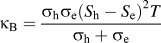 ${\kappa _{\rm{B}}} = {{{\sigma _{\rm{h}}}{\sigma _{\rm{e}}}{{\left( {{S_{\rm{h}}} - {S_{\rm{e}}}} \right)}^2}T} \over {{\sigma _{\rm{h}}} + {\sigma _{\rm{e}}}}}$ where S h and S e are the Seebeck coefficients of the holes and electrons, respectively, and σh and σe are the hole and electron conductivity values, respectively.Reference Nolas, Sharp and Goldsmid2 Above the Debye temperature, θD, Umklapp scattering is the dominant phonon scattering mechanism,Reference Nolas, Sharp and Goldsmid2
 $${\kappa _{\rm{L}}} = 3.5{\left( {{{{k_{\rm{B}}}} \over \hbar }} \right)^3}{{M{V^{{1 \mathord{\left/ {\vphantom {1 3}} \right. \kern-\nulldelimiterspace} 3}}}\theta _{\rm{D}}^3} \over {{\gamma ^2}T}}\quad ,$$
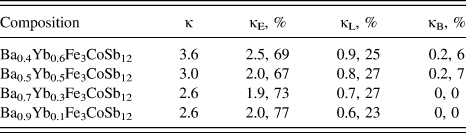
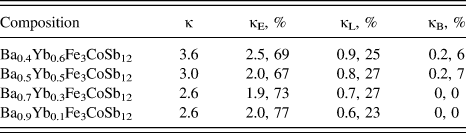
where M is the average mass per atom, V is the average atomic volume, γ is the Grüneisen parameter, k B is the Boltzmann constant, and  $\hbar$ is the reduced Planck constant. From Eq. (1), κL is proportional to T −1, thus κB can be estimated from the available data at elevated temperatures and is shown in Fig. 6. The extracted κB term for all the skutterudite specimens is summarized in Table I. As shown in Table I, as the Ba content increases the κB contribution decreases and is insignificant for the higher Ba content specimens. This can be explained by charge compensation between the filler atoms and the Fe content as described above. For a given Fe content, the number of electrons that are contributed by the filler atoms decreases with decreasing Yb filling due to the intermediate valence of Yb in skutterudites.Reference Nolas, Morelli and Tritt5,Reference Uher6,Reference Nolas, Kaeser, Littleton and Tritt28–Reference Lamberton, Tedstrom, Tritt and Nolas30
Temperature dependent (a) κ and (b) κL values for BaxYbyFe3CoSb12. The symbols corresponding to each specimen are as defined in Fig. 4.
Component details of κ for Ba0.4Yb0.6Fe3CoSb12 as a function of inverse temperature where the solid line illustrates the T−1 dependence of κL from 300 K to 550 K.
Estimated values from the different contributions to κ (W/m⋅K) at 800 K for BaxYbyFe3CoSb12.
The power factor (PF) as a function of temperature is shown in Fig. 7 for all specimens. For the two lower Ba content specimens (x ≤ 0.5), the PF reaches a peak at 650–700 K due to intrinsic excitation, while the PF for the higher Ba content specimens (x ≥ 0.7) increases continuously with increasing temperature. This is in good agreement with the transport properties discussed above. The maximum PF is 26 μW/cm K2 at 800 K for Ba0.9Yb0.1Fe3CoSb12. The ZT values for all specimens were calculated using the measured data, shown in Figs. 4 and 5, and are shown in Fig. 8. As shown in the figure, the ZT values increase with increasing temperature up to 800 K. The ZT values also increase with increasing Ba content. The highest ZT value (∼0.82) obtained at 800 K for Ba0.9Yb0.1Fe3CoSb12 is due to relatively high S values together with low κ values.
Temperature dependence of PF for all specimens. The symbols corresponding to each specimen are as defined in Fig. 4.
ZT versus temperature for BaxYbyFe3CoSb12. The symbols corresponding to each specimen are as defined in Fig. 4.
IV. CONCLUSIONS
Four relatively high-density polycrystalline double-filled skutterudites, BaxYbyFe3CoSb13 (x + y = 1), were synthesized by melting and annealing followed by hot pressing. PXRD patterns indicated that all specimens can be indexed to the cubic skutterudite phase and EDX indicated homogeneous specimens after hot pressing. The lattice constants increased with increasing Ba content due to the large ionic radius of Ba. The S and ρ values increased with increasing temperature and increased with increasing Ba content. The κ values for the two low Ba content specimens decreased with increasing temperature up to 550 K at which temperature they increased with increasing temperature due to bipolar diffusion. Bipolar diffusion became negligible due to relatively less charge compensation for the lower Yb concentrations. The ZT values of the high Ba content specimens increased with increasing temperature, and the highest value of ZT ≈ 0.82 at T = 800 K was obtained for Ba0.9Yb0.1Fe3CoSb12.
ACKNOWLEDGMENTS
This work was supported by the National Science Foundation Grant No. DMR-1400957. This work in Dr. Tritt's laboratory acknowledges, in part, the support of a KAUST Faculty Initiated Collaboration grant and also some funding from Clemson University.