Introduction
The pressure on tropical forests worldwide is well known and a source of critical concern, especially the rapid loss of biodiversity in South-East Asia (Webb et al. Reference Webb, Ferry Slik and Triono2010). The replacement of primary forests by increasing areas of secondary and plantation forest is due to anthropogenic pressure and the expansion of urban centres (Wright Reference Wright2005; Ngo et al. Reference Ngo, Turner, Muller-Landau, Davies, Larjavaara, Nik Hassan and Lum2013). Existing primary forests in South-East Asia are becoming increasingly fragmented and preserved only in national parks and nature reserves (Corlett Reference Corlett1988). Thus, small reserves have an important role in biodiversity conservation (Corlett Reference Corlett1988). As more forests come under threat from deforestation and degradation in South-East Asia, inventories of existing forests become essential for conservation purposes. We still have a poor understanding of the distribution patterns of taxa in this biogeographically complex region. The rate of forest degradation reduces the time we have left to document the biodiversity existing in these threatened ecosystems (Webb et al. Reference Webb, Ferry Slik and Triono2010).
During 2012, a rapid inventory was carried out by the first author to survey lichenized fungi in the Bukit Timah Nature Reserve (BTNR) in Singapore, perhaps the oldest small tropical rainforest reserve in the world (Corlett Reference Corlett1988). It became evident from this study that this long-term forest dynamic plot and last vestige of primary forest in a highly urbanized environment in tropical Asia still harbours a fair amount of lichen diversity, despite the pressure from urbanization and from being located within one of the most densely populated regions in the world.
Singapore lichens have been collected by botanists from 1800 to 1960, and some of these records were published only later (Sipman Reference Sipman2010). Some of the more noteworthy publications include those of Krempelhuber (Reference Krempelhuber1875, Reference Krempelhuber1877), Nylander & Crombie (Reference Nylander and Crombie1884) and Müller (Reference Müller1893). Since 1960, Singapore has been visited by several lichenologists, viz. Degelius in 1964, Tibell in 1983, Aptroot in 1989, and Sipman in Reference Sipman2003. The most complete lichen inventory made by Sipman (Reference Sipman2009, Reference Sipman2010) documented 296 species, including four species new to science, one in the family Graphidaceae (Ocellularia feigei Sipman). Sipman collected 962 samples of lichenized fungi from 17 localities in Singapore in 2000, probably the largest lichen collection ever made in Singapore (Sipman Reference Sipman2009). Since then, no lichens have been investigated in Singapore until the present study.
Graphidaceae is the largest family of tropical crustose lichens, with 2500 known species (Staiger Reference Staiger2002; Frisch Reference Frisch2006; Lücking et al. Reference Lücking, Chaves, Sipman, Umaña and Aptroot2008, Reference Lücking, Johnston, Aptroot, Kraichak, Lendemer, Boonpragob, Cáceres, Ertz, Fer raro and Jia2014; Rivas Plata et al. Reference Rivas Plata, Lücking and Lumbsch2012). The number of new species discovered in tropical and extratropical areas in recent years suggests that Graphidaceae might have more species than any other lichen family. It is predicted that most of the undiscovered diversity of the family is to be found in Mexico, northern South America, Bolivia, tropical West Africa, continental South-East Asia, Papua New Guinea and the northern part of Australia (Lücking et al. Reference Lücking, Johnston, Aptroot, Kraichak, Lendemer, Boonpragob, Cáceres, Ertz, Fer raro and Jia2014). Hence, the rapid inventory of BTNR in 2012 focused on Graphidaceae. Not surprisingly, among the sampled material we discovered seven new species and 19 new records for Singapore during two days of fieldwork. This was based on 109 specimens collected from a few sites within BTNR.
Materials and Methods
Study site
Bukit Timah Nature Reserve (BTNR) is a 164 ha forest reserve in central Singapore that contains Singapore's largest remaining patch of primary forest (Corlett Reference Corlett1988; LaFrankie et al. Reference LaFrankie, Davies, Wang, Lee and Lum2005). The reserve is dominated by coastal hill Dipterocarp forest and situated on Singapore's highest natural point (164 m above sea level). The core area of BTNR is limited to a 70 ha block of mainly primary forest dominated by Shorea curtisii Dyer ex King (Symington et al. Reference Symington, Ashton and Appanah2004; Ngo et al. Reference Ngo, Turner, Muller-Landau, Davies, Larjavaara, Nik Hassan and Lum2013). The climate is aseasonal, with an average temperature of 27·0°C, while mean annual rainfall is 2342 mm (Ngo et al. Reference Ngo, Turner, Muller-Landau, Davies, Larjavaara, Nik Hassan and Lum2013).
Laboratory methods
Specimens were examined at The Field Museum using LEICA MS5, MOTIC K400, and OLYMPUS SZX12 dissecting microscopes and ZEISS Axioscop 2, OLYMPUS BH-2, and VISTA VISION VWR V036 compound microscopes, in part connected to JENOPTIC ProgRes C3 and C5 digital microscope cameras. Anatomical measurements refer to specimens mounted in water; for iodine reactions, we used FLUKA 62650 Lugol's solution. We employed thin-layer and high-performance thin-layer chromatography (TLC or HPTLC) using solvent system C (Arup et al. Reference Arup, Ekman, Lindblom and Mattsson1993; Orange et al. Reference Orange, James and White2010).
Taxonomic Treatment
Astrochapsa sipmanii Weerakoon & Lücking sp. nov.
MycoBank No.: MB 811583
Differing from Astrochapsa astroidea (Berk. & Broome) Parnmen et al. in the olive-brown thallus and thick and coarse apothecial pruina.
Type: Singapore, Bukit Timah Nature Reserve, 01°21′N, 103°46′E, 147 m, low elevation CTFS plot, April 2012, G. Weerakoon 122 (F—holotype; SING—isotype).
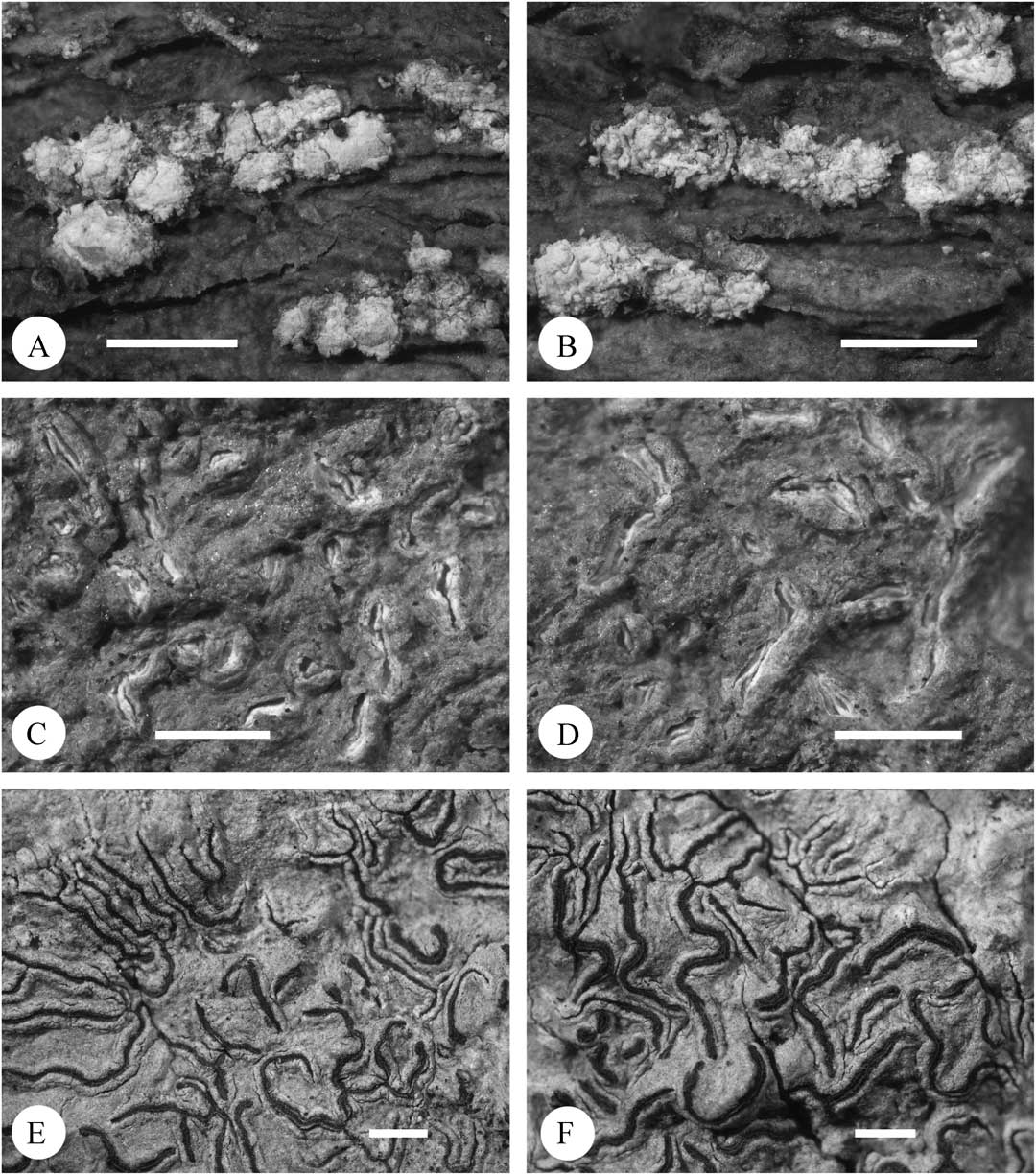
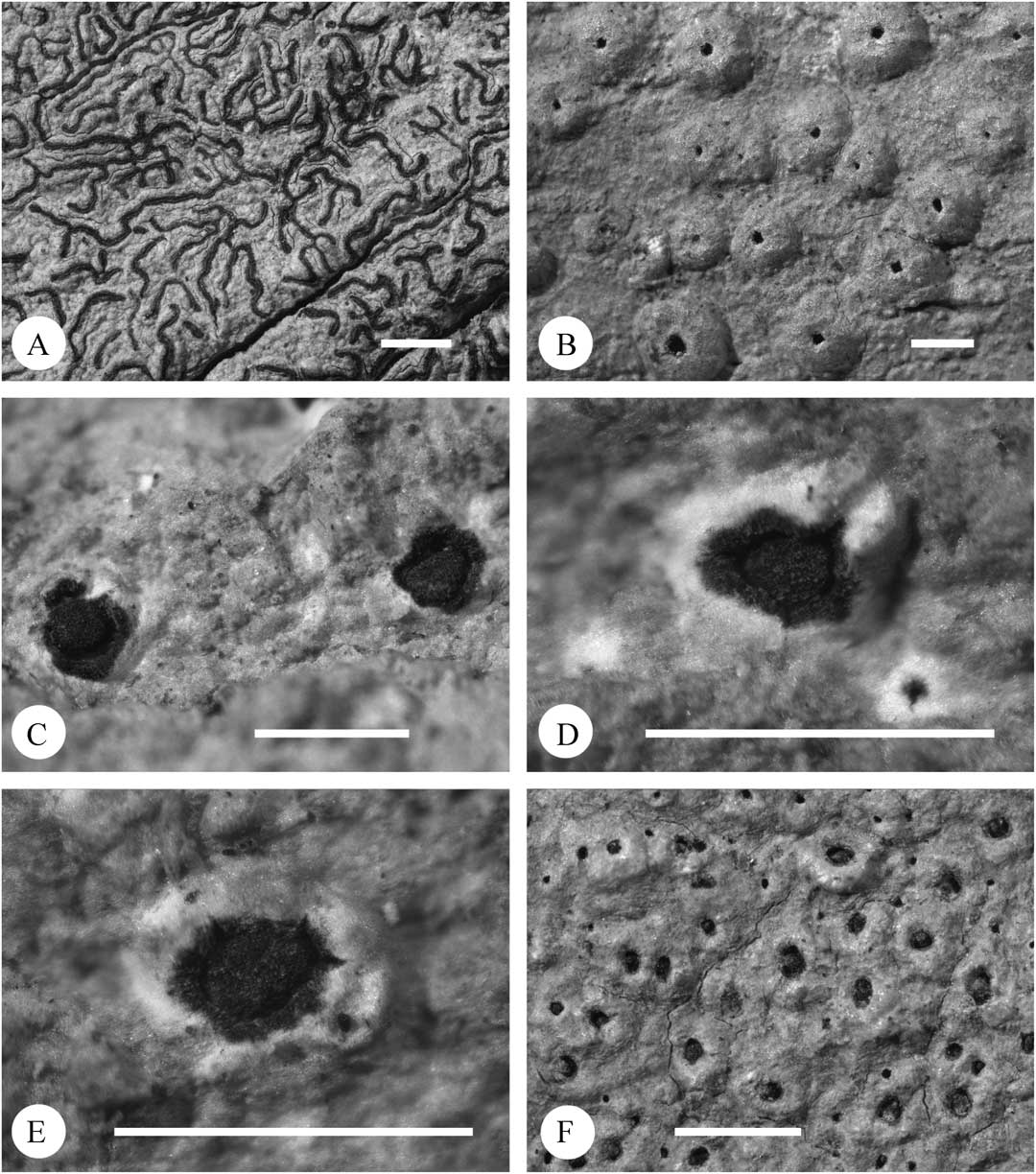
(Fig. 1A & B)
A & B, Astrochapsa sipmanii, thallus with ascomata (holotype); C & D, Fissurina duplomarginata, thallus with ascomata (holotype); E & F, Graphis bukittimaensis thallus with ascomata (holotype). Scales: A–F = 1 mm. In colour online.
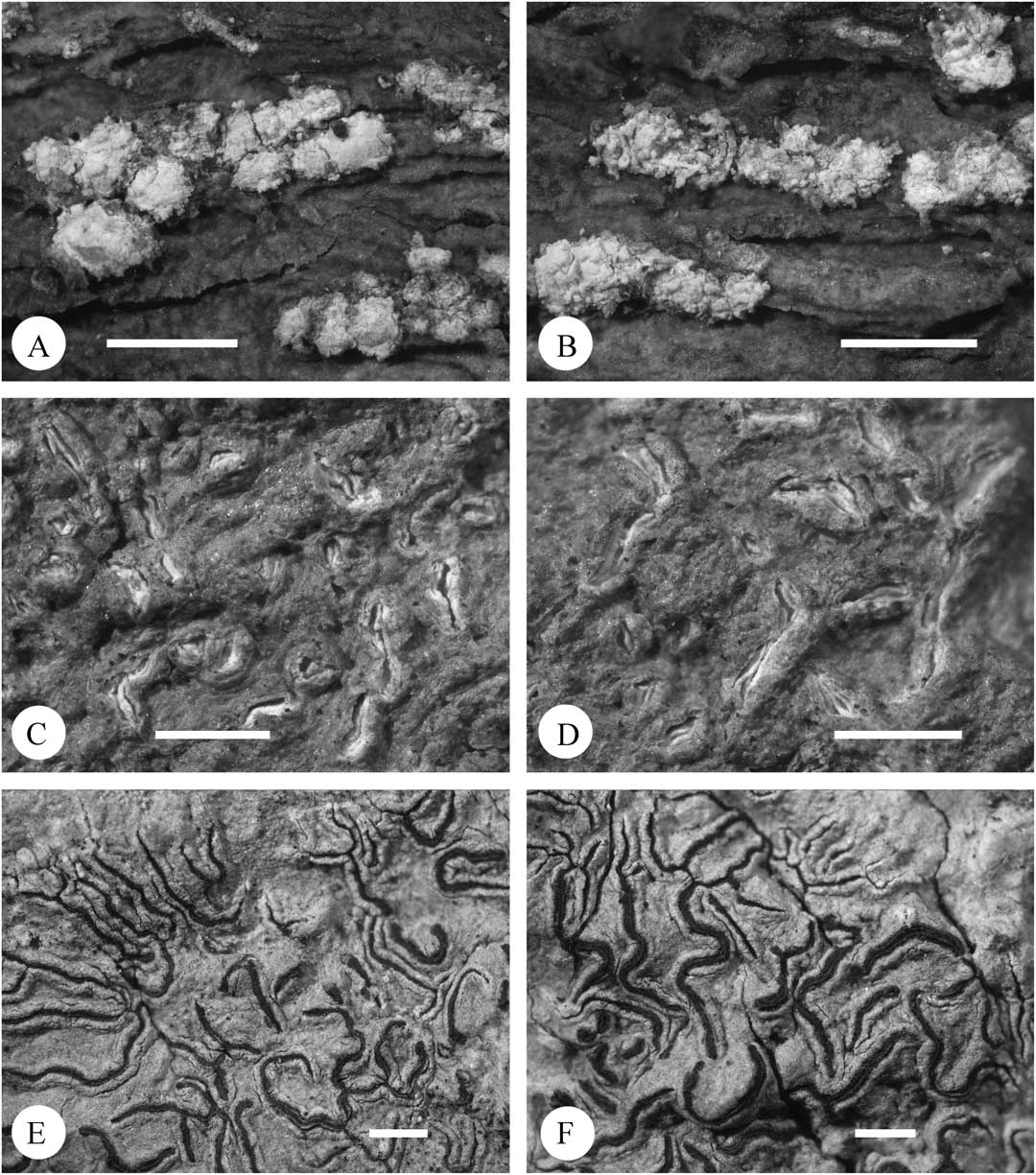
Thallus corticolous, up to 10 cm diam., endoperidermal, following the structure of the bark of the tree, olive-brown. Thallus in section very thin, 10–15 μm thick, ecorticate, with irregular photobiont in uppermost layer and lacking distinct medulla.
Apothecia rounded to irregular in outline, 0·4–0·7 mm diam. Disc exposed, grey, covered by thick granular pruina which makes the apothecia look like soralia. Margin lobulate, lobules erect to recurved, 0·1–0·2 mm long, sometimes falling off, inner surface whitish to salmon-coloured. Columella absent. Excipulum paraplectenchymatous, pale yellowish, 20–30 μm thick, covered by periderm layer. Periphysoids present, 15–20 μm long. Epithecium forming a layer of grey granules, 30–50 μm thick (the pruina). Hypothecium 10–15 μm high, yellowish, base below hypothecium with a 10–20 μm thick, dark brown to carbonized layer. Hymenium 80 μm high, clear. Paraphyses unbranched. Asci clavate, 70×10 μm. Ascospores 8 per ascus, 3–5-septate, with thin walls and septa, 12–15×3–4 μm, tapering, colourless, I–.
Chemistry
No substances detected by TLC or HPTLC.
Etymology
The new species is dedicated to Dr Harrie Sipman for his contributions to our knowledge of Singapore lichens.
Distribution and habitat
The new species was collected at a low elevation in slightly disturbed primary forest of the Bukit Timah Nature Reserve in Singapore. It is thus far known only from the type locality.
Remarks
This new species is similar to the generic type, Astrochapsa astroidea (Berk. & Broome) Parnmen et al., as well as to A. platycarpella (Vain.) Parnmen et al., but differs in the olive-brown thallus and thick apothecial pruina.
Fissurina duplomarginata Weerakoon & Lücking sp. nov.
MycoBank No.: MB 811584
Differing from Fissurina insidiosa C. Knight & Mitt. by the double margin of the lirellae and the more greenish, rough thallus.
Type: Singapore, Bukit Timah Nature Reserve, 01°21′N, 103°46′E, 147 m, low elevation CTFS plot, April 2012, G. Weerakoon 90 (F—holotype; SING—isotype).
(Fig. 1C & D)
Thallus corticolous, up to 5 cm diam., 25–75 μm thick, continuous, surface uneven to verrucose, greenish grey. Prothallus absent. Soredia and isidia absent. Thallus in section with thin prosoplectenchymatous upper cortex, 5–10 μm thick and algal layer, 20–60 μm thick, medulla indistinct. Photobiont Trentepohlia, cells 8–14×6–9 μm, yellowish green.
Lirellae immersed to erumpent, unbranched, 1–2 mm long, 0·4–0·5 mm wide, 0·2–0·3 mm high, slightly gaping, margin slightly fissured to lobulate, labia white, separated from thallus margin by a split (double margin). Proper excipulum very thin, 5–10 μm, non-carbonized, pale yellow, covered by orange-brown periderm 30–50 μm thick and layer of calcium oxalate crystals 30–60 μm thick. Periphysoids absent. Hymenium not inspersed, 100–120 μm high. Epithecium indistinct, granulose, 5–10 μm high, colourless. Paraphyses unbranched. Asci fusiform, 100–110×12–15 μm. Ascospores 8 per ascus, 3-septate, with thickened wall and septa and diamond-shaped lumina, 15–20×7–8 μm, with thin halo, 2·0–2·5 times as long as wide, colourless, I–.
Chemistry
No substances detected by TLC or HPTLC.
Etymology
The epithet refers to the labia separated from the thallus margin by a split which appears as a double margin.
Distribution and habitat
The new species was collected at a low elevation in slightly disturbed primary forest of the Bukit Timah Nature Reserve in Singapore. It is thus far known only from the type locality.
Remarks
The new species agrees mostly with Fissurina coarctata Makhija & Adaw., F. insidiosa C. Knight & Mitt. and F. longiramea Makhija & Adaw. in the 3-septate, non-amyloid ascospores, lack of chemistry, and solitary lirellae. It differs from all these species by the double margin of the lirellae. In addition, it differs from F. coarctata by the larger lirellae, from F. insidiosa by the greener, rougher thallus, and from F. longiramea by the short lirellae.
Additional specimens examined
Singapore: Bukit Timah Nature Reserve, 01°21′N, 103°46′E, 147 m, low elevation CTFS plot, 2012, G. Weerakoon 4, 7, 8, 21, 37, 38, 48, 62, 90A, 91 (SING).
Graphis bukittimaensis Weerakoon & Lücking sp. nov.
MycoBank No.: MB 811585
Differing from Graphis phaeospora Vain. in the erumpent lirellae with lateral thalline margin and the consistently 1-spored asci.
Type: Singapore, Bukit Timah Nature Reserve, 01°21′N, 103°46′E, 147 m, low elevation CTFS plot, April 2012, G. Weerakoon & S. Lum 95 (F—holotype; SING—isotype).
(Fig. 1E & F)
Thallus corticolous, up to 10 cm diam., 90–140 μm thick, continuous; surface uneven, white to very pale grey. Prothallus not observed. Thallus in section with loose upper cortex, 5–10 μm thick, irregular algal layer, 5–10 μm, and indistinct medulla, upper portion with large clusters of calcium oxalate crystals.
Lirellae erumpent, completely carbonized, elongate and irregularly to radiately branched, with lateral thalline margin, 1–5 mm long, 0·5–0·6 mm wide; disc concealed, labia black, initially entire but becoming striate. Excipulum crenulate, completely carbonized, 100–150 μm wide. Hypothecium prosoplectenchymatous, 10–15 μm high, hyaline to pale yellowish. Hymenium 150 μm high, colourless, inspersed, type B inspersion. Epithecium granulose, 5–10 μm high, olive-brown. Paraphyses unbranched. Asci fusiform, 120–140×20–30 μm. Ascospores 1 per ascus, regularly muriform, 70–100×15–25 μm, 3–4 times as long as wide, becoming brownish, I+ amyloid.
Chemistry
No substances detected by TLC or HPTLC.
Etymology
The epithet refers to the type locality, the Bukit Timah Nature Reserve (BTNR).
Distribution and habitat
The new species was collected at a low elevation in slightly disturbed primary forest of the Bukit Timah Nature Reserve in Singapore. It is thus far known only from the type locality.
Remarks
This new species superficially resembles Graphis insulana (Müll. Arg.) Lücking & Sipman and related taxa, but differs in the labia becoming striate. Anatomically it comes close to G. phaeospora Vain., including the ascospores becoming brownish, but in the latter the lirellae are prominent and covered by thin thalline tissue up to the top and hence appear grey, not black. Graphis phaeospora also has 1–4-spored asci. Due to the morphological similarity with G. insulana and relatives, we checked whether there is a known species with entire labia otherwise agreeing with the new taxon. However, here also, forms of G. phaeospora with entire labia would be the only option.
Additional specimens examined
Singapore: Bukit Timah Nature Reserve, 01°21′N, 103°46′E, 147 m, low elevation CTFS plot, April 2012, G. Weerakoon 78, 95B, 95C, 95D, 95F, 95J, 109, 120 (SING).
Graphis singaporensis Weerakoon & Lücking sp. nov.
MycoBank No.: MB 811586
Differing from Graphis novopalmicola A.W. Archer & Lücking in the smaller ascospores and in the immersed, densely branched lirellae with thin lateral thalline margin.
Type: Singapore, Bukit Timah Nature Reserve, 01°21′N, 103°46′E, 147 m, low elevation CTFS plot, April 2012, G. Weerakoon & Kang Min Ngo 102 (F—holotype; SING—isotype).
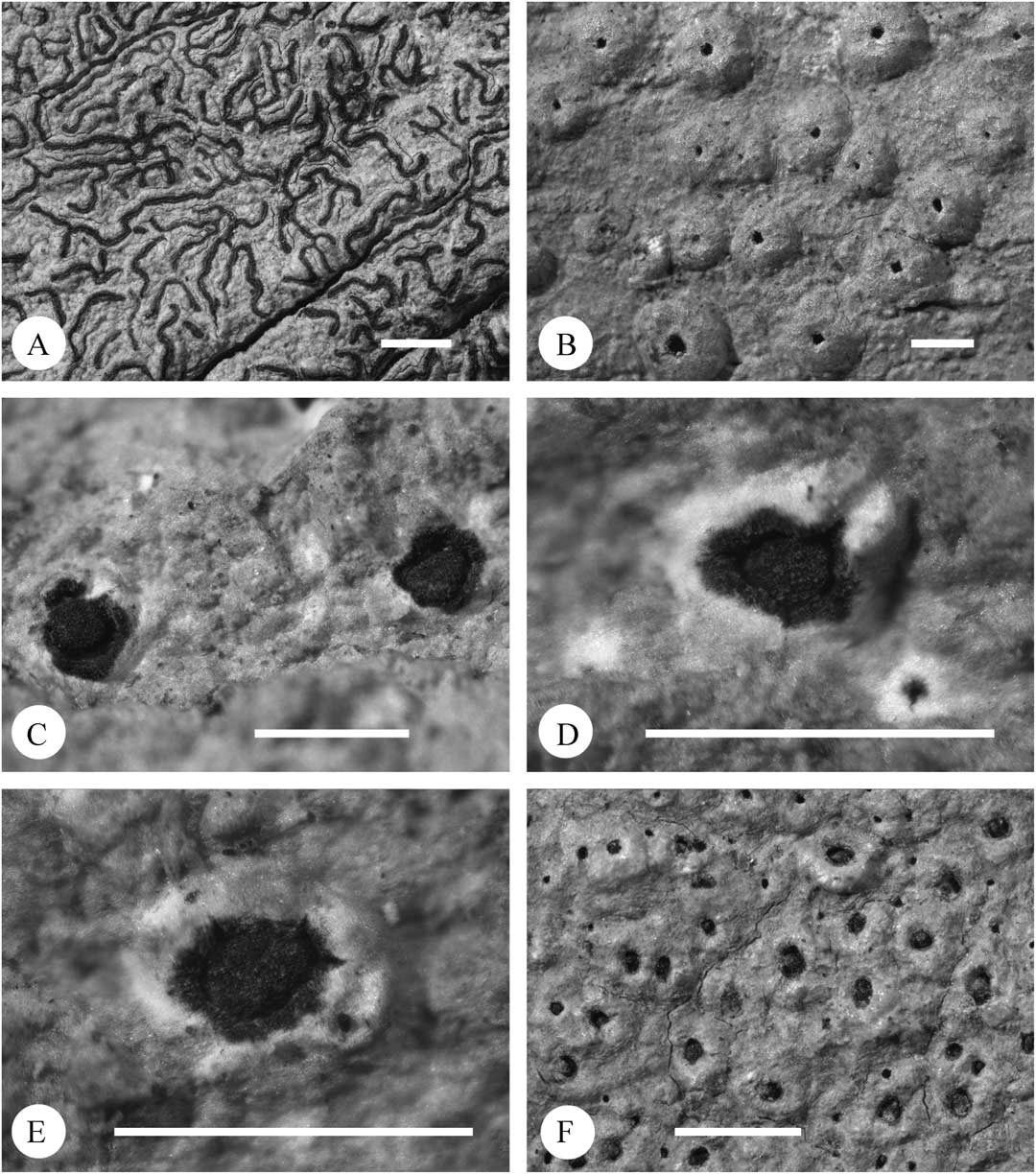
(Fig. 2A)
A, Graphis singaporensis, thallus with ascomata (holotype); B, Ocellularia gueidaniana, thallus with ascomata (holotype); C–E, Ocellularia rivasplatana, thallus with ascomata (C, holotype), ascomata enlarged (D & E, holotype); F, Ocellularia subudupiensis, thallus with ascomata (holotype). Scales: A–F = 1 mm. In colour online.
Thallus corticolous, up to 10 cm diam., 150–200 μm thick, continuous, surface uneven to verrucose, white to pale greenish grey. Prothallus not observed. Thallus in section with loose upper cortex, 5–10 μm thick, irregular algal layer, 70–100 μm, and medulla 100–120 μm, both with large clusters of calcium oxalate crystals.
Lirellae immersed, completely carbonized, very dense, irregular to stellately branched, with thin lateral thalline margin, 1–3 mm long, 0·1–0·2 mm wide; disc concealed, labia black, entire. Excipulum entire, completely carbonized, 30–60 μm wide. Hypothecium prosoplectenchymatous, 10–15 μm high, hyaline to pale yellowish. Hymenium 170–200 μm high, colourless, inspersed, type B inspersion. Epithecium granulose, 5–10 μm high, olive-brown. Paraphyses unbranched. Asci fusiform, 150–170×30 μm. Ascospores 2–4 per ascus, muriform, 50–70×17–20 μm, 3·0–3·5 times as long as wide, colourless, I+ amyloid.
Chemistry
Norstictic acid (major) and subnorstictic acid (trace) detected by TLC.
Etymology
The epithet refers to the type locality in Singapore.
Distribution and habitat
The new species was collected at a low elevation in slightly disturbed primary forest of the Bukit Timah Nature Reserve in Singapore. It is thus far known only from the type locality.
Remarks
There are only three species of Graphis known with entire labia, a completely carbonized excipulum, inspersed hymenium, muriform ascospores, and norstictic acid chemistry. Of these, G. novopalmicola A. W. Archer & Lücking has larger ascospores, whereas G. saxicola (Müll. Arg.) A. W. Archer has smaller ascospores and grows on rock. Both also have larger, erumpent lirellae with a thick lateral margin and are less branched. Graphis leprographa Nyl. has very short, prominent lirellae resembling those of G. dussii Vain., and also features larger ascospores.
Ocellularia gueidaniana Weerakoon & Lücking sp. nov.
MycoBank No.: MB 811587
Characterized by small, transversely septate, hyaline ascospores, prominent, carbonized but ecolumellate apothecia, and two unknown chemical substances resembling metabolites in the stictic acid chemosyndrome.
Type: Singapore, Bukit Timah Nature Reserve, 01°21′N, 103°46′E, 147 m, low elevation CTFS plot, April 2012, G. Weerakoon 53 (F—holotype; SING—isotype).
(Fig. 2B)
Thallus corticolous, epiperidermal, up to 10 cm diam., continuous, matt, uneven, pale greenish grey. Prothallus not observed. Thallus in section 50–70 μm thick, with a prosoplectenchymatous cortex 5–10 μm thick, rest of the thallus is made of the photobiont layer which is strongly encrusted with numerous grey granules, but no calcium oxalate crystals, and no distinct medulla. Photobiont Trentepohlia, cells rounded to irregular in outline, in irregular groups, yellowish green, 7–10×5–7 μm.
Ascomata prominent, hemispherical, 0·8–1·5 mm diam.; disc very thinly pruinose and covered by 0·1–0·3 mm wide pore, medulla white. Excipulum entire, 50–70 μm, carbonized, covered by orange-brown periderm layer that is 50–70 μm thick. Columella not present. Hypothecium prosoplectenchymatous, 10–15 μm high, colourless. Hymenium 120–130 μm high, colourless, clear. Epithecium indistinct. Paraphyses unbranched, apically smooth. Periphysoids absent. Asci fusiform, 100–110×20 μm. Ascospores 8 per ascus, ellipsoid, 5–7-septate, 20–30×7–8 μm, 2·8–3·7 times as long as wide, hyaline, distoseptate with lens-shaped lumina, I+ violet-blue.
Chemistry
Two unknown substances detected by TLC; orange spot (major) resembling connorstictic acid but with higher Rf at approximately 7, and orange-brown spot (major) resembling the guianensis unknown slightly above Rf = 20 (solvent C).
Etymology
This new species is dedicated to Cecile Gueidan, for her collaboration with the first author on the phylogeny of Pyrenulaceae and her guidance in carrying out the molecular work on Sri Lankan material at the Natural History Museum (London) in 2009.
Distribution and habitat
The new species was collected at a low elevation in slightly disturbed primary forest of the Bukit Timah Nature Reserve in Singapore. It is thus far known only from the type locality.
Remarks
This is another new species in the group with small, transversely septate, hyaline ascospores with an unknown chemistry. The unknown substances resemble those of the stictic acid aggregate but do not agree with any of the known substances in that chemosyndrome. They also differ from unknown substances listed in Frisch (Reference Frisch2006) and from those of O. udupiensis Patw. et al. and O. subudupiensis Weerakoon & Lücking sp. nov. The new species also differs from those taxa in the absence of a columella. There is no similar species in the genus.
Ocellularia rivasplatana Weerakoon & Lücking sp. nov.
MycoBank No.: MB 811588
Differing from Ocellularia exigua Müll. Arg. in the larger, broad-pored apothecia with a black-rimmed margin and filled with the black-topped columella.
Type: Singapore, Bukit Timah Nature Reserve, 01°21′N, 103°46′E, 147 m, low elevation CTFS plot, April 2012, G. Weerakoon 51 (F—holotype; SING—isotype).
(Fig. 2C–E)
Thallus corticolous, epiperidermal, up to 10 cm diam., continuous, verrucose, light green. Prothallus not observed. Thallus in section 50–100 μm thick, with prosoplectenchymatous cortex, 5–10 μm thick, photobiont layer 25–30 μm thick, medulla pale yellow, with K turning pinkish, 50–70 μm thick, strongly encrusted with numerous grey granules which disappear with K. Photobiont Trentepohlia, cells rounded to irregular in outline, in irregular groups, yellowish green, 6–10×5–8 μm.
Ascomata erumpent, round, 0·5–0·6 mm diam.; disc covered by 0·3–0·4 mm wide pore. Proper margin distinct, entire, visible as thick, internally black rim, completely filled by the black-topped columella. Excipulum entire, 25–50 μm, carbonized, covered by an orange-brown periderm layer that is 20–30 μm thick. Columella present, finger-like to barrel-shaped or becoming broad stump-shaped, 150–200 μm broad, carbonized. Hypothecium prosoplectenchymatous, 10–15 μm high, colourless. Hymenium 90–100 μm high, colourless, clear. Epithecium indistinct. Paraphyses unbranched, apically smooth. Periphysoids absent. Asci fusiform, 80–90×12–15 μm. Ascospores 8 per ascus, ellipsoid, 5–7-septate, 20–25×5–6 μm, 4·0–4·5 times as long as wide, hyaline, distoseptate with lens-shaped lumina, I+ violet-blue.
Chemistry
Cinchonarum unknown (major), accessory spots 2 and 3 (traces) according to Frisch (Reference Frisch2006).
Etymology
This new species is dedicated to Eimy Rivas Plata, for her contributions to our knowledge of the taxonomy and phylogeny of Graphidaceae and for the guidance given to the first author.
Distribution and habitat
The new species was collected at a low elevation in slightly disturbed primary forest of the Bukit Timah Nature Reserve in Singapore. It is thus far known only from the type locality.
Remarks
There are several species in Ocellularia with small, transversely septate ascospores combined with carbonized, columellate apothecia and with the cinchonarum unknown chemistry. However, almost all have a pigmented medulla, including the generic type, O. cavata (Ach.) Müll. Arg. They also differ in the usually prominent apothecia with a narrow pore and thalline margin. The only species lacking a medullary pigment is O. exigua, which also agrees in the erumpent apothecia, but it differs in the narrow pore with thalline margin. The broad-pored apothecia with black rim of the new species are very characteristic and resemble the apothecia of Melanotrema species, but that genus does not include taxa with the cinchonarum unknown chemistry.
Ocellularia subudupiensis Weerakoon & Lücking sp. nov.
MycoBank No.: MB 811589
Differing from Ocellularia udupiensis in the presence of three unknown secondary substances and in the comparatively rough thallus surface.
Type: Singapore, Bukit Timah Nature Reserve, 01°21′N, 103°46′E, 147 m, low elevation CTFS plot, April 2012, G. Weerakoon 29 (F—holotype; SING—isotype).
(Fig. 2F)
Thallus corticolous, epiperidermal, up to 10 cm diam., continuous. Surface uneven to rough, greenish grey to yellowish grey. Prothallus not observed. Thallus in section 50–100 μm thick, with prosoplectenchymatous cortex, 5–10 μm thick, photobiont layer 30–60 μm thick, medulla 30–50 μm thick, strongly encrusted with numerous large crystals of calcium oxalate. Photobiont Trentepohlia, cells rounded to irregular in outline, in irregular groups, yellowish green, 8–12×6–10 μm.
Ascomata erumpent, immersed with complete thalline margin, 0·4–0·6 mm diam.; disc covered by 0·1–0·2 mm wide pore. Proper margin distinct, entire, thin, filled by the columella which is grey-black above. Excipulum entire, upper half carbonized, covered by mixed layer of orange-brown periderm, 30–50 μm thick. Columella present, finger-like to barrel-shaped, 150–200 μm broad, carbonized. Hypothecium prosoplectenchymatous, 10–15 μm high, colourless. Hymenium 80 μm high, colourless, clear. Epithecium indistinct. Paraphyses unbranched, apically smooth. Periphysoids absent. Asci cylindrical, 80 × 10 μm. Ascospores 8 per ascus, ellipsoid, 5–7-septate, 25–30 × 6–7 μm, 4·1–4·3 times as long as wide, hyaline, distoseptate with lens-shaped lumina, I+ violet-blue.
Chemistry
Three substances (all major) detected by TLC forming pale to bright yellow spots with grey to brown centre at Rf = 60, 45, and 35 (solvent C). The middle spot appears to be isonotatic acid, the other two spots are unknown.
Etymology
The epithet refers to the similarity with Ocellularia udupiensis.
Distribution and habitat
The new species was collected at low elevation in slightly disturbed primary forest of the Bukit Timah Nature Reserve in Singapore. It is thus far known only from the type locality.
Remarks
This new species belongs in a large group of unrelated taxa within Ocellularia with small, transversely septate, hyaline ascospores and carbonized, columellate apothecia. Most species in this group have either no secondary substances or feature the psoromic acid or protocetraric acid chemosyndrome. Ocellularia udupiensis is one of a few species with unidentified substances, but these have different characteristics from those found in the new species described here; O. udupiensis also has a white-tipped columella. Ocellularia chonestoma (Leight.) Zahlbr. appears to share isonotatic acid with the new species but has norsubnotatic acid as accessory substance (two yellow spots); it also has prominent apothecia.
Additional specimen examined
Singapore: Bukit Timah Nature Reserve, 01°21′N, 103°46′E, 147 m, low elevation CTFS plot, April 2012, G. Weerakoon 10 (SING).
New records
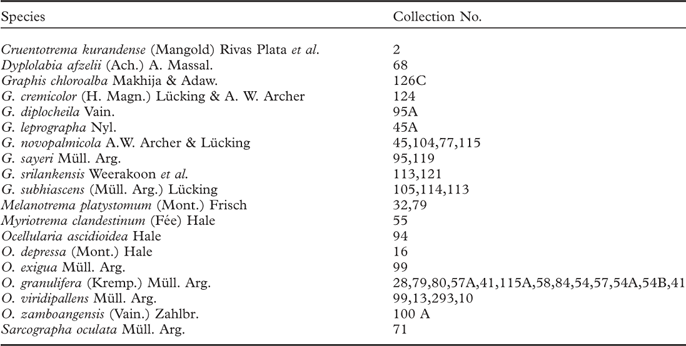
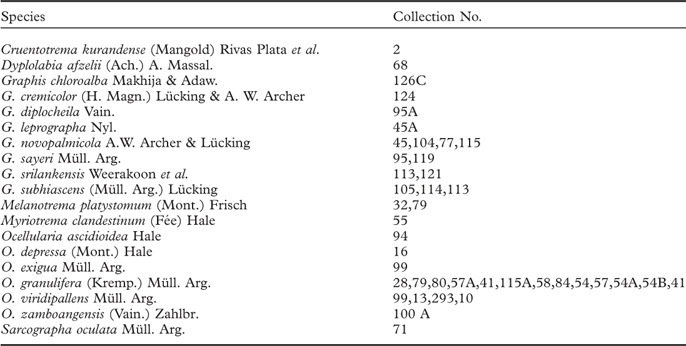
The new records of lichens from the Bukit Timah Nature Reserve are provided in Table 1.
New lichen records of the family Graphidaceae for Singapore
This publication continues our worldwide and community-wide revision of the lichen family Graphidaceae within the framework of the NSF-funded project “ATM – Assembling a taxonomic monograph: The lichen family Graphidaceae” (DEB-1025861 to The Field Museum; PI T. Lumbsch, Co-PI R. Lücking). G. Weerakoon would like to thank the staff of the Singapore Botanic Gardens for their assistance.