


Across the conflicts of the modern era, leaders have exhibited significant variation in wartime behavior. Some stand their ground against an aggressive adversary whereas others capitulate. Many leaders fight until they have secured every last war aim, yet others stop short of total victory or even settle for less than the prewar status quo. We also see a variety of behavior among leaders of the same regime type. Some democratic leaders bow to public opinion by ending unpopular conflicts, whereas others insist on continuing wars in the face of dissent. Likewise, a number of autocratic leaders fight until defeat is forced upon them, whereas others willingly lay down their arms to end wars. Variation also exists among leaders of the same state in a single war. Some leaders who take the helm midwar, for instance, continue to fight with the same tenacity as their predecessors, whereas others are more willing to treat with the adversary. Current theories of war termination offer little systematic explanation for this wide range of leader behavior. Although many cases align with their expectations, numerous “anomalous” cases exist.
A recent example of such a case lies in the United States’ experience with the war in Iraq. Begun in March of 2003 by then President George W. Bush, the war claimed more than 4,000 American lives by the time Bush left office in January of 2009 (icasualties.org). The war also took a heavy toll on Bush's popularity. At the end of his second term, only 34% of the country approved of his job performance, with 61% disapproving, making Bush second only to Richard Nixon in terms of unpopularity upon leaving office (Gallup 2009). Yet despite widespread displeasure with the war, and contrary to many existing theories of war termination that expect democratic leaders to be sensitive to popular opinion, Bush never gave any indication he was considering ending the war. On many occasions he dismissed public opinion outright, stating at one point that “We aren't leaving even if Laura [his wife] and Barney [his pet Scottish Terrier] are the only ones who support me” (Woodward Reference Woodward2006, 430). Later in the war, amid calls for his Secretary of Defense, Donald Rumsfeld, to resign, Bush acknowledged the dissent—“I hear the voices, and I read the front page, and I know the speculation”—but refused to heed it, declaring instead that “I'm the decider, and I decide what is best” (CNN.com 2006).
At the time, pundits offered a wide variety of idiosyncratic explanations for Bush's defiance of public opinion. Some, for example, posited that he was a “true believer” in the war, whereas others attributed it to a personal tendency to stubbornness. I maintain, however, that a much simpler explanation exists that can account for both Bush's behavior and the actions of many other leaders—both democratic and nondemocratic—who have continued to fight wars when others have felt they should stop. Briefly put, I argue that leaders’ perceived responsibility for wars—or, hereafter, their culpability for the decision to involve their states in the conflicts—will directly affect both their wartime behavior and the domestic audiences’Footnote 1 willingness to punish them should they lose. I define a culpable leader as any leader who was in charge of the state when the war began or who was directly connected to the decision to involve the state in the conflict. Culpable leaders will have strong incentives to continue fighting in the face of hardship because their citizens will want to punish them if they fail to succeed in a war they played a role in starting. This threat of domestic punishment for culpable leaders creates a “decider's dilemma”: Culpable leaders may want to back down, but their clear ties to the decision to involve the state in the war increase their risk of punishment if they settle for anything short of victory. Nonculpable leaders, in contrast, will not face this hard choice. Instead, because domestic audiences will be more forgiving of leaders whom they perceive to be unconnected to the choice to involve the state in the war, nonculpable leaders will be more willing to end the conflict, even if this means accepting a loss.
The concept of leader culpability improves our understanding of the domestic politics of war in four ways, three theoretical and one empirical. First, it can explain variation among frequently pooled leaders, including leaders of the same regime type or even leaders of the same state in a given war. Second, it provides us with a mechanism for the transfer of the pressure to win from one leader to the next. Third, leader culpability produces a more accurate model of how citizens perceive, assess, and decide whether to punish their leaders for poor war performance. Finally, in a more conceptual vein, distinguishing between leaders based on their culpability highlights the potential for sampling bias in existing empirical studies of the relationship between war outcome and leader punishment.
This article proceeds in four sections. The first briefly discusses how introducing culpability into our theories of war termination improves on existing work, and provides a more detailed discussion of my argument and the associated hypotheses. The second section describes the research design, including several variables coded specifically for this study. A third section presents the results, which indicate that leaders’ culpability for their states’ involvement in a war has a large effect in determining both the outcomes they are likely to preside over and the probability that their domestic audiences will punish them in the event of a loss. The final section concludes.
THEORY
Two Limitations
Before elaborating on why a leader's culpability will affect his or her war termination decision, we must first understand the utility of this new concept. In the Introduction I claimed that existing theories have a difficult time accounting for variation in leader behavior. This limitation stems from two common practices. First, much of the existing literature focuses on the differences between broad classes of leaders—namely, democratic leaders vs. nondemocratic leaders—which often has the effect of obscuring important distinctions within groups. Second, current theories do not offer a causal mechanism for the pressure to secure a victory to pass from one leader to the next. Because substantial variation exists both within regime types and even within leaders from the same state, overcoming these limitations is essential.
As to the first problem, regime-based theories assume leaders of the same regime type will have similar sets of incentives, especially in comparison to other types of political systems.Footnote 2 Although recent research cautions scholars against making the crude assumption that all leaders of the same regime type can be treated as a homogenous group,Footnote 3 work in this vein still assumes that, on the average, broad differences exist between the different types of states. Democratic leaders under condition X may be less sensitive to public opinion than leaders under condition Y, but both leaders will be more sensitive than their nondemocratic counterparts. Indeed, several prominent theories of war termination and wartime behavior more generally turn on this assumption (e.g., Bennett and Stam Reference Bennett and Stam1998; Reiter and Stam Reference Reiter and Stam III2002). This insight accounts for a number of democratic leaders throughout history, but it lacks a causal story for leaders who defy public opinion during unpopular wars. Related theories based on the assumption of democratic sensitivity to casualties suffer from a similar problem. They can tell us why some democratic leaders end costly wars, but not why others continue to fight in the face of heavy losses.Footnote 4
The second limitation—the lack of a mechanism to explain how and when the pressure to win will pass from the first leader to a successor (hereafter, “replacement leader”)—is not often mentioned in the literature, because scholars rarely focus on wartime leadership changes.Footnote 5 The standard logic regarding who will feel the pressure to attain victory is that the leaders who are in charge when the war starts (hereafter, “first leaders”) will, but subsequent leaders will not. For example, implicit in Downs and Rocke (Reference Downs and Rocke1994) is the assumption that any leader who leader takes power during a war should be more amenable to a war-weary constituency's demands than a leader who started the conflict. Leaders of the latter type, the authors argue, are more likely to face punishment if they lose, and therefore have the incentive to “gamble for resurrection” by staying in the conflict. Stanley (Reference Stanley2009) and Stanley and Sawyer (Reference Stanley and Sawyer2009) agree with the notion that first leaders should be more likely to continue fighting, but for slightly different reasons. For them, first leaders are more likely than replacements to remain in a conflict because they are more prone to a variety of informational biases and are more likely to feel entrapped. Bringing a new leader to power, the authors argue, can help overcome these impasses by either introducing new and possibly more informed perspectives or reducing the political costs of admitting defeat that kept the first leader in the conflict.Footnote 6
Both theories almost certainly capture the incentives of several first leaders who have exhibited a strong determination to win. What they cannot explain, however, is the variation among the set of leaders that replace them.Footnote 7 Why do some replacement leaders continue to gamble, whereas others choose to cut their losses and end the war? Why are some replacement leaders able to slip the bonds of entrapment, whereas others seem to inherit them from their predecessors? Without a causal means by which the incentive to continue fighting might pass from leader to leader, these questions remain unanswered. This problem is not inconsequential: Of the 259 warring states in this study, 51 (or nearly 20%) have changed leaders at least once by the end of the war.Footnote 8 Indeed, because some states change leaders multiple times; across the entire data set there are 96 replacement leaders, accounting for more than a quarter of the observations. Assuming a priori that all 96 will have similar incentives not only oversimplifies the political dynamics of the leader changes but also, as I demonstrate later, masks important differences among these leaders.
The Solution
Recognizing the importance of a leader's culpability addresses both of these limitations. First, it identifies a way for otherwise similar leaders to have different incentives for continuing a war. Because a leader's culpability stems from the specific role he or she plays in the conflict, we need not assume all democratic leaders or all leaders who take over midwar will be subject to the same constraints. Second, it also provides a means for replacement leaders to inherit culpability for a war. Because a leader's culpability for a war is largely determined by his or her position in the government or political connections to previous executive, predicting which replacement leaders will have incentives to keep fighting is fairly straightforward. Additionally, as I mentioned previously, culpability also provides a way to predict which leaders citizens will want to remove. Currently, scholars expect domestic audience members to punish leaders who lose. The historical record, however, suggests that their logic is more complex: Some leaders who fail to secure victories are punished, but others are not. Once we recognize that citizens will only want to punish culpable leaders who lose, explaining variation in leaders’ fates becomes an easier task.
In the following sections, I explain which leaders will be subject to the pressures of culpability; provide a rationale for why culpable leaders will have reason to gamble, whereas nonculpable leaders will not; and explain why citizens will want to punish culpable leaders who lose and spare nonculpable leaders who do the same.Footnote 9 I also present hypotheses on the effect of a leader's culpability on war outcomes and the likelihood of domestic punishment.
Determining Culpability
Two types of leaders are subject to the pressures of culpability. As I mentioned earlier, the first type consists of leaders who were in power when the war began, or first leaders. “First leader,” importantly, is not synonymous with “initiator.” Instead, this group includes initiators, leaders who choose to join conflicts already in progress, and leaders whose states were attacked. The defining criterion is that the leader oversaw the state's transition from peace to war. Although initiators and third-party joiners could, potentially, deserve more culpability because they actively chose to involve their states in conflicts, some scholars have argued that targeted leaders will acquire a similar burden (Bueno de Mesquita and Siverson Reference Bueno de Mesquita and Siverson1995). The theoretical rationale behind this claim is that citizens will view an attack on their state as a failure on the part of the leader to either foresee the danger and pre-empt the attack, or otherwise placate the aggressor and avoid violence altogether. Given this, and the fact that very few wars are the result of true “surprise attacks,” in which the targeted leader had no inkling of the impending conflict, it is reasonable to think that citizens in a targeted state will not automatically forgive the leader for their state's involvement in a war.Footnote 10
The second type of leader whom citizens will hold culpable is a leader who comes to power during the war and who is from the same political faction as the first leader. The term “faction” is intentionally vague, to accommodate any regime type. Membership in a leader's faction implies close proximity to the decision-making process and a political relationship with other faction members, including the executive. Although these successor leaders do not have direct responsibility for the war, the clear ties that exist between the new leaders and their predecessors will lead their citizens to transfer the blame with minimal, if any, discounting.Footnote 11 In nondemocratic states a transfer of culpability between a first leader and his or her replacement occurs if the new leader comes from the former leader's inner circle (e.g., the political elite in a one-party system, generals in a military junta, or the royal family in a monarchy). In democracies, culpability will transfer to a replacement leader if that leader is from the same political party or, in the case of a parliamentary system, the same party or cabinet as his or her culpable predecessor.Footnote 12
This assumption of a partisan cue draws on the large body of literature in American politics that demonstrates that citizens commonly rely on political heuristics such as party affiliation to make assumptions about and to draw connections between leaders.Footnote 13 There is also evidence that citizens are willing to act on these connections when administering punishment. Cotton (Reference Cotton1986, 625), for example, in a study directly relevant to the question at hand, provides evidence of democratic citizens’ willingness to pass blame along party lines in his study of U.S. wartime elections, where he finds that members of the president's party fare especially poorly. This leads him to conclude that the costs of war “can hurt the party associated with America's entry into the fighting.”Footnote 14
In general, citizens transfer culpability along factional lines because the first leader's fellow faction members are more likely than other actors to have played a role in or to have supported the war when it began. This is a safe assumption to make because executives should be reluctant to participate in wars unless they have, at minimum, support from their fellow faction members, regardless of their regime type. As Schultz (Reference Schultz2001b) noted, this strategic behavior is evident in democracies, where most of the wars executives choose to fight are supported (at least initially) by a large majority of the legislature. A similar story should also be true for nondemocratic leaders. Although these leaders face fewer constraints from the need for formal institutional approval, they should still be interested in the approval of their winning coalitions, whose support they need to remain in power. Consequently, we should not expect to observe many instances of leaders going to war without the support of those closest to them, regardless of regime.
Understanding Leader Behavior
Having established the determinants of culpability, I proceed to how culpability (or the lack thereof) affects a leader's war termination calculus. This helps to answer the related questions of why a culpable leader may continue to fight, even if victory is unlikely, and why a nonculpable leader may end a war, even when winning remains a possibility. As I argue in more detail subsequently, the primary factor in determining a leader's choice between continuation and termination of the conflict is the probability of punishment if he or she accepts any outcome less than a win. For culpable leaders this probability will almost always be very near one, whereas for nonculpable leaders it will most likely be zero.
The expectation that culpable leaders will face punishment if they do not secure a victory draws on the standard audience costs argument, which posits that citizens will punish a leader who fails to follow through on public statements successfully (Fearon Reference Fearon1994, Reference Fearon1997; Schultz Reference Schultz2001a, Reference Schultz2001b). The argument I present here builds on this logic in two important ways. First, it extends the domain of audience costs by suggesting that the actions a leader takes at the beginning of a war (either starting it or supporting it) will continue to affect the leader's behavior until either the conflict ends or he or she loses power. Extending the effect of audience costs in this way constitutes an innovation because both existing theories about and empirical tests of the argument are couched almost exclusively in the context of crises.Footnote 15 Crises and wars are different in important ways, but this does not mean that citizens will discount the leader's role in the decision that brought the state to war once the conflict escalates beyond the crisis. Indeed, as recent empirical work (e.g., Tomz Reference Tomz2007) suggests, the likelihood that a leader will face audience costs increases as the leader engages in more escalatory behavior. To account for this, I argue that citizens will want to make the actor(s) responsible for the state's participation in the war “pay” the audience costs in the event of a bad outcome, regardless of how long the conflict continues after the initial crisis.
The second improvement I make, which I discussed previously, is to provide a way to predict when this pressure to win will pass to replacement leaders. The current literature on crises overlooks this possibility, because most crises are too short to witness a change in leadership. The same does not hold, however, for wars, where leadership changes are not uncommon. The argument I present here fills this gap by positing that citizens will transfer the pressure to secure a victory from leader to leader along factional lines.
Once we realize that the pressure to deliver a promised outcome can extend beyond a crisis, and that this pressure can pass to subsequent leaders, we can explain why culpable leaders, regardless of when they came to power or their regime type, will have strong incentives to avoid settling without a win. As audience costs scholars would argue, the domestic opposition will leap at the chance to target a leader who ends a war he or she had a role in starting with anything less than a total victory.Footnote 16 If a first leader fails to win a war, domestic opponents will suggest the setback is indicative of a larger competence problem in an attempt to weaken the executive in other policy realms. Any culpable successor who presides over unfavorable results will face similar allegations. Affiliation with the first leader and earlier support of the conflict will complicate denying the opposition's claim that he or she is responsible for the loss.Footnote 17
Because culpable leaders who perform badly face a heightened risk of punishment, what types of behaviors should we expect from them? I predict that these leaders will continue fighting even if doing so carries a low chance of winning and the costs of staying in the war are high. Put differently, of leaders who fight wars, culpable leaders should have the higher probability of fighting until they have “lost the power to hurt” (Slantchev Reference Slantchev2003).Footnote 18 So long as winning the war (and, consequently, escaping punishment) remains a possibility, continuing to fight will always carry a higher expected utility for the leader than settling for less than victory in the current period. This is, of course, the logic Downs and Rocke (Reference Downs and Rocke1994) offered for why leaders who find themselves in losing battles should “gamble for resurrection.”Footnote 19 The argument I present here builds on this insight by offering a way to predict which leaders will take this gamble (culpable leaders), and which will admit defeat (nonculpable leaders). Because culpable leaders—regardless of when they come to power—will face punishment if they lose, they should always opt to keep fighting. We should also expect them to subject their states to higher costs (via riskier strategies, more aggressive tactics, troop increases, etc.) in an effort to increase their chances of winning. Although this approach may be costly for the state and anger the domestic audience further, the culpable leader has nothing to lose by trying, because the risk of punishment if he or she loses stays the same regardless of the additional resources invested in the war. The leader cannot, in other words, do worse by continuing to fight. Indeed, it is the only chance he or she has to do better.Footnote 20
For nonculpable leaders, the opposite is true. These leaders can only do worse if they choose to stay in the conflict. They face little risk of punishment for backing down—even if this means accepting a loss—but they expose themselves to more risks if they continue. Put differently, we should expect nonculpable leaders to be risk-averse compared to culpable leaders. Recall that culpable leaders will embrace the uncertainty of the future, because maintaining the potential for victory is the only way they can justify keeping the state in the conflict and keep the possibility of escaping punishment open. A nonculpable leader, in contrast, should eschew courses of action with uncertain outcomes, especially because he or she can achieve a good outcome (for him or her self) with certainty by backing down.
Although some may argue that winning is better than losing, ceteris paribus, opting to stay in a war will be unattractive to nonculpable leaders for at least two reasons, even if winning is still possible. First, victory is unlikely to be certain. Even if the state has fair odds of winning, staying in a war necessarily involves a gamble that may not pay off, and this potentially leaves the leader worse off than if he or she had terminated the war.Footnote 21 Second, choosing to stay in the war has the possibility of saddling the leader with the burden of culpability. Because his or her ability to back down without negative repercussions is common knowledge, declining this option would signal to the domestic audience that the leader is willingly taking on responsibility for the war. Put differently, whereas citizens might expect a culpable replacement leader to feel compelled to keep fighting because of ties to his or her predecessor, they will likely perceive the same decision made by a nonculpable successor as an active choice precisely because he or she lacks such ties. Given that culpability increases the probability of punishment in the event of a loss, a nonculpable leader should have no incentive to risk this outcome by staying in the war.Footnote 22
Nonculpable leaders should also have little reason to invest additional resources in the conflict. In addition to the risk of ultimately losing the conflict, continuing to pour resources into the war robs them of the chance to allocate those resources to other matters on their agendae. Moreover, unlike culpable leaders who having nothing to lose and everything to gain by taking risks in an effort to eke out a win, nonculpable leaders stand to lose substantially by engaging in such behavior for reasons discussed earlier. A nonculpable leader also faces the added risk of squandering goodwill with the domestic audience by subjecting them to additional costs, especially if they feel that victory is not possible.
Understanding Citizen Behavior
I now turn to the question of why citizens want to punish culpable leaders who perform poorly in wars, and spare nonculpable leaders who do the same. At least two reasons exist: incompetence and the state's international reputation. Culpable leaders are more susceptible than nonculpable leaders to being labeled “incompetent” because citizens can more easily link them to the decisions that led to poor outcomes. The first place a leader's incompetence can develop in the eyes of citizens is in the selection of the conflict. If a leader involves a state in a war in which the state is clearly outmatched or that goes poorly quickly, opponents of the leader could argue he or she lacks sound judgment in foreign policy. Citizens will have incentives to remove such a leader not only to prevent him or her from making the same mistake again, but also to deter future leaders from behaving similarly (Downs and Rocke Reference Downs and Rocke1994). Culpable leaders are more likely to face punishment for this reason than nonculpable leaders because they either oversaw the onset of the war or supported the decision to participate in the conflict.
The second way a culpable leader can appear incompetent in the eyes of citizens is in the way he or she prosecutes the war. If a culpable leader selects into a war the citizens initially viewed as a good bet, and goes on to lose (or simply fails to win), citizens will assume the leader must have done something to squander the state's chances of victory. Critically, the fact that the war seemed like a good idea at the start should not encourage the citizens (or the opposition) to be more forgiving if the war ends poorly. Indeed, it should inspire more indignation. If a state had, for instance, an estimated 95% chance of winning a war at the outset, yet it still loses, citizens will likely assume that a loss in the face of such overwhelmingly favorable odds must have resulted from the leader's severe mismanagement of the war (Gelpi and Greico Reference Gelpi and Grieco2001; Smith Reference Smith1998). A nonculpable leader, predictably, will have an easier time dodging such accusations of poor war management by credibly distancing himself or herself from the war's initial phases and/or earlier tactical decisions made by the previous leader(s).
The second reason citizens will be more willing to punish culpable leaders than nonculpable ones centers on how the leader is perceived by the international audience. As others have argued, domestic audience members have an incentive to remove executives when they feel the executives have damaged their international reputations (McGillivray and Smith Reference McGillivray and Smith2008). Although scholars typically discuss this concept in the context of international cooperation, where leaders damage their reputations by reneging on agreements, the concept is equally applicable to conflict situations (Tomz Reference Tomz2007). In a war, leaders can damage their reputations by failing to secure favorable outcomes for wars they had a hand in starting. A failure to win will call the leader's resolve into question in the eyes of other national leaders, potentially inviting more challenges in the future. Citizens, therefore, will want to remove such leaders from office and replace them with leaders whose international credibility is intact. This preference favors nonculpable leaders because of their ability to disassociate themselves both from the specific decision to go to war in the first place and from the previous leader(s) more generally. The new leader may prove to be a poor choice, potentially damaging his or her own reputation at a later date, but in the current time period, a leader without a record will be preferable to a leader with a tarnished one.
Hypotheses
The preceding logic implies several hypotheses regarding how a leader's culpability should affect both the outcomes he or she is likely to preside over and the probability that he or she will be punished if the state does not win. First, because culpable leaders face a heightened likelihood of domestic punishment if a war they are linked to ends poorly, they have stronger incentives than nonculpable leaders to secure the best outcome possible. This suggests the following hypothesis:
Hypothesis 1: Culpable leaders should be more likely to secure favorable war outcomes than nonculpable leaders.
Of course, simply having stronger incentives to win does not mean that leader will always be able to do so. All culpable leaders should try to win, but a stochastic component determines which gambles will pay off. Some culpable leaders may succeed, whereas others may stay in too long, making their state worse off than if they had settled earlier (i.e., the aforementioned tendency for culpable leaders to fight until they “lose the power to hurt”). This suggests that culpable leaders should be associated with extreme outcomes, that is, both major victories and catastrophic defeats. Nonculpable leaders, on the other hand, should be more likely to preside over medial to poor outcomes. This suggests the following hypothesis:
Hypothesis 2: Culpable leaders should be more likely to preside over extreme war outcomes than nonculpable leaders.
Although culpable leaders across all states should feel more pressure to end the war on favorable terms than their nonculpable counterparts, variation in domestic institutions might create differences among culpable leaders. For instance, in a democracy, where institutions facilitate removing the leader (e.g., a viable opposition and a means for regular changes in power), the leaders may be more responsive to the pressures associated with culpability.Footnote 23 This suggests the following hypotheses.
Hypothesis 3: Among culpable leaders, democratic leaders should be more likely to preside over favorable outcomes than culpable nondemocratic leaders.
Hypothesis 4: Among culpable leaders, democratic leaders should be more likely to preside over extreme outcomes than culpable nondemocratic leaders.
The culpable leader's incentive to fight until victory, of course, stems from anticipation of punishment by the domestic audience if he or she fails to win. As previous discussions argued, citizens have a multitude of reasons for wanting to punish culpable leaders who involve their states in wars that end poorly. A nonculpable leader, in contrast, faces a much smaller probability of domestic punishment, regardless of the ultimate terms of settlement. This suggests the following hypothesis:
Hypothesis 5: Culpable leaders who preside over unfavorable outcomes are more likely to be removed from office because of a war than nonculpable leaders who do the same.
Finally, as noted previously, because only some polities have institutions that enable the removal of leaders, the frequency of observed punishments might vary by regime type. Specifically, because domestic audiences can more easily remove their leaders through regular means in democracies, we might expect culpable democratic leaders to be punished more than their culpable nondemocratic counterparts.Footnote 24 This suggests the following hypothesis:
Hypothesis 6: Among culpable leaders who preside over unfavorable outcomes, democratic leaders should be more likely to be removed from office because of a war.
RESEARCH DESIGN
Testing the hypotheses regarding the effects of a leader's culpability on war outcomes and the likelihood of punishment accurately required several innovations in both variable construction and research design. To this end, I created a new data set of all leaders who participated in interstate wars between 1815 and 2000. The 259 warring states included in the analysis mirror the Correlates of War Project's list of interstate war participants (Sarkees Reference Sarkees2000).Footnote 25 To determine the population of leaders who were in charge of these states during the conflicts, I relied on two data sets of leaders (Bueno de Mesquita et al. Reference Bueno de Mesquita, Smith, Siverson and Morrow2003b; Goemans, Gleditsch, and Chiozza Reference Goemans2006).Footnote 26 I included leaders in the new data set if they were in power at any point during the war.Footnote 27 The resulting data set includes one observation for every leader who governed during a war (e.g., U.S. involvement in the Korean War constitutes two observations: one for Truman and one for Eisenhower) for a total of 355 observations. As I argued earlier and will demonstrate later, including all leaders who participated in wars in the punishment analysis simultaneously is critical not only to test the theory accurately, but also to avoid sampling error that will affect our ability to draw meaningful causal inferences.
Dependent Variables
War Outcome. Operationalizing the war's outcome required devising a coding method that would allow me to use every warring state in the data set as a separate observation. Scholars interested in modeling war outcomes typically drop all but one state from each war from their analyses, because including all of the states would introduce correlation among the error terms.Footnote 28 To reduce this problem, and include as many states as possible, I designed a coding scheme that focuses on the degree to which a leader achieved the state's maximum war aimsFootnote 29 instead of how he fared relative to his opponent. I used the maximum war aims for two related reasons. First, because war aims can change over the course of the war (Goemans Reference Goemans2000, Reiter Reference Reiter2009), relying on the original war aims would miss important changes in the state's goals. Second, using the maximum war aims is important because they provide the baseline against which citizens and, importantly, members of the domestic opposition will assess a leader's degree of accomplishment. Although a leader may want to revise the war aims downward to minimize the appearance of failure when predicting that he or she cannot win, the opposition will have strong incentives to remind citizens of the earlier higher aims.
Coding a war's outcome with respect to the state's maximum war aims produced the following six-point scale: 2: total victory (accomplish all war aims, no losses); 1: partial victory (achieve most, but not all war aims, no losses); 0: prewar status quo (accomplish no war aims, no losses); -1: partial loss (accomplish no war aims, make minor concessions, ally suffers major loss); -2: major loss (accomplish no war aims, make major concessions); -3: total loss (i.e., loss of sovereignty). The distribution for this variable was as follows: total loss (13%), major loss (6%), partial loss (22%), prewar status quo (12%), partial victory (7%), total victory (39%).Footnote 30
In addition to offering a more nuanced conceptualization of the different ways in which wars can end, the coding scheme represents a theoretical advance by providing a more accurate measure of a leader's achievement.Footnote 31 It also allows assignment of different outcomes across members of large coalitions, allowing a more accurate depiction of how individual states fared. In WWII, for instance, although Belgium and the United Kingdom were both on the same side, the former was conquered early in the war and occupied by Nazi Germany, whereas the latter maintained its sovereignty. Given these very different war experiences, I code Belgium's final outcome as a “total loss” because the state's formal participation in the war ended with the Nazi invasion, whereas I code the United Kingdom's final outcome as a total victory.Footnote 32
Domestic Punishment. Although the war termination literature offers several measures of leader punishment, testing my hypotheses required that I operationalize this variable in a different way. Existing designs, though both reasonable and intuitive, only incorporate one leader per war.Footnote 33 This difference would be irrelevant if the leader who started the war were always the same as the leader who ended it, but this is not the case. Instead, using only one leader per war introduces the potential for error into the analyses, regardless of which leader the researcher chooses to study. For example, if the sample only includes leaders who were in power when the war began, testing hypotheses regarding culpability becomes impossible because the key independent variable is a constant. Examining the leaders who are in power when the war ends introduces a different yet equally pernicious problem. Under this approach, the data set contains none of the leaders who were removed from power during the war, and includes all the leaders who were put into office to replace them. This exclusion is consequential because it systematically eliminates from the sample all of the culpable leaders who were removed during the war because of poor performance. This research design also oversamples nonculpable leaders who may have been brought to office with a specific mandate to end the war, many of whom will be nonculpable.Footnote 34
To address these concerns, I coded the dependent variable representing domestic punishment as a 1 if the leader was removed from power because of the war and a 0 otherwise.Footnote 35 Leaders qualified for a coding of 1 if (a) the majority of sources agreed their removal was a clear result of the war and (b) the removal was the result of coordinated punishment by domestic actors or by the leader's own doing when domestic punishment was imminent.Footnote 36 Using this coding rule, I determined that 61 leaders (around 17%) were punished because of a conflict.Footnote 37 Of these punished leaders, 22 (36%) were from democracies, whereas 39 (64%) were from nondemocracies. Importantly, disagreement among the sources was rare; of the 355 leaders, the role the war played in their departure from office was unclear in only 10 cases (or about 3% of the time).Footnote 38 Leaders received a coding of 0 if the majority of sources agreed they left office for reasons unrelated to a war, which includes a wide variety of scenarios. First, leaders can leave for institutional reasons that are separate from a war, such as having served the maximum number of terms in office (e.g., Gabriel Moreno of Ecuador, who left power in 1865), or fulfilling their positions as interim, regents, or other provisional leaders (e.g., Frank Forde of Australia, who took over as an interim after John Curtin died during World War II, or ‘Abd al-Ilah of Iraq, who was the regent for King Faisal II until the latter came of age in 1953). In these scenarios, the leadership change would have occurred even if the war had not taken place.Footnote 39
Five other scenarios also arise independent of the leader's performance in the war, but are more stochastic in nature. These include natural death, leaving for another high-ranking political position, sickness, retirement, and assassination. Whereas the first is self-explanatory (e.g., Franklin Roosevelt's death from a stroke during World War II or Victor Emmanuel II of Italy dying of natural causes in 1878), the latter four are not as straightforward.Footnote 40 Instances of leaders leaving an executive office to take another key position in government are rare (this occurs twice in the data set), but careful investigation of the circumstances surrounding their transition from one post to another demonstrated that they were not cases of leader punishment. I carefully considered cases in which the leader resigned for health reasons or retired, because leaders can offer both of these reasons in an attempt to provide themselves with a relatively graceful means of dodging political problems. For a leader to be classified as sick, he or she had to be bedridden (e.g., Woodrow Wilson or Vladimir Lenin, both incapacitated by strokes) or have a majority of sources state that the primary reason for his or her leaving office was illness (e.g., Tomáš Masaryk of Czechoslovakia, who left office in 1935). I classified a leader as “retiring” if a majority of sources agreed he or she left office by choice (e.g., James Polk of the United States, who left office in 1849, or Robert Menzies of Australia, who retired in 1963). Instances of assassination are interesting because although they appear to be prime examples of leader punishment in its most extreme form, a lethal shot from a lone gunman (e.g., the fates of Nasser al-Din Shah Qajar of Iran and Sidónio Pais of Portugal, who were slain by fanatics in 1896 and 1918, respectively) does not qualify as a coordinated political sanction from the domestic audience that is a result of the war and thus receives a coding of zero for this variable.Footnote 41
Finally, several others types of cases are coded as zeroes: Leaders who lost power because their states were absorbed into new political entities (e.g., the small European states that eventually were united under German control); leaders who remained in power for several years after the last war in the data set ended in 2000 (e.g., Qaboos bin Said Al Said of Oman, who participated in the first Gulf War in 1991 and is still in power as of 2010); leaders who were removed or who resigned over domestic matters (e.g., Richard Nixon's resignation in the wake of Watergate in 1974, or Saito Makoto of Japan, who resigned in 1934 after a financial scandal); or leaders who were overthrown by a foreign power during a war (e.g., Haile Selassie of Ethiopia, whom the Italians removed in 1936, or Manuel Bonilla of Honduras, who lost power at the hand of José Zelaya and the Nicaraguan army in 1907).Footnote 42
Independent Variables
Leader Culpability. I considered a leader culpable who met one of two criteria: (1) being in power when the state's involvement in the war began, or (2) sharing a political connection with a culpable predecessor. A political connection exists if the new leader is from the same political party as the culpable leader, or was a member of the culpable leader's cabinet, military junta, or close circle of advisors or, in the case of a monarchy, was a member of the culpable leader's family.Footnote 43 Nonculpable leaders, in contrast, are leaders who come to power during wars who lack such connections with the earlier, culpable leader(s).
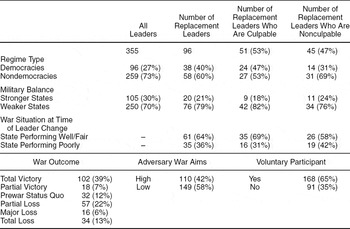
Of the 355 leaders in the data set, 96 (27%) are new leaders who come to power during a war. Of these 96 replacement leaders, 38 (40%) are from democracies, whereas 58 (60%) are from nondemocracies; 45 (47%) are nonculpable, whereas 51 (53%) share a political connection with a culpable predecessor. Interestingly, the distribution of culpability among replacement leaders across regimes is not as lopsided as one might anticipate. Given the relative ease with which democratic domestic audiences can replace leaders with whom they are dissatisfied, we might expect most replacement leaders in democracies to be nonculpable, because most leader changes during unpopular wars would, presumably, involve replacing a culpable leader with a nonculpable one. In actuality, however, a majority of the replacement leaders in democracies are subject to the pressures of culpability (24 of 38, or 63%). In nondemocracies, 47% (or 27 out of 58) of replacement leaders are culpable. Table 1 provides a sense of how the replacement leaders are distributed across several different categories.
Descriptive Statistics

Regime Type. I determined a state's regime type using the Polity IV data set, drawing the information from the last year the leader was in power while the war was in progress (Marshall and Jaggers Reference Marshall and Jaggers2000).Footnote 44 Following standard practice, I subtracted the “democracy” and “autocracy” scores for the state for each observation and created a scale in which -10 represents the most autocratic states and 10 represents the states that are most democratic. I considered states with a score of -10 to 5 as nondemocracies, and states that scored between 6 and 10 as democracies.
Voluntary Participation in the War. To control for the possibility that members of a domestic audience will hold leaders who initiated wars more responsible than leaders who were attacked, and to account for the fact that initiators are more likely to win, I created a variable that takes on a value of 1 if the leader either initiated or voluntarily joined the war (65% of the states) and 0 if the state was attacked (35%). I coded this variable using secondary sources that describe the initial military clashes that mark the beginning of the war.
Battlefield Situation. Because many leaders leave office midwar, a measure of how the state was faring at the end of the leader's tenure during the war is needed to determine if battlefield developments played a role in the leader's departure from office. To this end, I constructed a variable that captures how the state was progressing during the war. This variable took a value of -1 if the state had suffered a major setback (failure to repel a major offensive, loss of ground, etc.) during (roughly) the year preceding the leader change (36% of the observations); 0 if the state had made no progress without a setback (i.e., a stalemate) (44%); and 1 if the state had made progress (20%).Footnote 45 Importantly, I use only major events because domestic audiences are more likely to notice these given their lack of access to high-quality, fine-grained information about war developments (Berinsky Reference Berinsky2009). I use this variable for observations in which the leader leaves before the war ends, and the value of the war outcome variable for all cases in which the leader is in charge when the war ends.
The British experience in the Crimean War provides a nice example. For the first leader, Aberdeen, I used the battlefield situation variable covering the time between the United Kingdom's declaration of war in March of 1854 and early January of 1855, when Aberdeen leaves office on January 31. For the second leader of the war, Palmerston, who presides over the end of the war in 1856, but does not leave office until 1858, I used the war outcome variable. Although this may strike some as an “apples and oranges” comparison, because a final outcome is both qualitatively different and more important in the long term than a snapshot of the state's progress at a particular point in the war, this method provides the closest representation of the information citizens would have had at the time of the leader change. During Aberdeen's wartime tenure, for instance, the United Kingdom had met with limited success and had suffered a major setback with the now infamous “Charge of the Light Brigade” at the Battle of Balaklava in October 1854, in which the British lost 40% of their forces on the scene. The United Kingdom was dealt another blow soon after on Mount Inkerman, a battle that would claim the lives of 23% of all their forces dedicated to the war (Clodfelter Reference Clodfelter1992, 297). The United Kingdom and its allies, however, ended up winning the war in 1856, when the Russians dropped their territorial ambitions. This reversal of fortunes illustrates why two observations based on different sets of information are necessary. The British public in early 1855 would have been evaluating Aberdeen based on what they knew at the time (i.e., the recent failures and lack of progress), and not on knowledge of the United Kingdom's eventual win. Given this, I code Aberdeen's “outcome” as a loss and Palmerston's (which was also the war's final outcome) as a total victory.
Control Variables
Adversary's War Aims. I include the adversary's war aims as a control for three reasons. First, as I noted earlier, any leader should have incentives to prevent an adversary with extremely aggressive war aims from winning, because a loss in this case could have serious consequences for any leader, regardless of culpability. Second, because leaders set their states’ war aims strategically, they are only likely to select high war aims if they feel they are likely to achieve them. Leaders facing adversaries with high war aims, therefore, are more likely to lose. Third, the adversary's war aims proxy for how much the targeted country's citizens are likely to suffer if their state loses the war. Citizens of the targeted state, therefore, will be more upset with a leader who is unable to prevent an aggressive adversary's victory than they would be with a loss to a less aggressive opponent. I based the variable on the following broad classification of possible war aims: 1: achieving the prewar status quo; 2: extracting a policy change from the targeted state; 3: taking a portion of an ally's homeland territory; 4. taking a portion of the targeted state's homeland territory; 5: regime change in the targeted state; 6: total conquest of the targeted state. I coded adversaries as having “high” war aims if they received a coding of 4 or higher on this scale. Roughly 42% of states (110) have high war aims.
Casualties. As with the adversary's war aims variable, I control for the number of military fatalities suffered by the state, because of the strong effect scholars assume they have on the probability of leader punishment (Gartner and Segura Reference Gartner and Segura1998; Goemans Reference Goemans2000; but see Gelpi, Feaver, and Reifler Reference Gelpi, Feaver and Reifler2005/06).Footnote 46 In states with at least one wartime leadership transition, each leader's share of the casualties was weighted to reflect his or her personal share of the war (e.g., if a leader was in power for 15% of the war's duration, I allotted him or her 15% of the war's total casualties).Footnote 47 I log the final, weighted variable to account for a skewed distribution.
Prewar Tenure. This variable counts the number of days from the day the leader took office to the day the war began.Footnote 48 I include this variable because some have posited that leaders with longer prewar tenures will have a stronger hold on power and, consequently, should be more likely to retain office in the event of a loss, especially in nondemocratic polities (Bueno de Mesquita and Siverson Reference Bueno de Mesquita and Siverson1995). I logged the variable to account for a skewed distribution.
Relative Capabilities. This variable captures how strong an individual state is relative to its opponent(s), and is a necessary control for models predicting war outcome. I calculated this variable as the ratio of the state's capabilities over the sum of capabilities on the battlefield. I drew data on national capabilities from EUGene; I utilized the composite capability score in the final calculations (Bennett and Stam Reference Bennett and Stam2000).
RESULTS AND DISCUSSION
Having discussed the rationales behind the hypotheses and the construction of key variables, I now turn to my findings regarding the effect of culpability on war outcomes. In doing so, I also address the possibility that the relationship between war outcomes and leader culpability is epiphenomenal, and present additional evidence that culpable leaders are willing to expend more effort than nonculpable leaders. Following this, I turn to the leader punishment results, where I first present a brief illustration of why a research design that includes all leaders is necessary. I then discuss the effect of a leader's culpability on the likelihood that he or she will be punished by the domestic audience, and how this likelihood might vary across regimes.
Culpability and War Outcomes
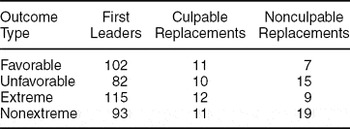
Earlier I hypothesized that culpable leaders would be likely to preside over both more favorable (Hypothesis 1) and more extreme outcomes (Hypothesis 2). Although an examination of the raw data lends support to these claims (see Table 2), to test the hypotheses more precisely I use two multivariate models with a leader's culpability as the key independent variable.Footnote 49
Leader Culpability and War Outcomes

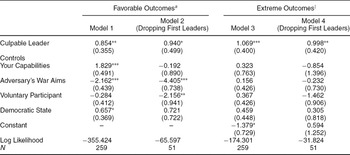
To test Hypothesis 1, I used an ordered logistic regression, where higher values of the dependent variable represent more favorable outcomes (recall the six-point coding scheme described earlier). For Hypothesis 2, I constructed a variable that takes on a value of 1 if the leader presided over a major victory or a catastrophic loss, and estimated a logistic regression model. Because, for the purposes of these models, I am only interested in the war's ultimate outcome, my unit of analysis is the leader who presided over the war's final outcome.Footnote 50 This gives me a total of 259 observations.Footnote 51 The results of the test for Hypothesis 1 are presented in Table 3, Model 1.
The Effect of Leader Culpability on War Outcomes

Note: Baseline: nonculpable leaders.
a Ordered logistic regression models.
b Logistic regression models.
* ≤ .10. ** ≤ .05. *** ≤ .01.
The positive and significant coefficient for the culpability variable in Model 1 provides strong support for Hypothesis 1; culpable leaders are more likely to achieve favorable outcomes than their nonculpable counterparts (the model's baseline). The strength of the culpability finding, even in the presence of many of the literature's standard predictors of war outcomes, lends credence to the idea that culpable leaders do not achieve their victories solely by selecting their wars strategically or by targeting weak opponents.Footnote 52 To demonstrate that this effect is not solely the product of first leaders who chose their wars wisely, and that the pressures of culpability do indeed carry forward to subsequent leaders, I re-estimated Model 1 on the subset of leaders who came to power during wars.Footnote 53 As Model 2 shows, culpable replacement leaders behave very similarly to their predecessors. Even when a sample is used that is less than 20% of the size of the first, culpable replacement leaders are still significantly more likely than nonculpable replacement leaders to achieve favorable outcomes.Footnote 54
Hypothesis 2 also receives strong support, suggesting that, for at least some culpable leaders, the desire to win traps them in wars they might have been better off losing earlier. Culpable leaders are more likely to preside over extreme outcomes than their nonculpable counterparts (Model 3), even when the sample is limited to replacement leaders (Model 4). The strength of the relationship between culpability and outcomes is even more apparent when we consider the raw data: Culpable leaders preside over an astonishing 95% (97/102) of the total victories and 88% (30/34) of the catastrophic losses.
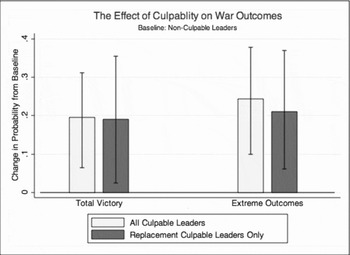
Figure 1 presents the first differences in the predicted probabilities for each model in Table 3. The leftmost pair of bars depicts the change in the probability of securing a total victory, moving from a nonculpable leader (the baseline) to a culpable leader for the entire sample of leaders who end wars (white bar) and the same change among just replacement leaders (gray bar). All other variables are held at their means or, in the case of dichotomous variables, modes. The rightmost bars represent the effect of culpability on the likelihood of presiding over an extreme outcome. As Figure 1 illustrates, and the 90% confidence intervals surrounding the effects confirm, culpable leaders preside over qualitatively different outcomes than nonculpable leaders, regardless of when they come to power, and these differences are both substantial and statistically significant.
The Effect of Culpability on War Outcomes

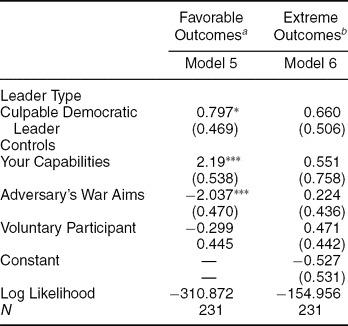
Hypothesis 3 posited that the pressures associated with culpability should be stronger among democratic leaders than among nondemocratic ones. To test this, I estimated the same model as before (without the democracy variable) on a sample of only culpable leaders and included a variable highlighting culpable, democratic leaders (see Table 4, Model 5). As before, because I am only interested in the war's final outcome, I use only the final observation for each war.Footnote 55 As the significant coefficient suggests, democratic leaders who played a role in bringing their state to war are more likely than culpable nondemocratic leaders (the model's baseline) to secure favorable outcomes.Footnote 56 Hypothesis 4, which posited that culpable democratic leaders should be more likely to preside over extreme outcomes, received less support. Although the coefficient is positive, it fails to achieve the conventional level of significance, suggesting that no differences exist between culpable leaders of different regimes in this regard.
The Effect of Leader Culpability on War Outcomes by Regime Type

Note: Baseline: culpable nondemocratic leaders.
a Ordered logistic regression models.
b Logistic regression models.
* ≤ .10. ** ≤ .05. *** ≤ .01.
Before proceeding to the leader punishment results, we must address two potential shortcomings of these analyses. First, the relationship I find between culpable leaders and war outcomes could be epiphenomenal. That is, nonculpable leaders might only come to power when the war is going poorly, and they thus have the unfortunate outcomes forced upon them instead of actively choosing to settle for worse terms. To address this possibility, I estimate a logistic regression model on the subset of leaders who come to power during wars. The dependent variable was whether the replacement leader was culpable; the independent variables were how the state was faring in the war before the new leader came to power (i.e., the battlefield situation variable) and whether his or her immediate predecessor left because of the war (i.e., the dependent variable for the punishment models). If the relationship between culpability and outcomes were epiphenomenal, both of these variables should predict the new leader's culpability. That is, nonculpable leaders should come to power when the state is faring poorly and/or follow leaders who were removed because of the war.
Interestingly, neither variable is a significant predictor of the new leader's culpability (see Table 2, supplementary online Appendix). A review of the raw data demonstrates why this null result exists. As I noted, 61 of the 355 leaders are removed because of the war. Of these 61, 42 (68%) have replacement leaders who follow them.Footnote 57 Of these 42 replacement leaders, more than half (22) are culpable. Although intuition might suggest that a nonculpable leader should follow a leader who was punished because of the war, this is not the case. A similar result obtains when we consider the possibility that nonculpable leaders should be more likely to come to power when the war is going badly for the state. Of the 96 replacement leaders in the data set, only 35 come to power when the state has suffered a series of recent failures (see Table 1). Of these 35, a slight majority (19 leaders, or 54%) are nonculpable, but a full 46% (16 leaders) are from the previous leader's faction. Once again, if conventional intuition were correct, we would expect a much more lopsided distribution in favor of nonculpable leaders under these circumstances. Instead, as with cases in which the predecessor is removed because of the war, nonculpable and culpable leaders have roughly equal chances of coming to power.
At first blush, these findings may seem counterintuitive, because we would expect wartime leadership changes to be related to the war, especially in democratic states. Things become clearer, however, once we consider certain aspects of the domestic political front. First, because democratic leaders rarely go to war without broad legislative support, many political elites will be reluctant to challenge the leader (at least initially), because the public will associate them with the war as well. Thus, we should not be surprised to see some democratic leaders (even those without fixed terms) retain power, even if public disapproval is high. Second, leadership changes in democracies are possible outside of elections, thereby denying the public an opportunity to choose the new leader.Footnote 58 Finally, many of the democratic leaders who were punished because of the war are removed shortly after the war is over. Because those leaders remain in power for the entire war, they do not enter the analysis presented in Table 2 of the supplementary online Appendix.
The second potential shortcoming of these analyses is the lack of direct evidence of culpable leaders expending more effort or otherwise “trying harder” than nonculpable leaders. Recall that in the Theory section, I argued that culpable leaders should be willing to stay in wars and continue fighting if they have not yet achieved a victory. Nonculpable leaders, by contrast, have incentives to avoid continuing to fight. Because these models only use one observation per war, and then only consider the final outcome, we cannot get an accurate sense of the decisions leaders make while the war is still in progress.
To remedy this, I created a new data set that consists of one observation per leader, per war month, for a total of 4,856 observations. For example, the United States's participation in the Korean War consists of 32 observations for Truman (June 1950 to January 1953) and 7 for Eisenhower (January through July 1953). I next coded a trichotomous dependent variable for each observation that took on a value of 0 if the leader settled for a loss or draw in that month, 1 if he or she continued fighting, and 2 if he or she won.Footnote 59 This data set allowed me to test the hypotheses that culpable leaders should be both more likely to continue fighting and less likely to lose in a given month than nonculpable leaders. To this end, I estimated a series of multinomial logit models with a leader's culpability as the independent variable, along with controls for duration and other factors that would affect either a leader's willingness to stay in a war (e.g., the adversary's war aims) or the war's outcome (e.g., the balance of capabilities). As expected (see Table 3, Model 1, of the supplementary online Appendix), culpable leaders are significantly more likely than nonculpable leaders to continue fighting rather than to lose in a given month. Importantly, as before, these relationships hold when I include a battery of controls (Model 2) or limit the sample to replacement leaders (Model 3). Taken together with the war outcome results, this first set of findings suggests that culpability plays a powerful role in shaping both the decisions leaders make during wars and the types of outcomes they are likely to oversee, regardless of whether they are in power at the start of war or assume power during the war.
Culpability and Punishment
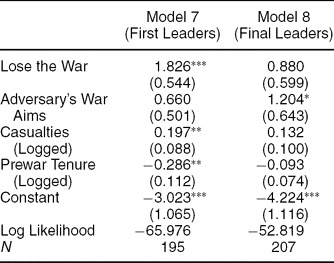
Before proceeding to Hypotheses 5 and 6, I first illustrate the point I raised previously regarding the need to incorporate all leaders who participate in wars when testing hypotheses about the relationship between a war's outcome and the likelihood of leader punishment. To do so, I present a simple logistic regression model of leader punishment estimated on two subsamples of the data: leaders who were in charge when the war began and leaders who presided over the war's conclusion (see Table 5). To simplify the presentation, I collapse the six-point outcome scale into three categories: win, draw, and lose.Footnote 60 For all models of punishment, leaders are the unit of analysis.
Logistic Regression Analysis Illustrating the Bias in One-leader Designs: The Effect of War Outcome on Leader Punishment

Note: Baseline: winning leaders.
* ≤ .10. ** ≤ .05. *** ≤ .01.
The difference in the estimates for the effect of a “losing leader” across the two models is striking. In Model 7, which only includes first leaders, losing leaders are significantly more likely to be punished than winning leaders. In Model 8, however, which only includes final leaders, the likelihood of punishment for losing leaders is no different, in a statistical sense, from that for winning leaders.Footnote 61 Moreover, the coefficient is considerably smaller than its counterpart in Model 7. Not only do these findings clash with one another, but also the second directly counters scholarly expectations of how citizens will treat a leader who presides over a foreign policy blunder, especially in democracies. These seemingly discordant findings only make sense when we consider how culpability is distributed across the two samples; the first has no nonculpable leaders, whereas the second has a majority of them. Put differently, Model 7 is highlighting the tendency for audiences to remove culpable leaders who fail, whereas Model 8 is picking up the tendency for audiences to forgive nonculpable leaders who inherit debacles from their predecessors. These findings not only demonstrate why we need to include all leaders simultaneously, but also underscore the need for scholars to appreciate a leader's culpability.
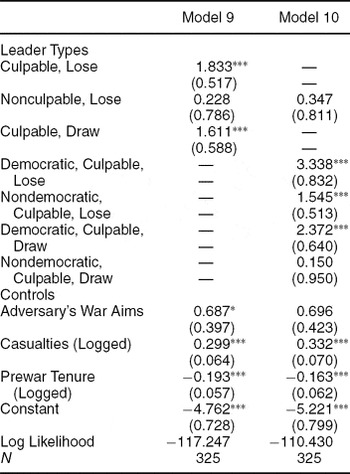
To test Hypotheses 5 and 6, I use a logistic regression model to estimate the effect of the independent variables on the probability of leader punishment. I use four indicator variables for this initial test to highlight the effect of the difference between culpable and nonculpable leaders who preside over poor outcomes: losses and draws.Footnote 62 I differentiate losses from draws because we might expect democratic and nondemocratic domestic audiences to react differently to these qualitatively distinct outcomes. Democratic audiences, for instance, may be more willing to punish culpable leaders who force their states to endure costly stalemates. Nondemocratic domestic audience members, by contrast, who are more insulated from the direct costs of war, may be more willing to tolerate a draw. Table 6 presents the results of the test of Hypothesis 5 (Model 9).
Logistic Regression Analysis of the Effect of Leader Culpability on the Likelihood of Being Removed Because of a War

Note: Baseline: winning leaders.
* ≤ .10. ** ≤ .05. *** ≤ .01.
This model specification dictates that we interpret the coefficients on these variables with respect to the excluded (or baseline) category, which comprises the winning leaders in the data set. These results align with the predictions of Hypothesis 5 precisely: Culpability has a strong, positive effect on whether a leader will be removed because of poor performance in a war. Culpable leaders who lose or draw are more likely to be removed than winners, whereas nonculpable, losing leaders are statistically indistinguishable from winners in terms of their likelihood of domestic punishment.Footnote 63 This finding has profound consequences for how we think about the war termination process. If nonculpable leaders who preside over poor outcomes face the same likelihood of domestic punishment as leaders who win, we should expect them to have little fear of accepting poor outcomes and no incentive to continue fighting.
Model 10 explores this relationship further by examining culpable leaders of different regime types separately. Once again, culpability exhibits a strong effect on the likelihood of a leader being punished, regardless of regime type. Culpable leaders who oversee losses are significantly more likely than winners to lose power because of a war, whereas nonculpable leaders who fail to win are no different, statistically speaking, from winners in their likelihood of punishment. The one exception is the culpable leaders of nondemocracies who draw. Although the coefficient is positive, the effect is relatively small and not statistically distinguishable from the model's baseline. This finding is not surprising, given the relative ease with which nondemocratic leaders can weather (relatively) minor policy failures. The fact that this finding only applies to leaders who draw, however, and not to those who lose, implies that these leaders are not completely immune to the pressures of culpability.
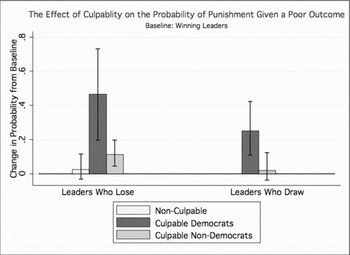
These results also suggest that interesting differences exist between culpable losing leaders of different regime types. Recall Hypothesis 6, which posited that culpable losing leaders from democracies will face a higher probability of removal than their nondemocratic counterparts. Figure 2 presents the relative risk of punishment for different leader types, which confirms the expectations of Hypothesis 6.
The Effect of Culpability on the Probability of Punishment Given a Poor Outcome

The leftmost set of bars represent the change in the probability of being punished as we move from the baseline (winning leaders) to the various types of losing leaders; the rightmost set of bars represent a parallel effect for leaders who draw. Once again, although all culpable leaders who lose are more likely to be punished than winners (i.e., neither 90% confidence interval includes zero), democratic culpable losers are significantly more likely to be punished than nondemocratic leaders who do the same (p-value 0.0138).Footnote 64 Finally, as the findings from Model 10 suggested, culpable, democratic leaders who draw are also more likely to lose power as a result of a war than nondemocratic leaders who draw (p-value 0.0321).
CONCLUSION
March 20, 2008, marked the fifth anniversary of the American invasion of Iraq and the start of a sixth year with more than 125,000 troops deployed in the region. With nearly 4,000 American fatalities and over 66% of the public opposing the war, much of the media coverage in the days leading up to the anniversary centered on the costs of the war (CNN.com 2008).Footnote 65 An opinion piece in The Washington Post by economists Linda Blimes and Joseph Stiglitz (Reference Blimes and Stiglitz2008) threw the financial burden of the war into sharp relief. Claiming that the war “was not only the second longest in American history (after Vietnam) [but] also the second most costly, surpassed only by World War II,” the authors projected the war would eventually cost the American people a staggering three trillion dollars. Amid such criticism, George W. Bush delivered a speech at the Pentagon to defend the war that had dominated his agenda for more than half of his time in office. Although he acknowledged that the price of the war had been heavy in terms of both blood and treasure, he reminded his audience of the need to continue the war to “honor [the fallen] by making sure their sacrifice was not in vain” (CNN.com 2008).
Although the specifics of Bush's speech are not remarkable, the fact that a democratic leader gave such a speech five years into an unpopular, costly war he initiated certainly is. If the existing literature is correct, events such as this should be well “off the equilibrium path” because democratic leaders should either pick wars they will win quickly or, failing that, remove their states from wars if costs become too high for the public to tolerate (Reiter and Stam Reference Reiter and Stam III2002). Why, then, did Bush and many other democratic leaders throughout history choose to continue fighting wars, despite public dissent?
The argument advanced here offers an answer to this puzzle while offering a comprehensive explanation for variation in leader behavior across regime types. Regardless of regime, culpable leaders are more likely to secure favorable war outcomes, even controlling for other factors, such as initiation and relative strength, that might account for victory. They are also more likely to preside over extreme outcomes (good and bad), the latter of which underscore the dilemma I mentioned in the Introduction. I also found broad support for the argument that culpable leaders are motivated to achieve such outcomes because of a greater likelihood of domestic punishment should they fail to win. Culpable losers are always more likely to be punished than nonculpable losers, and this effect is especially prominent in democratic states. Taken together, these findings strongly suggest that a leader's culpability plays a central role in both war termination and domestic punishment.
The findings here offer several new contributions. The first is the importance of appreciating that the domestic political scene of a warring state is a dynamic environment. The leadership changes that take place during times of war are often consequential to the war termination process and should not be ignored. The second implication speaks to the often-cited “declining advantage of democracy,” which states that democratic leaders will be more willing to end wars as they get longer and more costly for their citizens (Bennett and Stam Reference Bennett and Stam1998). The findings of this study suggest that this causal story has been applied to democratic leaders too broadly. All democratic leaders will be interested in public opinion, but we should expect only nonculpable leaders to respond to it by ending wars. Third, and perhaps most important, the findings suggest that patterns of leader behavior should not necessarily coincide with regime type, but rather with the individual leaders’ culpability.
The findings also suggest new avenues for future research. For instance, what paths to culpability exist other than being a member of the first leader's faction? Two possibilities exist. First, the public might hold a leader who was outside of the faction but an active supporter of the war responsible for this earlier opinion should that leader come to power. Hillary Clinton's apparent inability to put any political distance between herself and her earlier vote to authorize the war in 2003 during the 2008 Democratic primary is potentially a prime example of this notion at work. The same idea might also explain President Barack Obama's decisions both to leave Iraq, a war he publically opposed, and to stay in Afghanistan, a war he has consistently supported despite the political and material costs of doing so.Footnote 66 Second, as I mentioned very briefly in the Theory section, a nonculpable leader may become culpable for a war if he or she does not end it quickly after coming to power. That is, a window of opportunity might exist for the leader to end the war without repercussions, beyond which the war becomes the new leader's own problem instead of the sole responsibility of the predecessor(s). Determining how long that window can remain open and under what circumstances would be a logical next step for future research.
Several aspects of culpability's effects on the politics of the home front are also worth investigating. A leader's role in a conflict, for instance, may affect how he or she frames the war for the domestic audience. The previous discussion suggests that culpable leaders may be more likely to inflate their states’ perceived likelihood of victory (Gelpi, Feaver, and Reifler Reference Gelpi, Feaver and Reifler2005/06) in an effort to increase the public's tolerance for mounting costs and buy themselves more time to gamble. Nonculpable leaders, on the other hand, should be less likely to subscribe to the “success matters” thesis, because winning the war is less crucial for their continued tenure. Similar differences might also exist in terms of how leaders discuss the losses themselves. Culpable leaders may be more likely to publically frame casualties as a motivation for continued fighting, so that the fallen “will not have died in vain.” Nonculpable leaders, in contrast, should be more likely to recognize (and acknowledge publicly) that casualties are sunk costs that cannot be recouped, and cast the deaths as noble yet devastating losses. Less than five sentences into his announcement of the armistice with the Communists ending the Korean War, for instance, a nonculpable President Eisenhower noted that, “for this nation, the cost of repelling aggression has been high. In thousands of homes it has been incalculable. It has been paid in terms of tragedy” (Woolley and Peters Reference Woolley and Gerhard Peters2010). Such a blatant and stark portrayal of a war's toll would, arguably, be harder for a leader who was responsible for the war to make.
Finally, the effect of a leader's culpability on an adversary's behavior also merits consideration. Although earlier sections discussed the importance of the adversary's war aims, a leader's reaction to leadership changes in the opposing state is an intriguing question for future research.Footnote 67 Such changes would presumably be of great interest to leaders of other combatants, especially if they bring a nonculpable leader to power who may be more willing to settle. Indeed, given the opportunities the installation of a nonculpable leader presents, leadership turnovers have considerable potential to affect the wartime bargaining process. Do leaders in other states, for instance, view such transitions as occasions to offer an olive branch or as opportunities to press for additional spoils? Investigating whether the identity of the adversary mitigates the effects of culpability would also be worth pursing. Although nonculpable leaders may feel safe backing down in some wars, they may be reluctant to do so in wars against enduring rivals, because the odds of interacting with those states again in the future are relatively high. Developing a reputation for settling with a frequent adversary may not only invite future challenges but also leave the leader open to domestic opposition, because the adversary is likely a salient issue for the domestic audience.




Comments
No Comments have been published for this article.