Children of depressed parents are at an increased risk for a range of problem behaviors, including externalizing and internalizing symptoms and disorders (Beardslee, Bemporad, Keller, & Klerman, Reference Beardslee, Bemporad, Keller and Klerman1983; Bierderman et al., Reference Bierderman, Faraone, Hirshfeld-Becker, Friedman, Robin and Rosenbaum2001; Cummings & Davies, Reference Cummings and Davies1994; Goodman & Gotlib, Reference Goodman and Gotlib1999; Orvaschel, Walsh-Allis, & Ye, Reference Orvaschel, Walsh-Allis and Ye1988; Radke-Yarrow, Reference Radke-Yarrow1998; Weissman et al., Reference Weissman, Gammon, John, Merikangas, Warner and Prusoff1987). The intergenerational transmission of risk from parental depression to child problem behavior could occur through multiple pathways. Risk could be conferred through an interplay of genes, parenting, and environmental context that shifts and changes across development. It unlikely that shared genes or environment either fully account for the transmission of risk, which is more likely because of a cascade of multiple effects that influence one another over time (Masten et al., Reference Masten, Roisman, Long, Burt, Obradovic and Riley2005). This paper explores the unfolding of risk over time from parental depressive symptoms to child problem behaviors. We explore the cascade of risk from when children are 9 to 27 months of age, exploring how the timing and source of influence contributes to child problem behaviors at a time during which there is rapid individual change and development (see Brownell & Kopp, Reference Brownell and Kopp2007).
Specific differences in parenting behaviors have been found between depressed and nondepressed parents; depressed parents tend to be less engaged, less responsive, and less communicative with children than parents with fewer symptoms (e.g., Bettes, Reference Bettes1988; Feng, Shaw, Skuban, & Lane, Reference Feng, Shaw, Skuban and Lane2007; Rowe, Pan, & Ayoub, Reference Rowe, Pan and Ayoub2005; Shaw et al., Reference Shaw, Schonberg, Sherrill, Huffman, Lukon and Obrosky2006). It is challenging, however, to infer that the impact of these parenting differences on child outcomes is because of primarily environmental processes in studies of only biologically related families because children share both genes and environments with their biological parents. In studies of biological families, mental health problems in children of depressed parents could be due to shared genes or child-driven differences in parenting, not necessarily to parenting differences related to the parents' depression. Moreover, parenting changes across development; parenting behaviors needed for a 9-month-old infant differ from those most appropriate for a 27-month-old toddler because children of different ages have different needs. For instance, as children develop from 9 to 27 months they become more autonomous and acquire language (Gleason, Reference Gleason2005), as well as begin to regulate emotions in accordance with parental expectations (Kopp, Reference Kopp1989). However, these are also ages marked by changes and peaks in high emotional negativity (Bridges, Reference Bridges1932; Campbell, Spieker, Burchinal, Poe, & the NICHD Early Child Care Research Network, Reference Campbell, Spieker, Burchinal and Poe2006; Tremblay & Nagin, Reference Tremblay, Nagin, Tremblay, Hartup and Archer2005). As children develop, so too must parenting behaviors, which could be differently influenced by elevated depressive symptoms. In addition, the developing child may be influenced by parents' depressive symptoms at some stages in development more than others, and some children may be more sensitive than others. The developing neurological and attentional systems of children may also differ in their sensitivity to the continuum of parental depressive symptoms. For example, a recent set of papers advances a theory of differential susceptibility such that some children may be differentially susceptible to both positive and negative environmental influences (Belsky & Pluess, Reference Belsky and Pluess2009). Some children may be more malleable to environmental influences than other children, and thus having a parent with a low or high number of depressive symptoms may influence some children more than others. Using an adoption design, this study is a first step toward identifying genetic and environmental effects of parental depressive symptoms and how their timing influences child functioning in early childhood.
Depression is a common, debilitating, and recurring disorder (Üstün, Ayuso-Mateos, Chatterji, Mathers, & Murray, Reference Üstün, Ayuso-Mateos, Chatterji, Mathers and Murray2004; Weissman et al., Reference Weissman, Wolk, Wickramaratne, Goldstein, Adams and Greenwald1999). Throughout this paper, the term parental depression will be used to describe those who have met clinical criteria for unipolar depression and those who obtain elevated scores on depressive symptoms inventories. Associations between parental functioning and child outcomes have been documented in both cases (e.g., Anderson & Hammen, Reference Anderson and Hammen1993; Cummings, Keller, & Davies, Reference Cummings, Keller and Davies2005). Depression could arguably be especially debilitating in parents of young children, given that caregivers of toddlers are likely to face challenges each day that require interest and energy, and because the parenting of toddlers can benefit from positive emotions and feelings of efficacy (e.g., Dix, Reference Dix1991; Teti & Gelfand, Reference Teti and Gelfand1991). Moreover, depression is heritable (Lesch, Reference Lesch2004), with heritability estimated to account for 36% of the variance (Sullivan, Neale, & Kendler, Reference Sullivan, Neale and Kendler2000), suggesting that some child behavior and emotional problems related to parental depression may be due to shared genes. Genetically informed designs can take genetic contributions into account, thus providing an estimate of environmental influences independent of genetic influences. This study aims to advance our knowledge of both the genetic and environmental contributions by examining the timing of adoptive parental depressive symptoms and whether there is a direct genetic influence of parental depressive symptoms on toddler externalizing symptoms. Finding a direct genetic influence would have implications for future research and the ways in which children shape their own environments and outcomes over time, even at such a young age. Understanding the timing of environmental effects of parental depressive symptoms in this context, while also accounting for the chronicity and stability of symptoms over time, is a crucial area of study because this knowledge can inform and improve prevention and intervention efforts. It is possible that the impact of parental depression on child functioning differs depending on the age of the child and/or the developmental stage, and that these times of differential influence could represent sensitive periods of parental influence. However, we do not yet know when parental depressive symptoms are most crucial to child development.
Timing of Depressive Symptoms
Goodman and Gotlib (Reference Goodman and Gotlib1999) assert that the earlier a child is exposed to parental depression, the more likely that depression will have an impact on the child. They support this hypothesis with evidence detailing the crucial development of inhibitory systems and the hypothalamic–pituitary–adrenal system during infancy (Dawson, Reference Dawson, Dawson and Fischer1994; Stansbury & Gunnar, Reference Stansbury and Gunnar1994; Porges, Doussard-Roosevelt, Portales, & Suess, Reference Porges, Doussard-Roosevelt, Portales and Suess1994) and with the logic that earlier detriments will have a greater effect on a child's developmental trajectory than later detriments (Hay, Reference Hay, Murray and Cooper1997). Empirical research is mixed as to whether concurrent or earlier depression influences children the most. For example, previous work has found differential effects of early (infancy) and remitting parental depression versus current-only (preschool) depression (Alpern & Lyons-Ruth, Reference Alpern and Lyons-Ruth2003), whereas one meta-analysis of parental depression across childhood found that concurrent depression (as opposed to depression measured at earlier ages) is associated with the most negative child outcomes (Lovejoy, Graczyk, O'Hare, & Neuman, Reference Lovejoy, Graczyk, O'Hare and Neuman2000). Given that depression is often chronic (Weissman et al., Reference Weissman, Wolk, Wickramaratne, Goldstein, Adams and Greenwald1999), longitudinal studies that account for both prior and current depressive symptoms are necessary for examining the timing of depression. One method of accounting for the chronicity of depression uses latent growth curve modeling to demonstrate that that chronic parental depressive symptoms are more problematic than decreasing or mild depression (Ashman, Dawson, & Panagiotides, Reference Ashman, Dawson and Panagiotides2008; Gross, Shaw, Burwell, & Nagin, Reference Gross, Shaw, Burwell and Nagin2009); however, this method does not measure the relative importance of depressive symptoms on child behaviors at each observation. This study will focus on children from infancy to early toddlerhood, a period of rapid change (see Brownell & Kopp, Reference Brownell and Kopp2007) and high dependence on parental responsivity. Identifying ages of particular vulnerability to parental depressive symptoms could help in creating targeted groups for prevention and early intervention.
Exploring the timing of influence on child behaviors will help to identify the potential cascading effects of parental depressive symptoms over time. Previous research has demonstrated how child problems and competence modeled over time, accounting for across-time continuity, can elucidate the trajectories of behaviors across domains and potential causal factors (Masten et al., Reference Masten, Roisman, Long, Burt, Obradovic and Riley2005). Moreover, the exploration of how multiple domains influence other domains over time has provided a complex theory of the development of substance-use onset (Dodge et al., Reference Dodge, Malone, Lansford, Miller, Pettit and Bates2009). These studies provide evidence for the benefit of longitudinal research across multiple domains. In this study, we look at risks from one domain, genetic risk from elevated depressive symptoms in the nonrearing birth parent (BP), while also examining the unfolding effects over time of another domain, the timing of rearing parents' depressive symptoms on child externalizing problems. We explore the emerging cascade of risk across domains and over time.
Mothers and Fathers
Based on the higher prevalence rates of depression in women than men, it is understandable that the majority of studies conducted with parents with depressive symptoms have examined depression in mothers only. Most studies examining maternal depression find that depressed mothers parent more negatively (Lovejoy et al., Reference Lovejoy, Graczyk, O'Hare and Neuman2000), and that child outcomes are worse when mothers are depressed (e.g., Cummings & Davies, Reference Cummings and Davies1994). Many studies including paternal depression are correlational in nature, although a meta-analysis of these studies suggests significant associations between paternal depression and many types of childhood problem behavior (Kane & Garber, Reference Kane and Garber2004). Multiple studies have shown that children with two depressed parents have an increased risk of behavior problems when compared to children with only one depressed parent (e.g., Brennan, Hammen, Katz, & Le Brocque, Reference Brennan, Hammen, Katz and Le Brocque2002; Goodman, Brogan, Lynch, & Fielding, Reference Goodman, Brogan, Lynch and Fielding1993; Lieb, Isensee, Höfler, Pfister, & Wittchen, Reference Lieb, Isensee, Höfler, Pfister and Wittchen2002; Weissman et al., Reference Weissman, Gammon, John, Merikangas, Warner and Prusoff1987). Although recent research highlights importance of paternal depressive symptoms for both mother and child mental health and the importance of including fathers in research (e.g., Gross, Shaw, Moilanen, Dishion, & Wilson, Reference Gross, Shaw, Moilanen, Dishion and Wilson2008), little is known about the reasons for increased risk. One reason may be that a child who has two parents with depression may be at a greater risk, for genetic reasons, to become depressed themselves (Goodman & Gotlib, Reference Goodman and Gotlib1999). In addition, a depressed father could alter the childhood environment directly through his parenting or through an exacerbation of the mother's depression. In support of this idea, one study found that high paternal depressive symptoms exacerbated maternal depressive symptoms in infancy, but only in the presence of high child involvement (Mezulis, Hyde, & Clark, Reference Mezulis, Hyde and Clark2004). One marital partner may also buffer the effects of the other partner's depression. For example, in an adolescent sample, a positive father–child relationship counteracted the effects of maternal depressive mood on adolescent poor functioning (Tannenbaum & Forehand, Reference Tannenbaum and Forehand1994). These findings highlight the need to study both mothers and fathers using methodologies that allow genetic and environmental effects to be disentangled.
Using a cascades model, we examine how the environmental effects of having a parent with elevated depressive symptoms influences children while considering genetic contribution. Moreover, we begin to unpack different aspects of the environment, such as considering the influences of mothers and fathers separately and considering them together. Although the current study does not explore the mediating factors involved in how mothers and fathers may separately and together influence children over time, it is a first step looking at their influences in early childhood in a genetically informed way.
Genetically Informed Designs
Based on the sizable literature underscoring the heritability of depression (e.g., Sullivan et al., Reference Sullivan, Neale and Kendler2000) and a similarly large literature on the importance of rearing environment on children's emotional development (e.g., Davis & Windle, Reference Davis and Windle1997; Eisenberg, Cumberland, & Spinrad, Reference Eisenberg, Cumberland and Spinrad1998; Rutter, Reference Rutter, Shonkoff and Meisels2000), characterizing different patterns of risk of both maternal and paternal depressive symptoms is essential for advancing our understanding of how risk is conferred. The current study uses an adoption design, which allows us to parse genetic from environmental influences. Children placed for adoption at birth or soon after share only genes (and prenatal environment for birth mothers [BMs]) with their BPs. Thus, associations between an adopted child and their BPs' characteristics can be used to estimate genetic contributions to the child's characteristics. Adoptive parents (APs) are genetically unrelated to the adopted child, and thus associations between AP and their child cannot be the result of shared genetic influences between parent and child. Associations could be the result of evocative genotype–environment correlation, when children evoke a response from their environment. For example, an infant who is genetically predisposed to be fussy may evoke a type of parenting that is different from an infant who is genetically predisposed to less fussy (Natsuaki, Ge, Neiderhiser, & Reiss, in press). Associations could also be a direct result of the environment, for example, when a parent's overrreactive parenting style leads the child to become fussy over time.
Several studies using genetically informed designs have demonstrated both genetic and environmental influences of parental depression on child functioning. For example, in a twin sample, family conflict and genetic factors were found to be associated with depression in youth ages 8 to 17 (Rice, Harold, & Thaper, Reference Rice, Harold and Thaper2002). Few adoption studies have examined the genetic and environmental influence of parental depression on child outcomes. One exception is a study of adoptees that used retrospective reports and records of a history of treatment for depression and/or mania (Cadoret, O'Gorman, Heywood, & Troughton, Reference Cadoret, O'Gorman, Heywood and Troughton1985). The authors found a positive trend of BP depression on young adult depression, but as one meta-analysis pointed out (Sullivan et al., Reference Sullivan, Neale and Kendler2000), this study was underpowered and split the results by gender of the adoptee. When Sullivan and colleagues combined the adoptees into one sample, they found a significant genetic effect between biological parent risk and youth depression. In another study, adoptive mother (AM), but not adoptive father (AF), lifetime depression elevated adolescent risk of psychopathology (Tully, Iacono, & McGue, Reference Tully, Iacono and McGue2008). The effects of BP depression and the timing of the depressive symptoms were not tested in this study.
Genetically informed designs can also examine how parental depression moderates genetic risk. Using the current study's adoptive sample, one study found that children of BMs with major depressive disorder are fussier at 18 months when AMs were less responsive at 9 months of age (Natsuaki et al., in press). Children of APs with higher levels of responsiveness did show elevated fussiness at 18 months when BMs had major depressive disorder. This study demonstrated how children with a genetic risk from major depression may be more vulnerable to certain types of parenting in infancy. This study also found that children whose AP had more depressive symptoms were fussy, demonstrating an environmental effect. Another study with the current sample found that structured parenting was beneficial to toddlers at genetic risk for psychopathology, but was associated with behavior problems in toddlers at low genetic risk (Leve et al., Reference Leve, Kerr, Shaw, Ge, Neiderhiser and Scaramella2010). Children's reaction to the same type of parenting was dependent on the child's genetic risk. These studies highlight the importance of examining the genetic contributions to child outcomes because they aid in better understanding the effects of parenting behaviors and the environment.
Current Study
Participants are from a longitudinal, prospective adoption study, the Early Growth and Development Study (EGDS; Leve et al., Reference Leve, Neiderhiser, Ge, Scaramella, Conger and Reid2007; Leve, Neiderhiser, Scaramella, & Reiss, Reference Leve, Neiderhiser, Scaramella and Reiss2008). This study adds to previous findings from the EGDS by examining adoptive parental depressive symptoms across time, when the child is 9, 18, and 27 months of age. We also include multiple assessments of biological parent depression. We focus on predicting toddler externalizing problems at 27 months because parents are more accurate reporters of young child externalizing problems than internalizing (e.g., Edelbrock, Costello, Dulcan, Conover, & Kala, Reference Edelbrock, Costello, Dulcan, Conover and Kala1986; Loeber, Green, Lahey, & Strouthamer-Loweber, Reference Loeber, Green, Lahey and Strouthamer-Loeber1989; Welner, Reich, Herjanic, Jung, & Amado, Reference Welner, Reich, Herjanic, Jung and Amado1987), and because continuity with later problem behavior has been found to be stronger for externalizing than internalizing problem behavior from the toddler to school-age periods (Feng, Shaw, & Silk, Reference Feng, Shaw and Silk2008; Shaw, Gilliom, Ingoldsby, & Nagin, Reference Shaw, Gilliom, Ingoldsby and Nagin2003). The current study tests the intergenerational transmission of risk, in essence the cascading of risk, through the longitudinal assessment of AM, AF, and biological parent depressive symptoms, controlling for across-time continuity, from both genetic and environmental sources. Our focus is on identifying emerging evidence of a “cascade” of effects (Masten et al., Reference Masten, Roisman, Long, Burt, Obradovic and Riley2005), which is a dynamic and transactional developmental process of how genetic and environmental risk factors influence behavior problem development. Evidence of both genetic and environmental influences across time would suggest a need to incorporate these multiple sources of influence and change in future models seeking to understand causes of change and targets for prevention and intervention.
We expected that (a) higher levels of biological parent depressive symptoms would be associated with higher levels of toddler externalizing problems and (b) earlier and concurrent AM and AF depressive symptoms would be associated with toddler externalizing problems. Given the relative lack of research on father depressive symptoms, we did not make any a priori predictions about differences between mothers and fathers but did expect adoptive paternal depressive symptoms to account for independent variance in relation to child externalizing problems.
Method
Study overview and participants
Participants are from the EGDS, which is a longitudinal, multisite study. The sample consisted of 361 linked sets of adopted children, AMs, AFs, BMs, and birth fathers (BFs). The analytical sample consisted of 351 linked sets after removing outliers. In addition, 18 of the 351 families were same-sex couples. We systematically tested differences in depressive symptoms, child externalizing problems, and the relations between depressive symptoms and toddler problems between same-sex and opposite-sex couples, and found no significant differences. Therefore, same-sex families were included in the analyses. Only a subsample of the BFs was recruited (N = 95), and thus BF data were not included in the primary analyses and were tested separately.
Recruitment took place between 2003 and 2006, starting with the recruitment of adoption agencies (33 agencies in 10 states located in the Northwest, Mid-Atlantic, and Southwest regions of the United States). Agencies were selected to reflect the full range of adoption agencies in the United States: public, private, religious, secular, those favoring closed adoptions, and those favoring open adoptions. An agency-appointed liaison assisted with recruitment and identified participants who completed an adoption plan through their agency and met the following eligibility criteria: (a) the adoption placement was domestic, (b) the baby was placed within 3 months postpartum, (c) the baby was placed with a nonrelative adoptive family, (d) the baby had no known major medical conditions such as extreme prematurity or extensive surgeries, and (e) the BP and AP were able to read or understand English at the eighth-grade level. The liaison used the contact information provided by the agency to invite the BM and APs to participate. The liaison then recruited the BF or he was recruited through the BM. The study participants were representative of the AP and BP populations that completed adoption plans at the participating agencies during the same time period. See Leve et al. (Reference Leve, Neiderhiser, Ge, Scaramella, Conger and Reid2007) and Leve et al. (Reference Leve, Neiderhiser, Scaramella and Reiss2008) for more details about the study design and sample description.
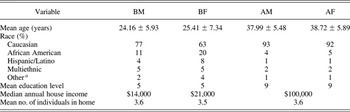
Forty-three percent of the children were female. The mean child age at placement was 3 days (SD = 13 days). The BPs typically had high school or trade school education levels and household incomes under $25,000, and APs were typically college-educated, middle-class families. APs had been married an average of 11.8 years (SD = 5.1 years, range = 1.2–27.1 years). Please see Table 1 for additional demographic information about this sample. There were no significant differences between this analytic sample and the full EGDS sample.
Demographics for birth parents and adoptive parents

Note: BM, birth mother; BF, birth father; AM, adoptive mother; AF, adoptive father. Education scores were as follows: 1 = <8th grade, 2 = completed 8th grade, 3 = completed 12th grade, 4 = some trade school, 5 = completed trade school, 6 = some junior college, 7 = completed junior college, 8 = some college, 9 = completed college, 10 = some graduate/professional school, and 11 = completed graduate/professional school.
aIncludes Asian, Native American/Pacific Islander, American Indian/Alaskan Native, and unknown.
Study design
BP and adoptive family in-person assessments were conducted by interviewers who completed a minimum of 40 hr of training, including a 2-day group session, pilot interviews, and videotaped feedback prior to administering interviews with study participants. All BP assessments were conducted in a location convenient to the participant, most often at home. The first BP interview occurred 3–6 months (average of 4 months) postpartum and the second was at 18 months. Adoptive family assessments occurred at 9, 18, and 27 months postpartum. All in-person assessments lasted 2–3 hr and included a collection of mailed self-report booklets, computer-assisted personal interview questions, and interviewer impressions. The first BP assessment also included a pregnancy history calendar about the BM's drug use, mental health and stress during pregnancy, and each adoptive family assessment included a series of videotaped interactions and standardized tasks.
Measures
Parent depressive symptoms
Depressive symptoms were measured for BPs at the first two measurement occasions and for AP depressive symptoms at all three measurement occasions using the Beck Depression Inventory (BDI; Beck & Steer, Reference Beck and Steer1993). Depressive symptoms were calculated as the sum of 20 items from the 21-item BDI (BM, α = 0.92, 0.90; BF, α = 0.89, 0.87; AM, α = 0.71, 0.79, 0.84; AF, α = 0.75, 0.81, 0.84); the suicidal ideation item was not administered to minimize situations where clinical follow-up would be needed (Leve et al., Reference Leve, Kerr, Shaw, Ge, Neiderhiser and Scaramella2010).
At approximately 4 and 18 months postpartum, BMs were also asked over the phone about prenatal depression using selected items from the BDI in the form of a Pregnancy History Calendar. The Pregnancy History Calendar is based on the Life History Calendar method, a strategy that has been shown in prior research to improve retrospective reporting by anchoring the retrospective reporting during specific periods with other significant events occurring during those periods (Caspi et al., Reference Caspi, Moffitt, Thornton, Freedman, Amell and Harrington1996). BMs reported on symptoms of depression during the three trimesters of their pregnancy. Preliminary analyses also examined full BDI scores and found comparable results.
Toddler behavior problems
At 27 months, AMs and AFs completed the Child Behavior Checklist (CBCL; Achenbach, Reference Achenbach1992), which consists of 99 behaviors rated on a 3-point scale with values of 0 (not true), 1 (sometimes true), and 2 (very true). The externalizing problems T score, which sums 24 out of the 99 items, was used in the present analyses (AM, α = 0.87; AF, α = 0.90), thereby indicating risk for externalizing psychopathology. To best account for severity of child behavioral problems and both mother and father contributions, the highest externalizing CBCL score was used to represent child problems, regardless of whether taken from mother or father. AM and AF reports of child externalizing scores were correlated at .40 (p < .001).
Additional covariates
Several additional covariates were included to control for variables that could confound or result in misinterpretation of the findings.
Openness in adoption
To control for similarities between birth and adoptive families resulting from contact and knowledge between parties, we controlled for the level of openness in the adoption. The perceived openness of APs and BPs, rated on a 7-point scale, were combined to create an aggregated openness measure. There was a high rate of convergence among reporters and the openness measure represents an aggregation across reporters (Ge et al., Reference Ge, Natsuaki, Martin, Leve, Neiderhiser and Shaw2008).
Child sex
Child sex was coded as 1 (female) or 2 (male).
Parent age
BM, AM, and AF age were entered as control variables.
Prenatal complications
The McNeil–Sjöström Scale for Obstetric Complications (McNeil & Sjöström, Reference McNeil and Sjöström1994) was used to create an index of pre- and neonatal complications. Items included three separate indices: (a) toxin exposure (exposure to radiation, X-ray, lead, and chemicals), (b) drug and alcohol use (cigarettes, second-hand cigarette smoke, alcohol, marijuana, cocaine, amphetamines, heroin, prescription pain killers, inhalants, sedatives, and tranquilizers), and (c) pregnancy risk (circulatory problems, infections, maternal age, prenatal care, weight gain and loss, nausea, bleeding, and fetal movement). We included these variables in the analyses in an effort to disentangle genetic influences from those of the prenatal environment. The scale generated a score for each BM based on retrospective self-report of pregnancy and neonatal events. Events meeting a minimum threshold of being at least potentially harmful or relevant to infant outcome were summed to form a total score. The McNeil–Sjöström Scale has been shown to have predictive validity (Nicodemus et al., Reference Nicodemus, Marenco, Batten, Vakkalanka, Egan and Straub2008) and to be more sensitive than other common measures of obstetric complications (McNeil, Cantor-Graae, & Sjostrom, Reference McNeil, Cantor-Graae and Sjostrom1994).
Elliot Youth Questionnaire Revised
At approximately 4 months postbirth, BPs were administered the Elliot Youth Questionnaire to measure engagement in various delinquent behaviors (Elliot & Huizinga, Reference Elliot and Huizinga1983). BPs were asked how many times he/she has done any of the law-violating behaviors during a specific time frame (e.g., purposely damaged or destroyed property, purposely set a fire, carried a hidden weapon, stolen something). Index offenses (IO) and minor delinquency (MD) subscales were used in this study as an index of BP antisocial behaviors (BM IO, α = 0.75; BM MD, α = 0.84; BF IO, α = 0.72; BF MD α = 0.87).
Personality Diagnostic Questionnaire
At 9 and 18 months the AMs and AFs completed the Personality Diagnostic Questionnaire to assess risk for antisocial personality disorder as defined in the DSM-IV (Hyler, Reference Hyler1994). The original true/false scale was adapted into a 4-point scale in order to capture low frequencies of antisocial behaviors. At 9 months eight questions about delinquent behaviors were used (AM, α = 0.75; AF, α = 0.82), and at 18 months four additional items adapted for this study were added to the original eight (AM, α = 0.75; AF, α = 0.89).
Infant Characteristics Questionnaire
At 9 months, AMs and AFs completed an abridged version of the 24-month Infant Characteristics Questionnaire (Bates, Freeland, & Lounsbury, Reference Bates, Freeland and Lounsbury1979), which consists of 24 items rated on a 7-point scale with 7 indicating a very difficult temperament. The fussiness scale, which sums 6 out of the 24 items, was used in the present analyses (AM, α = 0.81; AF, α = 0.82). Parallel to our measurement of child externalizing problems with the CBCL, the highest fussiness scale was used to represent child fussiness, regardless of whether taken from mother or father. AM and AF reports of child fussiness scores were correlated at .67 (p < .001).
Results
Overview of analyses
We hypothesized higher BP depressive symptoms would be associated with higher levels of toddler externalizing problems, and that both earlier and concurrent AM and AF depressive symptoms would be associated with toddler externalizing problems. We were specifically interested in the timing of parental depressive symptoms, expecting that both early and concurrent parental depressive symptoms would matter for child externalizing problems during the toddler period. Because of the lower number of BF participants, we used BMs only in our structural equation models to account for genetic effects. BFs were tested in separate post hoc regressions.
Before completing a full model including APs, we first examined whether depressive symptoms in BM should be included as multiple assessments in one latent factor or as independent predictors over time. One possibility was that depressive symptoms during pregnancy would be predictive, suggesting the possibility of a prenatal effect. Based on literature suggesting that chronicity of parental depression was as important, if not more important, than having elevated symptoms at any one time point (e.g., Gross et al., Reference Gross, Shaw, Burwell and Nagin2009), we decided to combine all assessment points to generate a latent factor of BM depressive symptoms. This decision was corroborated by preliminary structural equation analyses suggesting that BM depressive symptoms were relatively stable over time and significantly loaded onto the latent factor. In addition, when tested as individual observed variables, the assessments did not differ in their predictions of toddler externalizing problems. BM depressive symptoms were not limited to a prenatal effect, and we combined all assessments to form a latent factor of BM depressive symptoms.
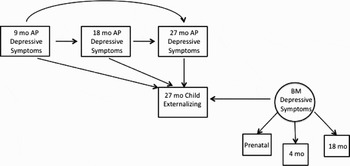
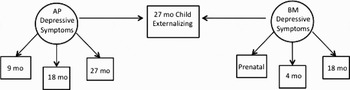
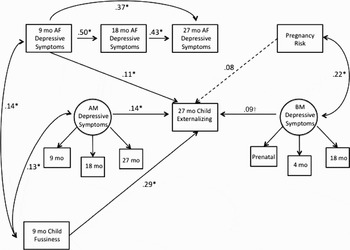
Similarly, before testing the full model including BMs, AMs, and AFs, we first examined the timing effects in AMs and AFs separately in the presence of a genetic effect. Several steps were taken to understand the timing of APs' depressive symptoms. First, a model was tested in which all three measurements of depressive symptoms were predictive of child externalizing symptoms at 27 months in addition to the genetic prediction (see Figure 1). Second, each measurement was tested alone to determine if there were unique effects of any one measurement. Third, if there were not unique effects of any one measurement, a latent factor of parental symptoms was created (see Figure 2). The timing effects from these models were used to guide the construction of the full model.
Example structural equation model where the timing of the influence of adoptive parent (AP) depressive symptoms on child externalizing problems at 27 months is tested in the presence of birth mother (BM) depressive symptoms. Each AP measurement has a direct path to child externalizing problems.

Example structural equation model where a latent factor of adoptive parent (AP) depressive symptoms predicts child externalizing problems at 27 months in the presence of birth mother (BM) depressive symptoms. Each AP measurement is loaded onto a latent factor of AP depressive symptoms.

The full model included prediction of child externalizing problems at 27 months by a latent factor of BM depressive symptoms, as well as the determined timing effects of APs. The full model allowed us to understand how parental depressive symptoms influence child externalizing problems in the presence of multiple predictors that may interact with one another. In order to understand how the predictors may interact, several follow-up analyses were planned.
Planned follow-up analyses
We expected several questions to remain following the testing of the full model. First, we were interested in understanding the potential pathways of genetic influence. For example, could the genetic effect operate through prenatal risk? It is also possible that a genetic effect could be associated with early child temperament. For these reasons, we planned to test whether effects of BM depressive symptoms operated through prenatal risk, and whether they predicted child temperament at 9 months. If we found an effect through child temperament, this could also suggest potential evocative gene–environment correlation through relations between child temperament and parenting. Last, depending on the AP timing effects, we planned to test whether one parent's depressive symptoms could influence the other's, thus better accounting for the larger family context and interrelationships.
Descriptive data
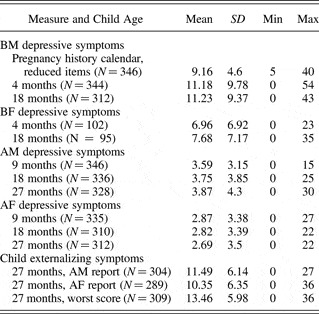
The means, standard deviations, ranges, minimums, and maximums for variables of interest are presented in Table 2. Log transformations and square root transformations were used to improve skewed distributions on all AM and AF depressive symptoms variables. Each model controls for parental antisocial behaviors. In addition child fussiness at 9 months, openness of the adoption process, BM age, AM age, AF age, child sex, pregnancy risk, prenatal exposure to toxins, and prenatal exposure to drugs were tested as controls.
Descriptive statistics
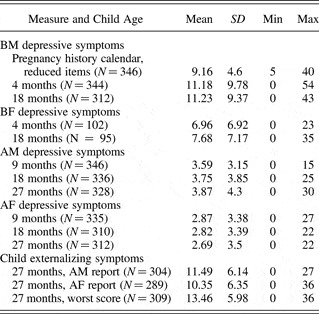
Note: BM, birth mother; BF, birth father; AM, adoptive mother; AF, adoptive father.
Structural equation models were executed with covariance matrices of observed variables, using THEIL (Molenaar, Reference Molenaar1996), a FORTRAN program for robust covariance matrix estimation. It improves the condition of a covariance matrix while leaving its underlying structure intact. Descriptives, correlations, and data preparation were calculated in SPSS 18.0. Modeling was performed using LISREL 8.80 (Jöreskog & Sörbom, Reference Jöreskog and Sörbom1996).
Model fit
Model fit was assessed using the root mean square error of approximation (RMSEA), the comparative fit index (CFI), and the normal theory weighted least-squares chi square (χ2). The RMSEA index includes adjustments for model complexity and is less influenced by the number of parameters in the model than other indicators of fit. The CFI compares the covariance matrices predicted by the model to the observed covariance matrix, and compares the null model with the observed covariance matrix. Like RMSEA, CFI is among the measures least affected by sample size (Fan, Thompson, & Wang, Reference Fan, Thompson and Wang1999). For RMSEA, a value of <0.05 is considered a good fit and <0.08 an adequate fit (Kline, Reference Kline2004). By convention, the CFI should be ≥0.90 to accept the model. The chi-square value is influenced by sample size and indicates good fit when p > .05. The Akaike information criterion (AIC) was used to compare models; a lower AIC indicates a better fit. Only standardized betas are reported.
AM and BM depressive symptoms and toddler externalizing problems
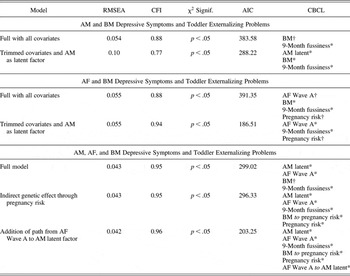
In this model, both AM and BM depressive symptoms were examined as predictors of toddler externalizing problems. We first tested a model that included all hypothesized paths of interest and covariates. These included paths from AM symptoms at 9, 18, and 27 months and from the latent BM depressive symptoms variable to 27-month toddler externalizing problems. In this model, only one covariate, child 9-month fussiness, significantly predicted toddler externalizing symptoms. In addition, AM antisocial behavior at 9 months (β = 0.20, p < .05), and marginally at 18 months (β = 0.07, p < .10), predicted AM depressive symptoms. BM antisocial behavior significantly predicted BM depressive symptoms (β = 0.38, p < .05). The model was not an adequate fit to the data (AIC = 383.58, RMSEA = 0.054, CFI = 0.88), χ2 (146) = 295.58, p < .05. As expected, AM depressive symptoms were moderately stable over time (βs = 0.56, 0.37, 0.31). In this full model with covariates and all hypothesized paths, only one hypothesized path to child externalizing problems was marginally significant: BM depressive symptoms (β = 0.11, p < .10).
In order to understand the AM timing effects to be entered into the full model, insignificant covariates predicting toddler externalizing problems were removed and each assessment of AM depressive symptoms (9, 18, or 27 months) was tested systematically. AM and BM antisocial behaviors were included in this model and significantly predicted parent depressive symptoms. While controlling for child temperament at 9 months, each assessment, when the other two assessments were removed, significantly predicted child externalizing problems at 27 months. Consequently, we decided to combine all assessments into a latent factor. This model with the latent factor, although still not an adequate fit, was an improvement over the previous model (AIC = 288.22, RMSEA = 0.10, CFI = 0.77), χ2 (51) = 234.22, p < .05. In this model, the latent factor of AM depressive symptoms significantly predicted toddler externalizing problems (β = 0.16, p < .05). BM depressive symptoms were also significantly related (β = 0.11, p < .05).
AF and BM depressive symptoms and toddler externalizing problems
AF and BM depressive symptoms were examined as predictors of toddler externalizing problems at 27 months of age. As with AMs, we first tested a model that included all hypothesized paths of interest and covariates. This model was not an adequate fit to the data (AIC = 391.35, RMSEA = 0.055, CFI = 0.88), χ2 (146) = 303.35, p < .05. As expected, AF depressive symptoms were stable over time (βs = 0.50, 0.43, and 0.37). In this full model, AF depressive symptoms at 9 months of child age was a marginally significant predictor of child externalizing symptoms (β = 0.11, p < .10) and BM depressive symptoms was significantly predictive (β = 0.11, p < .05). In this model, two covariates were significantly related to toddler externalizing symptoms, 9-month fussiness and pregnancy risk (marginally). In addition, AF antisocial behavior marginally at 9 months (β = 0.10, p < .10), and significantly at 18 months (β = 0.09, p < .05), predicted AF depressive symptoms. BM antisocial behavior significantly predicted BM depressive symptoms (β = 0.39, p < .05).
Similar to our systematic tests of timing effects of AM, we tested each assessment of AF depressive symptoms individually. As indicated by the model with all paths, only 9-month depressive symptoms was significantly predictive of toddler externalizing problems (β = 0.12, p < .05; AIC = 186.51, RMSEA = 0.055, CFI = 0.94), χ2 (62) = 128.51, p < .05.
AM, AF, and BM depressive symptoms and toddler externalizing problems
We next examined a model that tested BM, AM, and AF predictors together. We used our timing effects indicated by the prior models: BM and AM were tested as latent factors, and AF depressive symptoms at 9 months were included. We also included child fussiness at 9 months and pregnancy risk (see Figure 3). As shown in Figure 3, we also added a bidirectional path between BM depressive symptoms and pregnancy risk, as we expected that these two constructs would be related. As in previous models, we controlled for the effects of AP and BM antisocial behavior on depressive symptoms, and these significant associations followed the same pattern as reported in the above models.
Structural equation model predicting child externalizing problems at 27 months. This full model includes adoptive fathers (AF), adoptive mothers (AM), birth mother (BM), pregnancy risk, and 9-month child fussiness. Solid lines represent significant paths; dotted lines are insignificant. †p < .10. *p < .05.

The model fit was acceptable by the RMSEA and CFI indices (AIC = 299.02, RMSEA = 0.043, CFI = 0.95), χ2 (126) = 209.02, p > .05. The pattern of findings follows those of above: AM depressive symptoms (β = 0.14, p < .05) and 9 month AF depressive symptoms (β = 0.11, p < .05) were significantly associated with toddler externalizing problems at 27 months of age. BM depressive symptoms were marginally associated with toddler externalizing problems at 27 months of age (β = 0.09, p < .10), and were significantly correlated pregnancy risk (r = .22, p < .05). Pregnancy risk was not significantly associated with toddler externalizing and child fussiness at 9 months was significantly predictive (β = 0.29, p < .05). Child fussiness at 9 months was allowed to correlate with AM depressive symptoms and 9-month AF depressive symptoms (rs = .13 and .14, respectively).
Planned follow-up analyses: Exploring genetic, evocative, and timing effects
We had several planned analyses following the analyses above. First, we wondered whether the genetic effect of BM depressive symptoms was operating through pregnancy risk. Second, we tested whether there was an association between BM depressive symptoms and child fussiness that would reveal a genetic effect through child temperament or an evocative gene–environment correlation through relations between child temperament and parenting. Last, we examined possible associations between APs, specifically whether early father depressive symptoms at 9 months were associated with AM depressive symptoms.
Genetic effect through pregnancy risk
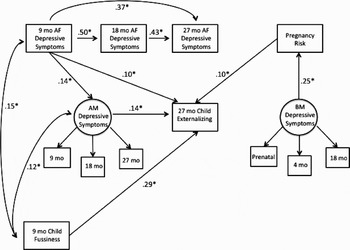
We removed the direct path from BM depressive symptoms to child externalizing symptoms at 27 months and added a direct path from BM depressive symptoms to pregnancy risk to examine the indirect genetic effect through BM pregnancy risk. BM depressive symptoms significantly predicted pregnancy risk (β = 0.25, p < .05) and pregnancy risk significantly predicted toddler externalizing problems (β = 0.10, p < .05). This model also had a lower AIC than the previous model and had an adequate fit as judged by the RMSEA and CFI indices (AIC = 296.33, RMSEA = 0.043, CFI = 0.95), χ2 (127) = 208.33, p < .05, indicating a better fit. This model suggests that there is an indirect effect of BM depressive symptoms on child externalizing problems at 27 months through pregnancy risk.
Evocative effect of child fussiness at 9 months on AP depressive symptoms
The significant bidirectional association between fussiness and AP depressive symptoms suggests two possible hypotheses: (a) AP depressive symptoms may indirectly influence child externalizing symptoms at 27 months through 9 months child fussiness, and (b) child fussiness may indirectly influence child externalizing symptoms at 27 months through AP depressive symptoms. The second hypothesis would suggest a potential evocative effect of a biologically driven fussiness from the child on parents' depressive symptoms, which in turn influence later child externalizing factors. However, tests of unidirectional paths of both hypotheses yielded comparable results, suggesting that we are not able to determine the direction of effects in this analysis.
Timing effects of APs
In the analyses mentioned above, we found that exposure to AF depressive symptoms when the child was 9 months old was predictive of later child externalizing problems at 27 months of age, whereas AM depressive symptoms as a latent factor composed of all assessments predicted child externalizing problems. In follow-up analyses we sought to partially explain why the timing of exposure to depressive symptoms differed by the parental status (mother or father) of APs. We tested the above model with the addition of one path: AF depressive symptoms at 9 months to AM depressive symptoms. The model fit was acceptable as judged by RMSEA and CFI indicators (RMSEA = 0.042, CFI = 0.96), χ2 (126) = 203.25, ns. The AIC of this model (AIC = 293.25) is lower than previous models indicating a better fit. The additional path was significant (β = 0.14, p < .05), and none of the other paths meaningfully changed. See Table 3 for a summary of the results and Figure 4 for a depiction of this final model.
Structural equation model predicting child externalizing problems at 27 months. This full model includes adoptive fathers (AF), adoptive mothers (AM), birth mother (BM), pregnancy risk, and 9-month child fussiness. This model includes the indirect effect of BM depressive symptoms on 27 child externalizing symptoms through pregnancy risk and the effect of AF 9-month depressive symptoms on AM depressive symptoms. *p < .05.

Results for structural equation models

Note: RMSEA, root mean square error of approximation; CFI, comparative fit index; AIC, Akaike information criterion; CBCL, Child Behavior Checklist (Achenbach, Reference Achenbach1992); AM, adoptive mother; BM, birth mother; AF, adoptive father. For the RMSEA a value of <0.05 is considered a good fit and <0.08 an adequate fit. The CFI should be ≥0.90 to accept the model. The chi square is influenced by the sample size and indicates good fit when p > .05. The AIC was used to compare models, and a lower AIC indicates a better fit. The CBCL indicates the significant paths predicting child CBCL at 27 months.
†p < .10. *p < .05.
BF linear regressions
The hypotheses were tested in a parallel manner using BF depressive symptoms as a predictor of child externalizing problems. Because of the reduced sample size of BFs, these analyses were only computed with 22% of the full data, thus requiring a much higher magnitude of correlation to achieve statistical significance. BF depressive symptoms were not predictive of child externalizing problems regardless of whether the 4- and 18-month BF data were examined independently, or whether a BF depressive composite was examined.
Discussion
This study helps to advance our understanding of how and when parental depressive symptoms contribute to problematic child outcomes, partitioning biological and environmental risk. We sought to understand the genetic and environmental effects of having a parent with elevated levels of depressive symptoms. We also used prospective longitudinal data to understand how the timing of parental depressive symptoms could influence the development of early child externalizing problems. We focused on the effects from infancy (9 months) to toddlerhood (27 months). This is the first genetically informed design that examines genetic, prenatal, environmental, and timing effects of parental depressive symptoms during these crucial years characterized by important transitions in social, emotional, and cognitive development (Perez & Gauvain, Reference Perez, Gauvain, Brownell and Kopp2007). The results suggest that there is an emerging cascade of risk on toddler externalizing problems, characterized by an indirect genetic effect through prenatal risk and environmental effects that differ depending on timing and parent. This suggests that there are sensitive periods in children's development of externalizing problems that are related to the presence of elevated depressive symptoms in their parents. The findings of this study have implications for identifying toddlers at risk for behavior problems and prioritizing prevention and early intervention for parents with symptoms of depression.
First, in support of previous work (e.g., Sullivan et al., Reference Sullivan, Neale and Kendler2000), we found evidence for a genetic effect of depressive symptoms on child disruptive behaviors; however, we found that this effect seemed to operate via pregnancy risk. BMs with more depressive symptoms had more problems during pregnancy, such as attending fewer prenatal care visits, losing or gaining more weight, and maternal illness. In turn, mothers with more pregnancy risk had toddlers with higher levels of externalizing problems at 27 months. This association was significant in the presence of both AM and AF depressive symptoms, suggesting that there is significant genetic risk from maternal depressive symptoms operating through the prenatal environment that is unique from the postnatal effects of interacting with a caregiver or caregivers struggling with depressive symptoms. To date, most studies reporting associations between parental depressive symptoms and child externalizing and related behaviors have interpreted these associations as a result of disruptions in parenting, family context, and reduced responsiveness or sensitivity on the part of the depressed parent (e.g., Chronis et al., Reference Chronis, Lahey, Pelham, Williams, Baumann and Kipp2007; Cummings et al., Reference Cummings, Keller and Davies2005). Although our findings support the important role of parental depressive symptoms as an environmental influence on child functioning, these findings also suggest that at least some of the impact of maternal depression on toddler problems is because of shared genes and the intrauterine environment. Previous findings from the EGDS have supported the roles of both genetics and environment. Nine-month-old infants at genetic risk, as indexed by BPs' externalizing behavior, showed heightened attention to frustrating events only when AMs had higher levels of anxious or depressive symptoms (Leve et al., Reference Leve, Kerr, Shaw, Ge, Neiderhiser and Scaramella2010). In this study we find an indirect effect of genetic risk through the prenatal environment in addition to main effects of environmental risk.
It is important that prenatal factors and risk be considered when examining genetic and environmentally mediated effects, particularly in adoption designs in which genetic effects could be at least partially due to the prenatal environment. Multiple studies have found associations between perinatal complications, toxins, and drug and alcohol use during pregnancy and externalizing problems in offspring (e.g., Beck & Shaw, Reference Beck and Shaw2005; Brennan, Greken, Mortensen, & Mednick, Reference Brennan, Grekin, Mortensen and Mednick2002; Wakschlag, Leventhal, Pine, Pickett, & Carter, Reference Wakschlag, Leventhal, Pine, Pickett and Carter2006). Using a statistical method that controls for environmental and genetic effects using analysis of siblings differentially exposed to alcohol during pregnancy, unique effects of alcohol use were found (D'Onofrio et al., Reference D'Onofrio, Van Hulle, Waldman, Rodgers, Rathouz and Lahey2007). However, a study that controlled for environmental and genetic confounds using the same analytic strategy found much reduced effects of smoking during pregnancy (D'Onofrio et al., Reference D'Onofrio, Van Hulle, Waldman, Rodgers, Harden and Rathouz2008). Adoption studies with adequate prenatal environment measurement can consider the associations between biological parent factors, such as depressive symptoms, and the prenatal environment. Consideration of this relationship could uncover possible pathways of genetic influence. In this study, we found that genetically driven characteristics in BPs were associated with certain prenatal environments, through which the child was influenced. One large-scale study found significant effects of stress events during pregnancy and smoking during pregnancy on child problems at age two in addition to postnatal risk factors (Robinson et al., Reference Robinson, Oddy, Li, Kendall, de Klerk and Silburn2008), supporting our finding that both pre- and postnatal factors can contribute to child outcomes. Our findings also suggest that the prenatal risk factors were driven by genetic factors in the BM.
Second, we found that after accounting for across-time continuity, AMs' depressive symptoms contribute to toddlers' externalizing problems regardless to the timing of the depressive symptoms during the infancy to toddler period. This may speak to the disparity in the research with biological families, where some research finds earliest depressive symptoms to matter the most (e.g., Alpern & Lyons-Ruth, Reference Alpern and Lyons-Ruth2003), whereas others find concurrent parent depression to adversely affect children's behavior in early and middle childhood (e.g., Cummings & Davies, Reference Cummings and Davies1994; Goodman & Gotlib, Reference Goodman and Gotlib1999; Radke-Yarrow, Reference Radke-Yarrow1998), and early intervention research suggesting that improvement in maternal depressive symptoms are associated with decreases in child externalizing and internalizing symptoms during the toddler and preschool periods (Shaw, Connell, Dishion, Wilson, & Gardner, Reference Shaw, Connell, Dishion, Wilson and Gardner2009). It may be difficult to parent infants with depressive symptoms, when the increased demands require energy and tolerance. In toddlerhood, mothers with depressive symptoms may struggle to guide their toddler during this age when toddlers need consistent supervision, support, and reinforcement. It is emotionally challenging to raise a toddler (Dix, Reference Dix1991), and as toddlers gain more language, mobility, and independence, they may be particularly challenging for mothers with more depressive symptoms. Mothers with more depressive symptoms have been found to be less engaged and responsive and to speak less to their children (e.g., Bettes, Reference Bettes1988; Feng et al., Reference Feng, Shaw, Skuban and Lane2007; Rowe et al., Reference Rowe, Pan and Ayoub2005; Shaw et al., Reference Shaw, Schonberg, Sherrill, Huffman, Lukon and Obrosky2006). We can then hypothesize that the mothering behaviors pulled for by an active 2-year-old could be especially difficult for a mother who feels fatigued, worthless, or hopeless. Infants and toddlers whose mothers have less energy and availability, and who provide less guidance, emotional support, and consistent consequences may in turn display more externalizing symptoms that are unique of biological attributes shared with their parent.
Third, in contrast to the abovementioned finding regarding the importance of concurrent depressive symptoms in AMs, we found that AFs' depressive symptoms at 9 months of child age prospectively contributed to toddler externalizing problems at 27 months of age. To further explore this finding, we tested whether AFs' depressive symptoms at 9 months were associated with AMs' symptoms at 27 months, and found a significant association. Although this raises the possibility that some of the influence of father depressive symptoms on toddlers is transmitted through the mother, it is notable that father symptoms at 9 months remained a significant predictor of toddler externalizing problems at 27 months, even after accounting for across-time continuity and with mother's depressive symptoms in the model. This is in contrast to previous research indicating that concurrent maternal depressive symptoms accounted for the effects of father depressive symptoms in early infancy (Carro, Grant, Gotlib, & Compas, Reference Carro, Grant, Gotlib and Compas1993). Although fathers can behave just as sensitively and appropriately in parent–child interactions as mothers (Belsky, Gilstrap, & Rovine, Reference Belsky, Gilstrap and Rovine1984; Lamb, Reference Lamb1997), research on fatherhood and parenting suggests that, on average, fathers become more engaged in child-rearing as the child becomes able to speak and act independently in toddlerhood (Laflamme, Pomerleau, & Malcuit, Reference Laflamme, Pomerleau and Malcuit2002). One study that examined predictors of mother– and father–infant attachment at 1 year found that fathers' attitude, but not mothers', toward the infant and parent role predicted the level of attachment (Cox, Owen, Henderson, & Margand, Reference Cox, Owen, Henderson and Margand1992). In early infancy, the mothers' role may be more determined; for example, in Western cultures mothers are more often looked to for feeding, diaper-changing, and soothing (Belsky et al., Reference Belsky, Gilstrap and Rovine1984; Lamb & Oppenheim, Reference Lamb, Oppenheim, Cath, Gurwitt and Gunsberg1989).
Perhaps at 9 months the elevated depressive symptoms are more detrimental to fathers' effects on child outcomes than at later child ages. Fathers who are less sure of their parenting role and have elevated depressive symptoms may be either more withdrawn or more emotionally reactive to their children's unpredictable and labile states in infancy. As the children grow, it may be easier for fathers to interact with their children, even with elevated depressive symptoms. Fathers are also expected to be more playmates in toddlerhood and less managers of basic care (Bretherton, Reference Bretherton1985; Laflamme et al., Reference Laflamme, Pomerleau and Malcuit2002; McBride & Mills, Reference McBride and Mills1993; Tiedje & Darling-Fisher, Reference Tiedje and Darling-Fisher1993; Wille, Reference Wille1995), and their own struggles with depressive symptoms may be less detrimental than mothers' depressive symptoms as mothers are often expected to manage the everyday challenges of raising a toddler.
Some of the literature on parental depression suggests that depressive symptoms may have a greater effect on maternal than paternal parenting (Connell & Goodman, Reference Connell and Goodman2002; Field, Hossain, Malphurs, Reference Field, Hossain and Malphurs1999). In contrast, we find direct effects of paternal depressive symptoms on later child externalizing problems. However, this does not delineate the mechanism of transmission. These direct effects could be through paternal parenting or through variables unmeasured in this study. Some research finds that the level of father involvement moderates the effect of maternal depression on child outcomes (Mezulis et al., Reference Mezulis, Hyde and Clark2004) or that maternal postpartum depression only contributes to toddler behavior problems if paternal psychopathology is present (Dietz, Jennings, Kelley, & Marshal, Reference Dietz, Jennings, Kelley and Marshal2009). Our finding that paternal depressive symptoms at 9 months relates to maternal depressive symptoms suggests some link between parental symptoms that may develop across child development, marriage, and through mechanisms that were unexplored in this study. For example, depression could alter coparenting, martial satisfaction (see review by Beach, Fincham, & Katz, Reference Beach, Fincham and Katz1998), spousal support (Rook, Pietromonaco, & Lewis, Reference Rook, Pietromonaco and Lewis1994), and problem solving skills (Christian, O'Leary, & Vivian, Reference Christian, O'Leary and Vivian1994). Future research could benefit from examining mechanisms of risk transmission within a genetically informed framework and in the family systems context.
Studies that clarify the pathways and timing of risk transmission to young children can inform prevention and early intervention work, as the targeting of parental depressive symptoms may benefit children's own psychopathology (Reyno & McGrath, Reference Reyno and McGrath2006; Weissman et al., Reference Weissman, Pilowsky, Wickramaratne, Talati, Wisniewski and Fava2006). We found evidence of both genetic and environmental influences of parental depressive symptoms on toddler externalizing problems, and that the timing of symptoms, and perhaps the interaction between parents, could influence early child behavior problems. Future research should consider additional factors such as parental involvement, attitudes, coparenting, marital conflict, and marital satisfaction.
Future research should also expand on this emerging cascade by considering both genetic and environmental risk in the prediction of child behavior problems. These findings demonstrate the necessity of considering multiple domains of influence and how their linkages influence one another across time (Masten et al., Reference Masten, Roisman, Long, Burt, Obradovic and Riley2005). These cascades are arguably especially important in infancy and early childhood when children's cognitive, emotional, and physical domains are developing rapidly, and they are highly dependent on caregivers and the environment. This study examines change through toddlerhood, considering genetic influences and the effects of a dynamic and changing caregiver environment.
Limitations and Conclusion
A number of limitations of this study should be considered. First, the EGDS participants are representative of birth and adoptive families from the agencies participating in this study; however, the adoptive families have high educational and economic backgrounds in comparison to national norms. There is a need to include demographic and material-economic factors in studies of parental depression (Oyserman, Mowbray, Meares, & Firminger, Reference Oyserman, Mowbray, Meares and Firminger2000). For generalizability to more high-risk environments and more ethnically diverse samples, further studies need to be conducted. The demographic differences between the adoptive and biological parents in terms of age and socioeconomic status, both of which could conceivably contribute to the impact of psychological factors on child outcomes, could also be considered; however, past adoption studies show that the favorability toward APs has negligible effects on heritability and environmental estimates (McGue et al., Reference McGue, Keyes, Sharma, Elkins, Legrand and Johnson2007).
Second, our genetic findings were not confirmed with depressive symptoms data from BFs. Replication of the findings using BFs' data would have provided a strong confirmation of genetic effects because the effects from a BF to a child are not confounded with prenatal environmental factors. Without BF data we are only including half of the child's genetic makeup. Several methodological issues may have contributed to our nonsignificant findings in BFs' data. First, although EGDS has a high number of BFs, the sample is still small for these analyses. Second, the BFs have a lower average and smaller range of depressive symptoms than the BMs participating in our study (see Table 1), which could limit their predictive power. However, we know that the observed effects from BMs to children are not simply the result of prenatal stress from depression during pregnancy because prenatal depression did not make a prediction to child functioning unique of postnatal BM depressive symptoms. Moreover, the aim of this study was not to isolate prenatal risk factors, although evidence of influence from pregnancy risk was found. Future work incorporating careful measurement of genes, prenatal environment, and postnatal environment is needed to further disentangle these influences (Knopik, Reference Knopik2009).
Third, we rely on self-report data for parental depressive symptoms, and on AP report for child externalizing problems. We note that there are potential limitations to the self-report of symptomatology of depression, and that depressed parents may have biased ratings of their children's problems (e.g., Briggs-Gowan, Carter, & Schwab-Stone, Reference Briggs-Gowan, Carter and Schwab-Stone1996). We attempted to mitigate the biased reports of parents by using the highest behavior problem score of the child from either AM or AF and using this same score in both analyses. We noted that mothers' and fathers' reports of child problems were significantly correlated (r = .40, p < .001).
Fourth, future models could examine reciprocal effects over time, such as one study that found child noncompliance at age 2 to predict concurrent maternal depressive symptoms, which in turn predicted age 4 internalizing and externalizing problems (Gross et al., Reference Gross, Shaw, Moilanen, Dishion and Wilson2008). This study also does not examine a number of potentially important contextual factors such as marital interaction, socioeconomic status, social supports, and siblings. Some of these factors have been shown to be important for the variables in this analysis; for example, there are additive effects for maternal depression and marital conflict on child outcomes (Essex, Klein, Cho, & Kraemer, Reference Essex, Klein, Cho and Kraemer2003).
As we begin to refine our understanding of the dynamic and changing relations between parental depressive symptoms, child effects, and child mental health, it will benefit the research to consider genetic and timing effects to best capture the transmission of risk. These effects suggest an emerging cascade, where in the presence of a genetic effect, parental depressive symptoms influence toddlers' behavior at crucial points in development. This cascade can be further explored in the future by the inclusion of more assessments of child behaviors and exploration of gene–environment correlation and interaction.