Unfractionated heparin and low-molecular-weight heparins belong to B01AB ATC class of antithrombotic compounds used as anticoagulants in various indications, such as thrombosis and thrombosis prophylaxis (Reference Guyton and Hall24).
As the single most expensive aspect of medical care, drugs have become the fastest growing component of healthcare costs: expenditures on medications set to outstrip hospital costs in many healthcare systems. Drug expenditure growth should continue outpacing the growth in overall healthcare expenditures and the growth in economy (Reference Agnelli, Piovella and Buoncristiani2,Reference Hoffman, Shah and Vermeulen27,Reference Malhotra, Karan and Bhargava35).
As per statistics, the annual global LMWHs market amounts to approximately 3.5 billion USD. Apparently, the antithrombotic market is expected to peak at just over 20 billion USD in 2012 across the seven major markets, including United States, France, Germany, Italy, Spain, United Kingdom, and Japan. In the meantime, the increase in expenditures for low-molecular-weight heparins is continuing. As yet, there are no breakthrough antithrombotic drugs in the pipeline that will threaten the main indications for LMWHs (Reference Engberg16,Reference Hoffman, Shah and Vermeulen27).
In Lithuania, utilization of LMWHs increased by 29.9 percent from approximately 789 thousand DDDs in 2007 to more than 1,025 thousand DDDs in 2008. The growth of utilization was consequently followed by the increase in expenditures; therefore, the total revenue from LMWHs in Lithuania increased by 23.6 percent, that is, from 5,723 thousand Lithuanian litas (LTL) in 2007 to 7,072 thousand LTL in 2008.
At Kaunas Medical University Hospital (KMUH)—the largest healthcare provider in Lithuania (40)—almost 8 percent of total medication expenditures are allocated to heparins annually. These costs represent approximately 15 percent of the total revenue from LMWHs in Lithuania. Utilization of LMWHs in KMUH increased more than fivefold during the 7-year period 2001–07 from 46.6 DDDs/1,000 hospitalization days in 2001 to 2,46.0 DDDs/1,000 hospitalization days in 2007. Hence, the expenditures also grew by 220.8 percent from more than 300 thousand LTL in 2001 to almost 1,000 thousand LTL in 2007.
The majority of low-molecular-weight heparins are being administered in inpatient settings. These institutions are particularly sensitive to the increase of expenditures and utilization; therefore, implementation and use of pharmacoeconomic analyses would enable hospitals to balance their budgets.
The key objective of our work was to perform pharmacoeconomic analysis for low-molecular-weight heparins based on their efficacy, safety, and treatment outcomes data to control the expenditures on LMWHs drug therapies.
In Lithuania, this type of study was original and the results would have direct implications for drug related decision making in healthcare institutions. It would enable all healthcare providers to rationalize the use of financial resources for heparins in considering choices among alternative use of economic resources. That could yield cost savings without compromising clinical outcomes or patient safety.
METHODS
Meta-analysis
Literature Search Strategy. The PubMed.gov database was used to conduct a comprehensive literature search for randomized controlled trials comparing safety and efficacy values of four different low-molecular-weight heparins with unfractionated heparin. The research was conducted by two independent reviewers who used inclusion/exclusion criteria based on objectives of the research. Keywords for the search were Enoxaparin, Dalteparin, Nadroparin, LMWHs, unfractionated heparin (UFH), and different combinations of those words (e.g. Dalteparin and Nadroparin, etc.). They were defined as keywords and text words.
The goal was to evaluate the overall superiority of heparins in comparison with each other.
Inclusion and Exclusion Criteria. Articles published in English between January 1990 and January 2008 were included in the meta-analysis. Each article had to contain information about randomized control trial methodology and results with direct comparison of two heparins in the treatment of the following conditions or diseases like: deep venous thrombosis (DVT), pulmonary embolism (PE), recurrent angina (RA), myocardial infarction (nonfatal MI, acute MI, and re-infarction), revascularization, hemorrhagic complications (e.g. major bleeding), and death. Meta-analysis was performed to assess the overall effect and safety of different low molecular weight heparins in comparison with unfractionated heparin.
Statistical Analysis
All meta-analyses were performed on studies that compared two low-molecular weight heparins or LMWH with unfractionated heparin. Under the fixed effects model, it was assumed that all studies come from a common population and that the effect size (odds ratio) was not significantly different among the different trials. This assumption was tested by the “Heterogeneity test.” If this test yielded a low p value (p < .05), then the fixed effects model might have been invalid. In this case, the random effects model might have been more appropriate, in which both the random variation within the studies and the variation between the different studies were incorporated.
A statistical software MedCalc was used for all calculations. MedCalc used the Mantel-Haenszel method for calculating the weighted summary odds ratio under the fixed effects model. Next, the heterogeneity statistic was incorporated to calculate the summary odds ratio under the random effects model. The program listed the results of the individual studies: several positive cases, the total number of cases, and the odds ratio with 95 percent confidence interval (CI). The total odds ratio with 95 percent CI was given both for the fixed effects model and the random effects model. If the value 1 was not within the 95 percent CI, then the odds ratio was statistically significant at the 5 percent level (p < .05). The random effects model would tend to give a more conservative estimate (i.e., with a wider confidence interval), but the results from the two models usually agreed where there was no heterogeneity. If the test of heterogeneity was statistically significant (p < .05) then more emphasis should have been placed on the random effects model.
Pharmacoeconomic Analysis
A cost minimization pharmacoeconomic analysis method was implemented and based on meta-analysis data, considering LMWHs as having a similar therapeutic effectiveness and safety parameters.
Cost Minimization Analysis
Cost minimization is one of the pharmacoeconomic tools and is applied when comparing several drugs of equal efficacy and safety results. This type of analysis is used when searching for the lowest cost alternative between competing therapies (Reference Arenas-Guzman, Tosti and Hay4,Reference Ngorsuraches39,Reference Sprague, Quigley and Adili51). The cost minimization analysis involved the expenditures on LMWHs in KMUH from 2005 to 2007 as well as the costs of LMWHs in Lithuania in 2007 and 2008. The pharmacoeconomic analysis included all LMWHs used at KMUH and in Lithuania (DU100 percent) during the aforementioned periods.
Reference Price
As per definition, the reference price allows paying a similar price for medications ensuring a similar benefit. Consequently, it creates an opportunity for reduction of costs of higher-priced products, that is, paying only the price of the lowest common denominator (Reference Miraldo36,Reference Richter43,Reference Stargardt, Schreyögg and Busse52).
As a result of the pharmacoeconomic analysis, it was reasonable to set the lowest price (i.e., single DDD price of one LMWH) as the reference. Further calculations demonstrated the economic advantages of the pharmacoeconomic analysis for the state government and healthcare provider budgets.
RESULTS
Meta-analysis of Heparins: Studies and Outcomes
The following results were obtained from meta-analysis:
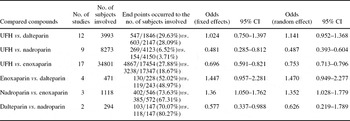
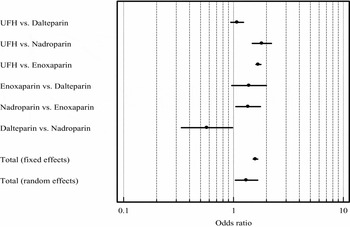
UFH vs. Dalteparin. Twelve studies involving 3,993 patients were included. The evaluated end points occurred in 547/1,846 (29.63 percent) patients treated with UFH versus 603/2147 (28.09 percent) patients treated with dalteparin. There were no statistically significant differences in the efficacy values of those two medicines, fixed effects odds ratio 1.141 [95 percent CI, 0.952 – 1.368]. Test for heterogeneity (Q = 23.2064; DF = 11; p = .0165) (Tables 1 and 2; Figure 1).
Data from the Accomplished Meta-analysis Comparing LMWHs with Each Other, and UFH

LMWH, low-molecular-weight heparin; UFH, unfractionated heparin; CI, confidence interval.
Pharmacoeconomic Calculations Based on the Utilization of LMWHs in Lithuania in 2007 and 2008 Suggesting Dalteparin Single DDD Price as the Reference

LMWH, low-molecular-weight heparin; LTL, Lithuanian litas.
Forest plot of odds ratio (95 percent CI) for meta-analysis of heparins.

UFH vs. Nadroparin. Nine studies involving the total of 8,283 patients were included. The end points occurred in 269/4,123 (6.52 percent) participants treated with UFH versus 154/4150 (3.71 percent) participants treated with nadroparin. There was a statistically significant difference in the efficacy values of those two medicines, fixed effects odds ratio 0.487 [95 percent CI, 0.393 – 0.604]. Test for heterogeneity (Q = 34.6006; DF = 8; p < .0001) (Tables 1 and 2; Figure 1).
UFH vs. Enoxaparin. Seventeen studies, involving the total of 34,801 patients were included. Aforementioned end points occurred in 4,867/17,454 (27.88 percent) participants treated with UFH versus 3238/17347 (18.67 percent) participants treated with enoxaparin. There was a statistically significant difference in the efficacy values that were estimated, fixed effects odds ratio 0.753 [95 percent CI, 0.713 – 0.796]. Test for heterogeneity (Q = 53.7578; DF = 16; p < .0001) (Tables 1 and 2; Figure 1).
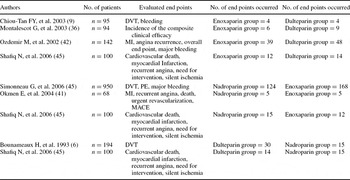
Enoxaparin vs. Dalteparin. Four studies involving 471 patients were include. The end points occurred in 130/228 (52.02 percent) patients treated with enoxaparin and in 119/243 (48.97 percent) patients treated with dalteparin. There were no statistically significant differences in the efficacy values that were estimated, fixed effects odds ratio 1.447 [95 percent CI, 0.957 – 2.281]. Test for heterogeneity (Q = 1.4669; DF = 3; p = .6899) (Tables 1 and 3; Figure 1).
Results of Studies Comparing LMWHs (Enoxaparin, Dalteparin, and Nadroparin)
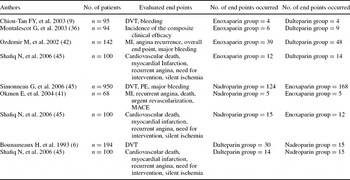
LMWH, low-molecular-weight heparin; DVT, deep vein thrombosis; MI, myocardial infarction; PE, pulmonary embolism; MACE, major adverse cardiac event.
Nadroparin vs. Enoxaparin. Three studies involving 1118 patients were included. The end points occurred in 402/546 (73.63 percent) patients treated with nadroparin and in 385/572 (67.31 percent) patients treated with enoxaparin. There were no statistically significant differences in the efficacy values that were estimated, fixed effects odds ratio 1.360 [95 percent CI, 1.050 – 1.762]. Test for heterogeneity (Q = 2.0356; DF = 2; p = .3614) (Tables 1 and 3; Figure 1).
Dalteparin vs. Nadroparin. Two studies involving 294 patients were included. The aforementioned end points occurred in 103/147 (70.07 percent) participants treated with dalteparin versus 118/147 (80.27 percent) participants treated with nadroparin. There were significant differences in the efficacy values, fixed effects odds ratio 0.577 [95 percent CI, 0.337 – 0.988], although the results were not statistically reliable. Test for heterogeneity Q = 3.5333; DF = 1; p = .0601 (Tables 1 and 3; Figure 1).
Cost-Minimization Analysis and Reference Pricing
At KMUH, heparins amount to approximately 8 percent of the total medication costs annually; furthermore, the consumption rates are increasing gradually. The analysis also demonstrated that DDD/1,000HD (hospitalization days) values fluctuate significantly within the group of heparins; for example, in 2005, the consumption of dalteparin reached the value of 74.11DDD/1,000HD, and the utilization of enoxaparin grew from 1.38DDD/1,000HD in 2001 up to 29.55DDD/1,000HD in 2005, which is over 21.4 times more during a 5-year period (Supplementary Table 1 which can be viewed online at www.journals.cambridge.org/thc2010019).
The cost minimization analysis was performed based on results of heparins’ meta-analysis, considering LMWHs as having a similar therapeutic effectiveness and safety. The lowest price (i.e., single DDD price of dalteparin) was set as the reference. It is important to emphasize that in Lithuania, a portion of all expenditures amounting to 8.49 percent in 2007 and 10.89 percent in 2008 were allocated to dalteparin, although the distribution of utilization totaled 12.49 percent in 2007 and 15.39 percent in 2008. Moreover, a total of 54.82 percent in 2007 and 46.54 percent in 2008 of all expenditures were allocated to nadroparin but that only reflected the distribution of utilization of only 45.62 percent in 2007 and 38.19 percent in 2008 (Supplementary Table 1).
Pharmacoeconomic estimations were performed using the cost-minimization analysis for obtained data of heparin sales in Lithuania in 2007 and 2008. Heparin costs in KMUH in 2005, 2006, and 2007 were also taken into consideration. The estimations included all LMWHs used at KMUH (DU100 percent) during the aforementioned period. As new LMWH bemiparin was introduced in Lithuanian market in spring of 2008, it was excluded from estimations.
Setting the reference price for low LMWHs would result in total savings of 1.830–2.070 thousand LTL in Lithuania annually. This provides that implementation of reference pricing would enable to decrease the total expenditures by 31.98–29.28 percent (Supplementary Table 2, which can be viewed online at www.journals.cambridge.org/thc2010019).
In the KMUH, the total savings varied from 171 thousand LTL in 2007 to 120 thousand LTL in 2006 and 144 thousand LTL in 2005; therefore, the findings from this study would enable the institution to decrease the expenditures on the group of LMWHs by 17–24 percent per annum.
DISCUSSION
In comparison to UFH, all LMWHs have independently proved to be safer and more effective than UFH, but within the group of LMWH, according to the meta-analysis results, none of the LMWHs demonstrated a significant superiority over each other; therefore, the group of LMWHs was interchangeable in terms of efficacy, safety, and treatment outcomes results and due to that suitable for cost minimization analysis and reference price implementation.
POLICY IMPLICATIONS
Several reviews published by other authors (Reference Aaserud, Dahlgren and Kösters1) established that reference pricing resulted in less use of the more expensive drugs and more use of reference drugs. This generally decreased the amount spent on drugs by third party payers. Reference pricing was not found to have adverse effects on health, nor did it increase the use of health services (Reference Hoffman, Shah and Vermeulen27).
LMWHs are most frequently used in the inpatient settings; therefore, as the utilization of heparins in the outpatient environment is very limited, hospital budgets would significantly benefit from implementation of reference pricing. LMWHs could be interchangeable in terms of their health benefits; that is the idea behind reference pricing, in which reimbursement of a drug is based on the least expensive option.
Subsequent to several estimations, dalteparin was selected as the reference drug, and reference pricing calculations were performed using dalteparin single DDD price as the reference. In KMUH, the estimated possible savings varied in the range of 120–171 thousand LTL from 2005 to 2007, therefore, the aforementioned methodology would enable the institution to decrease the expenditures for LMWHs by 16.54 percent to 23.63 percent annually (Supplementary Tables 1 and 2).
Understandably, it would be extremely important to start implementing the reference pricing in the largest healthcare institutions as that would results in significant decrease of expenditures. KMUH has recently launched the above-mentioned methodology and implemented the pharmacoeconomic decision modeling within the group of LMWHs. As these developments commenced in January 2009, the results concerning the expenditures for LMWHs should be available in the nearest future.
LMWHs were considered to be interchangeable after the meta-analysis results were obtained, where efficacy, safety, and treatment outcomes parameters of heparins were analyzed. The direct costs of LMWHs were shown to be very different at KMUH and other Lithuanian hospitals as well. Therefore, voluntary introduction of cost-minimization policies could become a useful tool enabling healthcare providers and inpatient settings balance their budgets and rationalize expenditures on anticoagulation therapies.
SUPPLEMENTARY MATERIAL
Supplementary Table 1
Supplementary Table 2
CONTACT INFORMATION
Edmundas Kadusevicius, PharmD, MD, PhD (e610614@yahoo.com), Associate Professor, Basic & Clinical Pharmacology, Kaunas Medical University, 9 Mickeviciaus, Kaunas LT-44307, Lithuania; Clinical Pharmacist, Department of Hospital Pharmacy, Kaunas Medical University Hospital, 2 Eiveniu, Kaunas LT-50009, Lithuania
Gabriele Kildonaviciute, PharmD (gabrielekil@yahoo.com), Assistant, Basic & Clinical Pharmacology, Kaunas Medical University, 9 Mickeviciaus, Kaunas LT-44303, Lithuania; Assistant Site Start-up Team Lead, Quintiles, JSC, 349 Savanoriu av., LT-49425, Lithuania
Birute Varanaviciene, PharmD (birute.varanaviciene@kmuk.lt), Head, Department of Hospital Pharmacy, Kaunas Medical University Hospital, 2 Eiveniu, Kaunas Lt-50009, Lithuania
Danguole Jankauskiene, MD, PhD (djank@mruni.lt), Professor, Department of Policy and Management, Mykolas Romeris University, 20 Ateities Street, Vilnius LT08303, Lithuania
CONFLICT OF INTEREST
All authors report having no potential conflicts of interest.