


%20--%3e%3c!DOCTYPE%20svg%20PUBLIC%20'-//W3C//DTD%20SVG%201.0//EN'%20'http://www.w3.org/TR/2001/REC-SVG-20010904/DTD/svg10.dtd'%3e%3csvg%20version='1.0'%20id='Layer_1'%20xmlns='http://www.w3.org/2000/svg'%20xmlns:xlink='http://www.w3.org/1999/xlink'%20x='0px'%20y='0px'%20width='64px'%20height='64px'%20viewBox='5.5%20-3.5%2064%2064'%20enable-background='new%205.5%20-3.5%2064%2064'%20xml:space='preserve'%3e%3cg%3e%3ccircle%20fill='%23FFFFFF'%20fill-opacity='0'%20cx='37.785'%20cy='28.501'%20r='28.836'/%3e%3cpath%20fill='%23595959'%20d='M37.441-3.5c8.951,0,16.572,3.125,22.857,9.372c3.008,3.009,5.295,6.448,6.857,10.314%20c1.561,3.867,2.344,7.971,2.344,12.314c0,4.381-0.773,8.486-2.314,12.313c-1.543,3.828-3.82,7.21-6.828,10.143%20c-3.123,3.085-6.666,5.448-10.629,7.086c-3.961,1.638-8.057,2.457-12.285,2.457s-8.276-0.808-12.143-2.429%20c-3.866-1.618-7.333-3.961-10.4-7.027c-3.067-3.066-5.4-6.524-7-10.372S5.5,32.767,5.5,28.5c0-4.229,0.809-8.295,2.428-12.2%20c1.619-3.905,3.972-7.4,7.057-10.486C21.08-0.394,28.565-3.5,37.441-3.5z%20M37.557,2.272c-7.314,0-13.467,2.553-18.458,7.657%20c-2.515,2.553-4.448,5.419-5.8,8.6c-1.354,3.181-2.029,6.505-2.029,9.972c0,3.429,0.675,6.734,2.029,9.913%20c1.353,3.183,3.285,6.021,5.8,8.516c2.514,2.496,5.351,4.399,8.515,5.715c3.161,1.314,6.476,1.971,9.943,1.971%20c3.428,0,6.75-0.665,9.973-1.999c3.219-1.335,6.121-3.257,8.713-5.771c4.99-4.876,7.484-10.99,7.484-18.344%20c0-3.543-0.648-6.895-1.943-10.057c-1.293-3.162-3.18-5.98-5.654-8.458C50.984,4.844,44.795,2.272,37.557,2.272z%20M37.156,23.187%20l-4.287,2.229c-0.458-0.951-1.019-1.619-1.685-2c-0.667-0.38-1.286-0.571-1.858-0.571c-2.856,0-4.286,1.885-4.286,5.657%20c0,1.714,0.362,3.084,1.085,4.113c0.724,1.029,1.791,1.544,3.201,1.544c1.867,0,3.181-0.915,3.944-2.743l3.942,2%20c-0.838,1.563-2,2.791-3.486,3.686c-1.484,0.896-3.123,1.343-4.914,1.343c-2.857,0-5.163-0.875-6.915-2.629%20c-1.752-1.752-2.628-4.19-2.628-7.313c0-3.048,0.886-5.466,2.657-7.257c1.771-1.79,4.009-2.686,6.715-2.686%20C32.604,18.558,35.441,20.101,37.156,23.187z%20M55.613,23.187l-4.229,2.229c-0.457-0.951-1.02-1.619-1.686-2%20c-0.668-0.38-1.307-0.571-1.914-0.571c-2.857,0-4.287,1.885-4.287,5.657c0,1.714,0.363,3.084,1.086,4.113%20c0.723,1.029,1.789,1.544,3.201,1.544c1.865,0,3.18-0.915,3.941-2.743l4,2c-0.875,1.563-2.057,2.791-3.541,3.686%20c-1.486,0.896-3.105,1.343-4.857,1.343c-2.896,0-5.209-0.875-6.941-2.629c-1.736-1.752-2.602-4.19-2.602-7.313%20c0-3.048,0.885-5.466,2.658-7.257c1.77-1.79,4.008-2.686,6.713-2.686C51.117,18.558,53.938,20.101,55.613,23.187z'/%3e%3c/g%3e%3c/svg%3e)
%20--%3e%3c!DOCTYPE%20svg%20PUBLIC%20'-//W3C//DTD%20SVG%201.0//EN'%20'http://www.w3.org/TR/2001/REC-SVG-20010904/DTD/svg10.dtd'%3e%3csvg%20version='1.0'%20id='Layer_1'%20xmlns='http://www.w3.org/2000/svg'%20xmlns:xlink='http://www.w3.org/1999/xlink'%20x='0px'%20y='0px'%20width='64px'%20height='64px'%20viewBox='5.5%20-3.5%2064%2064'%20enable-background='new%205.5%20-3.5%2064%2064'%20xml:space='preserve'%3e%3cg%3e%3ccircle%20fill='%23FFFFFF'%20fill-opacity='0'%20cx='37.637'%20cy='28.806'%20r='28.276'/%3e%3cg%3e%3cpath%20fill='%23595959'%20d='M37.443-3.5c8.988,0,16.57,3.085,22.742,9.257C66.393,11.967,69.5,19.548,69.5,28.5c0,8.991-3.049,16.476-9.145,22.456%20C53.879,57.319,46.242,60.5,37.443,60.5c-8.649,0-16.153-3.144-22.514-9.43C8.644,44.784,5.5,37.262,5.5,28.5%20c0-8.761,3.144-16.342,9.429-22.742C21.101-0.415,28.604-3.5,37.443-3.5z%20M37.557,2.272c-7.276,0-13.428,2.553-18.457,7.657%20c-5.22,5.334-7.829,11.525-7.829,18.572c0,7.086,2.59,13.22,7.77,18.398c5.181,5.182,11.352,7.771,18.514,7.771%20c7.123,0,13.334-2.607,18.629-7.828c5.029-4.838,7.543-10.952,7.543-18.343c0-7.276-2.553-13.465-7.656-18.571%20C50.967,4.824,44.795,2.272,37.557,2.272z%20M46.129,20.557v13.085h-3.656v15.542h-9.944V33.643h-3.656V20.557%20c0-0.572,0.2-1.057,0.599-1.457c0.401-0.399,0.887-0.6,1.457-0.6h13.144c0.533,0,1.01,0.2,1.428,0.6%20C45.918,19.5,46.129,19.986,46.129,20.557z%20M33.042,12.329c0-3.008,1.485-4.514,4.458-4.514s4.457,1.504,4.457,4.514%20c0,2.971-1.486,4.457-4.457,4.457S33.042,15.3,33.042,12.329z'/%3e%3c/g%3e%3c/g%3e%3c/svg%3e)
%20--%3e%3c!DOCTYPE%20svg%20PUBLIC%20'-//W3C//DTD%20SVG%201.0//EN'%20'http://www.w3.org/TR/2001/REC-SVG-20010904/DTD/svg10.dtd'%3e%3csvg%20version='1.0'%20id='Layer_1'%20xmlns='http://www.w3.org/2000/svg'%20xmlns:xlink='http://www.w3.org/1999/xlink'%20x='0px'%20y='0px'%20width='64px'%20height='64px'%20viewBox='5.5%20-3.5%2064%2064'%20enable-background='new%205.5%20-3.5%2064%2064'%20xml:space='preserve'%3e%3cg%3e%3ccircle%20fill='%23FFFFFF'%20fill-opacity='0'%20cx='36.924'%20cy='28.403'%20r='28.895'/%3e%3cpath%20fill='%23595959'%20d='M37.442-3.5c8.99,0,16.571,3.085,22.743,9.256C66.393,11.928,69.5,19.509,69.5,28.5c0,8.992-3.048,16.476-9.145,22.458%20C53.88,57.32,46.241,60.5,37.442,60.5c-8.686,0-16.19-3.162-22.513-9.485C8.644,44.728,5.5,37.225,5.5,28.5%20c0-8.762,3.144-16.343,9.429-22.743C21.1-0.414,28.604-3.5,37.442-3.5z%20M12.7,19.872c-0.952,2.628-1.429,5.505-1.429,8.629%20c0,7.086,2.59,13.22,7.77,18.4c5.219,5.144,11.391,7.715,18.514,7.715c7.201,0,13.409-2.608,18.63-7.829%20c1.867-1.79,3.332-3.657,4.398-5.602l-12.056-5.371c-0.421,2.02-1.439,3.667-3.057,4.942c-1.622,1.276-3.535,2.011-5.744,2.2%20v4.915h-3.714v-4.915c-3.543-0.036-6.782-1.312-9.714-3.827l4.4-4.457c2.094,1.942,4.476,2.913,7.143,2.913%20c1.104,0,2.048-0.246,2.83-0.743c0.78-0.494,1.172-1.312,1.172-2.457c0-0.801-0.287-1.448-0.858-1.943l-3.085-1.315l-3.771-1.715%20l-5.086-2.229L12.7,19.872z%20M37.557,2.214c-7.276,0-13.428,2.571-18.457,7.714c-1.258,1.258-2.439,2.686-3.543,4.287L27.786,19.7%20c0.533-1.676,1.542-3.019,3.029-4.028c1.484-1.009,3.218-1.571,5.2-1.686V9.071h3.715v4.915c2.934,0.153,5.6,1.143,8,2.971%20l-4.172,4.286c-1.793-1.257-3.619-1.885-5.486-1.885c-0.991,0-1.876,0.191-2.656,0.571c-0.781,0.381-1.172,1.029-1.172,1.943%20c0,0.267,0.095,0.533,0.285,0.8l4.057,1.83l2.8,1.257l5.144,2.285l16.397,7.314c0.535-2.248,0.801-4.533,0.801-6.857%20c0-7.353-2.552-13.543-7.656-18.573C51.005,4.785,44.831,2.214,37.557,2.214z'/%3e%3c/g%3e%3c/svg%3e)
%20--%3e%3c!DOCTYPE%20svg%20PUBLIC%20'-//W3C//DTD%20SVG%201.0//EN'%20'http://www.w3.org/TR/2001/REC-SVG-20010904/DTD/svg10.dtd'%3e%3csvg%20version='1.0'%20id='Layer_1'%20xmlns='http://www.w3.org/2000/svg'%20xmlns:xlink='http://www.w3.org/1999/xlink'%20x='0px'%20y='0px'%20width='64px'%20height='64px'%20viewBox='5.5%20-3.5%2064%2064'%20enable-background='new%205.5%20-3.5%2064%2064'%20xml:space='preserve'%3e%3cg%3e%3ccircle%20fill='%23FFFFFF'%20fill-opacity='0'%20cx='36.944'%20cy='28.631'%20r='29.105'/%3e%3cg%3e%3cpath%20fill='%23595959'%20d='M37.443-3.5c8.951,0,16.531,3.105,22.742,9.315C66.393,11.987,69.5,19.548,69.5,28.5c0,8.954-3.049,16.457-9.145,22.514%20C53.918,57.338,46.279,60.5,37.443,60.5c-8.649,0-16.153-3.143-22.514-9.429C8.644,44.786,5.5,37.264,5.5,28.501%20c0-8.723,3.144-16.285,9.429-22.685C21.138-0.395,28.643-3.5,37.443-3.5z%20M37.557,2.272c-7.276,0-13.428,2.572-18.457,7.715%20c-5.22,5.296-7.829,11.467-7.829,18.513c0,7.125,2.59,13.257,7.77,18.4c5.181,5.182,11.352,7.771,18.514,7.771%20c7.123,0,13.334-2.609,18.629-7.828c5.029-4.876,7.543-10.99,7.543-18.343c0-7.313-2.553-13.485-7.656-18.513%20C51.004,4.842,44.832,2.272,37.557,2.272z%20M23.271,23.985c0.609-3.924,2.189-6.962,4.742-9.114%20c2.552-2.152,5.656-3.228,9.314-3.228c5.027,0,9.029,1.62,12,4.856c2.971,3.238,4.457,7.391,4.457,12.457%20c0,4.915-1.543,9-4.627,12.256c-3.088,3.256-7.086,4.886-12.002,4.886c-3.619,0-6.743-1.085-9.371-3.257%20c-2.629-2.172-4.209-5.257-4.743-9.257H31.1c0.19,3.886,2.533,5.829,7.029,5.829c2.246,0,4.057-0.972,5.428-2.914%20c1.373-1.942,2.059-4.534,2.059-7.771c0-3.391-0.629-5.971-1.885-7.743c-1.258-1.771-3.066-2.657-5.43-2.657%20c-4.268,0-6.667,1.885-7.2,5.656h2.343l-6.342,6.343l-6.343-6.343L23.271,23.985L23.271,23.985z'/%3e%3c/g%3e%3c/g%3e%3c/svg%3e)
Background
Approximately 6% of community-dwelling older Americans are homebound. Reference Ornstein, Leff and Covinsky1 Homebound persons have significant healthcare needs, but only 11% receive any form of home-based care. Reference Reckrey, Yang and Kinosian2 The Department of Veterans Affairs has provided home-based primary care (HBPC) since 1972, and nearly 60,000 veterans receive HBPC annually. Reference Beales and Edes3,Reference Chan, Davis and Cooper4
Most antibiotic prescribing in the U.S. occurs in outpatient settings; similarly, it is prevalent in HBPC. Reference Datta, Fried and O’Leary5 However, appropriate antibiotic use remains a concern. Among veterans with urinary tract infection (UTI), antibiotic therapy was inappropriate in 74% of patients. Reference Gee, Ford, Conway, Ott, Sellick and Mergenhagen6 Furthermore, due to the challenges of delivering medical care in the home, the diagnosis of infection is challenging. Reference Datta, Kiwak and Fried7 To inform antimicrobial stewardship efforts, we evaluated antibiotic prescriptions and the application of standardized surveillance definitions among infections in HBPC.
Methods
We conducted a retrospective study of patients enrolled in the Veterans Affairs Connecticut Healthcare System HBPC Program who were recorded with influenza-like illness (ILI), pneumonia, UTI, or skin and soft tissue infection (SSTI) between January 1, 2023, and June 30, 2024. This program provides comprehensive longitudinal care to homebound veterans through both home and telehealth encounters by an interdisciplinary team of clinicians.
An infectious disease physician (D.N.) reviewed all recorded infections for evidence of ILI, pneumonia, UTI, or SSTI. We determined whether the infection was diagnosed and managed by HBPC clinicians or non-HBPC clinicians (eg, emergency department clinicians). Among infections diagnosed by HBPC clinicians, we collected demographics; living arrangements; clinical features of infection; laboratory, imaging and prescription (class, dose, duration of therapy, days from diagnosis to prescription) data; and 30-day clinical outcomes (resolution of infection vs hospitalization, infection-associated death). We further determined whether the specified infection met standardized surveillance definitions for home health care infections, which align with accepted clinical standards in HBPC. 8 Surveillance definitions for UTI were adapted such that dysuria was added as a criterion for patients without an indwelling urinary catheter. Discrepancies in the application of standardized surveillance definitions were resolved through discussion with another infectious disease physician (R.D.).
Descriptive statistics were used to characterize patients, infections, and prescriptions. We calculated the percentage of infections that met standardized surveillance definitions and evaluated concordance with clinical diagnoses. All analyses were performed using SAS 9.4 (Cary, NC). This study was deemed quality improvement by the Veterans Affairs Health Services Research and Development Service, which waived the need for further institutional review board approval.
Results
During the study period, 164 infections were recorded. Of these, 99 were diagnosed by non-HBPC clinicians. After excluding 5 other infections (odontogenic infection, sinusitis, otitis, conjunctivitis, Clostridioides difficile infection), 60 total infections diagnosed by HBPC clinicians were analyzed. These infections occurred among 54 patients (median [interquartile range] age, 84 [75 – 90] years; male sex, 91%; living with family, 63%; home health aide or nurse present, 59%).
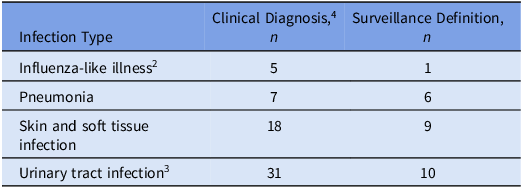
Among infections diagnosed during HBPC (n = 60), 31 (50%) were UTI including 3 catheter-associated UTI, 18 (28%) were SSTI, 7 (12%) were pneumonia, and 5 (8%) were ILI. Thirty-nine infections (65%) were diagnosed through home visits and 21 (35%) through telehealth visits. Within 30 days, 51 (85%) infections were treated at home, and 9 (15%) infections required emergent care. Among infections treated at home (n = 51), 44 had resolution of infection, 5 required hospitalization, and 2 had no documentation of resolution or hospitalization. There was 1 infection-associated death.
When evaluating UTI (n = 31), 25 (81%) and 23 (74%) had a urinalysis and urine culture completed, respectively. Among urine cultures (n = 23), common bacteria included Escherichia coli (n = 7), Enterococcus faecalis (n = 4), Klebsiella pneumoniae (n = 2), Enterobacter cloacae complex (n = 2), and Staphylococcus epidermidis (n = 2). Among pneumonia (n = 7), only 2 had chest X-rays. Among ILI (n = 5), 2 were associated with respiratory syncytial virus and 3 with SARS-CoV-2. When applying standardized surveillance definitions to infections, concordance with clinical diagnosis occurred in 43% of cases. The highest discordance was observed among UTI and ILI (Table 1).
Infections in home-based primary as defined by clinical diagnosis versus standardized surveillance definitions over an 18-month period 1

1 2008 Association for Professionals in Infection Control and Epidemiology and Centers for Disease Control and Prevention’s Healthcare Infection Control Practices Advisory Committee Surveillance Definitions for Home Health Care and Home Hospice Infections;2 3 clinical diagnoses of influenza-like illness involved COVID-19 and did not meet the surveillance definition;3 6 clinical diagnoses of urinary tract infection involved nonspecific symptoms such as weakness and fatigue and changes in urine character such as malodor;4 1 patient had a clinical diagnosis of both skin and soft tissue infection and urinary tract infection.
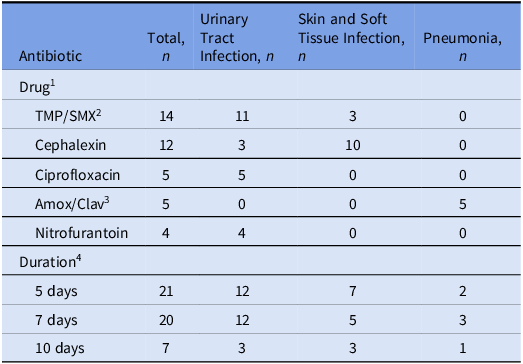
Antibiotics were prescribed by HBPC clinicians in 48 infections (Table 2). Of these, 26 (54%) were prescribed on the same day of diagnosis. Six (13%) were prescribed ≥ 5 days after diagnosis due to delayed availability of urine studies (n = 5) and inadequate response to non-anti-infective agents (n = 1). One antibiotic was prescribed in the setting of UTI to which the isolated pathogen was resistant. All doses accounted for renal and hepatic function, and 15% of prescriptions involved durations of therapy > 7 days. Among infections without antibiotic prescriptions (n = 12), 3 were ILI, and 9 involved prompt referrals to emergent care.
Most common antibiotic prescriptions among infections diagnosed and managed by home-based primary care clinicians at one site

1 Only shown for drugs with > 3 prescriptions;2 trimethoprim-sulfamethoxazole;3 amoxicillin/clavulanate;4 Missing data in 1 prescription.
Discussion
In this study of infections managed by HBPC clinicians over an 18-month period, UTI was the most diagnosed infection, and 35% of all infections were diagnosed via telehealth. Standardized surveillance definitions for home health infections were concordant with clinical diagnoses in only 43% of cases. Antibiotic dosages were appropriate, but opportunities for improvement were identified in antibiotic timing and duration. Collectively, these findings may inform antimicrobial stewardship efforts in HBPC.
Consistent with the epidemiology of infections in older adults, UTI was the most frequently encountered infection by HBPC clinicians. Over one-third of UTI were diagnosed through telehealth in which caregivers reported symptoms on behalf of patients. Telehealth encounters without direct patient interaction may limit the ability to obtain an accurate review of symptoms. This is notable as UTIs accounted for 52% of telephone encounters. A structured telehealth checklist including localizing symptoms suggestive of UTI may facilitate diagnosis and provide education to caregivers. Point-of-care tests may also offer benefit. Urine dipstick tests with negative results for both nitrites and leukocyte esterase have a high negative predictive value and may be used to rule out UTI. Reference Juthani-Mehta, Tinetti, Perrelli, Towle and Quagliarello9 Future work could examine the utility of these strategies in HBPC.
We applied standardized surveillance definitions for home health infections to those identified during HBPC and found less than half of clinical diagnoses met standardized infection surveillance definitions. UTI demonstrated the lowest concordance, despite the application of an adapted definition that included dysuria. This may be attributable to the use of nonspecific clinical features to diagnose UTI in our sample. Additionally, surveillance definitions do not include COVID-19. Revised criteria for home health infections may improve capture of HBPC-associated infections.
The presence of a HBPC pharmacist at the study site likely contributed to the appropriate dosing of antibiotics. However, 15% of prescriptions involved durations of therapy > 7 days, and trimethoprim/sulfamethoxazole was the most prescribed antibiotic. Future education could emphasize the high-quality evidence supporting the safety and efficacy of shorter treatment durations for infections in older adults and the potential for harm associated with trimethoprim/sulfamethoxazole in older adults. Reference Advani, Schmader and Mody10 Additionally, nearly half of antibiotics were prescribed after the day of diagnosis, with 13% prescribed ≥5 days after diagnosis. This time interval may present an opportunity to determine whether antibiotic therapy is still warranted.
This work has limitations, including small sample size and single-center retrospective design within the Veterans Health Administration, which may introduce observation bias. Nevertheless, we show that over one-third of infections in HBPC are diagnosed via telehealth, concordance between clinical diagnosis and surveillance definitions was low for UTI, and durations of antibiotic therapy are often prolonged. Larger studies are needed to validate these findings and guide stewardship efforts in HBPC.
Acknowledgements
We would like to thank Veterans Affairs Connecticut Healthcare System Home Based Primary Care staff whose support made this work feasible.
Financial support
This study was funded by grant IK2-CX001981 (to A.C.) from the VA CSRandD
Competing interests
All authors report no conflicts of interest relevant to this article.
Disclaimer
The findings and conclusions in this report are those of the authors and do not necessarily represent the official position of the Department of Veteran Affairs or the authors’ affiliated institutions.

 Open access

