Introduction
Cowpea (Vigna unguiculata L. Walp.) is an important food legume worldwide (Tan et al., Reference Tan, Tie, Luo, Zhu, Lai and Li2012). It is cultivated in tropical regions, usually inter-cropped with cereals, but also in rotation as a sole crop (Gajera et al., Reference Gajera, Domadiya, Patel and Golakiya2014). Cowpea plants are well adapted to high temperatures and drought and it is known for its high nutritional value. Therefore, it is useful for agricultural development globally (Carvalho et al., Reference Carvalho, Muñoz-Amatriaín, Castro, Lino-Neto, Matos, Egea-Cortines, Rosa, Close and Carnide2017). This species, although of African origin, has been cultivated for centuries in Mexico (Hernández and Delgado, Reference Hernández, Delgado, Zizumbo, Rasmussen, Arias and Terán1992). It is known as ‘xpelón’ in Maya-Yucatec and is cultivated in small areas for self-consumption within a traditional agroecosystem known as milpa (Castillo-Caamal, Reference Castillo-Caamal2006; Morales-Morales et al., Reference Morales-Morales, Andueza-Noh, Márquez-Quiroz, Benavides-Mendoza, Tun-Suarez, González-Moreno and Alvarado-López2019).
The phenotypic variability observed in V. unguiculata in the Yucatan Peninsula (Morales-Morales et al., Reference Morales-Morales, Andueza-Noh, Márquez-Quiroz, Benavides-Mendoza, Tun-Suarez, González-Moreno and Alvarado-López2019) provides an opportunity to explore the genetic diversity in this region. A landrace is defined by Camacho et al. (Reference Camacho, Maxted, Scholten and Ford-Lloyd2005) as a dynamic population of cultivated plants that has a historical origin, distinct identity and lacks formal crop improvement, as well as being genetically diverse, locally adapted and associated with traditional farming systems. Local farmers recognize cowpea landraces by their differences in lifespan, growth habit and pod and grain colours (Castillo-Caamal, Reference Castillo-Caamal2006; Morales-Morales et al., Reference Morales-Morales, Andueza-Noh, Márquez-Quiroz, Benavides-Mendoza, Tun-Suarez, González-Moreno and Alvarado-López2019). Nevertheless, farmers use the same names across similar landraces. This suggests either repeating genotypes or misclassification (Araújo et al., Reference Araújo, Fiege, Silva and Bertini2019). Few efforts have been made to characterize the genetic diversity and conservation status of cowpea germplasm in Mexico (Lagunes-Espinoza et al., Reference Lagunes-Espinoza, Gallardo-López, Becerril-Hernández and Bolaños-Aguilar2007; Morales-Morales et al., Reference Morales-Morales, Andueza-Noh, Márquez-Quiroz, Benavides-Mendoza, Tun-Suarez, González-Moreno and Alvarado-López2019). Conservation of cowpea landraces requires an understanding of the genetic variation of these local varieties. Careful characterization of landraces is a first step to guide efforts to conserve biodiversity and provide farmers with quality seeds of improved cultivars (Ghalmi et al., Reference Ghalmi, Malice, Jacquemin, Ounane, Mekliche and Baudoin2010).
Traditionally, genetic diversity among cowpea genotypes is estimated by measuring phenotypic variation. Nevertheless, the expression of qualitative or quantitative traits is subject to environmental influences and limits knowledge of the germplasm structure (Wamalwa et al., Reference Wamalwa, Muoma and Wekesa2016). Alternatively, molecular markers such as randomly amplified polymorphic DNA (RAPD) (Gajera et al., Reference Gajera, Domadiya, Patel and Golakiya2014), simple sequence repeat (SSR) (Ali et al., Reference Ali, Yao, Odeny, Kyalo, Skilton and Eltahir2015; Wamalwa et al., Reference Wamalwa, Muoma and Wekesa2016; Chen et al., Reference Chen, Chen, Hu, Wang, Wang, Wang and Chen2017) and inter-simple sequence repeat (ISSR) (Anatala et al., Reference Anatala, Mandavia, Gajera, Savaliya and Golakiya2014; Igwe et al., Reference Igwe, Afiukwa, Ubi, Ogbu, Ojuederie and Ude2017; Kumar et al., Reference Kumar, Golakia and Parakhia2017) have been applied to characterize genetic diversity, genetic relationships and germplasm management and conservation in V. unguiculata. Among the molecular techniques, ISSR markers are one of the simplest and most widely used techniques (Ghalmi et al., Reference Ghalmi, Malice, Jacquemin, Ounane, Mekliche and Baudoin2010). Furthermore, ISSR markers do not require prior information on the genome of the species, making them useful for studies of genetic diversity, phylogeny, genomic mapping and evolutionary biology (Tan et al., Reference Tan, Tie, Luo, Zhu, Lai and Li2012). The lack of collections in many areas of Mexico has prevented a precise assessment of genetic diversity and structure of cowpea landraces. Therefore, our work aimed to assess the genetic diversity and structure of 20 cowpea landraces from southeast Mexico with ISSR molecular markers.
Material and methods
Sample collection and DNA extraction
In total, 20 cowpea landraces from Yucatan Peninsula in the southeast of Mexico were sampled. These landraces were collected from farmers in areas where the agroecosystem milpa has been maintained as an important economic activity (Martínez-Castillo et al., Reference Martínez-Castillo, Zizumbo-Villarreal, Perales-Rivera and Colunga-GarcíaMarín2004). The list of cowpea landraces used and their origins are described in Table 1.
Code, origin and local name of 20 cowpea landraces from southeast Mexico

To obtain fresh leaf samples to extract high-quality DNA, seeds were sown in the greenhouse at the Campus de Ciencias Biológicas y Agropecuarias at the Universidad Autónoma de Yucatán. Five individual 15–20 d old plantlets per landrace were randomly chosen and approximately 100 mg of fresh leaves collected for DNA purification using a modified CTAB protocol described by Falcón and Valera (Reference Falcón, Valera, Eguiarte, Souza and Aguirre2007). We analysed only five plantlets per landrace because in self-pollinated crops such as V. unguiculata, the genetic variation is mainly found between populations and not within populations (Martínez-Castillo et al., Reference Martínez-Castillo, Camacho-Pérez, Villanueva-Viramontes, Andueza-Noh and Chacón-Sánchez2014; Menssen et al., Reference Menssen, Linde, Omondi, Abukutsa-Onyango, Dinssa and Winkelmann2017). The concentration of extracted DNA in the individual samples was measured using a NanoDrop Lite Spectrophotometer (Thermo Scientific) and the quality of the genomic DNA samples was determined by electrophoresis in a 0.8% agarose gel. All samples were then diluted with DNase free water to 25 ng/μl and frozen until used for ISSR analysis.
PCR amplification and ISSR analysis
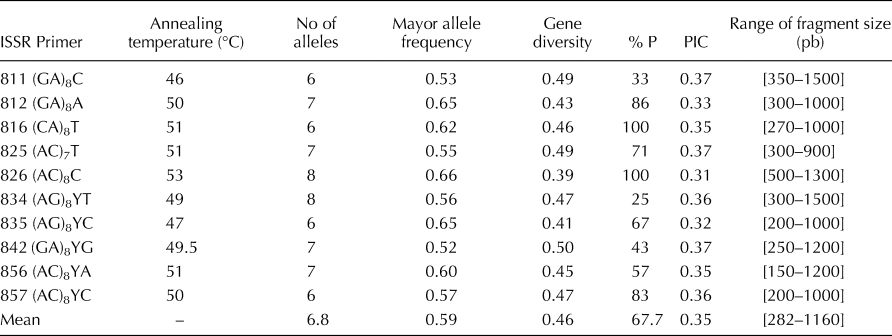
Twelve ISSR primers, previously used in cowpea genetic diversity studies (Ghalmi et al., Reference Ghalmi, Malice, Jacquemin, Ounane, Mekliche and Baudoin2010; Gajera et al., Reference Gajera, Domadiya, Patel and Golakiya2014; Igwe et al., Reference Igwe, Afiukwa, Ubi, Ogbu, Ojuederie and Ude2017; Araújo et al., Reference Araújo, Fiege, Silva and Bertini2019), were tested for their ability to detect polymorphisms in Mexican cowpea landraces. After a preliminary test, 10 primers that yielded good amplification and high levels of polymorphism were selected for ISSR analysis (Table 2).
Number of alleles, allele frequency, gene diversity, percentage of polymorphism and polymorphism information content of 10 ISSR's primers in cowpea landraces from southeast Mexico

% P, percentage of polymorphism; PIC, polymorphic information content.
Polymerase chain reaction (PCR) was performed in a final volume of 15 μl containing 30 ng template DNA, 1X PCR buffer, 0.2 mM MgCl2 (50 mM), 0.2 mM dNTPs (2.5 mM), 0.8 μM primer (10 μM) (T4Oligo) and 1 U of Taq DNA polymerase (5 U/μl) (Invitrogen Standard Taq DNA polymerase recombinant kit) suspended in ultrapure water. DNA amplification was performed in a Select Cycler II thermocycler (Select BioProducts, Edison N.J., EE.UU.) programmed for 4 min denaturation at 94°C, followed by 35 cycles of 1 min at 94°C, 1 min annealing with temperatures ranging from 46 to 53°C depending on the primer used, 1 min at 72°C and final extension for 10 min at 72°C. Amplification products were separated by electrophoresis in 1.5% agarose gel with 1X Sodium Boric acid buffer (Brody and Kern, Reference Brody and Kern2004), visualized and photographed over a UV transilluminator after staining with SYBR Safe (Thermo Fisher Scientific). Amplicon lengths were estimated with a 100 bp DNA Ladder (New England BioLabs, Ipswich, MA, USA).
Analysis of genetic diversity and population structure
Clear and distinct bands amplified by ISSR primers were scored for presence (1) and for absence (0) of individual allele among populations to obtain the data matrix.
Population structure was assessed with STRUCTURE 2.3.4 software based on a no admixture model (Evanno et al., Reference Evanno, Regnaut and Goudet2005). Models were tested for K-values ranging from 1 to 6, with 10 independent runs each and 100,000 Markov chain Monte Carlo interactions. The optimal K value was chosen according to the ΔK statistic proposed by Evanno et al. (Reference Evanno, Regnaut and Goudet2005) using STRUCTURE HARVESTER software (Earl Dent and vonHoldt, Reference Earl Dent and vonHoldt2012). Once the number of genetic clusters was established, each individual was assigned to a cluster and the overall membership of each sampled individual in the cluster was estimated. The genetic diversity and population structure of the cowpea landraces were further investigated by Wright's differentiation index (FST) using the Bayesian approach proposed by Zhivotovsky (Reference Zhivotovsky1999) with AFLP-Surv 1.0 software (Vekemans, Reference Vekemans2002). Because cowpea is treated as a highly self-pollinated plant (Menssen et al., Reference Menssen, Linde, Omondi, Abukutsa-Onyango, Dinssa and Winkelmann2017), the diversity statistics were calculated with the assumption that the populations are mostly selfing (FIS = 0.95). An analysis of molecular variance (AMOVA) was also performed with GenAlEx 6.5 software (Peakall and Smouse, Reference Peakall and Smouse2012).
To assess the genetic relationships among genotypes, a dendrogram was constructed using Nei's genetic distance modified by Lynch and Milligan (Reference Lynch and Milligan1994) and UPGMA. The dendrogram was assessed by bootstrap analysis with 1000 replicates using CONSENSUS software from the PHYLIP package (Felsenstein, Reference Felsenstein2005). The dendrogram was displayed and edited with MEGA version X software (Kumar et al., Reference Kumar, Stecher, Li, Knyaz and Tamura2018).
For each primer, the number of alleles, allele frequency, gene diversity, percentage of polymorphism (% P) and polymorphic information content (PIC), were calculated using PowerMarker version 3.25 software (Liu and Muse, Reference Liu and Muse2005). Genetic diversity indices were calculated at two levels – to the entire sample from Yucatan Peninsula and at individual landrace level. Given the dominant nature of ISSR markers, genetic diversity was also calculated by the Shannon-Weaver index (I). In addition, % P, the number of effective alleles (Ne) and expected heterozygosity (He), were calculated with PopGen version 1.31 software (Yeh et al., Reference Yeh, Yang and Boyle1999).
Results
Molecular diversity of V. unguiculata with ISSR
In this study, 10 ISSR markers were used to assess the genetic diversity of 20 cowpea landraces in Mexico. These ISSR markers generated a total of 68 loci with 67.7% P. The primers 816 and 826 resulted with 100% P. The number of alleles per locus ranged from 6 to 8 with a mean of 6.8 alleles per locus that ranged in size from 282 to 1160 base pairs (Table 2). The major allele frequency ranged from 0.53 to 0.66 with a mean value of 0.59 while genetic diversity ranged from 0.39 in the ISSR 826 to 0.50 in the ISSR 842 with a mean value of 0.46. In addition, the PIC values ranged from 0.31 in the ISSR 826 to 0.37 in the primers ISSR 811, 825 and 842 with a mean of 0.35 (Table 2).
Genetic structure of 20 cowpea landraces from Yucatan Peninsula, Mexico
The analysis of population structure suggested two genetically distinct groups (K = 2) for the entire sample from the Yucatan Peninsula (online Supplementary Fig. S1). The assignment of landraces in the two groups is shown in the bar plot of Fig. 1 with different colours. The red group composed of 12 landraces (P1, P2, P3, P4, P5, P6, P7, P8, P9, P10, P11 and P12). The green group composed of eight landraces (P13, P14, P15, P16, P17, P18, P19 and P20). Focusing on percentages of membership shared within each of the observed groups, the landrace P5 clearly shared more admixture out of the 20 cowpea landraces, with 61 and 39% membership with groups red and green, respectively (Fig. 1). The geographical distribution of the 20 cowpea landraces in Yucatan Peninsula is shown in the Fig. 3.
Inferred ancestry of 20 cowpea landraces for K = 2 groups coloured red and green. Each individual is represented by a thin vertical line, divided into coloured segments that represent the individual estimated membership to each group.

The genetic differentiation of cowpea landraces from southeast Mexico is shown in online Supplementary Table S1. The total diversity (Ht) was 0.24 and diversity within populations (Hs) was 0.14. In addition, the genetic differentiation was high (Fst = 0.42) and gene flow low (Nm = 0.19), indicating that 42% of total genetic diversity was explained by differences among landraces (online Supplementary Table S1). These results agree with the AMOVA which indicated that 66% of total molecular variance was distributed among landraces, while 34% of genetic variance was within landraces (online Supplementary Table S2).
Genetic relationships among 20 cowpea landraces from Yucatan Peninsula, Mexico
The analysis of genetic relationships generated with the UPGMA method showed the formation of two main different clusters (A and B) with 10 landraces each, congruent in part, with the STRUCTURE analysis (Fig. 2). Each branch was colour-coded according to the groups identified by STRUCTURE. Therefore, cluster A contained all landraces from the red group in the STRUCTURE analysis. The cluster B contained all landraces from the green group in the STRUCTURE analysis plus, the landraces P5 and P8 from the red group.
UPGMA dendrogram of genetic relationship of 20 cowpea landraces from Yucatan Peninsula, México. Each branch was colour-coded according to membership into the K = 2 groups identified by STRUCTURE (same colours as in Fig. 1).

Genetic diversity of 20 cowpea landraces from Yucatan Peninsula, Mexico
The genetic diversity was evaluated at two levels, across the entire sample and at landrace level. Both genetic diversity indices evaluated (He and I) showed a moderate level of genetic diversity for the entire sample of cowpea landraces (He = 0.19 and I = 0.30 respectively). Also, the % P and the Ne were 67.7% and 1.32, respectively (Table 3).
Genetic diversity parameters generated from 20 cowpea landraces from southeast Mexico with ISSR markers

% P, percentage of polymorphism; Ne, number of effective alleles; He, expected heterozygosity; I, Shannon's Information index; SD, standard deviation.
At landrace level, values of He ranged from 0.01 to 0.10 and the I ranged from 0.01 to 0.15 (Table 3). Overall, the landraces P12 and P5 both from the state of Campeche, municipality of Calakmul resulted with the highest genetic diversity parameters % P, Ne, He and I. Contrarily, the landraces P17 from the state of Campeche, municipality of Escárcega resulted with the lowest diversity indices with 1.5% P, 1.01 Ne, 0.01 He and 0.01 of I.
Discussion
Analysis of molecular diversity of V. unguiculata with ISSR
Understanding genetic variation has important implications both for the conservation of existing genetic resources and breeding programs for new varieties. In the present study, the genetic diversity and structure analysis of 20 cowpea landraces from southeast Mexico were determined using ISSR molecular markers.
The ISSR markers used in this study successfully assessed the genetic diversity of cowpea landraces, showing high values of % P and PIC. The high levels of polymorphism detected by ISSR primers reflect their coverage of the genome, since microsatellites, besides being abundant, are well distributed (Araújo et al., Reference Araújo, Fiege, Silva and Bertini2019). It has been shown that high polymorphism identifiable by molecular markers in cowpea hinged on the presence of repeated sequences of AC, CA, AG and GA, as adopted in this study (Igwe et al., Reference Igwe, Afiukwa, Ubi, Ogbu, Ojuederie and Ude2017). The mean PIC value observed here (0.35) was similar with previously reported values in cowpea (Chen et al., Reference Chen, Chen, Hu, Wang, Wang, Wang and Chen2017; Araújo et al., Reference Araújo, Fiege, Silva and Bertini2019). PIC value, as measured by Botstein et al. (Reference Botstein, White, Skolnick and Davis1980), showed that a mean PIC value ⩾0.5 is highly informative, 0.25–0.50 reasonably informative and <0.25 is slightly informative, where loci with many alleles and a PIC value near 1 are most desirable (Ali et al., Reference Ali, Yao, Odeny, Kyalo, Skilton and Eltahir2015).
When assessing genetic diversity in Algerian cowpea landraces using ISSR markers, Ghalmi et al. (Reference Ghalmi, Malice, Jacquemin, Ounane, Mekliche and Baudoin2010) found 104 alleles, a mean of 8.6 alleles per marker and 65% P. Recently, Araújo et al. (Reference Araújo, Fiege, Silva and Bertini2019) studying 52 landrace populations from Brazil found 80 alleles, a mean of 5.7 alleles per marker with a polymorphism of 76%. These results were similar to what was observed here and higher than that was observed by Anatala et al. (Reference Anatala, Mandavia, Gajera, Savaliya and Golakiya2014) studying 10 cowpea genotypes with ISSR markers in India. In that study, the authors found a total of 103 alleles, a mean of 5.7 alleles per marker and 47% P (Anatala et al., Reference Anatala, Mandavia, Gajera, Savaliya and Golakiya2014). These differences in the % P can be explained by the origin and size of populations used and the ISSR primers selected for the analysis.
Genetic structure and diversity of cowpea landraces from Yucatan Peninsula, Mexico
In contrast to many other important world crops, relatively little is understood about the domestication history, worldwide dispersal and distribution of genetic variation of cowpea. Two major gene pools (West African versus East African gene pools) are reported in Africa where domestication has occurred (Huynh et al., Reference Huynh, Close, Roberts, Hu, Wanamaker, Lucas, Chiulele, Cissé, David, Hearne, Fatokun, Diop and Ehlers2013). In addition to those gene pools, one additional gene pool was identified by Carvalho et al. (Reference Carvalho, Muñoz-Amatriaín, Castro, Lino-Neto, Matos, Egea-Cortines, Rosa, Close and Carnide2017), corresponding to the regions of North Africa and South Europe.
The results of Bayesian assignation and the UPGMA cluster analysis are congruent in part, with the formation of two main groups. These genetically distinct groups observed in the Yucatan Peninsula could correspond to West and East African gene pools, introduced in this region during the sixteenth and seventeenth centuries. Most cowpeas in North America did not move directly from West Africa, in contrast to the popular view that cowpea was introduced directly from this region during the slave-trading period (Huynh et al., Reference Huynh, Close, Roberts, Hu, Wanamaker, Lucas, Chiulele, Cissé, David, Hearne, Fatokun, Diop and Ehlers2013). In Mexico, V. unguiculata likely was brought independently from three different continents in different periods. It was probably first introduced in the Yucatan Peninsula by the Spaniards simultaneous with the Iberian cowpea in the Caribbean in the sixteenth century (Carvalho et al., Reference Carvalho, Muñoz-Amatriaín, Castro, Lino-Neto, Matos, Egea-Cortines, Rosa, Close and Carnide2017). At the same time, cowpea was brought from eastern Africa to the New World, mostly on slave ships (Herniter, Reference Herniter2019).
In Yucatan Peninsula, cowpea is known by a Maya word, xpelón, and used in the traditional Maya cuisine, mostly eaten in pibes, tamales and broths (Cázares and Duch, Reference Cázares, Duch, Chávez-Servia, Tuxill and Jarvis2004) especially in the traditional festivity of Hanan pixan, the day of the deaths, celebrated in November, which could suggest a very early consumption. However, when and how cowpea arrived in the area is unclear. It remains an open question that requires further studies. Among the exceptions in the UPGMA analysis, the landraces P5 and P8 that belong to the red group in the STRUCTURE analysis were placed in the green cluster in the UPGMA dendrogram. In the first case, the landrace P5 showed a high degree of admixture and shared a great percentage of membership with the green group (Fig. 1). The complexity of the seed exchange network among rural farming communities facilitates access to seeds from other families and communities. In these cases, seed mixture likely occurs, especially when the seed coat exhibits the same colour, increasing the gene flow among landraces (Martínez-Castillo et al., Reference Martínez-Castillo, Colunga-GarcíaMarín and Zizumbo-Villarreal2008). Alternatively, this accession could be an old variety developed by breeders in Mexico and adopted by farmers in the past. In the second case, despite the low levels of gene flow observed in P8 with the populations of the green group in the STRUCTURE analysis, it seems to be enough for the inclusion of P8 within the green cluster in the UPGMA or could be due to differences between both methods. Also, the landrace P8 is known by local farmers by ‘xpelón grande’ similar to the landraces P13 and P16 both placed in the green cluster, in reference to a long vegetative cycle.
The red group formed in the STRUCTURE analysis correspond with the geographical regions of northeastern and southwestern of Campeche, eastern Yucatan and southwestern of Quintana Roo. Likewise, the green group was found across the geographical regions of southern Yucatan and central-eastern of Quintana Roo (Fig. 3). The geographical distribution of both genetic groups in the Yucatan Peninsula likely results from a complex network of seed exchange between communities in this region and not agroecological patterns, environment or political divisions. Also, the geographical regions of southern Yucatan and central-eastern of Quintana Roo included cowpea landraces from both genetic groups. Therefore, these regions are priority areas to develop in-situ conservation programs of cowpea landraces. Nevertheless, to develop a complete understanding of the spatial distribution of cowpea genetic structure in the Yucatan Peninsula, the analyses of a larger number of accessions are necessary.
Geographical distribution and population structure of 20 cowpea landraces from Yucatan Peninsula, México. Red circles and green triangles correspond to the red and green groups identified by STRUCTURE.

Further, the level of genetic differentiation was relatively high (Fst = 0.42), in agreement with the results of the AMOVA, which indicated that 66% of the total variance was distributed among landraces. These results indicate a high genetic divergence between the cowpea landraces of Yucatan Peninsula and can be explained by the low level of gene flow (Nm = 0.19) and levels of endogamy presented in the studied landraces. These results also indicate that local farmers efficiently conserved cowpea landraces with a high level of genetic identity and these landraces should, therefore, be preserved as different accessions in any germplasm collection (Gómez et al., Reference Gómez, Latournerie, Arias, Canul, Tuxill, Chávez-Servia, Tuxill and Jarvis2004).
Genetic diversity of 20 cowpea landraces from Yucatan Peninsula, Mexico
Cowpea was domesticated in West Africa and low levels of genetic diversity both within and between landraces of cultivated cowpea are related to a severe genetic bottleneck that occurred during the cowpea domestication (Chen et al., Reference Chen, Chen, Hu, Wang, Wang, Wang and Chen2017). The level of genetic diversity identified in this study (Ht = 0.24, Hs = 0.14) was lower than what was observed earlier by Gajera et al. (Reference Gajera, Domadiya, Patel and Golakiya2014) and Igwe et al. (Reference Igwe, Afiukwa, Ubi, Ogbu, Ojuederie and Ude2017) in cowpea genotypes from India and Nigeria, respectively. Both authors reported values of total gene diversity (Ht) close to 0.4 and Hs = 0.3. These results may be due to the presence of Iberian cowpea in southeastern Mexico. In the study of Carvalho et al. (Reference Carvalho, Muñoz-Amatriaín, Castro, Lino-Neto, Matos, Egea-Cortines, Rosa, Close and Carnide2017) the authors reported a low genetic diversity in the Iberian cowpea germplasm with He = 0.1.
Genetic parameters including Nei's genetic diversity (He), numbers of effective alleles (Ne) as well as Shannon's information index (I) are crucial in the study of genetic diversity in plant species (Igwe et al., Reference Igwe, Afiukwa, Ubi, Ogbu, Ojuederie and Ude2017). Assessing the data from the entire sample of cowpea landraces from Yucatan Peninsula, the level of genetic diversity observed in our study (Ne = 1.32, He = 0.19 and I = 0.30), it is relatively moderate, compared to other genetic diversity studies with ISSR markers. In India, Gajera et al. (Reference Gajera, Domadiya, Patel and Golakiya2014) assessed the genetic variability among 11 cowpea genotypes that were selected by a range of variability in seed phenotypic and biochemical characteristics, the authors reported values of Ne, He and I of 1.7, 0.42 and 0.61, respectively. Later, Igwe et al. (Reference Igwe, Afiukwa, Ubi, Ogbu, Ojuederie and Ude2017) investigated the genetic diversity of 18 cowpea accessions from different regions in Nigeria using ISSR and SCoT markers, data from ISSR markers revealed that mean values of Ne, He and I were 1.85, 0.45 and 0.64, respectively.
At the landrace level, low levels of intra-landrace variability were observed. Self-pollinated crops like cowpea often possess low intra-population variability (Fikiru et al., Reference Fikiru, Tesfaye and Bekele2010; Etminan et al., Reference Etminan, Pour-Aboughadare, Mohammadi, Ahmadi-Rad, Noori, Mahdavian and Moradi2016; Henareh et al., Reference Henareh, Dursun, Mandoulakani and Haliloglu2016). In the study conducted by Ghalmi et al. (Reference Ghalmi, Malice, Jacquemin, Ounane, Mekliche and Baudoin2010) with cowpea landraces, no differences were observed between individuals of the same landrace with molecular markers. The selection pressure exerted by Mayan farmers over the years likely led to a reduction in genetic diversity strengthening specific agro-ecological adaptations to the region (Gómez et al., Reference Gómez, Latournerie, Arias, Canul, Tuxill, Chávez-Servia, Tuxill and Jarvis2004; Ghalmi et al., Reference Ghalmi, Malice, Jacquemin, Ounane, Mekliche and Baudoin2010; López et al., Reference López, Garruña, Castillo, Martínez-Hernández, Ortiz-García and Andueza-Noh2019). Also, the small number of individuals studied may not be representative of the genetic diversity present in the accessions, masking the results (López et al., Reference López, Garruña, Castillo, Martínez-Hernández, Ortiz-García and Andueza-Noh2019).
Interestingly, in the present study, two landraces (P5 and P12) that were collected in the Calakmul biosphere reserve in the estate of Campeche showed high levels of genetic diversity. These accessions comprise a valuable plant genetic resource that should be protected by conservation programs in the region and is a resource to be used in genetic improvement efforts.
In summary, our results contribute to the knowledge regarding the genetic diversity and structure of V. unguiculata in the Yucatan Peninsula, Mexico and should be considered when formulating criteria for sampling and conservation strategies of cowpea landraces in southern Mexico. Our results also identified cowpea landraces that are available for genetic improvement. Further studies including more landraces and with different molecular markers are suggested to obtain more detailed information and a precise assessment of genetic diversity and structure of cowpea landraces. We recommend to develop in-situ and ex-situ conservation programs of cowpea landraces in the region and to distinctly identify accessions with environmental tolerances, productivity and nutritional value for use in participatory breeding programs.
Supplementary material
To view supplementary material for this article, please visit https://doi.org/10.1017/S147926212000026X
Acknowledgements
The first author thanks the Secretaria de Educación Pública México – Programa para el Desarrollo Profesional Docente for a postgraduate scholarship (folio number: 511-6/2019-12931) and to the Department of Management and Conservation of Tropical Natural Resources in the Universidad Autónoma de Yucatán for the facilities provided for this research work. The authors are grateful to all local farmers that provided the seeds used in this study. Also, we would like to thank the two anonymous reviewers for their suggestions and comments.
Funding
This research was partially supported by the grant Agrodiversidad para la Agricultura Sostenible from SIIDETEY 2018 (SISTPROY: FMVZ-2018-0013)