1. Introduction
Parallel manipulators are commonly used in industrial applications due to the merit of high stiffness, carrying capacity, precision, and low movement inertia [Reference Merlet1]. Lower-mobility manipulators have attracted extensive attention from scholars because of their simpler structures, lower manufacturing cost, and larger workspaces when compared to 6-DOF manipulators [Reference Tsai2–Reference Li, Xu, Chen and Ye4]. Among lower-mobility manipulators, SCARA motion parallel manipulators, which include three translations in space plus one rotation around a given axis, are preferred for tasks such as material handling, surface mounting, parts assembly, and pick-and-place [Reference Krut, Company, Nabat and Pierrot5–Reference Tu, Chen, Ye and Li7].
The Delta robot is the most well-known manipulator that outputs three translations [Reference Clavel8], and numerous Delta-based SCARA motion manipulators have been proposed. The common structural feature of these Delta-based manipulators is that four identical limbs connect the base and the rigid moving platform, such as H4 [Reference Pierrot and Company9], I4 [Reference Krut, Benoit, Ota and Pierrot10], and Par4 [Reference Nabat, de la O Rodriguez, Company, Krut and Pierrot11]. Xie [Reference Xie and Liu12] introduced a high-speed parallel robot with Schönflies motion and analyzed kinematic issues. Salgado synthesized a novel 3T1R (T denotes translation and R denotes rotation) fully parallel manipulator using only lower kinematic pairs in ref. [Reference Salgado, Altuzrra, Petuya and Hernandez13]. Apart from Delta-based manipulators, many novel SCARA motion manipulators have been designed with different kinematic performances. Tian [Reference Tian, Fang and Ge14] designed a generalized parallel mechanism for 3T1R motion with the characteristics of partially decoupling motion. Zhao [Reference Zhao, Wu, Yang, Chen, Chen, Xiong and Zhang15] investigated a 3T1R manipulator and optimized its workspace. Alvarado [Reference Gallardo-Alvarado, Rodriguez-Castro and Delissantos-Lara16] presented the kinematics and dynamics analysis of a 4-PRUR (P is prismatic joint, R is rotational joint, and U is universal joint) parallel manipulator using screw theory and the principle of virtual work. Other novel architectures have been proposed for SCARA motion in the literature [Reference Guo, Wei, Qu, Zhang and Fang17–Reference Rossi, Simoni, Simas and Carboni20].
The manipulators with simple structures mainly offer the advantages of low manufacturing cost and large workspace. Some two-limb architectures have been presented in the literature [Reference Kong and Gosselin21–Reference Lee and Hervé25]. However, only one actuated joint in each limb is fixed to the base, which causes an increase in moving mass when the manipulator moves. It is well known that all actuators should be mounted on the base for better dynamic performance.
Human-like hands [26–Reference Yao, Ceccarelli, Carbone and Dong35] have the ability to perform dexterous manipulations, but they require complex and sophisticated drive systems and sensors, which can lead to high cost and difficulty in design and control. Suction gripping devices [Reference Hasegawa, Wada, Niitani, Okada and Inaba36–Reference Bryan, Kumar and Sahin38] have been developed for grasping objects in cluttered and narrow spaces, but they can be unstable at high speeds, accelerations, or payloads due to their soft material and variable contact area. Several grasping mechanisms based on parallel mechanisms have been proposed that offer high stiffness, accuracy, and load/weight ratio. Jin [Reference Jin, Fang, Zhang and Gong39] designed a novel dexterous hand using three parallel mechanisms as fingers, while Tian [Reference Tian and Zhang40] synthesized a redundant reconfigurable generalized parallel mechanism capable of grasping objects, and Wang [Reference Wang, Fang and Li41] proposed a generalized parallel mechanism with a configurable moving platform suitable for grasping larger or heavier objects. However, these parallel mechanism-based grasping mechanisms have complex structures, which can make control difficult.
Based on previous studies and tests, it has been identified that the simplicity of the architecture is crucial for effective manipulator design. Therefore, in this paper, we propose a novel two-limb architecture with a small number of lower kinematic pairs to address these requirements. Our approach involves constructing a gripper mechanism based on a two-limb 3T1R mechanism with an integrated three-finger end effector. According to our previous work in ref. [Reference Wang, Fang, Zhang and Li42], a 2-DOF driving system is used, and all actuators are mounted on the base to avoid the issue of a large moving mass caused by moving actuators. In Section 2, we use screw theory to verify the DOF characteristics of the proposed manipulator. In Section 3, we solve the inverse and forward kinematic issues. Subsequently, in Section 4, we evaluate the performance of the proposed manipulator in terms of its workspace, singularity, manipulability, and dexterity. We optimize the parameters of the proposed manipulator for improved dexterity in Section 5. Finally, we draw a conclusion in Section 6.
2. Description and mobility of the gripper mechanism
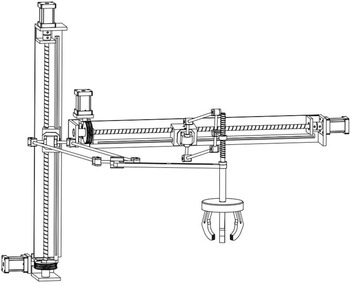
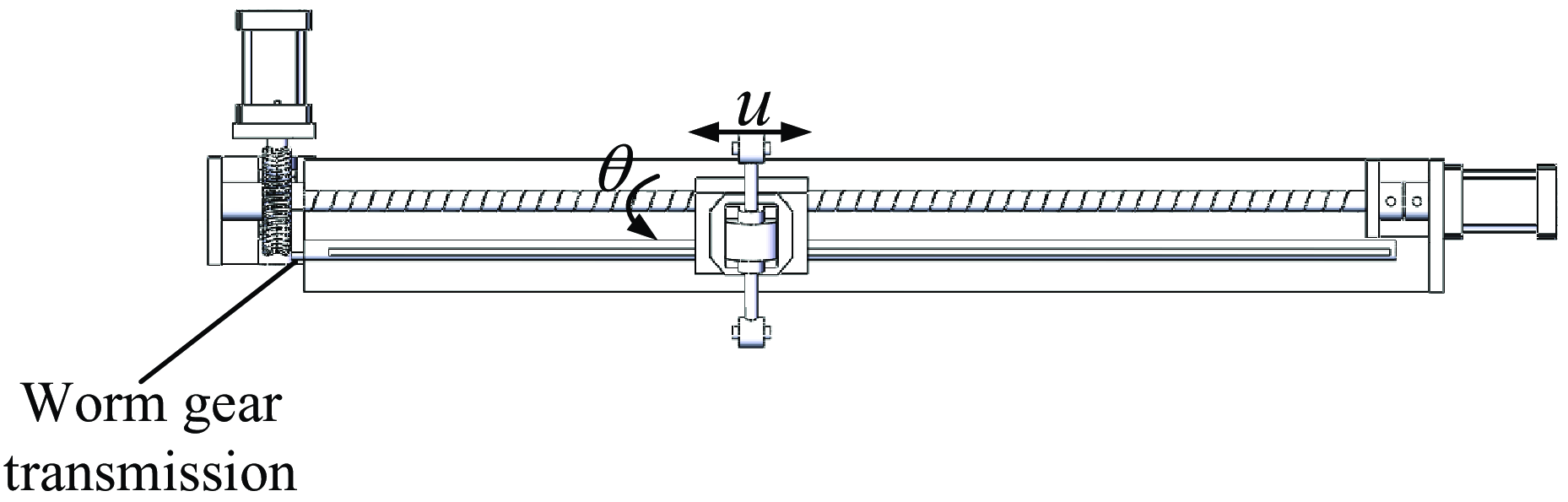
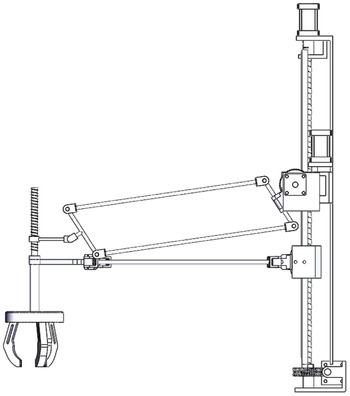
The proposed novel two-limb gripper mechanism is depicted in Fig. 1, consisting of two serial kinematic chains that connect the base and the end effector. The 2-DOF driving system is employed in both serial kinematic chains to achieve a compact design, as is shown in Fig. 2. The 2-DOF driving system is a PR-drive system, where the prismatic joint and the revolute joint are parallel to each other. The input rotation around the axis perpendicular to the
u
-direction is transformed by a worm gear drive system to a rotation around the
u
-direction. The translational direction and rotational angle of the output link are denoted by
u
and
 $\theta$
, respectively, and are controlled by two actuators. A revolute joint is used to connect the two serial kinematic chains, and the three-finger device is mounted on the revolute joint. By rotating the screw, the opening and closing of the three-finger end effector can be achieved.
Two-limb gripper mechanism.

2-DOF driving system.

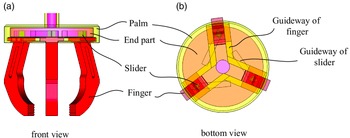
The architecture of the novel three-finger end effector architecture is illustrated in Fig. 3. The gripper comprises of a palm, an end part, three sliders, three fingers, six revolute joints, and six prismatic joints. The three fingers are arranged symmetrically, allowing for the symmetrical movement of the fingers. Taking one finger branch as an example, the finger is connected to the slider via a revolute joint, while the slider has a connection with the end part, forming the prismatic joint simultaneously. The linear movement of the finger is achieved by the prismatic joint between the finger and palm. The palm and end part are connected by a revolute joint, which permits the relative rotation between them. For the mechanism, the end part can output rotational motion, which is also the input motion for the gripper. Thus, the rotation of the end part can be utilized to control the opening and closing of the gripper.
Gripper architecture.

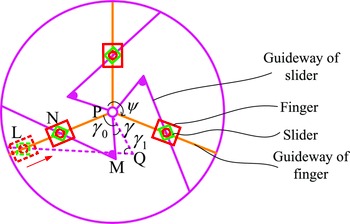
Figure 4 presents the kinematics of the gripper, where the joints and components are expressed in the same color as in the 3D model. The dotted line denotes the initial state in which configuration the angles between the lines LP and PQ and PQ and LQ are represented by
 $\gamma _{0}$
and
 $\gamma _{1}$
, respectively.
 $\gamma$
is the rotational angle of the end part. During the design procedure, the angles
 $\gamma _{0}$
and
 $\gamma _{1}$
as well as the length of MP can be specified. According to the geometric relationship, the length of MN can be calculated by the following equation:
 \begin{equation} \left| \mathrm{MN}\right| =\frac{\left| \mathrm{PQ}\right| \sin \left(\gamma _{0}-\gamma \right)}{\sin \left(\pi -\gamma _{0}+\gamma +\gamma _{1}\right)} \end{equation}
Kinematics of the gripper.

Then, the length of NP can be obtained by:
 \begin{equation} \left| \mathrm{NP}\right| =\left| \mathrm{MP}\right| \cos \left(\gamma _{0}-\gamma \right)+\left| \mathrm{MN}\right| \cos \left(\pi -\gamma _{0}+\gamma +\gamma _{1}\right) \end{equation}
Thus, the opening distance, that is, the length of LN, can be computed by:
 \begin{equation} \left| \mathrm{LN}\right| =\left| \mathrm{LP}\right| -\left| \mathrm{NP}\right| \end{equation}
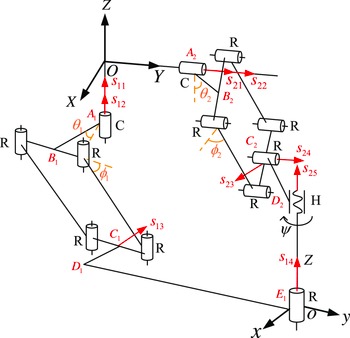
The geometric scheme of the two-limb mechanism is presented in Fig. 5. To facilitate the kinematic study, at the intersection point between the guide rails of the active prismatic joint
 $\mathrm{A}_{1}$
and
 $\mathrm{A}_{2}$
, the origin O is established as the reference point for the global coordinate system. The Z-axis coincides with the direction of joint
 $\mathrm{A}_{1}$
, and the Y-axis is directed along the movement of joint
 $\mathrm{A}_{2}$
. The end effector is equipped with a moving coordinate system, aligned such that its x-, y-, and z-axes run parallel to the X-, Y-, and Z-axes of the fixed coordinate system, respectively. The angle
 $\theta _{1}$
is measured from the dotted line parallel to the X-axis to
 $\mathrm{A}_{1}\mathrm{B}_{1}$
, while
 $\theta _{2}$
is determined from the dotted line parallel to the Z-axis to
 $\mathrm{A}_{2}\mathrm{B}_{2}$
.
 $\theta _{1}$
and
 $\theta _{2}$
denote the input angles. Additionally, the angle
 $\phi _{1}$
is calculated from the dotted line parallel to the short rod to the long rod of parallelogram joint, while
 $\phi _{2}$
is given by measuring from the dotted line parallel to the short rod to the long rod of parallelogram joint. The unit vectors collinear with the axes of different joints are labeled as
 $\boldsymbol{s}_{ij}$
.
 $\psi$
is the rotational angle of the screw joint. It can be observed that the first kinematic chain lies in the XOY plane, whereas the second kinematic chain lies in the XOZ plane.
Geometric scheme of the manipulator.

Based on screw theory [Reference Fang and Tsai43], the properties of output motion can be explored. A generalized prismatic joint can replace the parallelogram joint, allowing movement along the direction perpendicular to the long rod. The branch motion-screw systems for two kinematic chains can be written as:
 \begin{equation} \left\{\boldsymbol{\$ }_{1}^{m}\right\}=\left\{\begin{array}{l} \boldsymbol{\$ }_{11}=\left[\begin{array}{l@{\quad}l@{\quad}l@{\quad}l@{\quad}l@{\quad}l} 0 & 0 & 0; & 0 & 0 & 1 \end{array}\right]^{\mathrm{T}}\\[8pt] \boldsymbol{\$ }_{12}=\left[\begin{array}{l@{\quad}l@{\quad}l@{\quad}l@{\quad}l@{\quad}l} 0 & 0 & 1; & 0 & 0 & 0 \end{array}\right]^{\mathrm{T}}\\[8pt] \boldsymbol{\$ }_{13}=\left[\begin{array}{l@{\quad}l@{\quad}l@{\quad}l@{\quad}l@{\quad}l} 0 & 0 & 0; & -\dfrac{\cot \left(\phi _{1}+\theta _{1}\right)}{\sqrt{1+\cot ^{2}\left(\phi _{1}+\theta _{1}\right)}} & \dfrac{1}{\sqrt{1+\cot ^{2}\left(\phi _{1}+\theta _{1}\right)}} & 0 \end{array}\right]^{\mathrm{T}}\\[15pt] \boldsymbol{\$ }_{14}=\left[\begin{array}{l@{\quad}l@{\quad}l@{\quad}l@{\quad}l@{\quad}l} 0 & 0 & 1; & y_{14} & -x_{14} & 0 \end{array}\right]^{\mathrm{T}} \end{array}\right\} \end{equation}
 \begin{equation} \left\{\boldsymbol{\$ }_{2}^{m}\right\}=\left\{\begin{array}{l} \boldsymbol{\$ }_{21}=\left[\begin{array}{l@{\quad}l@{\quad}l@{\quad}l@{\quad}l@{\quad}l} 0 & 0 & 0; & 0 & 1 & 0 \end{array}\right]^{\mathrm{T}}\\[8pt] \boldsymbol{\$ }_{22}=\left[\begin{array}{l@{\quad}l@{\quad}l@{\quad}l@{\quad}l@{\quad}l} 0 & 1 & 0; & 0 & 0 & 0 \end{array}\right]^{\mathrm{T}} \\[8pt] \boldsymbol{\$ }_{23}=\left[\begin{array}{l@{\quad}l@{\quad}l@{\quad}l@{\quad}l@{\quad}l} 0 & 0 & 0; & \dfrac{\cot \left(\phi _{2}+\theta _{2}\right)}{\sqrt{1+\cot ^{2}\left(\phi _{2}+\theta _{2}\right)}} & 0 & \dfrac{1}{\sqrt{1+\cot ^{2}\left(\phi _{2}+\theta _{2}\right)}} \end{array}\right]^{\mathrm{T}}\\[15pt] \begin{array}{l} \boldsymbol{\$ }_{24}=\left[\begin{array}{l@{\quad}l@{\quad}l@{\quad}l@{\quad}l@{\quad}l} 0 & 1 & 0; & -z_{24} & 0 & x_{24} \end{array}\right]^{\mathrm{T}}\\[8pt] \boldsymbol{\$ }_{25}=\left[\begin{array}{l@{\quad}l@{\quad}l@{\quad}l@{\quad}l@{\quad}l} 0 & 0 & 1; & y_{25} & -x_{25} & p \end{array}\right]^{\mathrm{T}} \end{array} \end{array}\right\} \end{equation}
where
 $\{\boldsymbol{\$ }_{i}^{m}\}$
(i = 1, 2) is the motion-screw systems of two chains,
 $\boldsymbol{\$ }_{ij}$
(i = 1, 2 and j = 1, 2, … , 5) denotes the motion screws of joints in the two chains, and
 $\left(\begin{array}{l@{\quad}l@{\quad}l} x_{ij} & y_{ij} & z_{ij} \end{array}\right)^{\mathrm{T}}$
represents the position of the jth joint in the ith limb, and p is the pitch of the helical joint. Then, the branch constraint-screws systems that are reciprocal to motion-screw systems can be obtained as:
 \begin{equation} \left\{\boldsymbol{\$ }_{1}^{r}\right\}=\left\{\begin{array}{l} \boldsymbol{\$ }_{11}^{r}=\left[\begin{array}{l@{\quad}l@{\quad}l@{\quad}l@{\quad}l@{\quad}l} 0 & 0 & 0; & 1 & 0 & 0 \end{array}\right]^{\mathrm{T}}\\[7pt] \boldsymbol{\$ }_{12}^{r}=\left[\begin{array}{l@{\quad}l@{\quad}l@{\quad}l@{\quad}l@{\quad}l} 0 & 0 & 0; & 0 & 1 & 0 \end{array}\right]^{\mathrm{T}} \end{array}\right\} \end{equation}
 \begin{equation} \boldsymbol{\$ }_{2}^{r}=\left[\begin{array}{c@{\quad}c@{\quad}c@{\quad}c@{\quad}c@{\quad}c} 0 & 0 & 0; & 1 & 0 & 0 \end{array}\right]^{\mathrm{T}} \end{equation}
Note that the reciprocal screws
 $\boldsymbol{\$ }_{11}^{r}$
and
 $\boldsymbol{\$ }_{12}^{r}$
indicate that the first kinematic chain exerts two couples parallel to the x- and y-axis on the moving platform, whereas
 $\boldsymbol{\$ }_{2}^{r}$
represents the couple parallel to the x-axis from the second kinematic chain. The constraint-screw systems provide two constraint couples on the platform, which limits the rotations around the x- and y-axis. A common constraint couple acting about x-axis is obtained. Hence, the number of common constraint is 1, that is,
 $\lambda =1$
. Also, no redundant constraint exists in this mechanism, that is, v = 0. According to its equivalent mechanism, the mechanism is comprised of nine basic components and nine lower joints. Thus, the number of DOF is computed by the modified Kutzbach–Grübler formula [Reference Huang and Li44] as follows:
 \begin{equation} M=d\left(n-g-1\right)+\sum _{i=1}^{g}f_{i}+v=5\left(9-9-1\right)+9=4 \end{equation}
where d is the order of the mechanism,
 $d=6-\lambda$
, n denotes the number of basic components, g represents the number of joints,
 $f_{i}$
indicates the DOF of ith joints, and v is the number of redundant constraints.
Based on the analysis, the mechanism is a Schönflies motion generator if the three-finger end effector is removed. The rotation around the z-axis here is utilized to control the opening and closing of the three-finger end effector. Therefore, the whole DOF of the gripper mechanism remains at 4, which include three translational motions and grasp operation. Due to the structural restrictions in the motion, the geometry relationship between the joints remains unchanged, resulting in a noninstantaneous DOF.
3. Kinematics
The mechanism after removing the three-finger end effector possesses three translations in space plus one rotation around a given axis. The pose variables of the end effector can be given by
 $\boldsymbol{x} [\begin{array}{l@{\quad}l@{\quad}l@{\quad}l} x & y & z & \psi \end{array}]^{\mathrm{T}}$
. The input variables of the four actuators are provided by
 $\boldsymbol{q} [\begin{array}{l@{\quad}l@{\quad}l@{\quad}l} q_{1} & q_{2} & \theta _{1} & \theta _{2} \end{array}]^{\mathrm{T}}$
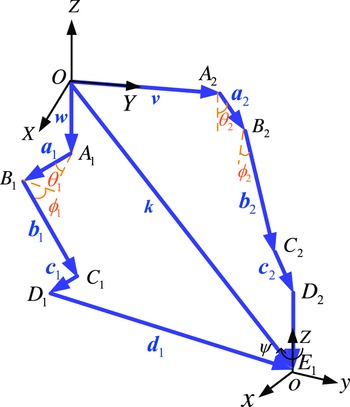
. The vector notation for the kinematic modeling of its equivalent simplified mechanism is presented in Fig. 6. The length of links are defined as
 $\mathrm{A}_{i}\mathrm{B}_{i}=l_{i1}, \mathrm{B}_{i}\mathrm{C}_{i}=l_{i2}, \mathrm{C}_{i}\mathrm{D}_{i}=l_{i3}$
, and
 $\mathrm{D}_{1}\mathrm{E}_{1}=l_{14}$
. The vector loop closure equations are utilized for both position and velocity analysis. Two equations can be obtained:
 \begin{equation} \left\{\begin{array}{l} q_{1}\boldsymbol{w}+l_{11}\boldsymbol{a}_{1}+l_{12}\boldsymbol{b}_{1}+l_{13}\boldsymbol{c}_{1}+l_{14}\boldsymbol{d}_{1}=\boldsymbol{k} \\[6pt] q_{2}\boldsymbol{v}+l_{21}\boldsymbol{a}_{2}+l_{22}\boldsymbol{b}_{2}+l_{23}\boldsymbol{c}_{2}+p\psi \boldsymbol{w}=\boldsymbol{k} \end{array}\right. \end{equation}
where the vectors are defined as follows:
Vector notation for the kinematic modeling.

 $\boldsymbol{w}=[\begin{array}{l@{\quad}l@{\quad}l} 0 & 0 & -1 \end{array}]^{\mathrm{T}}, \boldsymbol{v}=[\begin{array}{l@{\quad}l@{\quad}l} 0 & 1 & 0 \end{array}]^{\mathrm{T}}, \boldsymbol{k}=[\begin{array}{l@{\quad}l@{\quad}l} x & y & z \end{array}]^{\mathrm{T}}, \boldsymbol{a}_{1}=\boldsymbol{c}_{1}=[\begin{array}{l@{\quad}l@{\quad}l} \cos \theta _{1} & -\sin \theta _{1} & 0 \end{array}]^{\mathrm{T}}$
,
 $\boldsymbol{b}_{1}=[\begin{array}{l@{\quad}l@{\quad}l} \sin (\phi _{1}+\theta _{1}) & \cos (\phi _{1}+\theta _{1}) & 0 \end{array}]^{\mathrm{T}}, \boldsymbol{d}_{1}=[\begin{array}{l@{\quad}l@{\quad}l} \sin \theta _{1} & \cos \theta _{1} & 0 \end{array}]^{\mathrm{T}}, \boldsymbol{a}_{2}=[\begin{array}{l@{\quad}l@{\quad}l} \sin \theta _{2} & 0 & \cos \theta _{2} \end{array}]^{\mathrm{T}}$
,
 $\boldsymbol{b}_{2}=[\begin{array}{l@{\quad}l@{\quad}l} \cos (\phi _{2}-\theta _{2}) & 0 & \sin (\phi _{2}-\theta _{2}) \end{array}]^{\mathrm{T}}, \boldsymbol{c}_{2}=[\begin{array}{l@{\quad}l@{\quad}l} 1 & 0 & 0 \end{array}]^{\mathrm{T}}$
.
Further, Eq. (9) can be simplified as:
 \begin{equation} \left\{\begin{array}{l} l_{11}\cos \theta _{1}+l_{12}\sin \left(\phi _{1}+\theta _{1}\right)+l_{13}\cos \theta _{1}+l_{14}\sin \theta _{1}=x\\[5pt] -l_{11}\sin \theta _{1}+l_{12}\cos \left(\phi _{1}+\theta _{1}\right)-l_{13}\sin \theta _{1}+l_{14}\cos \theta _{1}=y\\[5pt] -q_{1}=z \end{array}\right. \end{equation}
 \begin{equation} \left\{\begin{array}{l} l_{21}\sin \theta _{2}+l_{22}\cos \left(\phi _{2}-\theta _{2}\right)+l_{23}=x \\[5pt] q_{2}=y \\[5pt] l_{21}\cos \theta _{2}+l_{22}\sin \left(\phi _{2}-\theta _{2}\right)-p\psi =z \end{array}\right. \qquad\qquad\qquad\end{equation}
Based on the results presented in Eqs. (10) and (11), it can be concluded that the output translation along the z-axis is a function of the input variable
 $q_{1}$
, while the output translation along the y-axis is dependent on the input variable
 $q_{2}$
. These equations demonstrate that the proposed manipulator exhibits partial decoupling of input–output motions, which facilitates precise control and enhances accuracy.
3.1. Inverse kinematic problems
For inverse kinematic problems, the positon of the end effector
 $\boldsymbol{x} [\begin{array}{l@{\quad}l@{\quad}l@{\quad}l} x & y & z & \psi \end{array}]^{\mathrm{T}}$
is given, and the input variables
 $\boldsymbol{q} [\begin{array}{l@{\quad}l@{\quad}l@{\quad}l} q_{1} & q_{2} & \theta _{1} & \theta _{2} \end{array}]^{\mathrm{T}}$
need to be computed.
Squaring both sides of the first two equations in Eq. (10) yields
 \begin{equation} g_{1}=g_{2}\cos \theta _{1}-g_{3}\sin \theta _{1} \end{equation}
where
 $g_{1}=l_{11}^{2}+l_{13}^{2}+l_{14}^{2}+2l_{11}l_{13}+x^{2}+y^{2}-l_{12}^{2}, g_{2}=2(l_{11}x+l_{13}x+l_{14}y), g_{3}=2(-l_{14}x+l_{11}y+l_{13}y)$
.
Hence, the input variable
 $\theta _{1}$
can be derived as:
 \begin{equation} \theta _{1}=2\arctan \left(\frac{-g_{3}\pm \sqrt{-g_{1}^{2}+g_{2}^{2}+g_{3}^{2}}}{g_{1}+g_{2}}\right) \end{equation}
Similarly, by squaring both sides of the first and the last equations in Eq. (11), an equation is obtained:
 \begin{equation} s_{1}=s_{2}\cos \theta _{2}-s_{3}\sin \theta _{2} \end{equation}
where
 $s_{1}=l_{21}^{2}+l_{23}^{2}+x^{2}+z^{2}+(p\psi )^{2}-l_{22}^{2}+2pz\psi -2l_{23}x, s_{2}=2l_{21}(p\psi +z), s_{3}=2l_{21}(l_{23}-x)$
.
Then, the input variable
 $\theta _{2}$
is computed:
 \begin{equation} \theta _{2}=2\arctan \left(\frac{s_{3}\pm \sqrt{-s_{1}^{2}+s_{2}^{2}+s_{3}^{2}}}{s_{1}+s_{2}}\right) \end{equation}
Since the two inputs of two prismatic joints can be obtained directly due to partial decoupling motion, the input parameters can be found as follows:
 \begin{equation} \left\{\begin{array}{l} q_{1}=-z \\[3pt] q_{2}=y \\[3pt] \theta _{1}=f_{1}\left(x, y\right) \\[3pt] \theta _{2}=f_{2}\left(x, z, \psi \right) \end{array}\right. \end{equation}
3.2. Direct kinematic problems
For direct kinematic problems, the input parameters
 $\boldsymbol{q} [\begin{array}{l@{\quad}l@{\quad}l@{\quad}l} q_{1} & q_{2} & \theta _{1} & \theta _{2} \end{array}]^{\mathrm{T}}$
are known, and the aim is to determine the coordinates of the end effector
 $\boldsymbol{x} [\begin{array}{l@{\quad}l@{\quad}l@{\quad}l} x & y & z & \psi \end{array}]^{\mathrm{T}}$
.
Squaring both sides of the first two equations in Eq. (10) yields
 \begin{equation} m_{1}=-x^{2}+m_{2}x \end{equation}
where
 $m_{1}=l_{11}^{2}+l_{13}^{2}+2l_{11}l_{13}+l_{14}^{2}+y^{2}-l_{12}^{2}-2l_{14}y\cos \theta _{1}+2(l_{11}+l_{13})y\sin \theta _{1}$
,
 $m_{2}=2[(l_{11}+l_{13})$
 $\cos \theta _{1}+l_{14}\sin \theta _{1}]$
.
Consequently, the position along the x-coordinate can be derived as:
 \begin{equation} x=\frac{1}{2}\left(m_{2}\pm \sqrt{-4m_{1}+m_{2}^{2}}\right) \end{equation}
Squaring both sides of the first and the last equations in Eq. (11) yields
 \begin{equation} n_{1}p\psi +\left(p\psi \right)^{2}=n_{2} \end{equation}
where
 $n_{1}=2z-2l_{21}\cos \theta _{2}, n_{2}=l_{22}^{2}+2l_{23}x-l_{21}^{2}-l_{23}^{2}-x^{2}-z^{2}-2l_{21}(l_{23}-x)\sin \theta _{2}+2l_{21}z\cos \theta _{2}$
.
Thus, the output rotation angle is calculated by:
 \begin{equation} \psi =\frac{\pm n_{1}+\sqrt{n_{1}^{2}+4n_{2}}}{2p} \end{equation}
In summary, based on the above analysis, the position coordinates and the orientation of the end effector can be obtained as:
 \begin{equation} \left\{\begin{array}{l} x=F_{1}\left(q_{2}, \theta _{1}\right)\\[3pt] y=q_{2}\\[3pt] z=-q_{1}\\[3pt] \psi =F_{2}\left(q_{1}, q_{2}, \theta _{1}, \theta _{2}\right) \end{array}\right. \end{equation}
3.3. Velocity analysis
Based on the forgoing kinematic analysis, differentiation on both sides of Eq. (16) with respect of time yields
 \begin{equation} \boldsymbol{K}_{x}\dot{\boldsymbol{x}}=\boldsymbol{K}_{q}\dot{\boldsymbol{q}} \end{equation}
The Jacobian J can be obtained by:
 \begin{equation} \boldsymbol{J}=\boldsymbol{K}_{\mathrm{q}}^{-1}\boldsymbol{K}_{\mathrm{x}} \end{equation}
where
 \begin{align*} \dot{\boldsymbol{x}} & =[\begin{array}{l@{\quad}l@{\quad}l@{\quad}l} \dot{x} & \dot{y} & \dot{z} & \dot{\psi } \end{array}]^{\mathrm{T}}, \dot{\boldsymbol{q}}=[\begin{array}{l@{\quad}l@{\quad}l@{\quad}l} \dot{\theta }_{1} & \dot{\theta }_{2} & \dot{q}_{1} & \dot{q}_{2} \end{array}]^{\mathrm{T}}, \boldsymbol{K}_{\mathrm{x}}=\left[\begin{array}{c@{\quad}c@{\quad}c@{\quad}c} a_{11} & a_{12} & 0 & 0\\ a_{21} & 0 & a_{23} & a_{24}\\ 0 & 1 & 0 & 0\\ 0 & 0 & -1 & 0 \end{array}\right],\\ & \boldsymbol{K}_{\mathrm{q}}=\left[\begin{array}{c@{\quad}c@{\quad}c@{\quad}c} b_{11} & 0 & 0 & 0\\ 0 & b_{22} & 0 & 0\\ 0 & 0 & 1 & 0\\ 0 & 0 & 0 & 1 \end{array}\right]\end{align*}
with
 $a_{11}=2x-2\cos \theta _{1}(l_{11}+l_{13})-2\sin \theta _{1}l_{14}, a_{12}=2y-2\cos \theta _{1}l_{14}+2\sin \theta _{1}(l_{11}+l_{13})$
,
 $a_{21}=-2x+2l_{23}+2l_{21}\cos \theta _{2}, a_{23}=2p\psi -2z-2l_{21}\sin \theta _{2}, a_{24}=2pz+2pl_{21}\sin \theta _{2}-2p\psi$
,
 $b_{11}=2((l_{11}+l_{13})y-l_{14}x)\cos \theta _{1}+2((l_{11}+l_{13})x+l_{14}y)\sin \theta _{1}$
,
 $b_{22}=2p\psi l_{21}\cos \theta _{2}+2l_{21}\left(l_{23}-x\right)\sin \theta _{2}-2l_{21}z\cos \theta _{2}$
Thus, the velocity equation of the proposed manipulator can be obtained as:
 \begin{equation} \boldsymbol{J}\dot{\boldsymbol{x}}=\dot{\boldsymbol{q}} \end{equation}
4. Performance evaluation of the gripper mechanism
Evaluating performance is an essential aspect of mechanical design. Some kinematic metrics are used to evaluate manipulator performance, such as singularity, workspace, manipulability, and dexterity. By analyzing these indices, designers can synthesize and construct manipulators that exhibit improved performance for practical applications. The Jacobian matrix and its properties, such as the determinant, eigenvalues, and condition number, serve as the basis for evaluating performance indices, making it an indispensable tool for analyzing the motion. Thus, the Jacobian matrix should be derived first.
4.1. Jacobian and singularity analysis
The Jacobian matrix plays a critical role in analyzing the singular configurations of a parallel manipulator by connecting the end effector velocity with the joint velocity. In this study, screw theory-based method [Reference Tsai45] is used to solve the Jacobian matrix.
Singular configurations within the workspace of a parallel mechanism can limit its performance, as these configurations may cause a change in DOF of the mechanism, allowing the end effector to move even though all actuators are locked. This is undesirable in practical applications, and it can affect manipulability and control accuracy. Therefore, a manipulator should not only avoid singular configurations but also maintain a safe distance from the region close to singularity to ensure better kinematic performance and control. When the manipulator approaches a singular configuration, the relationship between the input motion and output motion distorts, leading to difficulty in control. Thus, singularity analysis is important for better kinematic performance and control of a manipulator.
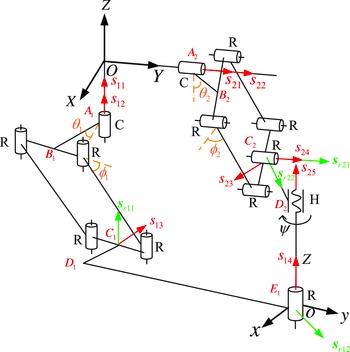
The screws associated with the joints in the mechanism are presented in Fig. 7. The instantaneous twist of the end effector can be given as
 $\boldsymbol{\$ }_{p}=[\begin{array}{l@{\quad}l} \boldsymbol{w}^{\mathrm{T}} & \boldsymbol{v}^{\mathrm{T}} \end{array}]^{\mathrm{T}}$
, where
 $\boldsymbol{w} = [\begin{array}{l@{\quad}l@{\quad}l} 0 & 0 & w_{z} \end{array}]^{\mathrm{T}}$
and
 $\boldsymbol{v} = [\begin{array}{l@{\quad}l@{\quad}l} v_{x} & v_{y} & v_{z} \end{array}]^{\mathrm{T}}$
are referred to the angular velocity and linear velocity of the end effector, respectively. The detailed expression can be obtained by using the linear combination of all joints in each limb:
 \begin{equation} \boldsymbol{\$ }_{P}=\dot{q}_{1}\boldsymbol{\$ }_{11}+\dot{\theta }_{1}\boldsymbol{\$ }_{12}+w_{13}\boldsymbol{\$ }_{13}+\dot{\psi }\boldsymbol{\$ }_{24} \end{equation}
 \begin{equation} \boldsymbol{\$ }_{P}=\dot{q}_{2}\boldsymbol{\$ }_{21}+\dot{\theta }_{2}\boldsymbol{\$ }_{22}+w_{23}\boldsymbol{\$ }_{23}+w_{24}\boldsymbol{\$ }_{24}+\dot{\psi }\boldsymbol{\$ }_{25} \end{equation}
in which
 $\boldsymbol{\$ }_{ij}$
indicates the unit screw associated with the jth joint in the ith limb,
 $\dot{q}_{i}$
is the linear velocity of the actuated prismatic joints, while
 $\dot{\theta }_{i}, w_{ij}$
and
 $\dot{\psi }$
denote the angular velocity of the actuated revolute joints, passive revolute joints, and screw joint, respectively.
Screws in the mechanism.

The screws can be given as:
 \begin{align} \boldsymbol{\$ }_{i1} & =\left[\begin{array}{l@{\quad}l} 0^{\mathrm{T}} & \boldsymbol{s}_{i1}^{\mathrm{T}} \end{array}\right]^{\mathrm{T}}\nonumber\\[3pt]\boldsymbol{\$ }_{i2} & =\left[\begin{array}{l@{\quad}l} \boldsymbol{s}_{i2}^{\mathrm{T}} & \boldsymbol{o}\boldsymbol{A}_{i}^{\mathrm{T}}\times \boldsymbol{s}_{i2}^{\mathrm{T}} \end{array}\right]^{\mathrm{T}}\nonumber\\[3pt]\boldsymbol{\$ }_{i3} & =\left[\begin{array}{l@{\quad}l} 0^{\mathrm{T}} & \boldsymbol{s}_{i3}^{\mathrm{T}} \end{array}\right]^{\mathrm{T}}\nonumber\\[3pt]\boldsymbol{\$ }_{14} & =\left[\begin{array}{l@{\quad}l} \boldsymbol{s}_{14}^{\mathrm{T}} & 0 \end{array}\right]^{\mathrm{T}}\nonumber\\[3pt]\boldsymbol{\$ }_{24} & =\left[\begin{array}{l@{\quad}l} \boldsymbol{s}_{24}^{\mathrm{T}} & \boldsymbol{o}{\boldsymbol{C}^{\mathrm{T}}_{2}}\times \boldsymbol{s}_{24}^{\mathrm{T}} \end{array}\right]^{\mathrm{T}} \end{align}
in which
 $\boldsymbol{s}_{11}=\boldsymbol{s}_{12}=\boldsymbol{s}_{14}=[\begin{array}{l@{\quad}l@{\quad}l} 0 & 0 & 1 \end{array}]^{\mathrm{T}}, \boldsymbol{s}_{21}=\boldsymbol{s}_{22}=\boldsymbol{s}_{24}=[\begin{array}{l@{\quad}l@{\quad}l} 0 & 1 & 0 \end{array}]^{\mathrm{T}}$
,
 $\boldsymbol{s}_{13}=\left[\begin{array}{l@{\quad}l@{\quad}l} -\dfrac{\cot \left(\phi _{1}+\theta _{1}\right)}{\sqrt{1+\cot ^{2}\left(\phi _{1}+\theta _{1}\right)}} & \dfrac{1}{\sqrt{1+\cot ^{2}\left(\phi _{1}+\theta _{1}\right)}} & 0 \end{array}\right]^{\mathrm{T}}$
,
 $\boldsymbol{s}_{23}=\left[\begin{array}{l@{\quad}l@{\quad}l} \dfrac{\cot \left(\phi _{2}+\theta _{2}\right)}{\sqrt{1+\cot ^{2}\left(\phi _{2}+\theta _{2}\right)}} & 0 & \dfrac{1}{\sqrt{1+\cot ^{2}\left(\phi _{2}+\theta _{2}\right)}} \end{array}\right]^{\mathrm{T}}$
.
To eliminate certain passive joint screws, we use the theory of reciprocal screws. Specifically, when locking the actuated prismatic in the first limb, a screw denoted as
 $\boldsymbol{\$ }_{{r}11}$
can be identified that is reciprocal to all screws but
 $\boldsymbol{\$ }_{11}$
. This screw is parallel to the axes of
 $\boldsymbol{\$ }_{12}$
and
 $\boldsymbol{\$ }_{14}$
and simultaneously perpendicular to the axis of
 $\boldsymbol{\$ }_{13}$
:
 \begin{equation} \boldsymbol{\$ }_{{r}11}=\left[\boldsymbol{s}_{{r}11}^{\mathrm{T}} \boldsymbol{o}{\boldsymbol{C}^{\mathrm{T}}_{1}}\times \boldsymbol{s}_{{r}11}^{\mathrm{T}}\right]^{\mathrm{T}} \end{equation}
After locking the actuated revolute joint in the first limb, a screw can be found as
 $\boldsymbol{\$ }_{{r}12}$
that is reciprocal to all screws besides
 $\boldsymbol{\$ }_{12}$
. This screw intersects with
 $\boldsymbol{\$ }_{14}$
and is parallel to the normal direction of the plane determined by the vectors
 $\boldsymbol{s}_{11}$
and
 $\boldsymbol{s}_{13}$
:
 \begin{equation} \boldsymbol{\$ }_{{r}12}=\left[\boldsymbol{s}_{{r}12}^{\mathrm{T}}0\right]^{\mathrm{T}} \end{equation}
Taking the orthogonal products of both sides of Eq. (25) with (28) and (29) in turn yields
 \begin{equation} \boldsymbol{\$ }_{r11}^{\mathrm{T}}\boldsymbol{\$ }_{P}=\dot{q}_{1}\boldsymbol{\$ }_{r11}^{\mathrm{T}}\boldsymbol{\$ }_{11} \end{equation}
 \begin{equation} \boldsymbol{\$ }_{r12}^{\mathrm{T}}\boldsymbol{\$ }_{P}=\dot{\theta }_{1}\boldsymbol{\$ }_{r12}^{\mathrm{T}}\boldsymbol{\$ }_{12} \end{equation}
When locking the actuated prismatic joint in the second limb, a screw denoted as
 $\boldsymbol{\$ }_{{r}21}$
can be identified that is reciprocal to all screws apart from
 $\boldsymbol{\$ }_{21}$
. This screw is parallel to the axes of
 $\boldsymbol{\$ }_{22}$
and
 $\boldsymbol{\$ }_{24}$
and simultaneously perpendicular to
 $\boldsymbol{\$ }_{23}$
:
 \begin{equation} \boldsymbol{\$ }_{{r}21}=\left[\boldsymbol{s}^{\mathrm{T}}_{{r}21} \boldsymbol{o}{\boldsymbol{C}^{\mathrm{T}}_{2}}\times \boldsymbol{s}^{\mathrm{T}}_{{r}21}\right]^{\mathrm{T}} \end{equation}
After locking the actuated revolute joint in the second limb, a screw can be found as
 $\boldsymbol{\$ }_{{r}22}$
that is reciprocal to all screws but
 $\boldsymbol{\$ }_{22}$
. This screw intersects with
 $\boldsymbol{\$ }_{24}$
and
 $\boldsymbol{\$ }_{25}$
simultaneously and is parallel to the normal direction of the plane determined by the vectors
 $\boldsymbol{s}_{21}$
and
 $\boldsymbol{s}_{23}$
:
 \begin{equation} \boldsymbol{\$ }_{{r}22}=\left[\boldsymbol{s}_{{r}22}^{\mathrm{T}} \boldsymbol{o}{\boldsymbol{C}^{\mathrm{T}}_{2}}\times \boldsymbol{s}_{{r}22}^{\mathrm{T}}\right]^{\mathrm{T}} \end{equation}
Taking the orthogonal products of both sides of Eq. (26) with (32) and (33) in turn yields
 \begin{equation} \boldsymbol{\$ }_{r21}^{\mathrm{T}}\boldsymbol{\$ }_{P}=\dot{q}_{2}\boldsymbol{\$ }_{r21}^{\mathrm{T}}\boldsymbol{\$ }_{21} \end{equation}
 \begin{equation} \boldsymbol{\$ }_{r22}^{\mathrm{T}}\boldsymbol{\$ }_{P}=\dot{\theta }_{2}\boldsymbol{\$ }_{r22}^{\mathrm{T}}\boldsymbol{\$ }_{22} \end{equation}
Based on the above analysis, Eqs. (30), (31), (34), and (35) can be rewritten in matrix form:
 \begin{equation} \left[\begin{array}{l} \boldsymbol{\$ }_{r11}^{\mathrm{T}}\\[5pt] \boldsymbol{\$ }_{r12}^{\mathrm{T}}\\[5pt] \boldsymbol{\$ }_{r21}^{\mathrm{T}}\\[5pt] \boldsymbol{\$ }_{r22}^{\mathrm{T}} \end{array}\right]\boldsymbol{\$ }_{P}=\left[\begin{array}{l@{\quad}l@{\quad}l@{\quad}l} \boldsymbol{\$ }_{r11}^{\mathrm{T}}\boldsymbol{\$ }_{11} & & & \\[5pt] & \boldsymbol{\$ }_{r12}^{\mathrm{T}}\boldsymbol{\$ }_{12} & & \\[5pt] & & \boldsymbol{\$ }_{r21}^{\mathrm{T}}\boldsymbol{\$ }_{21} & \\[5pt] & & & \boldsymbol{\$ }_{r22}^{\mathrm{T}}\boldsymbol{\$ }_{22} \end{array}\right]\left[\begin{array}{l} \dot{q}_{1}\\[5pt] \dot{\theta }_{1}\\[5pt] \dot{q}_{2}\\[5pt] \dot{\theta }_{2} \end{array}\right] \end{equation}
Equation (36) can also be expressed in a general form as:
 \begin{equation} \boldsymbol{J}_{x}\boldsymbol{\$ }_{P}=\boldsymbol{J}_{q}\dot{\boldsymbol{q}} \end{equation}
where
 $\boldsymbol{J}_{{x}}=\left[\begin{array}{l} \boldsymbol{\$ }_{{r}11}^{\mathrm{T}}\\[5pt] \boldsymbol{\$ }_{{r}12}^{\mathrm{T}}\\[5pt] \boldsymbol{\$ }_{{r}21}^{\mathrm{T}}\\[5pt] \boldsymbol{\$ }_{{r}22}^{\mathrm{T}} \end{array}\right], \boldsymbol{J}_{{q}}=\left[\begin{array}{l@{\quad}l@{\quad}l@{\quad}l} \boldsymbol{\$ }_{{r}11}^{\mathrm{T}}\boldsymbol{\$ }_{11} & 0 & 0 & 0\\[5pt] 0 & \boldsymbol{\$ }_{{r}12}^{\mathrm{T}}\boldsymbol{\$ }_{12} & 0 & 0\\[5pt] 0 & 0 & \boldsymbol{\$ }_{{r}21}^{\mathrm{T}}\boldsymbol{\$ }_{21} & 0\\[5pt] 0 & 0 & 0 & \boldsymbol{\$ }_{{r}22}^{\mathrm{T}}\boldsymbol{\$ }_{22} \end{array}\right], \dot{\boldsymbol{q}} = \left[\begin{array}{l} \dot{q}_{1}\\[5pt] \dot{\theta }_{1}\\[5pt] \dot{q}_{2}\\[5pt] \dot{\theta }_{2} \end{array}\right]$
By analyzing the obtained Jacobian matrix, it is possible to identify singular configurations.
4.1.1. Inverse kinematic singularity
If any of the diagonal elements of the matrix
 $\boldsymbol{J}_{q}$
are zero, it can lead to the occurrence of the inverse kinematic singularity in the mechanism. After performing calculations, the equation
 $\boldsymbol{\$ }_{{r}11}^{\mathrm{T}}\boldsymbol{\$ }_{11}=\boldsymbol{\$ }_{{r}21}^{\mathrm{T}}\boldsymbol{\$ }_{21}=1$
can be obtained. Therefore, the inverse kinematic singularity occurs when
 $\boldsymbol{\$ }_{{r}12}^{\mathrm{T}}\boldsymbol{\$ }_{12}=0$
or
 $\boldsymbol{\$ }_{{r}22}^{\mathrm{T}}\boldsymbol{\$ }_{22}=0$
. Then the following relations can be obtained:
 \begin{equation} \boldsymbol{\$ }_{{r}12}^{\mathrm{T}}\boldsymbol{\$ }_{12}=\boldsymbol{s}_{12}^{\mathrm{T}}\left(\boldsymbol{o}{\boldsymbol{A}^{\mathrm{T}}_{1}}\times \boldsymbol{s}_{{r}12}^{\mathrm{T}}\right) \end{equation}
 \begin{equation} \boldsymbol{\$ }_{{r}22}^{\mathrm{T}}\boldsymbol{\$ }_{22}=\boldsymbol{s}_{22}^{\mathrm{T}}\left(\boldsymbol{s}_{{r}22}^{\mathrm{T}}\times \boldsymbol{C}_{2}{\boldsymbol{A}_{2}}^{\mathrm{T}}\right) \end{equation}
If these three vectors
 $\boldsymbol{s}_{12}, \boldsymbol{o}\boldsymbol{A}_{1}$
, and
 $\boldsymbol{s}_{\mathrm{r}12}$
are coplanar, which means that the projection of
 $\mathrm{oA}_{1}$
and
 $\mathrm{B}_{1}\mathrm{C}_{1}$
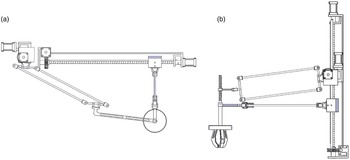
on the XOY plane are parallel to each other, and the mechanism moves to the singular configuration. This is the case illustrated in Fig. 8(a). When the three vectors
 $\boldsymbol{s}_{22}, \boldsymbol{C}_{2}\boldsymbol{A}_{2}$
, and
 $\boldsymbol{s}_{\mathrm{r}22}$
are coplanar, that is, the long rod and the short rod in the parallelogram joint form a right angle, Eq. (39) is equal to zero. The singular configuration is depicted in Fig. 8(b).
Inverse kinematic singular configurations: (a) case 1 and (b) case 2.

4.1.2. Forward kinematic singularity
From Eq. (37), we can obtain
 \begin{equation} \boldsymbol{J}_{{x}}=\left[\begin{array}{c@{\quad}c} \boldsymbol{s}_{{r}11}^{\mathrm{T}} & \boldsymbol{o}{\boldsymbol{C}^{\mathrm{T}}_{1}}\times \boldsymbol{s}_{{r}11}^{\mathrm{T}}\\[5pt] \boldsymbol{s}_{{r}12}^{\mathrm{T}} & 0\\[5pt] \boldsymbol{s}^{\mathrm{T}}_{{r}21} & \boldsymbol{o}{\boldsymbol{C}^{\mathrm{T}}_{2}}\times \boldsymbol{s}^{\mathrm{T}}_{{r}21}\\[5pt] \boldsymbol{s}_{{r}22}^{\mathrm{T}} & \boldsymbol{o}{\boldsymbol{C}^{\mathrm{T}}_{2}}\times \boldsymbol{s}_{{r}22}^{\mathrm{T}} \end{array}\right] \end{equation}
When the matrix
 $\boldsymbol{J}_{{x}}$
is rank-deficient, the forward kinematic singularity occurs. There is a zero element in this matrix. If there are two or more zero elements in the matrix, the matrix is rank-deficient. First, when
 $\boldsymbol{o}{\boldsymbol{C}^{\mathrm{T}}_{1}}\times \boldsymbol{s}_{{r}11}^{\mathrm{T}}$
is equal to zero, the vectors
 $\boldsymbol{o}\boldsymbol{C}_{1}$
and
 $\boldsymbol{s}_{{r}11}$
coincide with each other. According to the structural limitations, this case does not exist. Second, when
 $\boldsymbol{o}{\boldsymbol{C}^{\mathrm{T}}_{2}}\times \boldsymbol{s}^{\mathrm{T}}_{{r}21}$
is equal to zero, the vector
 $\boldsymbol{o}\boldsymbol{C}_{2}$
should coincide with
 $\boldsymbol{s}_{{r}21}$
. Similarly, due to the structural limitations, this case does not exist, either. Finally,
 $\boldsymbol{o}{\boldsymbol{C}^{\mathrm{T}}_{2}}\times \boldsymbol{s}_{{r}22}^{\mathrm{T}}$
vanishes, which means that the vector
 $\boldsymbol{o}\boldsymbol{C}_{2}$
coincides with
 $\boldsymbol{s}_{{r}22}$
. This is the case illustrated in Fig. 9.
Forward kinematic singular configuration.

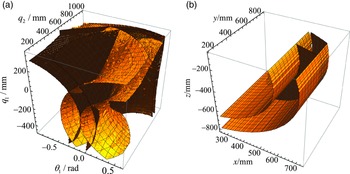
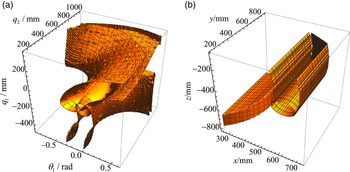
Furthermore, the inverse and forward kinematic singular surfaces in the joint space and workspace are presented in Figs. 10 and 11 utilizing the structural parameters that were previously introduced.
Inverse kinematic singular surfaces: (a) in the joint space and (b) in the workspace.

Forward kinematic singular surfaces: (a) in the joint space and (b) in the workspace.

4.2. Workspace analysis
The workspace of a manipulator is a critical evaluation metric used to assess the ability of the moving platform to achieve different poses, which significantly influences the manipulator’s performance. One common limitation of parallel mechanisms is their limited workspace. Generally, among manipulators with the same DOF, a larger workspace is preferable. In this section, the reachable workspace is analyzed. The primary factors that influence the manipulator’s workspace include the length limit of links, the angle limit of rotational joints, and interference issues between different links and the moving platform. It is essential to analyze the reachable workspace to optimize the manipulator’s design and ensure that it can achieve the desired performance.
The stroke of the first and second active prismatic joints are set to
 $-500\,\mathrm{mm}\leq q_{1}\leq 350\,\mathrm{mm}$
and
 $150\,\mathrm{mm}\leq q_{2}\leq 1000\,\mathrm{mm}$
, respectively, and the rotational angles of the first and second active rotational joints are in the range of
 $-50\deg \leq \theta _{1}\leq 35\deg$
and
 $-35\deg \leq \theta _{2}\leq 50\deg$
, respectively.
According to the structural characteristics, the rotational angles
 $\phi _{1}$
and
 $\phi _{2}$
are calculated in detail to avoid the interference between links:
 \begin{equation} \phi _{1}=\arccos \left(\boldsymbol{b}_{1}\boldsymbol{c}_{1}\cdot \boldsymbol{v}\right) \end{equation}
 \begin{equation} \phi _{2}=\arccos \left(\boldsymbol{b}_{2}\boldsymbol{c}_{2}\cdot \boldsymbol{u}\right) \end{equation}
in which
 $\boldsymbol{b}_{1}\boldsymbol{c}_{1}$
and
 $\boldsymbol{b}_{2}\boldsymbol{c}_{2}$
are normalized vectors of vectors
 $\boldsymbol{B}_{1}\boldsymbol{C}_{1}$
and
 $\boldsymbol{B}_{2}\boldsymbol{C}_{2}$
, respectively, and
u
and
v
are unit vectors along the X- and Y-axis, respectively. The expressions for these vectors can be given by:
 \begin{equation} \boldsymbol{b}_{1}\boldsymbol{c}_{1}=\frac{\boldsymbol{B}_{1}\boldsymbol{C}_{1}}{\left| \boldsymbol{B}_{1}\boldsymbol{C}_{1}\right| }, \boldsymbol{b}_{2}\boldsymbol{c}_{2}=\frac{\boldsymbol{B}_{2}\boldsymbol{C}_{2}}{\left| \boldsymbol{B}_{2}\boldsymbol{C}_{2}\right| }, \boldsymbol{u}=\left[\begin{array}{l@{\quad}l@{\quad}l} 1 & 0 & 0 \end{array}\right]^{\mathrm{T}}, \boldsymbol{v}=\left[\begin{array}{l@{\quad}l@{\quad}l} 0 & 1 & 0 \end{array}\right]^{\mathrm{T}} \end{equation}
Therefore, the rotational angle
 $\phi _{1}$
between the long rod of the parallelogram joint and the Y-axis should be limited to
 $45\deg \leq \phi _{1}\leq 100\deg$
, and
 $\phi _{2}$
between the long rod of the parallelogram joint and the X-axis should be in the range of
 $-25\deg \leq \phi _{2}\leq 70\deg$
.
For a parallel manipulator, the reachable workspace comprises the set of points that can be reached by the end effector. Hence, based on the structure parameters in Table I, the inverse kinematic solution is employed to calculate the reachable workspace. Then, according to the limitations of
 $q_{1}, q_{2}, \theta _{1}, \theta _{2}, \phi _{1}$
and
 $\phi _{2}$
obtained above, the points meeting these constraints can be selected. The reachable workspaces of the proposed mechanism are studied in the space
 $(\begin{array}{l@{\quad}l@{\quad}l} x & y & z \end{array})$
with the orientation
 $\psi =0$
and the space
 $(\begin{array}{l@{\quad}l@{\quad}l} x & \psi & z \end{array})$
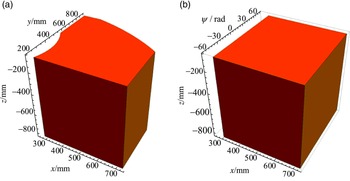
with the coordinate y = 400 mm, respectively. The workspaces are depicted in Fig. 12 using Mathematica software. According to the kinematic analysis, the y- and z-coordinate are related to the input variables
 $q_{2}$
and
 $q_{1}$
, respectively. As shown in Fig. 12(a), the 3D workspace can be interpreted as extruding the xoy plane along the z-axis, effectively illustrating the characteristic decoupling motion in the z direction. The kinematic solution indicates that the mechanism also possesses the characteristic of decoupling motion in the y direction. However, we acknowledge that Fig. 12(a) reveals a coupling relationship between the displacement in the x direction and the displacement in the y direction. This coupling is a consequence of the interaction between the actuated parameter
 $q_{2}$
and the position along the x-coordinate.
Structural parameters.

Workspace: (a) in the space
 $(\begin{array}{l@{\quad}l@{\quad}l} x & y & z \end{array})$
and (b) in the space
 $(\begin{array}{l@{\quad}l@{\quad}l} x & \psi & z \end{array})$
.

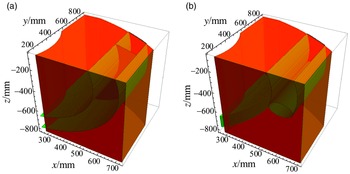
Additionally, Figs. 10(b) and 11(b) plot all kinematic solutions leading to singular configurations within the manipulator’s workspace. The relationship between the reachable workspace and the inverse kinematic singularity inside the reachable workspace is proposed in Fig. 13(a), while the relationship between the reachable workspace and the forward singularity inside the reachable workspace is depicted in Fig. 13(b). The green surface in both figures represents the singular surface within the reachable workspace. To enhance the manipulator’s performance, avoiding singular loci is crucial. In future work, the avoidance of singular loci will be investigated by planning the manipulator’s trajectory to expand its workspace.
Inverse kinematic singular surface (a) and forward kinematic singular surface (b) within the reachable workspace.

4.3. Manipulability
The kinematic manipulability index is used to evaluate the capability of velocity transmission of a manipulator and can also be considered as an equivalent measure of the dexterity [Reference Merlet46]. According to the definition in [Reference Yoshikawa47], the kinematic manipulability is the square root of the determinant of
 $\boldsymbol{J}\boldsymbol{J}^{\mathrm{T}}$
. The detailed expression can be given by:
 \begin{equation} \omega =\sqrt{\det \left(\boldsymbol{J}\boldsymbol{J}^{\mathrm{T}}\right)} \end{equation}
It should be noted that the Jacobian matrix is posture-dependent, and as a result, the kinematic manipulability is a local performance index. However, it provides a clear indication of whether the manipulator is in a singular configuration. When the value of
 $\omega$
is close to or equal to 0, the manipulator is in or near a singular configuration. Hence, the value of
 $\omega$
is desired to be greater than 0 to avoid the singular configurations.
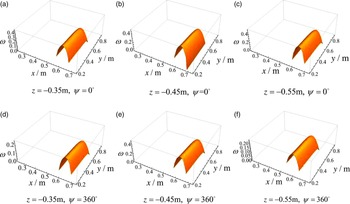
Based on the structure parameters, the kinematic manipulability for various z-value and rotational angles within the workspace can be calculated. The results are presented in Fig. 14. As can be observed, the value of kinematic manipulability is close to 0 when the end effector moves to the boundary along the x-axis or y-axis.
Kinematic manipulability for various z-value and rotational angles within the workspace.

4.4. Dexterity analysis
The dexterity of a manipulator is a critical measure of its kinematic performance in pick-and-place applications, defined as the ability to move to any position or direction and apply forces or torques in any direction [Reference Li and Xu48]. The condition number of the Jacobian matrix is used to evaluate the dexterity of a manipulator [Reference Gosselin and Angeles49,Reference Merlet50], with a lower value indicating better dexterity. In particular, the inverse of the condition number, which ranges from 0 to 1, is commonly used as a measure. Some studies [Reference Tannous, Caro and Goldsztejn51–Reference Briot and Bonev55] have also used dexterity to evaluate the accuracy and sensitivity of a manipulator. Specifically, a higher dexterity tends to lead to higher accuracy. Although manipulability is a related concept, dexterity is a more appropriate measure for evaluating accuracy in many cases.
The kinetostatic conditioning index (KCI) is a posture-independent index. As defined in [Reference Angeles56], the expression can be given by:
 \begin{equation} \mathrm{KCI}=\frac{1}{\kappa _{\min }}\times 100\% \end{equation}
where
 $\kappa _{\min }$
is the minimum condition number. When
 $\kappa _{\min }$
is equal to 1, the KCI is 100%. Then, the manipulator has the istropic characteristics, which means that the manipulator possesses good motion transmission performance.
In order to evaluate the dexterity within the whole workspace, the global conditioning index (GCI) is proposed [Reference Gosselin and Angeles49]. The expression can be given by:
 \begin{equation} \mathrm{GCI}=\frac{\int _{W}\frac{1}{\kappa }dV}{V} \end{equation}
in which W is the whole workspace and V is the volume of the workspace.
However, different types of degrees of freedom (i.e., three translational motions and one rotation) presents the challenge for unifying the units of each element in the Jacobian matrix and representing the physical meaning of the manipulator with the condition number. To solve this problem, Altuzarra [Reference Altuzarra, Hernandez, Salgado and Angeles57] proposed a method to normalize the nonhomogeneous Jacobian matrix using the concept of characteristic length. The detailed expression of the homogeneous Jacobian matrix
 $\boldsymbol{J}_{h}$
can be defined as:
 \begin{equation} \boldsymbol{J}_{\mathrm{h}}=\left(\begin{array}{l@{\quad}l} \boldsymbol{A} & \frac{1}{L}\boldsymbol{B} \end{array}\right) \end{equation}
where L is the characteristic length,
 $\boldsymbol{A}$
represents the
 $4\times 3$
submatrix formed by the first three columns of
 $\boldsymbol{J}$
, and
 $\boldsymbol{B}$
denotes the
 $4\times 1$
submatrix formed by the fourth column of
 $\boldsymbol{J}$
.
After normalizing the nonhomogeneous Jacobian matrix, the Jacobian matrix
 $\boldsymbol{J}_{\mathrm{h}}$
can attain dimensionally homogeneous. The isotropy condition can be given by:
 \begin{equation} \boldsymbol{J}_{\mathrm{h}}^{\mathrm{T}}\boldsymbol{J}_{\mathrm{h}}=\left[\begin{array}{l@{\quad}l} \boldsymbol{A}^{\mathrm{T}}\boldsymbol{A} & \dfrac{1}{L}\boldsymbol{A}^{\mathrm{T}}\boldsymbol{B}\\[11pt] \dfrac{1}{L}\boldsymbol{B}^{\mathrm{T}}\boldsymbol{A} & \dfrac{1}{L^{2}}\boldsymbol{B}^{\mathrm{T}}\boldsymbol{B} \end{array}\right]=\sigma ^{2}\boldsymbol{I} \end{equation}
where
 $\sigma$
is a nondimensional scalar and
 $\boldsymbol{I}$
denotes the
 $4\times 4$
identity matrix. The manipulator is considered isotropic when the homogeneous Jacobian matrix becomes isotropic. If there is no solution to the isotropy condition, then the manipulator is nonisotropic.
From Eq. (48), we can obtain the following relationships:
 \begin{equation} \mathrm{tr}\left(\boldsymbol{A}^{\mathrm{T}}\boldsymbol{A}\right)=3\sigma ^{2} \end{equation}
 \begin{equation} \frac{1}{L}\boldsymbol{A}^{\mathrm{T}}\boldsymbol{B}=\mathbf{0} \end{equation}
 \begin{equation} \frac{1}{L^{2}}\boldsymbol{B}^{\mathrm{T}}\boldsymbol{B}=\sigma ^{2} \end{equation}
Then, the characteristic length can be expressed as:
 \begin{equation} L=\sqrt{\frac{3\boldsymbol{B}^{\mathrm{T}}\boldsymbol{B}}{\mathrm{tr}\left(\boldsymbol{A}^{\mathrm{T}}\boldsymbol{A}\right)}} \end{equation}
The condition number
 $\kappa$
of the homogeneous Jacobian matrix
 $\boldsymbol{J}_{\mathrm{h}}$
can be calculated by:
 \begin{equation} \kappa =\left\| \boldsymbol{J}_{\mathrm{h}}\right\| \left\| \boldsymbol{J}_{\mathrm{h}}^{-1}\right\| \end{equation}
in which
 $\| \cdot \|$
indicates the norm of the matrix argument. It should be noted that Frobenius norm is frame-invariant and analytic. Hence, the calculation of the condition number by means of the Frobenius norm can be expressed as:
 \begin{equation} \kappa =\frac{1}{4}\sqrt{\mathrm{tr}\left(\boldsymbol{J}_{\mathrm{h}}^{\mathrm{T}}\boldsymbol{J}_{\mathrm{h}}\right)\mathrm{tr}\left[\left(\boldsymbol{J}_{\mathrm{h}}^{\mathrm{T}}\boldsymbol{J}_{\mathrm{h}}\right)^{-1}\right]} \end{equation}
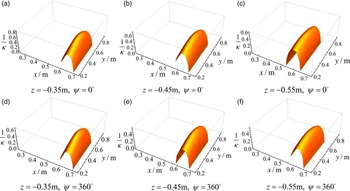
Based on the structure parameters, the value of the characteristic length can be calculated as L = 0.2171 m. The KCI is depicted in Fig. 15 with various z-values and rotational angles. According to the analytical results, the maximum KCI over the whole workspace is observed when the end effector is located at x = 0.65 m and y = 0.5 m, indicating that the manipulator has better performance in this position. Additionally, smaller values of KCI correspond to smaller z-coordinate magnitudes and larger rotational angles. Conversely, the value of KCI approaches zero at the boundary of the workspace, suggesting that the manipulator is less dexterous in these postures, and this region should be avoided.
Reciprocal of Jacobian matrix condition number.

However, to the best of our knowledge, the Jacobian matrix is configuration-dependent. The local conditioning number varies with different postures and provides a local indication of dexterity of a manipulator. To obtain a global measure of dexterity within the entire workspace, the GCI is calculated. The expression in Eq. (46) is too complicated to compute the value of GCI. Furthermore, the value of
 $1/\kappa$
can be zero in some postures, indicating that singularity occurs in these postures. Hence, a simplified numerical approach in ref. [Reference Li and Xu48] is used to approximate the GCI value:
 \begin{equation} \mathrm{GCI}=\frac{1}{N}\sum _{i}^{N}\frac{1}{\kappa _{i}} \end{equation}
where the workspace is discretized into a set of N points and
 $\kappa _{i}$
is the value of
 $\kappa$
at the ith point. Therefore, the results can be calculated by researching the points within the workspace. The larger the value of GCI, the higher the global dexterity. The GCI of the proposed manipulator can be obtained as
 $\mathrm{GCI}=0.2754$
.
5. Parameter optimization
In the previous section, the dexterity of the proposed manipulator was studied and corresponding charts were plotted. The optimization of the manipulator parameters was carried out to improve its dexterity in this section, which is an essential factor in the design of manipulators. The analytical results of the dexterity of the proposed manipulator can be used to guide the optimization of the parameters. From the perspective of practical applications, the length of links is not determined arbitrarily. The objective of the optimization was to find the appropriate length of links that result in improved dexterity. To achieve this objective, the parameter-finiteness normalization method proposed by Liu [Reference Liu and Wang58] was used. This method reduces the number of parameters from n to (n− 1) and defines logical bounds for each parameter. The parameters optimization procedure makes it possible to reveal the relationship between the dexterity and the parameters in a limited space. The process of design optimization can be described as follows:
Step1. Identification of design parameters. According to the geometric relationship in the structure, let
 $l_{11}=l_{21}, l_{12}=l_{22}, l_{13}=1.2l_{11}, l_{23}=2l_{21}$
. Then, the three design parameters can be determined as
 $l_{11}, l_{12}$
, and
 $l_{14}$
.
Step 2. Determination of parameter design space (PDS). According to the definition in [Reference Liu and Wang58], the normalization factor of the manipulator is obtained by:
 \begin{equation} D=\frac{l_{11}+l_{12}+l_{14}}{3} \end{equation}
The three nondimensional parameters can be calculated by:
 \begin{equation} r_{1}=\frac{l_{11}}{D}, r_{2}=\frac{l_{12}}{D}, r_{3}=\frac{l_{14}}{D} \end{equation}
For this proposed manipulator, the normalized parameters should be specified as:
 \begin{equation} \left\{\begin{array}{l} r_{1}+r_{2}+r_{3}=3\\[3pt] r_{2}\succ r_{1}\\[3pt] r_{3}\succ r_{1} \end{array}\right. \end{equation}
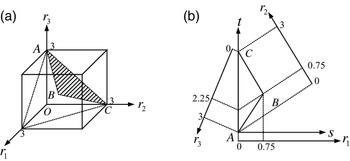
Then, the PDS for the proposed manipulator defined by Eq. (58) is depicted as the shaded triangle ABC in Fig. 16(a), where all possible design parameters values are included. Figure 16(b) shows the triangle ABC in a plan view. In the plan space, the design parameters can be expressed as:
 \begin{equation} \left\{\begin{array}{l} r_{1}=s \\[6pt] r_{2}=\dfrac{\sqrt{3}}{3}t-\dfrac{1}{2}s \\[6pt] r_{3}=3-\dfrac{\sqrt{3}}{3}t-\dfrac{1}{2}s \end{array}\right. \end{equation}
or
 \begin{equation} \left\{\begin{array}{l} s=r_{1}\\[7pt] t=\dfrac{\sqrt{3}\left(3+r_{2}-r_{3}\right)}{2} \end{array}\right. \end{equation}
Step 3. We identify the optimum region. Herein, let D = 400. For each set of values
 $(s,t)$
, there is a set of corresponding values of design parameters
 $(r_{1}, r_{2}, r_{3})$
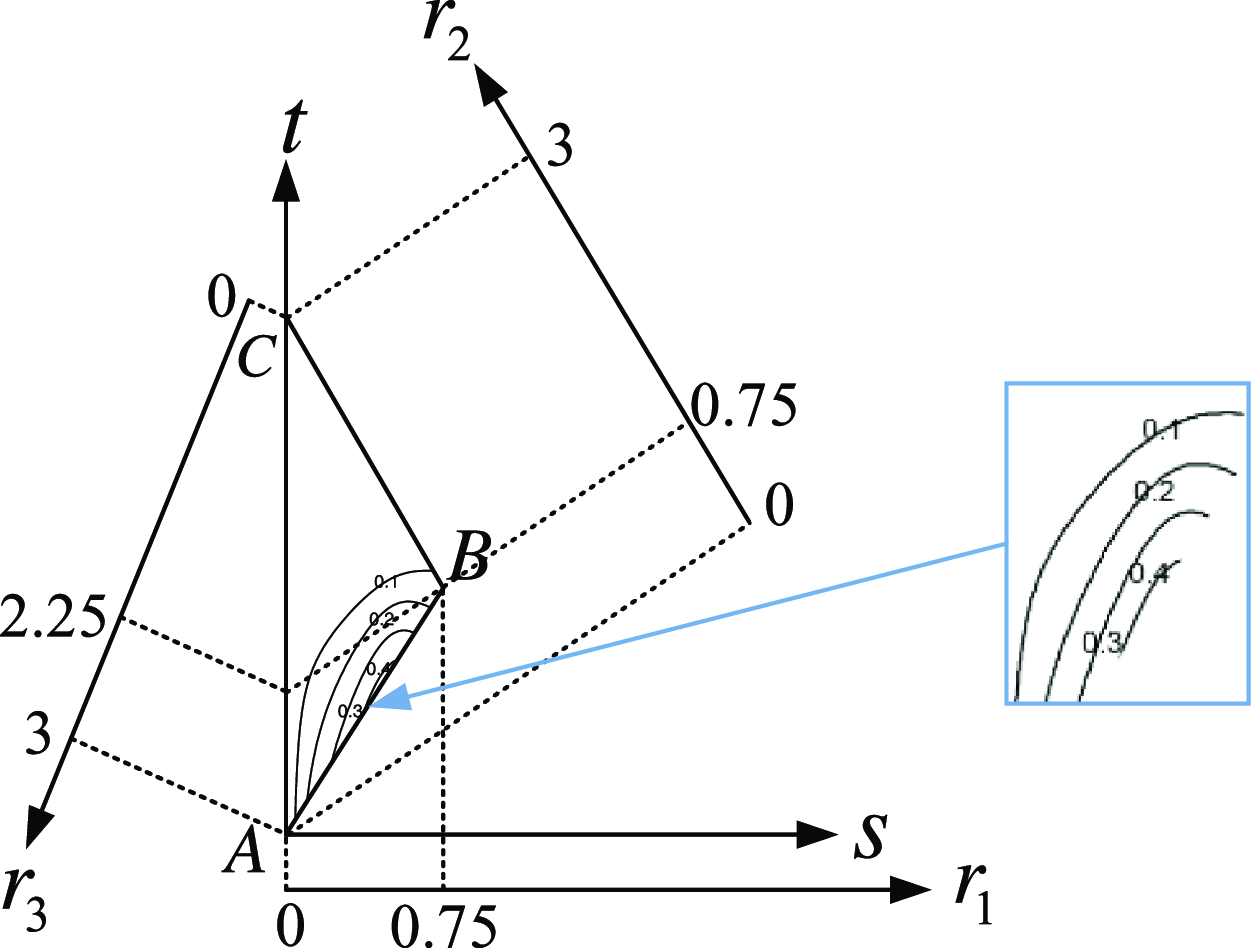
. Using the design parameters, the GCI is calculated. The relationship between the dexterity and the normalized parameters in the PDS is illustrated in Fig. 17. It is noteworthy that the optimum region is the intersection between the dexterity chart and the PDS. Therefore, the proposed manipulator can be studied in this finite optimal design region.
Step 4. We select a candidate from the optimal region. The optimum region in Fig. 17 contains all possible normalized parameters for different optimal manipulators. As can be seen in Fig. 17, the GCI has a large value in the region
 $s\in [0.4,0.5]$
and
 $t\in [1.0,1.1]$
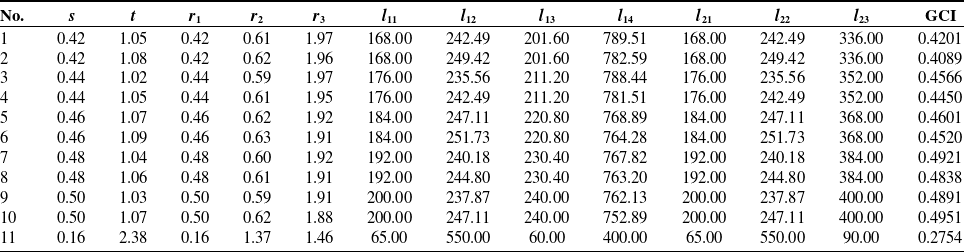
. Thus, 10 groups of candidates are chosen whose GCI is larger than 0.4. The values of design parameters, optimized length, and GCI are listed in Table II.
Optimized parameters and corresponding GCI.

Parameter design space of the proposed manipulator: (a) spatial space and (b) plan view.

Distribution of GCI in the parameter design space.

Step 5. Check whether the optimized parameters meet the design objectives. If the optimized parameters can meet the design objective, then the optimal design is finished; otherwise, we return to Step 4.
Table II shows that the first 10 group data are chosen from the optimal region, whose GCI is larger than 0.4. The last group parameters are measured from the model of the proposed manipulator in Fig. 1. The objective of the optimization is to find the appropriate length of links, where the proposed manipulator has a better dexterity. The proposed manipulator with No. 10 optimal parameters will have better dexterity.
6. Conclusion
This paper presents a novel two-limb gripper mechanism with an integrated three-finger end effector. The mechanism is composed of only a small number of lower pairs and components, which simplifies manufacturing and installation. The simple two-limb structure also avoids interference between the limbs and platform, providing a fairly large workspace. To address the issue of moving actuators, the mechanism employs a 2-DOF driving system. The gripper mechanism possesses a decoupled motion property that makes it easy to control and plan its trajectory. To enhance its industrial application, we evaluate the performance of the proposed manipulator and optimize its parameters for improved dexterity.
In future work, we plan to analyze the stiffness and dynamic properties of the gripper mechanism. Additionally, we will carry out trajectory planning to avoid singular loci and optimize the workspace. To validate its performance, a prototype will be fabricated. These advancements will improve the efficiency and reliability of the gripper mechanism, making it a valuable addition to the field of robotics.
Author contributions
All authors contributed to the study conception and design. Analysis and data collection were performed by Lin Wang and Yi Yang. The first draft of the manuscript was written by Lin Wang, and all authors commented on previous versions of the manuscript. All authors read and approved the final manuscript.
Financial support
This work was supported by the National Natural Science Foundation of China Grant Number 51975039. The third author would like to thank the financial support from the Natural Sciences and Engineering Research Council of Canada (RGPIN-2022-04624) and gratefully acknowledge the financial support from the York Research Chairs (YRC) program. In addition, the first author would like to acknowledge the China Scholarship Council (CSC) (No. 202007090138) for financial support and the use of the research facilities at Lassonde School of Engineering at York University.
Competing interests
The authors declare no competing interests.