Introduction
The Indian Himalayan Region (IHR) is comprised of the Trans, Northwest, West, Central and Eastern Himalayan provinces. The Trans-Himalayan biographic zone is located across the divide of the Great Himalaya. In Northern India, this zone comprises the eastern most part of Jammu and Kashmir, parts of the Lahul, Spiti and Kinnaur districts (Himachal Pradesh) and areas of the Uttarkhand State. Compared to the main Himalaya, this region is impoverished but harbours many rare and endangered plant and animal species. Ladakh, the Trans Himalayan part of the Jammu and Kashmir states located between the Greater Himalaya and the Karakoram Range, is known as the ‘cold desert’ of India and is comprised of two districts, Leh (45110 km2) and Kargil (14,086 km2) with several peculiar climatic conditions. It lies between 31° 44’ 57’ - 34° 10'12’ N latitude and 76° 46’ - 78° 41’ E longitude characterised by prolonged sub-zero temperature, infertile sandy soils with low water holding capacity, dry humidity (less than 30%), low oxygen content, intense solar radiation, low atmospheric pressure, high wind velocity and rugged terrain.
Ladakh, known as the little Tibet, is comprised of five valleys, Leh, Nubra, Changthang, Suru and Zanskar. The people of Ladakh have settled in these valleys and depend on agriculture for their existence. Due to the strategic defence location of Ladakh with its borders with Pakistan and China, a large number of army personnel are deployed here and add to the local population. The annual fresh food requirement of these troops is about 7500 MT. Therefore the local people and armed forces in Ladakh have to depend upon a supply of fresh vegetables, meat and other food items from other parts of India to meet their daily requirements.
The north western part of Himalaya shows varied climatic and topographic features. In winter, the temperature falls to -35°C and the altitude varies from 10,000 to 12,000 feet from mean sea level (MSL) and atmospheric oxygen pressure is 30% less than at MSL. This type of cold, arid and desert-like conditions is far from the natural habitat of poultry, and so the poultry industry in this region is still a backyard venture with low numbers of birds. To boost the production of fresh meat in the region, the Defence Institute of High Altitude Research (DIHAR), Leh, Ladakh has developed several technologies to meet the food requirements of the troops deployed here (Biswas et al., Reference BISWAS, ROY, GOGOI, AHMED and SINGH2010).
Problems encountered during hatching at high altitude
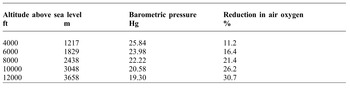
Barometric pressure declines with altitude, as does the partial pressure of oxygen and absolute humidity (Table 1). Fresh ventilating air will tend to be colder and drier at high altitude than at sea level, where the air exerts a pressure of about 760 mm Hg and approximately 20% of this is oxygen, which exerts a partial pressure of 152 mm Hg. Partial pressure refers to the amount of air pressure due to a specific gas fraction of the atmosphere. The oxygen content of air is always 21%, but reduced partial pressure at high altitude provides less oxygen from a given volume of air. This pressure reduction results in lower levels of oxygen for the chick embryo, which is partially compensated by its higher capacity for binding oxygen to blood haemoglobin (Dragon et al., Reference DRAGON, CAREY, MARTIN and BAUMANN1999).
Relationship between altitude, oxygen content of air and barometric pressure (Biswas et al., Reference BISWAS, ROY, GOGOI, AHMED and SINGH2010).

Fertility and hatchability are the major concerns in the hatchery industry (Peters et al., Reference PETERS, SHOYEBO, ILORI, OZOJE and ADEBAMBO2008). There are several factors that influence the hatchability of eggs including pre-incubation storage time and fertility and incubation conditions such as temperature, humidity, ventilation, position, egg turning and candling. Eggs laid at sea level and incubated at high altitude are subject to hypoxia, hypocapnia and excessive water loss, resulting in retarded development and poor hatchability. In terms of moisture loss from eggs, breeder flocks that are adapted to high altitude overcome this problem by laying eggs with a lower effective pore area and therefore water vapour loss through the egg shell at any altitude remains the same as that seen at sea level (Rahn et al., Reference RAHN, CAREY, BALMAS, BHATIA and PAGANELLI1977).
It is a recognised fact that it is more difficult to achieve satisfactory hatching rates at higher elevations. This difficulty is not only due to feeding, breeding and management, as eggs produced at higher elevations will hatch well if shipped to lower elevations for incubation. Eggs produced at lower elevations will produce poorer hatches if incubated at higher elevations (Celen et al., Reference CELEN, YILDIRIM, PARLAT and ALKIS2009).
The Tibetan chicken is a local poultry breed that inhabits altitudes of 2,900 m and has a hatchability of approximately 75% at that altitude. The ability of the Tibetan chicken embryos to adapt to high altitude may be due to the increase in haemoglobin concentration in blood, which augments the blood oxygen-carrying capacity (Zhang et al., Reference ZHANG, WANG, CHAMBA and WU2008). In addition, the higher venous carbon dioxide partial pressure and lower venous blood pH promotes unloading of oxygen from haemoglobin.
Poor hatches of commercial poultry at high elevations are due to oxygen starvation, and hatches could be improved by increasing the oxygen available (Celen et al., Reference CELEN, YILDIRIM, PARLAT and ALKIS2009). At altitudes above 2000 meters, injections of oxygen into the setter and hatchery can help to raise the oxygen level from 21 to 23-25%. The main drawbacks of using oxygen are the cost involved and safety. Its use may therefore be limited to the hatching of parent stock.
Hatchability percentage is adversely affected by hypoxia at high altitude (Lundy, Reference LUNDY1969). The cause of higher embryonic mortality has been reported to be lower haemoglobin levels. Chickens require an adaptation period for normal fertility and hatchability at high altitude. If chicks are grown from day old to onset of lay at high altitude, then the survivors will show better hatchability compared to adult hens brought from sea level (Smith and Abbott, Reference SMITH and ABBOTT1961).
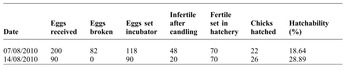
On an experimental basis, recently DIHAR has established a hatchery at Leh, and, even with adequate management practices, this hatchery is barely yielding 30% (Table 2). There is a requirement for substantial research and development to obtain good hatchability percentages in these locations. Efforts are currently being made to modify the existing hatchery system in collaboration with the Indian Institute of Technology (IIT), Delhi and, at the same time, the possibility of putting the hatchery in a pressurised chamber to control the atmospheric pressure and gaseous exchange to enhance the hatchability percentage at DIHAR, Leh is being investigated.
Hatchability percentage achieved at DIHAR (DRDO), Leh (3500m above MSL).

Remedies for increasing hatchability
Some important factors can be considered as remedies for high altitude, hatching related constraints. By increasing the air pressure inside the incubator near to sea level, it is possible to produce satisfactory results and some hatcheries provide a pressurised atmosphere in the incubator room (pressurised incubation). Injecting oxygen (O2) directly into the cabinet in which the eggs are to be incubated (O2 supplementation) can be applied, and the concentration of O2 should be 23-25%. Oxygen can be supplied into both the setter and hatchery compartments from O2 cylinders that have a pressure regulator valve and flow meter. A gas analysis apparatus is used to determine the percentage of O2 in the mixed air within the incubator cabinets.
It is known that hatchability falls by about 5% for each 1% (7.6 mm Hg) reduction in oxygen concentration and by 0.5% for each 1% change in relative humidity (RH) by 2.5%. Supplementation of O2 into the incubator increases hatchability by 10 to 14%. In a study at 2195 m above sea level (pO2 ≈120mm Hg), supplementary oxygen given to eggs in forced draught incubators, which increased pO2 to 146 mm Hg (19% O2) throughout incubation, increased hatchability by approximately 13% (Celen et al., Reference CELEN, YILDIRIM, PARLAT and ALKIS2009). Increased hatchability at altitude has been reported to be associated with such types of O2 supplementation (Christensen and Bagley, Reference CHRISTENSEN and BAGLEY1988; Christensen and Donaldson, Reference CHRISTENSEN and DONALDSON1992). Oxygen supplementation increased the haemoglobin concentration in embryos, providing evidence of physiological adaptation by embryos to low pO2 (Christensen and Donaldson, Reference CHRISTENSEN and DONALDSON1992).
Higher incubation temperature in combination with increased oxygen tension has been shown to decrease embryonic mortality during the third and fourth weeks of incubation, and resulted in higher hatchability. Christensen and Bagley (Reference CHRISTENSEN and BAGLEY1988) suggested that hatchery managers running operations at high altitudes should supplement oxygen and incubate turkey eggs at higher temperatures than at lower altitudes (Table 3).
Temperature, relative humidity, O2 and CO2 concentration for optimum hatchability (Biswas et al., Reference BISWAS, ROY, GOGOI, AHMED and SINGH2010).

Under hypoxic conditions, strain differences have been noted for hatchability (Peters et al., Reference PETERS, SHOYEBO, ILORI, OZOJE and ADEBAMBO2008), and resistance of chick embryos to hypoxia can be increased by selection (Smith and Abott, 1961). In practical terms, eggs produced by breeder hens kept at high altitudes seem to produce normal hatches if they are incubated at low altitudes. Some hatchability may be restored over a period of time if genetic selection is practiced in the breeding program, however it cannot ever be restored to normal commercial rates.
Conclusions
Establishing a hatchery unit in Leh- Ladakh is a prerequisite to expanding poultry farming activities and to develop a locally adapted breed for this region. The unavailability of day old chicks locally is the major bottleneck in the development of poultry farming in Ladakh. Similarly, in the absence of hatcheries, hatching of eggs produced by crossing local and exotic chickens is impossible; therefore the development of a local breed becomes an unfeasible task. Additionally, the availability of local chickens is becoming scarce because there are no commercial poultry farms available in this region. An initiative has been taken by DIHAR to establish a pressurised normobaric hatchery with facilities to monitor oxygen concentrations, carbon dioxide concentrations, relative humidity and temperature as per the climate of Ladakh in order to facilitate better hatchability at high altitude.