Implications
Additional grazing time during the night does not improve feed intake and animal productivity. Positive effects of nutrient return to the grassland were not observed in this study, as sheep crowded together in one corner of the plots during darkness and no even distribution of faecal and urinary nutrient excretions occurred. Considering the risk of animal losses and the importance of sheep manure as fuel, our observations confirm the common practice of penning sheep overnight to be an adequate management scheme for pastoralists in the Inner Mongolian steppe.
Introduction
Worldwide, there is a large diversity of ruminant production systems, including intensive indoor systems as well as pastoral systems that extensively use rangelands. From an economic point of view, it is important for all these production systems to maximize the feed intake of animals in order to minimize the feed to live weight gain (LWG) ratio and thus to improve the overall productivity (Baumont et al., Reference Baumont, Prache, Meuret and Morand-Fehr2000). In grazing animals, the daily feed intake is generally assumed to be closely related to their daily foraging time (Newman et al., Reference Newman, Parsons, Thornley, Penning and Krebs1995). Allden and Whittaker (Reference Allden and Whittaker1970) showed that herbivores compensate a decrease in available fodder by increasing their daily foraging time. Ayantunde et al. (Reference Ayantunde, Fernandez-Rivera, Hiernaux, Van Keulen and Udo2002) identified positive effects of additional night grazing on cattle performance in a semi-arid area in Sadore, Niger. In the same experimental area, Fernandez-Rivera et al. (Reference Fernandez-Rivera, Ayantunde, Hiernaux and Turner1996) observed a lower forage intake and higher live weight (LW) losses of cattle when they were corralled at night compared with animals having additional time for grazing at night. For grazing sheep that were corralled overnight in a study carried out in Niger during the dry season, supplementation with concentrate feeds was necessary to maintain animal performance (Ayantunde et al., Reference Ayantunde, Fernandez-Rivera, Hiernaux, van Keulen, Udo and Chanono2000). Hence, night grazing became a common practice in East (Nicholson, Reference Nicholson1987) and West Africa (Bayer, Reference Bayer1990; Ayantunde et al., Reference Ayantunde, Fernandez-Rivera, Hiernaux, Van Keulen and Udo2002) to increase the time available for grazing, to minimize heat stress for the animals and to increase forage intake and therefore animal performance.
In Inner Mongolia, the use of rangelands for sheep grazing is an important component of agriculture and nomadic pastoralists traditionally moved through large catchment areas. Since the 1950s, the pastoralists have settled down and consequently grasslands close to the settlements are used intensively for livestock grazing, whereas distant areas are used extensively for hay-making without any nutrient reflux. Commonly, sheep only have access to the pastures during the daytime and are kept in yards overnight. Thus, farmers are able to collect the manure as fuel and can prevent animal losses due to theft. An interruption of the nutrient reflux and grazing restricted to the daytime may negatively affect long-term grassland productivity as well as the feed intake and performance of the animals. Hence, this study analysed the effect of continuous grazing (CG), where sheep graze day and night, and daytime grazing (DG) on herbage mass (HM) and quality as well as feed intake and LWG of sheep in the Inner Mongolian steppe at different times of the grazing season.
Material and methods
Study area
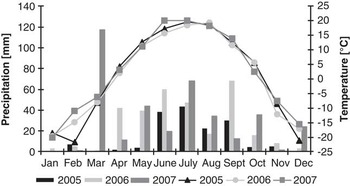
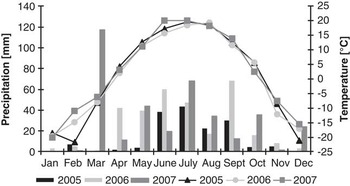
A grazing experiment was conducted close to the Inner Mongolia Grassland Ecosystem Research Station (IMGERS). The station is located in the Xilin river watershed in the autonomous region of Inner Mongolia approximately 600 km north of Beijing (116°42′E; 43°38′N) at an average altitude of 1200 m above sea level. The climate is semi-arid continental. The long-term average annual precipitation (1980 to 2003) is 343 mm, 85% of which occurs in the vegetation period between May and September. Annual precipitation in the study years was highly variable, with 158 mm in 2005, 312 mm in 2006 and 367 mm in 2007 (Figure 1). The mean annual air temperature between 2005 and 2007 was 0.7°C, ranging from −21.2°C in January to 19.0°C in July. The vegetation period lasts for approximately 150 days, with only 100 days without frost. Across the three study years, mean air temperatures at night were 16°C, 16°C and 14°C in July, August and September, when grazing took place. Climate data measured at IMGERS were provided by the Institute of Botany, Chinese Academy of Sciences, Beijing.
Monthly precipitation (in mm, bars) and air temperature (in °C, lines) measured at the Inner Mongolia Ecosystem Research Station during 2005 to 2007.
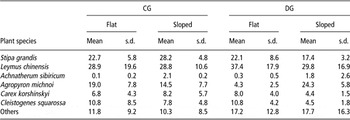
The experimental site is located within the typical steppe zone (Yu et al., Reference Yu, Ellis and Epstein2004). Dominant plant species are C3 grasses, including the perennial bunchgrass Stipa grandis and the perennial rhizome grass Leymus chinensis (Xiao et al., Reference Xiao, Wang, Jiang, Ojima and Bonham1995; Bai et al., Reference Bai, Han, Wu, Chen and Li2004). Plant species compositions on the CG and DG plots are given in Table 1. The dominant soil types are classified as Chestnut and Calcic Chernozem (IUSS Working Group WRB, 2007).
Means and s.d. of above-ground DM herbage mass of different plant species on flat or moderately sloped, CG and DG plots as percentage of the total dry mass determined in the beginning of July (means of the years 2005 to 2007)
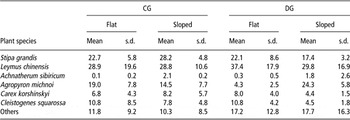
DM = dry matter; CG = continuous grazing; DG = daytime grazing.
Experimental design
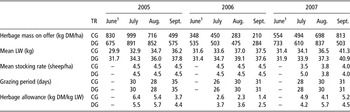
During the grazing seasons, which lasted from mid-June to mid-September, two grazing treatments, CG and DG, were tested. Both treatments were evenly allotted to two blocks: a flat and a moderately sloped area. CG sheep were allowed to graze continuously for 24 h/day throughout the grazing seasons, whereas DG sheep were allowed to graze only during the daytime and were kept in a pen without herbage cover from sunset till sunrise. Sunrise was at 0400 h in July, 0430 h in August and 0500 h in September, and sunset at 2030 h, 2000 h and 1900 h, respectively. Therefore, the grazing time of DG sheep was 16.5 h in July, 15.5 h in August and 14.0 h in September. The grazing season lasted for 98, 90 and 93 days in 2005, 2006 and 2007, respectively. Grazing plots of 2 ha each were used for hay-making in the preceding years. The plots were grazed at a moderate herbage allowance (HA) of 5.3, 2.6 and 4.6 kg dry matter (DM)/kg LW in 2005, 2006 and 2007, respectively. In 2005 and 2006, nine sheep per plot were used over the entire grazing season. In 2007, the number of sheep per plot was adjusted monthly to the actual HM on offer in order to maintain a moderate HA, and on average eight sheep per plot were used. The details of the experimental scheme are given in Table 2.
Experimental scheme from June to September between 2005 and 2007
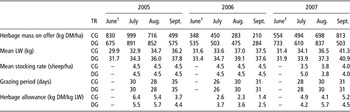
TR = treatment; Aug. = August; Sept. = September; CG = continuous grazing; DG = daytime grazing; DM = dry matter; LW = live weight.
1Adaptation period.
Animals and animal management
Non-pregnant, non-lactating female sheep of the local breed ‘Mongolian fat-tailed sheep’ were purchased from local farms each year. The sheep were approximately 15 months old in the beginning of the annual trials. Before the experiments started, sheep were weighed, ear-tagged, treated against internal and external parasites and allocated according to their LW into three weight groups (light, medium and heavy). Animals from each weight group were randomly distributed among the four experimental plots in order to equalize the mean LW of all sheep per plot. The treatment against parasites was repeated in July. After an adaptation period of approximately 10 days on the plots, the animals were weighed on 2 consecutive days. This initial LW averaged 31.3 ± 0.53 kg across the 3 years. All sheep were weighed again on 2 consecutive days each in July, August and September to determine their mean LW and LWG during each month. In September 2006, no weight data were collected, because of an early onset of winter, which required additional feeding of hay. CG sheep had continuous access to water and mineral lick stones, whereas DG sheep only had access to water and minerals during the daytime.
Feed digestibility and intake
In the beginning of each annual experiment, six sheep per plot were randomly chosen and used to determine the digestibility of ingested organic matter (dOM) and organic matter intake (OMI). On 10 consecutive days per month (days 1 to 10 in July, August and September), gelatine capsules containing 2.5 g of the inert marker titanium dioxide (TiO2) were orally administered to the sheep. Dosing was carried out at the same time each day, and faecal grab samples were obtained daily from the rectum on days 6 to 10 (sampling period) immediately after administering the capsules. Faecal samples were analysed for nitrogen (N), organic matter (OM) and TiO2 concentrations. OMI was calculated from dOM and total faecal OM output, which was estimated from the TiO2 concentration in faecal OM, assuming a faecal recovery of TiO2 of 100% (Glindemann et al., Reference Glindemann, Tas, Wang, Alvers and Susenbeth2009). dOM was estimated from CP (=N × 6.25) content in faecal OM according to the regression equation of Wang et al. (Reference Wang, Tas, Glindemann, Rave, Schmidt, Weissbach and Susenbeth2009). The intake of digestible organic matter (DOMI) was calculated by multiplying OMI by dOM.
HM and chemical composition
Concomitant to faeces collection, HM was measured by clipping herbaceous plants within three representative areas per plot (each 0.5 m2) to 1 cm stubble height. Herbage samples were pooled, dried at 60°C for 24 h and weighed. After grinding to pass a 1 mm sieve by a Cyclotec Mill (Tecator, Höganäs, Sweden), samples were analysed by NIRS for NDF, ADF, ADL, CP, DM, OM, in vitro digestible organic matter (IVdOM) and metabolizable energy (ME) concentrations. NIRS calibration was carried out using subsets of herbage samples. For a detailed description of NIRS calibration as well as the analytical methods, see Schönbach et al. (Reference Schönbach, Wan, Schiborra, Gierus, Bai, Müller, Glindemann, Wang, Susenbeth and Taube2009). Faecal samples were frozen immediately after collection, pooled by sheep at the end of each sampling period, homogenized and analysed for N, DM and OM concentrations. A sub-sample was oven-dried at 60°C for 36 h, ground to pass a 1 mm screen and analysed for TiO2 concentration using the procedure of Brandt and Allam (Reference Brandt and Allam1987), modified by Glindemann et al. (Reference Glindemann, Tas, Wang, Alvers and Susenbeth2009). Although in 2005 and 2006, samples of each sheep were analysed with repeated determination, samples of the six sheep per plot were pooled in 2007 and analysed with three replicates to reduce the number of analyses.
Statistical analysis
Data were analysed using the mixed-model procedures of SAS version 9.1 (SAS, 2000). The model included the fixed effects year, block and treatment, as well as the repeated effect month. The following model was used:

where μ is the overall mean, YEi the year (2005, 2006 and 2007), Bj the block (flat and sloped area), TRk the treatment (CG, DG), Ml the month (July, August and September) and eijkl the random experimental error. Interactions TR × M, TR × YE and TR × M × YE were analysed. One experimental plot was taken as one observation using the mean values of the six sampled sheep per plot for all animal-related parameters. Hence, in total 36 observations were analysed. Probabilities for all effects and their interactions were determined. A heterogeneous auto-regression covariance structure was chosen. When the effects were significant (P ⩽ 0.05), the Tukey test was used to test for differences between least squares means.
Results
HM and chemical composition
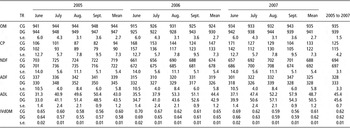
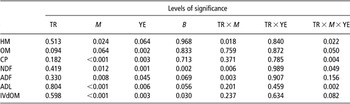
HM and chemical composition of the herbage are shown in Table 3. HM and herbage quality were not influenced by treatment (P > 0.05; Table 4). However, as the grazing season progressed, the concentrations of NDF, ADF and ADL increased (P = 0.012, P = 0.008 and P < 0.001, respectively), whereas CP concentration and IVdOM declined from 141 g CP/kg DM and 0.670 in June to 103 g CP/kg DM and 0.584 in September (P < 0.001), respectively. HM varied inconsistently between months (P = 0.024). HM tended to be different between years (P = 0.064), whereas herbage quality parameters differed between years (P < 0.05).
Concentrations of OM, CP, NDF, ADF and ADL (in g/kg DM) as well as IVdOM from June to September between 2005 and 2007 on CG and DG pastures (least squares mean ± s.e.)
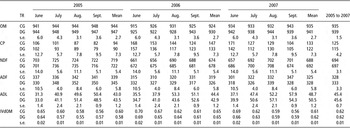
OM = organic matter; DM = dry matter; IVdOM = in vitro digestibility of OM; CG = continuous grazing; DG = daytime grazing; TR = treatment; Aug. = August; Sept. = September.
Levels of significance of the effects of grazing TR on HM (in kg dry mass/ha) and concentrations of OM, CP, NDF, ADF and ADL (in g/kg DM) as well as IVdOM
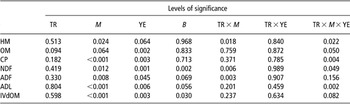
TR = treatment; HM = herbage mass; OM = organic matter; DM = dry matter; IVdOM = in vitro digestibility of OM; M = month; YE = year; B = block.
Feed digestibility and intake
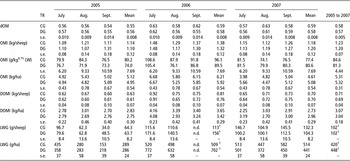
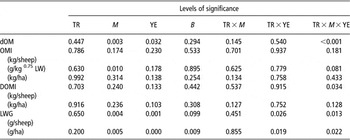
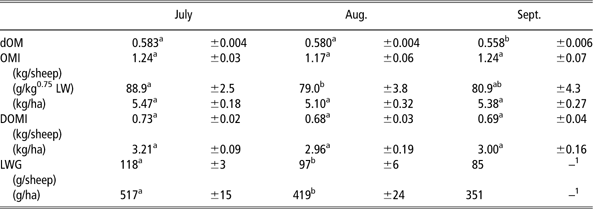
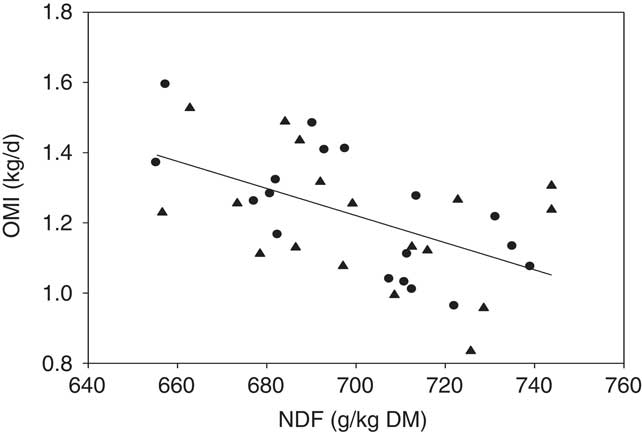
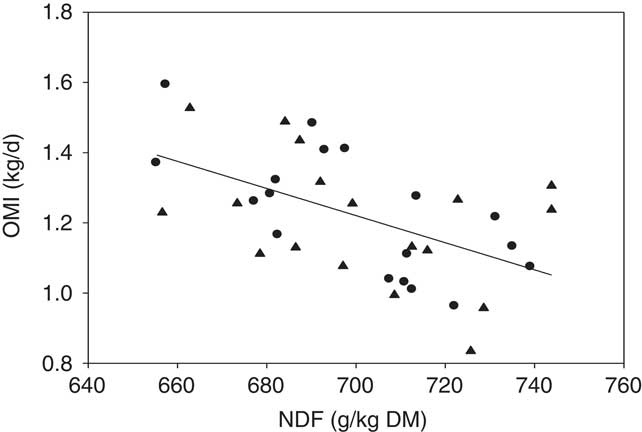
dOM was very similar in CG (0.577) and DG sheep (0.572; Table 5). As the vegetation period proceeded, dOM decreased from 0.583 in July to 0.558 in September across both treatments (P = 0.003; Tables 6 and 7). Differences were also observed between years, with 0.554, 0.580 and 0.587 in 2005, 2006 and 2007, respectively (P = 0.032). OMI per sheep of 1.23 kg/day in CG and 1.20 kg/day in DG and OMI per ha of 5.31 kg/day in CG and 5.32 kg/day in DG were not influenced by treatment (P > 0.05). Likewise, there was no difference in OMI per kg0.75 LW between treatments at 85 g/kg0.75 LW in CG and 81 g/kg0.75 LW in DG. No differences in OMI per sheep and OMI per ha were observed between months and years. However, OMI per kg0.75 LW varied between months (P = 0.010) because of changes in animals' LW. A close relationship between OMI per sheep and herbage NDF concentration was detected (P < 0.001, R 2 = 0.29; Figure 2). The respective equations did not differ between treatments.
dOM, daily OMI and DOMI and daily LWG of sheep on CG and DG pastures from July to September between 2005 and 2007 (least squares mean ± s.e.)
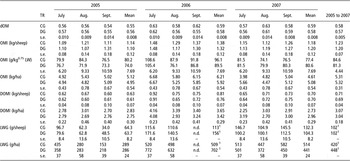
dOM = digestibility of ingested organic matter; OMI = daily intake of organic matter; DOMI = digestible organic matter intake; LWG = daily live weight gain; CG = continuous grazing; DG = daytime grazing; TR = treatment; Aug. = August; Sept. = September; LW = live weight; n.d. = not determined.
1Arithmetic means.
Significant levels of the effects of grazing TR on dOM, daily OMI and DOMI and daily LWG of sheep
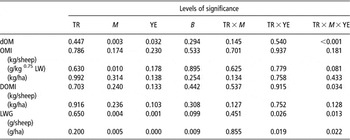
TR = treatment; dOM = digestibility of ingested organic matter; OMI = intake of organic matter; DOMI = digestible organic matter intake; LWG = live weight gain; M = month; YE = year; B = block; LW = live weight.
Effects of month on dOM, daily OMI and DOMI and daily LWG of sheep (least squares mean ± s.e.)
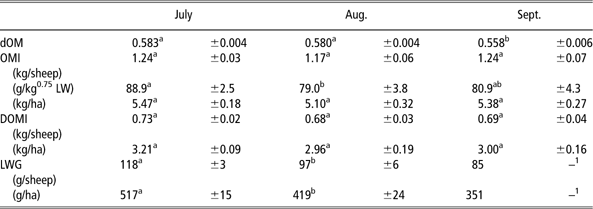
dOM = digestibility of ingested organic matter; OMI = intake of organic matter; DOMI = digestible organic matter intake; LWG = daily live weight gain; Aug. = August; Sept. = September; LW = live weight.
a,bWithin a row, means with a common superscript are not significantly different at P ⩽ 0.05.
1No standard error could be estimated due to missing values in September 2006.
Relationship between the NDF concentration of herbage and the organic matter intake (OMI) of sheep of two grazing treatments (● = continuous grazing; ▴ = daytime grazing): OMI = 3.93 to 0.039 NDF.
LWG
LWG was identical in CG (101.5 g/day) and DG animals (101.8 g/day; Table 3). LWG per sheep (P = 0.004) and LWG per ha (P = 0.005) differed between months and were higher in July than in August and September (Tables 6 and 7). In 2005, LWG decreased continuously from July to September (P = 0.005). This trend could also be observed for the first two months in 2006, whereas in September, no LW data were recorded, because of an early onset of winter. In 2007, no differences in LWG were observed between months (P > 0.05). LWG per sheep (P = 0.001) and LWG per ha (P < 0.001) differed between years.
Discussion
HM and chemical composition
Herbage CP concentrations averaged 120 g/kg DM and decreased from 141 to 102 g/kg DM with advancing vegetation period. These values were thus consistently above 60 to 80 g/kg DM, regarded as the minimum CP concentration for grazing sheep fed at a maintenance level (Minson, Reference Minson1990; Van Soest, Reference Van Soest1994). It is therefore unlikely that even the lower CP concentrations at the end of the vegetation period induced N deficiencies for rumen microbial activity and, as a consequence, reduced diet digestibility (Van Soest, Reference Van Soest1994) and animal feed intake (Moore and Mott, Reference Moore and Mott1973). NDF and ADL concentrations increased and IVdOM declined with advancing maturity, which agrees with the findings of Schiborra (Reference Schiborra2007) and Schönbach et al. (Reference Schönbach, Wan, Schiborra, Gierus, Bai, Müller, Glindemann, Wang, Susenbeth and Taube2009) on sites close to our experimental area. Hence, it is likely that increasing NDF concentrations and lower IVdOM were responsible for the declining OMI of the animals (see the next section). The effect of month on HM and herbage quality varied between years according to the annual variation in precipitation. Compared with 312 mm in 2006 and 367 mm in 2007, precipitation of 158 mm was very low in 2005, which reduces grassland productivity (Xiao et al., Reference Xiao, Wang, Jiang, Ojima and Bonham1995; Bai et al., Reference Bai, Han, Wu, Chen and Li2004) and, because of a more rapid plant maturation, herbage quality (Schönbach et al., Reference Schönbach, Wan, Schiborra, Gierus, Bai, Müller, Glindemann, Wang, Susenbeth and Taube2009).
The additional amount of nutrients remaining on the plots, when animals were also present on pastures at night, did not influence HM or composition, neither in dry years nor towards the end of the grazing seasons. This is probably because of the following two reasons: (i) it could clearly be shown that water is the first limiting factor for herbage growth in this region (Xiao et al., Reference Xiao, Wang, Jiang, Ojima and Bonham1995; X. Gong, personal communication) and (ii) at night, sheep stayed most of the time close together in frequently used areas of the plots, which prevented an even and effective distribution of excreted nutrients.
Feed digestibility and intake
The dOM of DG sheep during the daytime did not differ from that of CG sheep having additional time for grazing at night. Similar findings were also reported for grazing cattle (Nicholson, Reference Nicholson1987; Iason et al., Reference Iason, Mantecon, Sim, Gonzalez, Foreman, Bermudez and Elston1999; Ayantunde et al., Reference Ayantunde, Fernandez-Rivera, Hiernaux, van Keulen, Udo and Chanono2001). This is in agreement with the similar herbage composition (see previous section) and shows that animals of both treatment groups did not select plant or plant parts of different herbage quality. Nevertheless, a relatively small, but significant decrease in dOM with proceeding vegetation period was found in our study, which corresponds to the declining IVdOM due to increasing herbage NDF and ADL concentrations (see previous section).
In particular, in forages with high fibre concentrations, the volume of the digestive tract may limit the feed intake of animals (Mertens, Reference Mertens1994). Hence, Baumont et al. (Reference Baumont, Cohen-Salmon, Prache and Sauvant2004) showed that herbage NDF concentrations largely affect the daily feed intake of grazing sheep. Accordingly, a reduction in OMI with increasing NDF concentrations was observed in this experiment. Herbage NDF concentrations were similar or higher than that in a study carried out by Reid et al. (Reference Reid, Jung and Thayne1988), who offered C4 (720 g NDF/kg DM) and C3 grasses (560 g NDF/kg DM) to sheep. Nevertheless, the daily OMI of our sheep (83 g/kg0.75 LW) was higher than that determined in this study (71.4 g (C3) and 65.7 g/kg0.75 LW (C4)) or by Moore and Mott (Reference Moore and Mott1973; 74 g/kg0.75 LW) and Pfander (Reference Pfander1970; 75.9 g/kg0.75 LW). Similar to our findings, Schlecht et al. (Reference Schlecht, Blummel and Becker1999) showed in a literature review that the daily OMI of zebu cattle kept under semi-arid range conditions is high (80 to 100 g/kg0.75 LW) despite forage NDF concentrations of >700 g/kg DM and suggested that fore-stomach volume may increase as an adaptation to low-quality forage.
Several studies have revealed that additional time on pasture at night leads to an increase in forage intake of grazing animals (Nicholson, Reference Nicholson1987; Fernandez-Rivera et al., Reference Fernandez-Rivera, Ayantunde, Hiernaux and Turner1996; Ayantunde et al., Reference Ayantunde, Fernandez-Rivera, Hiernaux, van Keulen, Udo and Chanono2000). However, animals normally do not show any significant grazing activity at night (Arnold, Reference Arnold1985; Ayantunde et al., Reference Ayantunde, Fernandez-Rivera, Hiernaux, Van Keulen and Udo2002). Instead, two main grazing periods exist during the day: the first from dawn until mid-day and the second close to sunset (Van Soest, Reference Van Soest1994). Prache et al. (Reference Prache, Gordon and Rook1998) hypothesized that sheep even try to avoid night grazing by a more efficient grazing in the morning. This was confirmed by measurements of the chewing activity of sheep in our experimental area (L. Lin, personal communication). Nevertheless, additional night grazing can become an important factor for intake and animal performance, if forage availability (Iason et al., Reference Iason, Mantecon, Sim, Gonzalez, Foreman, Bermudez and Elston1999; Ayantunde et al., Reference Ayantunde, Fernandez-Rivera, Hiernaux, van Keulen, Udo and Chanono2001) and/or quality (Joblin, Reference Joblin1960) are low. Herbivores try to compensate for a decrease in forage mass or quality by extending their grazing time (Bayer, Reference Bayer1990) and are thereby able to maintain their feed intake (Arnold, Reference Arnold1985).
Additional time on pasture during night did not increase OMI of CG compared with DG sheep in our study. The animals were present on pasture during the two main grazing periods, and the time on pasture offered to DG sheep of 14.0 to 16.5 h/day was longer than the average time on pasture of free-ranging beef cattle of 9.5 h/day determined by Arnold and Dudzinski (Reference Arnold and Dudzinski1978) on the basis of a literature review. Moreover, animals will graze more efficiently by increasing bite mass and intake rates (Newman et al., Reference Newman, Parsons, Thornley, Penning and Krebs1995; Ayantunde et al., Reference Ayantunde, Fernandez-Rivera, Hiernaux, van Keulen, Udo and Chanono2001) or by reducing mastication rates (Prache et al., Reference Prache, Gordon and Rook1998), if their grazing time is restricted. Smith (Reference Smith1961) and Iason et al. (Reference Iason, Mantecon, Sim, Gonzalez, Foreman, Bermudez and Elston1999) found that ruminants increase their intake rates by grazing for longer periods without any interruption and by delaying their resting and ruminating activities to the night. Altogether, these factors might thus have curtailed the possible benefits from CG in our study and explain why, despite the low and decreasing herbage availability and quality, no difference in the OMI of sheep was determined throughout the entire grazing season.
LWG
In contrast to Ayantunde et al. (Reference Ayantunde, Fernandez-Rivera, Hiernaux, Van Keulen and Udo2002), who found a lower animal performance when the grazing time of cattle was restricted to daytime, LWG per animal and LWG per ha were not different between CG and DG sheep in our study. This is in accordance with the similar OMI and DOMI of sheep of the two treatment groups (see previous section) and confirms the results from free-grazing cattle in the Ethiopian Rift valley (Nicholson, Reference Nicholson1987) and the sub-humid grasslands of central Nigeria (Bayer, Reference Bayer1990). LWG of CG and DG sheep decreased with advancing vegetation period, although OMI and DOMI were not influenced by month. These results indicate that the animals increased their grazing activity to compensate a declining HM and quality and thus required more energy for this activity with proceeding vegetation period. Within the frame of our research project, Lin et al. (Reference Lin, Dickhoefer, Müller, Wurina and Susenbeth2011) observed longer grazing times of sheep at high grazing intensities and low HM compared with those grazing plots with smaller stocking densities and greater HM. Higher physical activities might therefore have reduced the amount of energy available for the growth of sheep in our study towards the end of the grazing season. No interaction between treatment and month was found for LWG per sheep, indicating that even at low HA and quality in September, CG sheep did not benefit from additional time on pasture.
Conclusions
Offering additional time on pasture to sheep during the night does not increase their feed intake and performance most likely because of the animals' ability to adapt their feeding behaviour. As faecal and urinary excretion during night is concentrated on small areas of the pasture, positive effects of night grazing on nutrient returns and hence grassland productivity are unlikely. Considering the risk of animal theft and the lack of fuel, the common practice of penning sheep near the farms overnight appears to be an adequate management scheme for pastoralists and their families in the Inner Mongolian steppe.
Acknowledgements
The authors gratefully acknowledge the financial support by Deutsche Forschungsgemeinschaft (DFG, German Research Foundation) within the framework of the DFG research group 536 ‘Matter fluxes in grassland of Inner Mongolia as influenced by stocking rate’, a Sino-German cooperation project.