Introduction
According to the World Health Organisation, mental health problems will be the primary cause of morbidity by 2030 (Mathers & Loncar, Reference Mathers and Loncar2006). Previous research noted that 70% of health problems and mortality among young people are a result of mental and substance use disorders (McGorry, Reference McGorry2005) and recent epidemiological studies in Ireland (Cannon et al. Reference Cannon, Coughlan, Clarke, Harley and Kelliher2013) suggested that by the age of 13 years, one in three young people are likely to have experienced some type of mental disorder. Therefore, early intervention for youth mental health problems is likely to result in long-term health and societal gains (McGorry et al. Reference McGorry, Purcell, Hickie and Jorm2007; Sawyer et al. Reference Sawyer, Afifi, Bearinger, Blakemore, Dick, Ezeh and Patton2012). However, health care workers experience major challenges to meet the needs of this population (Coughlan et al. Reference Coughlan, Cannon, Shiers, Power, Barry, Bates, Birchwood, Buckley, Chambers, Davidson, Duffy, Gavin, Healy, Healy, Keeley, Maher, Tanti and McGorry2013).
Consistent links have been identified between low socio-economic status and suicidal behaviour particularly among young people (Middleton et al. Reference Middleton, Sterne and Gunnell2006; Baudelot & Establet, Reference Baudelot and Establet2008). Living in socioeconomically disadvantaged urban neighbourhoods has been associated with various psychosocial problems including: mental ill-health (Kalff et al. Reference Kalff, Kroes, Vles, Hendrisken, Feron, Steyaert, van Zeben, Jolles and van os2001; Stirling et al. Reference Stirling, Wilson and McConnachie2001), lower employment expectation (Quane & Rankin, Reference Quane and Rankin1998), chronic exposure to community violence (Mendelson et al. Reference Mendelson, Turner and Tandon2010), problematic interpersonal relationships and classroom behavioural problems (Patterson et al. Reference Patterson, Kupersmidt and Vaden1990). Similar psychosocial issues in socioeconomically disadvantaged urban areas have been reported in an Irish context (O’Kelly et al. Reference O’Kelly, Cullen, O’Kelly, O’Kelly and Bury2010), where substance abuse, criminal activity, poor housing conditions and anti-social behaviour were key concerns among residents (O’Kelly et al. Reference O’Kelly, Cullen, O’Kelly, O’Kelly and Bury2010; Stevenson et al. Reference Stevenson, McNamara and Muldoon2014).
Health care workers may encounter many challenges when trying to identify mental and substance use disorders in young people, including: fear of misinterpreting the developmental changes that coincide with adolescence for a mental disorder (Patel et al. Reference Patel, Flisher, Hetrick and McGorry2007); reluctance to over medicate young people (Iliffe et al. Reference Iliffe, Gledhill and da Cunha2004); determining whether the symptoms pinpointing towards a diagnosis of depression are actually just a normal response to the young person’s social environment (Chew-Graham et al. Reference Chew-Graham, Mullin, May, Hedley and Cole2002) and financial limitations (where an inability to obtain health insurance may result in reduced access to services) (Kataoka et al. Reference Kataoka, Zhang and Wells2002; Sturm et al. Reference Sturm, Ringel and Andreyeva2003; Biddle et al. Reference Biddle, Gunnell, Sharp and Donovan2004).
Without understanding how the current system works for health care workers and young people, optimum implementation of interventions to lessen the burden of youth mental and substance use disorders is a challenge (Wasserman et al. Reference Wasserman, Hoven, Wasserman, Carli, Sarchiapone, Al-Halabí, Apter, Balazs, Bobes and Cosman2012). Therefore, we aim to examine how health care workers perceive the development, identification and treatment of mental and substance use disorders among young people living in socioeconomically disadvantaged urban areas, by conducting a qualitative inquiry.
Methods
Setting
The study was conducted in two of Ireland’s most socioeconomically disadvantaged urban centres: Limerick City and Dublin South Inner City during 2011–2012, where youth mental ill-health (Healy et al. Reference Healy, Naqvi, Meagher, Cullen and Dunne2012; Leahy et al. Reference Leahy, Schaffalitzky, Armstrong, Bury, Davis, Cussen-Murphy, Davis, Dooley, Gavin, Keane, Keenan, Latham, Meagher, McGorry, McNicholas, O'Connor, O'Dea, O'Keane, O'Toole, Reilly, Ryan, Sanci, Smyth and Cullen2013) and substance abuse are population health challenges (Cullen et al. Reference Cullen, O'Brien, O'Carroll, O'Kelly and Bury2009). While mental health care in Ireland has historically been structured around large psychiatric hospitals, since 1984 there has been a progressive shift towards a more community-based model of treatment and now multidisciplinary community mental health teams are the norm (MacGabhann et al. Reference MacGabhann, Scheele and Dunne2004). The introduction of new legislation in 2001 (Kelly, Reference Kelly2007) and mental health policy in 2006 (Expert Group on Mental Health Policy, 2006) have further driven these changes. However, it is acknowledged that delayed progress with implementation of this policy has resulted in ‘service gaps’, in the care of specific groups – especially adolescents/young people (McGorry et al. Reference McGorry, Purcell, Hickie and Jorm2007; Coughlan et al. Reference Coughlan, Cannon, Shiers, Power, Barry, Bates, Birchwood, Buckley, Chambers, Davidson, Duffy, Gavin, Healy, Healy, Keeley, Maher, Tanti and McGorry2013).
Sampling and recruitment
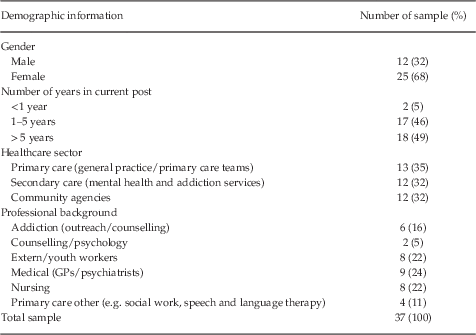
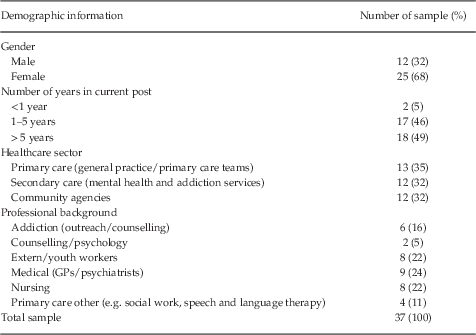
We adopted a purposive sampling framework to achieve a diverse range of knowledge and experience across the health care spectrum. Sampling parameters included (1) geographical region: two socioeconomically disadvantaged urban areas and (2) health/social care agency: the study sample included health care workers (n=37) from clinical sites and agencies reflective of the range of settings where young people seek help for mental and substance use problems and which have a direct link with primary care. The study sample included health care workers from primary care (general practice and primary care teams), secondary care (mental health and addiction services) and community agencies. Health care workers who were engaged in the area of youth mental health and/or addiction at each participating site were identified by a member of the Project Steering Group and invited to participate. The study was approved by the Irish College of General Practitioners and HSE-Midwest Research Ethics Committees (Table A1 describes the settings and study participants).
Data collection
The interviews were conducted by the first three authors (D.L., E.S. and C.A.) at various health care and community settings and ranged in length from 16 to 120 minutes; interview length was often dependent on the health care worker’s work environment (e.g., time constraints were an issue in busy clinical settings). Interviews elicited information on participants’ experience of and attitudes towards screening and early intervention for youth mental and substance use disorders. The topic guide was informed by a literature review on the role of primary care in addressing youth mental health (Cullen et al. Reference Cullen, Broderick, Connolly and Meagher2012), which outlined the importance of multifaceted interventions (e.g., promoting awareness, further training for GPs and implementing guidelines) to enhance the GP role in addressing youth mental health problems and two theoretic frameworks: ‘Social Determinants of Health’ (Wilkinson & Marmot, Reference Wilkinson and Marmot2003), which explored young peoples’ engagement with services in terms of need identification, treatment engagement/sustainment and community resource engagement and the ‘Chronic Care Model’ (Bodenheimer et al. Reference Bodenheimer, Wagner and Grumbach2002) (e.g., self-management support, clinical information systems, delivery system redesign, decision support, organisation and community resources).
Semi-structured interviews examined: demography (e.g., professional background, experience and training in youth mental health and substance use disorders and current screening practices). The theoretical frameworks informed questions relating to the identification of service user needs, the challenges of meeting the needs of young people in regards to treatment engagement/sustainment, need identification, the availability of community resources and attitudes/views on the barriers and enablers of screening and early intervention for youth mental and substance use disorders (see Appendix B for a copy of the interview schedule). Interviews were digitally recorded and transcribed verbatim.
Data analysis
Thematic analysis was used to analyse respondents’ experiences of and attitudes towards screening and early intervention for mental and substance use disorders among young people. Braun and Clarke (Reference Braun and Clarke2006: 79) described thematic analysis as a ‘method for identifying, analysing and reporting patterns (themes) within data’. Data were analysed in accordance with Braun and Clarke’s (Reference Braun and Clarke2006) five-step process: (1) Familiarisation with the data – reviewing audio files, reading and re-reading the interview transcripts; (2) Initial coding – relating to the interview questions and topic guide as well as ‘free codes’ developed by the researcher were generated and data relevant to those codes were collated; (3) searching for themes – after collating all of the codes, the researchers tried to establish relationships between them to identify major themes; (4) theme audit and review – checking themes against coded extracts; and (5) defining and naming themes – reviewing the names of the themes (Braun & Clarke, Reference Braun and Clarke2006). Two researchers (D.L. and E.S.) coded all of the interviews individually and corroborated themes with the principal investigator (W.C.) to reach consensus. The computer software, NVivo9 was used to store and organise data.
Bronfenbrenner’s Theory of Human Development (1979) as a theoretical framework for analysis
In the preliminary stages of analysis, similarities to Bronfenbrenner’s Ecological Theory of Human Development (1979) were noted, therefore major themes were categorised according to the ecological systems in this theory: the microsystem, the mesosystem, the exosystem and the macrosystem (Bronfenbrenner, Reference Bronfenbrenner1979). The microsystem refers to an individual’s immediate environment (e.g., interpersonal relations with family, school, neighbourhood etc.). Factors associated with the mesosystem include relations between two or more microsystems (e.g., relationships between school and peers). The exosystem describes the external factors, which influence a person’s social setting (e.g., parental stress at work and repercussions on the home environment). The macrosystem includes the wider societal events that shape the individual’s social context (Bronfenbrenner, Reference Bronfenbrenner1989; see Fig. A1 for an illustration of Bronfenbrenner’s Ecological Theory).
Results
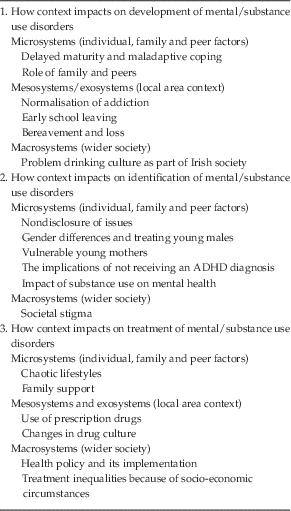
Social context was identified as central theme across the interview transcripts. The researchers recognised within the data that individuals are influenced not only by family and peer groups, but by the local context in which they live and furthermore by wider society. Therefore the (1) Development, (2) Identification and (3) Treatment of mental and substance use disorders are presented in relation to how they are influenced by the four key ecological systems, the micro-, meso-, exo- and macrosystem (see Table A2 for a breakdown of themes/subthemes).
Theme 1 How context impacts on the development of mental/substance use disorders.
The main contextual factors associated with the development of mental and substance use disorders among young people included individual characteristics within the micro-system (e.g., maladaptive coping strategies); local area contextual issues in the meso-exo-systems (e.g., the negative relationship between criminal violence and drug culture on a young person’s microsystem/local community) and the attitudes towards mental ill-health in Irish society within the macrosystem.
i. Microsystems (the individual and family/peer relationships)
Delayed maturity and maladaptive coping
According to health care workers, young people often developed maladaptive coping skills (e.g., physical violence, substance abuse, etc.) in an environment where there might not be appropriate role-modelling for adaptive coping skills. Suicide and suicidal ideation are also very common, where there is ‘a general expectation’ that an individual’s quality of life will not be very good due to socio-economic disadvantage:
‘There are two young people in the last six weeks that have committed suicide that my young people would know’. (Youth Worker)
Role of family and peers
Health care workers noted that the people who should be playing a key role in the young person’s recovery, are very often at the core of the problem; negative maladaptive family patterns may recur and peer behaviours can fast-track an individual into developing problems, most often addictive behaviour:
‘You are looking at kids who have grown up in incredibly disintegrated families…we would have parents…or even grandparents who are heroin addicts’. (GP)
ii. Mesosystems and exosystems (local area context)
Normalisation of addiction
The high incidence of substance use and mental health issues has resulted in a normalisation of severe addiction. Health care workers found that some parents were now becoming very tolerant in regards to cannabis use:
‘The argument that the parent has is that he is only using marijuana now. They think that is nothing at all’. (Child Psychiatrist)
Early school leaving
Many health care workers found that a lack of incentive within their local environment to stay in school seemed to exacerbate psychosocial problems in young people. Some health care workers identified parental barriers as a key contributory factor to early school leaving, particularly where both parents and children had literacy issues:
‘Almost all would be out of school very young and then they are like twenty three year old thirteen year olds’. (Outreach Worker)
Bereavement and loss
Health care workers could identify many different cases where young people must cope with loss for health reasons, suicide or family members being in prison. Some health care workers felt that witnessing a considerable amount of loss at a young age tends to result in ‘disassociation and avoidant behaviour patterns’ as a mechanism of maladaptive coping for young people:
‘All the girls have the same issue. They are all self-harming…fifty per cent of the girls… have a dead parent’. (Youth Worker)
iii. Macrosystems (wider society)
Problem drinking as part of Irish culture
Many health care workers also experienced difficulties trying to determine the key contributing factor to a young person’s problem (e.g., the mental health problem and substance abuse issue given the excessive alcohol consumption). With alcohol use so ingrained in the culture of the nation, it becomes difficult for health care workers to persuade young people and parents alike they are using alcohol in harmful ways:
‘If you say to the parents – do you know what the recommended amount that you drink is? They look at you like you are a bit weird and go – “are you sure?”’ (Child Psychiatrist)
Theme 2 How context impacts on the identification of mental and substance use disorders.
Identification of mental and substance use disorders proved difficult for health care workers due to problems within the individual’s microsystem such as non-disclosure of issues and conflicting views on the diagnosis of attention deficit/hyperactivity disorder (ADHD). Societal stigma within the macrosystem towards mental ill-health often deterred young people from engaging with services.
i. Microsystems (the individual and family/peer relationships)
Young people and non-disclosure of issues
Some participants identified the lack of communication between health care workers and young people as a major barrier to identification of mental health problems. Participants identified several factors as possible reasons for communication issues (e.g., concealing substance use, fear of violent family members, choosing to talk to peers instead of parents/health care workers, lack of maturity, low self-esteem, avoidant coping and feeling uncomfortable disclosing problems in the presence of parents):
‘I have had so many times where they just won’t talk to me at all. That guy that I was saying was in the clinic…He came into me and he literally wouldn’t open his mouth’. (GP)
Gender differences and treating young males
Young men not disclosing issues was common, with some health care workers describing consultations that consisted of ‘a series of monosyllabic answers’. Other factors contributing to males’ reluctance to discuss personal problems were the culturally accepted idea that ‘men don’t talk, men don’t cry’ and ‘gang mentality’. It was also clear that expressing negative emotions is perceived differently for young men and young women:
‘Boys…when they are emotionally upset, present as angry…people don’t…think of somewhere like here. They just think he is a teenager and he is angry as opposed to maybe he is depressed. A lot of the girl’s schools would refer here if there is a girl presenting with behavioural problems because they feel it is gender inappropriate’. (Child Psychiatrist)
Vulnerable young mothers
Some of the health care workers identified young mothers as a particularly vulnerable group. There were worries that many would develop postnatal depression because participants’ felt that young mothers very often receive little support from the children’s fathers. However, in contrast to young males, social supports, encouragement and positive affirmation are common for young mothers:
‘We need something accessible like the Well Woman Centres [a national chain of health services for women]…In big regions like a city you need a clinic for young men…that get STDs…they can go in to this place incognito?...But they could go somewhere like that for psychiatry as well and say “I am not in the best of form”’. (Nurse)
Diagnosing young people with ADHD
There were a number of instances where drug addiction and criminality were linked to a diagnosis of ADHD. However, some health care workers suggested that the diagnosis can lead to better acceptance of a young person’s behaviour, as it reframes them within the context of the disorder, rather than being attributed to behavioural problems alone. Conversely, one health care worker believed that the number of young people receiving ADHD diagnoses and taking prescribed medication was unnecessary, instead highlighting the need for lifestyle changes:
‘With a lot of young people, they have been given ADHD tablets since they were one [year old]. When really…their nutrition is crap and they are not engaged in anything’. (Youth Worker)
Impact of substance use on mental health
Many health care workers considered substance use to have devastating effects on the young person’s mental health, academic ability and social development. Health care workers felt that engaging in treatment might not be an option for some because of drug-related paranoia and trust issues:
‘There are lots of self-help groups but...drugs can really affect them and make them feel paranoid’. (Counsellor)
ii. Macrosystems (wider society)
Societal stigma
Respondents identified the stigma within Irish culture that exists towards mental health problems as a barrier to young people seeking help for their problems. Furthermore, health care workers felt some young people, even when help had been sought, were reluctant to engage with services due to the stigma attached to mental health issues and attending certain treatment centres:
‘I have had personal experience of someone not coming to an appointment…she met a friend of hers and they walked past the clinic…because she couldn’t say to her friend, I’m going into that [clinic]’. (Adult Psychiatrist)
Theme 3 How context impacts on the treatment of mental/substance use problems.
Health care workers often experienced difficulties treating young people because of their chaotic lifestyles. Factors within the local area context (e.g., drug-related violence) posed further difficulties in terms of providing appropriate treatment. Treatment barriers within the macrosystem included restrictions resulting from mental health policy and segregation between healthcare services.
i. Microsystems (the individual and family/peer relationships)
Chaotic lifestyles
According to many health care workers, factors associated with chaotic lifestyles included: families, peers, the local environment and the larger societal context of being young in Ireland. Therefore, it is not uncommon for young people to miss appointments or struggle to continue with treatment. Youth workers (in the absence of parents who may also have their own mental health/addiction issues) often have to provide a link between the young person and the health care workers they are working with to ensure treatment engagement:
‘The mental health and substance abuse issues tend to be more predominant in areas where socio-economic factors are big and that also affects their ability to get to the clinic’. (Clinical Psychologist)
Family support
The majority of health care workers found that young people were more likely to progress in treatment if their parents were willing to proactively engage with services. However, some health care workers also emphasised the danger of caregiver burden on family members when trying to support the young person:
‘What we would experience here with the family support programme…the addict becomes the other people’s lives’. (Addiction Counsellor)
Use of prescription drugs
Health care workers expressed concerns about the common use of prescription drugs (especially antidepressants, sedatives/hypnotics) among young people and their parents in socio-economically disadvantaged communities. According to some health care workers, prescription drug use was often viewed as an ‘acceptable way to treat’ emotional problems. Furthermore, health care workers also indicated their concern about prescribing any medication for mental health issues due to the potential for addiction or reselling:
‘I never gave him any meds, much to his disappointment, but the difficulty is that…a lot of them go out there and sell it’. (Adult Psychiatrist)
ii. Mesosystems/exosystems (local area context)
Changes in drug culture
The introduction of a wider and cheaper range of psychoactive drugs and ‘head shops’ meant health care workers were faced with more difficulties in treating youth substance use problems. Changes in drug culture also resulted in increased violence and gang affiliation where ‘power, abuse and intimidation’ leave families living their lives in fear. Health care workers struggled to help young people with treatment strategies that are often lost when the young person returns to their destructive neighbourhoods:
‘People can come…and put in a hell of a good effort…but if they’re going back to an environment where it’s just full of chaos…it’s...very difficult’. (Addiction Counsellor)
iii. Macrosystems (wider society)
Health policy and its implementation
Mental health policy in Ireland (especially ‘A Vision for Change’ and the ‘Mental Health Act’ 2001) was not viewed favourably by health care workers, especially in respect of its failure to deliver appropriate services to young people, particularly 16 and 17-year-olds. The Mental Health Act also poses difficulties in terms of parental consent being necessary for treatment:
‘A lot of adolescents that we have are trying to meet the developmental tasks of adolescence. And part of that is being…more responsible, more adult and we are…taking that away from them’. (Child Psychiatrist)
There is also a certain amount of ambiguity among health care workers (particularly between staff members from primary and secondary care) in regards to the potential relationship between psychiatry services and primary care teams. Currently, specialist psychiatry services are reluctant to work with young people who might be experiencing mild emotional problems as they feel that community-based psychology services would be more suitable:
‘We still have people that are very seriously ill and we cannot sustain this because we are also dealing…with the worried well’. (Nurse)
Treatment inequalities because of socio-economic circumstances
If people from socioeconomically disadvantaged areas do seek treatment, they may have difficulty in getting the best care due to financial barriers:
‘It goes back to…economic apartheid…if they have health insurance and are wealthy they can get themselves off to a nice expensive clinic. If they have none of those…you are dealing with very limited services’. (GP)
Societal attitudes and adverse media coverage has resulted in an increased level of stigma attached to living in socially economically disadvantaged urban areas:
‘There’s great stigma within schools…hospitals…in society and particularly with [specific deprived urban area] right now with the publicity on [national TV programmes]…and people are now discriminated against because they are living in appalling conditions’. (Public Health Nurse)
Discussion
Key findings
Our findings highlight the important relationship between the individual, family and peers, local community and wider society, consistent with ecological theories of development (Bronfenbrenner, Reference Bronfenbrenner1989, Reference Bronfenbrenner2005; Ungar et al. 2013). Consistent with previous social and environmental theories, the influence of parents, peers and community can play an important role on adolescents’ potential for risk-taking behaviour (Igra & Irwin, Reference Igra and Irwin1996). Several studies have noted the link between parental substance abuse and the negative psychosocial repercussions for the children (Andreas et al. Reference Andreas, O’Farrell and Fals-Stewart2006; Barnes et al. Reference Barnes, Mitic, Leadbeater and Dhami2009). Similar to other research, risk-taking behaviour such as substance abuse, as a way to cope with stressful social environments was commonplace in both study sites (Bonomo & Bowes, Reference Bonomo and Bowes2001).
Early school leaving was also a common theme in our findings and it was perceived that there was little incentive for young people to stay in the educational system. Early school leaving has been linked with a higher risk of alcoholism in adulthood (Crum et al. Reference Crum, Ensminger, Ro and McCord1998) and school engagement can be an important protective factor in delaying the onset of substance abuse in adolescence (Simons-Morton & Chen, Reference Simons-Morton and Chen2005). In a systematic review of effective mental health promotion for young people, researchers identified the importance of a collaborative effort between parents, teachers, youth workers and young people in low-income communities to facilitate the school environment as a place to promote mental health interventions (Barry et al. Reference Barry, Clarke, Jenkins and Patel2013).
The higher rate of referrals for female patients compared with males was an interesting finding, particularly when the majority of youth suicides occur in males and are frequently underpinned by untreated mental illness (Houston et al. Reference Houston, Hawton and Shepperd2001). However, previous research in Ireland reported higher rates of psychiatric disorders among females (Edokpolo et al. Reference Edokpolo, James, Kearns, Campbell and Smyth2010; McMahon et al. Reference McMahon, Reulbach, Corcoran, Keeley, Perry and Arensman2010). In a qualitative study with young Irish males who had attempted suicide, Cleary noted that ‘hegemonic masculinity norms’, whereby more traditional or conventional male gender roles are assumed (Connell, Reference Connell2005) and using alcohol as coping mechanism were the key factors that discouraged help-seeking (Cleary et al. Reference Cleary, Nixon and Fitzgerald2007). In the My World Survey, gender was identified as both a risk and protective factor; males consistently reported higher levels of satisfaction with life compared with females but they also engaged in more risk-taking behaviour, including problem drinking, substance abuse and violence towards others (Dooley & Fitzgerald, Reference Dooley and Fitzgerald2012).
A key area of concern in the current study was health care workers’ conflicting views on diagnosing young people with ADHD. While some participants felt that it explained behavioural difficulties, others were concerned about young people being incorrectly diagnosed and taking unnecessary medication. However, previous Irish studies have reported high levels of undiagnosed ADHD (Fitzgerald, Reference Fitzgerald2001; Syed et al. Reference Syed, Masaud, Nkire, Iro and Garland2010) and combined psychotherapeutic and pharmacological interventions was highlighted as a necessary treatment strategy (Van Hout & Foley, Reference Van Hout and Foley2013). Conflicting views in regards to ADHD diagnoses highlights the need for increased training of non-mental health care workers in mental health diagnoses and better communication between mental health care professionals and health care workers from other settings.
In line with Bronfenbrenner’s Ecological Model, the larger cultural and societal systems acted as a powerful influence over the participants’ lives (Bronfenbrenner, Reference Bronfenbrenner2005). The macrosystems outlined in this paper (e.g., outdated mental health policy and stigma) left families vulnerable to great harm and deterioration. The stigma attached to living in socioeconomically disadvantaged urban areas has been well documented in previous research, thus resulting in negative psychosocial consequences for the residents (Hastings, Reference Hastings2004) and underutilisation of government and community services (Stevenson et al. Reference Stevenson, McNamara and Muldoon2014). The additional challenges within the broader societal context, which health care workers experience when working with young people living in socioeconomically disadvantaged urban areas (e.g., financial restraints, limited staff, time and resources, chaotic environments, drug-related crime and violence) provide additional support for Tudor Hart’s Inverse Care Law whereby the level of medical and psychosocial supports available does not meet the requirements of the population served (Hart, Reference Hart1971).
Implications for further research and clinical practice
In socioeconomically disadvantaged urban areas, interventions that support and engage with the families and their local communities are most likely to be effective in preventing and treating mental and substance use problems. Previous research identified key areas to facilitate drug prevention in families: school-based prevention programs, working with parents and health care workers and collaboration with schools, parents and the wider community (Cuijpers, Reference Cuijpers2003). However, previous research noted that parents from socioeconomically disadvantaged areas were less likely to engage in interventions, with lack of time, financial restraints, childcare responsibilities and fear of stigma being the predominant barriers to engagement (Velleman et al. Reference Velleman, Templeton and Copello2005; Murry et al. Reference Murry, Heflinger, Suiter and Brody2011). Thus, additional supports such as outreach work and home-based interventions for families in socioeconomically disadvantaged urban areas are necessary to establish initial links and facilitate proactive relationships with the health care services.
While the family represents the child’s early microsystem for learning how to live (Swick & Williams, Reference Swick and Williams2006) the young person’s wider ‘community’ must also be a secure environment (Bronfenbrenner, Reference Bronfenbrenner1989). Previous research noted the reduced level of social capital within Irish communities, where young people feel less connected with their local environment (Illback & Bates, Reference Illback and Bates2011). In the absence of mesosystems and exosystems, families and communities are at risk of negative psychosocial repercussions (L’Abate, Reference L’Abate1990; Swick & Williams, Reference Swick and Williams2006). Continuing and increasing collaborative work on psychosocial problems from health care workers and community agencies who are dedicated to improving the lives of young people is vital. At a macrosystem level, work geared towards changing cultural attitudes towards mental ill-health, alcohol use and societal stigma towards individuals living in socioeconomically disadvantaged urban settings requires continued support. Additionally, it is necessary for the wider societal contexts of mental health service policy to continue to evolve and deliver appropriate services if we are to effectively address youth mental health.
Strengths and limitations of the study
Our qualitative approach allowed us to develop an in-depth understanding of the difficulties health care workers experience when addressing young people with mental health and substance use problems. The influence of the study’s theoretical frameworks combined with participants’ accounts provided significant information, which should influence future service planning and development. Bronfenbrenner’s ecological theory allowed a focus on the immediate and broader aspects of context with regard to influences on a young person’s mental health. However, it is worth noting the limitations of a qualitative study in terms of generalisability and the unique context of Ireland (e.g., mental health policy and the excessive drinking culture) might make some of the results less applicable to other cultures and systems.
Health care workers in the current study were very engaged in the area of youth mental and substance use disorders, half of the respondents had been working in this setting for more than 5 years, which suggests these communities are fortunate to have health care workers who are committed to working with them for a long time. However, further research should focus on recruiting health care workers without these specialist skills and determine the factors that might motivate health care workers to work in deprived urban areas with youths who are considered high risk. The time variation in regards to interview length should also be noted as a limitation, as some health care workers were limited in the amount of time they could dedicate to the interview by their busy clinical settings.
Conclusions
The role of context in a young person’s life is a vital one, within each system from the micro to the macro, opportunities for positive growth and development can be lost or gained. Each system has an important part to play, from the family home to the health care services. Practitioners and policy makers must make an effort to understand the reciprocal relationship of dependency and influence with all the other systems (Ungar et al. Reference Ungar, Ghazinour and Richter2013) when creating treatments and interventions for young people. Interventions that enhance the capacity of health and social care professionals to identify and appropriately respond to the specific needs of youth mental and substance use disorders in socioeconomically disadvantaged urban areas are a priority.
Acknowledgements
The authors thank all health care workers who supported and participated in this study and members of the project steering committee who provided useful advice and assistance with advising on the study protocol and its implementation.
Conflicts of Interests
None.
Financial Support
This research was funded by the Health Research Board (HRB) of Ireland ‘Health Research Awards’ (HRB_HRA 2010/4).
Appendix A
Demographic information for healthcare professionals
Context theme – major themes and subthemes

Appendix B: Interview schedule
Interview schedule – health care workers
Demography/descriptive data
1) How long have you been in your current profession?
2) What kind of training have you had in youth mental health?
3) How do you usually become aware of young people who might have a mental health or substance misuse disorder?
4) What proportion of your time is spent working with young people with such conditions?
5) Can you tell me about your previous/current practice of screening/early intervention for mental distress and/or substance misuse amongst young people?
Experience of mental and substance use disorders among young people
1) How are service user needs identified?
2) What are the main challenges in regards to meeting the needs of young people with respect to
a. treatment engagement?
b. treatment sustainment?
c. need identification?
d. resources available?
e. differences between adults and young people?
3) Are there additional supports/community resources available outside of this service for service users?
a. If so…can you tell me more about them?
4) How would you improve your service with respect to
a. access to services for young people?
5) What is your view on the inclusion of parents/guardians in a young person’s treatment for mental/substance use difficulties?
Attitude towards screening/early intervention
1) Do you think it would be feasible to have screening in your service?
2) What are the main factors that facilitate screening/early intervention for mental distress/substance misuse in young people?
3) What are the main barriers that prevent screening/early intervention for mental distress/substance misuse in young people?
4) If the child of a friend of yours had a mental health or substance misuse difficulty, what would you advise them to do in the first instance?
5) If you have a service user presenting with both mental and substance use difficulties what kind of treatment options are available to them?
6) Could you tell me briefly about a young person that you cared for that resulted in a positive outcome? What was the condition? How did you help? Why was the outcome so good?
7) Are there any other comments you would like to make?
Appendix C
Bronfenbrenner’s Ecological Model. Adapted from Bronfenbrenner (Reference Bronfenbrenner1979).