As scholars of higher education regularly point out, American universities face a fundamental tension between access and exclusion. On the one hand, as publicly supported institutions operating in a democracy, they are charged with promoting social mobility and sharing knowledge that can improve society. On the other, they are tasked with identifying and supporting elites—those talented, ambitious, and hardworking individuals who deserve the most money and accolades. In his 1993 History of Education Society presidential address, “Race, Meritocracy, and the American Academy during the Immediate Post-World War II Era,” historian James Anderson describes one way in which northern white colleges and universities coped with this tension after World War II. During this time, Fred Wale, director of education for the Julius Rosenwald Fund, compiled a list of 150 outstanding black scholars with degrees from schools like the University of Chicago, Harvard, Columbia, and the University of Michigan; extensive teaching experience at historically black colleges and universities (HBCUs); and highly regarded publication records. Wale sent his list to hundreds of university presidents, encouraging them to consider these qualified candidates for faculty appointments. His efforts made minimal impact: between 1945 and 1947, only twenty-three of the scholars on Wale's list were offered permanent faculty positions at northern white universities.Footnote 1
How did these universities justify the continued exclusion of black faculty from their hallowed halls? White administrators went to extraordinary lengths to explain away their racism—going so far as to hold up black service workers as evidence of faculty diversity. They argued that black faculty would not be comfortable at white institutions, that black scholars never applied to open positions, and that actively recruiting black faculty would require discriminating against whites. The most popular argument, however, relied on meritocracy. University hiring practices were designed to select the most qualified applicants, regardless of race: the absence of black tenure-track faculty at top universities simply indicated that these applicants were not among the most qualified. As Robert Sproul, president of the University of California, noted in his response to Wale: “To the best of my knowledge there is no group prejudice against Negros on the staff at this University.”Footnote 2 This shared commitment to a narrow definition of meritocracy in the American education system allowed for the continued exclusion of people of color from top universities, both at the student and faculty levels.
As David Labaree notes, “A common problem with discussions of the American system of higher education is that they tend to focus much too heavily on a few institutions at its very pinnacle.”Footnote 3 This hyperfocus on elite institutions obscures the contributions of women, people of color, and other historically marginalized groups. For instance, most of the black scholars Anderson describes in his address took positions in HBCUs or outside academia, which means that, in the many histories of the Ivy League, they are nowhere to be found. Similarly, as Mary Ann Dzuback's notes in her 2003 HES presidential address, “Gender and the Politics of Knowledge,” at the turn of the twentieth century, female faculty did exceptional research in women's colleges. After being excluded from the very institutions at which they received their PhDs, increasingly influential majority female faculty pushed women's colleges to raise their salaries, hire more professors with PhDs, provide them with research assistants, fund their travel to conferences, and expand library collections to meet their research needs. They also used their public service requirements (e.g., serving on state and federal committees on women's issues) to enhance the visibility of their scholarship.Footnote 4 Without including Barnard or Mount Holyoke in our historical accounts, we ignore these women, their scholarship, and their strategies for participating fully in the production of knowledge. This is why work like Anderson's and Dzuback's is so important.
Yet, however tragic their exclusion from top universities, the scholars that Anderson and Dzuback describe were still able to engage in traditional academic scholarship. It would be difficult to argue that Barnard or Atlanta University—where W. E. B. Du Bois published groundbreaking sociological work—were not themselves elite schools.Footnote 5 In the manner of other top institutions, they valued original scholarship and teaching in the liberal arts and gave their faculty leeway to participate in these endeavors as they saw fit. In contrast, in the true “base” of higher education, students and faculty rarely engage in such activities. The newer, less selective, teaching-focused, vocationally oriented schools that “define the college experience for most Americans . . . and feed the most graduates into the American economy” receive even less attention from historians than women's colleges and HBCUs.Footnote 6 Although these institutions do not participate in the production of knowledge as Anderson and Dzuback conceptualize it (i.e., research), they are vital to the smooth operation of our system of higher education. In what follows, I draw on insights from my own work on for-profit colleges and police education to advocate for more historical scholarship on low-status institutions.Footnote 7
The Benefits of Stratification
In his recent book, A Perfect Mess, Labaree notes that American higher education has always grown at its “base”—by adding campuses and increasing enrollment at younger, larger teaching institutions that also tend to have a vocational focus. Such institutions include community colleges, for-profit colleges, and local comprehensive state universities. This form of expansion allows for the preservation of the “pinnacle” (i.e., older schools with excellent reputations that maintain high admission standards and produce most of our new scientific knowledge) even as broad access to postsecondary education expands. The system permits everyone to go to college (access), while ensuring that those who attend top colleges continue to be marked as elites (exclusion). Employers adjust by paying more attention to the prestige of workers’ alma maters: it matters less that a prospective employee went to college than where they went to college. At its face, this kind of argument sounds like a conspiracy theory—as if a criminal mastermind has purposefully designed our system of higher education to be unjust. Certainly, no university would publicly acknowledge that its aim is to exclude low-income students or reproduce the elite. Far from being the product of evil forces, however, this system exists because we value both of its conflicting goals.
Consider, for example, President Richard Nixon's 1971 statement to Congress laying out the federal government's higher education expansion strategy:
At the present time, thousands of individuals of all ages and circumstances are excluded from higher education for no other reason than that the system is designed primarily for 18-22 year olds who can afford to go away to college. . . . The Federal Government can do its part by supporting access to higher education for all of our people and providing the resources needed to help develop new forms of higher education which would be responsive to all of their needs [emphasis added].Footnote 8
Notice that the president saw the development of new types of institutions (like the for-profit University of Phoenix, founded in 1974) as a solution to increasing demand for postsecondary training among older students. At no point did he suggest that top universities should begin recruiting working adults, or providing them with flexible course scheduling, on-campus childcare, and other resources in response to their unique needs. Presumably, elite universities admit students through meritocratic processes that ignore the realities of their family and work lives. Here, we see a direct parallel to Sproul's argument that the University of California does not harbor any prejudice against black scholars.Footnote 9 Relaxing admissions standards—or perhaps, more accurately, changing them to recognize working adults’ unique contributions—undermines the blind sorting function of the university. However, as democratic institutions, American colleges and universities have a second charge: they must offer the possibility of social mobility and produce knowledge for the public good. Just as it would be jarring to turn the University of Michigan into an open access institution, it is upsetting to imagine excluding thousands of eager students from higher education entirely. Since no single institutional type can serve both these functions, the system tends toward stratification.
Unfortunately, we cannot offer a good account of when and how stratification increases without also studying higher education's base. Arguably, the pinnacle of higher education has been firmly established for some time—at least since the founding of the flagship public universities some 160 years ago. While these institutions have certainly been influenced by changing political, economic, and social conditions, their evolution has been incremental compared to the dramatic changes occurring at the base. And indeed, big changes at the top (e.g., the adoption of ethnic studies programs) are already well documented.Footnote 10 Among for-profit colleges and universities (FPCUs) alone, the shift in institutional form in the last sixty years has been astounding. As late as the 1960s, proprietary business schools offered certificates for bookkeepers, secretaries, stenographers, and clerks. They rarely conferred bachelor's degrees and focused their recruitment efforts primarily on recent high school graduates, college students who dropped out of traditional programs, and “the mature woman—widowed, divorced, or married, and seeking additional income to supplement the family earnings.”Footnote 11 By the turn of the twenty-first century, the biggest earners in the for-profit educational industry were multinational corporations, accredited by the same agencies as elite private universities, and offering master's and doctoral programs for working adults over the age of twenty-two.Footnote 12 An equivalent shift would be Harvard focusing its efforts on certificates in air conditioning repair—a change that would most certainly inspire volumes and volumes of academic analysis.
It is outside the scope of this essay to explain why low-status institutions change as rapidly as they do. However, briefly considering two examples from the base can help us see what we miss when we rely too heavily on the pinnacle to understand access to and exclusion from the production of knowledge. First, this hyperfocus on the elite obscures the unique appeal of the base and its complicated relationship to the pinnacle. During the 1970s, FPCUs gained access to federal financial aid, regional accreditation, and a new consumer base—not by promising to be shadow versions of elite institutions but by rejecting the existing blueprint for the university entirely. Second, most histories of higher education ignore the ways in which the base shapes knowledge through practice. By the 1960s, for example, most top universities had eliminated or completely redesigned their programs for police. Instead, instruction for future officers took place at less selective institutions, where knowledge about policing emerged from practice—not research.
Different on Purpose
Both Anderson's and Dzuback's addresses highlight the notable accomplishments of marginalized scholars who found homes in the institutions that would accept them. For example, Anderson recognizes the achievements of James Raymond Lawson, who published several articles in the well-regarded Journal of Chemical Physics while heading the Department of Physics at Fisk University—a historically black college in Nashville, Tennessee.Footnote 13 These minoritized scholars were remarkable in that they produced research on par with their colleagues at R1 universities – doctoral granting institutions with at least $5 million in research expenditures - despite having fewer funds and less time to devote to scholarship.Footnote 14 The distinction between top research universities and their less resourced counterparts represents one form of stratification—that based on status. At their core, however, these institutions are more alike than they are different. All are modeled on the research university ideal type, which places value on basic research and instruction in the liberal arts. In contrast, the growth of FPCUs represents stratification by function, not quality or status. Certainly, one can argue that FPCUs are not as good for students as schools like Columbia, Barnard, or Fisk. But FPCUs gained financial, political, and social support by depicting themselves as different, not worse, than the traditional university. In the 1970s—a decade with high unemployment, low job tenure, and an increasingly female and mid-career (35 to 44 years old) workforce—this argument was particularly compelling.Footnote 15 Using the realities of a changing labor market as a springboard, proponents of for-profit higher education argued that institutional diversity could be a bulwark against the exclusivity and narrow vision of the university.
During this time, one could find calls for institutional diversity in Congress, where lawmakers debated giving proprietary schools access to federal financial aid. In a 1971 hearing, Rep. Edith Green, chair of the House Subcommittee on Education, asked: “Why shouldn't $100 go to the student who attends a proprietary institution if he has made the decision that at that proprietary institution he can get the education he wants?”Footnote 16 One could hear the same arguments in the courts, where proprietary schools sued for the right to join regional accrediting associations. In his 1970 decision on Marjorie Webster Junior College, Inc. v. Middle States Association of Colleges and Secondary Schools, Inc., DC District Court Judge John Lewis Smith Jr. wrote:
The American system of free enterprise is structured on fair and open competition—not monopoly. The national interest is not best served by stifling competition from any available source. With the unprecedented demands on educational resources in this country, every institution should be given the opportunity to demonstrate its worth.Footnote 17
Finally, one could read these arguments in the meeting minutes of regional accrediting associations, which had to decide whether to accredit profit-making schools. In 1977, Thurston Manning, director of the North Central Association's Commission on Institutions of Higher Education, gave a speech where he declared:
The issue of the conflict between educational quality and educational diversity will become more important, because we are increasing the diversity of our educational system. . . . Whether we will continue to have the diverse educational system needed for our diverse peoples will depend on whether we can resist the temptation to see quality through standardization, and instead embrace the fact that the two goals of quality and diversity are in tension, and our task is to find an effective balance.Footnote 18
In many of the places that mattered most in higher education, the same arguments rang out. Different kinds of students need different kinds of schools. Only students have the right to determine which school they will attend. Institutional diversity ensures healthy competition between colleges and universities. It is the job of regulators to facilitate diversity and ensure a minimum level of quality.
For their part, FPCUs were extremely effective at arguing that, because they offered coursework in practical skills at convenient times and locations, they were the superior choice for working adults. Consider, for example, the MBA—one of the first degrees FPCUs offered that elite nonprofit colleges and universities were already offering. Why would any student choose to pursue their MBA at DeVry University over Harvard, Stanford, or the University of Chicago? Certainly, the cost and selectivity of the latter institutions act as barriers to entry. However, no new organizational form can succeed by pitching itself as an inferior, yet attainable, version of the ideal, and FPCUs were no exception. In their early years, for-profit MBA programs marketed themselves as distinct from, even diametrically opposed to, the traditional MBA. For example, a 1990 advertisement from the Keller Graduate School of Management, whose founders would later purchase DeVry University, states:
Keller Graduate School of Management was founded on the idea that the most important components of an MBA program are effective teaching and student mastery of practical management skills.
We reasoned that while there is an important need for MBA programs with world class research-minded faculties like Harvard, Stanford and the University of Chicago . . . in today's world, there is an equally critical need for a high-quality MBA program which focuses on practical skills and concepts.Footnote 19
Its distinctiveness from “world class research-minded” institutions remains a key feature of DeVry's marketing plan. The university continues to argue that its focus on the practical makes it “Different. On purpose.”Footnote 20 A psychologist may have a more nuanced explanation for why this oppositional strategy works. Perhaps the institutions that serve working adults must themselves reject the system that excludes, marginalizes, and ignores their key clientele. Regardless, the position has an intuitive appeal: it relies heavily on the nagging concern that top universities are not providing students with the practical skills they need to thrive in the real world.
Once again, FPCUs benefited from the zeitgeist of the 1970s. This was a decade in which “the business press, corporate officers, the deans themselves, journalists, and other professional observers” began lambasting the MBA for its lack of relevancy.Footnote 21 The most frequently cited criticism of the degree came from Robert Hayes and William Abernathy in their 1980 article, “Managing Our Way to Economic Decline”:
What has developed, in the business community as in academia, is a preoccupation with a false and shallow concept of the professional manager, a “pseudoprofessional” really—an individual having no special expertise in any particular industry or technology who nevertheless can step into an unfamiliar company and run it successfully through strict application of financial controls, portfolio concepts, and a market-driven strategy.Footnote 22
Because business school graduates were finance and law experts—not line managers promoted from within the organization—they prioritized maximizing short-term profit through well-tested means, and had little experience with the basic functions of their companies. For-profits designed their MBA for middle managers who had to return to school to compete with young business school graduates, but who could not afford to quit their jobs to do so. The loyal, hardworking employee who works their way up to middle management cut a sympathetic figure in the public imagination and FPCUs likely benefited by association.
In summary, there is something appealing about the base of higher education, which an excessive focus on the pinnacle tends to ignore. If they mention them at all, existing histories of higher education depict low-status institutions as refuges for those who discover they have nowhere else to go.Footnote 23 But FPCUs do not talk about themselves this way. Instead, they are rebels who play on our worst fears about the traditional university and claim to enhance diversity at both the student and institutional levels. (John Sperling, the founder of the University of Phoenix, even titled his autobiography Rebel with a Cause to juxtapose his life's work against that of a traditional academic.)Footnote 24 Indeed, this rhetoric is so appealing that scholars of modern FPCUs have found that students will choose a for-profit program even when there is a nonprofit alternative nearby that offers convenient classes at a fraction of the cost.Footnote 25 More historical work on the base can offer explanations for when this messaging is more or less effective, as well as who it appeals to and why. Such work can also identify when the base produces entirely new organizational forms—like the multinational, publicly traded for-profit university—rather than increasing enrollment at existing institutions. It can tell us which new forms are likely to survive and what role pinnacle institutions play, if any, in determining who lives and who dies.
The Application of Knowledge
In her address, Dzuback makes a clear distinction between the production of knowledge and its transmission:
Women, who had been teaching in primary schools since the early nineteenth century and in secondary schools and academies for women since the end of the eighteenth, were considered appropriate transmitters of knowledge, particularly when the students were young. But women used their collegiate positions to extend that role into the production of knowledge, the last bastion of male control of the politics of knowledge [emphasis added].Footnote 26
In this passage, Dzuback assumes that the reader knows that the “production of knowledge” refers to research, not teaching or professional employment. This shared understanding of the “production of knowledge” likely stems from the focus of historians, philosophers, and sociologists of knowledge on top universities—where research in the sciences, social sciences, and humanities is a core function. From Pierre Bourdieu's Homo Academicus to Andrew Abbott's Chaos of Disciplines, prominent scholars often base their theories of knowledge production on the institutions at which they and their colleagues are employed.Footnote 27 Doing so exclusively, however, ignores how knowledge is shaped in fields that have been ousted from top universities. Research and instruction in the practice of policing, for example, lost its foothold at elite universities in the 1960s and 1970s.
In the 1930s and 1940s, it was not uncommon for top universities to offer courses for law enforcement and to appoint former police officers—many without advanced degrees—to faculty positions. For example, in 1916, August Vollmer, chief of the Berkeley Police Department, began collaborating with faculty at UC Berkeley to develop coursework for police officers. He was soon poached by another institution, however. His first official academic appointment was at the University of Chicago, where he taught police administration in the history department. Similarly, when deciding whether to found a School of Criminology, Berkeley looked to its peer institutions for inspiration. At the time, Harvard offered a course in police laboratory science and was also considering opening its own criminology department. These two examples illustrate that police science was, at the very least, not unwelcome at top universities. Today, however, neither Harvard, Berkeley, nor the University of Chicago offer undergraduate degrees in criminal justice—a field that is arguably closer to a traditional academic discipline than the police science of the past. What happened?
Once again, stratification emerged to balance the competing functions of the university. Consider, for example, the case of UC Berkeley's School of Criminology in the late 1950s. During this time, the school came under fire for offering training that was “too occupational” and “not a proper pursuit for an undergraduate.” Faculty were reprimanded for conducting studies that “would more properly be called surveys than research.”Footnote 28 As a condition of remaining at the university, the school was forced to cut its coursework related to law enforcement, “specifically those leading to the training of policemen and the more routine aspects of crime detection, in finger-printing, forensic ballistics, foot-prints” and to create a “balanced program based on a body of knowledge drawn from Sociology and Psychology.”Footnote 29 In short, it had to become a more traditional academic department. Critics did not argue that research on law enforcement and education for police were worthless pursuits. They simply questioned whether such pursuits belonged at an institution like Berkeley instead of California's more vocationally oriented institutions (such as community colleges or the California State University system). Ultimately, administrators at Berkeley—including then chancellor Clark Kerr, the lead architect of California's Master Plan for Higher Education—decided on the latter.Footnote 30
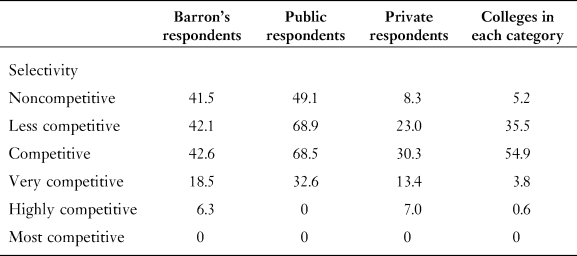
Unfortunately, the problem of educating police did not go away simply because top universities stopped considering it. Indeed, in 1967, the President's Commission on Law Enforcement and Administration of Justice recommended that “the ultimate aim of all police departments should be that all personnel with general enforcement powers have baccalaureate degrees.”Footnote 31 Who would educate these police officers if not the top universities in the country? By the 1970s, most collegiate-level education for police took place in the base of higher education. Of the 1,070 schools operating police education programs between 1975 and 1977, 48 percent were community colleges. Among four-year colleges and universities, public institutions made up 60 percent of those educating police.Footnote 32 Similarly, these programs were also clustered in less selective institutions, as defined by the Barron's Profiles of American Colleges classification system—a composite measure of mean SAT/ACT scores, high school rankings of applicants, and acceptance rates.
Consistent with Labaree's argument about the benefits of stratification, in this case we see the base absorbing tasks the pinnacle will not take on. Higher education fulfills its promise to contribute to the public good, while preserving the pinnacle's freedom to pursue knowledge for its own sake.Footnote 33
One critical question is whether knowledge about the police changed when these programs shifted from the pinnacle to the base. Unfortunately, without more detailed historical work, it is difficult to say. We do have some sense that less selective programs offered more practical training than their more selective counterparts. For example, in their 1978 audit of programs funded through the Law Enforcement Education Program, the Department of Justice found that, across all institutional types, 15 percent of courses provided only “training” (e.g., “traffic control techniques, report writing, polygraph, defensive techniques, and correctional operations and procedures”). At community colleges, 24 percent of all courses were training-based, as opposed to 9 and 8.5 percent at four-year colleges and universities, respectively.Footnote 34 Around the same time, the National Advisory Commission on Higher Education for Police Officers sent questionnaires to the heads of 1,070 police programs about the textbooks used in their coursework. They classified the 606 books the program heads listed and found that 60.5 percent were purely prescriptive—they described either how to do police tasks or listed administrative policies.Footnote 35 We also know that faculty in police programs tended to have less education than their counterparts in other departments. In 1975-76, only 78 percent of police education faculty had at least a master's degree, as opposed to 93 percent of all faculty. They were also more likely to work part time—only 42 percent had full-time appointments. These broad sketches of police faculty and curricula cannot tell us exactly what was happening in the classroom or with regards to faculty research. However, they do offer a hypothesis: when fields move into the base of higher education, they become more focused on applied knowledge over the production of knowledge through traditional scholarship.
Even after the School of Criminology at UC Berkeley closed for good in 1976, researchers at the university continued to produce scholarship on the criminal justice system—albeit it with a different form and focus. Did instructors at California's community colleges rely on this scholarship when teaching future officers? If so, how did they interpret this new knowledge? Did scholarship on policing at Berkeley fundamentally change once police officers were no longer participating in its creation? In other words, did former police officers (like Vollmer) produce different scholarship than classically trained sociologists? Finally, did the type and content of instruction police officers received change the nature of policing itself? We might ask these same questions of other fields that tend to be concentrated in the base (e.g., paraprofessions in health, law, and business). However, we cannot answer any of them without first producing more histories of low-status institutions themselves. In ignoring these schools, we miss a basic throughput in the production of knowledge. If a sizable number of California's police officers were educated at community colleges in the 1970s, we need to know what these colleges were teaching in order to better understand police culture and practices during this time. In transmitting applied knowledge, these schools helped shape the beliefs, norms, and behaviors upon which our more abstract knowledge of policing is based.
The appeal of writing histories of prestigious colleges and universities is great. Their ivied halls are what many Americans envision when they say the word college. They are old, maintain excellent records of their own activities, and are intriguing by virtue of their exclusivity. As Dzuback's and Anderson's addresses indicate, even historians who are interested in the stories of marginalized groups often focus on their slow integration onto elite college campuses, rather than their more rapid entry into low-status ones.Footnote 36 We have too long ignored the schools that grant the most access to our higher education system—newer, less selective, undergraduate-serving institutions that focus on teaching over scholarship and practice over theory—as well as their impact on knowledge. These base institutions are not mere mirrors of their more prestigious counterparts. Indeed, their distinctiveness is what permits our higher education system to be both accessible and exclusionary, removed from the concerns of the outside world and oriented toward the public good. The expansion of FPCUs in the 1970s reminds us that newly created institutions must define their distinctiveness, and will do so in ways that play on our existing concerns about the effectiveness of collegiate education. In this way, they possess a unique appeal that can be used to their political and financial advantage. And though they are less likely to participate in the production of knowledge in the traditional sense (i.e., research), low-status institutions transmit the applied knowledge that shapes entire professions. Low-status institutions have had a great impact on the way scholarship is interpreted, repackaged, and transmitted to students, particularly in fields that elite colleges have little interest in (such as training police). Future historical work on low-status institutions should consider the challenges of studying such places—including limited access to historical materials at institutions that cannot maintain extensive archives, or for schools that have closed or changed ownership—and how to overcome them.
Percent of institutions with programs for police, by selectivity, 1975-1977

Source: Lawrence Sherman, The Quality of Police Education: A Critical Review with Recommendations for Improving Programs in Higher Education (San Francisco: Jossey-Bass, 1978), 107.