


Introduction
In recent times, warnings have spread about the negative consequences polarization brings about for liberal democracy. We have often witnessed how radicalized leaders and their followers start questioning, or stop abiding by, fundamental democratic norms. When elections are unfavorable to them, some losers put into question the legitimacy of the process, putting a strain on the democratic system. For instance, as seen in the 2020 US presidential election, allegations of fraud were used as a political tool to discredit the system and the winner. We have witnessed in liberal democracies all over the world that leaders and their followers do not always concede electoral defeat and question the legitimacy of the results.
Over the last years, political science research has tried to understand to what extent voters are willing to sacrifice basic democratic norms to support politicians that challenge the election outcomes. This is a crucial question, given that if voters and elites do not accept electoral defeat, one of the basic tenets of democracy – the peaceful alternation of power – falters and hence democracy may be in peril. Following the minimalist definitions of democracy as a system of peaceful alternation, democracies are stable when, among others, losers accept the electoral outcome and winners do not use their power to crush parties or candidates defeated at the polls. When the loser’s consent is broken and candidates call into question the rules of the game after losing the election, democracy is endangered.
Polarization is often mentioned as one of the crucial drivers of citizens’ support for politicians that erode democratic norms. Voters are expected to condone or even support the undemocratic behavior of those leaders with whom they feel close to in order to stop those they dislike from accessing power. However, despite the growing interest in the effect of (affective) polarization, we still do not know much about the mechanisms behind this effect: is the ideological distance – and, hence, policy-related considerations – that drives the effect or, as the recent literature tends to emphasize, is it affective polarization that explains it?
This is the main question we address on this paper. Given that affective polarization and ideological distance are two dimensions not necessarily correlated with each other (Iyengar et al. Reference Iyengar, Lelkes, Levendusky, Malhotra and Westwood2019) and that have different determinants, it is important to understand which of them drives tolerance or support for democratic backsliding. Are individuals emotionally away from a candidate as likely to accept the erosion of democratic norms as individuals whose policy positions stand in sharp contrast? In short, what is the effect of affective polarization and ideological distance on support for democratic undoing?
This article examines the effect of both affective polarization and ideological distance on people’s likelihood to preserve or reject democratic norms. By conceptualizing two different ways of conceiving political conflict and studying whether citizens are more tolerant to undemocratic behavior with politicians that are closer to them, we make a contribution to previous works, which have been largely oblivious to examining the interplay between affective polarization and ideological distance on support for democratic erosion.
Moreover, we test our argument with two different samples: a sample of citizens and a sample of politicians. This empirical exercise allows us to contribute to the debate about the consequences of ideological distance and affective polarization at the citizen and elite levels (Iyengar et al. Reference Iyengar, Lelkes, Levendusky, Malhotra and Westwood2019). The literature tends to view mass polarization as a by-product of elite polarization (Banda and Cluverius Reference Banda and Cluverius2018; Gidron et al. Reference Gidron, Adams and Horne2020), and democratic backsliding as an elite-driven process (Levitsky and Ziblatt Reference Levitsky and Ziblatt2019). Under this assumption, we might expect differences between citizens and politicians: are the latter more or less likely than the former to trade off democratic principles for partisan or ideological proximity? Do affective polarization and ideological distance erode politicians’ commitment to democratic principles more intensely?
We focus on the case of Catalonia, Spain. According to Gidron et al. (Reference Gidron, Adams and Horne2019), Spain ranks high in levels of affective polarization among 20 developed countries, with other indices showing a largely similar picture (Wagner, Reference Wagner2021). The levels of ideological polarization also fluctuate, but the overall picture is a similar one: Spain tends to be at the upper rank (Casal Bértoa, Reference Casal Bértoa2025). Catalonia is, within Spain, a case of a polarized political society that has experienced intense political conflict in the last decade (Madariaga and Riera, Reference Madariaga and Riera2022; Rodon and Guinjoan, Reference Rodon and Guinjoan2022). One might argue that Spain and, in particular, Catalonia, constitute a difficult case to find an effective democratic check from the public (in either of the two dimensions, affective polarization and ideological distance). Moreover, the Catalan case is a multiparty democracy with two equally important dimensions of political competition: the traditional left-right dimension and the territorial dimension – against and in favor of Catalan secession. Hence, ideological distance and affective polarization could differently affect citizens’ evaluation of the behavior of politicians in both dimensions (affective polarization in left-right and in territorial terms; and ideological distance in left-right and territorial terms).
Our research design is based on a conjoint experiment that was delivered to two groups. First, to a representative survey of the voting-age population in Catalonia. Second, to local, regional and national politicians in Catalonia. The conjoint experiment was identical for citizens and politicians, and respondents were presented with five pairs of candidates with randomly varying attributes, which included a candidate’s position on the traditional left-right axis and his/her position on the territorial debate. In addition, it included a statement by the candidate – probed in another survey – in which he/she questioned (or not) the electoral defeat of his/her party. This design allows us to test the extent to which candidates’ undemocratic practices affect citizens’ choices when the latter are faced with different ideological trade-offs. In other words, we can examine the effect of undemocratic attitudes as a function of an individual’s distance to his/her preferred party in both the ideological and the territorial dimension. In addition, the survey also captured an individual’s affection toward the different parties, which we employ to analyze whether citizens with high/low levels of affective polarization are more or less likely to tolerate the erosion of democratic norms when they are far away from the candidate.
Our results show, first and foremost, that voters are substantially less likely to vote for candidates that question the legitimacy of the electoral defeat. We observe that democratic undoing by a given candidate reduces voters’ support for him/her in a systematic and consistent way. Individuals are not willing to tolerate undemocratic practices even when the candidate shares their preferred policy position in the two-dimensional space. The same holds true for the sample of politicians: we observe very minor differences between citizens and elites.
If anything, voters appear to be even more demanding with ideologically proximate candidates regarding compliance with basic democratic norms, thereby suggesting that voters expect higher levels of democratic integrity among their own. This occurs for both the left-right and the territorial dimension. On the contrary, affective proximity with the candidate does moderate punishment: those who are closer to the group of the candidate tend to forgo undemocratic behavior to a larger extent. Finally, we show that the moderating role of affective polarization on punishment of undemocratic behavior is contingent on baseline attitudes toward democracy: respondents that expressed more skepticism toward democracy in a set of pre-treatment questions are more willing to bear with the undemocratic behavior of politicians they feel close to.
Interestingly, we do not observe the same moderating pattern in the sample of politicians. The degree to which political elites dislike and are willing to punish undemocratic behavior is roughly constant across levels of ideological and affective proximity.
Theory
As several liberal democracies around the world have recently grappled with internal political tension, political science research started to look at the factors behind the onset of democratic backsliding. Over the last few years, many works have taken a keen interest in studying why citizens and elites oftentimes tolerate undemocratic practices (Levitsky and Ziblatt, Reference Levitsky and Ziblatt2019; Graham and Svolik, Reference Graham and Svolik2020).
This tolerance represents a key ingredient in the minimalist notion of democracy (Przeworski, Reference Przeworski1991; Svolik, Reference Svolik2019, Reference Svolik2020), which posits that beyond the role of constitutional institutions, both the public and the elites are themselves essential democratic checks. On the one hand, voters can prevent processes of democratic backsliding by holding politicians accountable for not abiding to democratic norms. On the other, elites restrain themselves from displaying undemocratic attitudes, as they expect such behavior will be penalized by the public. Ultimately, both voters and political elites reach an equilibrium in which undemocratic practices – and the temptation to resort to them – are appeased, thereby setting in motion or consolidating the democratic system.
Previous research has looked at which factors can jeopardize this equilibrium. One of the most important factors traditionally highlighted by scholars has been ideological distance. Thus, when voters or parties are far away from each other on ideological grounds – traditionally measured in the European context using the left-right dimension – the expectation is that election losers have much to lose, election winners may be tempted to (unilaterally) impose policies that trigger conflict, and that agreement between the different sides is unlikely. Despite seminal works did not reach a definitive conclusion on whether polarization triggered democratic erosion (Daalder, Reference Daalder1971; Sartori, Reference Sartori1976; Broockman et al., Reference Broockman, Kalla and Westwood2023), over the past few years, and in the wake of recent contexts of intense political conflict, the interest has once again switched to whether voters and elites may dispense undemocratic practices when the government, the opposition or the governed are far apart in some fundamental dimensions. For instance, as recently shown by Canen et al. (Reference Canen, Kendall and Trebbi2021), ideological distance accounts for a significant share of the overall levels of polarization in the US context. Similarly, recent work from Avramovska et al. (Reference Avramovska, Lutz, Milačić and Svolik2022) using survey data from seven European countries shows that, despite democracy being favored by a majority of respondents, citizens are able to trade democratic values for their preferred identity policies.
Besides ideological polarization, a vibrant strand of research has highlighted the role of affective polarization in explaining certain undemocratic practices. Defined as the animosity (or dislike) between the in-group and the relevant out-group, affective polarization, compared to ideological polarization, constitutes a psychological attitude rooted in affect and identity. While it often refers to partisan identity, affective polarization can occur also among different types of socio-political groups. And it may or may not be correlated with the traditional left-right divide (Iyengar et al., Reference Iyengar, Lelkes, Levendusky, Malhotra and Westwood2019; Banda and Cluverius, Reference Banda and Cluverius2018; Hobolt et al., Reference Hobolt, Leeper and Tilley2021; Dias and Lelkes, Reference Dias and Lelkes2022). As Schedler (Reference Schedler2023, p. 351) states, ‘partisan animosity and policy disagreement are two independent dimensions that may or may not be related’. Empirical studies have detected that over recent years, and across many countries, levels of affective polarization have been high and often increasing over time (Levendusky, Reference Levendusky2018; Gidron et al., Reference Gidron, Adams and Horne2020; Wagner, Reference Wagner2021; Dimant, Reference Dimant2024).
With affective polarization gaining ground around the world, some authors have examined whether it may be connected to democratic undoing. One of the assumptions in these works is that affective polarization is a major driver of tolerance toward undemocratic practices (Gidron et al., Reference Gidron, Adams and Horne2023). In other words, when the animosity between political groups is high, some individuals may be more likely to justify undemocratic practices, even when most citizens and politicians value democracy (Grillo and Prato, Reference Grillo and Prato2023). Schedler (Reference Schedler2023) argues that in contexts of heightened polarization and conflict, the rival camps tend to perceive and portray political adversaries as enemies (democratic enemyopia and enemography). Puryear et al. (Reference Puryear, Kubin, Schein, Bigman, Ekstrom and Gray2024) find that citizens often overestimate political opponents’ willingness to accept even the most basic moral wrongs, which fosters dehumanization. Expanding on this, Gonzalez-Ocantos and Meléndez (Reference Gonzalez-Ocantos and Meléndez2025) provide empirical evidence from Latin America demonstrating that partisans construct regime stereotypes by depicting their own group as the sole defenders of democracy while viewing opponents as inherently authoritarian ‘foes’. When both camps perceive the opposing side as a risk to democracy, it provides fertile ground for justifying exclusionary or illiberal policies as a necessary defense of the system, and an increased tolerance of one’s own leaders’ deviation from basic democratic norms may ensue.
Using data for 53 countries, Orhan (Reference Orhan2022) concludes that affective polarization emerges as a primary factor driving support for undemocratic positions. Likewise, research using experimental data reveals that support for norm-eroding policies increases when an individual’s own party is in power (Simonovits et al., Reference Simonovits, McCoy and Littvay2022), when the own party benefits from it (Gidengil et al., Reference Gidengil, Stolle and Bergeron-Boutin2022), and when individuals think that the opposing party is willing to subvert democracy (Braley et al., Reference Braley, Lenz, Adjodah, Rahnama and Pentland2023). Finally, Aarslew (Reference Aarslew2022) further shows that individuals keep supporting their party because revelations of malpractice do not change the views they hold on the opposing parties.
Despite existing evidence showing that affective polarization leads to tolerance or support for democratic undoing, recent work presents a more complex or mixed picture. Some authors call into question that affective polarization influences political choices (Broockman et al., Reference Broockman, Kalla and Westwood2023). Orr et al. (Reference Orr, Fowler and Huber2023) alert about the difficulty of manipulating perceptions of party identity without manipulating beliefs about policy agreement, and show that partisans care much more about policy agreement than they do about party loyalty. Similarly, Voelkel et al. (Reference Voelkel, Chu, Stagnaro, Mernyk, Redekopp, Pink, Druckman, Rand and Willer2023) manipulate affective polarization to reduce it, but this intervention does not shrink support for undemocratic candidates.
Of course, the connection between polarization and tolerance toward undemocratic practices of the politicians of the voters’ own camp can facilitate processes of democratic backsliding, but the link is far from automatic. Voters’ polarization can make them more tolerant toward certain undemocratic practices, and this may change politicians’ structure of incentives. The same may be true for politicians: affective polarization among the elites can make it more likely that they attempt to engage, promote, or tolerate democratic undoing. But the extent to which this will translate into actual backsliding is a whole different question, that depends on institutional and political conditions (Somer and McCoy, Reference Somer, McCoy, Torcal and Harteveld2024), given that democratic backsliding is a system-level outcome (Waldner and Lust, Reference Waldner and Lust2018; Grillo et al., Reference Grillo, Luo, Nalepa and Prato2024).
Given the question marks previous studies have left behind, we complement the literature in three fundamental ways. First, and building upon the classical literature on ideological polarization as well as the more recent research on affective polarization, our objective is to determine which of the types of polarization, if any, drives individuals’ willingness to trade democratic principles. It is still not entirely clear from previous studies if support for undemocratic practices undertaken by one’s party is less likely when individuals are distant on the traditional dimensions of competition – i.e, the left-right – or on the affective dimensions. In this regard, our study follows a similar approach to a recent contribution by Frederiksen (Reference Frederiksen2022), who shows that the interplay between partisanship, undemocratic behavior, and policy agreement is important in order to understand people’s willingness to support undemocratic practices.
Second, and compared to previous works that have considered arguably extreme measures of democratic undoing, we focus on a crucial element of democracy largely neglected until now: the loser’s consent. This is a key democratic norm according to which election losers accept their defeat without questioning the legitimacy of the democratic process (Przeworski, Reference Przeworski1991; Nadeau and Blais, Reference Nadeau and Blais1993; Gidron et al., Reference Gidron, Adams and Horne2020). As famously put by Przeworski (Reference Przeworski1991), accepting defeat is crucial in preserving democratic regimes. Additionally, and in order to transcend the context of US politics and bring it closer to the context of multiparty systems (Dimant, Reference Dimant2024), we adapt the undemocratic behavior of the candidates in our experimental design to capture a relatively mild defiance of the loser’s consent. Instead of overt rejection of the result of a democratic election or an outright attempt of institutional manipulation, we conceptualize the losers’ consent by distinguishing political candidates that unambiguously accept an electoral defeat from those that question the rules of the game after losing an election.
The third contribution of the paper is related to the debate on to what extent polarization and democratic backsliding are elite-driven processes. We use the same research design and apply it both to a sample of regular citizens and a sample of elected politicians in order to assess to what extent politicians behave in a distinct way when evaluating undemocratic behavior against ideological distance or affective polarization.
Finally, to investigate the effects of democratic norms – as captured by a candidate’s loser’s consent – on voters’ choices with respect to other candidate’s attributes, we focus our interest on the case of Catalonia (Spain), a region that has experienced relevant political turbulence during the last decade. In Catalonia, political competition is structured along a bidimensional axis, combining the traditional left-right and the territorial debate (against and in favor of Catalan secession) (Rodon and Guinjoan, Reference Rodon and Guinjoan2022). Hence, one might argue that this scenario constitutes a difficult case to find an effective democratic check from the public (in either of the two dimensions). In addition, ideological distance and affective polarization could differently affect citizens’ evaluation of the behavior of politicians across the two dimensions (see Balcells et al., Reference Balcells, Fernández-Albertos and Kuo2021). All in all, we claim that, even in highly polarized contexts, ideological proximity and affective proximity are likely to capture different voters’ considerations of meaningful policy distances, on the one hand, and voters’ sense of belonging to in-groups, on the other. The distinct psychological underpinnings of both processes – one rooted in cognition, the other one in affection – may have different implications for citizens’ tolerance toward undemocratic politicians.
More specifically, and as for affective proximity, we expect that a voter with a strong positive in-group bias and out-group animosity will be more tolerant toward undemocratic practices, more so if this action comes from a politician belonging to his or her same social group. Affective proximity may activate the exoneration of democratic undoing practices if they come from candidates with whom voters exhibit a form of in-group bias. Indeed, in-group bias activates motivated reasoning, and people tend to process the information in terms that are more positive for their in-group members and more negative for the out-group. Hence, we can expect that strong feelings toward certain groups or parties lead citizens to regard more positively the behavior from the politicians that represent the group they identify with and more negatively that of the out-group. Affective polarization would therefore pave the way for lower satisfaction with democracy (Wagner, Reference Wagner2021) and democratic backsliding (Orhan, Reference Orhan2022).
However, the same must not necessarily be true for ideological (i.e., positional) proximity. Net of the affective component (see Orr et al., Reference Orr, Fowler and Huber2023), the effect of the distance on the left-right dimension or any other relevant dimension on tolerance of undemocratic behavior is less clear. On the one hand, a rational calculus may drive voters to trade the neglect of certain democratic norms in exchange for policy proximity. One may even dislike undemocratic behavior, but dislike even more a politician that is far from her position and hence resolve the trade-off in a way that is dangerous for democracy. On the other hand, a democratic citizen may be interested in keeping under democratic check candidates with whom she shares policy positions, and may even tolerate some ideological distance in order to preserve democracy.
Overall, we conceive two potential empirical scenarios. A pessimistic scenario would display a society characterized by a high elasticity between democratic norms and policy preferences, in which voters trade off basic democratic norms in exchange of their preferred representatives in office delivering their preferred policies. The opposite, more optimistic, scenario would be characterized by a low elasticity between democratic norms and voters’ policy preferences: individuals are not willing to trade off democratic principles for their preferred policy positions and, consequently, individuals are less likely to support calling the election defeat into question. Interestingly, the Catalan case offers the opportunity to estimate and compare these elasticities for the two main dimensions of political competition, the left-right and the territorial dimensions (Bassan-Nygate and Weiss, Reference Bassan-Nygate and Weiss2022; Rodon and Guinjoan, Reference Rodon and Guinjoan2022).
The conventional wisdom in the literature states that elites are more ideologically distant than citizens. This is a consequence of elites being, for obvious reasons, more politically aware, sophisticated, and, ultimately, more ideologically constrained than the mass public (Fiorina and Abrams, Reference Fiorina and Abrams2008). Recent work also points to the fact that politicians tend to be more affectively polarized than citizens (Enders, Reference Enders2021). Moreover, research on democratic backsliding tends to portray it as a fundamentally elite-driven process. Even when public opinion supports backsliding, this is often regarded as a consequence of elites’ positions (Cinar et al., Reference Cinar2022).
All these factors would lead us to more pessimistic expectations for elites than for ordinary citizens. At the same time, nonetheless, it is true that political elites are, on average, better educated and have larger resources than the median citizen (Manin, Reference Manin1997), thus being less likely to hold undemocratic attitudes. An additional counter-balancing force may be related to social desirability: the more sophisticated politicians may be more aware and willing to conceal their tolerance of undemocratic attitudes. Although our research design, based on a conjoint experiment, has been shown to mitigate social desirability bias (Horiuchi et al., Reference Horiuchi, Markovich and Yamamoto2021), this may still be a concern. Hence, given the conflicting arguments for the relationship between elites and democratic undoing, our purpose in this last section is mostly exploratory.
The case
There are good reasons to test our expectations using Catalonia as a case study. Catalonia has a highly fragmented party system that is organized around two dimensions: the left-right and the territorial dimensions. In Catalonia, these two dimensions not only structure party competition but also interact in a non-orthogonal way (Liñeira et al., Reference Liñeira, Muñoz and Rico2021). In a pattern that also largely applies to Spain, traditionally the left has been associated with more pro-decentralization positions, while conservative politicians and voters have largely favored a more centralized view of the territorial distribution of power. This alignment between territorial and ideological dimensions has long shaped party competition and reinforced ideological polarization (Madariaga and Riera, Reference Madariaga and Riera2022), a dynamic that has intensified in recent years, particularly among right-wing forces (León, Reference León2015).
During the last decade, there has been a period of increasing political polarization in the territorial dimension, often known as the second dimension. In 2010, a ruling by the Spanish Constitutional Court limited the level of self-government that Catalonia had reached in the statute of autonomy that had been approved in 2006. As a consequence of that ruling, a substantial segment of the public opinion and the political elite moved from supporting increased self-government within Spain to support self-determination and, eventually, independence (Guinjoan and Rodon, Reference Guinjoan, Rodon and Cuadras-Morató2016).
The events that occurred in the upcoming years, with Catalan political leaders and civic society attempting to find a way to hold an official referendum on secession, intensified the division along the territorial debate. In 2017, a referendum deemed illegal by the Spanish courts was held, and the Spanish riot police attempted to prevent it by clashing with voters. As a consequence, the members of the Catalan government were either imprisoned or left the country, and Catalan autonomy was temporarily suspended (c.f. Rodon and Guinjoan, Reference Rodon and Guinjoan2022). In June 2021, the Spanish Council of Ministers (a left-wing coalition of PSOE and Podemos with parliamentary support of a Catalan pro-independence party) approved a pardon for which the Catalan political leaders in prison were released. The Catalan independence process intensified polarization and allegedly facilitated the rise of the extreme right-wing party Vox, a political formation characterized by its strongly centralist, authoritarian, anti-immigration, and anti-feminist platform (Rama et al., Reference Rama, Zanotti, Turnbull-Dugarte and Santana2021). Overall, the territorial question did not only polarize the electorate along identity lines, but also reconfigured the ideological axis, making the defense of national unity largely inseparable from conservative stances on other issues (Torcal and Comellas, Reference Torcal and Comellas2022).
Such a polarized context is arguably a difficult case for citizens’ punishment of undemocratic behavior. Even if the territorial debate had historically articulated party preferences in Catalonia, the events that occurred between 2012 and 2019 increased the salience of such debate and forced many people to take sides. We believe that such a configuration may contribute to voters’ willingness to tolerate undemocratic attitudes: this type of political conflict may spur in-group–out-group dynamics as defined by the social identity theory (Tajfel et al., Reference Tajfel1986), which are a fertile ground for highly inelastic preferences. Voters may prefer a candidate with whom they share positions in the national dimension regardless of other considerations, including democratic undoing.
Research design
In order to test our expectations, we designed a conjoint experiment in which we presented our respondents with five pairs of candidates with randomly varying attributes. For each pair, respondents had to pick the candidate they would vote for in a forced choice. The experiment also included a battery of questions that tap on the socio-demographic characteristics (gender and language) of the candidate. Most crucially, we ask respondents – before conducting the experiment–to report their position on the two relevant dimensions of competition (left-right and pro-/anti-independence) as well as their democratic attitudes.
The choice of a conjoint experimental design to test our hypotheses is aligned with recent literature in political science, as such designs have become the workhorse method for studying multidimensional preferences. Conjoint experiments provide an effective, robust, and often externally valid (Hainmueller et al., Reference Hainmueller, Hopkins and Yamamoto2014) framework to test the causal effects of multiple attributes (and their interactions) on the choice and evaluation of candidates, policies, and other objects of interest. The literature has identified several limitations, specifically those related to the use of the Average Marginal Component Effect (AMCE) as the main or sole quantity of interest (Hobolt et al., Reference Hobolt, Leeper and Tilley2021), the presence of unrealistic profiles (De la Cuesta et al., Reference De la Cuesta, Egami and Imai2022), and the fact that the written presentation of profiles (often in tabular format) may limit the external validity of the experiments (Bansak et al., Reference Bansak, Hainmueller, Hopkins and Yamamoto2021; Abramson et al., Reference Abramson, Koçak and Magazinnik2022). In our design and analysis, as we discuss below, we seek to mitigate these potential problems to the greatest extent feasible.
We fielded our experiment in August 2021, which was applied to two different samples. First, a sample of 1,001 individuals recruited from a commercial online panel using education, gender, and age quotas. Second, a sample of politicians that we collected directly. We selected all the representatives of Catalan districts at the Catalan, Spanish, and European Parliaments, as well as members of local councils of cities and towns over 50,000 inhabitants. We invited 1,437 politicians and received 273 responses.Footnote 1
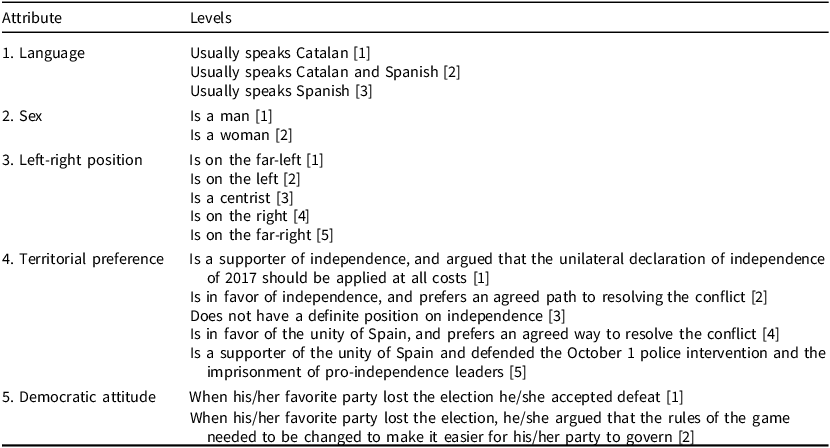
In the conjoint, we operationalize candidates’ (un)democratic behavior through the idea of the loser’s consent: the candidate is presented as either willing to accept an election defeat of his/her party if that happens or, rather, arguing that rules should be changed in order to make it easier for his/her party to govern. Table 1 shows the five attributes and the corresponding levels.
Conjoint design

Table 1. Long description
A table detailing attributes and their corresponding levels for a conjoint design. The table has five rows and columns. The columns are labeled ‘Attribute’ and ‘Levels’. The attributes and their levels are as follows: Row 1: Attribute 1. Language. Levels: Usually speaks Catalan, Usually speaks Catalan and Spanish, Usually speaks Spanish. Row 2: Attribute 2. Sex. Levels: Is a man, Is a woman. Row 3: Attribute 3. Left-right position. Levels: Is on the far-left, Is on the left, Is a centrist, Is on the right, Is on the far-right. Row 4: Attribute 4. Territorial preference. Levels: Is a supporter of independence, and argued that the unilateral declaration of independence of 2017 should be applied at all costs, Is in favor of independence, and prefers an agreed path to resolving the conflict, Does not have a definite position on independence, Is in favor of the unity of Spain, and prefers an agreed way to resolve the conflict, Is a supporter of the unity of Spain and defended the October 1 police intervention and the imprisonment of pro-independence leaders. Row 5: Attribute 5. Democratic attitude. Levels: When his/her favorite party lost the election he/she accepted defeat, When his/her favorite party lost the election, he/she argued that the rules of the game needed to be changed to make it easier for his/her party to govern.
The treatment
The operationalization of democratic undoing is one of the key decisions of our design. Authors working in the US context (e.g., Graham and Svolik, Reference Graham and Svolik2020) have used several dimensions of undemocratic positions, such as electoral fairness (redistricting or strategies for vote suppression), checks and balances (governing by executive order or ignoring adverse court rulings), or civil liberties (prosecuting journalists or banning certain rallies in the state capital). Likewise, the Polarization Research Lab in the US tracks the evolution of five different democratic norms across time, including ignoring Supreme Court judges, censorship, or party loyalty in the face of election denial (Iyengar et al., Reference Iyengar, Lelkes and Westwood2023). Some of these dimensions do not apply to a parliamentary democracy in which districts are constitutionally fixed, and some others would not have been credible in the context of this study. Instead, we chose to use what we consider to be a credible expression of undemocratic attitudes in our context: questioning the result of the election when one’s party has been defeated, and calling for a reform of the rules of the game to gain partisan advantage.
In recent times and across different contexts, we have observed candidates questioning the rules after an electoral defeat. Most prominently, Jair Bolsonaro, after the 2022 presidential elections in Brazil, questioned his defeat and asked the electoral authorities to discount some ballots tallied with specific voting machines.Footnote 2 In a different way, but also complaining about the rules a posteriori, the candidate from the winning party in the 2017 Catalan regional elections questioned the rules because she could not reach office despite winning the elections. When it became clear that she would not be able to secure the necessary votes in Parliament, Inés Arrimadas criticized the existing electoral rules for over-representing Catalan secessionist voters.Footnote 3
Questioning the rules of the game after an electoral defeat can be deemed as a relatively mild and realistic case of undemocratic position-taking in our context, in which the candidate did not attempt to forcibly overrule an adverse election result, but rather made a case for changing the rules in favor of her party. This is therefore a case of rejection of the loser’s consent (Przeworski, Reference Przeworski1991; Nadeau and Blais, Reference Nadeau and Blais1993) that signals an arguably undemocratic position. The effect of this attribute, and how it interacts with other positions of the candidate, is the key quantity of interest of this paper.
There are two requirements of the treatment that need to be satisfied. First, from a substantive perspective, it should measure undemocratic behavior by a democratic candidate. In other words, for the treatment to be valid, questioning the rules after an election defeat must be perceived as undemocratic by voters rather than capture some other valence characteristic like being a sore loser. Second, the strength of the treatment should be comparable to other common undemocratic practices and, therefore, generate a similar degree of rejection by voters. If not, the treatment might be capturing something that is perceived as especially unacceptable that deserves a strong punishment by voters.
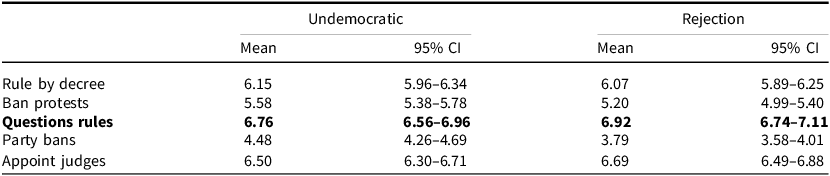
To check the validity and strength of the treatment, and benchmark it against other treatments used in the literature, we included additional questions in a separate survey (N = 1,602)Footnote 4 . We compared the call for changing the rules of the game in the event of an election defeat with arguments in favor of (i) governing by decree, (ii) banning allegedly undemocratic protests, (iii) banning parties/candidates labeled as disloyal to the country, and (iv) a direct governmental appointment of judges. We randomized two different questions asking respondents to rate the different arguments in two separate dimensions. That is, half of the respondents were asked to rate the arguments in a 10-point scale, from completely democratic (value 0) to completely undemocratic (value 10). The other half were asked to rate the same arguments but this time ranging from completely acceptable (value 0) to completely unacceptable (value 10).
In Table 2, we present the results of this exercise, which shows how our treatment is perceived as slightly more undemocratic than ruling by decree and similarly undemocratic than directly appointing judges of the constitutional court. More generally, we observe that our treatment falls within the range of previously used examples of undemocratic behavior in the literature. In terms of assessing the strength of the treatment (whether the action can be deemed ‘acceptable’ or not), our findings lead us to similar conclusions, as we observe that it also falls within the expected range. Interestingly, questioning the rules after an electoral defeat produces a similar degree of rejection by voters than, for example, having a discretionary appointment of judges.Footnote 5
Rating of undemocratic and rejection attitudes (0–10 scale)

Table 2. Long description
A table comparing undemocratic and rejection attitudes on a 0-10 scale. The table has 4 rows and 4 columns. The columns are labeled ‘Undemocratic’ with sub-columns ‘Mean’ and ‘95% CI’, and ‘Rejection’ with sub-columns ‘Mean’ and ‘95% CI’. The rows are labeled with different actions: Rule by decree, Ban protests, Questions rules, Party bans, and Appoint judges. Row 1: Rule by decree, Undemocratic Mean: 6.15, 95% CI: 5.96-6.34, Rejection Mean: 6.07, 95% CI: 5.89-6.25. Row 2: Ban protests, Undemocratic Mean: 5.58, 95% CI: 5.38-5.78, Rejection Mean: 5.20, 95% CI: 4.99-5.40. Row 3: Questions rules, Undemocratic Mean: 6.76, 95% CI: 6.56-6.96, Rejection Mean: 6.92, 95% CI: 6.74-7.11. Row 4: Party bans, Undemocratic Mean: 4.48, 95% CI: 4.26-4.69, Rejection Mean: 3.79, 95% CI: 3.58-4.01. Row 5: Appoint judges, Undemocratic Mean: 6.50, 95% CI: 6.30-6.71, Rejection Mean: 6.69, 95% CI: 6.49-6.88.
Ideological and affective distance
The conjoint design includes candidates’ positions on the ideological and territorial dimensions. These are the two main dimensions of political competition in Catalonia; the party system as well as voters’ behavior are structured on this two-dimensional space. On the one hand, the ideology is operationalized with a standard scale of five discrete categories ranging from the far-left to the far-right. The position on the territorial dimension, on the other hand, is a bit more complex to operationalize in this context. We decided to also use five discrete positions, from the radical supporters of secession to the radical supporters of the unity of Spain. The extremes are defined in a context-specific way, making reference to their position in the 2017 constitutional crisis in Catalonia. Between these two extremes, we include a level for the moderates in both sides (those that support secession or unity of Spain but privileging dialogue) and one in the middle for the ambiguous/undefined positions.
As said above, one of the key questions we aim to address is that of trade-offs. We want to understand to what extent our respondents are willing to trade democratic integrity for proximity on either both or one of the two dimensions. Hence, for ideological proximity, the quantities of interest are the interactions between, on the one hand, the candidate’s undemocratic attitude and, on the other, the distance between the positions of the candidate and the voter in the left-right and the territorial dimensions. Specifically, for respondent i her ideological proximity with candidate j on dimension m is measured as follows:
 ${\rm{Ideological\;Proximity}}_{ij}^m = - abs\left( {x_j^m - x_i^m} \right)$
where x stands for the position in each dimension m (left-right and territorial).Footnote 6
Finally, to assess whether affective polarization moderates the trade-off between democratic attitudes and proximity in the two dimensions, we follow Wagner (Reference Wagner2021) and base our measurement on respondents’ level of like/dislike for each party. This captures both positive and negative partisanships, encompassing robust in-group attachments as well as the out-group animosity that characterizes contemporary polarization (Gonzalez-Ocantos and Meléndez, Reference Gonzalez-Ocantos and Meléndez2025). Specifically, we group Catalan parties as being left or right and pro- or anti-secession and measure respondents’ degree of esteem or animosity toward each of these groups of parties. Hence, the affective proximity of respondent i to candidate j in the left-right (L - R) and territorial (TERR) dimensions, respectively, are calculated as follows:
 ${\rm{Affective}}\;{\rm{Proximity}}_{ij}^{L - R} = \left( {\matrix{ {\overline {Like} _i^{left}} & \!\!\!\!\!\!\!{{\rm{if}}\;x_j^{L - R} = {\rm{far}} - {\rm{left}} \vee {\rm{left}}} \cr {\overline {Like} _i^{right}} & {{\rm{if}}\;x_j^{L - R} = {\rm{right}} \vee {\rm{far}} - {\rm{right}}} \cr } } \right.$
 ${\rm{Affective}}\;{\rm{Proximity}}_{ij}^{TERR} = \left( {\matrix{ {\overline {Like} _i^{pro - secession}} & {{\rm{if}}\;x_j^{TERR} = {\rm{pro}} - {\rm{secession}}} \cr {\overline {Like} _i^{pro - unity}} & \!\!\!\!\!\!\!\!\! {{\rm{if}}\;x_j^{TERR} = {\rm{pro}} - {\rm{unity}}} \cr } } \right.$
where
 ${\overline {Like} _i}$
stands for the average respondents’ sympathy for left, right, pro - secession, and pro - unity parties, respectively,Footnote
7
measured in a 6-point scale (from feelings of ‘a lot of antipathy’ to feelings of ‘a lot of sympathy’).Footnote
8
With these measures we can know what is the affective proximity of the respondent toward the candidate she is faced with in those two dimensions, and how that interacts with his undemocratic behavior.
Results: ordinary citizens
The empirical analysis of the ordinary citizens’ sample is divided into three parts, corresponding to the main questions outlined above. First, we show the effect of all attributes included in the conjoint table on the probability of candidates’ selection (baseline results). Second, we dig deeper on the trade-off between ideological and affective proximity vis-à-vis basic democratic norms. Finally, we explore whether the acceptance (or otherwise questioning) of democratic norms is moderated by an individuals’ degree of affective polarization and voters’ self-reported democratic preferences.
Which candidates do people select?
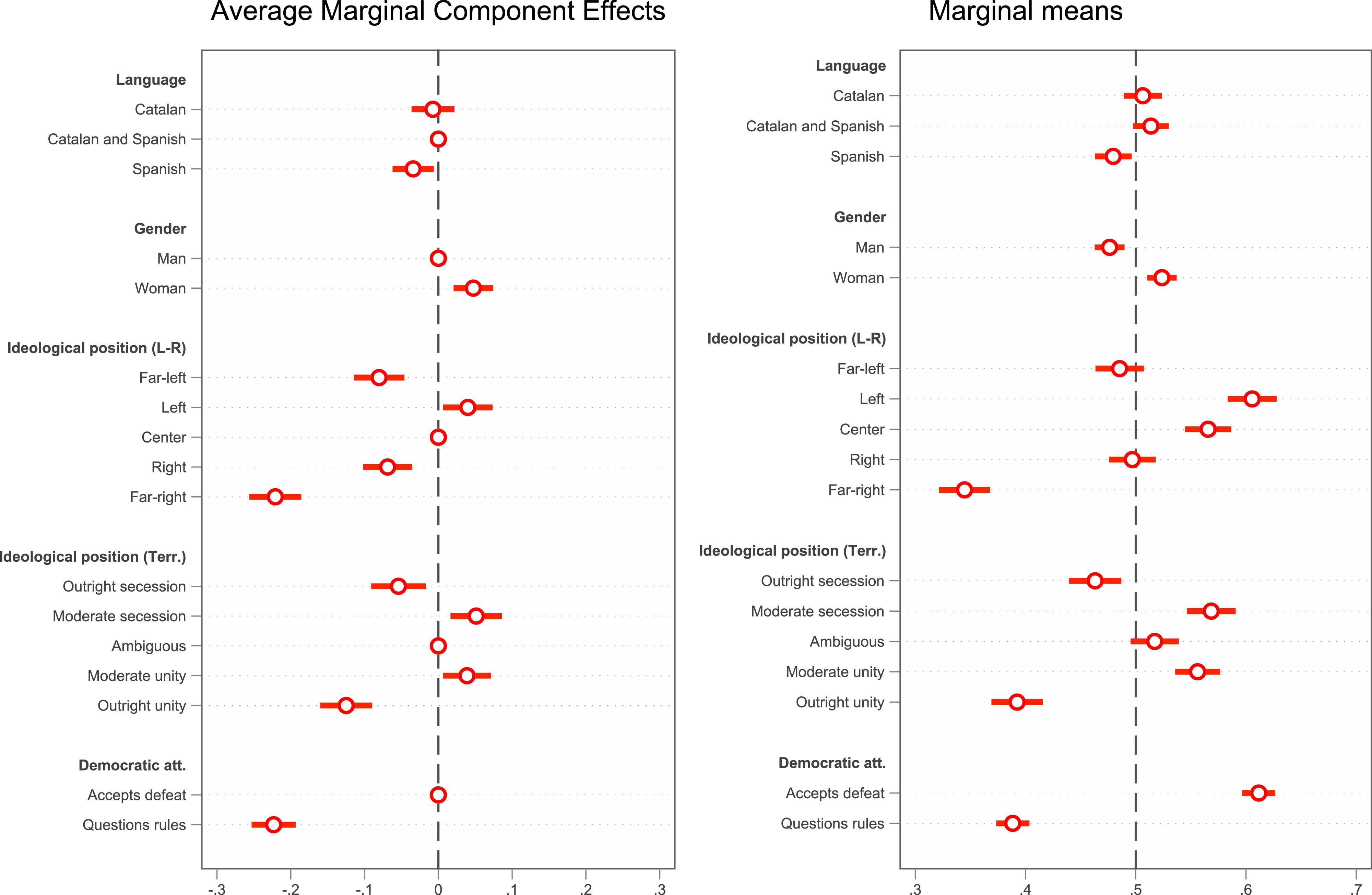
Figure 1 includes two graphs. On the left, we show the AMCE of each of the attributes. On the right, we display the marginal means of the same attributes. Following Leeper et al. (Reference Leeper, Hobolt and Tilley2020), we display both metrics in order to show the causal effect of each attribute on the outcome (AMCE), as well as the differences between groups (Marginal Means (MM)).
The determinants of citizens’ selection of candidates.
Note: Whiskers indicate 95% confidence intervals.

The results in Figure 1 reveal that people are especially reactive to three candidate traits: far-right candidates; those whose territorial stance favors outright unity; and, most crucially, those who question the democratic rules. Both the AMCE and the MM coefficients indicate that the effect of democratic undoing is similar to the effect of the position in the two dimensions of political competition. When a candidate is willing to question the democratic rules of the game after an electoral defeat, individuals are substantially less likely to choose them, and the reported effect mirrors, on average, that of a far-right position and preference for outright unity. The other coefficients indicate that Catalans have a slight favorable view for female and left-wing candidates and a slight unfavorable view for candidates who only speak Spanish.Footnote 9
The next analysis evaluates respondents’ choices as a function of their distance to candidates on the different traits. Due to the random assignment of candidates’ attributes, respondents often saw politicians with whom they share some (or all) of the characteristics. Therefore, for each trait, we computed whether or not a respondent shared the same characteristic as the displayed candidate or, for scales, its proximity to the candidate. This allowed us to have different levels of (dis)similarity across different dimensions.
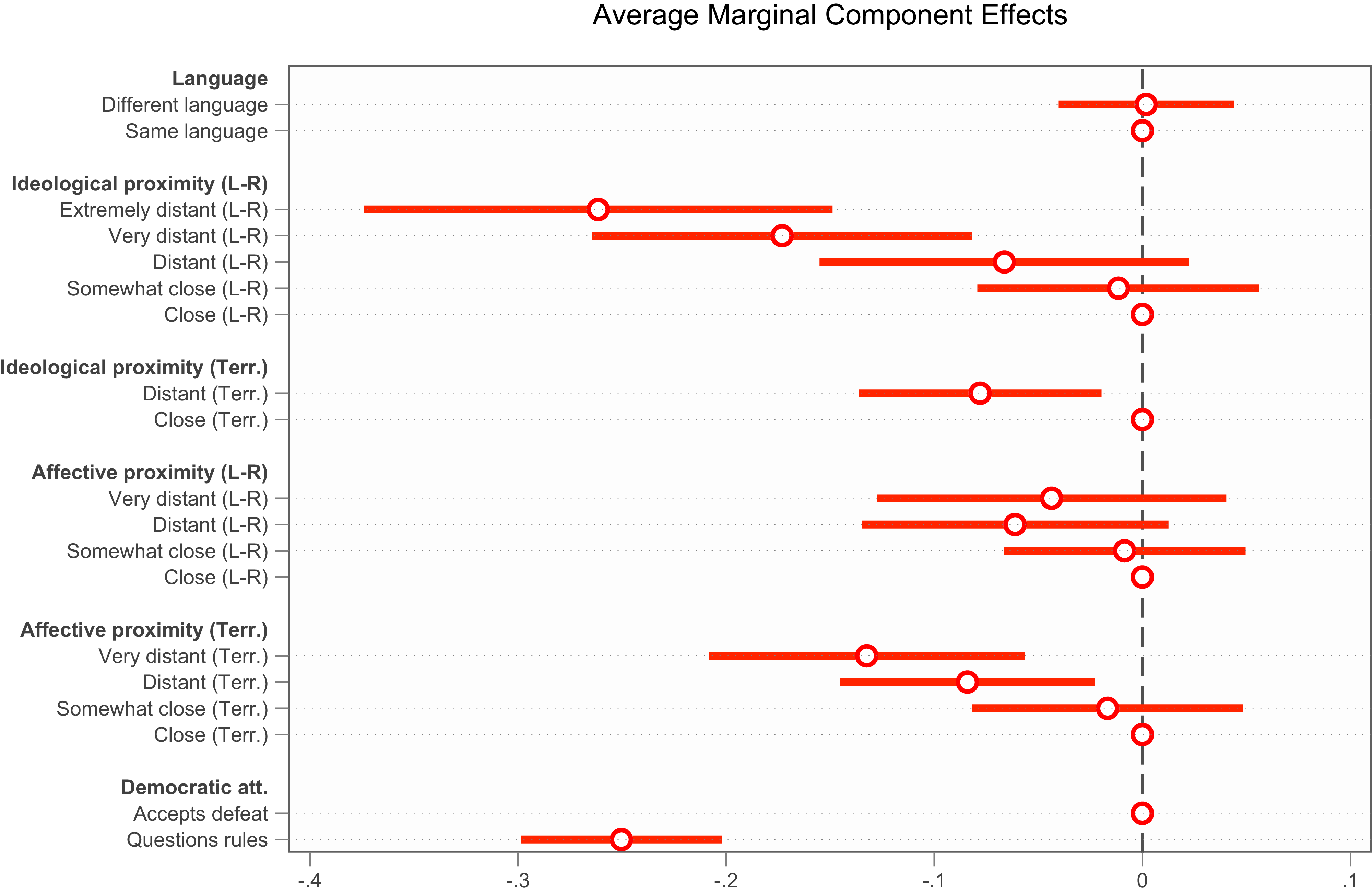
Using this information, Figure 2 shows the AMCEs for the similarity/proximity analysis. In order to examine the potential trade-off between democratic undoing and proximity in any of the two dimensions, candidates’ democratic attitudes are kept at the original coding, and hence no distance value is calculated.
The effect of proximity on candidates’ choice.
Note: Whiskers indicate 95% confidence intervals.

Results introduce some nuances to the previous evidence. While in the analysis of the determinants of citizens’ selection of candidates’ ideology (extreme-right), territorial preferences (outright unity) and democratic attitudes (questioning rules) had a similar negative impact on the likelihood of selecting a candidate, ideological distance stands as the most powerful predictor of candidate selection in the similarity analysis. Hence, if a respondent saw an extreme-right (left) candidate and the respondent located herself on the extreme-left (right) – i.e., the ‘extremely distant’ category – the likelihood of voting for this candidate decreased by around 0.4 points. This is almost twice as large as the effect of a candidate that questions democratic rules.
Trade-off between proximity and democratic backsliding
The previous analysis looked at the average effect of the different attributes on the likelihood to choose a candidate. We now analyze the trade-off between proximity and undemocratic behavior. Our goal is to assess whether ideological proximity – the policy-distance between an individual and a candidate – or affective proximity – in-group emotional bias toward political parties – is relevant for explaining how individuals react to undemocratic attitudes.Footnote 10
In order to address this question, we run a model combining the ideological and the affective proximity in the two core dimensions of competition in Catalonia (see the appendix for the full specification of the model).Footnote 11 Each panel in Figure 3 presents the marginal effects of being faced with a candidate that questions democratic rules with respect to one that accepts them on the likelihood of choosing him/her at different values of proximity.
Marginal effects of undemocratic behavior on candidate selection.
Note: Whiskers indicate 95% confidence intervals. See the appendix for the full specification of the model and the complete regression table.

First of all, we observe that the marginal effects are negative across the board. This means, first and foremost, that respondents are consistently less likely to choose candidates willing to challenge the democratic norms, regardless of the distance in any of the two dimensions.
Yet, if we differentiate between ideological and affective proximity, we can observe some interesting patterns. The two panels in the left in Figure 3 show that the gap between candidates questioning and accepting the rules widens as individuals become closer to the candidate in ideological terms, both in the left-right and the territorial dimensions. To better understand the implications of this finding, the Appendix displays the predicted probability of choosing a given candidate as a function of whether she accepts or not the democratic rules. The evidence is clear in showing that, while democratic candidates always register a higher likelihood of being selected than non-democratic ones, the closer the candidate moves to the voter’s policy preference, the larger is this gap.
The evidence goes in the opposite direction for affective proximity. The two panels in the right of Figure 3 show that, as individuals feel closer to the displayed candidate, the negative effect of an undemocratic behavior diminishes. Hence, while being faced with a non-democratic candidate that is very distant to a voter reduces the probability of choosing him/her by nearly 0.3 points, when the candidate is affectively close to the voter, the gap is reduced to 0.2 points (see the appendix for the predicted values instead of the marginal effects).
Finally, there seems to be no large differences on the effect of distance between the left-right and the territorial dimensions.
Heterogeneity
We have observed how affective proximity with a candidate makes voters more tolerant with her undemocratic attitudes. On average, however, we see that voters tend to punish undemocratic politicians even when they belong to their in-group. In this section, we further explore this moderation effect. More specifically, we analyze whether citizens’ self-reported democratic attitudes have an impact on the extent to which they tolerate politicians’ undemocratic practices.
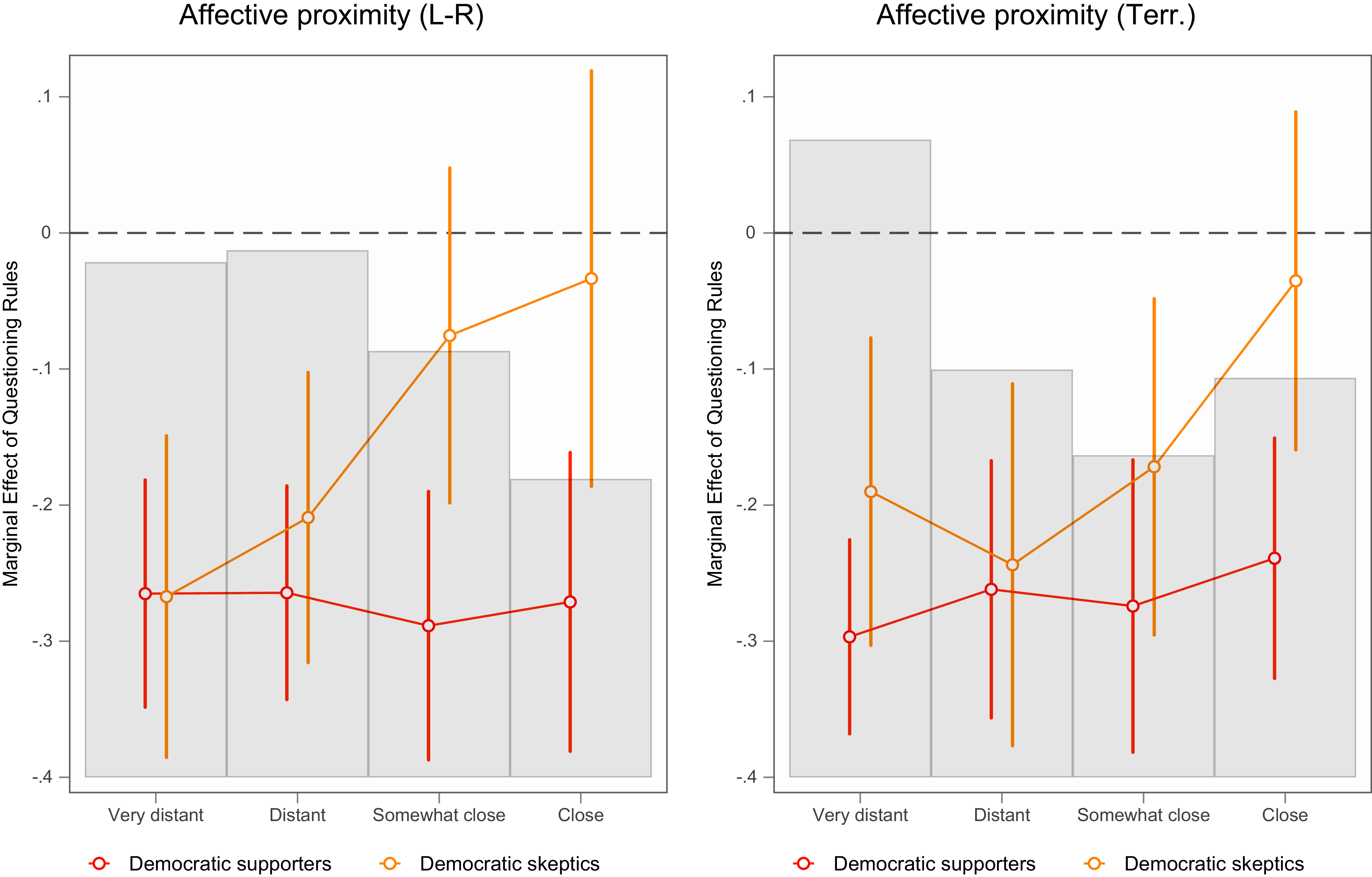
In order to do so, we have classified the respondents into two groups: democratic supporters and democratic skeptics. We have separated them using pre-treatment questions on the extent to which they favor a strong leader, a military government, and a democracy as forms of government.Footnote 12 Respondents that score high in the first two and low in the third are classified as democratic skeptics, and those that score low on the first two and high on the latter are classified as democratic supporters. As shown in Figure 4, it is among the group of democratic skeptics that we find the relevant moderation effect of affective proximity. In fact, among those that are less supportive of democracy, we observe an absence of punishment for undemocratic attitudes of those politicians that are affectively close to them. This result is important as it contributes to set the scope conditions of our key findings with more precision and also confirms that the mechanism behind the main findings is related to democratic attitudes.Footnote 13
Marginal effects of undemocratic behavior by democratic attitudes.
Note: Whiskers indicate 95% confidence intervals.

Results: politicians
While the previous section examined the attitudes of citizens, we now turn to the results of the conjoint experiment with our sample of Catalan politicians. Much of the literature highlights the reciprocal relationship between elites and mass publics (Zaller, Reference Zaller1992): elites can shape democratic norms and political preferences through their behavior and discourse (Druckman and Lupia, Reference Druckman and Lupia2000; Lenz, Reference Lenz2012; Graham and Svolik, Reference Graham and Svolik2020), while citizens can constrain or enable elites by signaling what they are willing to tolerate (Stimson et al., Reference Stimson, MacKuen and Erikson1995; Soroka and Wlezien, Reference Soroka and Wlezien2010). Our design does not allow us to empirically assess such interactions, since the citizen and elite samples were collected independently. Nevertheless, comparing the responses of both groups offers valuable insights into whether the logics shaping tolerance for undemocratic practices operate similarly across mass and elite levels.
The left panel in Figure 5 displays the AMCE of each attribute, and on the right, we present the marginal means. In our sample of politicians, being in the far-right, hardline anti-independence, and questioning the rules after a defeat are the three attributes that reduce the likelihood of choosing a candidate by other politicians. The magnitude of the AMCE of the three characteristics is comparable, although the marginal means of the far-right and outright unity attributes (around 0.3) are slightly lower than the undemocratic attitude (0.4). If we compare it with Figure 1, we can observe how the results closely resemble those obtained in the sample of ordinary citizens.
The determinants of politicians’ selection of candidates.
Note: Whiskers indicate 95% confidence intervals.

The same is true for the results in Figure 6, which replicates the analysis presented in Figure 2: if we look at the effect of proximity between the respondent and the profile evaluated in the conjoint, we can see how distance in the left-right dimension is, again, the most influential factor in determining candidate selection by politicians. However, in the case of politicians, the magnitude of the effect of undemocratic behavior is close to the magnitude of extreme ideological distance, which indicated that, if anything, politicians tend to be even more strict in judging undemocratic behavior.Footnote 14
The effect of proximity on politicians’ candidate selection.
Note: Whiskers indicate 95% confidence intervals.

Overall, the findings reveal that politicians, like citizens, consistently sanction candidates who display undemocratic attitudes. This convergence suggests that support for democratic norms is not confined to one side of the representative relationship but is broadly shared across both publics and elites. Such alignment matters because it reduces the likelihood of a disconnect whereby elites might tolerate behaviors that citizens oppose, or vice versa. At the same time, the similarity between mass and elite responses raises important questions about the sources of this alignment: whether both groups are reacting to the same contextual pressures, whether elites and citizens internalize a common normative framework, or whether they reinforce each other over time.
What is different between the two groups, however, is the interaction between undemocratic behavior and ideological/affective proximity, which does not follow the same pattern. While for ordinary citizens punishment of undemocratic behavior was conditional on affective proximity, the same is not true for politicians: we do not observe a systematically different punishment of undemocratic behavior for candidates that are closer or more far apart from the surveyed politicians in either the ideological or affective scales (see Figure 7). Overall, politicians seem to punish undemocratic behavior regardless of the position or partisanship of the candidate being evaluated.
Marginal effects of undemocratic behavior on politicians’ candidate selection.
Note: Whiskers indicate 95% confidence intervals.

Conclusions
The idea that voters are willing to trade off democratic principles for partisan or ideological interests has received increasing attention over the last few years. Most notably, Svolik (Reference Svolik2019), Svolik (Reference Svolik2020), and Graham and Svolik (Reference Graham and Svolik2020) have shown that when voters are confronted with a tension between partisan interests and democratic principles, the former tend to prevail. According to the evidence provided by the literature so far, for instance, from the USA and Venezuela, significant fractions of divided electorates are willing to sacrifice democratic principles in order to see their partisan interests satisfied. To put it simply, part of the available empirical evidence seems to confirm that polarization trumps civic virtue. However, more recent studies find no effect of affective polarization on democratic norms (Broockman et al., Reference Broockman, Kalla and Westwood2023)
We put this idea to the test in a different but also polarized political context: Catalonia. Our goal was threefold. First, to examine the average effect of democratic norms vis-à-vis the other two dimensions of political competition – in the Catalan case, the left-right and the territorial divide. Second, to analyze if polarization does, as expected, contribute to citizens’ tolerance toward politicians that erode core democratic norms. And third, to study the role of a crucial distinction between ideological distance and affective polarization.
We used a conjoint experiment in which respondents were confronted with pairs of candidates with randomly varying characteristics. Our results indicate that, in contrast with other cases, respondents were concerned about the politicians’ erosion of democratic norms. The punishment was strong, significant, and consistent across the policy space. However, a key finding of this paper is related to the moderating effect of one of the two types of polarization. We have shown that it is only affective proximity, and not ideological distance, that makes voters more tolerant of politicians’ undemocratic behavior. This is especially the case for those with lower baseline support for democracy.
While politicians behave in a very similar way than ordinary citizens when it comes to average punishment of undemocratic behavior, in this case affective polarization does not seem to moderate punishment: elected representatives’ judgment of undemocratic behavior does not seem to depend on how affectively polarized they are. Future studies can explore whether this is due to politician’s higher commitment to democratic norms or to a higher social desirability bias, among different potential explanations.
The implications of our paper are important and likely extend beyond the Catalan and the Spanish case. Several countries in the world share similar high levels of both affective and ideological polarization. In addition, other contexts elsewhere, such as Scotland (UK) or Quebec (Canada), also have a structurally embedded bidimensional structure of political competition. Yet, our findings not only speak to these contexts. In other societies, a second new largely orthogonal dimension can also arise, bringing about new dynamics for both ideological and affective polarization and their relationship with tolerance toward democratic norms (Hobolt and Rodon, Reference Hobolt and Rodon2020; Reiljan and Ryan, Reference Reiljan and Ryan2021; Koedam et al., Reference Koedam, Binding and Steenbergen2025). Therefore, our findings likely reflect broader patterns of political polarization increasingly observed in contemporary democracies.
All in all, our results serve as a reminder of a key source of democratic risk: citizens may become more lenient with – or supportive of – democratic backsliding in contexts of intense affective polarization. The same is not necessarily true for ideological distance: a world in which citizens and politicians have very distant policy preferences but these do not crystallize into strong and opposing social identities would still be one in which citizens perform their role as democratic checks and, hence, deter politicians’ temptations of eroding core democratic norms. On the contrary, when political positions are packed into strong social identities, it can be easier for would-be authoritarians to retain support from their followers despite their antidemocratic behavior. The extent to which this increased lenience will actually translate into actual backsliding will depend on a number of systemic and contextual factors, but at the very least this is an important facilitating mechanism (Svolik, Reference Svolik2020).
Supplementary material
The supplementary material for this article can be found at https://doi.org/10.1017/S1755773926100630.





 Open access

