INTRODUCTION
The optimal corporate governance structure depends, among other factors, on the costs and benefits of governance practices, which vary between contexts (Boone, Field, Karpoff, & Raheja, Reference Boone, Field, Karpoff and Raheja2007; Coles, Daniel, & Naveen, Reference Coles, Daniel and Naveen2008; Linck, Netter, & Yang, Reference Linck, Netter and Yang2008). Contingency and contextual perspectives are needed to assess the relationship between corporate governance and firm performance to demonstrate that in some contexts, certain board designs may be recommended, but in other contexts, other designs may be more suitable (Crossland & Hambrick, Reference Crossland and Hambrick2007; Andrés & Rodríguez, Reference Andrés and Rodríguez2011; Minichilli, Zattoni, Nielsen, & Huse, Reference Minichilli, Zattoni, Nielsen and Huse2012).
A key aspect of firm governance is ownership structure, including the typology of the firm's shareholders (La Porta, López-de-Silanes, & Shleifer, Reference La Porta, López-de-Silanes and Shleifer1999; Thomsen & Pedersen, Reference Thomsen and Pedersen2000; Maury, Reference Maury2006; Bammens, Voordeckers, & Van Gils, Reference Bammens, Voordeckers and Van Gils2010). As Erakoviç and Overall (Reference Erakoviç and Overall2010) note, the relationship between the board and the owners in family businesses (FBs) versus non-family businesses (NFBs) is an important contingency variable.
Considering these potential relationships, the goal of this study is to assess whether or not the optimal level of board monitoring is lower for FBs than for NFBs. To this end, we adopt a contingency approach in which the impact of board independence (as a proxy for board monitoring) on a firm's strategic performance is considered to vary, depending on the context under analysis, particularly in terms of family involvement in ownership and control. Due to lower net agency costs and higher goal alignment between owners and managers in publicly traded FBs compared with NFBs (Anderson & Reeb, Reference Anderson and Reeb2003; Villalonga & Amit, Reference Villalonga and Amit2006), our basic premise is that the benefits and costs of board independence vary across firms, depending on family involvement, and thus the governance mechanisms should differ between these types of firms (Bartholomeusz & Tanewski, Reference Bartholomeusz and Tanewski2006; Chen & Nowland, Reference Chen and Nowland2010). These findings suggest the reconsideration and reshaping of widely held and traditionally evidenced beliefs regarding the empirical links between board independence and performance. Those beliefs, based on agency theory, lead to the postulate that more independent boards are always an adequate solution for corporate governance. We propose that board independence is limited in its effect on firm performance and that stewardship-based corporate governance structures may result in better performance. The current study uses board size, the independent director ratio and CEO duality as proxies for board independence, and it considers nonlinearities in the relationship between board independence and firm performance. Such nonlinear specification enables the reconciliation of inconsistent research outcomes by clarifying whether the relationship of our independent variables with firm performance is positive or negative. The moderation test allows examination of whether or not the context under analysis (family involvement) leads to changes in the inflection points at which the relationships switch from positive to negative.
Data from Southern European businesses enables us to analyse the impact of corporate governance on firm performance in a context in which the legal protection of minority shareholders is low, ownership concentration is high, and a significant number of firms are owned and controlled by family groups (La Porta, López-de-Silanes, & Shleifer, Reference La Porta, López-de-Silanes and Shleifer1999; Rajan & Zingales, Reference Rajan and Zingales2002)Footnote 1.
To pursue our objectives, this article will proceed as follows: in the next section, we review previous research and subsequently offer hypotheses. In the third section, we define the sample, variables and methodology. The results, conclusions and implications of the study are discussed in the final sections.
THEORETICAL FRAMEWORK
The importance of the board's monitoring role is grounded in agency theory, which is based on the premise that there is an inherent conflict between the interests of a firm's owners and managers that arises from the separation of company ownership and control (Fama & Jensen, Reference Fama and Jensen1983; Shleifer & Vishny, Reference Shleifer and Vishny1997). Agency theory implies that adequate monitoring mechanisms need to be established to protect shareholders from opportunistic behaviours on the part of management to maximise their own self-interest. From this perspective, the main function of the board of directors is consequently to reduce the principal–agent conflict between managers and shareholders (Jensen & Meckling, Reference Jensen and Meckling1976).
In publicly traded FBs, controlling family shareholders have strong incentives to monitor management to protect family wealth (Anderson & Reeb, Reference Anderson and Reeb2003; McVey, Draho, & Stanley, Reference McVey, Draho and Stanley2005; Barontini & Caprio, Reference Barontini and Caprio2006), thereby mitigating the classical agency problem (Agency Problem I) (Villalonga & Amit, Reference Villalonga and Amit2006). In these firms, the family's participation in ownership and management results in lower goal divergence between owners and managers (Jaskiewicz & Klein, Reference Jaskiewicz and Klein2007). Another type of agency cost, however, can be higher within publicly traded FBs relative to their non-family counterparts. Concentrated family ownership and control brings about the risk of abuse of power and the extraction of private benefits at the expense of non-family minority shareholders (Agency Problem II) (Villalonga & Amit, Reference Villalonga and Amit2006). If the large shareholder is not a family (e.g., institutional investors, holding companies, banks, the state), the private benefits of control are diluted among several independent owners. As a result, the large shareholder's incentives for expropriating minority shareholders are small, but so are its incentives for monitoring the managers. Thus, we revert to Agency Problem I. In contrast, if the large shareholder is a family, it has greater incentives for both expropriation and monitoring, which are thereby likely to lead the Agency Problem II to overshadow Agency Problem I.
Nevertheless, according to some scholars (Becker, Reference Becker1974; Jensen & Meckling, Reference Jensen and Meckling1976; Eisenhardt, Reference Eisenhardt1989; Daily & Dollinger, Reference Daily and Dollinger1992), FBs should be characterised by lower net agency problems than NFBs. This hypothesis has been tested and confirmed by Chrisman, Chua, and Litz (Reference Chrisman, Chua and Litz2004). The net positive effects induced by the presence of the owning family have been proved in public companies (Anderson & Reeb, Reference Anderson and Reeb2003; Villalonga & Amit, Reference Villalonga and Amit2006), where the institutional overlap between family and business is often carefully managed and the disadvantages of family involvement are overpowered by its benefits, contrary to what occurs in privately held FBsFootnote 2 (Sciascia & Mazzola, Reference Sciascia and Mazzola2008).
In contrast to agency theory, which suggests that those in a position of power and who hold superior information will use these advantages to exploit others, stewardship theory posits that managers are essentially trustworthy individuals and are therefore good stewards of the resources entrusted to them (Donaldson & Davis, Reference Donaldson and Davis1994). As Davis, Schoorman, and Donaldson (Reference Davis, Schoorman and Donaldson1997) note, the agency and stewardship theories do not seem to exclude each other; each theory is more applicable to certain settings and situations. High levels of goal alignment favour stewardship-based relationships whereas lower or absent levels of goal alignment support the predictions of agency theory (Jaskiewicz & Klein, Reference Jaskiewicz and Klein2007). Based on this argument, scholars have identified stewardship theory as being potentially highly applicable to the realm of FBs, which are characterised by involvement-oriented management philosophies, strong firm identification, low reliance on institutional power and personal and social fulfilment (Anderson & Reeb, Reference Anderson and Reeb2003; Chrisman, Chua, & Litz, Reference Chrisman, Chua and Litz2004; Corbetta & Salvato, Reference Corbetta and Salvato2004b; Lane, Astrachan, Keyt, & McMillan, Reference Lane, Astrachan, Keyt and McMillan2006; Miller & Le Breton-Miller, Reference Miller and Le Breton-Miller2006; Pieper, Reference Pieper2010). From this perspective, family members are expected to be altruistic towards each other, as a result of kinship obligations that are part of the axiomatically binding normative moral order in most cultures (Schulze, Lubatkin, Dino, & Bucchold, Reference Schulze, Lubatkin, Dino and Bucchold2001; Chrisman, Kellermanns, Chan, & Liano, Reference Chrisman, Kellermanns, Chan and Liano2010; Huybrechts, Voordeckers, Lybaert, & Vandemaele, Reference Huybrechts, Voordeckers, Lybaert and Vandemaele2011). Family owners, free from short-term financial market demands, use their influence to benefit all the organisation's stakeholders. They are emotionally committed to the long-term survival and reputation of their firms because their fortunes, careers and personal honour, as well as that of their children and ancestors, are at stake (Le Breton-Miller & Miller, Reference Le Breton-Miller and Miller2009). In this context, altruism leads to a transfer of experience-based knowledge about the business from generation to generation, increasing cooperation and communication within the company and reducing agency costs (Schulze, Lubatkin, & Dino, Reference Schulze, Lubatkin and Dino2003). Therefore FBs, which are characterised by high goal alignment between owners and managers, might require less control from a board than NFBs (Muth & Donaldson, Reference Muth and Donaldson1998; Sundaramurthy & Lewis, Reference Sundaramurthy and Lewis2003).
Steward behaviour can allow governance mechanisms, such as boards, to serve different functions and roles (Lane et al., Reference Lane, Astrachan, Keyt and McMillan2006). By emphasising the potential for pro-organisational attitudes among organisational decision makers and the board's role in supporting them, stewardship theory essentially redirects the focus from board monitoring to board advisingFootnote 3 (Davis, Schoorman, & Donaldson, Reference Davis, Schoorman and Donaldson1997; Gubitta & Gianecchini, Reference Gubitta and Gianecchini2002; Bammens, Voordeckers, & Van Gils, Reference Bammens, Voordeckers and Van Gils2010). From this perspective, the primary role of the board is to serve and advise, rather than to discipline and monitor, as prescribed by agency theory (Corbetta & Salvato, Reference Corbetta and Salvato2004a, Reference Corbetta and Salvato2004b; Le Breton-Miller & Miller, Reference Le Breton-Miller and Miller2009). In this sense, Davis, Schoorman, and Donaldson (Reference Davis, Schoorman and Donaldson1997) argue that, in contrast to the viewpoint taken by agency theorists, the interests of managers and owners may actually be aligned. Hence governance devices designed and based on agency theory prescriptions may be redundant and even prove inefficient in FBs. Stewardship behaviour is expected to prevail in FBs, and effective methods to control or motivate an opportunistic manager may not be effective for controlling or motivating a steward (Muth & Donaldson, Reference Muth and Donaldson1998; Jaskiewicz & Klein, Reference Jaskiewicz and Klein2007). The pro-organisational behaviour of family members leads FBs to be more effective wealth creators than NFBs (Anderson & Reeb, Reference Anderson and Reeb2004). Any form of direct or indirect control may lower the motivation of stewards, negatively affecting their pro-organisational behaviour and leading to losses in terms of wealth creation.
Despite differences in the forms of agency costs among firms with different ownership and control structures and despite different conceptions of the behaviours of decision makers (economic perspective of agency theorists vs. pro-organisational perspective of stewardship theorists), corporate governance regulations generally recommend the same corporate governance practices for all types of companies. A common theme is the agency theory perspective, which seeks to strengthen the monitoring role of boards and leads to normative recommendations that boards should be independent. Thus, boards should have a relatively large size, a majority of independent directors and non-dual leadership structures (Zajac & Westphal, Reference Zajac and Westphal1996a; Gubitta & Gianecchini, Reference Gubitta and Gianecchini2002; Corbetta & Salvato, Reference Corbetta and Salvato2004a). Within stewardship theory, however, control is viewed as potentially counterproductive and organisational structures that facilitate managerial power are preferred over those designed to constrain managerial power (Donaldson & Davis, Reference Donaldson and Davis1994). From this perspective, larger boards with more independent directors and non-dual leadership structures could potentially reduce the stewardship behaviour of FBs (Jaskiewicz & Klein, Reference Jaskiewicz and Klein2007). In keeping with these arguments, stewardship settings involve relatively small boards that accommodate a higher ratio of executive directors who take on more of an advising roleFootnote 4 as well as dual leadership structures (Gubitta & Gianecchini, Reference Gubitta and Gianecchini2002; Daily, Dalton, & Rajagopalan, Reference Daily, Dalton and Rajagopalan2003; Corbetta & Salvato, Reference Corbetta and Salvato2004b).
HYPOTHESIS DEVELOPMENT
Most previous empirical studies focus only on the benefits of independent boards on the basis of their monitoring function (Coles, Daniel, & Naveen, Reference Coles, Daniel and Naveen2008; Linck, Netter, & Yang, Reference Linck, Netter and Yang2008; Adams, Hermalin, & Weisbach, Reference Adams, Hermalin and Weisbach2010), thus testing linear relationships between board characteristics and firm performance. These studies assume that the optimal level of monitoring occurs at extreme levels of independence or that no optimal level exists (Chen & Nowland, Reference Chen and Nowland2010). The presence of conflicting results, as well as the existence of contrary arguments in the literature, has led us to suspect the presence of nonlinear relationships between corporate governance variables and firm performance. Therefore, in this study, we advance previous studies by considering both the benefits and cost of the monitoring board role, thus integrating the agency and the stewardship theories.
Our basic premise is that the level of goal alignment affects the relationship between board independence (as a proxy for board monitoring) and firm performance (Jaskiewicz & Klein, Reference Jaskiewicz and Klein2007). In keeping with these ideas, no single optimal structure will fit all firms. Specifically, we propose that the benefits and costs of board monitoring are likely to be contingent on the type of controlling shareholder (as a proxy for goal alignment) (Aguilera & Jackson, Reference Aguilera and Jackson2003; Huse, Reference Huse2005). Higher levels of goal alignment and lower net agency costs, which we assume occur in FBs, are expected to better reflect stewardship theory settings (board dependence). Lower levels of goal alignment and higher net agency costs, which we assume to apply to NFBs, are expected to reflect settings more reflective of agency theory (board independence). We develop our hypothesis by using three indicators of board independence, those being the board size, the independent directors ratio and the leadership structure.
Hypothesis on board size
With respect to board size, there is no consensus regarding the direction of the relationship between board size and firm performance (see the meta-analytic review of Dalton, Daily, Johnson, & Ellstrand, Reference Dalton, Daily, Johnson and Ellstrand1999). The empirical literature provides some evidence of positive (Beiner, Drobetz, Schmid, & Zimmermann, Reference Beiner, Drobetz, Schmid and Zimmermann2006; Setia-Atmaja, Tanewski, & Skully, Reference Setia-Atmaja, Tanewski and Skully2009), negative (Yermack, Reference Yermack1996; Andrés, Azofra, & López, Reference Andrés, Azofra and López2005; Cheng, Reference Cheng2008; Kota & Tomar, Reference Kota and Tomar2010) and non-significant (Bonn, Reference Bonn2004; Jaggi, Leung, & Gul, Reference Jaggi, Leung and Gul2009) relationships.
There are both advantages and disadvantages associated with larger or smaller boards. The CEO may find that a smaller board can be more manageable and more easily dominated due to the potential for social cohesion (Shaw, Reference Shaw1981), whereas a larger group of directors would require the CEO to invest more time and effort in building consensus for a given course of action. If the board is large, it is more independent in the sense that the CEO's influential power is diluted and it is more difficult for the CEO to be dominant (Muth & Donaldson, Reference Muth and Donaldson1998). Larger boards may also provide advantages in terms of greater human capital (Pfeffer, Reference Pfeffer1972; Andrés & Rodríguez, Reference Andrés and Rodríguez2011) and greater monitoring capacity (Jensen, Reference Jensen1993). However, oversized boards lead to increased costs associated with free-rider conflicts and problems related to coordination, control and flexibility in decision making, which negatively affect the effectiveness of board roles (Lipton & Lorsch, Reference Lipton and Lorsch1992; Jensen, Reference Jensen1993; Forbes & Milliken, Reference Forbes and Milliken1999). Directors on a smaller board are more willing to participate in company affairs, have a clearer focus, build better relationships, cooperate more with directors (Eisenberg, Sundgren, & Wells, Reference Eisenberg, Sundgren and Wells1998), agree on a particular outcome and engage in genuine interaction and debate (Firstenberg & Malkiel, Reference Firstenberg and Malkiel1994).
Therefore, considering both the benefits and costs associated to board size, we propose that the relationship between board size and firm performance is concave and has an interior maximum. This inflection point is reached when the marginal benefits of larger boards equals their marginal costs. Within the context of FBs, boards that are too large reduce the stewardship behaviour within the family and increase agency problems. Therefore the board becomes more a symbolic entity and less a part of the management process. Lane et al. (Reference Lane, Astrachan, Keyt and McMillan2006) suggest that small boards may be more desirable, since larger boards may inhibit full family participation and individual responsibility. Larger boards in FBs will be associated with less cohesion among directors and can thereby impair board-monitoring ability (Corbetta & Salvato, Reference Corbetta and Salvato2004a). Other possible negative effects of larger boards include the possibility of FBs coming to be intimidated by boards; the establishment of merely cosmetic boards; and expense of board member remuneration, which most FBs would be reluctant to bear (Navarro & Ansón, Reference Navarro and Ansón2009). In summary, as a result of the moderating influence of family involvement, we expect the benefits of larger boards in FBs to be overtaken by their costs, even when FB boards are smaller than NFB boards:
Hypothesis 1 : The inflection point at which the nonlinear relationship between board size and firm performance turns from positive to negative will be smaller in FBs than in NFBs.
Hypothesis on independent directors
With regard to the impact of independent directors on firm performance, there are both benefits and costs associated with having more independent directors. Empirical research is far from conclusive, as shown by Dalton's, Daily's, Ellstrand's, and Johnson's, meta-analysis (Reference Daily and Dollinger1998). Various studies provide evidence of positive (Baysinger & Butler, Reference Baysinger and Butler1985; Pearce & Zahra, Reference Pearce and Zahra1992; Daily & Dalton, Reference Daily and Dalton1993), negative (Muth & Donaldson, Reference Muth and Donaldson1998; Klein, Shapiro, & Young, Reference Klein, Shapiro and Young2005; Bhagat & Bolton, Reference Bhagat and Bolton2008) and non-significant (Hermalin & Weisbach, Reference Hermalin and Weisbach1991; Villalonga & Amit, Reference Villalonga and Amit2006) impacts of independent directors on firm performance.
Independent directors most effectively engage in monitoring on boards because they have few conflicts of interest (Jensen, Reference Jensen1993). Viewed from an agency perspective, executive directors may have varying objectives as a result of private motivations and their lack of independence from the CEO (Zajac & Westphal, Reference Zajac and Westphal1996b; Dalton et al., Reference Dalton, Daily, Johnson and Ellstrand1999). Independent directors are more likely to support shareholder interests, reduce the influence of management on the board, exert control and monitor the execution of firm responsibilities (Fama & Jensen, Reference Fama and Jensen1983). Independent director appointments can also be relevant to the advisory role of the board, because such directors can provide comprehensive and complementary external knowledge (mostly based on university training and external work experience) that can be used by management teams in formulating and implementing strategies (Daily & Dalton, Reference Daily and Dalton1993). However, a board made up entirely of independent directors could not efficiently work to their combined capacity because of its lack of experience and knowledge of key aspects of the firm and its environment. Such a board would have difficulty acquiring this necessary firm-specific knowledge (Ford, Reference Ford1992; McVey, Draho, & Stanley, Reference McVey, Draho and Stanley2005).
Stewardship theory provides a different perspective, by suggesting that directors and managers are not opportunistic and self-serving, but are motivated to act in the best interests of their organisations and to maximise shareholder wealth by improving organisational performance (Donaldson & Davis, Reference Donaldson and Davis1991). Executive directors are thus seen as highly valuable to boards, because they spend their working lives at the company they direct. They have experience with business operations and are therefore expected to have greater firm-specific knowledge related to company operations than independent directors (Fama & Jensen, Reference Fama and Jensen1983). This experience and knowledge leads to better decision making (Donaldson & Davis, Reference Donaldson and Davis1991; Bonn, Reference Bonn2004; Christensen, Kent, & Stewart, Reference Christensen, Kent and Stewart2010) and allows boards to efficiently provide advice (Carpenter & Westphal, Reference Carpenter and Westphal2001; Raheja, Reference Raheja2005). Executive directors also facilitate the transfer of information between the board and the management team (Donaldson & Davis, Reference Donaldson and Davis1991). Therefore, according to stewardship theory, less independent boards are expected to be associated with superior financial performance. Effectiveness of monitoring relies on access to information (Boone et al., Reference Boone, Field, Karpoff and Raheja2007) and independence (as a proxy for monitoring) has costs in terms of information.
Considering both the benefits and costs associated to independent directors, we propose that the relationship between the independent directors ratio and firm performance is concave and has an interior maximumFootnote 5. This inflection point is reached when the marginal benefit of more independent directors (and less executive directors) equals its marginal cost. Within the context of FBs, several studies show that FBs disclose less information to independent parties (external to the family) (Lane et al., Reference Lane, Astrachan, Keyt and McMillan2006; Cheng, Reference Cheng2008). This higher information asymmetry leads board independence to reduce agency costs by a smaller amount in FBs than in NFBs (Chen & Nowland, Reference Chen and Nowland2010). Moreover, family owners associate a loss of control and discretion with very independent boards, and FBs tend to choose directors who are not truly independent (due to friendly or contractual relationships with the company), thus compromising board independence and reducing the benefits of monitoring (Chen & Nowland, Reference Chen and Nowland2010). As Lane et al. (Reference Lane, Astrachan, Keyt and McMillan2006) note, independence status is largely irrelevant to achieving accountability in FBs. Finally, too many independent directors reduce the stewardship behaviour of family members, thus worsening the firm performance. Based on these arguments, our second hypothesis is as follows:
Hypothesis 2 : The inflection point at which the nonlinear relationship between the ratio of independent directors and firm performance turns from positive to negative will be smaller in FBs than in NFBs.
Hypothesis on leadership structure
Whether or not the role of the chairperson of the board should be separate from the role of the CEO has also been debated. Although a number of empirical studies have provided important insights into the relationship between leadership structure and performance, their results are also far from conclusive, as the meta-analytic review of Dalton, Daily, Ellstrand, and Johnson (Reference Dalton, Daily, Ellstrand and Johnson1998) demonstrates. There is evidence that CEO duality has positive (Donaldson & Davis, Reference Donaldson and Davis1994; Finkelstein & D'Aveni, Reference Finkelstein and D'Aveni1994; Kota & Tomar, Reference Kota and Tomar2010), negative (Rechner & Dalton, Reference Rechner and Dalton1991; Coles, McWilliams, & Sen, Reference Coles, McWilliams and Sen2001) and non-significant (Baliga, Moyer, & Rao, Reference Baliga, Moyer and Rao1996; Brickley, Coles, & Jarrell, Reference Brickley, Coles and Jarrell1997; Jackling & Johl, Reference Jackling and Johl2009) effects on firm performance. A recent meta-analysis conducted by Rhoades, Rechner, and Sundaramurthy (Reference Rhoades, Rechner and Sundaramurthy2001) indicates that leadership matters and the authors provide support for the contingency view that the context moderates the relationship between CEO duality and firm performance.
On the one hand, agency theorists argue that if the same person performs both roles, it can lead to the inefficient supervision of opportunistic behaviour by management and an increase in CEO entrenchment (Daily & Dalton, Reference Daily and Dalton1993; Jensen, Reference Jensen1993). The separation of the roles increases board independence because it dilutes the power of the CEO and increases the board's ability to properly execute its oversight role.
On the other hand, stewardship theorists argue that CEO duality is expected to positively affect firm performance because managers are inherently trustworthy and are good stewards of company resources (Donaldson & Davis, Reference Donaldson and Davis1991, Reference Donaldson and Davis1994) rather than opportunistic individuals. In addition to financial incentives, managers are also motivated by such non-financial motives as job satisfaction, advancement and recognition, respect for authority and work ethic. They seek intrinsic satisfaction by performing challenging work. Moreover, because supporters of stewardship theory advocate that the interests of managers are aligned with those of the owners, they believe that CEO duality could promote unified and strong leadership with a clear sense of strategic direction (Davis, Schoorman, & Donaldson, Reference Davis, Schoorman and Donaldson1997; Braun & Sharma, Reference Braun and Sharma2007). As Adams and Ferreira (Reference Adams and Ferreira2007) suggest, if the CEO is also the chairperson of the board, specific knowledge about the business, as well as its strategic direction and investment opportunities, will be made available to directors, allowing them to more effectively provide advice, facilitating timely and optimal decisions (Brickley, Coles, & Jarrell, Reference Brickley, Coles and Jarrell1997) and improving firm performance (Donaldson & Davis, Reference Donaldson and Davis1991).
Stewardship behaviour is expected to prevail in FBs, and effective methods to control or motivate an opportunistic manager may not be effective for controlling or motivating a steward (Muth & Donaldson, Reference Muth and Donaldson1998; Jaskiewicz & Klein, Reference Jaskiewicz and Klein2007). The pro-organisational behaviour of family members leads FBs to be more effective wealth creators than NFBs (Anderson & Reeb, Reference Anderson and Reeb2004). Any form of direct or indirect control, such as non-CEO duality, may lower the motivation of stewards, negatively affecting their pro-organisational behaviour and leading to losses in terms of wealth creation. Within the context of FBs, CEO duality is more likely to lead to situations in which the benefits that result from information flow, as well as unity in decision making, exceed the drawbacks of agency problems (Donaldson & Davis, Reference Donaldson and Davis1991; Davis, Schoorman, & Donaldson, Reference Davis, Schoorman and Donaldson1997). The third hypothesis is stated as follows:
Hypothesis 3 : In FBs, the benefits associated with dual leadership structures will outweigh their associated costs and the effect of CEO duality on performance will be positive. The opposite is expected in NFBs.
RESEARCH METHODOLOGY
Data and sample
The empirical analysis is conducted on data from a sample of publicly traded firms from Spain, Portugal and Italy, regarding the period from 2003 to 2007. We chose these countries because their legal systems were developed within the tradition of French civil law. Due to its lower protection of shareholder interests, both the ownership concentration and the proportion of family controlling shareholders tend to be higher in countries with this type of legal system than in countries whose legal systems originate from common law or Scandinavian or German civil law (La Porta, López-de-Silanes, & Shleifer, Reference La Porta, López-de-Silanes and Shleifer1999).
We constructed a database of FBs and NFBs operating in the selected countries. This database was manually compiled, based on information provided by Bureau Van Dyjk, a supplier of data on ownership structures, and public information on significant shareholders published by stock market regulators and/or company websites. Managerial and board information was collected from firms’ financial and corporate reports. We used the Amadeus Database and the financial reports released by firms as sources of financial data.
We used the control chain methodology to identify the owners of firms (La Porta, López-de-Silanes, & Shleifer, Reference La Porta, López-de-Silanes and Shleifer1999). Because our aim was to obtain a sample that was as homogeneous as possible, thus allowing us to link observed differences to the identities of the controlling shareholders, rather than to the level of property rights concentration, we only included firms with an ultimate owner. We considered a company to have an ultimate owner if the main shareholder directly or indirectly held a percentage of the company greater than or equal to 25% (García-Ramos & García Olalla, Reference García-Ramos and García Olalla2011)Footnote 6. On the basis of these criteria, all the firms in our sample have a concentrated ownership structure. We divided the sample into two groups: FBs and NFBs. It should be noted that firms that are majority owned by a single individual were excluded from the sample. By adopting this criterion, we avoid the risk of classifying firms that are owned and run by an individual entrepreneur (those termed lone founder businesses by Miller, Le Breton-Miller, Lester, & Canella, Reference Miller, Le Breton-Miller, Lester and Cannella2007) as FBs because typical FBs are characterised as organisations that are usually controlled and managed by several family members (Gómez-Mejía, Haynes, Núñez-Nickel, Jacobson, & Moyano-Fuentes, Reference Gómez-Mejía, Haynes, Núñez-Nickel, Jacobson and Moyano-Fuentes2007; Miller et al., Reference Miller, Le Breton-Miller, Lester and Cannella2007). The main shareholders in NFBs are institutional investors, holding companies, the state, banks, etc., but not families; in FBs the main shareholder is a family. Moreover, for a firm to be included in the final sample of FBs, we required family members to not only collectively control at least 25% of property rights but also be actively involved in controlling and/or managing the firm. With the application of these criteria, we ensured that our subsample of FBs had a family character in terms of management control and that family influences were present at the highest managerial levels. Moreover, we only included those firms for which information was available on all the considered variables over the entire 4-year period. After these filters were applied, the number of companies included in the sample was 247, of which 87 were FBs and 160 were NFBs.
Variables and method
Dependent variable
Consistent with Jensen and Meckling's (Reference Jensen and Meckling1976) assertion that agency relationships within the firm have a strong impact on its growth rate and following other studies of FBs (Schulze et al., Reference Schulze, Lubatkin, Dino and Bucchold2001; Chrisman, Chua, & Kellermanns, Reference Chrisman, Chua and Kellermanns2009) and NFBs (Amason, Shrader, & Tompson, Reference Amason, Shrader and Tompson2006; Titus, Covin, & Slevin, Reference Titus, Covin and Slevin2011), we define strategic performance in terms of sales growthFootnote 7, which is assumed to reflect the fulfilment of the economic goals of the firm (Chrisman, Chua, & Litz, Reference Chrisman, Chua and Litz2004).
In particular, we used long-term sales growth as our dependent variable. A firm's sales growth rate is essential for long-term survival and profitability; therefore, long-term sales growth is a better measure of performance than short-term sales growth (see, Schulze et al., Reference Schulze, Lubatkin, Dino and Bucchold2001; Chrisman, Chua, & Litz, Reference Chrisman, Chua and Litz2004; Chrisman, Chua, & Kellermanns, Reference Chrisman, Chua and Kellermanns2009). Moreover, the main determinants of stewardship behaviours (trust, altruism, relational contracts and non-financial family goals) take a relatively long time to exert their effects on firm performance. This is in line with the FB literature (James, Reference James1999), which suggests that advantages related to family involvement should be measured over long time spans given the long-term orientation of most FBs. Hence, long-term sales growth may be a better dependent variable than short-term sales growth in models that aim to explain the determinants of value-enhancing organisational behaviour in FBs (Corbetta & Salvato, Reference Corbetta and Salvato2004a).
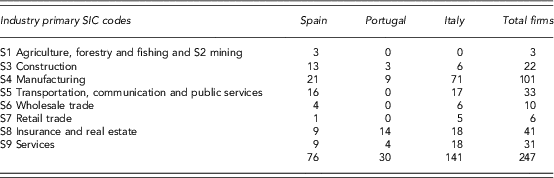
The average sales growth of each firm was calculated for the 4 years between 2004 and 2007 (Amason, Shrader, & Tompson, Reference Amason, Shrader and Tompson2006; Titus, Covin, & Slevin Reference Titus, Covin and Slevin2011). Because sales revenues over the four calendar years were positively skewed, we used logarithms to minimise the skewness. Thus, the sales growth variable was measured by the differences in the logarithm of total sales revenue from 1 year to another (Chrisman, Chua, & Kellermanns, Reference Chrisman, Chua and Kellermanns2009). To account for differing growth rates in the industries and countries represented in the sample, the 4-year average industry growth rate per country was subtracted from each firm's 4-year average growth rate. This created a relative sales growth rate figure, controlling for industry and country, that was used as the dependent variable (Baysinger & Butler, Reference Baysinger and Butler1985; Villalonga & Amit, Reference Villalonga and Amit2006; Miller et al., Reference Miller, Le Breton-Miller, Lester and Cannella2007; Christensen, Kent, & Stewart, Reference Christensen, Kent and Stewart2010; Titus, Covin, & Slevin, Reference Titus, Covin and Slevin2011). In Table 1, we present the sample distribution by country and by industry.
Sample distribution
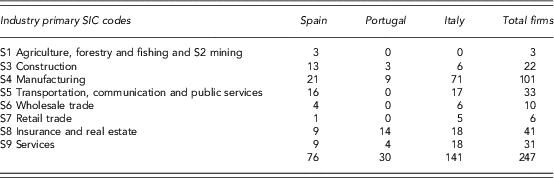
We incorporated industry effects because sector heterogeneity might affect firm performance due to differences regarding, for instance, the level of business risk, competition within the sector, industry standards, economies of scale or competitive intensity (Andrés, Azofra, & López, Reference Andrés, Azofra and López2005; Braun & Sharma, Reference Braun and Sharma2007; Jackling & Johl, Reference Jackling and Johl2009). We adopted the Standard Industrial Classification of Economic ActivitiesFootnote 8 (2003).
Country effects were incorporated because there is evidence to suggest that country-specific factors, such as political and institutional factors, may affect firm performance relationships (Andrés, Azofra, & López, Reference Andrés, Azofra and López2005; Guest, Reference Guest2008). For instance, recent empirical evidence indicates that international differences in growth and productivity are related to differences in political, institutional and legal environments – that is, to the governance infrastructure of a country. Country effects are relevant as long as firms can be substantially affected by institutional settings prevailing in different nations, which are heterogeneous (Crossland & Hambrick, Reference Crossland and Hambrick2007). Although the systems in Spain, Portugal and Italy originated from the same legal tradition and are therefore very similar in terms of culture and institutional setting, there are also differences in national-level regulations (Bettinelli & Chugh, Reference Bettinelli and Chugh2009; Minichilli et al., Reference Minichilli, Zattoni, Nielsen and Huse2012).
Independent variablesFootnote 9
Sales growth is regressed against the following variables, used as proxies for board monitoring:
• Board size: The total number of directors on the board of each company (Andrés, Azofra, & López, Reference Andrés, Azofra and López2005; Huang, Reference Huang2010; Kota & Tomar, Reference Kota and Tomar2010).
• Independent directors: The independent director ratio – that is, the number of independent directors divided by the total number of directors on the board of each company (Chen & Nowland, Reference Chen and Nowland2010; Huang, Reference Huang2010; Fraile & Fradejas, Reference Fraile and Fradejas2012). Independent directors are those highlighted as ‘independent’ in the companies’ annual reports.
• Leadership structure: A dummy variable that takes a value of 1 when the CEO and the chairperson of the board is the same person and a value of 0 otherwise (Zajac & Westphal, Reference Zajac and Westphal1996b; Braun & Sharma, Reference Braun and Sharma2007; Kota & Tomar, Reference Kota and Tomar2010).
Moderator variable
• Family: A dummy variable that takes the value 1 if the firm is a FB (see definition in the ‘data and sample’ section) and 0 otherwise to control for differences in the performance-board independence relationship due to family ownership and control (Chrisman, Chua, & Kellermanns, Reference Chrisman, Chua and Kellermanns2009). The interaction variables were constructed by multiplying the family moderator variable by each of the independent variables.
Control variablesFootnote 10
Consistent with the work of Schulze et al. (Reference Schulze, Lubatkin and Dino2001, Reference Schulze, Lubatkin, Dino and Bucchold2003) and others performing comparative studies (Chrisman, Chua, & Litz, Reference Chrisman, Chua and Litz2004; Chrisman, Chua, & Kellermanns, Reference Chrisman, Chua and Kellermanns2009), we controlled for age, size and debt in our analysis to avoid any bias in the results:
• Firm size: The natural logarithm of the value of total assets. Previous studies have found that organisational size is related to organisational performance for various reasons, including diversification, economies of scale and access to less expensive funding, among others, which suggests that size should be included as a control variable (Andrés, Azofra, & López, Reference Andrés, Azofra and López2005; Cheng, Reference Cheng2008; Huang, Reference Huang2010; Kota & Tomar, Reference Kota and Tomar2010).
• Firm debt: The ratio of total debt to total assets. This figure was included because firm debt provided a mechanism for curbing agency costs (Andrés, Azofra, & López, Reference Andrés, Azofra and López2005; Cheng, Reference Cheng2008; Jackling & Johl, Reference Jackling and Johl2009).
• Firm age: The natural logarithm of the number of years since the firm's founding. This figure was included to control for company life cycle and growth prospects (Forbes & Milliken, Reference Forbes and Milliken1999; Anderson & Reeb, Reference Anderson and Reeb2003; Miller et al., Reference Miller, Le Breton-Miller, Lester and Cannella2007).
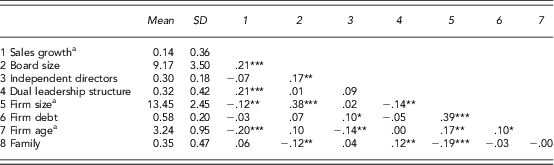
We tested our hypothesis using an ordinary least squares (OLS) multiple regression model. It should be stressed that most of the papers on the role of the board of directors use this method. Furthermore, regression models are recommended for the analysis of moderating effects (Marquardt, Reference Marquardt1980; Aiken & West, Reference Aiken and West1991). To ensure that the significance of the regression equation was not solely caused by the control variables, hierarchical regressions were run. Table 2 presents descriptive statistics for the sample and correlation matrix. Although the correlation coefficients are weak and do not violate the assumption of independence between the variables, the absence of multicolinearity was verified in each regression model for all variables including the interaction terms; no tolerance coefficient was close to 0 and no variance inflation factor (VIF) coefficient was higher than 10, meaning that multicolinearity is not a significant problem in our sample (Myers, Reference Myers1990). It must be noted that to minimise correlations between the independent variables and their interaction terms, before the computations involving the interaction terms, the independent variables were centred as recommended by Aiken and West (Reference Aiken and West1991) and Marquardt (Reference Marquardt1980).
Descriptive statistics and correlations between variables
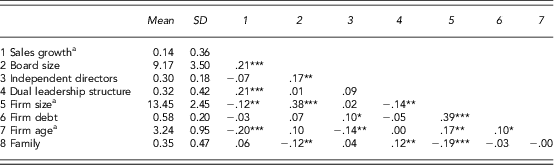
Spearman's ρ.
aLogarithmised (ln).
*p < .05; **p < .01; ***p < .001.
Hypothesis 1 and Hypothesis 2 propose that the nonlinear relationships between the independent variables and the dependent variable are contingent on the type of controlling shareholder. To test these hypotheses, we should derive the optimal levels of board size and independent directors at which firm performance is maximised depending on whether the firm is a FB or a NFB. To that end, we must obtain the first derivative of performance with respect to each of the board monitoring variables. Note that these are the inflection points at which the relation between board size and firm performance, as well as that between independent directors and firm performance, change from positive to negative. This step will only be possible if the results of the empirical analysis allow for it – that is, if the nonlinear relationships are confirmed.
ANALYSIS AND RESULTS
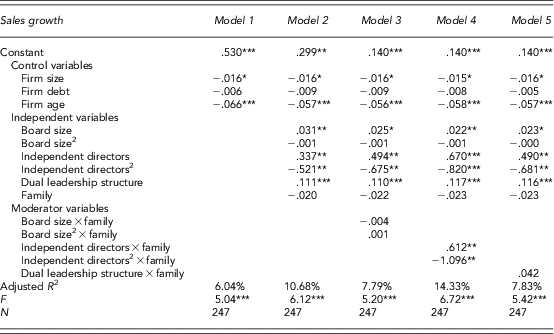
Table 3 presents the results of the OLS regression models to evaluate the influence of board independence on the performance of the firms under consideration. Model 1 includes only the control variables. Model 2 incorporates the board independence and family influence variables. We also include the squares of the board size and independent director values to assess the existence of nonlinear relationships with the dependent variable. Models 3–5 incorporate the interaction terms used to test our hypotheses.
Empirical analysis results

Coefficients from the OLS regression are reported.
*p < .05 (two-tailed); **p < .01 (two-tailed); ***p < .001 (two-tailed).
The regression models are all significant at the 0.001 level. Overall, the full regression model explains a modest amount of the variance in our dependent variable, sales growth (see adjusted R 2 on Table 3). Of the five models, Model 4 is the strongest.
Model 1 shows that two of the control variables under consideration are statistically significant and thus are determined to affect sales growth: firm size and firm age have negative effects on sales growth (β = −0.016 and p < .05; β = −0.066 and p < .001). However, the contribution of firm debt is not statistically significant (β = −0.006 and p > .1).
In Model 2, the results indicate that the impact of board size on sales growth is positive, as shown by the coefficient of board size (β = 0.031 and p < .01). The coefficient of board size2 is negative but this relationship is not statistically significant (β = −0.001 and p > .1). As for the second independent variable, the significance of the positive and negative coefficients of independent directors (β = 0.337 and p < .01) and independent directors2 (β = −0.521 and p < .01) show an inverted U-shaped relationship between the proportion of independent directors and firm performance. The result for the third independent variable indicates that dual leadership structure is positively related to sales growth (β = 0.111 and p < .001). Although our hypotheses are concerned only with the moderating influences of family involvement, we included the family variable in this model because family influence may directly affect performance (Anderson & Reeb, Reference Anderson and Reeb2003; Chrisman, Chua, & Kellermanns, Reference Chrisman, Chua and Kellermanns2009). However, the coefficient for family was not statistically significant (β = −0.020 and p > .1), indicating that family involvement, independent of the effects of the board of directors, entails no advantages or disadvantages for FBs in terms of sales growth.
Models 3–5 show the moderating effects of family involvement.
Hypothesis 1 proposes that the inflection point at which the nonlinear relationship between board size and firm performance turns from positive to negative will be smaller in FBs than in NFBs. Model 3 shows that the impact of board size on sales growth is positive, as shown by the coefficient of board size (β = 0.025 and p < .05). Although the coefficient of board size2 is negative (β = −0.001 and p > .1), this trend lacks statistical significance so does not allow us to confirm the expected nonlinear relationship between board size and firm performance. As a consequence, it is not possible to derive the optimum board size. Moreover, the coefficient of the moderator term is not significant for board size (α = −0.004 and p > .1) or board size2 (α = 0.001 and p > .1). Therefore, Hypothesis 1 was not supported; there is a positive relationship between board size and sales growth which is not moderate by family involvement.
Hypothesis 2 defends that the inflection point at which the nonlinear relationship between the independent director ratio and firm performance turns from positive to negative will be smaller in FBs than in NFBs. In Model 4, the results indicate that the contribution of independent directors to sales growth is nonlinear. The significance of the positive and negative coefficients of independent directors (β = 0.670 and p < .001) and independent directors2 (β = −0.820 and p < .001) show an inverted U-shaped relationship between the proportion of independent directors and firm performance. Moreover, results indicate a significant interaction between independent directors and family influence. The coefficients of the moderator terms show that the incremental effect for FBs with respect to NFBs is positive and significant for independent directors (α = 0.612 and p < .01) and is negative and significant for independent directors2 (α = −1.096 and p < .01). As these results indicate, family involvement moderates the inverted U-shaped relationship between independent directors and sales growth. Following the procedures by Aiken and West (Reference Aiken and West1991) to plot the interaction effects, we optimally derive the inflection points at which the relation between independent directors and sales growth turns from positive to negative in FBs and NFBs. Overall, the optimal level of independent directors that maximises firm performance is ~27.92% in FBs and 40.87% in NFBs. These findings regarding inflection points lend support to Hypothesis 2.
Hypothesis 3 proposes that in FBs the benefits associated with dual leadership structures will outweigh their associated costs and the effect of CEO duality on performance will be positive, whereas the opposite is expected in NFBs. Model 5 indicates that dual leadership structure is positively related to sales growth (β = 0.116 and p < .001) and that the interactive effect between leadership structure and family influence is not statistically significant (α = 0.042 and p > .1). Because family involvement does not moderate the relationship between leadership structure and sales growth, which is positive for both FBs and NFBs, Hypothesis 3 was not supported. These results are examined in greater depth in the following section.
DISCUSSION
The results for board size were not as expected. As we have previously explained, without a nonlinear relationship between board size and firm performance, Hypothesis 1, which states that the inflection point of the nonlinear relationship will be reached at a lower level of board size for FBs than for NFBs, is not supported – that is, the benefits associated with larger boards will be offset by drawbacks at a lower board size in FBs than in NFBs. The analysis shows that board size has a positive impact on sales growth. Moreover, the relationship between board size and firm performance is not moderated by family involvement in the business. This finding implies that sales growth in both NFBs and FBs increases according to board size, suggesting that for firms in our sample, larger boards are better for improving strategic performance. A larger group of directors would require the CEO to invest more time and effort in building consensus for a given course of action. With larger boards, the CEO's influential power is diluted and it is more difficult for the CEO to dominate. More directors on the board also imply greater monitoring capacity and more human capital. If a positive relationship between board size and firm performance exists, for both FBs and NFBs in our sample, all of these benefits appear to be higher than costs derived from problems with coordination, communication and flexibility in decision making associated with larger boardsFootnote 11.
The results for independent directors were as expected. Our study highlights the moderating effect of family involvement on the relationship between independent directors and sales growth. As shown in Figure 1, the contribution of independent directors to firm performance is nonlinear for both FBs and NFBs. This finding indicates that there is an optimal level of board monitoring in terms of board composition and reinforces the argument that an adequate combination of executives and independent directors is better than excessive independence as a means of helping firms to achieve better performance. However, there are significant differences between the two inverted U-shaped curves. The inflection point at which the relationship turns from positive to negative is reached at a lower level in FBs. More specifically, while sales growth in FBs is increasing in independent directors up to an optimum level of 27.92%, the overall inflection point for NFBs is close to 40.87%. Moreover, while pre-optimum level (low level of independent directors) benefits for FBs are higher than in NFBs, so are the costs beyond the optimum level (high levels of independent directors). Thus, although both FBs and NFBs incorporate similar proportions of independent directors (~30%) into their boards, their contribution to sales growth is not the same.
Independent directors and firm type
As we stated in the theoretical section of this paper, both independent and executive directors are necessary for effective board performance. However, although good governance recommendations essentially advocate having a majority of independent directors (Aguilera & Cuervo-Cazurra, Reference Aguilera and Cuervo-Cazurra2004), having a majority of insiders is more desirable in FBs because having too many independent directors is perceived as a control mechanism and will lower the motivational levels of stewards. This finding reinforces the hypothesis that the knowledge provided by executive directors to a board is particularly important for the achievement of better performances in FBs, in which the knowledge and experience of family directors contribute to the effective performance of the board's advisory role. Thus, the results only support the agency theory in the presence of low levels of independent directors and, consistent with stewardship theory, having a majority of insiders on the board has a positive effect on the performance of a FB (Sundaramurthy & Lewis, Reference Sundaramurthy and Lewis2003). At low levels of board independence, the professional knowledge of independent directors with functional skills and experience that are lacking in the family may be essential for FBs (Jones, Makri, & Gómez-Mejía, Reference Jones, Makri and Gómez-Mejía2008). This idea may explain why the slope of the curve is higher in FBs at low levels of board independence.
With regard to leadership structure, although we found that the effect of CEO duality on sales growth is not moderated by family involvement in the business, the results are quite revealing. The positive effect of CEO duality on long-term sales growth indicates the validity of stewardship theory over agency theory in both FBs and NFBs. Therefore, shareholders in our sample may benefit from the clear and unambiguous leadership afforded by a combined CEO-chairperson (Braun & Sharma, Reference Braun and Sharma2007) as stewardship theorists suggest, whereas the notion of separating leadership roles in a manner consistent with agency theory is not supported by the data in this study.
Even though our specific hypotheses received mixed support, the findings of this study tend to support the contention that the performance of FBs is better when board independence (as a proxy of board monitoring) is lower compared with NFBs, as our general hypothesis proposed. Finally, our results suggest that excluding the effects of board independence (as a proxy for board monitoring), the FBs and NFBs in our sample exhibit similar strategic performance as measured by long-term sales growth.
CONCLUSIONS
This paper highlights the importance of suitably contextualising any assessment of a board of directors as a business governance mechanism. We adopt a contingency approach wherein the impact of board independence, as a proxy for board monitoring, on firm performance in Southern Europe, is observed as a relationship that varies depending on family involvement in ownership and control.
Recommendations regarding governance mechanisms are currently based on agency settings. However, the results of this research show that in FBs, where levels of goal alignment between owners and managers are expected to be higher than in NFBs, more independent boards are not the best solution for corporate governance, and stewardship theory-based governance mechanisms, which essentially redirect the board's focus from monitoring to advising (Adams, Hermalin, & Weisbach, Reference Adams, Hermalin and Weisbach2010; Bammens, Voordeckers, & Van Gils, Reference Bammens, Voordeckers and Van Gils2010), lead to better corporate performance. Therefore, this research emphasises the need to consider not only the benefits of board independence but also its costs. The introduction of more formal monitoring settings into FB structures may negatively affect their steward behaviour and business culture, reducing the level of goal alignment (Corbetta & Salvato, Reference Corbetta and Salvato2004a). Strategic performance in FBs is better when monitoring by the board is lower compared with NFBs, suggesting that what works well to control or motivate an opportunistic manager may not work well to control or motivate a steward. To encourage long-term sales growth maximisation, shareholders may optimally elect a less independent board that does not monitor intensively. Indeed, fewer independent directors and dual leadership structures are associated with better FB performance in our sample.
Moreover, our findings support agency theory at low levels of board independence and stewardship theory when the proportion of independent directors surpasses 27.92%. This finding is important because in some cases, firms may demonstrate strong agency and stewardship characteristics in different contexts, which may create some challenges (Le Breton-Miller & Miller, Reference Le Breton-Miller and Miller2009). This detail makes it even more obvious that no single theory is able to fully determine the nature of the relationship between corporate governance and performance. However, agency propositions advocating a majority of independent directors as well as non-dual leadership structures appear to be somewhat implausible in the high-ownership concentration context of Southern Europe. Among FBs, the governance structures that lead to better performances are those that empower management control (dependent boards). In our sample of NFBs, which also have concentrated ownership structures, governance solutions that empower board control (independent boards) are only partially supported. The most unexpected result for this group of firms shows that dual leadership structures improve long-term sales growth.
In summary, our results show that because agency problems and goal alignment vary depending on context, corporate solutions should also be different. Our main conclusion is that board independence (as a proxy for board monitoring) must be limited depending on the benefits and costs of board monitoring in each context. The reforms related to boards of directors being discussed in Southern European countries may be heavily influenced by those introduced in the United States and the United Kingdom for widely held firms without recognising that the separation of ownership and control is not a problem in the Southern European context, except in a very small number of companies (Aguilera & Cuervo-Cazurra, Reference Aguilera and Cuervo-Cazurra2004). Consequently, many of the recommendations may actually be harmful or inefficient for Southern European firms that have concentrated ownership structures, particularly FBs. Our findings have implications for the development of codes of good governance, which we believe should not be homogeneous but instead should adapt to the very diverse body of listed companies, especially FBs (Navarro & Ansón, Reference Navarro and Ansón2009).
Although the firms in our NFB subsample have concentrated ownership structures, they represent a very heterogeneous group in terms of the identities of their major shareholders (institutional investors, holding companies, banks, the state, etc.). Therefore, further research is needed to establish clearer conclusions about the prevalence of agency or stewardship propositions.
Acknowledgements
The authors acknowledge the Editor-in Chief of the Journal of Management and Organization, Peter Galvin, PhD, and three anonymous reviewers for their helpful comments and recommendations as well as for their constructive criticism of the manuscript. All errors are our responsibility.