Introduction
One key debate within social gerontology and the sociology of the lifecourse since the late 1980s has focused on understanding the causes of increased heterogeneity of transitions to adulthood and retirement in late modern societies. Drawing on an understanding of the lifecourse as institutionally, normatively embedded action (Mayer Reference Mayer2009), scholars have suggested that the structural and cultural apparatus that segmented the ‘modern’ lifecourse in three distinct stages has been undermined by forces of globalisation, labour market de-regulation, re-structuration of public services and individualisation processes so as to produce de-institutionalised and/or de-standardised lifecourse trajectories (Beck Reference Beck2001; Brückner and Mayer Reference Brückner and Mayer2005; Gilleard and Higgs Reference Gilleard and Higgs2005; Hughes and Waite Reference Hughes and Waite2007; Kohli Reference Kohli2007).
An important feature of this debate hinges on the role of chronological age (CA) in supporting the institutional structures and processes that organise the lifecourse. Indeed, in his seminal paper ‘The World We Forgot’, Kohli (Reference Kohli and Marshall1986) argued that CA became the main criterion – the marker – for a modern stratified system of public rights and duties that included military draft, and access to welfare rights such as pensions. Indeed, between the last decade of 19th century and the 1940s, a variety of forms of insurance, arising from different socio-political configurations, were established in Europe and North America to address the risks associated with old age (poverty, illness, isolation, etc.). As these different systems evolved into what are sometimes known as welfare regimes (Esping-Andersen Reference Esping-Andersen1990), different principles, funding and benefit schemes have come to underpin pension provision. One distinctive and unifying characteristic of those different systems, past and present, is that they rely on the establishment of a qualifying, minimum age for pension entitlement. Such continued reliance on CA goes somewhat against the changing cultural norms about old age proposed by theories of lifecourse de-standardisation (Bytheway Reference Bytheway2011). To be sure, the idea that CA should be the standard for pension entitlement was already controversial during the process of establishment of early old-age pension schemes such as that created by the Old Age Pension Act of 1908 in Britain (Thane Reference Thane2000: 217–35; see also Beveridge Reference Beveridge1942: 96). What can explain this sustained and on-going inconsistency? How has this contradiction been addressed? What alternative metrics have been proposed to resolve the inadequacies of CA and why have they not been able to shape contemporary work, welfare and health institutions? In this paper, I suggest that to answer these questions we need to conduct an in-depth investigation on the role of age standards in the shaping of lifecourse processes and institutions.
From a sociological perspective, standards are explicit, formalised rules or specifications informing collective engagement with objects or persons in a particular realm of action, such as the use of calendar years to categorise a person's age. Because standards ‘regulate and calibrate social life by rendering the … world equivalent across cultures, time, and geography’ (Timmermans and Epstein Reference Timmermans and Epstein2010: 70), they have become the focus of a thriving field of research, usually labelled the sociology of standardisation. In this field, researchers are interested in understanding how standards are generated and developed, how they are resisted and for what reasons, and how they interact with local contexts to transform social action (Bowker and Star Reference Bowker and Star1999; Busch Reference Busch2011; Lampland and Star Reference Lampland and Star2009). This usually entails exploring the dynamic relationship between cognitive or epistemic dimensions of standards and normative, social and political processes.
Drawing on this approach, Treas (Reference Treas, Lampland and Star2009) detailed how the increased use of CA was linked to the requirement of precision, certainty and impartiality in a wide range of classification practices and decision-making procedures inherent to modern bureaucracies. In this, the establishment of the linkage between the epistemic norms of statistical reasoning and the information requisites of State administration in the latter part of the 19th century (Desrosières Reference Desrosières, Wagner, Wittrock and Whitley1991) induced a reliance on numerical rather than categorical age-reporting. These processes combined together to raise awareness of CA and its normative implications in European and North American societies (Chudacoff Reference Chudacoff1989), a processes that has been reinforced in late modernity (Biggs Reference Biggs2005; Hendricks Reference Hendricks, Dannefer and Philipson2010; Nikander Reference Nikander2009; Settersten Reference Settersten, Mortimer and Shanahan2003). In this paper, I propose to further the application of the conceptual tools of the sociology of standardisation to understand the transformation of the role of age standards in shaping lifecourse processes and institutions since the period addressed by Treas and Kohli. My approach is historical, focusing on expert knowledge and debates about the pros and cons of using CA or alternative age metrics from the mid-20th century onwards. I use those deliberations as a ‘window’ into the infrastructural dimensions of lifecourse processes but leave open, at this stage, how they have influenced policies or practices relating to retirement, pensions or health care.
In the paper, I first outline a conceptual framework which suggests that contradictory rationalities used in the implementation of CA, referred to above, have sustained a continued dynamic of critique and justification about the moral and epistemic worth of age standards. After a small section describing the methodological approach of the paper and its empirical basis, I describe how a critique of CA was established within the various strands of gerontological knowledge during the 20th century. In the fourth section, I explore how alternative age standards emerged from this critical movement and proposed a form of ‘standardised differentiation’ (Busch Reference Busch2011) that aimed to conjoin individuals’ unique capacities or needs to roles or services. I further suggest that these ‘personalised’ age measurements have proliferated along two axes, one relating to the ‘ideal’ that justifies the measurement, and another representing a continuum between proposals that emphasise measurement of behaviour and those that focus on somatic qualities. In the final section, I argue that the proliferation of and uncertainty around ‘personalised’ age measurements has prompted the emergence of institutional programmes aimed at establishing agreed criteria and conventions for the validation of age standards, leading to a contraction of the space of epistemic and political possibilities for age measurement towards a contemporary focus on biomedical markers of ageing.
Age standards: from investment in form to form substitution
In social science, CA is usually considered a simple numerical measurement: the time, typically measured in completed years, between birth and some specific time. It is a measurement routinely collected by statistical offices and agencies around the world, and frequently used in biomedical, psychological and social research on ageing. However, most social scientists agree that CA, in and of itself, is an ‘empty’ variable in that it does not provide information regarding the behaviour of the individual on which the measurement has been made. Indeed, it is only by drawing on lay or expert beliefs about how age indexes individuals’ traits that it becomes a meaningful measurement (Bytheway Reference Bytheway2011; Settersten and Mayer Reference Settersten and Mayer1997).
In this regard, following Desrosières (Reference Desrosières, Wagner, Wittrock and Whitley1991, Reference Desrosières2008 a, Reference Desrosières2008 b), age measurement can be thought of as being deployed at the intersection between qualification and quantification. For Desrosières, quantification – meaning putting in numerical form – is interdependent on a specific type of qualification work that aims to construct conventions and classes across individual cases. In the case of CA, qualification means that equivalences have to be drawn between individuals of different genders, classes, localities, etc., on the basis of the number of years lived since birth, a process which underpins the linkage between the processes of chronologisation and individualisation that Kohli (Reference Kohli and Marshall1986: 272) identifies as a key feature of the modern lifecourse. Desrosières’ work calls our attention to the negotiations and compromises that underpin such qualification work by drawing on the theoretical work of his collaborator, Laurent Thévenot.
In the 1980s, Thévenot (Reference Thévenot1984) suggested that in order to understand economic activity fully it was necessary to attend to the forms and standards that ensure compatibility of values and pricing. Investment in form, Thévenot argued, is as important as other forms of investment undertaken by economic agents because it encodes a ‘stable relation with a certain lifespan’ within a certain area where the code is accepted as valid. Forms such as salary scales or standard time (Zerubavel Reference Zerubavel1982) significantly reduce uncertainty of return from other investments, particularly if they are objectified as material implements (Callon and Latour Reference Callon, Latour, Cetina and Cicourel1981). Thévenot suggested that these arrangements are both cognitive and political, in that a particular form of qualification of objects or persons supports and enforces co-ordination between economic agents. In subsequent work with Boltanski, Thévenot further suggested a wider role for standards in that,
[w]hen persons grasp events as human actions in the perspective of coordination, they relate behaviours to some relevant good, the format of the good being highly variable … When properly formatted, persons and things qualify for a certain mode of coordination. (Thévenot Reference Thévenot, Beckert and Zafirovski2006: 111–2)
Re-articulating the traditions of conflict and functionalist sociologies, Boltanski and Thévenot (Reference Boltanski and Thévenot2006) argued that in situations of conflict and uncertainty, actors and groups enter a dynamic of critique and justification searching to build the conditions for the qualification of people or things in orders of worth, which recursively act as cognitive scaffolds to understand situated action and to act appropriately. Although acknowledging Garfinkel's ([1967] Reference Garfinkel1984) work in their attention to the constitutive nature of conventions, they argue that actors’ moral justifications entail not only processes of sense-making but also, and importantly, require investment – durable, explicit, objectified commitment – to one way of ‘grasping events’.
My proposition, drawing on the above, is that age measurement is a type of investment in form, that is to say, a costly operation attempting to embed a method of qualification in categories or standards so as to support a stable relation between individuals’ characteristics and social institutions at different points in time. Because it has become so entrenched in current social institutions in the CA format, it is difficult to grasp fully how methods of qualification combine with procedures of quantification in the production of age measurement more generally. Key insights into this process can be provided, however, by analysis of age-recording procedures in populations with variable knowledge of age. For example, drawing on fieldwork conducted on the 1971 Moroccan Census, Quandt (Reference Quandt1973) reports on the trials and tribulations of interviewers in collecting age data. One of the interviews she transcribes is especially illuminating:
‘What is your age?’
‘Who me? Our generation was unrecorded. We didn't have any. No date of birth. Nothing.’
‘How many [years], how many? Estimate.’
‘How am I going to estimate? I have nothing to estimate with. I can tell you that I am 60 years; 70 I haven't yet reached.’
‘Have you reached 80?’
‘I don't think so. Someone who is 80 is…’
‘You who still have energy, you are 70.’
‘Perhaps that, perhaps it is correct, Sir.’ (Quandt Reference Quandt1973: 45)
The transcript is revealing because of how the interaction exactly inverts the order between CA and what it usually is seen to ‘index’. Indeed, in the agreed absence of the very apparatus that would make knowledge of age possible, and to be able to reach a numerical measurement of age, interviewer and interviewee used a lay measure of functional ability (‘energy’) to infer the age of the interviewee. In this, age is quantified by converting a qualification into a measurement. Interestingly, such qualification is based on a cognitive operation that seeks equivalences between the interviewee and other individuals (‘Someone who is 80 is…’). But such evaluation implicitly also relates such equivalence to a specific world, or mode of co-ordination where ‘energy’ is a relevant property of individuals – most likely agricultural labour, in this case. These processes reveal, I argue, the basic features of age measurement, made more complex by the multitude of cases under consideration and the multiplicity of possible ‘coherent cognitive and political schemas’ through which equivalences can be drawn in in research and professional statistics (Desrosières Reference Desrosières, Wagner, Wittrock and Whitley1991: 214).
This last aspect is particularly significant in relation to age measurement. What are the possible schemas of qualification under which it is relevant to measure and quantify age? What is age measured for? To a large degree, this has already been answered in the analysis of the link between the consolidation of modern administrative systems of distribution of rights, obligations and CA. However, there is a tension between the rationality that underpins such administrative action and the form of age measurement deployed in CA. As Kohli has poignantly observed,
Chronological age is apparently a very good criterion for the rational organisation of public services and transfers. It renders the life course … orderly and calculable. [H]owever there is an uneasy tension between the formal rationality of such procedures and the substantive rationality that they are supposed to provide. Chronological age is essentially an ascriptive criterion and thus at odds with the modern emphasis on universalism … In a universalistic regime, it is normatively preferable to allocate right and duties by a criterion based on achievement, such as ‘functional age’. Empirically on the other hand the implementation of such criterion is difficult and may even be self-defeating … replacement of chronological age by ‘functional age’ … would be very costly in several respects. (Kohli Reference Kohli and Marshall1986: 286–7)
Kohli's suggestion is that at the heart of CA lies a fundamental contradiction between the value of efficient administration and the other goods that the State is supposed to pursue. In this respect, CA can be thus conceived as a formalised compromise between efficiency and other modern cognitive and political schemas deployed by the State. But, as I will show in the remainder of the paper, this compromise has become increasingly unstable. The first reason for this relates to how conventional standards fundamentally present two faces to their users: one shielded by the certainty of taken-for-granted realities, and another where their foundations appear to crack and crumble before our eyes (Thévenot Reference Thévenot2009: 797; see also Moreira, May and Bond Reference Moreira, May and Bond2009). The second reason pertains to the impurity of CA as convention, making it easier to denounce as a manufactured composite of different coherent epistemic and political schemas (Boltanski Reference Boltanski1990). This impurity has, I suggest, fuelled continued and sustained critical engagement with CA, whilst it was becoming established as a routine numerical measurement.
Such critique, as Kohli intimates, might be difficult to bring to bear in the validation of an alternative, generalised form of age measurement. This is due to the expediency of CA as a metric. Because it is ‘empty’, CA has been used in the form of a ‘proxy variable’ for the measurement of a variety of other qualities which have interested statisticians and other researchers. In this respect, CA has worked as what Star and Griesemer (Reference Star and Griesemer1989) have labelled a ‘boundary object’, supporting the activities of different ‘social worlds’, yet maintaining a common identity across them. This, in turn, has meant that while CA does not fully satisfy the requirements of any specific cognitive or political schema, it has been recurrently collected and entered in the set of variables used for a wide array of purposes. Because it has supported work within these sets of activity, where it acquires well-defined meanings, age measurement has effectively become ‘locked in’ to CA. That is to say that the incumbency of CA and its plasticity have worked together to maximise its practical advantages while raising the bar for the development of any alternatives (Arthur Reference Arthur1994).
But, as Kohli explains, the use of achievement criteria to pursue those goals would also be difficult to implement. There are two main reasons for this. One relates to the different achievement criteria that would have to be mobilised for different areas of State action, making it difficult to find a common measure for qualifying individuals for criminal responsibility and pensions, for example. The second concerns how such diverse efforts to measure achievement or need would have to be validated within appropriate epistemic and political schemas, and these themselves qualify for use within and across a modern universalistic State. This would be a huge, costly endeavour, in and of itself. Thus, seeking to replace CA with another standard would be ‘very costly’, because, as Callon would put it, in order ‘to establish other links and new translations [one] would first need to undo those already in existence by mobilising and enrolling new alliances’ (Reference Callon and Law1991: 152).
In the remainder of the paper, I explore empirically how these factors have played out in expert attempts to replace CA with other measurements of ageing.
Methodological note
The data analysed in the paper were collected as part of an on-going research project on age standardisation. The overall project combines interview, archival and documentary material. The empirical sections of this paper draw mainly from the historical documentary data-set, which contains approximately 4,000 references published between 1935 – the year marking the establishment of modern gerontology (Park Reference Park2008) – and Reference Park2013. This data-set was constructed through searches on electronic bibliographic databases (Web of Science, PubMed, JSTOR) for the keywords ‘measurement of age’, ‘biological age’, ‘functional age’, ‘biological age’, ‘biomarkers of ageing’ and ‘measurement of senescence’. These searches were complemented by identification of other articles, books or documents referenced by the papers in the original database.
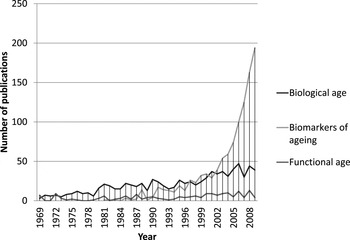
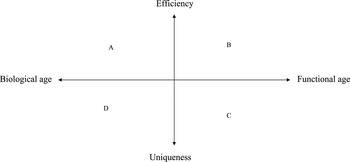
This paper's analytical focus on published research papers is warranted by the aim to understand the emergence, structure and dynamics of a particular field of research concerned with the development of alternative age measurements. In this regard, the analysis takes a similar approach to Landecker's (Reference Landecker2007) historical study of standardisation of tissue culture practices. Two approaches to data analysis were used. First was the use of scientometric tools to identify historical trends in the literature (see Figure 1) and, through analysis of citation networks, key papers in the development of the field of research. Second, drawing on the analytical framework described in the previous section, in particular the relationship between measurement and qualification, I identified ‘genres’ or types of age measurement proposed in the literature under analysis, from which resulted the typological model presented in Figure 2. The model is conceptualised as a projection of two axes representing continua of idealised forms of age measurement (X) and qualification (Y). The resulting categories of age measurement are intended as Weberian ideal types, heuristic devices that enabled identification and exploration of specific empirical cases (Ragin and Amoroso Reference Ragin and Amoroso2010). It is not a rigid classification of species of age measurement, but rather a conceptual tool to understand the space of possibilities for age measurement between the late 1940s and the 1980s. The interaction between the two modes of data analysis supported the argument proposed in the section entitled ‘Proliferation and regulation of age measurement’.
Research on ‘personalised age’ by number of publications on Web of Science (1969–2013).

Typology of substitute age standards.

Opening up chronological age
In his opening remarks for the 1954 CIBA Foundation Colloquium on Ageing, Professor R.E. Tunbridge OBE, a well-known physiologist working at the University of Leeds, asked the following questions:
Is ageing a chronological term, merely reflecting the passage of years, and if so, what years, or are the public right in assuming, as they generally do, that ageing is synonymous with senescence and/or decay? The concept of the elixir of life … has long served as a tremendous stimulus to mankind, to higher flights of imagination or sometimes to derision. We shall not dwell upon these fantasies, nor shall we deal with that other very important aspect of the problem, what one might call the political, economic and social aspects of ageing, of which we as citizens cannot be unaware. (Tunbridge Reference Tunbridge, Woltenholme and Cameron1955: 1)
Tunbridge was well placed to ask these questions, having been the main instigator of the colloquia to coincide with the Third International Gerontological Congress to be held in London that year. In the audience, there were some of the most prominent researchers in the emerging field of gerontology, such as Sir Frederic Barlett, of the Cambridge Experimental Psychology Laboratory, Peter Medawar, then at University College London, Nathan Shock, Director of the US Public Health Service Section on Gerontology, and Edmund Cowdry, founder of the International Association of Gerontology. But, from the outset, Tunbridge extended the audience of his questions to include ‘the public’. The question of whether ageing was ‘merely’ a chronological measurement or related to functional and physiological decline allied the experts in the room to concerns of the wider population. He warned, however, that such interest should not be linked with fantasies of immortality, but that it was related to pressing social and political issues of the time.
By making explicit the link between the research question and issues of political, economic and social organisation, Tunbridge was also suggesting that accepting uncritically a chronological view of ageing was no longer possible. To respond to the concerns of the public, it was necessary to open up and explore how chronology related to ‘senescence and decay’, if at all. The confidence with which Tunbridge articulated these questions, while partially hinging on his prestige in the medical, scientific and policy worlds, was also legitimised by an acknowledgement, amongst the audience, that this was a legitimate question to ask. Indeed, as Paolo Palladino and I have suggested (Moreira and Palladino Reference Moreira and Palladino2011), the origins of the interrogation of CA as a measurement can be traced back to the consolidation of the sciences of growth in the United States of America (USA) at the beginning of the 20th century.
In that period, Progressive reforms of the American nation, and growing anxieties about modernisation, induced the expansion of privately and publicly funded research on child development (Prescott Reference Prescott, Stern and Markel2004; Smuts Reference Smuts2008). These aimed to replace the concern with poor and delinquent children with a scientific understanding of the ‘normal’ child, and consequently a variety of studies sought to examine development by means of serial observations of selected children (e.g. the Harvard Growth Study). The concepts and ideals of the child development research movement can be seen as embodied in the figure of Lawrence Frank, one of the key planners of the movement. A social scientist, Frank was typically troubled by modernisation and the resulting, growing disjunction between habitual human behaviours and industrial, technological culture. He thus regarded the understanding of processes of normal physiological and psychological development as key to the design of beneficent social institutions and the management of individual behaviour (Bryson Reference Bryson1998: 410).
Interestingly, it was in this scientific and political context that Nathan Shock, later a participant at the 1954 CIBA Colloquium, began his academic career in the mid-1930s, as a researcher in the Oakland Growth Study, focusing on physiological changes in adolescence. There, Shock was able to establish that the onset of a physiological event – menarche – was more important than CA in structuring changes in development (Shock Reference Shock1943), a belief he held dear and applicable to ageing when, on Frank's recommendation, he transferred to the Section on Gerontology in 1941. From this position, he went on to establish the Baltimore Longitudinal Study of Aging, a major programme of investigation into the nature of ageing funded by the US National Institutes of Health since 1958, and whose results are frequently quoted as a key source to support the view that individuals age at different rates (Moreira and Palladino Reference Moreira and Palladino2011).
Such emptying of the meaning of CA was also observable in the same period in the laboratory sciences. In this, the figure of Edmund Cowdry – also a participant at the 1954 Colloquium – was vital. Concerned with the social and political consequences of the Great Depression, Cowdry had, in 1935, gathered together a group of experts for a conference under the auspices of the Macy Foundation and its director Lawrence Frank, which he later published as Problems of Ageing (Cowdry Reference Cowdry1939). In this forum, he was able, drawing on the ideas of Nobel Prize-winning surgeon and eugenist Alexis Carrel (Reference Carrel1912), to propose that the rate of ageing in tissues was determined by their surrounding environment of nutrients, regardless of the organism's CA (Park Reference Park2013). This explained why,
…the burden of years is not evenly felt by blood vessels of all sorts. In addition to such local differences in susceptibility remarkable differences in speed of operation of the ageing processes are noted. (Cowdry Reference Cowdry1939: 665)
By disentangling the ‘operation of the ageing processes’ from a singular measurement of time since birth of the organism, Cowdry compounded the case against CA from a biological and medical perspective. In particular, he questioned the idea that there was an alignment between the calendar and the various ‘speeds’ at which different organs develop and decay. If welfare institutions, professionals and experts were to address the ‘problems of ageing’, and to redress the fate of the ‘old’ of being seen as ‘useless’ in modern society, he argued, it was necessary to do away with the notion that years since birth could index physiological status (Park Reference Park2008; also Katz Reference Katz1996). The principal reason why Cowdry's proposal was to become central to gerontology was because it aligned a programme of social reforms with contemporaneous medical and scientific ideas and practices regarding growth and ageing, whereby ‘the old temporal delimiters of birth and death have become blurred and natural time has been increasingly stripped from the body’ (Armstrong Reference Armstrong, Cooter and Pickstone2000: 258).
Although it is usually thought that the social and behavioural sciences were slow to criticise CA, mainly due to Birren's well-known statement that ‘chronological age is one of the most useful single items of information about an individual’ from which ‘an amazingly large number of general statements or predictions can be made’ (Birren Reference Birren and Birren1959: 8; also Baars Reference Baars, Dannefer and Philipson2010), there were in fact similar movements within those sciences.
In psychology, the work of Ross McFarland is perhaps the most significant in this regard. Trained as a psychologist in the 1920s in the USA, McFarland's approach to the study of ageing and function at work was shaped by post-doctoral work in Cambridge with Frederic Barlett, to study the effects of altitude in the performance of aeroplane pilots. This work led to him being invited to collaborate with Henderson, Mayo and others at the Harvard Fatigue Laboratory (Scheffler Reference Scheffler2011), and further to his proposal that the physiological concepts of internal equilibrium and homeostasis were key to understanding differential human cognitive performance at work across the lifespan. His concern with the inadequacies of CA in assessing function was sparked,
[in] WWII when it became necessary to employ a large number of retired older workers in the war industries, especially in the aircraft manufacturing companies of Southern California. At that time a study was made, The Older Worker in Industry, reporting that older workers, if properly placed, could function effectively. In fact, they had greater stability on the job, fewer accidents and less time lost from work as did younger workers (McFarland, Reference McFarland1943). The investigation showed it was unfair to judge workers in terms of their chronological age. (McFarland Reference McFarland1973: 1)
In the 1943 study cited, McFarland had been asked to assess the possibility of deploying older workers in new functions. Of note is the fact that such investigation resulted from a situation where the age-segregating policy of retirement had been suspended, and where alternative forms of duty allocation were necessary. What emerged was that the application of CA as an index of function was inadequate for an efficient organisation of labour. Strikingly, particularly if we recall the discussion of Boltanski and Thévenot above, McFarland explicitly framed this discrepancy in normative terms, as relating to fairness, which was particularly acute at a time of collective war effort. But war was not the only context where industrial efficiency should guide the use of age standards.
With increases in longevity after the war, McFarland argued that ageing ‘cannot be arbitrarily evaluated as good or bad, but rather that [it] must be clearly understood in relation to the demands of specific jobs or employment possibilities’ (McFarland Reference McFarland1956: 21). This belief in the arbitrary nature of the qualification of people ‘as good or bad’ founded on CA also motivated the Nuffield Foundation's support for the work of A. T. Welford and Barlett in the Research Unit into Problems of Ageing at the Cambridge Laboratory from 1946 (Welford Reference Welford1958). Welford, along with Le Gros Clark (Le Gros Clark and Dunne Reference Le Gros Clark and Dunne1955), another Nuffield-supported researcher, was particularly significant in establishing the view that most of the issues arising from older people in industry had come about as a result of changes in technology, a generational effect that had become crystallised in CA-based retirement policies after the war (Harper and Thane Reference Harper, Thane and Jefreys1989). This further denounced the historical contingencies upon which CA measurement was based.
Social sciences’ engagement with CA was somewhat hampered by the role Lawrence Frank played in shaping the gerontological field in the pre-war years, in that he positioned those sciences in a subsidiary role to the more ‘fundamental’ knowledge on the normal curve of development and senescence (Frank Reference Frank1950). However, Frank was also instrumental in the appointment of Robert Havighurst to the Committee of Human Development (CHD) at Chicago, while the CHD was still mainly concerned with psychological child development (Achenbaum Reference Achenbaum1995: 104). It was Havighurst who linked with sociologist Ernest Burgess to design an educational and research programme in social gerontology in the late 1940s. This proved decisive for the growth of the sub-discipline, leading to the establishment of the Kansas City Study of Adult Life in the mid-1950s where, drawing on a Chicago ‘community-based’ style of research, gerontology's first ‘social science laboratory’ was established (Achenbaum Reference Achenbaum1995: 106).
Two important sociological approaches to ageing came from the study. One was the theory of disengagement (Cummings and Henry Reference Cummings and Henry1961), which, echoing somewhat the wishes of Frank, argued that the ‘normal curve’ of development and senescence was paralleled by a decoupling of moral obligations and personality in older people. The other, embodied in the figure of Bernice Neugarten, focused instead on how age norms interacted with personality and biological changes to shape behaviour (Neugarten Reference Neugarten1964).
Of key significance in the development of this approach was Neugarten's study of the meaning of menopause for middle-aged women, which found that menopause was ‘not necessarily an important event in understanding the psychology of middle aged women’ (Neugarten Reference Neugarten1968: 142). For Neugarten, in the later years of life, age norms and ‘age status systems’ were more important to understand behaviour and personality than biological events. However, Neugarten also found that at the phase in life when there was most variation across individuals, there was also ‘an increase in the extent to which respondents ascribe importance to age norms and place constraints upon adult behaviour in terms of age appropriateness’ (Neugarten, Moore and Lowe Reference Neugarten, Moore and Lowe1965: 715), a cultural rigidity that successive age-segregating retirement policies in the USA had re-enforced.
Ever the optimist, Neugarten identified signs that changes in the fluidity of the age grading system in the 1970s might challenge this state of affairs leading to the development of,
an age-irrelevant society in which arbitrary constraints based on chronological age are removed and in which all individuals, whether they are young or old, have opportunities consonant with their needs, desires and abilities. (Neugarten Reference Neugarten1974: 197)
Such vision of an ‘age-irrelevant society’ where distribution of rights and responsibilities hinges on ability and need, while, normatively, not radically different from those proposed by Cowdry or McFarland, is enriched by an empirical attention to different socially embedded ways of growing old – the ‘desires’, in her words. This contributed to questioning the inevitability of contemporaneous age-grading systems – its arbitrary constraints – and to further de-naturalising the lifecourse within social science through the consolidation of the institutional paradigm, of which Kohli's Reference Kohli and Marshall1986 paper is a prime example.
From the mid-1930s onwards, across biological, behavioural and social sciences, a mounting critique was directed at the foundations of CA. It might be said that such critique was an important ‘glue’ holding the field of gerontology together, divided as it was by different understandings of the ageing process. The critique highlighted the epistemic inadequacies – the artificiality – of an age-measurement system where equivalences were drawn between individuals with a wide diversity of physiological, psychological and sociological characteristics. In this process, CA became increasingly seen as an arbitrary age standard. The critique also denounced the way in which CA deployed an unfair treatment of persons by medical, work and welfare institutions, classifying people as ‘good or bad’ on the basis of years lived alone. The emphasis given to different types of injustice produced by CA was a function of the varying forms of the ‘good’ drawn by scientists in constructing their critique and proposing an alternative. It is to the exploration of the alternatives that I now turn.
Plotting personalised age measurement
The critical movement against CA was paralleled by the construction of alternative measurements which aimed to substitute the nefarious effects of the prevailing standard. As I have argued, although there was consensus amongst experts about the inadequacy of CA, there was also keen awareness of the hurdles associated with form substitution, as discussed in the conceptual section of this paper. This meant that proponents of alternative age measurements had to be explicit about both the epistemic and political advantages of their creations if they were to mobilise and enrol new allies. This eases somewhat the analysis of a multifarious array of different proposals crafted over a 70-year period. From this analysis, two key findings can be put forward.
First, that the large majority of proposed alternative age standards are underpinned by the mobilisation of expert knowledge to distinguish or differentiate between persons previously categorised as equivalent. Substitute age standards are, in this respect, part of the wider shift in standardisation in late modernity, whereby measures and scales promise individualisation and ‘personalisation’ of technologies or services. The purpose is, as endocrinologist Harry Benjamin put it in explaining the goal of coining the concept of biological age, to develop ‘for the individual what our actuaries and biostatisticians have figured out so ingeniously for groups’ (Benjamin Reference Benjamin1947: 226, my emphasis). As Busch (Reference Busch2011) and Epstein (Reference Epstein2008) have suggested, the goal of such standards is neither to develop a universalistic measure, applicable to all, nor to rely solely on individualistic assessments. Instead, in domains as diverse as communication technologies, biomedicine or ageing, experts focus on the conception, validation and implementation of standards which purport to identify the combination of unique characteristics of persons that are relevant to a specific market, service, technology, type of work, etc.
Second, data analysis suggests that the diverse array of substitute age standards can be qualitatively categorised by projecting them on to a space structured by two continua (see Figure 2): one relating to the mode of co-ordination that justifies the measurement, and another ranging between proposals that emphasise measurement of behaviour – functional age – and those that focus on somatic qualities – biological age (see Salthouse Reference Salthouse, Birren, Robinson and Livingston1986). In terms of justification, substitute measures tend to qualify persons in two different ways. Efficiency refers to the cognitive and moral scaffolds that aim to use individualised measurement to maximise older people's participation in the economy and polity, and streamline the use of health, social or commercial services. It is usually associated with proposals that aim to re-align instrumental and substantive rationality in age measurement. Uniqueness, on the other hand, aims to provide the means through which persons can achieve their personal life goals, desires and ambitions throughout the lifecourse. This is a form of justification that emphasises the value of individuals’ unique personal characteristics, such as wisdom, inspiration, extraversion or creativity. Out of this relationship, four quadrants result (A–D) where, I suggest, it is possible to plot the large majority of substitute measurements under analysis.
Propositions in quadrant A are typically associated with biomedicine. This is where Benjamin's biological age, referred to above, would be positioned. More instructive, however, is Alex Comfort's work on this subject. Nowadays mostly known as the author of Joy of Sex, Comfort was a key figure in the consolidation of biological gerontology, having written the first textbook on the subject (Comfort Reference Comfort1956). A student and follower of Medawar's (Reference Medawar1952) evolutionary understating of ageing, Comfort was mostly known for promoting an approach to the measurement of ageing hinging on the effects of the ‘force of mortality’ upon survival curves (Comfort Reference Comfort1956: 22–44). His engagement with health care, with the development of new pharmacological approaches to ageing (Bender, Kormendy and Powell Reference Bender, Kormendy and Powell1970) and his need to find an application for biology of ageing within the problem-driven research policy environment of the 1960s (Ruivo Reference Ruivo1994), led him, however, to the view that while,
for a proper account of ageing it has so far been necessary to insist on the force of mortality as the sole generally applicable criterion, [now a] new attempt to work out battery tests of human physiological age is overdue. It is justified by experimental necessity. Agents are known which seem to prolong the life-span of rats and mice … It is highly probable that some of these would affect human life-span if they could be tested briefly and ethically. (Comfort Reference Comfort1972: 101)
Elaborated within a project funded by the United Kingdom's Medical Research Council, Comfort's ‘battery test’ was explicitly justified by changes in medical technology. According to him, agents ‘which seem to prolong the life-span’ compel the development of new metrics for both practical and ethical reasons, i.e. they need to be able to detect, with minimal risk, proximate changes in underlying biological processes before their ultimate, temporally distant effect – the postponement of death – can be measured. In a proposition that anticipates much of what is now understood to be the function of ‘biomarkers of ageing’ (Kirkwood Reference Kirkwood1998), Comfort articulates an evaluative, regulatory role for the measurement of biological age, assessing the effects of presumed anti-ageing therapies and enabling their effective implementation through the bio-clinical management of individuals.
In quadrant B, we will find substitute measurements of age akin to those proposed by McFarland, discussed in the previous section, and which span from strict measurement of specific functions to generalised assessments of social functioning (e.g. Lawton and Brody Reference Lawton and Brody1969). Their aim is to produce a measurement of individual functional abilities (or disabilities), and envisage a corresponding articulation of these with the tasks the individual might be asked to perform, or the services or goods she or he might be entitled to. As was discussed above, a central concern within this group of substitute measurements is the effect of technology on work and the lifecourse. An indication of this unease is revealed in a review of measures of age conducted for the World Health Organization by Francois Bourlière in the late 1960s. In this, he argued that:
It is evident that the ‘wear and tear’ of existence does not show in the same way and at the same rate for all of us … This entails a series of problems of concern not only for the physician and the psychologist but also to the sociologist and the economist. In particular, the diversity we display in the pattern of ageing has implications for professional life. Every possible effort should be made to adapt the type of work done to the changing capacities of the individual. (Bourlière Reference Bourlière1970: 9)
Bourlière, a respected physiologist, had led a series of studies at the Claude Bernard Gerontological Centre that compared ageing processes in ‘traditional’ and ‘modern’ occupations in France (e.g. Bourlière, Clément and Parot Reference Bourlière, Clément and Parot1966). These had revealed that while traditional jobs were associated with faster decline in function, individuals in modern occupations were more likely to become inactive due to changing work conditions and retirement policies. Bourlière thus proposed that new metrics were necessary to adjust the ‘changing capacities of the individual’ to ‘type of work’ performed by him or her. This would give rise to work and Welfare institutions that would use such technical means to assess capacities and requirements/needs regularly to achieve efficient deployment of resources.
In quadrant C, there is an apparent tension between the emphasis on function and the pursuit of an ideal of individual uniqueness. However, where the ‘common good’ is seen as best served in supporting individual creativity and ‘genius’, attribution of value becomes based on the quality of subjective experiences (Boltanski and Thévenot Reference Boltanski and Thévenot2006: 98–106). Proposals in this quadrant tend thus to focus on the views of self and others on their position on the lifecourse, and to articulate the ambitions and desires that were expressed in Neugarten's vision of the ‘age-irrelevant society’, or in Laslett's concept of ‘subjective age’, where personal achievement and experience are emphasised to the detriment of public, social roles (Laslett Reference Laslett1989: 193–5). The best examples to epitomise such an approach in terms of age measurement are the use of reminiscence and life-review instruments (Settersten and Mayer Reference Settersten and Mayer1997: 249–51). A key figure in the development of these implements was Robert Butler, the American psychiatrist usually credited with having coined the term ‘ageism’ (Butler Reference Butler1969), and the first director of the US National Institute of Aging (NIA) between 1975 and 1982.
Butler suggested that reminiscence was a normal occurrence in ageing and that the life review could be used as an instrument to understand the evolution of ‘personal characteristics that seemed to be associated with age, such as candour, serenity, and wisdom’ (Butler Reference Butler1963 a: 67). In particular, Butler argued,
that many manifestations heretofore associated with aging per se reflect instead medical illness, personality variables, and social-cultural effects … Intensive studies, involving frequent contact over considerable periods of time, based upon the growing personal relationship between the investigator and the older person, would contribute to our understanding of the subjective experience of aging … If we can get behind the façade of chronological aging we open up the possibility of modification through both prevention and treatment. (Butler Reference Butler1963 b: 721)
Taking the model of the psychotherapeutic relationship, Butler suggested that individual experience and expectations about the ageing process could be understood and shaped by the life-review instrument. These were seen as fundamental in providing meaning to ‘the possibility of modification’ but only if combined with other conventional measures. As Butler acknowledged, characteristics such as wisdom were ‘elusive concepts … difficult to demonstrate [and] even harder to measure’ (Reference Butler1982 b: 355). In this way, instruments such as the life review alluded to a subjective, individualised hermeneutic, and are seen to escape the usual requirements of precision and objectification, emphasising instead the qualification individuals construct of their own position in the lifecourse.
Proposals developed in quadrant D are linked to the identification of somatic qualities that enable exceptional longevity. In this approach, centenarians and other long-living individuals are conceived as ‘models’ of ageing well. Measurement of chronological years is not used to index functional capacity but instead to challenge the statistical norms and normative expectations of old age, and longevity becomes a measure of healthy, successful ageing rather than years lived. As the investigators of the New England Centenarian Study put it, ‘the older you get, the healthier you've been’ (http://www.bumc.bu.edu/centenarian/overview/). In this respect, the current focus on exceptional longevity continues a tradition of research on the ‘biological uniqueness of long-lived individuals’ that had been first articulated by Nathan Shock and his colleagues in the Baltimore Longitudinal Study of Aging (Moreira and Paladino Reference Moreira and Palladino2011). Such persons are seen as ‘model organisms’, and are valued in research for being outliers, and not typical or average. They are also seen as moral examples, embodying the markers of the ‘good life’, longevity being associated, for example, in some studies to extraversion and low neuroticism (e.g. Givens et al. Reference Givens, Frederick, Silverman, Anderson, Senville, Silver, Sebastiani, Terry, Costa and Perls2009).
The vision within this approach is that by studying, measuring and learning from these exceptional individuals, we might be able to extend the potential for longevity to significant portions of the population (Kirkwood Reference Kirkwood1999; also Fries Reference Fries1980). In clarifying the political underpinning of this proposal, the work of Alex Comfort is of use again. He argued that,
Insofar as biology is more than a branch of idle curiosity, its assignment in the study of old age is to devise if possible means of keeping human beings alive in active health than would normally be the case – in other words to prolong individual life. People now rightly look to science to provide the practical realisation of perennial human wishes [and] medicine can afford to treat protests based upon an interested misreading of biology of human societies [as] a compound of illiberal opinion and bad science. (Comfort Reference Comfort1964: 270–1)
Refuting a neo-Malthusian reading of the work of August Weismann that would emplace a moral worth on dying for the benefit of the species’ survival (Moreira and Palladino Reference Moreira and Palladino2008), Comfort linked substitute age-measurement techniques such as the one he proposed to a wider political, libertarian narrative. As an anarchist, Comfort was deeply concerned with how social norms and political prejudices about older people imposed unjustifiable burdens on their individual freedom (Comfort Reference Comfort1977). Removal of the fetters associated with CA could only be brought about by ‘a compound’ of libertarian movement and good science, which he associated with a precise and robust measurement of senescence. As biologist of ageing Tom Kirkwood put it in his BBC Reith Lectures in 1999, this entails a challenge to ‘look in radically new ways at the maintenance of health and quality of life of older people [and to] imagine a world in which the first thing the doctor asks is not your date of birth’ (Kirkwood Reference Kirkwood1999: 215, my emphasis)
Proposals of substitute age measurements have emphasised, since the 1940s, the need to devise standards to differentiate between individuals ‘of similar age’. They have done so, however, by relying on different understandings of the relationship between normative ideals of the lifecourse and approaches to knowledge making. This diversity of possible engagements with age standards is partially responsible for the proliferation of proposed instruments in the last 70 years. To explain this proliferation fully, however, we need to focus also on how transformations on the way standards are produced and used in late modern societies has affected age standardisation, which will be the focus of the next section.
Proliferation and regulation of age measurement
One of the distinctive features of the process of consolidation of CA as a metric was the role of the State in collecting, calculating and using it as a means for distributing rights and duties. As is generally agreed by social scientists, the last four decades saw major transformations of the function and power of the State in governing polities. This has meant that whereas before the State had a central role in the production and validation of standards, in the neo-liberal era, these activities have become de-centralised. As Desrosières (Reference Desrosières2008 b: 12) has argued, the polycentric, multiplication of networked centres of decision within globalised, ‘financialised’ markets has led to a proliferation of standards-making agencies and institutions. This, in turn, has led to the need to create systems of certification, ‘quality assurance’ and audit which seek to entrust the myriad of differentiating standards produced (Busch Reference Busch2011: 201–38).
Similar processes appear to be at work in the domain of age standards. Since the late 1960s, an increasing variety of organisations have proposed substitute age standards: universities, pharmaceutical companies, biotechnology firms, health insurers, occupational health agencies, charities, social care providers, etc. Companies have been set up whose only objective is the provision of age measurement. Indeed, any cursory browse on the internet for ‘age’ would reveal that there are currently available a variety of tests to ascertain individuals’ so-called real age, from simple questionnaires to those using bio-molecular techniques such as telomere length measuring. This has had a direct effect on the quantity and type of substitute age measurements proposed. Using as an indicator the number of scientific publications focusing on ‘functional’, ‘biological age’ and ‘biomarkers of ageing’ (Figure 1), it is possible to observe a sustained growth of the field of research, whereby for ‘biological age’ alone there was an increase from around six or seven publications per year in the early 1970s, to around 18–20 in the late 1980s to a tripling of that figure in more recent years.
This expansion and intensification of research on ‘personalised age’ has not, however, built a growing consensus, with papers instead proposing ever-different ‘markers’, techniques of measurement or approaches to statistical calculation of battery tests. As the American Federation of Aging Research put is as recently as 2011, ‘[w]hile there are several candidates for biomarkers of aging, none have so far proven a true measure of the underlying aging process’ (2011: 2). Continued debate and uncertainty about the purpose, accuracy, reliability, practicality and safety of alternative age standards has proved problematic, with some commentators arguing that it ‘has not been done [because it] cannot be done’ (Miller Reference Miller2001: 2; also Costa and McRae Reference Costa and McCrae1980, Reference Costa and McCrae1988).
As a response to this impending uncertainty, proponents of substitute age standards have set up a variety of institutional arrangements to work on the quality of such standards. These are workshops, consortia and funding initiatives set up from the 1980s onwards, aiming to understand and enhance the practices and procedures of research on age measurement. The focus of such initiatives on knowledge-generating institutions and procedures reveals an important dimension of these scientists’ ‘uncertainty work’ (Moreira, May and Bond Reference Moreira, May and Bond2009: 685). Their focus can be best described through the concept of ‘regulatory objectivity’ in that it concerns the collective, reflexive exploration of the conventional dimensions of programmes of research and action (Cambrosio et al. Reference Cambrosio, Keating, Schlich and Weisz2006). From this perspective, the establishment of conventional ‘standards for age standards’ is aimed at creating endogenous systems of regulation within a de-centralised, polycentric system of knowledge production. This has had substantial consequences for research on ‘personalised age’ measurement.
One key turning point in this process was the organising of the Biological Markers of Aging Conference by the NIA in 1981 (Reff and Schneider Reference Reff and Schneider1982). Gathering experts from diverse field such as pathology, psychology, epidemiology or zoology, the conference aimed to establish criteria for the validation of a panel of markers to be used in the measurement of ageing. Explaining the need for the conference, the NIA Director Robert Butler argued that,
[t]here are both scientific and socioeconomic imperatives for developing biological makers of aging. The scientific imperatives derive from … the possibility that certain age-related phenomena … may be controlled through intervention, [the testing of which] is dependent upon accurate measures of biological aging. The socioeconomic imperative [stem] from economic perturbations that have threatened the integrity of the Social Security System, [and which have motivated] proposals to increase the age of social security eligibility … Because of the increased age of the workforce and conflicts over retirement age …, we must be able to assess properly the impact of aging on human performance. (Butler Reference Butler, Reff and Schneider1982 a: vi)
What is evident from reading this quote is how Butler refers to the justifications for substitute age measurement deployed in quadrants A and B of the model analysed in the previous section, only to align them with the epistemic conventions associated with biological age alone. This reduction of the space of moral and cognitive possibilities for age standards is important because of how the 1981 NIA conference set the agenda for a series of workshops, consortia and funding initiatives in the next 30 years in the USA, Asia and Europe (e.g. the EC FP7 MARK-AGE Programme). As proponents of replacement age standards are encouraged to abide by common criteria such as those proposed by the 2000 biomarkers workshop (Butler et al. Reference Butler, Sprott, Warner, Bland, Feuers, Forster, Fillit, Harman, Hewitt, Hyman, Johnson, Kligman, McClearn, Nelson, Richardson, Sonntag, Weindruch and Wolf2004: B561), they are also implicitly required to align their work with the epistemic and normative conventions of biological age. One of the effects of these activities has been the focus on the left-hand side of the vectorial space described above and a concentration of research and funding on quadrant A, particularly with a focus on biomarkers of ageing (see Figure 1). This entails a reduction of the range of possibilities for the moral emplacement of justifications of new age standards.
However, it cannot be said that this is an unexpected finding, as this shift towards biological age measurement partakes in an emerging consensus amongst ageing researchers that health and health maintenance practices, supported by new arrangements between laboratory science and public health (Butler et al. Reference Butler, Miller, Perry, Carnes, Williams, Cassel, Brody, Bernard, Partridge, Kirkwood, Martin and Olshansky2008), are key to both the maximisation of older people's participation in the economy and the realisation of personal desires throughout the lifecourse (Moreira and Palladino Reference Moreira and Palladino2008). Whether biological age measurement will in the future enact a compromise between the various ideals of the ‘common good’ that scaffold our engagement with the lifecourse is difficult to say. Further research is needed to understand how health practitioners view these technologies as well as to explore how individuals are currently using substitute age measurements to shape their lifecourse trajectories.
Conclusion
In this paper, I have argued that an analysis of the role of expertise and standardisation in the governing of the contemporary lifecourse is of crucial importance. I have proposed a theoretically grounded approach to understanding age measurement as a costly operation aiming to embed in categories a stable relation between a mode of qualification of individuals and social institutions at different points in time. I have suggested that and how CA became increasingly distrusted by experts during the 20th century as a fair and accurate marker of the lifecourse, and the sociological reasons why, despite sustained efforts to find an alternative, there is still uncertainty regarding the validity and applicability of the myriad of substitute age measurements proposed over the years. This contributes to our understanding of the de-standardisation of the lifecourse in that it reveals the infrastructural root of why a fully individualised, variable lifecourse might not be yet practically, institutionally possible.
I have also identified the mechanisms that underpin the proliferation of substitute age measurements since the 1960s, both in terms of how they aim for personalisation of technologies and services, and how they differently imagine the ‘person’ to fit varied political and epistemic schemas. This was a period in the history of age standardisation where a multiple space of moral and cognitive possibilities for age measurement was generated and cultivated. However, I have also described how institutional responses to a decentred process of standardisation have, since the 1980s, reduced this space of possibilities, and moved research and political investment towards an emphasis on biological, somatic characteristics. This is, I argue, key to understanding how current institutional framings of the ageing process might shape the range of possible engagements with lifecourse processes available to individuals. As health and the ‘obligation to stay active’ increasingly bear on how social and political institutions delineate ‘the trade-offs across the lifespan’ (Daniels Reference Daniels2009: 39; see also Lassen and Moreira Reference Lassen and Moreira2014), understanding the generation and validation of age measurements becomes crucial if we are to further intergenerational and socio-economic justice.
Acknowledgements
This research was partly supported by the Nordea Foundation (DK) through the provision of funds for a Research Professorship. I am indebted to colleagues at the Centre for Healthy Ageing at the University of Copenhagen for encouragement and support in developing this project. Special gratitude goes to Lene Otto, who passed away before I could thank her properly. Draft sections of this paper were presented and gained from participants’ comments at the 4S/EASST Annual Conference 2012, the International Symposium on the Biopolitics of Aging (Copenhagen, December 2013) and the BSA Annual Conference (Leeds, April 2014). The paper also benefited from generous, close reading and critical comments provided by Geoff Bowker, Lawrence Busch, Neil Jenkings, Aske Juul Lassen, Fadhila Manzaderani, Barbara Marshall, Paolo Palladino and John Vincent.