


In this paper we investigate the role of semantic transparency (ST) in English compound processing. In order to pursue this aim, we formalize ST using a distributional-semantics approach, focusing on different degrees of similarity between a compound and its constituents and the orthographic variability in the usage of English compounds.
The role of ST has been a central issue in the literature on compound word processing. This variable measures the degree to which the meaning of a compound is associated to the meanings of its constituents: carwash is semantically transparent, because it denotes something associated to both cars and washing, whereas fleabag is not transparent, because it does not denote an actual bag containing fleas. To what extent ST influences the processing of a compound word is far from clear. The seminal study of Sandra (Reference Sandra1990) suggests that compound ST modulates the involvement of constituent representations in word processing. Sandra has shown that semantic priming emerges only for semantically transparent compounds (e.g., priming effect for truck–carwash), while the constituents of opaque compounds cannot trigger the same facilitation effect (e.g., no priming effect for moon–Sunday). This result suggests that constituents are helpful in accessing a compound only when their meaning is sufficiently related to the compound concept, and hence compound processing is ultimately semantically driven.
The results of later studies have only partially confirmed this view, even if a ST effect has been often reported, at least in the limited sense that transparent compounds are recognized faster than their opaque counterparts (e.g., Ji, Gagné, & Spalding, Reference Ji, Gagné and Spalding2011; Libben, Gibson, Yoon, & Sandra, Reference Libben, Gibson, Yoon and Sandra2003). However, the semantic properties of a compound have been hardly proven to modulate constituent access: constituent priming effects are present in both opaque and transparent compounds (e.g., priming effect for both car–carwash and sun–Sunday; Libben et al., Reference Libben, Gibson, Yoon and Sandra2003), and constituent frequency is a reliable predictor of processing time irrespective of ST (Pollatsek & Hyönä, Reference Pollatsek and Hyönä2005). Moreover, some results indicate that even the semantic representations of constituents are routinely accessed independently of ST (e.g., Dohmes, Zwitserlood, & Bölte, Reference Dohmes, Zwitserlood and Bölte2004; Ji et al., Reference Ji, Gagné and Spalding2011). Current evidence hedges in favor of the idea that constituent representations are always accessed at the lexical level and only late semantic processing of these representations generates the reported ST effects (Libben, Reference Libben1998).
Recently, it has been proposed that a variety of results associated with ST may depend on how the measure is conceptualized (Marelli & Luzzatti, Reference Marelli and Luzzatti2012) and hence operationalized. ST is most often modeled in terms of semantic relatedness, focusing on the semantic similarity between a compound and its constituents. That is, access to constituent representations helps recognizing transparent compounds because their meanings activate the compound meaning. This view is efficiently formalized within a localist framework (Libben, Reference Libben1998), assuming that constituents and compounds are discrete units in a network representing word meanings as symbolic nodes: in the case of high ST, the constituent nodes are linked to the compound, whereas such links are rescinded in the case of opaque compounds. However, ST can also be interpreted as the degree of semantic compositionality of a compound, measuring how well the combination of the constituents represents the compound meaning, independently of the degree to which the components, when treated as independent words, are related to the meaning of the whole. This approach assumes that the concepts associated to the first (modifier) and second (head) constituent are combined into a structured representation during compound processing: the meaning of swordfish is not related to the meaning of sword; nevertheless, when sword and fish are considered together, it becomes apparent that sword underlines features which highly characterize the combined concept swordfish, hence swordfish is semantically compositional to a certain degree. Although this approach can also be defined in localist terms (Devereux & Costello, Reference Devereux and Costello2006; Gagné & Shoben, Reference Gagné and Shoben1997), it is probably more profitably characterized by a distributed view of lexical meanings (Lynott & Ramscar, Reference Lynott and Ramscar2001), under which a (transparent) compound is seen as the result of a merger between the constituents’ subsymbolic nodes. The compositional view of ST has recently found empirical support. An interaction between constituent frequency measures and ST emerges when the conceptual combination between constituents is encouraged by experimental manipulations (e.g., by presenting the two constituents in different colors or employing compound-like nonword fillers; Ji et al., Reference Ji, Gagné and Spalding2011). Moreover, if ST ratings are quantified by asking subjects about the extent to which compound meaning is predicted from the meaning of the underlying constituents, the variable significantly modulates constituent frequency effects (Marelli & Luzzatti, Reference Marelli and Luzzatti2012), whereas the same modulation does not emerge when subjects are directly asked for the degree of semantic similarity between the components and the whole word. In conclusion, conceptualizing ST in terms of semantic compositionality is a promising approach when trying to understand the role of ST in compound processing.
The two hypotheses described above are obviously not mutually exclusive, and ST as usually measured may encompass different latent variables. Most transparent compounds are both compositional and similar to their constituents, making it difficult to disentangle effects associated to either interpretations of ST. This study attempts to paint a clearer picture by exploiting quantitative measures developed under the tenets of distributional semantics. The central idea of distributional semantic models (DSMs) is that the meanings of words and phrases can be approximated by vectors summarizing their patterns of co-occurrence in corpora. The similarity between two word meanings can be modeled as the proximity of their corresponding vectors. In other words, these models work under the assumption that the more similar two meanings are, the more often they will be found in the same contexts. DSMs have already been successfully applied in cognitive science. Popular models such as latent semantic analysis (Landauer & Dumais, Reference Landauer and Dumais1997), hyperspace analogue to language (Lund & Burgess, Reference Lund and Burgess1996) and topic models (Griffiths, Steyvers, & Tenenbaum, Reference Griffiths, Steyvers and Tenenbaum2007) have been shown to predict human performance in a number of tasks involving lexical semantic knowledge. Kuperman (Reference Kuperman2009) and Wang, Tien, Hsu, and Pomplun (Reference Wang, Tien, Hsu and Pomplun2012) already observed that compound ST can be characterized in terms of proximity of the compound vector to the head and modifier vectors. However, these approaches do not address the issue we discussed above, namely, the confusion between semantic relatedness and semantic compositionality. By focusing on similarity between lexical meanings, they are hardly informative about compositionality.
Nevertheless, DSMs permit to take compositionality into account from a different point of view, that is, by taking notice of the spelling alternations of written compounds. English compound words (Bauer, Reference Bauer1998) can be written either as unique orthographic strings (solid form) or with a blank space separating the constituents (open form).Footnote 1 Recently, Kuperman and Bertram (Reference Kuperman and Bertram2013) have extensively studied this phenomenon, showing that spelling variability is dependent on a number of variables, including semantic, lexical, and orthographical dimensions. In particular, semantic similarity between the two constituents has a significant effect on the preference for either alternatives: compounds with similar constituents are more likely to be written as open forms. The authors associate this effect to a semantic combination procedure: similar constituents are easier to integrate, and they are thus written in a form favoring combinatorial processing.Footnote 2 This interpretation is in line with the traditional view on spelling variation, which assumes different forms to be associated to different degrees of semantic compositionality (Frisson, Niswander-Klement, & Pollatsek, Reference Frisson, Niswander-Klement and Pollatsek2008). The open form would cue a more productive usage of compounding and thus procedures in which constituent concepts are actively combined. We propose that semantic representations extracted from contexts in which a compound is written in open versus solid form will capture more or less compositional usages of the compound and that this orthographic cue can thus be used as a proxy for compositionality. The usage of a compound in open form suggests an active, systematic combination between constituent meanings, with the combined concept being computed online. In contrast, the usage of a solid form should be more often associated to a lexicalized compound meaning, resulting from a certain degree of semantic drift that is unpredictable on the sole basis of the constituents.
In this work we exploit distributionally based measures of ST and orthographic variability in order to investigate the processing of English compound words. First, we run a crowdsourcing analysis to gather further evidence regarding the semantic dimensions influencing spelling alternations. The purpose of this preliminary study is to bring concrete support to our intuition regarding spelling forms and their informativeness about semantic compositionality. Second, we use the very measures extracted in the first study to predict lexical decision latencies. ST effects were tested in a regression-design study including, along with the distributionally based ST measures, a series of psycholinguistic variables concerning the compound and its constituents. The results we obtained are informative of the semantic procedures involved in compound reading.
EXPERIMENT 1: SEMANTIC COMPOSITIONALITY AND ORTHOGRAPHIC VARIABILITY IN COMPOUND WORDS
In the present experiment, we look for evidence supporting the hypothesis that different spelling realizations subtend different connotations of the compound meaning. Although this is a common belief in the morphological literature, the research on the issue is (with the noteworthy exception of Kuperman & Bertram, Reference Kuperman and Bertram2013) extremely limited. Further results are needed to strengthen our assumption. Here, we consider compounds appearing in both open and solid form in a large corpus and evaluate to what extent these orthographic forms are associated to qualitatively different semantic neighborhoods. If open forms subtend more compositional connotations vis-á-vis solid forms, we expect their neighbors to be semantically closer to the constituent meanings. Crucially, this alleged effect would be independent from the actual similarity between a compound and its constituents (or between the constituent themselves), further indicating that compositionality cannot be reduced to the semantic relatedness between independent lexical meanings.
Materials and methods
A set of 100 compound words was used in the present experiment. These words were randomly sampled from an initial set comprising all two-constituent compounds listed in the English Lexicon Project database (ELP; Balota et al., Reference Balota, Yap, Cortese, Hutchison, Kessler and Loftis2007).
Sentence internal co-occurrencesFootnote 3 were collected from the ukWaC (http://wacky.sslmit.unibo.it/), English Wikipedia (http://en.wikipedia.org/)and BNC (http://www.natcorp.ox.ac.uk/) corpora (about 2.8 billion words total). Compound meanings were approximated by vectors indicating their frequency of co-occurrence with the 10,000 most frequent content words in the corpora. Raw counts were reweighted using positive pointwise mutual information (Turney & Pantel, Reference Turney and Pantel2010). Separate vectors were collected for contexts related to open and solid compound forms. Open forms were identified on the basis of the noun–noun dependencies revealed by Maltparser (Nivre, Hall, & Nilsson, Reference Nivre, Hall and Nilsson2006). In order to evaluate the semantic connotations of the solid and open forms, we extracted the nearest neighbors of their corresponding vectors. Nearest neighbors are words whose vectors are very close to the target (i.e., the compounds) in the semantic space and are informative of the semantic area the word belongs to.
For each compound we considered the three closest neighbors to the open form and the three closest neighbors to the solid form. The resulting six words were paired with both compound constituents, hence obtaining 12 word pairs associated to each compound. Participants were asked to rate each pair for the relatedness between the meanings of the two words, using a 5-point rating scale ranging from completely unrelated (1) to almost the same meaning (5). Each pair was evaluated by 10 different raters. Participants were recruited in a crowdsourcing study using the Crowdflower platform (http://www.crowdflower.com). Crowdsourcing is a widespread method in economics and social sciences aimed at the fast collection of large amounts of data by means of online surveys. Recently it has been shown (Schnoebelen & Kuperman, Reference Schnoebelen and Kuperman2010) that, as far as linguistic materials are tested, crowdsourcing provides data for psychological experiments that are as reliable as those collected in traditional, pen-and-paper tests. A total of 55 participants were recruited in the experiment, each evaluating 218 pairs on average. Only native speakers of English were admitted.
The collected ratings were evaluated in a mixed-effects analysis including orthographic form as predictor. In other words, the analysis was aimed at testing whether the perceived semantic relatedness between the extracted neighbors and the constituent meanings was higher for open than for solid forms. Compounds, constituents, neighbors, and participants were included as random intercepts. Participants’ ratings were log-transformed for their distribution to be more Gaussian shaped. Atypical outliers were removed (employing 2.5 standard deviation of the residual errors as criterion) in order to ensure that results were not overly influenced by them.
Results
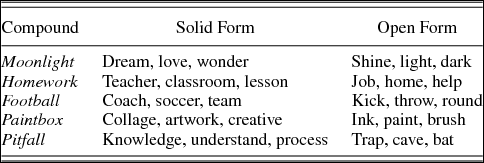
Table 1 reports examples of “nearest neighbors” for different forms of the same compounds. The examples suggest that the different spelling forms are used to express different meaning connotations of the same compound word. When written as open forms, compounds tend to be related to the literal constituent meanings, displaying neighbors that are very close to its constituent lexemes. However, solid realizations have neighbors related to an extended (if not metaphorical) meaning of the compound word, often at an abstract level. This qualitative observation is confirmed by the crowdsourcing study. According to the participants’ intuitions, semantic neighbors are closer to the constituent meanings when extracted from open forms (mean = 2.25, SEM = 0.06) as opposed to solid forms (mean = 2.13, SEM = 0.06). The difference, although small, is significant in the mixed-effects analysis (p = .0006).Footnote 4
Examples from the semantic neighborhoods of the same compounds in the two different forms

Note: The example words are chosen from the top 10 neighbors of each compound form in the described distributional semantic model.
Discussion
In this preliminary experiment we investigated the different meanings associated to open versus solid compound forms. We exploited methods from distributional semantics to extract the semantic neighbors of each form and had them judged by participants in a crowdsourcing study. Participants’ intuitions indicated that vectors associated to open forms populate a semantic area more associated to the meanings of their constituents, as opposed to the vectors associated to solid-form.
This piece of evidence is in line with the results by Kuperman and Bertram (Reference Kuperman and Bertram2013) and Frisson et al. (Reference Frisson, Niswander-Klement and Pollatsek2008) and confirms our assumption regarding spelling alternations: open forms reflect productive, constituent-based combinatorial procedures, as opposed to solid forms reflecting a more lexicalized interpretation of the compound. As a consequence, the semantic relationship between a compound and its constituents can change on the basis of the spelling form considered, leading to quite different predictions in psycholinguistic terms. In the following experiment, we will use this orthographic variability as a proxy for semantic combination to test the consequences of the latter on compound-word processing.
EXPERIMENT 2: SEMANTIC PROCESSING IN THE RECOGNITION OF COMPOUND WORDS
In this experiment we exploit distributionally based measures of ST and orthographic variability in order to investigate the processing of English compound words. We extract distributionally derived semantic measures for open and solid forms of the same compounds. On the basis of the results of the preliminary study, we assume that the distributional semantic similarity between a compound written in solid form and its parts provides an estimate of the relatedness of the compound to its constituents when the compound is used noncompositionally, whereas the same measure for the compound written in open form captures a more compositional usage of the compound itself. These measures were used to predict lexical decision latencies in a regression-design study. If ST effects are purely dependent on the semantic relatedness between a compound and its constituents, and compositionality plays only a limited role, we should find very similar effects on response times for measures associated to open and solid compounds. However, the conceptual-composition hypothesis would predict that semantic similarity will be more reliable as a ST measure when calculated in contexts where the compound is used in an actively compositional way (i.e., open compounds), in comparison with contexts in which the compound is more lexicalized (i.e., solid compounds).
Materials and methods
Two-constituent compounds listed in the CELEX database (Baayen, Piepenbrock, & Gulikers, Reference Baayen, Piepenbrock and Gulikers1995) were selected as the initial pool of stimuli. Those for which lexical decision latencies also were available in the ELP (Balota et al., Reference Balota, Yap, Cortese, Hutchison, Kessler and Loftis2007) were chosen. In order to obtain reliable measures from the DSMs, only those compounds that occur more than 50 times in both open and solid forms in the source corpora were eventually used as experimental stimuli. The final set comprised 1,176 two-constituent compound words. Response times (RTs) in lexical decision from the ELP (Balota et al., Reference Balota, Yap, Cortese, Hutchison, Kessler and Loftis2007) were employed as dependent variable. RTs were logarithmically transformed in order to obtain a more Gaussian-shaped distribution. Note that compounds in the ELP are presented as unique orthographic strings. In other words, we investigated lexical decision latencies for compounds in solid forms. Still, ST predictors were considered for both solid and open forms. Frequencies of both the compounds and their constituents were collected from the CELEX database (Baayen et al., Reference Baayen, Piepenbrock and Gulikers1995). The bias toward concatenated spelling (BiasC), proposed by Kuperman and Bertram (Reference Kuperman and Bertram2013), was also considered. BiasC (the proportion of times the compound is written in solid form) measures the preference for writing the compound as a unique word as opposed to separate constituents, and it was shown to be an important predictor in lexical decision.
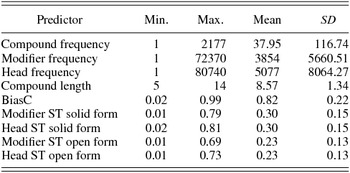
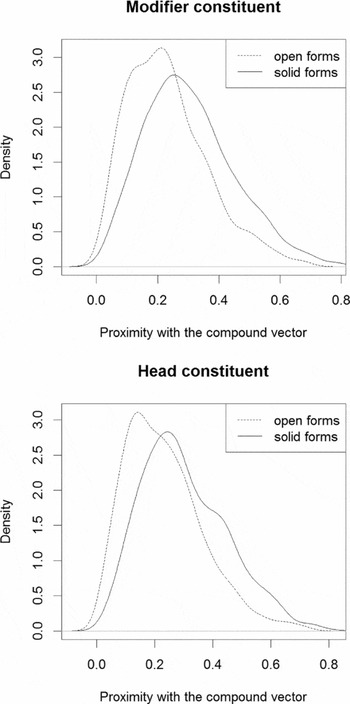
Sentence internal word-to-word co-occurrences were collected following the same procedure described for Experiment 1. The reference corpus was a concatenation of the ukWaC (http://wacky.sslmit.unibo.it/), English Wikipedia (http://en.wikipedia.org/), and BNC (http://www.natcorp.ox.ac.uk/) corpora (about 2.8 billion words total). Constituent meanings were approximated by vectors indicating their frequency of within-sentence co-occurrence with the 10,000 most frequent content words in the corpora. Compound vectors were obtained following the same procedure: separate vectors were collected for contexts related to open and solid compound forms. Raw counts were reweighted using positive pointwise mutual information (Turney & Pantel, Reference Turney and Pantel2010). Two ST measures were obtained: ST relative to the modifier constituent and the head constituent was modeled as the proximity (measured by cosine of angle) between the compound vector and modifier and head vector, respectively. Since in our set of stimuli the very same compounds appeared in both orthographic forms, each compound had different measures for the open and the solid form. Figure 1 reports the density distributions of the ST measures. Table 2 summarizes the distributions of all the considered predictors.
Summary of the independent variables

Note: Frequency measures are extracted from the CELEX database (18.6 million words). BiasC and ST measures were based on a concatenation of the ukWaC, English Wikipedia, and BNC corpora (about 2.8 billion words in total). ST, Semantic transparency; BiasC, bias toward concatenated spelling.
Density distributions of the semantic transparency measures, quantified as the proximities between constituent and compound vectors.

Generalized additive models (Wood, Reference Wood2006) were employed as primary statistical tools. First, the effects of a series of well-studied lexical variables were considered in order to partial out their contributions. Log-transformed frequencies of both the compound and its constituents,Footnote 5 as well as string length (i.e., number of letters), were introduced in the model, and potential interactions (as reported by e.g., Bertram & Hyönä, Reference Bertram and Hyönä2003; Kuperman, Schreuder, Bertram, & Baayen, Reference Kuperman, Schreuder, Bertram and Baayen2009; Marelli & Luzzatti, Reference Marelli and Luzzatti2012) were also tested. BiasC was introduced as an additional covariate. The model was progressively simplified by removing parameters that did not significantly contribute to the model fit; effects were evaluated one by one on the basis of likelihood ratio tests.
Once this lexical baseline was established, we investigated whether the introduction of the ST measures improved the model fit. Effects associated to head and modifier ST were tested along with a dummy variable specifying whether the semantic measure is derived from solid or open forms. Because the correlation between ST measures was relatively high (.51), modifier ST was regressed on head ST, and the latter was replaced by the residuals of the resulting model (Kuperman et al., Reference Kuperman, Schreuder, Bertram and Baayen2009). Once the final model was identified, atypical outliers were removed (employing 2.5 SD of the residual errors as criterion). The model was then refitted to ensure that the results did not depend on these few outliers. Reported results are consistent with those of the refitted model.
Results
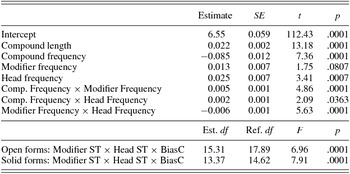
In the analysis dedicated to the lexical variables, significant main effects were found for all the considered predictors. In particular, length led to longer RTs (the longer the compound, the slower the response). Moreover, interactions between frequency measures were also included in the final model, resulting in 36.4% of explained deviance. The introduction of ST measures significantly increased the overall goodness of fit (38.9%, p = .0003). In particular, an interaction between BiasC, head ST, modifier ST, and spelling form was eventually included. Outlier removal further increased model fit to 42.4%.
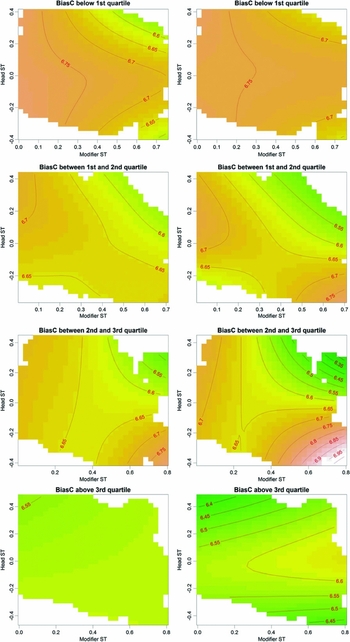
Table 3 summarizes the effects in the final model. ST measures resulted in an interaction best described in nonlinear terms (the introduction of the smoothing term led to significant fit improvement; p = .0001). The modulation of the dummy variable (coding for the orthographic form) was also justified (p = .0034), indicating that the interaction between the ST measures is different between the two forms. These effects were further qualified by an interaction with BiasC (p = .0001). Figure 2 represents the resulting four-way interaction. The heat maps report modifier ST on the x axis, and head ST on the y axis; the dependent variable (log-transformed RTs) is reported on the z axis, with the color variation ranging from red (slower RTs) to green (faster RTs). Contour lines delimit areas with significantly different RT values. As a consequence, the number of contour lines is an index of effect size. Left-hand panels represent the effects for solid forms, right-hand panels represent the effects for open forms. Progressively increasing BiasC levels are represented by different panels in the vertical dimension: the lower the panel, the larger the BiasC values. The top and bottom panels, corresponding to extreme levels of BiasC, indicate that at these levels the interaction between ST measures is minimal. Mostly only a main effect of BiasC can be observed, with fastest RTs for large BiasC (lowest panels) and slowest RTs for small BiasC. In contrast, central panels indicate an interaction between ST measures, as RTs become progressively shorter as long as both ST measures become higher. In other words, RTs are faster when both modifier and head are strongly associated to the compound meaning (upper right corners of the four central panels); however, it is sufficient that either constituent is unrelated to observe slower responses. A further piece of evidence comes from the difference between compound forms. Comparing the right-hand to left-hand panels, it is clear that the effect is much larger when associated with open forms, vis-á-vis solid spelling: ST measures that are collected in contexts presenting open forms predict a boost in RTs for related constituents that is hardly observed when considering solid compounds.
Parameters included in the final model and corresponding significance tests

Note: The bottom part of the table reports the approximate significance of the smoothing terms. ST, Semantic transparency; BiasC, bias toward concatenated spelling.
The interaction between semantic transparency (ST) measures, extracted from (left) solid and (right) open compound forms, and bias toward concatenated spelling (BiasC). Left-hand panels represent the effects for solid forms, and right-hand panels represent the effects for open forms. Progressively increasing BiasC levels are represented by different vertical panels: the lower the panel, the larger the BiasC values. Response times are represented by the color variation on the z axis: longer latencies are represented by red areas (online only), and shorter latencies are represented by green areas (online only).

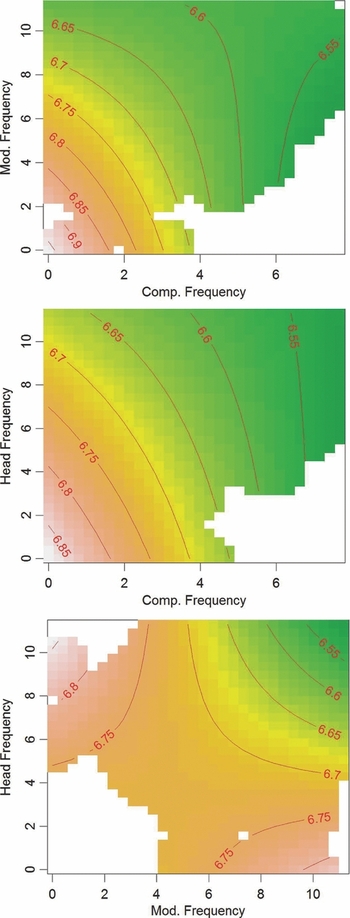
In addition, linear interactions between frequency measures were found (see Figure 3). The lower the frequency of the compound, the larger the effect of constituent frequencies (top and middle panels of Figure 3). In the left portion of these panels (corresponding to lower compound frequency), contour lines bend and become more horizontal: this indicates that the frequency of the constituents helps compound recognition more when the compound frequency is low. The effect is observed for both the modifier and the head constituent, although it is larger for the former. Moreover, constituent frequency measures interact with each other (bottom panel of Figure 3): the shortest RTs are observed when both constituents have very high frequency (upper right corner), and compound recognition is most difficult when either constituent has low frequency, regardless of its position.
Linear effects of the frequency measures: interaction between compound and modifier frequency (top panel), interaction between compound and head frequency (middle panel), interaction between modifier and head frequency (bottom panel). Response times are represented by the color variation on the z axis: longer latencies are represented by red areas and shorter latencies by green areas (online only).

Discussion
In the present study we tested distributionally based ST measures as predictors of RTs in lexical decision (Balota et al., Reference Balota, Yap, Cortese, Hutchison, Kessler and Loftis2007). Different measures were extracted on the basis of the different usage of compounds, capitalizing on the orthographic variability that these constructs show in English (open vs. solid forms). The measures we adopted had significant effects on response latencies and turned out to improve the fitting of a baseline model composed of lexical variables.
The main result of this experiment, however, is that the effects of the ST measures are most often observed when these are based on the open form of the compound, that is, when the co-occurrence vectors refer to contexts in which the compound is written as two separate constituents. On the basis of previously reported evidence and the results emerging from Experiment 1, the orthographic variability of compounds may be thought of as a reflection of compositionality in compound production. We can thus assume that the open form is used in contexts in which the two constituents are actively combined in order to create a new, composed meaning, and the associated effect can be interpreted in terms of conceptual combination: when processing a compound, the reader attempts to combine the constituent meanings and does not only directly access the meaning of the whole word. This interpretation is confirmed by inspecting the interaction between ST measures (central right panels of Figure 2): a boost in compound recognition is observed when both constituents are strongly related to the open-compound meaning, indicating that compound processing is easier when the semantic contribution of both constituents is important. Either constituent being far from the compound meaning suffices to make the processing more difficult. The possibility to integrate both constituents is thus crucial for the semantic processing of compounds, an effect that is difficult to explain with a pure relatedness-based model (for which fly should be helpful in recognizing butterfly, irrespective of the unrelated constituent butter). A combinatorial procedure, on the other hand, would underline the importance of both constituent meanings, in line with the reported interaction between constituent-based ST measures.
The analysis involving ST measures based on solid compounds led to different results. In this case, the interaction between ST predictors has a much smaller (if not negligible) effect size. It seems that this condition is not ideal to describe compound properties associated to semantic combination. This is not surprising; solid forms tend to be used in contexts in which the compound meaning is most crystallized, therefore reflecting situations in which the role of constituents is not crucial (see examples in Table 1). In other words, the semantic properties of the compounds are reflected in the way these are used in context, and the corresponding measures are the most informative when built out of contexts where presumably some conceptual composition took place (i.e., open-form contexts). Note however that compound stimuli are presented in their solid forms in the ELP. The properties associated to the everyday usage of a compound can thus dissociate from its actual form and arguably represent information stored in the mental lexicon. In other words, the properties observed for open forms are associated to the compound representation itself and play a role during processing irrespective of the way the compound is actually presented. (Obviously, how a compound is presented in the experimental setting can still influence the relative importance of the combination procedure; see Juhasz, Inhoff, & Rayner, Reference Juhasz, Inhoff and Rayner2005.)
The routine access to both (open-form and solid-form related) connotations of a compound is also supported by the modulation of BiasC. The interaction between ST measures is evident when both open and solid forms are familiar to the reader (i.e., at midlevels of BiasC, central panels of Figure 2), but it is not found when extreme BiasC levels are considered. Very large BiasC values (i.e., cases where the compound is almost always written as a unique word) are associated to fast RTs and no interplay between constituent ST measures, suggesting that in the processing of these compounds constituent meanings play only a limited role. In contrast, low BiasC values, although also showing limited interactions between ST measures, are associated to very slow RTs, probably due to the interference emerging from presenting a compound that often appears in open form as a unique word. This result is in line with the interpretation in terms of the familiarity of a form over the other, suggested by Kuperman and Bertram (Reference Kuperman and Bertram2013), but it also implies that both forms (and information associated to both forms) are accessed during processing.
In conclusion, the present results support the hypothesis of a routinely combinatorial procedure (Ji et al., Reference Ji, Gagné and Spalding2011; Marelli & Luzzatti, Reference Marelli and Luzzatti2012), even for known compounds presented in concatenated form. As proposed by Marelli and Luzzatti (Reference Marelli and Luzzatti2012), this may be thought of as complementary semantic processing in a multiple route framework (Kuperman et al., Reference Kuperman, Schreuder, Bertram and Baayen2009). The present data fit well with this proposal also when considering the effects of the lexical covariates that we included in the analysis: the reported frequency effects are a direct prediction of the model and reflect trade-offs in the access to the different lexical representations involved. In particular, the interactions between constituent and compound frequency indicate that constituent cues are more involved in processing when the compound is difficult to recognize directly (Kuperman et al., Reference Kuperman, Schreuder, Bertram and Baayen2009), and the interaction between constituent frequencies is typical of lexical decision, when constituents are arguably processed in parallel and the participants’ choice capitalizes on the properties of both (Marelli & Luzzatti, Reference Marelli and Luzzatti2012). In both cases, the phenomena are easily explained by conceiving parallel and interacting routes in compound processing (Kuperman, Bertram, & Baayen, Reference Kuperman, Bertram and Baayen2008), in which different variables are exploited in order to maximize the efficiency of word recognition.
GENERAL DISCUSSION
In this paper we studied semantic effects in compound processing by borrowing methods from computational (distributional) semantics. We measured ST by examining the similarity between co–occurrence vectors representing the compound and its constituents, but different measures were extracted on the basis of the different usages of compounds, capitalizing on their orthographic variability in English (open vs. solid forms). These different orthographic forms were taken as a proxy measure of semantic compositionality. Solid and open forms subtend rather different meaning connotations of the same compounds: open forms reflect a productive, constituent-based combinatorial procedure, whereas solid forms have more lexicalized meanings, associated to the whole compound, often at an abstract level. This assumption was confirmed in Experiment 1, showing that semantic neighbors of the compounds were rated to be closer to constituent meanings when extracted from open forms, as opposed to solid ones. In Experiment 2, the extracted ST measures were tested in a lexical decision task and turned out to improve the fitting of a baseline model of lexical variables. Results indicate that distributionally based ST variables are most predictive of RTs when extracted from contexts presenting the compounds as open forms and suggest that compound processing involves a conceptual combination procedure focusing on the merger of constituent meanings.
DSMs have already been successfully employed in psycholinguistic experiments, but usually they were aimed at predicting off-line measures or, at most, quantifying word association (e.g., to replicate semantic priming effects; Lund, Burgess, & Atchley, Reference Lund, Burgess, Atchley, Moore and Lehman1995). The present study exploits vector space modeling to characterize the internal properties of compound words. Although it represents one of the first steps (see also Kuperman & Bertram, Reference Kuperman and Bertram2013) in applying this interdisciplinary approach to the study of isolated word processing, and its nature is thus exploratory, the results are clear cut: not only the proposed measures are good predictors of the processing time and can be profitably employed in psycholinguistic studies but also the results offer theoretical insights that are consistent with recent perspectives on compound processing.
A central issue of the present manuscript concerned how to best describe the role of constituent meanings in compound processing. Either the contribution of the constituent meanings depends on their semantic similarity to the separate, holistic meaning of the compound or the constituent meanings are combined in an active process to obtain the compositional concept. In previous studies, these conditions have been effectively dissociated by means of experimental manipulations (Ji et al., Reference Ji, Gagné and Spalding2011; Marelli & Luzzatti, Reference Marelli and Luzzatti2012). In the present work, we aimed at replicating these alternative accounts by exploiting corpus-based measures focusing on different orthographic realizations of the same compounds (open vs. solid forms). Under these conditions of natural language usage, characterizing the constituent-contribution issue in strictly binary terms may be misleading: we cannot expect a 100% consistent association between orthographic realizations and semantic processing, and a certain amount of noise in the data is unavoidable. In other words, contexts where the orthographic form is not informative of a specific semantic connotation (compositional vs. lexicalized) are to be expected, as are examples in which the form choice depends on nonsemantic aspects of the compound (Kuperman & Bertram, Reference Kuperman and Bertram2013). The consequent partial overlap between open and solid form variables notwithstanding, measures extracted from either realization still resulted to be informative of semantic processing: open forms generated representations that are perceived to be closer to the constituent meanings (Experiment 1) and ST measures that are better predictors of the constituent roles in compound access (Experiment 2).
The effect of the ST measures indicate that, as far as constituents are concerned, a combinatorial procedure is more apt at characterizing their role in the semantic processing of the compound, and this combinatorial procedure can in turn be captured by looking at contexts in which the compound is produced in its open form. The central role played by compositional processes in accessing a compound meaning is a long-standing proposal in the conceptual-combination literature. Although this research line stems from the study of novel combinations (e.g., Gagné & Shoben, Reference Gagné and Shoben1997), more recent results indicate that also for known, lexicalized compounds a procedure capitalizing on the active combination of constituent meanings is routinely in place (Gagné & Spalding, Reference Gagné, Spalding, Libben and Jarema2006, Reference Gagné and Spalding2009). In line with this view, the results by Ji et al. (Reference Ji, Gagné and Spalding2011) and Marelli and Luzzatti (Reference Marelli and Luzzatti2012) indicate that compound ST and conceptual combination are strongly associated phenomena and that the latter may provide the ideal theoretical framework to characterize the former.
Clearly, the ST measures we employed are meant to test the role of constituent meanings, and the present data cannot be taken as suggesting that a lexicalized holistic meaning is not (also) accessed when reading a compound word. Conversely, the very effect of BiasC (Kuperman & Bertram, Reference Kuperman and Bertram2013) suggests that both a compositional approach (captured by open forms) and the access to the lexicalized compound meaning (captured by solid forms) may take place during processing (although the relevance of either procedure is influenced by the relative familiarity with the orthographic variants). The hypothesis of multiple processing streams suits well the proposal of the multiroute model (Kuperman et al., Reference Kuperman, Schreuder, Bertram and Baayen2009). The principle at the base of this model is that, when processing a complex word, every possible lexical cue is considered in order to maximize the efficiency in accessing the word meaning. A direct access to the lexicalized meaning of the compound and a combinatorial procedure involving the constituent meanings are both potentially useful sources of information regarding the compound semantics and could be interactively at work during compound processing. The access to the holistic meaning is crucial to activate those semantic aspects that are secondary to lexicalization phenomena and cannot thus be computed online on the basis of the constituent meanings. The combinatorial procedure, capitalizing even on partial information regarding the constituents (Marelli & Luzzatti, Reference Marelli and Luzzatti2012), has a very early onset and can thus provide a boost to compound access before information regarding the whole-word is available.
This kind of architecture suits well a distributional approach to semantics. If compound meaning is represented as a distribution across semantic features (Landauer & Dumais, Reference Landauer and Dumais1997) or topics (Griffiths et al., Reference Griffiths, Steyvers and Tenenbaum2007), separate procedures (direct vs. combinatorial) are expected to activate very similar patterns and hence be informative with regards to the same compound representation (at least when both procedures lead to consistent results, that is, in compounds that are reasonably transparent). The computational details of how this should be formalized are still unclear, but we hope that the promising development of compositional DSMs (that derive a distributional meaning for a composite expression from the distributional representations of its parts, e.g., Mitchell & Lapata, Reference Mitchell and Lapata2010; Baroni & Zamparelli, Reference Baroni and Zamparelli2010) will provide tools to pursue this aim.
ACKNOWLEDGMENTS
This research was supported by the ERC 2011 Starting Independent Research Grant 283554 (COMPOSES). We thank Raymond Bertram and two anonymous reviewers for their insightful comments on previous versions of the paper.