Introduction
Hearing impairment and speech impairment are common developmental problems in childhood affecting respectively 1–2% (Darin et al. Reference Darin, Hanner and Thiringer1997; Fortnum et al. Reference Fortnum, Summerfield, Marshall, Davis and Bamford2001) and 7% of the child population (Burden et al. Reference Burden, Stott, Forge and Goodyer1996). Our ability to communicate is essential for healthy social and cognitive development, and therefore early routine screening is important to detect, and provide support for, affected children. The presence of communication difficulties is a risk factor for social isolation and psychiatric disorders both in childhood and in later adult life (van Os et al. Reference van Os, Kenis and Rutten2010) Schizophrenia is a severe mental disorder that affects an individual's ability to communicate and to interact socially. The classic psychotic symptoms of schizophrenia most often manifest in late adolescence or early adulthood, but physical and behavioural abnormalities may present much earlier in childhood (Jones et al. Reference Jones, Rodgers, Murray and Marmot1994; Griffiths et al. Reference Griffiths, Sigmundsson, Takei, Rowe and Murray1998; Bearden et al. Reference Bearden, Rosso, Hollister, Sanchez, Hadley and Cannon2000; Isohanni et al. Reference Isohanni, Jones, Moilanen, Rantakallio, Veijola, Oja, Koiranen, Jokelainen, Croudace and Jarvelin2001) and occur in up to one-third of affected individuals (Jones et al. Reference Jones, Rodgers, Murray and Marmot1994).
Abnormalities of hearing and speech have long been of interest to schizophrenia research. The classical core symptoms of psychosis are auditory hallucinations and speech deviations, whose activation patterns map onto brain areas corresponding to ‘inner speech’ (Shergill et al. Reference Shergill, Brammer, Williams, Murray and McGuire2000a, Reference Shergill, Bullmore, Simmons, Murray and McGuireb). Furthermore, hearing and speech impairment could represent early treatable risk factors. Jones et al. (Reference Jones, Rodgers, Murray and Marmot1994) described a non-significant increase in schizophrenia in children with speech problems (at age 6 years), although findings were based on few exposed cases. Four more recent longitudinal studies have reported inconsistent results (Bearden et al. Reference Bearden, Rosso, Hollister, Sanchez, Hadley and Cannon2000; Isohanni et al. Reference Isohanni, Jones, Moilanen, Rantakallio, Veijola, Oja, Koiranen, Jokelainen, Croudace and Jarvelin2001; Cannon et al. Reference Cannon, Caspi, Moffitt, Harrington, Taylor, Murray and Poulton2002a; Blanchard et al. Reference Blanchard, Jacobson, Clarke, Connor, Kelleher, Garavan, Harley and Cannon2010). However, a register-based study from Denmark reported significant associations between speech impairment at 3–12 years and schizophrenia spectrum disorder (Mouridsen & Hauschild, Reference Mouridsen and Hauschild2008), although they were unable to adjust for important potential confounders such as parental psychical illness, socio-economic status and obstetric complications.
Hearing impairment and psychotic disorders have primarily been investigated in elderly populations (Cooper et al. Reference Cooper, Curry, Kay, Garside and Roth1974; van der Werf et al. Reference van der Werf, van Boxtel, Verhey, Jolles, Thewissen and van Os2007). David et al. (Reference David, Malmberg, Lewis, Brandt and Allebeck1995) examined the association between schizophrenia and hearing impairment detected at conscription (i.e. in early adulthood). To date, no study has examined hearing impairment during childhood and subsequently diagnosed schizophrenia or other non-affective psychosis. There are, however, some studies of psychotic symptoms: Stefanis et al. (Reference Stefanis, Thewissen, Bakoula, van Os and Myin-Germeys2006) reported a statistically significant association between self-reported hearing impairment and the presence of positive ‘psychotic-like experiences’ (self-reported) at age 19. This finding was replicated in a recent study by van der Werf et al. (Reference van der Werf, Thewissen, Dominguez, Lieb, Wittchen and van Os2011), where, in addition, the magnitude of the association with hearing impairment increased with increasing levels of psychotic symptoms. However, follow-up studies indicate that the majority of low-grade psychotic symptoms are benign and transitory and are poor predictors of subsequent psychosis (Werbeloff et al. Reference Werbeloff, Drukker, Dohrenwend, Levav, Yoffe, van Os, Davidson and Weiser2012). In light of this, there is a need to examine how clinically overt psychotic disorders are associated with objectively measured childhood hearing impairment (audiometry).
The present study used data from the Swedish Well Baby Clinic (WBC) journal records, which include clinical information on hearing (audiometry) and speech impairments recorded at routine screening. We were able to use WBC records for a population-based sample of psychosis cases and matched controls identified through Swedish registers. We used these to investigate associations between prospectively ascertained speech and/or hearing impairment in early childhood (age 4) and risk of adult-onset non-affective psychosis, while taking into account important potential confounders such as obstetric complications, parental psychiatric illness and occupational class.
Method
Study population
We conducted a case–control study among individuals born in Sweden 1975–1985. Cases were individuals diagnosed with schizophrenia or other non-affective psychoses in Stockholm County before 1 January 2004, as identified from the Swedish National Patient Register, which contains all in-patient admissions in hospital care since 1987 (National Board of Health and Welfare, 2009), and from the Stockholm Non-Affective Psychoses Study (SNAPS), which includes psychiatric out-patient data from 1997 (Jorgensen et al. Reference Jorgensen, Ahlbom, Allebeck and Dalman2010). Diagnoses were also confirmed through manual searches in hospital and clinic records. The sources of case ascertainment include all public psychosis care in Stockholm County and represent almost all possible cases because very few private facilities existed at that time. The aim was to recruit four matched controls for each case. Because of non-participation, most cases had less than four matched controls, with an average of two cases for each control. Potential controls were obtained from the Medical Birth Register (Axelsson, Reference Axelsson2003) and the National Patient Register so as to exclude those who had been admitted to a psychiatric in-patient clinic (to avoid misclassification of case–control status due to co-morbidity between psychiatric disorders). Controls were thereafter selected randomly and matched by sex, date and place of birth (municipality and hospital) to each case.
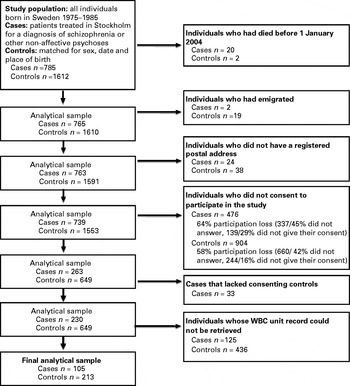
A total of 785 eligible cases and 1610 controls were identified (Fig. 1). Individuals who had died, emigrated or did not have a permanent address were excluded, resulting in 739 cases and 1553 controls being invited to participate in the study.
Derivation of the final analytical sample.

Because individual WBC records were collected, informed consent was required according to Swedish regulations and the ethical committee at the time. Among cases, 337 (45%) did not respond and 139 (19%) refused participation. Correspondingly, 660 (42%) controls did not respond and 244 (16%) refused participation. Among cases, 33 lacked consenting controls and were therefore additionally excluded.
During the study period, WBC journals were archived following the principles of conservation and routine thinning of data. This meant that, until 2003, medical records completed by physicians were preserved. Clinical notes by other health professionals were optionally archived, and could be eliminated 10 years after the last note (Riksarkivet, 1992). In Stockholm, all records were kept for children born in 1978 or 1980 and beyond, but for the years 1974–1977 and 1979 only records for children born on the 5th, 15th or 25th of each month were kept (in Stockholm City Archives). Thus, the final analytical sample comprised 105 and 213 consenting cases and controls, who constituted intact matched case–control sets and for whom WBC unit records could be retrieved.
Exposure variables from the WBC records
WBC
The WBC in Sweden is a free, preventive health-care programme for all preschool children with almost complete coverage (99.8% participation rate in Stockholm County) (Blennow et al. Reference Blennow, Lindfors, Lindstrand and Ekroth de Porcel2009). The programme includes continual recording of growth and developmental milestones, including motor control, visual function, hearing (audiometry), speech and psychosocial performance. Data are recorded systematically by specially trained nurses and doctors according to standardized routines and schedules. If any abnormality is observed, the child is referred to a specialist. For this study, information from the WBC journals was extracted by a nurse blind to outcome.
Hearing impairment
At 4 years of age, all children are tested with pure tone audiometry at the WBC by a child health nurse trained in play audiometry. In play audiometry the child learns to move toys (for example block the holes or rings on a stick) when they hear tone signals from an audiometer. Frequencies of 500, 1000, 2000 and 4000 Hz are tested, where hearing levels of less than 25 dB are considered abnormal for screening purposes (normal hearing being equivalent to 20 dB or better). Children referred to an ear, nose and throat (ENT) specialist or audiologist, as a result of audiometry, were defined as hearing impaired in this study.
Speech impairment
WBC nursing staff record continuous observations of communication ability as part of the psychomotor assessments from birth until the start of school. At age 4, a special examination, focused on the child's general speech development, is performed using a conversation test. In this study any speech delay, poor vocabulary, problems with pronunciation that are age deviant, in addition to mutism and stammering or any referral to a specialist for these problems recorded by the WBC, were defined as speech impairment.
Outcome definition
Cases were individuals diagnosed with non-affective psychosis (ICD-10 F20–29 or ICD-9 295, 297 and 298, excluding 298A). Each individual was assigned just one diagnosis according to a ranking of the included diagnoses. Group 1, schizophrenia: ICD-9 295 A–D, G, W–X and ICD-10 F20; Group 2, schizotypal disorder, persistent delusional disorders, induced delusional disorder, schizo-affective disorders, other non-organic psychotic disorders: ICD-9 295 F and H, 297B–D, W and X, 298 C–E, ICD-10 F21–22, 24–28; Group 3, unspecified non-organic psychosis: ICD-9 298X, ICD-10 F29; Group 4, acute and transient psychotic disorders: ICD-9 298C and E, ICD-10 F23.
Possible confounders
Information on parental psychiatric contact was obtained from WBC records and dichotomized as any or none. Parental occupational class was further retrieved from these records and categorized as manual workers, non-manual employees and others. The group ‘others’ consisted mainly of unknown occupation, self-employed, students or pensioners. Non-manual employees were used as the reference category. Low birthweight (<2500 g), prematurity (gestational age <33 weeks) and Apgar score (<7 at 1 min and/or at 5 min) were collected from birth records filed routinely in the WBC journals.
Statistical methods
Odds ratios (ORs) with 95% confidence intervals (CIs) were calculated using conditional logistic regression. All the analyses were performed in SPSS version 16.0 (www.spss.com).
Results
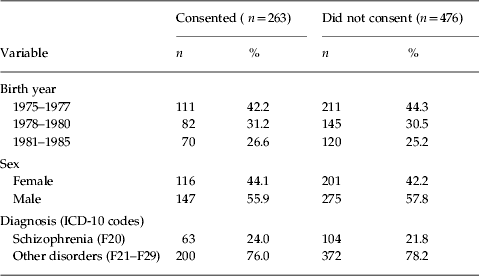
Distributions of sex, age and diagnosis did not differ between cases participating and those not participating in the study (Table 1).
Distributions of eligible cases who consented and did not consent to participate in the study with regard to birth year, sex and diagnosisa

a No significant differences between groups.
At the end of the study period (1 January 2004), the sample population was between 18 and 28 years old, with a mean age of 23.7 years. Of the 105 cases, 55 (52%) were male. Fifty-three (51%) had ICD-10 unspecified non-organic psychoses (F29), 20 (19%) had schizophrenia (F20), 13 (12%) acute and transient psychotic disorder (F23), 12 (11%) schizo-affective disorder (F25), five (5%) persistent delusional disorder (F22) and two (2%) schizotypal disorder (F21). Only two cases lacked ICD-10 diagnoses but had ICD-9 diagnoses, one ICD-9 295E and the other 298X; they were treated as ICD-10 F29 and F23 respectively.
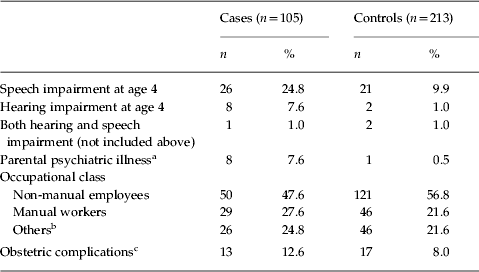
Table 2 shows the distribution of referrals for hearing and speech impairment among cases and controls. Eight cases (7.6%) and two controls (1.0%) were referred as a result of hearing impairment, and 26 cases (25.8%) and 21 controls (9.9%) met criteria for speech impairment. Only three of the 50 children referred for speech impairment had also been referred for hearing impairment.
Descriptive characteristics of cases and controls
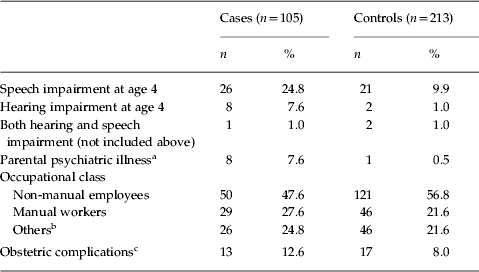
a Parental psychiatric contact or attempted/completed suicide, according to Well Baby Clinic (WBC) records.
b Unknown occupation, self-employed, students or pensioners.
c Birthweight <2500 g, Apgar score <7 (at 1 and/or 5 min) or gestational age <33 weeks.
Parental psychiatric illness, parental occupational class (manual workers and others) and obstetric complications were more common among cases than controls (Table 2), and were therefore all adjusted for in the final models.
Hearing and speech impairment and risk of psychosis
Children with speech impairment at age 4 had a 2.6-fold increased risk (95% CI 1.4–4.9) of developing non-affective psychosis. This association remained essentially unchanged (OR 2.4, 95% CI 1.2–4.8) after adjusting for possible confounders (Table 3).
Odds ratios (ORs) with 95% confidence intervals (CIs) for non-affective psychosis (F20–29) in relation to speech and hearing impairment at age 4

The association between hearing impairment at age 4 and later psychotic illness was even more pronounced, with a greater than sixfold excess risk (OR 6.0, 95% CI 1.6–23.2) among those affected, although the number of exposed cases was small (n = 8). This risk increase was attenuated, but remained statistically significant following adjustment for parental psychiatric history (OR 4.9, 95% CI 1.2–19.4), but not materially changed by further adjustment for occupational class and obstetric complications (OR 4.6, 95% CI 1.1–18.2).
The sample size did not allow for estimation of the risk associated with the double exposure of hearing and speech impairments but the increased risks of psychoses in relation to each impairment remained after exclusion of individuals with both exposures at age 4 (Table 3).
Discussion
Capitalizing on audiometry and speech evaluations prospectively collected in a population dataset, we found that both hearing impairment and speech impairment in early childhood were independently associated with excess risk of later non-affective psychosis.
Previous studies exploring associations between hearing impairment and psychotic illness have only examined deficits in adult or elderly populations (Cooper et al. Reference Cooper, Curry, Kay, Garside and Roth1974; David et al. Reference David, Malmberg, Lewis, Brandt and Allebeck1995; van der Werf et al. Reference van der Werf, van Boxtel, Verhey, Jolles, Thewissen and van Os2007). Our findings suggest that the association between hearing impairment and later psychosis onset already exists by early childhood. Of note, two studies of paranoid psychosis in the elderly and psychotic-like symptoms (Cooper et al. Reference Cooper, Curry, Kay, Garside and Roth1974; Stefanis et al. Reference Stefanis, Thewissen, Bakoula, van Os and Myin-Germeys2006) report that individuals with hearing problems at younger ages have a higher risk of developing psychotic-like symptoms than those who report hearing deficits later in life. As the aetiology of hearing impairment differs at 4 years of age compared to that occurring in adults, the mechanism of any association between hearing impairment and psychosis may also differ with age.
Our results are also consistent with most (Bearden et al. Reference Bearden, Rosso, Hollister, Sanchez, Hadley and Cannon2000; Mouridsen & Hauschild, Reference Mouridsen and Hauschild2008), but not all, of the previous literature examining speech impairment and psychosis risk. Although Jones et al. (Reference Jones, Rodgers, Murray and Marmot1994) reported a higher proportion of cases than controls with speech problems at age 2, the relationship was not statistically significant. Cannon et al. (Reference Cannon, Caspi, Moffitt, Harrington, Taylor, Murray and Poulton2002a) reported that their schizophrenia cases (n = 34, DSM interviewed at age 26) showed abnormalities of receptive, but not expressive, language at ages 3–9. Blanchard et al. (Reference Blanchard, Jacobson, Clarke, Connor, Kelleher, Garavan, Harley and Cannon2010) also reported a significant association between impairments in receptive, but not expressive, language and positive psychotic-like symptoms at ages 11–13. Isohanni et al. (Reference Isohanni, Jones, Moilanen, Rantakallio, Veijola, Oja, Koiranen, Jokelainen, Croudace and Jarvelin2001); however, reported no differences in speech attainment in relation to schizophrenia caseness, although their children were examined at age 1, which may be too early to diagnose speech impairment reliably.
Common causes of sensory impairment and psychoses?
Psychosis originates in early neurodevelopment, and early impairment in hearing or speech may indicate similar developmental mechanisms related to common genetic and environmental influences (Abel, Reference Abel2004). For example, there are several environmental causes of hearing impairment in childhood, such as intrauterine infections (rubella, cytomegalovirus, toxoplasmosis) (McLeod et al. Reference McLeod, Boyer, Karrison, Kasza, Swisher, Roizen, Jalbrzikowski, Remington, Heydemann, Noble, Mets, Holfels, Withers, Latkany and Meier2006; Best, Reference Best2007; Hassan & Connell, Reference Hassan and Connell2007), neonatal and obstetric complications (e.g. hypoxia, hyperbilirubinaemia, very low birthweight) (Bergman et al. Reference Bergman, Hirsch, Fria, Shapiro, Holzman and Painter1985; Roizen, Reference Roizen2003), middle ear infections (Davidson et al. Reference Davidson, Hyde and Alberti1989) and low socio-economic status (Chadha et al. Reference Chadha, Agarwal, Gulati and Garg2006). These are all known risks for psychotic illness (Mason & Winton, Reference Mason and Winton1995; Cannon et al. Reference Cannon, Jones and Murray2002b; Wicks et al. Reference Wicks, Hjern, Gunnell, Lewis and Dalman2005; Mason et al. Reference Mason, Rimmer, Richman, Garg, Johnson and Mottram2008; Abel et al. Reference Abel, Wicks, Susser, Dalman, Pedersen, Mortensen and Webb2010; Arias et al. Reference Arias, Sorlozano, Villegas, Luna, McKenney, Cervilla, Gutierrez and Gutierrez2012) and therefore also may act as potential confounders of any association between hearing impairment and psychosis. In a contemporaneous Swedish study of preschool children (Darin et al. Reference Darin, Hanner and Thiringer1997), the aetiology of hearing loss was reported to be 58% prenatal causes (with heredity in 33%), 7% perinatal causes, 12% postnatal causes and 23% unknown. These findings are consistent with the Finnish study of Vartiainen et al. (Reference Vartiainen, Kemppinen and Karjalainen1997). However, a more recent Swedish conscript study (Augustsson & Engstrand, Reference Augustsson and Engstrand2006) did not provide support for an important role in later hearing impairment for either childhood secretory otitis media or acute otitis media before age 4 (even repeated episodes). In Sweden, a morbilli vaccination programme was introduced in 1971 and a rubella vaccination programme in 1974, followed by the morbilli–parotitis–rubella (MPR) vaccination programme in 1982; cases of hearing impairment induced by rubella or mumps are very rare (Darin et al. Reference Darin, Hanner and Thiringer1997).
Our study also found an association between hearing impairment and parental psychiatric illness (Table 3). Other studies suggest that congenital malformations, including midline facial anomalies, central nervous system (CNS) anomalies and minor physical anomalies, are more common in offspring of mentally ill parents (Bennedsen et al. Reference Bennedsen, Mortensen, Olesen and Henriksen2001; Webb et al. Reference Webb, Pickles, King-Hele, Appleby, Mortensen and Abel2008). We had no information about parental hearing ability, but the association between hearing impairment and parental psychiatric illness may be related to several factors, for example hereditary factors or syndromes that predispose to hearing or speech impairment and psychiatric illness similar to the 22q11 deletion syndrome (Baker & Skuse, Reference Baker and Skuse2005). Intra-uterine exposure to psychotropic drugs (Samren et al. Reference Samren, van Duijn, Koch, Hiilesmaa, Klepel, Bardy, Mannagetta, Deichl, Gaily, Granstrom, Meinardi, Grobbee, Hofman, Janz and Lindhout1997; Bromfield et al. Reference Bromfield, Dworetzky, Wyszynski, Smith, Baldwin and Holmes2008) may also predispose children of mentally ill mothers to congenital malformation (Reis & Kallen, Reference Reis and Kallen2008, Reference Reis and Kallen2010).
Sensory deficits as a cause of psychoses?
The relationship between sensory deficits and psychosis risk may stem from several possible independent and interdependent mechanisms. For example, poor comprehension and restricted contact with others, as a result of hearing or speech impairment, could create problems understanding others' mental state, beliefs, thoughts and intentions – their theory of mind (ToM) – and interfere with the acquisition of mentalizing ability (van Os et al. Reference van Os, Kenis and Rutten2010). Childhood developmental language disorder also seems to involve significant deficits in ToM (Clegg et al. Reference Clegg, Hollis, Mawhood and Rutter2005), and poor social functioning and poor ToM may also be related to an increased risk of psychosis (Clegg et al. Reference Clegg, Hollis, Mawhood and Rutter2005; Gibson et al. Reference Gibson, Penn, Prinstein, Perkins and Belger2010) and underlie associations between hearing impairment and psychoses (Stefanis et al. Reference Stefanis, Thewissen, Bakoula, van Os and Myin-Germeys2006; van Os et al. Reference van Os, Kenis and Rutten2010). Communication problems alone may represent a psychosocial risk (Cooper et al. Reference Cooper, Curry, Kay, Garside and Roth1974; Mortensen et al. Reference Mortensen, Nørgaard-Pedersen, Waltoft, Sørensen, Hougaard, Torrey and Yolken2007; Mouridsen & Hauschild, Reference Mouridsen and Hauschild2008), increasing vulnerability to later illness. Children with sensory deficits are likely to suffer social disadvantages, and as a result they may accrue other experiences known to be psychosis ‘risk generators’. It is now well recognized that children with hearing or speech impairment may be more likely to suffer bullying (Sweeting & West, Reference Sweeting and West2001), and research indicates that childhood bullying may be a dose-related and preventable cause of psychosis-like experiences (Schreier et al. Reference Schreier, Wolke, Thomas, Horwood, Hollis, Gunnell, Lewis, Thompson, Zammit, Duffy, Salvi and Harrison2009; Arseneault et al. Reference Arseneault, Bowes and Shakoor2010). If a sensory deficit can be detected early using a clinically acceptable and cost-effective method, the opportunity for intervention may mitigate possible future risks. In 2007, Sweden introduced hearing screening with transient evoked otoacoustic emission (TEOAE) for all newborns at maternity hospitals, whereas most WBC units still screen preschool children using audiometry. Cheap and effective screening programmes such as this, along with new and developing treatments such as cochlear implants, promise to provide for less hearing impairment in the future.
Strengths and limitations
There are notable strengths to this study. The prospective design circumvents recall bias and reverse causality. Exposures and outcomes were all objective assessments by health professionals, and therefore not as prone to misclassification as self-report. Diagnoses of non-affective psychoses from the Swedish health data register, used for this study, have been shown to be highly valid (Dalman et al. Reference Dalman, Broms, Cullberg and Allebeck2002; Ekholm et al. Reference Ekholm, Ekholm, Adolfsson, Vares, Osby, Sedvall and Jonsson2005). More recently, analysis of psychiatric records showed that 94% of out-patient diagnoses fulfilled ICD-10 criteria for schizophrenia and other psychoses (Jorgensen et al. Reference Jorgensen, Ahlbom, Allebeck and Dalman2010). Finally, the study's population-based design vouches for its external validity and greater relevance for other populations and settings.
There are also important limitations. In particular, the non-participation rate was high (64% for cases and 58% for controls, defined as those refusing consent or not responding). Non-participation was, as expected, higher in cases than controls (χ2 = 8.0, df = 1, p < 0.005). In theory, the likelihood of participation may have differed according to the presence of hearing and/or speech impairment. However, if such differential participation were to inflate our estimates or to be the main explanation of our findings, it would need to apply to controls but not to cases. We deem this unlikely because the prevalence of speech and hearing impairment among controls was similar to what has been observed in the general population. A prevalence of hearing impairment of 1% among controls in this study corresponds well to the 1–2% in a general population of children (Darin et al. Reference Darin, Hanner and Thiringer1997; Fortnum et al. Reference Fortnum, Summerfield, Marshall, Davis and Bamford2001). Similarly, the prevalence of speech impairments of 9.9% of the controls in this study compares to 7% found in a general population of children (Burden et al. Reference Burden, Stott, Forge and Goodyer1996). Among cases, there were no differences between consenters and non-consenters with respect to age, sex or diagnosis (see Table 1), supporting the external validity of our findings. However, the study population was too young (mean age 23.7 years) to cover the entire lifetime risk period for schizophrenia or non-affective psychosis, and therefore our results may not apply to non-affective psychoses with later onset. Young age may also explain why a relatively large number of cases received a diagnosis of unspecified, non-organic psychosis.
The cases and controls were matched for municipality of birth in Stockholm County. All cases had a connection to Stockholm as adults because they had been diagnosed with schizophrenia or other non-affective psychoses in Stockholm County before 1 January 2004, whereas controls were not treated in psychiatric care in Stockholm. Unfortunately, we do not have any data available to explore where participants lived as adults. However, the majority of individuals born in Stockholm County stay on or return to the area (Statistics Sweden, 2012). If the controls tend to move out of Stockholm County to a large extent, they are at risk of being misclassified as controls, when they in fact may have been diagnosed in out-patient care in other counties. This would, however, only attenuate our results. There are also possible effects in other directions. For example, cases may have a longer period of urban living compared to controls. Another aspect is that families with children with hearing and language impairment may be less likely to move out of Stockholm. However, these families may, to a greater extent, move from Stockholm because social support from the community is known to be better outside Stockholm County.
There is an association between several different indicators of socio-economic position in childhood and subsequent psychosis (Wicks et al. Reference Wicks, Hjern, Gunnell, Lewis and Dalman2005). Measures such as parental educational level or household income might have been more appropriate measures of socio-economic status in this context, but data on these characteristics were not available to us. Information on parental psychiatric contact was based on WBC records only, which may have led us to underestimate the prevalence of parental psychiatric disorder. It is likely that the WBC records cover more severe parental psychiatric illness and that missed parental cases are more likely to be less severe. As this information was recorded prospectively, any such misclassification should be similar in cases and controls and therefore not an important source or error. Finally, children with a more general communication problem (not directly related to hearing or speech) who interact with the WBC staff in an unexpected or odd way could be perceived as having speech impairment and this communication problem may in itself constitute a risk factor for later psychotic illness.
Conclusions
These results support the hypothesis that psychoses have a developmental aspect with presentation of antecedent biomarkers early in life, and long before the onset of psychosis. This study adds to the growing body of evidence that early hearing and speech impairment constitute risk indicators for later non-affective psychosis.
Hearing and speech impairment may represent potentially important aetiological clues and potentially modifiable risk factors. A recent report suggests that newborn hearing screening compared to later childhood screening is associated with better gross motor outcomes, better social development and higher quality of life at age 3 to 5 (Korver et al. Reference Korver, Konings, Dekker, Beers, Wever, Frijns and Oudesluys-Murphy2010). Thus, early identification and intervention with hearing- and speech-impaired children may have preventive effects on a wide range of symptoms, in addition to a positive effect on later life outcomes. Routine screening for sensory impairment in young children is relatively inexpensive and may provide a key opportunity for early intervention and prevention.
Acknowledgements
We thank nurse L. Hedenström for extracting information from the WBC journals and K. Henriksson for help with definitions of the exposure.
Declaration of Interest
None.