




No CrossRef data available.
American Democracy in an Age of Rising Inequality
Published online by Cambridge University Press: 01 December 2004
Abstract
The Council of the American Political Science Association approved the appointment of a Task Force on Inequality and American Democracy in the fall of 2002. A fifteen-member task force was convened in January 2003 and collectively worked during the subsequent eighteen months to prepare extensive reviews of research on inequality and American democracy. (The research reviews are available on the APSA Web site—as are materials for undergraduate and graduate teaching—http://www.apsanet.org/inequality.) Based on three reviews, the task force prepared a short report, which forms the basis of the present text. It concludes that progress toward realizing American ideals of democracy may have stalled—and in some arenas reversed. The task force's work was extensively and rigorously debated among its members, scrutinized by three distinguished independent peers, and reviewed by the APSA Council. This report is ultimately the responsibility of its authors; no opinions, statements of fact, or conclusions should be attributed to the American Political Science Association or to the Russell Sage Foundation, which provided some support to the task force. The members of the task force are: Lawrence Jacobs (Chair, University of Minnesota), Ben Barber (University of Maryland), Larry Bartels (Princeton University), Michael Dawson (Harvard University), Morris Fiorina (Stanford University), Jacob Hacker (Yale University), Rodney Hero (Notre Dame University), Hugh Heclo (George Mason University), Claire Jean Kim (University of California, Irvine), Suzanne Mettler (Syracuse University), Benjamin Page (Northwestern University), Dianne Pinderhughes (University of Illinois, Champagne–Urbana), Kay Lehman Schlozman (Boston College), Theda Skocpol (Harvard University), and Sidney Verba (Harvard University).
Information
- Type
- APSA TASK FORCE REPORT
- Information
- Copyright
- © 2004 American Political Science Association
Task Force on Inequality and American Democracy
Equal political voice and democratically responsive government are cherished American ideals. Indeed, the United States is vigorously promoting democracy abroad. Yet, what is happening to democracy at home? Our country's ideals of equal citizenship and responsive government may be under growing threat in an era of persistent and rising inequalities. Disparities of income, wealth, and access to opportunity are growing more sharply in the United States than in many other nations, and gaps between races and ethnic groups persist. Progress toward realizing American ideals of democracy may have stalled, and in some arenas reversed.
We have reached this conclusion as members of the Task Force on Inequality and American Democracy formed under the auspices of the 14,000-member American Political Science Association (APSA). As one of several task forces formed to enhance the public relevance of political science, ours was charged to review and assess the best current scholarship about the health and functioning of U.S. democracy in a time of rising inequality. We have surveyed the evidence about three interlinked areas of concern and their consequences: citizen participation, government responsiveness, and patterns of public-policy making. We have done our work as experts, paying close attention to data and evidence in all of their ambiguity.1
In addition to the sources specifically cited in this report, we rely upon evidence and citations in three broad reviews of the social science research prepared by our task force, focusing respectively on “Inequalities of Political Voice,” “Inequality and American Governance,” and “Inequality and Public Policy.” See http://www.apsanet.org/inequality.
Generations of Americans have worked to equalize citizen voice across lines of income, race, and gender. Today, however, the voices of American citizens are raised and heard unequally. The privileged participate more than others and are increasingly well organized to press their demands on government. Public officials, in turn, are much more responsive to the privileged than to average citizens and the least affluent. Citizens with low or moderate incomes speak with a whisper that is lost on the ears of inattentive government, while the advantaged roar with a clarity and consistency that policy makers readily heed. The scourge of overt discrimination against African Americans and women has been replaced by a more subtle but still potent threat—the growing concentration of the country's wealth and income in the hands of the few.
Equal rights, rising economic inequality, and American democracy
American society has become both more and less egalitarian in recent decades. Following the civil rights revolution of the 1950s and 1960s, racial segregation and exclusion were no longer legally or socially acceptable. Whites and African Americans began to participate together in schools and colleges, the job market, and political and civic organizations. Gender barriers have also been breached since the 1960s, with women now able to pursue most of the same economic and political opportunities as men. Many other previously marginalized groups have also gained rights to full participation in American institutions and have begun to demand—and to varying degrees enjoy—the dignity of equal citizenship.2
But as U.S. society has become more integrated across barriers of race, ethnicity, gender, and other longstanding forms of social exclusion, it has simultaneously suffered growing gaps of income and wealth. Gaps have grown not just between the poor and the rest of society, but also between privileged professionals, managers, and business owners on the one hand, and the middle strata of regular white- and blue-collar employees on the other hand. Many middle-class families are just barely staying afloat with two parents working.3
And many African Americans, Latinos, and women who head families find themselves losing ground. There are signs of increased segregation by, for example, income and race in public schools.4 Meanwhile, the rich and the super-rich have become much more so—especially since the mid-1970s. Indeed, the richest 1 percent of Americans has pulled away from not only the poor but also the middle class.Rising economic inequality has been documented by extensive research, using diverse methodologies, which has analyzed authoritative government and nongovernment data.5
Data on economic inequality has been collected from authoritative sources including the U.S. government (e.g., U.S. Bureau of the Census, U.S. Bureau of Labor Statistics, U.S. Bureau of Economic Analysis, and U.S. Internal Revenue Service) and the Luxembourg Income Study. Information on the distribution of income and other economic rewards in the United States can be found in Mishel, Bernstein, and Boushey 2003. Evidence that compares income and wealth distributions in the United States and other advanced industrial democracies can be found in the Luxembourg Income Study (http://www.lisproject.org).
The next few paragraphs are based on Mishel, Bernstein, and Boushey 2003, 52–57, 86–94, 277–307, and table 1.8.
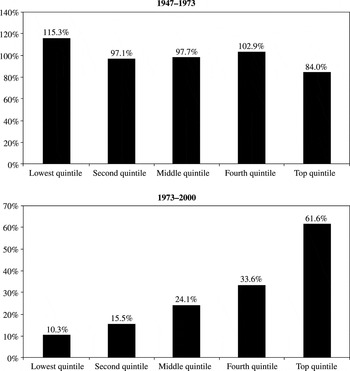
The highest earners, of course, have always enjoyed a disproportionate hold over income. The top quintile has enjoyed more than 40 percent of income in the United States since 1947. What stands out over the past three decades is the sharp and unmistakable increase in the concentration of income at the top. Figure 1, which is based on U.S. census data, presents the rate of growth in average income broken down by fifths for two historical periods—the quarter century after the Second World War (1947–73) and the subsequent quarter century (1973–2000). In the immediate postwar period, income growth was steady and comparable across the income distribution: each fifth saw its income double or nearly double. In addition, the lowest fifth experienced somewhat faster income growth.

Growth in family income
The pattern of income growth changed significantly, however, in the last quarter century. Members of the top fifth saw their income increase by 61.6 percent, much faster than any other part of the income distribution. Indeed, the top 5 percent grew even faster—87.5 percent. The bottom fifth experienced the lowest rate of income growth in the same period (10.3 percent). Even the middle income groups grew at half or less the rate of the most affluent. As a result, from 1973 to 2000, income increased 51 percent faster in the top fifth than the bottom fifth, while nearly the opposite had occurred during the previous quarter century—income increased 31 percent more slowly in the top fifth compared to the bottom fifth from 1947 to 1973.

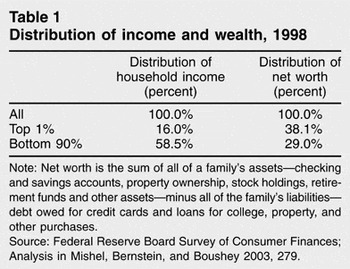
Even as the distribution of income has moved rapidly to the top, the most affluent have attained a larger slice of the country's wealth (as defined by stock holdings, mutual funds, retirement savings, ownership of property, and other assets). Table 1 is based on the Federal Reserve Board's 1998 Survey of Consumer Finances and shows the distribution of household income and net worth (i.e., total family assets minus liabilities, such as mortgages and other forms of debt). The top 1 percent of households drew 16.6 percent of all income but commanded more than double this proportion of the country's wealth (38.1 percent). By contrast, the supermajority of the country—the bottom 90 percent of households—earned the majority of household income (58.8 percent) but controlled only 29 percent of the country's wealth.7
Although the Federal Reserve's Survey was conducted near the stock market's peak (1999), the value of the stock market remained at or near record levels even after its sharp decline (1999 to 2001), with the wealthiest households enjoying much of the gain.
Distribution of income and wealth, 1998

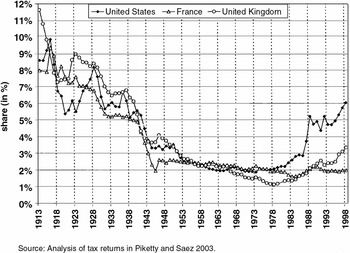
Disparities in wealth and income have increased faster in the United States than in Canada, France, Germany, Italy, and nearly all other advanced industrial democracies. Many kinds of statistics could be cited to document this state. Figure 2 compares income trends for American families with those of British and French families. The proportion of income accruing to the top one-tenth of a percent of families ran along parallel tracks for much of the twentieth century. All three countries reduced inequality from the end of World War I until the 1960s. But the United States, from the mid-1970s on, rapidly diverged from its two allies in this respect. By 1998 the share of income accruing to the very rich was two or three times higher in the United States than in Britain and France.

Top 0.1 percent income shares in the United States, France, and the United Kingdom, 1913–98
Disparities are particularly striking when it comes to race. Since the civil rights era, the absolute levels of income and wealth enjoyed by African Americans and Hispanics have risen, but income and especially wealth remain far behind levels for white America. Living conditions, too, remain tenuous for the black middle class and continue to lag far behind. And, of course, the quality of life for African Americans below the middle class is even more precarious.
The absolute economic circumstances of minorities have improved. The civil rights movement and the challenges to overt discrimination made important contributions to these improvements. Nonetheless, gaps remain. The median white household earned 62 percent more income and possessed twelve times more wealth than the median black household; nearly two-thirds of black households (61 percent) and half of Hispanic households have no net worth, while only a quarter of white Americans are in this predicament. Even young, married, black couples in which both adults work—the shining beacons of progress toward racial equality—still earn 20 percent less income than their white counterparts and possess a staggering 80 percent less net worth. (These figures are based on an all-too-infrequent survey and analysis of income and wealth among African Americans from 1987 to 1989, though the results are confirmed by recent analysis of more contemporary data, including some from 1999.)8
The survey shows that the median income for white households during that period was $25,384 as compared with $15,630 for their black counterparts; the net financial assets of whites amounted to $43,800, compared with $3,700 for blacks. Among two-earner young couples (25 to 35 years old), white couples enjoyed a median income of $36,435 and a median net worth of $23,165, compared with an income of $29,377 for black couples and a net worth of $4,124. Oliver and Shapiro 1997, 86–90, 96–103. Shapiro 2004 provides additional data on this subject, including 1999 data: see 47–56 for a discussion of race and wealth, 60–64 for analysis of parental wealth, and 70–72 for data on inheritance.
Economic inequalities in the United States result from a variety of causes—including developments in technology, transformations in family life, and market forces that promote global integration.9
Burtless 1999; Freeman 1994; Freeman and Katz 1994; Smeeding 2002; Gottschalk and Smeeding 1997; Danziger and Weinberg 1994.
Rigorous cross-national studies are available at http://www.lisproject.org. Our research review, “Inequality and Policy,” discusses evidence regarding the distributional consequences of overall government policy and individual policies.
How concerned should we be about persistent and rising socioeconomic inequalities? According to opinion surveys, Americans accept considerable disparities of income and wealth—much more than their European counterparts do.11
Unequal economic outcomes are seen as largely reflecting differences among individuals rather than flaws in the economic system. Americans support private property and free enterprise, and see much of the skewed distribution of wealth and income as a legitimate result of differences in individual talent and effort.Americans accept economic inequalities only when they are sure that everyone has an equal chance to get ahead. Research shows that upward mobility remains an avenue of advancement for some Americans. But the number of Americans who are able to enjoy the fruits of upward mobility does not come close to offsetting the rise in economic disparities among the many.12
The evidence demonstrates that economic opportunity and upward mobility are declining, challenging a core precept of the American dream.Even more clearly, Americans celebrate and expect equal democratic rights. Americans fervently believe that everyone should have an equal say in our democratic politics and what government does. They embrace the ideal enunciated by the Declaration of Independence that “all men are created equal,” which in our time is taken to mean that every citizen—regardless of income, gender, race, and ethnicity—should have an equal voice in representative government.
According to the National Elections Studies (NES) and other evidence, Americans are increasingly worried about disparities of participation, voice, and government responsiveness.13
Unless otherwise noted, the data cited in this paragraph are from NES; see also Nye, Zelikow, and King 1997, especially the chapters by Gary Orren, “Fall from Grace: The Public's Loss of Faith in Government,” and Robert J. Blendon, John M. Benson, Richard Morin, Drew E. Altman, Mollyann Brodie, Marios Brossard, and Matt James, “Changing Attitudes in America.”
The 1995 survey is discussed in Blendon et al., forthcoming; the 2000 poll was conducted by International Communications Research.
The evidence our task force has compiled suggests that our fellow citizens are right to be concerned about the health of our democracy. We find disturbing inequalities in the political voice expressed through elections and other avenues of participation. We find that our governing institutions are much more responsive to the privileged than to other Americans. And we find that the policies fashioned by our government today may be doing less than celebrated programs of the past to promote equal opportunity and security, and to enhance citizen dignity and participation. Indeed, trends in all three areas—citizen voice, government decision making, and public policy—may together be amplifying the influence of the few and promoting government unresponsiveness to the values and needs of the many. Such a negative spiral can, in turn, prompt Americans to become increasingly discouraged about the effectiveness of democratic governance, spreading cynicism and withdrawal from elections and other arenas of public life.
Unequal Voices
Only some Americans fully exercise their rights as citizens, and they usually come from the more advantaged segments of society. Those who enjoy higher incomes, more occupational success, and the highest levels of formal education are the ones most likely to participate in politics and make their needs and values known to government officials.
Our review of research on inequality and political participation as well as other components of American political life demonstrates an extraordinary association between economic and political inequality. The more daunting challenge is to define precisely the relationships between the two. At this point, there is no consistent evidence of simple paths from rising economic inequality to political and policy developments. There is, however, ample research suggesting complex interrelationships between increased economic inequality and changes in American institutions, political behavior, and public policy. As we suggest below, there is an urgent need for research that analyzes these interconnections.
The half of Americans who vote
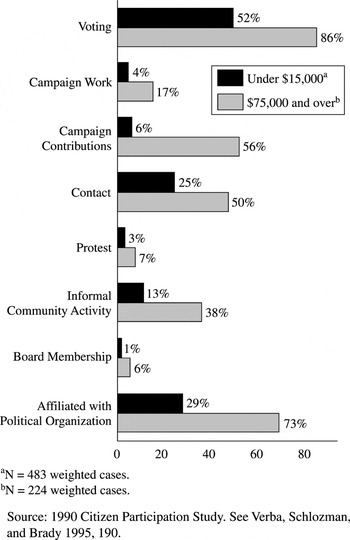
Voting is the most obvious means for Americans to exercise their rights of citizenship, yet only a third of eligible voters participate in midterm congressional elections and only about half turn out for today's presidential elections. Even voters in presidential elections tend to be from the ranks of the most advantaged Americans. Figure 3, based on a national survey of Americans in 1990, compares the political activity of two income groups (each of which constituted roughly one-fifth of the sample)—those having family incomes below $15,000 and those at the top of the income ladder, with family incomes over $75,000. Nearly 9 out of 10 individuals in families with incomes over $75,000 reported voting in presidential elections while only half of those in families with incomes under $15,000 reported voting. (This pattern of stratification has also been documented in a variety of analyses, including those based on census data and validated votes.)15

Percentage active in various political activities: High- and low-income groups
We should be surprised that the turnout of eligible voters is so low and uneven in the United States at the beginning of the twenty-first century. Turnout declined in the 1960s and has not rebounded since, even though African Americans in the South were brought into the electorate through the Voting Rights Act of 1965, and even though voting has been simplified through a number of legal reforms—from easing residency requirements to making it easier to register and acquire an absentee ballot. Educational levels have also increased, and education cultivates skills and values that encourage voting. If increasing numbers of Americans had not received more education in recent times, the decline in voting might have been even sharper.
Although electoral participation ticks up somewhat when contests are closely fought and parties make extra efforts to mobilize voters, a number of ongoing trends discourage voting and reinforce inequalities in voter turnout. Rising economic inequality may discourage less privileged voters.16
And part of the decline in voting since the early 1970s results from laws in many states that forbid former (as well as current) prisoners from voting, sometimes for their entire lives. Millions of Americans, especially minority men, have been excluded from basic participation in our democracy by such laws.17 The selective outreach of the Democratic and Republican parties contributes to the stratification of voting, as we discuss below.In sum, less advantaged Americans vote less because they lack the skills, motivation, and networks that the better-advantaged acquire through formal education and occupational advancement.
Beyond voting
Low and unequal voting is sobering in part because casting a ballot is America's most widespread form of political participation. Many fewer than half of the Americans who vote in presidential elections take part in more time-consuming and costly political activities, such as making financial contributions to candidates, working in electoral campaigns, contacting public officials, getting involved in organizations that take political stands, and demonstrating for or against political causes.
Campaign contributors are the least representative group of citizens. Only 12 percent of American households had incomes over $100,000 in 2000, but a whopping 95 percent of the donors who made substantial contributions were in these most affluent households.18
Figure 3 shows that 56 percent of those with incomes of at least $75,000 reported making some form of campaign contribution, compared with a mere 6 percent among Americans with incomes under $15,000. Contributing money to politicians is a form of citizen activity that is, in practical terms, reserved for a select group of Americans. As wealth and income have become more concentrated and the flow of money into elections has grown, campaign contributions give the affluent a means to express their choices that is unavailable to most citizens, thus further aggravating inequalities of political voice.Exercising the rights of citizenship requires resources and skills, which privileged occupations disproportionately bestow on the economically well-off. Managers, lawyers, doctors, and other professionals enjoy not only higher education and salaries, but also greater confidence and skills to speak and organize than do individuals who sweep floors, clean bedpans, or collect garbage. These disparities in resources and skills are evident in a host of political activities, as shown in figure 3.
- Nearly three-quarters of the well-off are affiliated with an organization that takes political stands (like the AARP or advocacy groups) as compared with only 29 percent of the least affluent.
- Half of the affluent contact public officials, as compared with only 25 percent of those with low incomes.
- Thirty-eight percent of the well-off participate in informal efforts to solve community problems, compared with only 13 percent of those in the lowest income groups.
- Even protesting, which might appear to demand little in the way of skills or money and is often thought of as “the weapon of the weak,” is more prevalent among the affluent. Seven percent of the better-off protest to promote such causes as abortion rights or environmentalism, compared with 3 percent among the poor.
Some argue that the Internet will be a democratizing force because it heralds a new frontier of virtual participation and new forms of citizen-to-citizen communication. The Internet, however, appears to be reinforcing existing inequalities because it is disproportionately accessible to—and used by—the affluent, non-Hispanic whites, and the highly educated.19
Using the Internet to participate in politics generally entails knowing in advance that one wants political information, or that one wants to enter a discussion or to make a monetary contribution. People who are ambivalent about politics or not already involved may not be drawn in simply by the availability of the Internet. In short, the Internet may “activate the active” and widen the disparities between participants and the politically disengaged.Interest groups for the well-off dominate Washington
Citizens express preferences not just by individual acts, but also through the organized groups they support. Today there are many more voluntary associations and interest-group organizations than in the past. In the 2001 Washington Representatives—a publication identifying individuals, firms, and organizations registered as lobbyists—organizations that begin with the word “American” alone numbered more than 600.20
Over the past four decades, Americans have organized a broader array of interest groups than ever before. Among these are watchdogs for the previously unorganized—for example, poor children, gays, and the disabled. Many new groups have also formed to expand the representation of consumers, women, environmentalists, and African Americans and ethnic minorities. All of this organizing amounts to an enrichment and enlargement of U.S. democracy.21
But even as the number of organizations speaking for underrepresented interests and preferences has grown, corporate managers and professionals have also increased their sway for a number of reasons.First, since the 1970s, the proportion of the work force that is unionized fell by about half to 12.9 percent, due to the decline of unionization in the private sector (where only 8.2 percent are currently unionized).22
Blue-collar trade unions have experienced an especially sharp decline. A larger and growing proportion of higher-educated Americans belong to professional societies, compared with those with less education, who belong to trade unions.23Skocpol 2003, fig. 5.20.
Ibid.; Skocpol 2004.
In short, the number of interest groups has grown, and they have become more diverse; many formerly marginalized Americans have gained some voice in public debates. Yet the dominance of the advantaged has solidified, and their capacities to speak loudly and clearly to government officials have been enhanced.
Contemporary political parties exacerbate inequalities
Most interest groups are the instrument of the few who want to press for particular benefits. Political parties, on the other hand, are the vehicle for reaching and mobilizing the broad public. Indeed, the United States invented political parties in the nineteenth century in order to mobilize ordinary citizens and succeeded in ushering in a far higher proportion of eligible voters to the polls than go today. The problem today is that this mechanism for a broad and inclusive democracy caters to some of the same narrow segments of American society that also disproportionately deploy interest groups on their behalf. Advantage begets additional advantage.
Both of the major political parties intensify the skewed participation in U.S. politics by targeting many of their resources on recruiting those who are already the most privileged and involved.26
Democrats and Republicans alike have become highly dependent on campaign contributors and activists and have become accustomed to competing for just over half of a shrinking universe of voters. What is more, political parties ignore parts of the electorate that have not turned out at high rates in past elections; the major parties have both become less likely to personally contact large numbers of less privileged and less active citizens—even though research tells us that personal contact is important in encouraging citizens to vote.27 Table 2, based on a national survey in 1990, shows that in terms of average family income individuals who identify with and regularly vote for the Democratic Party are substantially less affluent than their Republican counterparts. Just as striking, however, both parties seek campaign workers and campaign contributors among their more affluent adherents.Party mobilization for political activity: Who is asked?

The uneven playing field
Disparities in participation mean that the concerns of lower- or moderate-income Americans, racial and ethnic minorities, and legal immigrants are systematically less likely to be heard by government officials. In contrast, the interests and preferences of the better-off are conveyed with clarity, consistency, and forcefulness.
Unequal political voice matters because the advantaged convey very different messages to government officials than do the rest of the citizenry. For example, Americans who participate in politics are much less likely than many of their fellow citizens to have known the necessity of having to work extra hours to get by. The privileged are unlikely to have delayed medical treatment for economic reasons or cut back on their spending for food or their children's education. Those Americans who would be most likely to raise issues about basic opportunities and needs—from escaping poverty to securing jobs, education, health care, and housing—tend to be the least likely to participate in politics. The less advantaged are so absent from discussions in Washington that government officials are likely to hear about their concerns, if at all, from privileged advocates who try to speak for them.28
Political voice is also unequal because Americans who are very active in politics often have more intense or extreme views than average citizens. They tend, for instance, to identify themselves as far more conservative or liberal. The most loyal partisans and fringe activists have become more prominent in U.S. politics in recent times with the erosion of such mass mobilizing organizations as voluntary associations and unions, a development that may have significant consequences for American governance. The intense and unrelenting expressions of “extremists” (combined with the proliferation of interest groups speaking for specialized constituencies) make it harder for government to work out compromises or to respond to average citizens, who may have more middle-of-the-road opinions about a range of important matters, from abortion to tax cuts.29
How Government Responds
Generations of reformers have understood a simple truth: What government officials hear influences what they do. What citizens do or don't do in politics affects what happens in the halls of government. Because government officials today hear more clearly and more often from privileged and highly active citizens, policy makers are less likely to respond readily to the concerns of the majority. The skew in political participation toward the advantaged increases the probability of policies that tilt toward maintaining the status quo and continue to reward the organized and already well-off.
Money buys attention
Today politicians are not usually directly bribed by political contributors or moneyed interests. Research does not support the idea that specific votes in Congress are directly determined by campaign contributions.30
Ansolabehere, de Figueiredo, and Snyder 2003a; Ansolabehere, de Figueiredo, and Snyder 2003b; Wright 1985; and Wright 1990.
Money is the oxygen of today's elections, given the reliance of candidates on high-priced consultants and expensive media advertisements.31
Big contributors have the power to discourage or perhaps suffocate unfriendly candidates by denying them early or consistent funding. After the election, moreover, government officials need information to do their jobs, and research shows that big contributors earn the privilege of meeting regularly with policy makers in their offices. Money buys the opportunity to present self-serving information or raise some problems for attention rather than others.Generous contributors also attend countless rounds of fund-raisers. They build relationships with government officials who can undertake helpful, low-profile actions—inserting a rider into an omnibus bill, expediting the scheduling of a bill that has been languishing in committee, or making sure that threatening regulatory legislation receives minimal funding for implementation. Equally important, legislators can decide to pay more attention to the kinds of concerns that big contributors press forward, such as requests for a narrowly targeted subsidy, tax cut, or regulatory exemption, than to problems of broader democratic import.
Congress favors the organized
Recent changes in how Congress designs legislation reinforce and expand the advantages of the organized. Government money to fund projects—from building highways and waterways to constructing buildings—has long been allocated to well-organized and vocal groups with connections inside Washington. A century ago, the reforms of the Progressive Era aimed to end machine politics that doled out government funds, or “pork,” in exchange for votes and campaign contributions. Civil service exams, government oversight, and a more watchful press put a stop to the crudest forms of corruption. But the best-organized still feast on discretionary government spending because members of Congress remain convinced that pork produces votes and campaign contributors.
New developments within Congress have more finely targeted government largess to narrow factions. As the two parties have polarized into increasingly warring tribes, the majority party in Congress has funneled greater proportions of defense contracts, transportation funding, appropriation earmarks for higher-education institutions, and other programs to the districts of fellow partisans. Members of Congress have further directed government funds coming into their districts to specific geographic areas that vote at higher rates and provide their greatest support.32
Balla et al. 2002; Carsey and Rundquist 1999; Lee 2000; Levitt and Snyder 1995; Levitt and Snyder 1997.
Party controls over the redrawing of the districts from which members of state legislatures and the House of Representatives are elected are also making government less responsive to average citizens. In an age of advanced information technology, it is possible for party strategists working through state legislatures to pick, in essence, the precise set of voters who will send members to state legislatures and Congress. Redistricting is happening more often now than every 10 years after the census. Artificial districts with very peculiar boundaries are becoming the norm, creating seats safe from electoral competition for Democrats and Republicans alike.33
Legislators are picking voters, rather than the other way around. This situation furthers partisan polarization in our legislatures and makes representatives less responsive to large numbers of Americans with middle-of-the-road views. Economic inequality did not cause these political developments but it has interacted with institutional and organizational changes in ways that augment the influence of the affluent and better-organized.Who gets the policies they want?
Skewed participation among citizens and the targeting of government resources to partisans and the well-organized ensure that government officials disproportionately respond to business, the wealthy, and the organized when they design America's domestic and foreign policies.34
Jacobs and Shapiro 2000. Erikson, MacKuen, and Stimson (2002) offer an alternative interpretation. Our research review, “Inequality and American Governance,” discusses this alternative account, noting, in part, that the empirical analysis of the full political system in Erikson, MacKuen, and Stimson is not inconsistent with the account offered here.
Recent research strikingly documents that the votes of U.S. senators are far more influenced by the policy preferences of each senator's rich constituents than by the preferences of the senator's less privileged constituents.35
In particular, income-weighted preferences were much more influential than simple averages of state opinion, especially for Republican senators. Constituents at the 75th percentile of the income distribution had almost three times as much influence as those at the 25th percentile on their senators' general voting patterns, and even more disproportional influence on specific salient roll call votes on the minimum wage, civil rights, government spending, and abortion. The preferences of constituents in the bottom fifth of the income distribution had little or no effect on their senators' votes.The bias in government responsiveness toward the affluent is evident not only in Congress but also in national government policy more generally. Government officials who design policy changes are more than twice as responsive to the preferences of the rich as to the preferences of the least affluent.36
A 10 percentage point increase in support for policy change among the best-off (i.e., those in the 90th percentile of the income distribution) was associated with a 4.8 percentage point increase in the likelihood of a corresponding policy change; the preferences of the poorest (i.e., individuals in the 10th percentile of the income distribution) produced only a 2 percentage point increase in the likelihood of a corresponding policy shift (Gilens 2003).
Business and other elites also exert far more influence than the general public on U.S. foreign policy, which not only guides the country's diplomatic and defense affairs but also affects domestic economic conditions through decisions on trade and the protection and promotion of American jobs and businesses.37
Jacobs and Page, forthcoming.
Even the recent rise of “public interest” citizen associations has not significantly corrected the bias of the system toward the more privileged. Professionally run advocacy groups, such as environmental or consumer groups, have developed the capacity to go head-to-head with business groups in gaining publicity in the national media and shaping agendas of congressional debate. This means that concerns important to many Americans can receive a strong hearing in the national media and in Washington, DC. But research also shows that, as professional advocacy groups speaking for broad public concerns have gained influence, they have become less likely to champion bread-and-butter issues of less privileged Americans.38
Missed Opportunities for Democratic Government
What government does not do is just as important as what it does.39
This point is developed in Hacker 2004.
These broadly inclusive government programs have also encouraged ordinary citizens to become more active participants in our democracy. The United States pioneered schooling for all and has spent as much as or more than many advanced industrialized countries on it since the 1800s. Promotion of education has helped to open the door to opportunity for students who work hard, to propel the country's economy, and to lower economic disparities. It has also boosted participation in volunteer organizations and democratic life. The GI Bill extended generous assistance to attend universities, community colleges, and vocational schools for millions of veterans of World War II and the Korean War.40
Since the 1970s, federal programs like Pell Grants and state initiatives have allowed millions of lower- and middle-income students to pursue post-secondary schooling.Similarly, Social Security, which provides protection against low income in retirement to employees who contribute to the system, has helped to foster an extraordinary level of participation by the elderly in the electoral process and civic life. Social Security has encouraged participation by low- and moderate-income seniors, which means that the elderly are less subject to the skew in favor of the affluent and better-educated that generally characterizes political participation in the United States.41
America can boast, then, of a distinguished track record of government programs that have not only enhanced opportunity and security for the many, but also promoted democracy by expanding political voice.
But what are the equivalents of such broadly responsive programs today? The educational and training benefits for America's all-volunteer military are modest compared with those in the original GI Bill and, consequently, they have been less effective in boosting the schooling of veterans to the level of nonveterans.42
Moreover, rising tuition, the declining value of individual Pell Grants, and state budget cuts have made higher education less affordable to nonveterans at a time when its economic value has risen and its contribution to counteracting the bias in political participation is invaluable.43While Social Security protects and engages seniors, few government programs ensure opportunity and security and encourage political engagement for Americans who are not elderly. This situation reinforces the preoccupation of political leaders with improving the programs of the aged rather than assisting young and old alike. The fact that nonelderly Americans are less engaged in politics than the elderly makes it less likely that our government will adequately address the many challenges faced by working-age adults and their children—access to affordable health care, paying for higher education, and finding ways to care for family members when parents must work full-time. Judging from public opinion surveys, large majorities of Americans would like our government to find ways to support citizens of all ages as they face old and new challenges. Our government, however, is too often failing to respond.
New barriers to equal citizenship
One of the great stories of the past century in the United States has been the reduction of overt discrimination that once excluded millions of Americans from the core of political, economic, and social life. Women gained the right to vote and the right to run for office alongside men. Popular struggles by African Americans culminated in the Civil Rights Act of 1964, which outlawed racial discrimination in public accommodations, prohibited federal funding of educational institutions if they discriminated, and forbade racial and gender discrimination by employers and unions. Another landmark was the Voting Rights Act of 1965, which cleared the way for all African Americans to vote.
America's extension of basic citizenship rights expanded the political participation of minorities and women and improved their living conditions. Public opinion toward African Americans and other minorities experienced a remarkable shift: while only 45 percent of Americans agreed in 1944 that “Negroes should have as good a chance as white people to get any kind of job,” a near-unanimous 97 percent espoused this view only three decades later.44
Indicators point to real improvements in the lowly economic circumstances of minorities. African American men have moved into the highest-income categories at an impressive rate over the last few decades; and the number of women in managerial and professional jobs rose impressively, as did their wages.45 On the political front, the gap in voter turnout between African Americans and whites has narrowed.Yet the historic accomplishments of the 1960s “rights revolution” may now be jeopardized by continuing economic and political inequalities. The sustained reduction of overt discrimination has been countered by inconsistent improvements in income equality since the early 1970s, which are undermining the trend toward greater economic progress and political inclusion of many African Americans, Latinos, and women, even as they also threaten equal opportunity and citizenship for many white men. The country and, especially, African Americans have been particularly influenced by the increasing concentration of wealth after 1980 and slower income growth since the 1970s. During the 1980s, the wage gap between African Americans and whites returned to levels last seen in the 1950s.46
There were significant economic improvements in the 1990s. Minorities saw their absolute economic positions get better. The progress of the 1990s did not, however, close the income gap between whites and other racial and ethnic groups.47
It will be essential therefore to monitor the nation's economic conditions carefully. At stake is continued economic progress for many minorities, who remain disproportionately unemployed or in lower-wage jobs. The story of minorities since 1970 is complex but ultimately sobering: the economic circumstances of racial and ethnic minorities have improved in absolute terms, even as many members of minorities have fallen further behind white America.As the relative economic conditions for many in the ranks of America's minorities have stagnated, improvements in minority participation and political influence have also faced challenges. The political playing field remains highly unequal, and the immediate gains of the rights revolution have not yielded sustained equalization of political voice. Four decades after the rights revolution, racial and gender inequalities continue to hamper educational attainment, employment prospects, income, and other factors critical to the distribution of the skills and resources that generate political participation. Some believe that the constraints caused by economic disparities have been exacerbated by waning support for affirmative action and other efforts to narrow racial and gender gaps.48
When less advantaged Americans experience stagnating economic fortunes and continuing disparities in political voice, the promise of greater equality for minorities is compromised.Renewing American Democracy and the Tradition of Political Science
Our work as a task force continues a long and distinguished tradition in political science of combining rigorous scholarship with a commitment toward safeguarding and invigorating democratic life. For more than a century, prominent scholars of political science as well as the profession's organized entity, the American Political Science Association, have repeatedly returned to the unique position of political science as the scholarly discipline most closely engaged with studying actual politics and government policy. Political science scholarship offers a credible check on the claims of ideologues, vested interests, and commentators. The independence from the powerful that can be afforded by universities and research organizations gives our scholarly communities unique credibility and a vantage point to analyze political power and its exercise. Writing in the cauldron of the Cold War and McCarthyism during the early 1950s, David Easton observed:
Entrenched power groups in society, those who have a firm hold on a particular pattern of distribution of social goods, material and spiritual, have a special reason to look askance at … probing into the nature and source of their social positions and activities. History has yet to show us empowered groups who welcomed investigation into the roots and distribution of their strength. Such knowledge is at least discomforting, if not inherently dangerous; the underlying myth concerning the location of power is seldom borne out by the facts.49
Easton 1953, 50–51.
The first generation of political scientists rejected what Arthur Bentley described as the “soul stuff” in favor of accurately analyzing—in the face of entrenched machine politics and patronage—the true dynamics of democratic participation, the economic and social constraints on political life, and the operations of government.50
Woodrow Wilson, who served as president of the American Political Science Association before being elected president of the United States in 1912, conducted a searching analysis of the failure of congressional and constitutional processes to respond to the challenges imposed by the industrial revolution in ways that restored government responsiveness and forestalled an erosion of citizen trust in democratic government.51 A little later, Pendleton Herring, president of the association and a prominent foundation leader in funding social science research, produced a series of seminal scholarly books from the late 1920s into the 1940s that pinpointed the flaws in American democracy and helped to refocus attention from corruption in political parties to analysis of the invaluable contributions they can make to the functioning of a democratic system.52 In profiling the functional services of parties to democracy against the backdrop of persistent criticism, Herring helped to build a tradition of research that later positioned E. E. Schattschneider and his legendary 1950 APSA task force to hold up political parties, warts and all, as the democratic antidote to the programmatic biases of an interest group system that favored the already advantaged.53The engagement of political science with improving American democracy through scholarship was an important motivation behind the professional shift toward emulating the physical sciences by using quantitative methods to study political behavior. V. O. Key, a pioneer of behavioralism, conducted a series of path-breaking studies of political parties, voting, and public opinion out of a deep concern that economic and racial biases in American democracy were hobbling its potential and legitimacy.54
David Easton, who introduced the concept of the “political system” and was closely associated with the rise of positivism in the discipline, was similarly motivated by a commitment to promote open democratic self-governance and popular sovereignty.55Easton, quoted in Bang 1998.
Easton 1953, 41, 121; Easton's dissertation quoted in Bang 1998.
Easton 1965, 121.
We share the conviction of our predecessors that rigorous scholarly research is a tool for supporting and invigorating democratic participation and governance, especially in an era of polarization among American political elites and party activists. We need more research, and we need new avenues of research on American democracy.
Three clusters of research questions deserve particular attention in a new generation of critical studies of democratic politics and policy. First, we need to know more about the interactions of economic and social conditions with American politics. Research on political participation has been a welcome area of persistent research on enduring levels of income stratification. Yet, we know little about the connections between changing economic inequality and changes in political behavior, governing institutions, and public policy. As noted above, there is little evidence of a direct effect of rising economic inequality on widening political disparities, but we need to confirm or challenge this impression with more analysis of the complex political associations with rising inequality.
Any serious effort to evaluate inequality and American politics requires sustained professional commitment to collecting data on the living conditions, attitudes, and political behavior and experiences of minorities, women, and less affluent Americans. The best studies of stratification often must rely on surveys that are dated; in considering the economic inequality of African Americans, we had to rely on analysis of a survey that is nearly two decades old. Many areas of research related to political voice, governance, and policy lack critically important data.
Second, the fragmentation of political science scholarship into fields, subfields, and still more subdivisions—often pursuing separate empirical and theoretical agendas—has atrophied research on the linkages among the components of American politics and the cumulative effects of the dynamic and reciprocal connections among these components. The result is a small inventory of research on the two-way flows between economic and social inequalities, governance, and policy. Put simply, we know a lot about discrete fragments of American politics, but astonishingly little about the interrelationships of these elements and their cumulative effects on American democracy.
There have been notable successes in studying cross-field interrelationships. An important body of our work focused on contemporary research on “policy feedbacks”—that is, research tracing the ways in which public policies affect subsequent patterns of political participation and government activity.58
Hacker 2002; Mettler 2002; Pierson 1993; Skocpol 1992; Mettler and Soss 2004. Part of this research has examined how American politics and policy feedbacks and influence the longevity and illness of Americans. Morone and Jacobs 2004.
Bartels 1991; Bartels 2002; Bartels 2003; Page and Shapiro 1983; Erikson, Wright, and McIver 1993; Erikson, MacKuen, and Stimson 2002; Jacobs 1993; Jacobs and Shapiro 1994; Jacobs and Shapiro 2000; Druckman, Jacobs, and Ostermeier, forthcoming; Jacobs and Page, forthcoming; Manza, Cook, and Page 2002.
We need to expand these promising areas of research. One strategy for making progress is to encourage cross-field collaboration among scholars with different areas of expertise. This strategy might be encouraged by recalibrating our criteria for reviewing manuscripts and colleagues to give positive weight to scholarly contributions that cross disciplines and political science subfields.
Third, there is a vital need for continued research on whether and to what extent growing economic inequality and its interactions with political developments may put at risk our system of democratic participation and governance. Our predecessors urged our profession never to become complacent in expecting the stability and continuation of our democratic form of participation and governance in the face of continuous and at times radical economic and social changes.
The Declaration of Independence promised that all American citizens would enjoy equal political rights. Nearly every generation has returned to this promise and struggled to elevate the performance of American democracy to its high ideals. The promise of American democracy is threatened again. The threat is less overt than the barriers of law or social custom conquered by earlier generations. Today, the risk is that rising economic inequality will solidify longstanding disparities in political voice and influence, and perhaps exacerbate such disparities. Our government is becoming less democratic, responsive mainly to the privileged and not a powerful instrument to correct disadvantages and look out for the majority. If disparities of participation and influence become further entrenched—and if average citizens give up on democratic government—unequal citizenship could take on a life of its own, weakening American democracy for a long time to come.
References
REFERENCES
American Political Science Association, Committee on Political
Parties.
1950.
Toward a more responsible two-party system.
American Political Science Review
44 (3),
supplement.Google Scholar
Ansolabehere, Stephen,
John M. de Figueiredo, and
James M. Snyder.
2003a.
Why is there so little money in U.S. politics?
Working Paper 9409.
Cambridge, MA:
National Bureau of Economic Research.
Ansolabehere, Stephen,
John M. de Figueiredo, and
James M. Snyder
2003b.
Why is there so little money in U.S. politics?
Journal of Economic Perspectives
17 (1):
105–30.Google Scholar
Balla, Steven,
Eric Lawrence,
Forrest Maltzman, and
Lee Sigelman.
2002.
Partisanship, blame avoidance, and the distribution of legislative
pork.
American Journal of Political Science
46 (3):
515–25.Google Scholar
Bang, Henrik.
1998.
David Easton's postmodern images.
Political Theory
26 (3):
281–316.Google Scholar
Bartels, Larry M.
1991.
Constituency opinion and congressional policy making: The Reagan
defense buildup.
American Political Science Review
85 (2):
457–74.Google Scholar
Bartels, Larry M.
2002.
Economic inequality and political representation.
Paper presented at the 2002 Annual Meeting of the American Political
Science Association, Boston.
http://www.princeton.edu/∼bartels/papers.
Bartels, Larry M.
2003.
Partisan politics and the U.S. income distribution.
Paper presented at the Russell Sage Foundation Conference on the
Social Dimensions of Inequality, Washington, DC,.
Bentley, Arthur.
1908.
The process of government: A study of social pressures.
Chicago:
University of Chicago Press.
Berry, Jeffrey M.
1999.
The new liberalism: The rising power of citizen groups.
Washington, DC:
Brookings Institution Press.
Blendon, Robert J.,
John M. Benson,
Richard Morin,
Drew E. Altman,
Mollyann Brodie, and
Marios Brossard.
Forthcoming.
Changing attitudes in America. In
Why Americans mistrust government, eds.
Joseph Nye,
Philip Zelikow, and
David King.
Cambridge:
Harvard University Press.
Burtless, Gary.
1999.
Growing American inequality: Sources and remedies. In
Setting the national priorities: The 2000 election and beyond, ed.
Henry Aaron and
Robert Reischauer,
137–65.
Washington, DC:
Brookings Institution.
Campaign Finance Institute Task Force on Presidential Nomination
Financing.
2003.
Participation, competition, and engagement: How to revive and
improve public funding for presidential nomination politics.
Washington, DC:
Campaign Finance Institute.
Campbell, Andrea Louise.
2003.
How policies make citizens: Senior political activism and the American
welfare state.
Princeton:
Princeton University Press.
Carsey, Thomas, and
Barry Rundquist.
1999.
Party and committee in distributive politics: Evidence from defense
spending.
Journal of Politics
61 (4):
1156–69.Google Scholar
Cohen, Jere,
Rebecca Warner, and
David Segal.
1995.
Military service and educational attainment in the all-volunteer
force.
Social Science Quarterly
76 (1):
88–104.Google Scholar
Danziger, Sheldon, and
Daniel Weinberg.
1994.
The historical record: Trends in family income, inequality, and
poverty. In
Confronting poverty: Prescriptions for change, ed.
by Sheldon Danziger,
Gary Sandefur, and
Daniel Weinberg,
18–50.
Cambridge:
Harvard University Press.
Druckman, James N.,
Lawrence R. Jacobs, and
Eric Ostermeier.
Forthcoming.
Candidate strategies to prime issues and image.
Journal of Politics.
Easton, David.
1947.
The theory of the elite.
PhD diss.,
Harvard University.
Easton, David
1953.
The political system.
New York:
Alfred Knopf.
Easton, David
1965.
A framework for political analysis.
Englewood Cliffs, NJ:
Prentice Hall.
Erikson, Robert S.,
Michael B. MacKuen, and
James A. Stimson.
2002.
The macro polity.
New York:
Cambridge University Press.
Erikson, Robert S.,
Gerald C. Wright, and
John P. McIver.
1993.
Statehouse democracy: Public opinion and policy in the American
states.
New York City:
Cambridge University Press.
Fiorina, Morris P.
1999.
Extreme voices: A dark side of civic engagement. In
Civic engagement in American democracy, ed.
Theda Skocpol and
Morris P. Fiorina,
396–425.
Washington, DC, and New York:
Brookings Institution Press and Russell Sage Foundation.
Ford, Lynne E.
2002.
Women and politics: The pursuit of equality.
New York:
Houghton Mifflin.
Francis, Mark,
Valerie S. Sheridan,
Natacha Leonard, and
Diane R. Murphy, eds.
2001.
Washington representatives 2001.
Washington, DC:
Columbia Books.
Frankenberg, Erica,
Chumgmei Lee, and
Gary Orfield.
2002.
A multiracial society with segregated schools: Are we losing the
dream?
Cambridge, MA:
Harvard Civil Rights Project.
Freeman, Richard.
2004.
What, me vote? In
Social inequality, ed.
Kathryn Neckerman,
703–28.
New York:
Russell Sage Foundation.
Freeman, Richard, ed.
1994.
Working under different rules.
New York:
Russell Sage Foundation.
Freeman, Richard, and
Lawrence Katz.
1994.
Rising wage inequality: The United States vs. other advanced
countries. In
Working under different rules, ed.
Richard Freeman,
29–62.
New York:
Russell Sage Foundation.
Gerber, Alan S., and
Donald P. Green.
2000.
The effects of canvassing, telephone calls, and direct mail on
voter turnout: A field experiment.
American Political Science Review
94 (3):
653–63.Google Scholar
Gilens, Martin.
2003.
Public opinion and Democratic responsiveness: Who gets what they
want from government?
Paper presented at the Inequality and American Democracy
Conference, Princeton, NJ, November 7–8.
http://www.princeton.edu/∼csdp/events/pdfs/Gilens.pdf.
Gopoian, J. David.
1984.
What makes PACs tick? An analysis of the allocation patterns of
economic interest groups.
American Journal of Political Science
28 (2):
259–81.Google Scholar
Gottschalk, Peter.
1997.
Inequality, income growth, and mobility: The basic facts.
Journal of Economic Perspectives
11 (2):
21–40.Google Scholar
Gottschalk, Peter, and
Timothy Smeeding.
1997.
Cross-national comparisons of earnings and income inequality.
Journal of Economic Literature
35 (2):
633–87.Google Scholar
Hacker, Jacob S.
2002.
The divided welfare state: The battle over public and private social
benefits in the United States.
New York:
Cambridge University Press.
Hacker, Jacob S.
2004.
Privatizing risk without privatizing the welfare state: The hidden
politics of social policy retrenchment in the United States.
American Political Science Review
98 (2):
243–60.Google Scholar
Hall, Richard L., and
Frank W. Wayman.
1990.
Buying time: Moneyed interests and the mobilization of bias in
congressional committees.
American Political Science Review
84 (3):
797–820.Google Scholar
Herring, Pendleton.
1940.
The politics of democracy: American parties in action.
New York:
Rinehard.
Hochschild, Jennifer.
1995.
Facing up to the American dream: Race, class, and the soul of the
nation.
Princeton:
Princeton University Press.
Jacobs, Lawrence R.
1993.
The health of nations: Public opinion and the making of health
policy in the U.S. and Britain.
Ithaca:
Cornell University Press.
Jacobs, Lawrence R., and
Robert Y. Shapiro.
1994.
Issues, candidate image and priming: The use of private polls in
Kennedy's 1960 presidential campaign.
American Political Science Review
88 (3):
527–40.Google Scholar
Jacobs, Lawrence R., and
Robert Y. Shapiro
2000.
Politicians don't pander: Political manipulation and the loss of
democratic responsiveness.
Chicago:
University of Chicago Press.
Jacobs, Lawrence R., and
Benjamin Page.
Forthcoming.
Who influences U.S. foreign policy over time?
American Political Science Review.
Key, V. O.
1949.
Southern politics in state and nation.
New York:
Alfred A. Knopf.
Key, V. O.
1961.
Public opinion and American democracy.
New York:
Alfred A. Knopf.
Klinkner, Philip, and
Rogers Smith.
1999.
The unsteady march: The rise and decline of racial equality in
America.
Chicago:
University of Chicago Press.
Kroszner, Randall S., and
Thomas Stratmann.
1998.
Interest group competition and the organization of Congress: Theory
and evidence from financial services political action committees.
American Economic Review
88 (5):
1163–87.Google Scholar
Langbein, Laura.
1986.
Money and access: Some empirical evidence.
Journal of Politics
48 (4):
1052–62.Google Scholar
Lee, Frances.
2000.
Senate representation and coalition building in distributive
politics.
American Political Science Review
94 (1):
59–72.Google Scholar
Leighley, Jan E., and
Jonathan Nagler.
1992a.
Individual and systemic influences on turnout: Who votes?
Journal of Politics
54 (3):
718–40.Google Scholar
Leighley, Jan E., and
Jonathan Nagler
1992b.
Socioeconomic class bias in turnout, 1964–1988: The voters
remain the same.
American Political Science Review
86 (3):
725–36.Google Scholar
Levitt, Steven, and
James Snyder.
1995.
Political parties and the distribution of federal outlays.
American Journal of Political Science
39 (4):
958–80.Google Scholar
Levitt, Steven, and
James Snyder
1997.
The impact of federal spending on House election outcomes.
Journal of Political Economy
105 (1):
30–53.Google Scholar
Lyons, Michael, and
Peter F. Galderisi.
1995.
Incumbency, reapportionment, and U.S. House redistricting.
Political Research Quarterly
48 (4):
857–71.Google Scholar
Manza, Jeff,
Fay Lomax Cook, and
Benjamin Page, eds.
2002.
Navigating public opinion: Polls, policy, and the future of
American democracy.
New York:
Oxford University Press.
Manza, Jeff, and
Christopher Uggen.
2004.
Punishment and democracy: Disenfranchisement of nonincarcerated
felons in the United States.
Perspectives on Politics
2 (3):
491–505.Google Scholar
Mettler, Suzanne.
2002.
Bringing the state back in to civic engagement: Policy feedback
effects of the G.I. Bill for World War II veterans.
American Political Science Review
96 (2):
351–65.Google Scholar
Mettler, Suzanne, and
Joe Soss.
2004.
The consequences of public policy for democratic citizenship:
Bridging policy studies and mass politics.
Perspectives on Politics
2 (1):
55–73.Google Scholar
Michaels, Walter Benn.
2004.
Diversity's false solace.
New York Times Magazine, 11 April.
Mishel, Lawrence,
Jared Bernstein, and
Heather Boushey.
2003.
The state of working America, 2002/2003.
Ithaca:
Cornell University Press.
Morone, James A., and
Lawrence R. Jacobs, eds.
2004.
Healthy, wealthy, and fair: Health care and the good society.
New York:
Oxford University Press.
National Center for Public Policy, and Higher Education.
2002.
Losing ground: A national status report on the affordability of
American higher education.
San Jose, CA.
http://www.highereducation.org/reports/losing_ground/ar.shtml.
National Telecommunications, and Information
Administration.
1998.
Falling through the Net II: New data on the digital divide.
http://www.ntia.doc.gov/ntiahome/net2/falling.html.
Norris, Pippa.
2001.
Digital divide: Civic information, information poverty, and the
Internet worldwide.
Cambridge:
Cambridge University Press.
Nye, Joseph S., Jr.,
Philip D. Zelikow, and
David C. King, eds.
1997.
Why people don't trust government.
Cambridge:
Harvard University Press.
Oliver, Melvin, and
Thomas Shapiro.
1997.
Black wealth/white wealth: A new perspective on racial
inequality.
New York:
Routledge.
Orfield, Gary,
Susan E. Eaton, and
the Harvard Project on School Desegregation.
1996.
Dismantling desegregation: The quiet reversal of Brown v. Board of
Education.
New York:
W. W. Norton.
Page, Benjamin I., and
Robert Y. Shapiro.
1983.
Effects of public opinion on policy.
American Political Science Review
77 (1):
175–90.Google Scholar
Page, Benjamin I., and
Robert Y. Shapiro
1992.
The rational public: Fifty years of trends in Americans'
policy preferences.
Chicago:
University of Chicago Press.
Piketty, Thomas, and
Emmanuel Saez.
2003.
Income inequality in the United States, 1913–1998.
Quarterly Journal of Economics
118 (February):
1–39.Google Scholar
Pierson, Paul.
1993.
When effect becomes cause: Policy feedback and political change.
World Politics
45 (4):
595–628.Google Scholar
Rosenstone, Steven J., and
John Mark Hansen.
1993.
Mobilization, participation, and democracy in America.
New York:
Macmillan.
Schattschneider, E. E.
1960.
The semi-sovereign people.
New York:
Holt, Rinehart, and Winston.
Schier, Steven E.
2000.
By invitation only: The rise of exclusive politics in the United
States.
Pittsburgh, PA:
University of Pittsburgh Press.
Schlozman, Kay Lehman, and
John T. Tierney.
1986.
Organized interests and American democracy.
New York:
Harper and Row.
Schlozman, Kay Lehman,
Sidney Verba, and
Henry E. Brady.
1999.
Civic participation and the equality problem. In
Civic engagement in American politics, ed.
Theda Skocpol and
Morris P. Fiorina,
427–60.
Washington, DC:
Brookings Institution; New York: Russell Sage Foundation.
Shapiro, Thomas M.
2004.
The hidden cost of being African American: How wealth perpetuates
inequality.
New York:
Oxford University Press.
Skocpol, Theda.
1992.
Protecting soldiers and mothers: The political origins of social policy
in the United States.
Cambridge:
Belknap Press of Harvard University Press.
Skocpol, Theda
2003.
Diminished democracy: From membership to management in American civic
life.
Norman:
University of Oklahoma Press.
Skocpol, Theda
2004.
Voice and inequality: The transformation of American civic
democracy.
Perspectives on Politics
2 (1):
1–18.Google Scholar
Skrentny, John D.
2002.
The minority rights revolution.
Cambridge:
Belknap Press of Harvard University Press.
Smeeding, Timothy M.
2002.
Globalization, Inequality, and the Rich Countries of the G-20: Evidence
from the Luxembourg Income Study.
Luxembourg Income Study Working Paper No.320. July 2002.
Smeeding, Timothy M.
2004.
Public policy and economic inequality: The United States in comparative
perspective.
Paper prepared for Campbell Institute Seminar, Inequality and
American Democracy, February 20.
http://www.maxwell.syr.edu/campbell/Events/Smeeding.pdf.
Swain, John W.,
Stephen A. Borrelli, and
Brian C. Reed.
1998.
Partisan consequences of the post-1990 redistricting for the U.S. House
of Representatives.
Political Research Quarterly
51 (December):
945–67.Google Scholar
Thernstrom, Stephan, and
Abigail Thernstrom.
1997.
America in black and white: One nation, indivisible.
New York:
Simon and Schuster.
Traugott, Michael W., and
John P. Katosh.
1979.
Response validity in surveys of voting behavior.
Public Opinion Quarterly
43 (3):
359–77.Google Scholar
Uggen, Christopher, and
Jeff Manza.
2002.
Democratic contraction? Political consequences of felon
disenfranchisement in the United States.
American Sociological Review
67 (6):
777–803.Google Scholar
U.S. Bureau of the Census.
2003.
Statistical abstract of the United States.
http://www.census.gov/statab/.
Verba, Sidney,
Kay Lehman Schlozman, and
Henry E. Brady.
1995.
Voice and equality: Civic voluntarism in American politics.
Cambridge:
Harvard University Press.
Weakliem, David L.,
Robert Andersen, and
Anthony F. Heath.
2003.
The directing power? A comparative study of public opinion and income
distribution.
Storrs, CT:
Department of Sociology, University of Connecticut.
Welch, Finis.
2002.
Half full or half empty? The changing economic status of African
Americans, 1967–1996. In
Beyond the color line: New perspectives on race and ethnicity in
America, ed.
Abigail Thernstrom and
Stephan Thernstrom,
181–200.
Stanford:
Hoover Institution Press.
Wilson, Woodrow.
1885.
Congressional Government.
Boston:
Houghton Mifflin.
Wilson, Woodrow
1908.
Constitutional government in the United States.
New York:
Columbia University Press.
Wilson, Woodrow
1952.
Leaders of men.
Princeton:
Princeton University Press.
Wright, John R.
1985.
PACs, contributions, and roll calls: An organizational perspective.
American Political Science Review
79 (2):
400–14.Google Scholar
Wright, John R.
1990.
Contributions, lobbying, and committee voting in the U.S. House of
Representatives.
American Political Science Review
84 (2):
417–38.Google Scholar
Growth in family income
Distribution of income and wealth, 1998
Top 0.1 percent income shares in the United States, France, and the United Kingdom, 1913–98
Percentage active in various political activities: High- and low-income groups
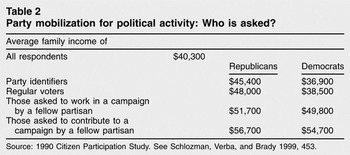
Party mobilization for political activity: Who is asked?
 You have
Access
- 123
- Cited by