INTRODUCTION
Over the past 12 years, molecular analyses of avian haemosporidia (Plasmodium and Haemoproteus, phylum Apicomplexa) based, primarily, on cytochrome b sequences, has revealed a rich genetic diversity which was not apparent morphologically (Bensch et al. Reference Bensch, Stjernman, Hasselquist, Östman, Hansson, Westerdahl and Pinheiro2000; Ricklefs and Fallon, Reference Ricklefs and Fallon2002; Bensch et al. Reference Bensch, Pérez-Tris, Waldenström and Hellgren2004; Latta and Ricklefs, Reference Latta and Ricklefs2010). It is likely that as many species of avian haemosporidia exist as there are host species (Ricklefs and Fallon, Reference Ricklefs and Fallon2002; Bensch et al. Reference Bensch, Pérez-Tris, Waldenström and Hellgren2004). In addition, molecular studies of avian haemosporidian assemblages have changed the view that these organisms are usually host specialists (Ricklefs and Fallon, Reference Ricklefs and Fallon2002; Ricklefs et al. Reference Ricklefs, Fallon and Bermingham2004, Reference Ricklefs, Swanson, Fallon, Martinez-Abrain, Scheuerlein, Gray and Latta2005; Fallon et al. Reference Fallon, Bermingham and Ricklefs2005; Hellgren et al. Reference Hellgren, Pérez-Tris and Bensch2009). On the contrary, many lineages of Plasmodium and Haemoproteus exhibit considerable host breadth.
In addition to this host breadth, avian haemosporidia vary widely in the frequency with which they are encountered by, and/or their compatibility with, individuals from different bird species. The parasite prevalence (proportion of infected individuals in a host population) can range among host species from 0 to 100%, and the ecological and evolutionary basis for this variation is not yet well understood. If we consider host species as different resources for haemosporidians, behavioural, reproductive, and life-history characteristics of host species could promote differential exposure and resistance to these parasites. For instance, some studies have shown that nesting height of host species in the forest stratum is positively associated with blood parasite prevalence (Bennett and Fallis, Reference Bennett and Fallis1960; Garvin and Remsen, Reference Garvin and Remsen1997; Fecchio et al. Reference Fecchio, Lima, Silveira, Braga and Marini2011). According to Bennett and Fallis (Reference Bennett and Fallis1960), blood parasite vectors are more abundant in the forest canopy. Thus species that build their nests higher in the forest stratum are more exposed to these vectors, and consequently should be more frequently infected by blood parasites. If differential exposure to vectors is indeed an important determinant of haemosporidian prevalence in birds, then other predictions can be made: (1) migratory species should be more parasitized than resident species, because they are exposed to 2 or more vector and parasite faunas during their annual cycle (Waldenström et al. Reference Waldenström, Bensch, Kiboi, Hasselquist and Ottoson2002); (2) species that build closed nests or nest in cavities should be less parasitized than open nesting species, because closed and cavity nests can act as a barrier/protection against blood sucking insects (Read, Reference Read1991; Fecchio et al. Reference Fecchio, Lima, Silveira, Braga and Marini2011); (3) we expect that social bird species will be more parasitized than non-social bird species since sociality promotes parasite transmission (Alexander, Reference Alexander1974); and (4) larger birds should be more parasitized because they present larger surface areas for attack by blood-sucking insects (Scheuerlein and Ricklefs, Reference Scheuerlein and Ricklefs2004) and emit more CO2, which is the main volatile compound used by blood parasite vectors to locate hosts (Lehane, Reference Lehane2005).
Host resistance is also an important factor associated with haemosporidian prevalence, as is evident in the frequently high virulence of novel parasites introduced to naïve host populations, a case in point being Plasmodium relictum in the native Hawaiian avifauna (Atkinson et al. Reference Atkinson, Dusek, Woods and Iko2000). For instance, one would expect bird species at a higher risk of infection or exposure to parasites to have a higher investment in immune function (Møller, Reference Møller1998; Palacios and Martin, Reference Palacios and Martin2006). In birds, longer incubation periods possibly might enhance the development of the immune system (Ricklefs, Reference Ricklefs1992). This hypothesis was initially suggested to explain the negative correlation found between blood parasite prevalence and incubation period evident in non-raptorial altricial land birds and in raptorial birds (see Ricklefs, Reference Ricklefs1992 and Tella et al. Reference Tella, Blanco, Forero, Gajón, Donázar and Hiraldo1999 for a more in-depth discussion). Therefore, if indeed immunocompetence is associated with incubation period, then it is expected that bird species with longer incubation periods will be less parasitized.
Although studies on avian haemosporidia are on the rise, we still lack a basic understanding of how ecological and evolutionary factors mold the distributions of haemosporidia among species in the bird community (but see Ricklefs et al. Reference Ricklefs, Swanson, Fallon, Martinez-Abrain, Scheuerlein, Gray and Latta2005; Latta and Ricklefs, Reference Latta and Ricklefs2010). Phylogenetic studies of these parasites, within a regional context, are necessary to evaluate host-parasite associations at the community level, including the degree of host specialization and geographical distribution of the different parasite lineages (Fallon et al. Reference Fallon, Bermingham and Ricklefs2005). However, diversity, geographical distribution and phylogenetic relationships of avian haemosporidians are still poorly known (Fallon et al. Reference Fallon, Bermingham and Ricklefs2005). Within this context, the goal of this study was to analyse the structure and organization of an avian haemosporidian assemblage, by assessing the extent to which these parasites specialize on hosts and by exploring which host traits could explain interspecific variation of prevalence, in a bird community of the Cerrado biome in Central Brazil.
MATERIALS AND METHODS
Study area
Fieldwork was conducted in Estação Ecológica de Águas Emendadas (ESECAE), which is a 10547 ha Cerrado nature reserve close to Brasília, Brazil (15°32′–15°38′S and 47°33′–47°37′W). Mean annual precipitation in Brasília is 1·552 mm, with most of the rainfall occurring from November to January, while the dry season occurs during winter, which is from June to August (Maia and Baptista, Reference Maia, Baptista and Fonseca2008). Birds were captured in a 100 ha (1 km × 1 km) plot, which was delimited inside ESECAE. The plot area comprises 4 different vegetation types of the Cerrado biome: ‘cerrado’ (sensu stricto), ‘campo cerrado’ (open cerrado), ‘campo sujo’ (grassland with sparse shrubs) and ‘campo limpo’ (grassland without shrubs).
Field methods
Birds were captured between 2005 and 2009 in the reproductive season for most host species (August to December). Bird ringing was carried out periodically (25 sessions a year) by the members of the Laboratório de Ecologia e Conservação de Aves from Universidade de Brasília, as part of a long-term study on the demography and conservation of birds from the Cerrados of Central Brazil. Information on species reproductive and life-history parameters such as nest type (closed or opened), nest height, social system (pairs or groups), length of incubation, migratory status (resident or migratory species), and individual body mass were obtained from this long-term project database that consists of approximately 8500 ringed individuals and 3800 monitored nests between 2002 and 2010 (Marini, unpublished data).
Birds were captured in 10 to 20 mist-nets (mesh = 35 mm) of 10 or 12 m length and 2·5 m height. Nets were opened from sunrise until midday and were monitored every 30 min. Captured individuals were banded with metal rings issued by Centro de Pesquisas para Conservação de Aves Silvestres (CEMAVE/IBAMA), weighed with Pesola spring balance to the nearest 0·1 g and released. Species nomenclature follows the South American Classification Committee (Remsen et al. Reference Remsen, Cadena, Jaramillo, Nores, Pacheco, Pérez-Emán, Robbins, Stiles, Stotz and Zimmer2011). Approximately 50 μl of blood were obtained from the femoral or brachial vein using disposable needles or lancets and were stored in 1 ml of absolute ethanol (license issued by IBAMA, number 15256-1).
Molecular analysis
DNA samples were screened for Plasmodium and Haemoproteus infections using the primers 343F and 496R following Fallon et al. (Reference Fallon, Ricklefs, Swanson and Bermingham2003) with slight modifications. This protocol uses primers designed to amplify a 154 nucleotide segment of RNA-coding mitochondrial DNA (Fallon et al. Reference Fallon, Ricklefs, Swanson and Bermingham2003). Since Leucocytozoon, another closely related blood parasite, was absent from this bird community in a previous study (Fecchio et al. Reference Fecchio, Lima, Silveira, Braga and Marini2011), this genus of blood parasites was not screened for. PCR reactions were run with TaKaRa™ (TaKaRa Bio USA, Madison, WI, USA) reagents in 10 μl volumes that contained the following final concentrations: 1X buffer, 2 mmol MgCl2, 0·25 mmol of each dNTP, 0·4 μmol of each primer, and 0·25 units Taq polymerase. One μl of the extracted DNA was used in each reaction. Thermal cycling conditions were as follows: initial denaturation of 2 min at 94 °C followed by 35 cycles of 50 sec denaturation at 94 °C, 50 sec annealing at 55 °C, and 25 sec extension at 72 °C. The reaction was completed with a 3 min extension at 72 °C. One μl of PCR product was run out on a 1% agarose gel stained with ethidium bromide and visualized with a UV light source.
To identify parasite infections to their cytochrome b haplotype, we first attempted to amplify a 702 bp segment of the cytochrome b gene for all samples determined to be infected by the 343F-496R screening procedure using the following primers and thermal cycling conditions: 3932F (5′-GGG TTA TGT ATT ACC TTG GGG TC- 3′; complement of 3932R in Olival et al. Reference Olival, Stiner and Perkins2007) and DW4 (Perkins and Schall, Reference Perkins and Schall2002), 1 μl of genomic DNA was subjected to an initial denaturation of 4 min at 94 °C, followed by 35 cycles of 94 °C for 20 sec, 49 °C for 10 sec, and 68 °C for 45 sec, and a final extension at 68 °C for 3 min. Reactions were run with TaKaRa™ reagents in 10 μl volumes that contained the final concentrations: 1X buffer, 0·2 mmol dNTP, 2 mmol MgCl2, 0·04% BSA, 0·2 μmol of each primer, and 0·25 units of Taq.
A nested PCR was run using a 0·5 μl aliquot from the 3932F-DW4 reaction for those samples with weak or no bands, using the following primers and thermal cycling conditions: 413F and 926R (Ricklefs et al. Reference Ricklefs, Swanson, Fallon, Martinez-Abrain, Scheuerlein, Gray and Latta2005) under initial denaturation of 94 °C for 1 min and 28 cycles of 94 °C for 20 sec, 52 °C for 10 sec, and 68 °C for 50 sec, and a final extension at 68 °C for 7 min. Reactions were run with TaKaRa™ reagents in 20 μl volumes with the same concentrations as in the initial PCR reaction. Sequencing of the cytochrome b gene segments was carried out on an ABI 3100 Genetic Analyzer (Applied Biosystems, Foster City, CA, USA) according to the manufacturer's protocol. By using nested PCR our sequencing success was 90%; when lineage identity was unclear because of multiple infection, the sequence was removed from further analyses.
Phylogenetic analysis
Cytochrome b haplotypes (up to 663 bp long) sequenced in this study were aligned using Clustal X v2·0 (Larkin et al. Reference Larkin, Blackshields, Brown, Chenna, McGettigan, McWilliam, Valentin, Wallace, Wilm, Lopez, Thompson, Gibson and Higgins2007). We estimated a maximum likelihood phylogeny and assessed confidence in our clades by 100 bootstraps using the RAxML Black Box (Stamatakis et al. Reference Stamatakis, Hoover and Rougemont2008). RAxML Black Box uses as a default a GTR + G (gamma) model of evolution. Our tree was rooted with 6 mammalian Plasmodium species, that constitute the most appropriate outgroup to avian and lizard haemosporidians (Plasmodium spp., Haemoproteus spp., and Leucocytozoon spp.) based on outgroup-free rooting methods (Outlaw and Ricklefs, Reference Outlaw and Ricklefs2011). In addition to the RAxML analysis, we performed a Bayesian analysis in MrBayes v. 3.1.2 (Ronquist and Huelsenbeck, Reference Ronquist and Huelsenbeck2003) using the same evolutionary model (GTR + G) as for the ML analysis. We ran 3 million generations, sampling at every 500 steps, and discarded 50 000 generations as burn-in.
Defining haemosporidian lineages
Avian haemosporidian lineages were defined by comparing ca 600 nucleotides from the cytochrome b gene of the parasite. Because most of the lineages obtained in this study are not described species, they were defined, primarily, in relation to genetic variation and host species (Fallon et al. Reference Fallon, Bermingham and Ricklefs2005). There is no general agreement on the level of genetic variation of mitochondrial DNA required to define a species of avian haemosporidia (Ricklefs et al. Reference Ricklefs, Fallon and Bermingham2004, Reference Ricklefs, Swanson, Fallon, Martinez-Abrain, Scheuerlein, Gray and Latta2005). For instance, haemosporidia in birds with only 0·6% difference in their nucleotide sequences have been considered different lineages (Ricklefs et al. Reference Ricklefs, Swanson, Fallon, Martinez-Abrain, Scheuerlein, Gray and Latta2005), while up to 3·1% differences have been noted for cryptic Plasmodium species in Caribbean Anolis lizards (Perkins, Reference Perkins2000). In mammals, less than 1% divergence in cytochrome b sequences was observed in different Plasmodium species (Escalante et al. Reference Escalante, Freeland, Collins and Lal1998), and lineages differing by only 0·5% were shown to be evolutionarily independent in another bird study (Bensch et al. Reference Bensch, Pérez-Tris, Waldenström and Hellgren2004). In the present study, sequences differing in at least 3 nucleotides (0·5%) were considered distinct lineages.
Host specificity
To estimate host specificity we calculated the S *TD index proposed by Poulin and Mouillot (Reference Poulin and Mouillot2005)
 $$S_{TD}^* = \displaystyle{{\sum {\sum\limits_{i \lt j} {\omega _{ij} (\,p_i p_j )}}} \over {\sum {\sum\limits_{i \lt j} {(\,p_i p_j )}}}} $$
where the summations are over the set {i = 1, … , s; j = 1, … , s, such that i < j and s is the number of host species used by the parasite}, ω ij is the pairwise genetic distance between host species i and j, p i and p j is the prevalence of the parasite lineage on host i and j, respectively. S *TD is the weighted average of the genetic distance between hosts, regardless of the number of host species parasitized. In place of pairwise genetic distance we used Linnean taxonomic ranks, dividing the taxonomy into orders, suborders, families, subfamilies, genera, and species. For example, 2 species in the same genus have a distance of 1, whereas 2 species in the same order, but different suborders, have a distance of 5. The maximum value possible is 6, representing 2 species from different orders. The index ranges from a value of zero (host species specialist) to 6 (evenly distributed host order generalist). Lineages recovered only once receive a zero by default; however, with fewer than 2 samples it is impossible to assess host specialization. Moreover, high levels of uncertainty of the S *TD value exists in poorly sampled lineages both because host range (estimated as the number of infected host species) is strongly related to sample size of haemosporidian lineages (Ricklefs et al. Reference Ricklefs, Swanson, Fallon, Martinez-Abrain, Scheuerlein, Gray and Latta2005) – it is unlikely that we have recovered poorly sampled lineages from all compatible hosts – and because we do not have an accurate estimate of prevalence in small samples. Additionally, some host species are poorly sampled, meaning that we are likely to miss rare haemosporidian lineages infecting these hosts (Ventim et al. Reference Ventim, Morais, Pardal, Mendes, Ramos and Pérez-Tris2012). However, the S *TD gives a more biologically meaningful approximation of a lineage's host breadth than simply adding up the number of host species it infects.
Statistical analyses
To determine the influence of bird species traits on blood parasite prevalence, Generalized Linear Mixed-effect Models (GLMM) were fitted to the data using the ‘lmer’ function implemented in the R package lme4 (Bates and Maechler, Reference Bates and Maechler2010). For each GLMM (one for Plasmodium and one for Haemoproteus (Parahaemoproteus)), the response variable was the infection prevalence for each of the 14 most abundant bird species (minimum sample size = 14 individuals), which was inserted in R as a 2-vector response variable that included the number of infected individuals as well as the number of non-infected individuals (Crawley, Reference Crawley2007). We chose this cut-off based on Jovani and Tella (Reference Jovani and Tella2006). These authors argue that around 15 individuals per species could be used as a reasonable trade-off between not losing too much data from analyses and maintaining acceptable levels of uncertainty. Each model was assigned a binomial error distribution and a logit link function. To control for the lack of statistical independence in the data because of phylogenic effects, variance was decomposed across species by using a hierarchical taxonomic effect (Family/Genus) that was inserted in the models as a random term, while species biological parameters (nest height, species weight, social system, nest type, incubation time and migratory status) were considered as fixed effects. Because of the low number of species that were either closed or cavity nesters, these 2 types of nests were grouped into 1 single category.
Before models were fitted, the numeric variables were standardized by subtracting the mean and dividing by 2 S.D., except for the categorical variables, thus, effect sizes of models are on a comparable scale (Gelman, Reference Gelman2008). Data exploration was done in accordance to the protocol of Zurr et al. (Reference Zurr, Ieno and Elphick2010) to check for possible collinearity among the variables, homogeneity of variance, and outliers before models were fitted. GLMM assumptions were verified in the global model (because we used AICc for model selection, see below), which included all the variables without interaction, by checking diagnostic plots of the residual distribution and conditional modes for the random effects. Estimated model variance was verified for overdispersion; including the random taxonomic effect reduced overdispersion (i.e. when compared with a GLM), and neither of the GLMM were overdispersed. Our models were consistent with mixed model assumptions.
Several explanations have been proposed for the observed variation among host species in parasite prevalence (see Introduction section) and we have considered many of these hypotheses in the set of candidate models to be tested, including a null model (no fixed effects, only the intercept with random effects) and a global model (all fixed factors in addition to the random effects). We did not include any models with interactions among the 6 fixed factors because we do not know of any empirical support or theoretical basis a priori to include their interactions. However, we did include all possible variable associations without interaction terms in the set of candidate models (62 models) that together with the null and global model gave a total of 64 models.
We selected models using second-order Akaike's Information Criteria (AICc), which is derived from information theory and measures the relative strength of evidence for each alternative model in a set of candidate models (Burnham and Anderson, Reference Burnham and Anderson2002). AICc measures the relative goodness of fit of a model, while taking the number of parameters in each of the models into consideration, and models are penalized with the addition of parameters. Thus, AICc selects a model that has a good fit with a minimum number of parameters (Mazerolle, Reference Mazerolle2004).
Model selection and model averaging were done using the R package AICcmodavg (Mazerolle, Reference Mazerolle2010) and all other statistical tests were done in R (R Development Core Team, 2008).
Models were ranked using ΔAICc and Akaike's weight (w i). Models with ΔAICc values up to 2 are generally considered to present substantial support, but models with ΔAICc up to 7 may contain sufficient information to be considered plausible hypotheses (Burnham et al. Reference Burnham, Anderson and Huyvaert2011), while w i represents the probability of a model being the best among the candidate models and varies from 0 (no support) to 1 (complete support) (Burnham and Anderson, Reference Burnham and Anderson2002; Mazerolle, Reference Mazerolle2004). Multi-model inference was carried out in the a priori set of models that presented ΔAICc equal or lower than 7 (Burnham et al. Reference Burnham, Anderson and Huyvaert2011). Estimates of parameters by model averaging and calculations of the unconditional standard errors and unconditional confidence intervals (C.I.) were done as described by Burnham and Anderson (Reference Burnham and Anderson2002).
RESULTS
In total, 790 individuals belonging to 54 bird species from 18 families were analysed (Appendix 1). Prevalence varied among species from zero to 100% and total prevalence (pooled Plasmodium and Haemoproteus) was 21% (166 infected individuals).
Sequence data for 149 haemosporidian infections were obtained. Twenty-six of the 166 infected host individuals (17%) exhibited multiple infections, based on double peaks in the chromatograms. Two haplotypes could be phased out by matching them to known haplotypes in our community in 6 of these multiple infections, leaving 20 infections as unidentified. We found 89 Haemoproteus (Parahaemoproteus) infections (11 haplotypes, of which 8 were recovered more than once), 38 Plasmodium infections (11 haplotypes, of which 6 were recovered more than once), and 2 Haemoproteus (Haemoproteus) infections.
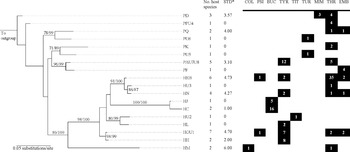
Twenty-three cytochrome b haplotypes were found, which were grouped into 18 blood parasite lineages, of which 8 belonged to Plasmodium, 9 belonged to Haemoproteus (Parahaemoproteus) and only 1 to Haemoproteus (Haemoproteus). The phylogeny contained multiple strongly supported groups (Fig. 1). Hereafter, lineages of Haemoproteus are designated by prefix H and lineages of Plasmodium by prefix P.
Phylogeny of avian haemosporidia from the Cerrado in Central Brazil based on a ca 600 bp fragment of the mitochondrial cytochrome b gene. Support for relationships are listed for nodes supported by at least 1 method (bootstrap >70 or posterior probability >0·95). Plasmodium lineages begin with a ‘P’ and Haemoproteus lineages with an ‘H’. The table on the right indicates the number of host species from which each lineage was recovered and shows the index of host specificity. Abundance of each lineage is partitioned by host family (COL, Columbidae [order Columbiformes], PSI, Psittacidae [order Psittasiformes]; BUC, Bucconidae [order Galbuliformes]; TYR, Tyrannidae; TIT, Titrydae [both belong to the order Passeriformes, suborder Tyranni]; TUR, Turdidae; MIM, Mimidae; THR, Thraupidae; EMB, Emberizidae [all 4 belong to the order Passeriformes, suborder Passeri]).

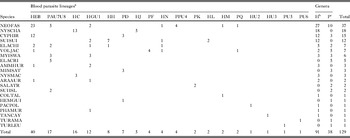
Distribution of Plasmodium and Haemoproteus lineages by host species and family
Of the 18 bird families encountered in the studied community of Central Brazil, only 9 were infected with haemosporidians. Lineages HC and HJ were recorded exclusively in Bucconidae, while PPU4 was solely found in Thraupidae, PF in Emberizidae and HH in Tyrannidae (Fig. 1).
Blood parasite lineage distribution among host species is presented in Table 1. The most abundant lineages were HEB, PAU7U8, HC and HGU1. Lineage HEB was found primarily in white-banded tanager (Neothraupis fasciata) and white-rumped tanager (Cypsnagra hirundinacea) (57·5% and 30% prevalence, respectively), HH was found primarily in suiriri flycatcher (Suiriri suiriri) (87·5%) and HC was only found in white-eared puffbird (Nystalus chacuru) and spot-backed puffbird (Nystalus maculatus). Specialist lineages (S *TD = 0) were HJ, PF, and PPU4, which were recovered from white-eared puffbird, blue-black grassquit (Volatina jacarina) and white-banded tanager, respectively. With the exception of lineage HC, the most abundant lineages were also the most generalist (Fig. 1). Interestingly, 4 lineages were recorded only once, even though other potential hosts were available (species that are phylogenetically close and/or free of parasites). Our data suggest that most host species can be infected with a variety of blood parasites (Table 1).
Distribution of haemosporidian lineages among the bird species

a Lineages are designated by prefix P (Plasmodium) and H (Haemoproteus).
b Haemoproteus.
c Plasmodium.
Variation in prevalence of Plasmodium and Haemoproteus (Parahaemoproteus) in association with host ecological characteristics
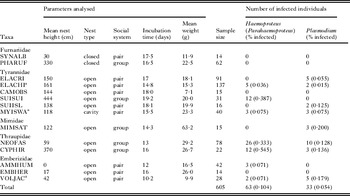
In total, 605 individuals were analysed from 14 species (minimum of 14 individuals per species) representing the following families: Furnariidae, Tyrannidae, Mimidae, Thraupidae and Emberizidae, all belonging to the order Passeriformes (Appendix 2).
Because Haemoproteus (Parahaemoproteus) and Plasmodium are transmitted by distinct blood-sucking insect families, Ceratopogonidae and Culicidae, respectively (Valkiūnas, Reference Valkiūnas2005), which should present behavioural differences when it comes to host-seeking behaviour, GLMMs were fitted separately for each haemosporidian genus. A GLMM was not fitted for Haemoproteus (Haemoproteus) because only 1 individual was identified.
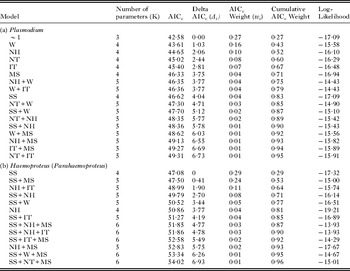
We could not pinpoint one single best model to explain either Plasmodium or Haemoproteus (Parahaemoproteus) prevalence (Table 2). For Plasmodium prevalence, the best model was the null model with w i of 0·27, while for Haemoproteus (Parahaemoproteus) the best model had w i of 0·29 and had only social system as a fixed factor. Several models presented ΔAICc values equal or lower than 7 (Table 2), therefore model averaging was conducted on these.
The most parsimonious (Delta AICc equal or lower than 7·0) GLMM investigating interspecific parasite prevalence of (a) Plasmodium and (b) Haemoproteus (Parahaemoproteus), showing the number of parameters (K), second order Akaike's Information Criteria (AICc), measure of each model relative to the best model (Delta AICc), Akaike's weight (AICcw i), cumulative Akaike's weight and log likelihood

In the case of Plasmodium prevalence, all confidence intervals for the parameters included zero, which provides little evidence that any of the parameters are good predictors of prevalence (Table 3a). This is consistent with the null model being the best model in the candidate model set. For Haemoproteus (Parahaemoproteus), model averaging indicated that social system is an important predictor of Haemoproteus (Parahaemoproteus) prevalence (Table 3b). The unconditional 95% C.I. for the influence of social system on prevalence did not include zero. Indeed, after back-transforming the data (prevalence ranges between zero and one), individuals in species with social nesting groups were, in general, 52% more likely to be infected than those in species that did not form groups (i.e., bred as pairs). In addition, the estimate for social system was also the highest among the other parameters analysed (parameters were standardized to be comparable) and the best model had only social system as a fixed factor, thus giving support that social system was the only important predictor of Haemoproteus (Parahaemoproteus) prevalence. None of the other variables presented non-zero effect sizes for Haemoproteus (Parahaemoproteus) prevalence (Table 3b).
Model averaging estimates and precision (unconditional standard error and 95% confidence interval) were calculated using a cut-off point of ΔAICc value of 7 for the different parameters, based on GLMM of blood parasite prevalence of (a) Plasmodium and (b) Haemoproteus (Parahaemoproteus)

DISCUSSION
Organization of the Plasmodium and Haemoproteus assemblage
The haemosporidian diversity and range of host specificity in this Brazilian Cerrado assemblage are comparable to estimates in previous surveys in North America (Ricklefs et al. Reference Ricklefs, Swanson, Fallon, Martinez-Abrain, Scheuerlein, Gray and Latta2005), Lesser Antilles (Fallon et al. Reference Fallon, Bermingham and Ricklefs2005) and Europe (Hellgren et al. Reference Hellgren, Pérez-Tris and Bensch2009; Ventim et al. Reference Ventim, Morais, Pardal, Mendes, Ramos and Pérez-Tris2012): several lineages of both Plasmodium and Haemoproteus coexist locally and exhibit varying levels of specificity, from infecting one to several distantly related hosts. Although co-speciation is a prominent aspect in some parasite-host systems (Poulin, Reference Poulin2007; Krasnov, Reference Krasnov2008), this is not the case in the avian haemosporidian system; instead, host switching appears to abound throughout the evolutionary history of this group of parasites (Ricklefs et al. Reference Ricklefs, Fallon and Bermingham2004). Nonetheless, there is not one single generalized Plasmodium in any bird community (except on Hawaii) suggesting that some constraints on generalization exist. For example, Fallon et al. (Reference Fallon, Bermingham and Ricklefs2005) showed that specialization at the family or subfamily level is common in the haemosporidian-bird system in the Lesser Antilles, but strict host specialization at species level is relatively rare. Trade-off theory of resource specialization postulates that the benefit of being able to utilize several resources (in our case, the ability to infect multiple host species) comes at a cost of reduced fitness on all resources (Futuyma and Moreno, Reference Futuyma and Moreno1988). However, Hellgren et al. (Reference Hellgren, Pérez-Tris and Bensch2009) and Ventim et al. (Reference Ventim, Morais, Pardal, Mendes, Ramos and Pérez-Tris2012) recently demonstrated that both Plasmodium and Haemoproteus lineages recovered from many host species (i.e., generalized parasites) were also the most prevalent in the populations of their compatible hosts, suggesting that there is no fitness cost to generalization. Because the ESECAE bird community is rather isolated from other nearby Cerrado areas, more studies on other bird communities are necessary to clarify whether the use of hosts by the lineages found in this study reflects local ecological conditions or if it is a historical characteristic of them. Regardless, the general pattern of diversity and specialization in our study mirrors that of many other studies, conducted at both regional and local scales.
Do reproductive and life-history characteristics of hosts influence blood parasite prevalence?
Apart from social system, which was a strong predictor of Haemoproteus (Parahaemoproteus) prevalence, none of the models presented a very strong support. It is possible that the life history and reproductive parameters analysed in this study are not good predictors of avian haemosporidian prevalence.
Parasitism is a cost associated with sociality, but usually only when parasite transmission occurs via direct contact, as in the case of ectoparasites (Alexander, Reference Alexander1974). A meta-analysis conducted by Côté and Poulin (Reference Côté and Poulin1995), using different taxa of vertebrate hosts and parasites with different transmission modes (contagious parasites, which are transmitted via contact with infected individuals or feces, and mobile parasites which do not need proximity among hosts for transmission), showed that parasitism increased with the degree of host sociality when parasites were transmitted by direct contact. In contrast, parasite intensity significantly decreased with increasing group size of hosts for mobile parasites. However, these studies did not include parasites transmitted by vectors. In the case of haemosporidia, which need vectors to be transmitted to their avian hosts, would an increase or decrease in prevalence be expected with an increase in host sociality? According to Mooring and Hart (Reference Mooring and Hart1992), living in groups decreased the probability of an attack by blood-sucking arthropods because of an encounter-dilution effect. Accordingly, lower blood parasite prevalence would be expected in social hosts. Alternatively, a higher rate of encounter with blood-sucking arthropods would be expected if these vectors locate their hosts by olfactory stimuli, such as CO2 emissions and other volatile odors, which could be amplified by close proximity of host members. This latter hypothesis could be applied to haemosporidia, which are transmitted to vertebrate hosts by vectors that use olfactory cues to locate both avian (Yezerinac and Weatherhead, Reference Yezerinac and Weatherhead1995) and mammalian (Davies et al. Reference Davies, Ayres, Dye and Deane1991) food sources. In support of this hypothesis, it has been shown that the evolutionary transition from solitary breeding to colonial breeding in birds comes with a greater risk of infection by blood parasites (Tella, Reference Tella2002). In Neotropical primates, Davies et al. (Reference Davies, Ayres, Dye and Deane1991) showed that Plasmodium prevalence increased with group size. Thus, it seems that social system and group size are important determinants of haemosporidian prevalence in vertebrate hosts.
Although the other variables analysed in this study did not predict an effect on haemosporidian prevalence, they have had an effect on haemosporidian prevalence in other studies. According to Bennett and Fallis (Reference Bennett and Fallis1960), blood parasite prevalence could be positively associated with nesting height because blood parasite vectors are more abundant in the forest canopy. Three studies have tested this association, 2 of which found the expected positive correlation, 1 of them in a bird community from Louisiana, USA (Garvin and Remsen, Reference Garvin and Remsen1997) and 1 in Brazil (Fecchio et al. Reference Fecchio, Lima, Silveira, Braga and Marini2011). Ricklefs et al. (Reference Ricklefs, Swanson, Fallon, Martinez-Abrain, Scheuerlein, Gray and Latta2005), however, did not find a correlation between nest height and blood parasite prevalence in a bird community from Missouri, USA. Complicating matters is the documented variation in vertical stratification among blood-sucking dipterans and the fact that we do not know which species are competent in vectoring avian haemosporidia in our locality. That is, some species are more abundant in the canopy and others at ground level (Derraik et al. Reference Derreik, Snell and Slaney2005), age composition varies vertically between mosquito species (Snow and Wilkes, Reference Snow and Wilkes1977), and although overall diversity of Culicoides increases with height, the abundance of some species is higher towards the ground (Veras and Castellón, Reference Veras and Castellón1998). Without knowledge of avian haemosporidian vector species at our site, or their particular vertical stratification pattern, we cannot reject the general hypothesis that vertical stratification of vectors influences haemosporidian prevalence in the vertebrate host. We only reject the Bennett and Fallis (Reference Bennett and Fallis1960) hypothesis. Thus, although there is some support in the literature for this hypothesis, more studies with diverse bird species are needed to clarify if, indeed, vector stratification has an effect on blood parasite prevalence.
Closed and cavity nests might provide a barrier of protection against the attack of blood-sucking insects, in which case species that build these kinds of nests would be less parasitized (Read, Reference Read1991; Fecchio et al. Reference Fecchio, Lima, Silveira, Braga and Marini2011). We found no overall effect of nest type on blood parasite prevalence, although Fecchio et al. (Reference Fecchio, Lima, Silveira, Braga and Marini2011) reported higher Haemoproteus prevalence for open nesting species, but at the same time closed nesting species presented lower Plasmodium prevalence. Although attacks by haematophagous insects often happen during the night (Lehane, Reference Lehane2005), these attacks also happen during the day, outside the nest. Thus, in this period, the nest structure cannot protect the birds, making the effect of nest structure more diffuse. So, it does not appear as statistically significant in the model. Therefore, it is not yet clear if nest structure can function as a barrier to blood-sucking insects, and more studies, preferably from different regions, are still needed.
Data from this study found no support for a negative association between incubation period and haemosporidian prevalence, a result that would be expected if immunocompetence is related to embryonic developmental period (Ricklefs, Reference Ricklefs1992). Some studies have shown consistent results with Ricklefs (Reference Ricklefs1992) hypothesis, such as Tella et al.'s (1999) study on breeding species of raptors in Spain and Arriero and Møller's (Reference Arriero and Møller2008) study on Palearctic bird species. However, a study on 12 coexisting breeding bird species (Passeriformes) in Arizona, USA did not exhibit the same association (Palacios and Martin, Reference Palacios and Martin2006). In this latter study, nestling species under high parasite pressure presented higher immune cellular responses, but this immune response was not accompanied by longer embryonic development periods, showing no indication that incubation period is associated with either parasite prevalence or host immune response. Therefore, more studies on a local scale might be necessary to investigate whether there is an effect of incubation period on haemosporidian prevalence.
In conclusion, the bird-haemosporidian assemblage studied in the Cerrado in Central Brazil confirms the pattern that seems to be unfolding with the use of molecular markers: the existence of haemosporidian lineages that are extreme host generalists, contrasting with the assumption (established using morphological data of haemosporidian parasites) that avian haemosporidia are host specialists. In this study, 1 life-history trait, social reproduction, was associated with increased haemosporidian prevalence. However, this trait was associated only with Haemoproteus (Parahaemoproteus) prevalence. More studies are needed to reveal which, and to what extent, life-history traits can be considered as good predictors of blood parasite prevalence in bird communities; our analysis included only 14 species, and patterns of parasite prevalence might change with the addition of more species. In addition, field studies conducted by the same researchers in the same locality are more likely to detect patterns than studies based on data compiled from the literature, which include the added variance of spatial and temporal sampling of blood parasites, as well as differences in methods used to detect parasites.
ACKNOWLEDGMENTS
This study was partly funded by a research grant from Conselho Nacional de Desenvolvimento Científico e Tecnológico – CNPq – Brazil and Fundação de Apoio à Pesquisa do Distrito Federal (FAPDF) to M.Â.M. Laboratory analyses were supported in part by the Curators of the University of Missouri. We thank CNPq for a Doctorate Scholarship awarded to A.F., Researcher Fellowship to M.Â.M. and CAPES for awarding M.R.L. with a Sandwich Scholarship (Proc N°: BEX 5066/10-7). We thank the administrators of ESECAE/DF for the permit to conduct this study, and CEMAVE/ICMBio for the banding permits and metal bands. We also thank the comments of two anonymous referees on earlier versions of the manuscript.
APPENDIX 1
Blood parasite prevalence (pooled Plasmodium and Haemoproteus) from a bird community of the Cerrado in Central Brazil. Species and families of birds are organized phylogenetically

APPENDIX 2
Reproductive and life history traits of 14 bird species from the Cerrado of Central Brazil, and haemosporidian prevalence using mitochondrial cytochrome b sequences as the diagnostic method. Species name can be found on Appendix 1.