Introduction
“Again and again, it was necessary to remind everyone that no education is politically neutral.” - bell hooks (Reference hooks1994, p. 37)
Donald Trump, the 47th president of the United States, has signed 130 executive orders (EOs) at the time of this writing (Federal Register, n.d.). Twenty-six of the EOs were signed on his first day in office in 2025, and no other president comes close to that number of EOs signed on their first day (e.g., Joe Biden is the closest with nine EOs signed on his first day in office, USA Facts Team, 2025). The deluge of EOs is coupled with state and federal turbulence (e.g., Price et al., Reference Price, Megerian and Weissert2025), including threats to science, research, and higher education (e.g., Garisto et al., Reference Garisto, Kozlov and Tollefson2025; Mervis, Reference Mervis2025; Stancy et al., Reference Stancy, Casiano, Ward and News2025). The policy shifts highlighted here—and others that we do not speak directly to—impact workers and organizations across the United States, and policy shifts also impact education. We recommend that industrial-organizational (I-O) psychology professorsFootnote 1 consider how policy shifts affect teaching and training. To prepare students for their futures, we explore how to incorporate policy shifts into I-O teaching and training effectively.
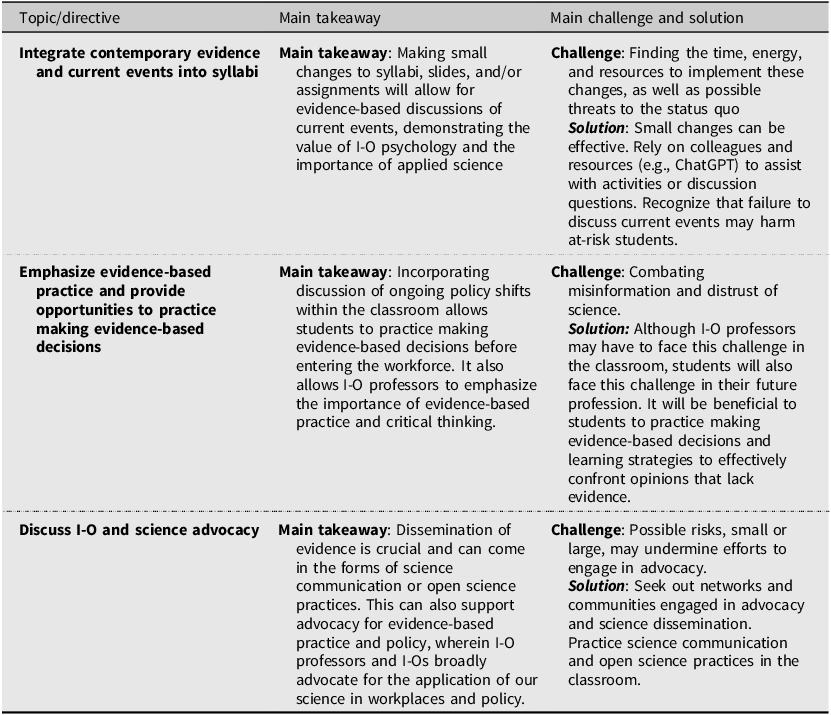
In this article, we call on I-O psychology professors to (a) create space for discussing contemporary policy shifts in their course planning; (b) emphasize and practice implementing evidence-based practice; and (c) discuss I-O and science advocacy in the workplace and community. Our goal as I-O professors should be to present evidence and facts, not personal opinions or beliefs, and to create classroom and training environments that foster students’ development of critical thinking skills. However, it may be challenging and require extra effort to consider the facts and evidence when there is significant and continuous change to how organizations are allowed to operate, given these policy shifts. As such, part of the focus of this policy brief contains recommendations for incorporating policy shifts regardless of the available science on a given topic. In addition to discussing rationale and logistics, we recognize natural discomfort with this level of intentionality in instruction or discussion of current events that are both fluid and controversial. Therefore, we suggest ways to make uncomfortable pedagogy more comfortable. To anchor our discussion and to clarify implications for training practices, we rely on EO 14151, “Ending Radical and Wasteful Government DEI Programs and Preferencing,” as a single demonstrative example while acknowledging that many other EOs could be relevant to class discussion and training.Footnote 2 Finally, we present suggestions and resources for staying informed about ongoing policy shifts and their impacts. Table 1 summarizes the main points of our article.
Summary of the Article and Accompanying Resources

Incorporating contemporary policy and evidence
Students are often curious about the relationship between course content and the real world. This desire to apply knowledge to make sense of real-world events and lived experiences is heightened when policy shifts introduce uncertainty and, therefore, a need to make sense of new policy and new ways of doing (e.g., sensemaking, Maitlis & Christianson, Reference Maitlis and Christianson2014). As an applied science, I-O psychology lends itself well to analyzing and interpreting real-world events and implications for workers and organizations, which is especially pertinent amid ongoing policy shifts.
Drawing on EO 14151, the order to end federal diversity, equity, inclusion, and accessibility (DEIA) programs and require agencies to eliminate related positions, grants, and policies, we argue EOs could be compelling case studies across multiple I-O psychology courses. For example, in an I-O psychology (or related) survey course, EO 14151 offers an opportunity to explore topics such as power and status, organizational culture and justice, training, leadership, and change management. The EO could also facilitate selection-specific discussions around adverse impact, legal compliance, and strategies for diversity-related recruitment. Meanwhile, in a research methods or statistics course, it could prompt critical engagement with issues like the operationalization of DEIA constructs, construct validity, measurement, variability, and research ethics. To deepen learning, students might engage in role-play exercises as employees or human resource managers tasked with implementing policies aligned with the EO, identifying and analyzing the challenges they may encounter in real-world organizational contexts.
Beyond EO 14151, as there are other EOs and policy shifts that may be relevant to the classroom or training environment, I-O professors could explore implications of, for example, EO 14159 (“Protecting the American People Against Invasion”) on various industries and the labor market, EO 14179 (“Removing Barriers to American Leadership in Artificial Intelligence”) on selection, talent management, and the future of work, or EO 14177 (“President’s Council of Advisors on Science and Technology”) on psychological and organizational science. These EOs, and others, can be brought into conversations in a variety of classes at both the undergraduate and graduate levels to spark debate, inspire critical thinking, and provide opportunities to address conflicting goals among stakeholders.
Contextualizing these policy shifts within the classroom allows the I-O professor to tie content to current events and evidence or theory rather than relying on outdated examples that might not be relevant (or accurate, given the policy shifts) to the current class of students. Nevertheless, I-O professors face several challenges that can hinder the inclusion of contemporary events and policy shifts in the classroom, limiting their ability to take advantage of the opportunity for learning and engagement. For example, I-O professors are incentivized to fulfill competing demands (i.e., teaching and research, service, personal) and face limited resources, leading them to recycle textbooks or syllabi often rather than restructure their classes every semester. However, to adequately tie content to real-world situations and scenarios, we maintain that I-O professors should make space for current events in one or more topics in the course. Some I-O professors can dedicate time to major course revisions, but others must work within existing structures. In the latter case, incremental updates each semester can be practical. Focus on one activity per unit: update a reading, incorporate a recent article or podcast, or revise a case study to reflect current events or policy changes. Due to the flurry of activity, using an AI such as ChatGPT may help the I-O professor create activities (e.g., mock debates, role play, critical thinking questions).
We should also note that I-O professors can leverage their existing skills and expertise—knowledge of the literature, empirical evidence, and research methodologies—to analyze and engage with new issues effectively. I-O professors are expected to be experts, but being an expert does not mean being omniscient. Experts have developed a combination of knowledge and skills to analyze the intricacies of novel and dynamic situations, and identify evidence-based solutions that could (but might not) work. This behavior role models skills necessary and complementary to knowledge, such as adaptability, critical thinking, and intellectual humility, all of which students will benefit from developing. We also recommend relying on your network for guest speakers (e.g., colleagues from the law school or ADA office on campus, friends in applied jobs) to supplement lectures, discussions, or training.
Furthermore, I-O professors may feel challenged by the lack of knowledge regarding the exact outcomes or impacts of policy shifts, the burden of emotional regulation (e.g., Grandey, Reference Grandey2000) that goes into understanding these topics, and the chance that discussion of the policy shifts disrupts the status quo of the classroom. Initially, I-O professors may avoid integrating contemporary issues and real-world examples into the classroom due to these many challenges. Yet, discussion of contentious policy shifts may present topics that immediately impact students’ personal lives compared to more traditional topics. This personal connection to one’s identity and beliefs can amplify one’s personal and emotional investment in the topic, which could raise conflict in the classroom, but could also be an opportunity for meaningful engagement with class content. I-O professors should not see conflict as a sign that incorporating current events and policy changes into the classroom is not an effective teaching strategy. Discomfort and conflict, when managed effectively, enhance growth and learning by improving information retention, cognitive flexibility, adaptability, and resilience (Dweck, Reference Dweck2006; Hayes et al., Reference Hayes, Pistorello and Levin2012).
Finally, policy shifts may negatively impact students who cannot always be seen, heard, and validated in the classroom (e.g., policy shifts regarding gender identity and immigration status). I-O professors can manage this conflict effectively by setting expectations around classroom respect, professionalism, and constructive dialog. I-O professors could also facilitate and moderate an anonymous online chat that could permit students with precarious or marginalized identities to voice ideas about policy shifts that could directly relate to them and make them a target of retaliation, thereby protecting students’ physical safety and promoting psychological safety. It is important to consider that although policy shifts may be confusing or contentious to some students, they may directly impact others. For example, although EO 14159 may be relevant to conceptual or practical classroom discussions, it may also have real-world implications for international students, such as those on F1 visas. These students may fear having their visas revoked as retaliation for making public statements that challenge the current political administration (Ma, Reference Ma2025), and they may feel safer to voice their questions and contribute their thoughts on an anonymous classroom platform (e.g., TopHat).
Emphasize and practice implementing evidence-based practice
Many undergraduate and graduate students will become the next generation of practitioners and decision makers in organizations. We have long lamented the science–practice gap as a field (e.g., Banks et al., Reference Banks, Pollack, Bochantin, Kirkman, Whelpley and O’Boyle2016, Reference Banks, Barnes and Jiang2021), and much of the backlash and rollback of evidence-based policy and practice results from misinformation, distrust of science, and poor application. This also highlights the importance of I-O psychologists, and I-O professors possess influence over these challenges when working with students. For example, I-O psychologists can offer a deeper understanding of underlying behavioral phenomena, such as how to identify and address bias in selection practices. Of course, it is important that we know about best practices in selection. However, if we are not present in organizations or able to help create bias-free selection practices (as well as help create equitable work practices and inclusive workplaces and cultures), the knowledge alone is insufficient. We must link knowledge (e.g., what is discussed and learned in the classroom) with action (e.g., being an I-O psychologist who makes a difference in organizations). As such, I-O professors must emphasize evidence-based practice, something they likely already do in their classes and training and provide opportunities to practice implementing evidence-based recommendations. This cornerstone of I-O training is crucial at this point and must not be overlooked.
Despite its historical importance to I-O training, this strategy is likely to be accompanied by discomfort. Public distrust and resistance to scientific findings can exacerbate the gap between I-O knowledge and action (e.g., Keener et al., Reference Keener, Kepes and Torka2023). However, emphasizing the importance of evidence-based practice during training is a critical learning opportunity that supports a future generation of workers who embrace looking to the most recent evidence to identify best practices, even when it goes against their intuitions. To address this discomfort, I-O professors can support students as they learn to navigate their discomfort through case studies, classroom debates, and reflection exercises. Furthermore, students, who will face uncomfortable conversations in their careers and lives, can learn how to communicate research findings to nonacademic or lay audiences, which is a skill that can support effective negotiation and advocacy for evidence-based practices in their organizations. This allows I-O professors to emphasize the importance of evidence-based practice and gives students the opportunity to work through tangible examples (i.e., linking knowledge with action). I-O professors can explicitly discuss tensions and congruence between evidence and beliefs, intuition, or emotion.
In anchoring our discussion to EO 14151, this EO depicts how specific policy shifts can create a challenging (and sometimes confusing) context to discuss evidence-based practice, as it is a politically polarizing topic that has lost connection to the evidence in public discourse. I-O professors can help students critically evaluate the evidence by designing classroom activities that pose questions such as: “What evidence exists regarding the (in)effectiveness of various DEIA initiatives?” “Which organizational outcomes—both positive and negative—are empirically linked to workplace diversity?” and “How can organizations identify and combat bias in selection without the use of formal DEIA programs?” These discussions should facilitate a balanced examination of the evidence that supports and challenges DEIA programs, allowing students to develop nuanced, evidence-based perspectives. In practice, students could design evidence-based initiatives that support equal opportunity in light of EO 14151 and its directives. This strategy will allow students to practice working through different ways of managing policy shifts in the classroom, where conflict can be discussed through a developmental lens so that they are better prepared when they enter the workforce and face similar conflicts.
Discuss I-O advocacy
Finally, although the word “advocacy” might invoke thoughts of political activism, “advocacy” can also refer to presenting evidence to challenge misinformation, discussing cutting-edge research, supporting evidence-based policies in our organizations and communities, and simply speaking up in the wake of misinformation broadly. For researchers, one avenue of I-O advocacy could be engaging in more open science practices and science communication to increase the accessibility of our work (e.g., Castille et al., Reference Castille, Kreamer, Albritton, Banks and Rogelberg2022). For example, saying “yes” to interviews with news media or podcasts, writing and distributing blog posts and infographics, or sharing summaries of research that support an evidence-based practice on social media can be simple yet effective advocacy. Advocacy can also include involvement in local, state, or federal politics to promote evidence-based policy. With the current policy shifts, it will be important for I-O psychologists to advocate for practices within organizations that adhere to new precedents, but also with the available evidence, fully recognizing that these two might not always fit together.
This strategy can also be practiced in the classroom. In anchoring our discussion of policy shifts with EO 14151, for example, instead of promoting DEIA initiatives that may now be restricted, I-O psychologists might advocate for programs that incorporate evidence-based practices previously housed under DEIA but framed in business-outcome language. Class assignments could include developing communication strategies that present research findings about organizational effectiveness in ways that transcend political framing, focusing instead on engagement, retention, and innovation that resonate across ideological spectrums.
Advocacy, particularly when challenging misinformation or the status quo, will require I-O professors to get comfortable with being uncomfortable. Speaking up and engaging in voice behaviors can be seen as a personal or social risk as it invites pushback, criticism, and resistance (Burris, Reference Burris2012), but like other risks, there can be small and large benefits. A few strategies can reduce the discomfort of taking these risks. One is to build a strong foundation in the evidence and to communicate effectively to different audiences. Another strategy is identifying allies within academic, professional, and broader communities to reinforce the messaging. Finally, advocacy does not require confrontation or combativeness; advocacy can be conducted through empathetic and mindful questions, sharing resources, or simply creating a space where uncomfortable ideas can be discussed without judgment. Embracing discomfort can allow I-O professors to play a more active role in their organizations and communities to advocate for evidence-based practice and decision making.
Staying up to date
The biggest challenge to addressing the suggestions in our article is the sheer number of policy shifts and content that could be discussed in class. We argue that incremental change and taking small steps to address real-world and current events are better than avoidance. Perhaps one determines they have the resources to dedicate a few class periods to the ongoing policy shifts (e.g., updating syllabi and activities), whereas another determines they can enlist grad students to create a local or digital advocacy platform. Regardless of implementation, we suggest digesting and critically reflecting on the policy shifts. This may be easier to incorporate with class prep already baked into one’s schedule. We recommend relying on evidence-based, unbiased sources to keep informed of the policy shifts. For example, Society for Industrial and Organizational Psychology (SIOP) has created a page that includes updates on federal policy in the News Center that is accessible to SIOP members (SIOP, n.d.). SIOP also has a SIOP Advocacy group in which members can participate. The Society for Human Resource Management (SHRM) also has a page dedicated to advocacy (SHRM, n.d.), and the Academy of Management and its subdivisions are working on combating misinformation. Harvard Business Review publishes articles and podcasts (among other formats) that cover relevant topics, such as Williams et al. (Reference Williams, Maechtlen and Doklas2025) article on navigating DEI in the shifting landscape. Signing up for push notifications from these sources, subscribing to newsletters, or following authors of relevant works on social media can also be beneficial.
Conclusion
What we discussed in this policy brief is not exhaustive; there are many ways I-O professors can foster critical discussion of policy shifts and what our science says about their implications. Although we may have opinions about these policy shifts, it is in our students’ best interests that we rely on science, evidence, and practical application rather than our personal beliefs. It can be challenging for students and faculty alike to separate emotion from evidence. However, an effective I-O psychologist thinks critically and uses evidence to support or refute a policy shift and its impact on organizations and workers. The evidence-based approach also demands flexibility. As policies evolve over the next 4 years and beyond, the I-O community must remain committed to our science to make work better for everyone. To do that, we must start by having these conversations in the classroom.