1 Introduction
A spherical particle moving in a shear flow is subject to a force perpendicular to the flow direction, which is termed the lift force (Saffman Reference Saffman1965; McLaughlin Reference McLaughlin1991). The effects of this lift force were first identified approximately 170 years ago by Poiseuille’s observation that blood corpuscles in capillaries tended to keep away from the walls (Poiseuille Reference Poiseuille1836). The lift forces play an important role in many areas including aerosol science (Gavze & Shapiro Reference Gavze and Shapiro1998), biology (Kleinstreuer, Zhang & Donohue Reference Kleinstreuer, Zhang and Donohue2008), chemical engineering (Dandy & Dwyer Reference Dandy and Dwyer1990), air pollution and public health (Salmanzadeh et al. Reference Salmanzadeh, Zahedi, Ahmadi, Marr and Glauser2012). Studies have demonstrated that the lift force in shear flows could significantly affect the migration of particles, especially in the boundary layer (Zou et al. Reference Zou, Cheng, Zhang and Zhao2007; Zheng & Silber-Li Reference Zheng and Silber-Li2009; Zhou & Papautsky Reference Zhou and Papautsky2013). Therefore, a quantitative description for the lift force in shear flows is critical to understanding the particle dynamics in practical applications.
The lift force acting on particles depends on the Knudsen number (Knudsen Reference Knudsen1950),
 $Kn={\it\lambda}/L$
, where
 ${\it\lambda}$
is the fluid mean free path and
 $L$
is the characteristic length of the particle (for spherical particles,
 $L$
equals the particle radius,
 $R$
). In the continuum regime (
 $Kn\ll 1$
), Saffman (Reference Saffman1965) studied the lift force on spherical particles moving in a linear shear flow at low-Reynolds number by using singular perturbation techniques, and derived the lift forces as
 $$\begin{eqnarray}F_{L,\mathit{saff}}=6.46{\it\mu}R^{2}V\sqrt{\frac{|G|{\it\rho}}{{\it\mu}}}\text{sgn}(G),\end{eqnarray}$$
where
 ${\it\mu}$
and
 ${\it\rho}$
are the viscosity and density of the fluid,
 $V$
is the relative velocity between the particle and the fluid and
 $G$
is the velocity gradient of the shear flow. It is worth mentioning that no lift force can be deduced based on the Stokes-flow equation (Bretherton Reference Bretherton1962). Thus the Saffman lift force is caused by the inertial effects (Cherukat & McLaughlin Reference Cherukat and McLaughlin1994; Asmolov Reference Asmolov1999). Equation (1.1) has been reported to be in good agreement with experiments (Merzkirch & Bracht Reference Merzkirch and Bracht1978; Busnaina, Taylor & Kashkoush Reference Busnaina, Taylor and Kashkoush1993). Here, it should be noted that the direction of
 $F_{L,\mathit{saff}}$
is in the same direction as the velocity gradient, which is defined as positive lift force in the present work (negative lift force being against the velocity gradient). The positive lift force is physically explained as follows. The higher fluid velocity on one side of the particle gives rise to a lower pressure, while the lower fluid velocity on the other side gives rise to a higher pressure. As a result, a net lift force that is directed toward the high-velocity region is induced by the pressure difference. In this sense, the Saffman lift force is quite similar to the Magnus lift force, which is exerted on rotating particles in fluids (Rubinow & Keller Reference Rubinow and Keller1961).
For nanoparticles moving in gases (air in many applications (Mädler & Friedlander Reference Mädler and Friedlander2007) and the mean free path of air is approximately 60–80 nm at standard conditions), the flow regime is in the free molecule regime (
 $Kn\gg 1$
), where the velocity distribution of the gas molecules is assumed to be undisturbed by the presence of the suspended particles and the analysis of the lift force involves solving the Boltzmann equation with a velocity gradient. Kröger & Hütter (Reference Kröger and Hütter2006) studied the lift force on spherical particles in highly rarefied gases and found that the direction of the lift force is negative. Liu & Bogy (Reference Liu and Bogy2008, Reference Liu and Bogy2009) first gave an explicit formula for the lift force in a shear flow of a dilute gas under the assumption of rigid-body collisions,
 $$\begin{eqnarray}\boldsymbol{F}_{L}=-{\textstyle \frac{1}{6}}(2+{\it\sigma}_{{\it\tau}}-{\it\sigma}_{p}){\rm\pi}{\it\rho}\boldsymbol{G}R^{2}{\it\lambda}V,\end{eqnarray}$$
where
 ${\it\sigma}_{{\it\tau}}$
and
 ${\it\sigma}_{p}$
are the tangential and normal accommodation coefficients, which depend on how gas molecules are reflected upon collision with a particle. When the reflection is purely diffuse (
 ${\it\sigma}_{{\it\tau}}={\it\sigma}_{p}=1$
) or specular (
 ${\it\sigma}_{{\it\tau}}={\it\sigma}_{p}=0$
), (1.2) is reduced to
 $$\begin{eqnarray}\boldsymbol{F}_{L}=-{\textstyle \frac{1}{3}}{\rm\pi}{\it\rho}\boldsymbol{G}R^{2}{\it\lambda}V.\end{eqnarray}$$
It is clearly seen that the lift force in (1.3) is negative and in the opposite direction to the Saffman lift force in the continuum limit. It is argued that the negative lift force is due to the higher momentum transfer between gas molecules and the particle in the high-velocity region compared with that in the low-velocity region, which generates a force towards the low-velocity side. However, according to our recent work regarding the drag and thermophoretic forces on particles (Li & Wang Reference Li and Wang2003a ,Reference Li and Wang b , Reference Li and Wang2004, Reference Li and Wang2005; Li Reference Li2009; Wang & Li Reference Wang and Li2011, Reference Wang and Li2012), as the particle size decreases to the nanoscale, the rigid-body collision assumption becomes questionable and the non-rigid-body interaction between the particle and gas molecules may play a notable role. The importance of gas–nanoparticle intermolecular interactions (usually van der Waals potential) has been verified by nanoparticle mobility (Kaufman et al. Reference Kaufman, Skogen, Dorman, Zarrin and Lewis1996; de la Mora et al. Reference de la Mora, De Juan, Liedtke and Schmidt-Ott2003) and nanoparticle deposition (Zhang et al. Reference Zhang, Li, Yan and Yao2012) experiments. Hence, the lift force in (1.3) may not apply to nanoparticles. To accurately predict the lift force acting on spherical particles in shear flows of rarefied gases it is crucial to consider the gas–nanoparticle non-rigid-body interactions and develop a generalized lift force formula.
The present paper is devoted to an analysis of the lift force on spherical nanoparticles in shear flows of dilute gases. An analytical formula for the lift force is derived on the basis of gas kinetic theory by considering the intermolecular interactions. The formula includes (1.3) as a special case if rigid-body collisions are assumed. Furthermore, it is predicted that both positive and negative lift forces could be observed depending on the non-rigid-body interaction potential and temperature.
2 Assumptions and methods
The lift force is derived in the free molecule regime (
 $Kn\gg 1$
), where the mean free path of the gas is large compared to the radius of the spherical particle and the gas molecules reflected by the particle usually travel a long distance before colliding with other molecules (Gombosi Reference Gombosi1994). Thus, the interactions between the incident gas molecules and those reflected by the particle can be ignored. In such a condition, the presence of the particle does not affect the velocity distribution of the gas molecules. The Chapman–Enskog gas kinetic theory can therefore be used to calculate the lift force. In shear flows with a velocity gradient, the velocity distribution function of gas molecules is given by Chapman & Cowling (Reference Chapman and Cowling1970),
 $$\begin{eqnarray}f=f_{0}\left(1-\frac{4{\it\mu}{\it\beta}^{4}}{{\it\rho}}\overset{\circ }{\boldsymbol{v}\boldsymbol{v}}\boldsymbol{ : }\frac{\partial }{\partial \boldsymbol{r}}\boldsymbol{V}_{0}\right),\end{eqnarray}$$
where
 $f_{0}$
is the Maxwellian velocity distribution function of gas molecules in equilibrium,
 ${\it\beta}=(2R_{g}T)^{-1/2}$
is the reciprocal of the most probable molecular speed, where
 $R_{g}$
is the gas constant and
 $T$
is temperature and
 $\boldsymbol{v}$
is the thermal velocity of the molecules, which is the total molecular velocity
 $\boldsymbol{v}^{\prime }$
relative to the local mass velocity of the gas
 $\boldsymbol{V}_{0}$
. The superscript ‘
 $\circ$
’ indicates that the sum of the diagonal components of a tensor is zero. The scalar product of the two tensors
 $\overset{\circ }{\boldsymbol{v}\boldsymbol{v}}\boldsymbol{ : }(\partial /\partial \boldsymbol{r})\boldsymbol{V}_{0}$
is defined as the scalar equal to the divergence of
 $\overset{\circ }{\boldsymbol{v}\boldsymbol{v}}\boldsymbol{\cdot }(\partial /\partial \boldsymbol{r})\boldsymbol{V}_{0}$
.
Following the pioneering work by Li & Wang (Reference Li and Wang2003a
,Reference Li and Wang
b
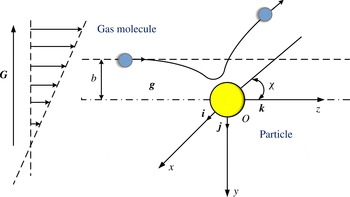
, Reference Li and Wang2004), the analytical expression of the lift force can be derived by calculating the total momentum transfer upon non-rigid-body collisions between gas molecules and the particle. As shown in figure 1, a spherical particle moves steadily in a shear flow with velocity gradient
 $\boldsymbol{G}$
. The relative velocity vector between the particle and the shear flow is
 $\boldsymbol{V}$
. For convenience, the reference frame with origin at the centre of mass of the particle is introduced, with
 $\boldsymbol{V}$
being collinear with the
 $z$
axis.
 $\boldsymbol{i}$
,
 $\boldsymbol{j}$
and
 $\boldsymbol{k}$
are the unit vectors along the
 $x$
,
 $y$
and
 $z$
axes, respectively. The relative velocity of the gas molecules is
 $\boldsymbol{g}=\boldsymbol{v}-\boldsymbol{V}$
. The colatitude and azimuthal angles of
 $\boldsymbol{g}$
in the frame of reference are denoted by
 ${\it\phi}$
and
 ${\it\theta}$
, respectively. The velocity gradient
 $\boldsymbol{G}$
of the shear flow is in the negative
 $y$
direction.
For the flow in figure 1, the Chapman–Enskog distribution function for the gas molecules can be rewritten as (Bird Reference Bird1994)
 $$\begin{eqnarray}f=f_{0}+f_{1}=f_{0}\left(1-\frac{4{\it\mu}{\it\beta}^{4}v_{y}v_{z}}{{\it\rho}}G\right),\end{eqnarray}$$
where the equilibrium velocity distribution function is given by
 $$\begin{eqnarray}f_{0}=n\left(\frac{{\it\beta}}{\sqrt{{\rm\pi}}}\right)^{3}\exp (-{\it\beta}^{2}v^{2}),\end{eqnarray}$$
 $n$
is the number density of the gas, and the second-order approximation of velocity distribution
 $$\begin{eqnarray}f_{1}=-f_{0}\frac{4{\it\mu}{\it\beta}^{4}v_{y}v_{z}}{{\it\rho}}G.\end{eqnarray}$$
Given the gas viscosity (Hirschfelder et al. Reference Hirschfelder, Curtiss, Bird and Mayer1954)
 $$\begin{eqnarray}{\it\mu}=\frac{5\sqrt{{\rm\pi}}}{16}\frac{{\it\rho}{\it\lambda}}{{\it\beta}{\it\Omega}^{(2,2)\ast }},\end{eqnarray}$$
the velocity distribution function reads
 $$\begin{eqnarray}f=f_{0}\left(1-\frac{5\sqrt{{\rm\pi}}}{4}\frac{{\it\beta}^{3}{\it\lambda}v_{y}v_{z}}{{\it\Omega}^{(2,2)\ast }}G\right),\end{eqnarray}$$
where
 ${\it\Omega}^{(2,2)\ast }$
is the reduced viscosity collision integral.
Collision model between a molecule and a small particle in a linear shear flow.

3 Lift force on spherical particles in the free molecule regime
3.1 Lift force formula on nanoparticles
The lift force on a spherical nanoparticle can be obtained by
 $$\begin{eqnarray}\boldsymbol{F}_{L}=m_{r}\int _{\boldsymbol{v}}f_{1}g\boldsymbol{g}Q(g)\,\text{d}\boldsymbol{v},\end{eqnarray}$$
where
 $m_{r}=m_{g}m_{p}/(m_{g}+m_{p})$
is the reduced mass of a gas molecule with mass
 $m_{g}$
and a particle with mass
 $m_{p}$
, and
 $Q(g)$
is the collision cross-section, which depends on the reflection scenario of the gas molecules upon collision with the particle. There are two limiting cases: specular scattering and diffuse scattering (Hirschfelder et al.
Reference Hirschfelder, Curtiss, Bird and Mayer1954; Chapman & Cowling Reference Chapman and Cowling1970). For specular scattering,
 $$\begin{eqnarray}Q_{s}(g)=2{\rm\pi}\int _{0}^{\infty }(1-\cos {\it\chi})b\,\text{d}b,\end{eqnarray}$$
and for diffuse scattering,
 $$\begin{eqnarray}Q_{d}(g)=2{\rm\pi}\left[\int _{0}^{b_{0}}\left(1+\frac{1}{g}\sqrt{\frac{{\rm\pi}k_{B}T}{2m_{r}}}\sin \frac{{\it\chi}}{2}\right)+\int _{b_{0}}^{\infty }(1-\cos {\it\chi})\right]b\,\text{d}b,\end{eqnarray}$$
where
 $$\begin{eqnarray}{\it\chi}={\rm\pi}-2b\int _{r_{m}}^{\infty }\frac{\text{d}r}{r^{2}\sqrt{1-\displaystyle \frac{b^{2}}{r^{2}}-\frac{{\it\Phi}(r)}{m_{r}g^{2}/2}}}\end{eqnarray}$$
is the angle of scattering (Hirschfelder et al.
Reference Hirschfelder, Curtiss, Bird and Mayer1954; Li & Wang Reference Li and Wang2003a
). In (3.2)–(3.4),
 $b$
is the impact factor for the gas–particle collisions (see figure 1),
 $b_{0}$
is the critical impact factor, for which the gas molecule orbits around the particle upon collision (Hirschfelder et al.
Reference Hirschfelder, Curtiss, Bird and Mayer1954; Li & Wang Reference Li and Wang2003a
),
 $r$
is the centre-to-centre distance between the gas molecule and particle,
 $r_{m}$
is distance of the closet encounter,
 $k_{B}$
is the Boltzmann constant and
 ${\it\Phi}(r)$
is the gas–particle interaction potential.
By substituting (2.3) and (2.4) into (3.1), the lift force is obtained as
 $$\begin{eqnarray}\boldsymbol{F}_{L}=-m_{r}\int _{\boldsymbol{v}}f_{0}\frac{5\sqrt{{\rm\pi}}}{4}\frac{{\it\beta}^{3}{\it\lambda}v_{y}v_{z}}{{\it\Omega}^{(2,2)\ast }}Gg\boldsymbol{g}Q(g)\,\text{d}\boldsymbol{v},\end{eqnarray}$$
where the relative velocity vector
 $\boldsymbol{g}$
is
 $$\begin{eqnarray}\boldsymbol{g}=g\sin {\it\phi}\cos {\it\theta}\boldsymbol{i}+g\sin {\it\phi}\sin {\it\theta}\boldsymbol{j}+g\cos {\it\phi}\boldsymbol{k}\end{eqnarray}$$
and the thermal velocity components of the gas molecules in the
 $y$
and
 $z$
directions are equal to
 $$\begin{eqnarray}v_{y}=g\sin {\it\phi}\sin {\it\theta},\quad v_{z}=g\cos {\it\phi}+V.\end{eqnarray}$$
It is reasonable to assume that
 $V\ll v$
, such that
 $$\begin{eqnarray}\text{d}\boldsymbol{v}\approx \text{d}\boldsymbol{g}=g^{2}\sin {\it\phi}\,\text{d}{\it\phi}\,\text{d}{\it\theta}\,\text{d}\boldsymbol{g}\end{eqnarray}$$
and the Maxwellian velocity distribution
 $f_{0}$
can be rewritten as (Li & Wang Reference Li and Wang2003a
)
 $$\begin{eqnarray}f_{0}=n\left(\frac{{\it\beta}}{\sqrt{{\rm\pi}}}\right)^{3}(1-2{\it\beta}^{2}gV\cos {\it\phi})\exp (-g^{2}{\it\beta}^{2}).\end{eqnarray}$$
Substituting (3.6)–(3.9) into (3.5) and integrating over
 ${\it\theta}$
from 0 to
 $2{\rm\pi}$
and
 ${\it\phi}$
from 0 to
 ${\rm\pi}$
, the lift force reads
 $$\begin{eqnarray}\displaystyle \boldsymbol{F}_{L}=\frac{m_{r}n}{{\it\Omega}^{(2,2)\ast }}\boldsymbol{G}{\it\lambda}V\!\left[\frac{5}{3}\!\int _{0}^{\infty }g^{5}{\it\beta}^{6}\exp (-g^{2}{\it\beta}^{2})Q(g)\,\text{d}g-\frac{2}{3}\!\int _{0}^{\infty }g^{7}{\it\beta}^{8}\exp (-g^{2}{\it\beta}^{2})Q(g)\,\text{d}g\right]\!\!. & & \displaystyle \nonumber\\ \displaystyle & & \displaystyle\end{eqnarray}$$
If
 ${\it\gamma}=g{\it\beta}$
is introduced,
 $$\begin{eqnarray}\boldsymbol{F}_{L}=\frac{m_{r}n}{{\it\Omega}^{(2,2)\ast }}\boldsymbol{G}{\it\lambda}V\left[\frac{5}{3}\int _{0}^{\infty }{\it\gamma}^{5}\exp (-{\it\gamma}^{2})Q(g)\,\text{d}{\it\gamma}\text{ - }\frac{2}{3}\int _{0}^{\infty }{\it\gamma}^{7}\exp (-{\it\gamma}^{2})Q(g)\,\text{d}{\it\gamma}\right].\end{eqnarray}$$
By using the collision integrals definition (Chapman & Cowling Reference Chapman and Cowling1970)
 $$\begin{eqnarray}{\it\Omega}^{(l,q)\ast }=\int _{0}^{\infty }\frac{\text{e}^{-{\it\gamma}^{2}}{\it\gamma}^{2q+3}Q^{l}(g)\,\text{d}{\it\gamma}}{[(q+l)!/2]\{1-[1+(-1)^{l}]/(2+2l)\}{\rm\pi}R^{2}},\end{eqnarray}$$
and considering that the particle mass is much larger than the mass of a gas molecule (
 $m_{r}\approx m_{g}$
and
 ${\it\rho}=m_{g}n$
), we obtain
 $$\begin{eqnarray}\boldsymbol{F}_{L}=\frac{1}{3}{\rm\pi}{\it\rho}\boldsymbol{G}R^{2}{\it\lambda}V\left(5\frac{{\it\Omega}^{(1,1)\ast }}{{\it\Omega}^{(2,2)\ast }}-\text{6}\frac{{\it\Omega}^{(1,2)\ast }}{{\it\Omega}^{(2,2)\ast }}\right).\end{eqnarray}$$
According to the Chapman–Enskog theory, the distribution function
 $f$
can be considered as an expansion in powers of
 ${\it\lambda}G/V$
(Chapman & Cowling Reference Chapman and Cowling1970; Bird Reference Bird1994). It is worth mentioning that only the second-order approximation of the velocity distribution function is considered in the derivations. Thus, the present result is valid only when
 ${\it\lambda}G/V\ll 1$
. Usually, the second-order approximation gives a sufficiently accurate evaluation for the velocity distribution (Chapman & Cowling Reference Chapman and Cowling1970). Higher-order terms are significant only in the cases with extremely large velocity gradients. Furthermore, in the near-wall region (the distance between the particle and the wall is less than the mean free path of the gas), (2.1) is not applicable to describe the velocity distribution of gas molecules incident on a particle coming from the solid wall (Chen & Xu Reference Chen and Xu2002; Ivchenko, Loyalka & Tompson Reference Ivchenko, Loyalka and Tompson2007). In general, however, the mean free path is small compared with the thickness of the boundary layer. Thus, our derivation is valid in most regions of the boundary layer.
3.2 Lift force on microparticles with rigid-body collisions
Equation (3.13) is a general expression for the lift force by considering the van der Waals interactions between the particle and gas molecules. For microparticles, the gas–particle interactions are insignificant and the assumption of rigid-body collisions is valid. In this case, the reduced collision integrals for specular and diffuse scatterings are given as
 $$\begin{eqnarray}{{\it\Omega}_{s}}^{(1,1)\ast }={{\it\Omega}_{s}}^{(1,2)\ast }=1\quad \text{and}\quad {{\it\Omega}_{d}}^{(1,1)\ast }=1+\frac{{\rm\pi}}{8},\quad {{\it\Omega}_{d}}^{(1,2)\ast }=1+\frac{5{\rm\pi}}{48}.\end{eqnarray}$$
Moreover, the collision integral
 ${\it\Omega}^{(2,2)\ast }$
happens to be approximately unity for particles moving in air at room temperature (Hirschfelder et al.
Reference Hirschfelder, Curtiss, Bird and Mayer1954). Therefore, for microparticles, (3.13) is reduced to (1.3), which demonstrates that (1.3) is simply a special case of (3.13).
3.3 Positive and negative lift force on nanoparticles
As the particle size decreases to the nanoscale, the rigid-body collision model becomes inaccurate and the gas–particle intermolecular interactions are important. Equation (3.13) gives a generalized formula for the lift force in the free molecule regime by considering the gas–particle intermolecular potential. In (3.13), it is seen that the direction of the lift force is determined by the value of the collision integral term,
 $[5{\it\Omega}^{(1,1)\ast }-6{\it\Omega}^{(1,2)\ast }]/{\it\Omega}^{(2,2)\ast }$
, which could be positive or negative, depending on the gas–particle interactions and temperature. If
 $[5{\it\Omega}^{(1,1)\ast }-6{\it\Omega}^{(1,2)\ast }]/{\it\Omega}^{(2,2)\ast }<0$
, (3.13) is in the opposite direction to
 $\boldsymbol{G}$
(negative lift force), which is the same with (1.3), while if
 $[5{\it\Omega}^{(1,1)\ast }-6{\it\Omega}^{(1,2)\ast }]/{\it\Omega}^{(2,2)\ast }>0$
, a positive lift force takes place.
To show the variation of the lift force direction, herein, the Lennard-Jones potential is employed to model the intermolecular interactions
 $$\begin{eqnarray}{\it\Phi}_{LJ}(r)=4{\it\varepsilon}\left[\left(\frac{{\it\sigma}}{r}\right)^{12}-\left(\frac{{\it\sigma}}{r}\right)^{6}\right],\end{eqnarray}$$
where
 ${\it\varepsilon}$
is the depth of the potential well and
 ${\it\sigma}$
is the collision diameter. It is convenient to introduce dimensionless or reduced variables
 $T^{\ast }=k_{B}T/{\it\varepsilon}$
for the temperature,
 $g^{\ast }=g\sqrt{m_{r}/(2{\it\varepsilon})}$
for the relative velocity and
 $b^{\ast }=b/{\it\sigma}$
for the impact parameter. The collision integrals are calculated numerically according to (3.12) and it has been verified that our numerical results are consistent with those in the literature (Hirschfelder et al.
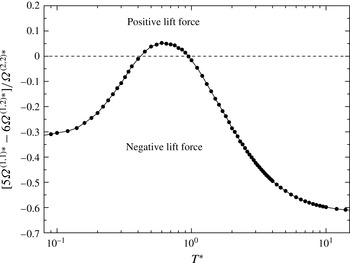
Reference Hirschfelder, Curtiss, Bird and Mayer1954; Kim & Monroe Reference Kim and Monroe2014). Figure 2 shows the collision integral term
 $[5{\it\Omega}^{(1,1)\ast }-6{\it\Omega}^{(1,2)\ast }]/{\it\Omega}^{(2,2)\ast }$
as a function of
 $T^{\ast }$
. In the high- and low-temperature region, the lift force is found to be negative, which is consistent with (1.3). However, it is clearly seen that the lift force turns positive when
 $T^{\ast }$
is roughly in the range of 0.42–0.95. In other words, in the free molecule regime, the lift force is not always negative and can change direction if the temperature and potential parameters are varied.
Variation of
 $[5{\it\Omega}^{(1,1)\ast }-6{\it\Omega}^{(1,2)\ast }]/{\it\Omega}^{(2,2)\ast }$
as a function of reduced temperature
 $T^{\ast }=k_{B}T/{\it\varepsilon}$
for the Lennard-Jones potential function. For positive lift force,
 $[5{\it\Omega}^{(1,1)\ast }-6{\it\Omega}^{(1,2)\ast }]/{\it\Omega}^{(2,2)\ast }>0$
is required.

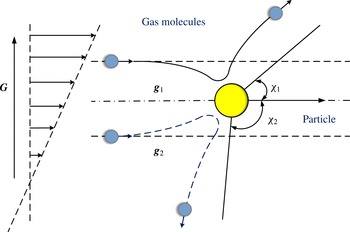
We note that the thermophoretic force on nanoparticles immersed in a dilute gas with a temperature gradient has also been found to reverse direction in the same temperature range (Wang & Li Reference Wang and Li2011, Reference Wang and Li2012). Following the explanation of the reverse thermophoresis effect, the reverse lift force effect found here can be understood as follows. For non-rigid collisions, the scattering angle and consequently the momentum transfer efficiency depend on the incoming velocity of the gas molecules for a given impact parameter and gas–particle interaction potential. Figure 3 depicts two possible trajectories of single gas molecules with different incoming velocities. The solid trajectory shows a gas molecule with a relatively high
 $g$
, which results in a small scattering angle
 ${\it\chi}$
,
 ${\it\chi}_{1}$
(as shown in figure 3). In contrast, a low
 $g$
for the same impact parameter leads to a large
 ${\it\chi}$
,
 ${\it\chi}_{2}$
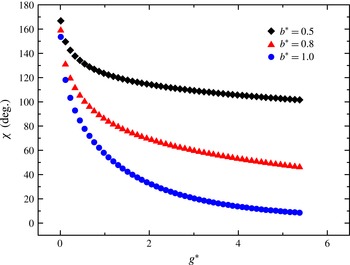
, which may enhance the momentum transfer at the low-velocity side and generate a positive lift force that is directed towards the high-velocity side, as illustrated by the dashed trajectory in figure 3. In figure 4, the scattering angle
 ${\it\chi}$
is depicted as a function of the reduced velocity at different reduced impact parameters
 $b^{\ast }$
. It is seen that
 ${\it\chi}$
decreases and the momentum transfer is weakened as
 $g^{\ast }$
increases. As a result, it is possible that the gas molecules on the low-velocity side have higher momentum transfer due to larger scattering angles under the influence of the interaction potential. Therefore, the lift force can push the particle to the high-velocity side. According to a recent study by Khrapak (Reference Khrapak2013, Reference Khrapak2014), in a certain temperature range, the decay of the momentum transfer efficiency with the increase of velocity is very steep and positive lift force can be reasonably expected. However, for extremely high or low temperature, the momentum transfer efficiency becomes less sensitive to velocity and a positive lift force may not occur. In the case of rigid-body collisions, however, the scattering angle
 ${\it\chi}$
remains constant for a given impact parameter
 $b$
(independent of
 $g$
). In this case, the momentum transfer between gas molecules and the particle is higher on the high-velocity side than that on the low-velocity side. This leads to a lift force opposite to the velocity gradient. This is why (1.3) always gives a negative lift force.
Trajectories of gas molecules colliding with a particle at different velocities.

Variation of the scattering angle
 ${\it\chi}$
as a function of the reduced velocity
 $g^{\ast }$
at different reduced impact parameter
 $b^{\ast }$
.

3.4 Lift force on nanoparticles with different potentials
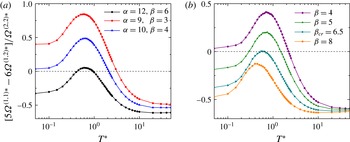
The conventional LJ 12-6 potential function used in figure 2 is a commonly adopted potential for van der Waals interactions between gas molecules. It may not be adequate to model the interaction of a gas molecule with a particle. A rigorous description of the molecule–particle interaction is complex. However, it is usually assumed that the overall molecule–particle potential can be described by the summation of the LJ interactions between the gas molecule and each constituent atom of the particle (Rouquerol, Rouquerol & Sing Reference Rouquerol, Rouquerol and Sing1999). The principle of additivity of the pairwise interactions has been widely used in exploring the interactions between molecules and nanoscale objects, although it has limitations (Girifalco, Hodak & Lee Reference Girifalco, Hodak and Lee2000; Wong et al. Reference Wong, Liu, Wang, Chao and Li2012). Thus, in our previous work (Wang & Li Reference Wang and Li2012), we proposed that the molecule–particle interaction can be expressed in a form similar to the LJ potential,
 $$\begin{eqnarray}{\it\Phi}(r)={\it\varepsilon}\left[c_{1}\left(\frac{{\it\sigma}}{r}\right)^{{\it\alpha}}-c_{2}\left(\frac{{\it\sigma}}{r}\right)^{{\it\beta}}\right],\end{eqnarray}$$
where
 $c_{1}$
,
 $c_{2}$
,
 ${\it\alpha}$
and
 ${\it\beta}$
are potential parameters. For the van der Waals interaction between a pair of gas molecules, we usually employ the LJ 12-6 potential. While, the interaction potential between a single molecule and a semi-slab of solid takes the 9-3 form (Hamaker Reference Hamaker1937; Everett & Powl Reference Everett and Powl1976; Seville, Tüzün & Clift Reference Seville, Tüzün and Clift1997). Moreover, if the interactions are confined to a single solid lattice plane, the interaction potential between a single molecule and the solid lattice plane takes the 10-4 form (Everett & Powl Reference Everett and Powl1976; Rouquerol et al.
Reference Rouquerol, Rouquerol and Sing1999). Therefore, it is expected that the
 $r$
dependence for the molecule–particle interaction potential will lie among these cases and the direction of the lift force depends on the potential parameters.
Variation of
 $[5{\it\Omega}^{(1,1)\ast }-6{\it\Omega}^{(1,2)\ast }]/{\it\Omega}^{(2,2)\ast }$
as a function of reduced temperature
 $T^{\ast }=k_{B}T/{\it\varepsilon}$
for (a) three pairs of
 ${\it\alpha}$
and
 ${\it\beta}$
values of the LJ
 ${\it\alpha}{-}{\it\beta}$
potential function and (b) different
 ${\it\beta}$
values of the LJ
 ${\it\alpha}{-}{\it\beta}$
potential function with
 ${\it\alpha}=12$
.

For illustrative purpose, we compute the reduced collision integrals by using (3.16). As shown in figure 5, the lift force can be positive in a range of temperatures regardless of the potential parameters. Furthermore, it is seen that the positive lift force takes place as the value of
 ${\it\beta}$
becomes less than a critical value
 ${\it\beta}_{cr}$
, for a given
 ${\it\alpha}$
. The terms involving in
 ${\it\alpha}$
and
 ${\it\beta}$
in (3.16) correspond to repulsive and attractive interactions, respectively. As
 ${\it\beta}$
increases (generally
 ${\it\alpha}>{\it\beta}$
), the molecule–particle interactions tend to be rigid-body collisions and positive lift forces will not occur. Due to the complexity of the reduced collision integrals, the criterion by which the direction of the lift force depends on the potential parameters is very complicated. Detailed information about this issue can be found in the reference by Wang & Li (Reference Wang and Li2012), which gives a theoretical criterion for negative thermophoresis in the free molecule regime.
4 Conclusions
In summary, based on the gas kinetic theory, we have derived an analytical formula for the lift force on spherical nanoparticles in shear flows of dilute gases by considering the gas–particle non-rigid-body interactions. The current formula can be reduced to that in the case of rigid-body collisions, which generalizes the theoretical formula to both micro- and nano-sized particles. We also present that the lift force on nanoparticles can be in the direction opposite to what it would be if the rigid-body collision is considered in a certain temperature range.
Acknowledgement
This work is supported by the National Natural Science Foundation of China (grants no. 51306004).