



INTRODUCTION
In the summer of 1673, in what Koenraad O. Meinsma once qualified as “one of the most inexplicable events in Spinoza's life,”Footnote 1 the philosopher left his residence in The Hague to travel to Utrecht and stayed there for some three weeks. This event has garnered much interest, for two main reasons. In the first place, it is agreed that something must have induced the rather homebound Spinoza to undertake the journey, especially since Utrecht was occupied at the time by the French, rendering travel dangerous. The paucity of available sources has kept most scholars from suggesting a motive, but those who have been so bold are virtually unanimous in positing that Spinoza traveled on a diplomatic or political mission,Footnote 2 referring in support to his first biographer Johannes Colerus's report, gathered from the philosopher's landlord Hendrik van der Spyck, that at his return he was greeted by a frenzied crowd that was ready to lynch him as a “spy, murmuring that he treated with the French of matters pertaining to state and nation,” with Spinoza countering that “many among the highly placed know why I went to Utrecht.”Footnote 3 A second reason for the interest is formed by the connection the trip offers between Spinoza and the French general in Utrecht, Louis II de Bourbon (1621–86), the prince of Condé, renowned not only for his military exploits but also for his interest in the arts and sciences, as evinced in his patronage of dissident thinkers like Isaac La Peyrère of pre-Adamite fame.Footnote 4 Condé thus figures in all early accounts of Spinoza's trip,Footnote 5 and yet the conflicting nature of these accounts, combined with the paucity of firsthand sources, has left later scholars debating at length the precise nature of the prince's involvement as Spinoza's inviter, as his host, and as his ready benefactor.Footnote 6
As such, the interest of Spinoza's visit to the city of Utrecht in the summer of 1673 surpasses that of the elusive mystery it represents for his biographers. For some it signals the philosopher's acquaintance with the Condé circle as a promising avenue to account for the French translation of the Tractatus theologico-politicus, and for the dissemination of his thought into France.Footnote 7 Others are less specific, but still recognize the potential offered by the association of Spinoza's name with the great Condé in terms of prestige, identifying the Utrecht visit as a key moment for the establishment of his renown in the intellectual world at large.Footnote 8 So too scholars have seized upon the alleged political motive behind the trip, framing the Utrecht jaunt as a reflection or extension of Spinoza's philosophical ideals. It has thus been suggested that the Utrecht trip was an opportunity for him to put his republican ideals into practice,Footnote 9 with one scholar even speculating about a link with the contemporaneous plans for a conspiracy against Louis XIV involving Spinoza's former Latin teacher Franciscus van den Enden (1602–74).Footnote 10 Similarly, the event has been placed in the context of his developing politics, specifically his work on the abortive Tractatus politicus during this same period.Footnote 11 Notwithstanding their differences, these narratives of the trip's significance are unified in their fixation on Condé and on the French occupying party as a whole.
This paper, however, will argue that the main actors for Spinoza's Utrecht visit are rather to be sought among the city's resident Cartesians. A detailed reconstruction of the trip will be offered in four parts, revisiting known sources and presenting newfound material. The first two sections will consider the circumstances under which the plans to have Spinoza brought to Utrecht were forged, demonstrating how they could not have been the brainchild of Condé, but had their origins in the Utrecht Cartesians’ fascination with the author of the Tractatus theologico-politicus. Two further sections will present the available evidence for the Utrecht stay itself, addressing Spinoza's interaction with the French libertine officers and with the resident Dutch Cartesians respectively. A concluding section will begin by offering a new hypothesis for the motive that led Spinoza to undertake the trip. Since the proposed historiographical shift away from Condé and his occupying forces effectively turns the Utrecht visit into an aspect of the Dutch rather than the French reception history of Spinoza's philosophy, the conclusion will also address the wider implications of this event. On a very concrete level, it will trace a line from the Utrecht visit to the renewed turmoil over Spinoza's thought that arose soon thereafter, leading him to abandon the printing of his completed Ethica. The trip to Utrecht would thus reduce his masterpiece to a posthumous work that could not be engaged until after his lifetime. More provocatively, the conclusion will also draw attention to the mutual respect that developed between Spinoza and the resident Cartesians during his stay in Utrecht in the summer of 1673. As such, the old discourse of opposition between Spinoza and the Dutch Cartesians in Utrecht will need to make way for a perspective that can also account for the underexplored points of convergence.
DEMOTING CONDÉ
The most debated aspect of Condé’s involvement with Spinoza's Utrecht visit has been his role as host. This question so fascinated Pierre Bayle that in the first edition of the Dictionaire (1697) he reported that Condé and Spinoza had not met, changed his mind for the second (1702), and finally reverted to his original position in a letter for the Mémoires de Trévoux (May 1706)—only to have the eighteenth-century editor of his correspondence, Pierre des Maizeaux, add a footnote to the latter missive when he published it, supplying alleged firsthand reports for an encounter between the prince and Spinoza.Footnote 12 While the thesis of a meeting continued to be defended by Richard Popkin (1992), who boldly claimed that there is “ample evidence that Spinoza met the Prince,” the fact of the matter is that it had long ago already been demonstrated to be untenable. On 15 July 1673, only days before Spinoza's arrival, the prince left Utrecht for Grave to bolster the French attack on Nijmegen, and never returned.Footnote 13
Of course, that Condé did not himself meet or host Spinoza in Utrecht does not mean he could not have been the one to invite him, as is often maintained as well. Yet recently Jeroen van de Ven denounced this frequently evoked supposition as a myth, arguing that the invitation was not extended by Condé, but by his officer, Jean-Baptiste Stoupe (1623–92), author of the 1673 polemical pamphlet La religion des Hollandois, in which Spinoza and his Tractatus are famously adduced as the worst example of what the ostensibly orthodox republic was willing to tolerate.Footnote 14 Central to Van de Ven's reconstruction is a brief, undated archival note he recovered from Stoupe to Johannes Georgius Graevius (1632–1703), professor of history and politics in Utrecht and, most importantly, a leading member of the city's Cartesian network.Footnote 15 Having identified Stoupe as Spinoza's inviter, Van de Ven still insists on Condé’s role in the plans, writing that the prince may have been “one of the originators of the plan.”Footnote 16 Yet rather than leaving open the possibility that Condé was the “originator” of the Spinoza plan, the note actually makes this option quite unlikely. Stoupe writes,
Tomorrow[Footnote 17] I will speak with his highness the prince about Spinoza. I do not believe, however, that his highness is willing to invite him in his own name to come. If any names of those who summon him are to be mentioned, you may mention me and Feuquières, and I promise to provide for travel expenses as well as all other costs. A letter of safe conduct will also be procured from his highness and sent to Spinoza. And if he obtains this safe conduct, he has nothing to fear. You, dear sir, will show him the way to take.
While Graevius's side of the conversation is unfortunately missing, the above text is sufficient to show that he had been entertaining worries which Stoupe now attempted to assuage. Evidently Graevius had let on his fear that costs might dissuade Spinoza from coming, and so Stoupe promises to take care of the finances. The Utrecht professor had also pointed to the potential danger of travel under the current circumstances, with Stoupe now assuring him that Spinoza will have no reason to fear once he has the necessary documents in hand. Graevius must therefore have known—somehow—that Spinoza was hardly eager to make the journey from The Hague to Utrecht.
How Graevius came by this information can be gathered from a series of newly found letters addressed to him by Johannes Bouwmeester (1630–80), an Amsterdam physician and one of Spinoza's closest friends.Footnote 18 The plans for the Utrecht visit are first touched on in a missive from 15 June 1673, when Bouwmeester writes that he has passed all the relevant information on to his friend.Footnote 19 It soon becomes clear, however, that Spinoza's departure for Utrecht is far from being a done deal. On 5 July Bouwmeester writes that he has passed also the latest details on to Spinoza, and then adds,
At last he responded that he had decided to go to you [pl.], if a letter of safe conduct can be obtained from the Prince of Orange. But if not, I hardly think it will be possible to move him to go. He is now applying himself zealously to this matter, and I have no doubt that he will obtain something, and he has promised to let me know as soon as possible.Footnote 20
Spinoza was thus hardly jumping to accept the invitation extended him. Not only did he take a long time to respond, he also took all necessary precautions to ensure that his return from French-occupied territory to the province of Holland would pass unhindered. Two weeks later, when the arrangements were in their final stage and Spinoza even had a passport from Condé in hand, Bouwmeester still felt it necessary to warn Graevius, “Whether he will come, I do not know. For up to now I have had no response from him.”Footnote 21 Indeed, the worry that Spinoza might bail at the last minute may also explain why the inviting party had asked Bouwmeester to accompany his friend on the trip, an offer he had to decline, to his regret.Footnote 22 Graevius had likely known that a Utrecht trip would be a hard sell to Spinoza ever since his visit to the province of Holland early in June, when he saw Bouwmeester in Amsterdam and presumably explored the possibilities of having Spinoza come to Utrecht.Footnote 23 He had left his hometown on or after 12 May 1673,Footnote 24 and first traveled to The Hague, where he looked up his closest friend and frequent correspondent Nicolaas Heinsius the Elder (1620–81). By 18 May he had traveled on to Amsterdam together with Heinsius,Footnote 25 meeting with, among others, the Amsterdam burgomaster Joan Huydecoper (1625–1704), and the Walloon pastor Louis Wolzogen (1633–90), who also served as professor of church history to the Athenaeum Illustre.Footnote 26 The way Heinsius later drops Spinoza's name in a letter to Graevius, without any other mention of the philosopher in their correspondence of the time, leaves little doubt that the two spoke of him during Graevius's visit.Footnote 27 One thus wonders whether Graevius first attempted to contact Spinoza in The Hague through Heinsius, only to seek the aid of Bouwmeester in Amsterdam thereafter.
However Spinoza's reluctance ended up coming to Graevius's attention, it seems to be the key to unlocking also that part of Stoupe's letter where the identity of the inviter is discussed. Here too Stoupe is responding to something Graevius had said or written to him, in this case that it would be best to enlist Condé to write a letter of invitation, so that Spinoza might be won over by his stature as well as by the level of safety his signature alone could guarantee.Footnote 28 Of course, this implies that Condé was not the mastermind behind the plans, but rather engaged by others to execute a part of their initiative. This is in fact precisely what the Nijmegen Huguenot pastor and professor Johannes Braun (1628–1708) wrote in his response to Stoupe's La religion, noting that it was at Stoupe's “request” that Condé had the philosopher come from The Hague.Footnote 29 The same hierarchy is suggested by the only extant firsthand source of the Utrecht trip apart from Stoupe's note to Graevius and the Bouwmeester letters. On 28 July 1673, Stoupe's older brother Pierre, who served as commander of the city of Utrecht for the French, reported to Condé about the hanging in effigy of Jean de Barthon, Viscount of Montbas, of which he had learned from “the man named Spinoza,” specifying that the latter had come “from The Hague at my brother's request”Footnote 30—not “your request.” That Condé had a supporting role and at best a moderate interest in getting Spinoza to Utrecht is suggested not only by the explicit identification here of Jean-Baptiste Stoupe as the initiator, but also by the fact that Pierre Stoupe's concern is not to announce Spinoza's arrival, but rather to pass on the latest intelligence from the province of Holland (incidentally gained from Spinoza), exactly as the prince had ordered at his departure from Utrecht.Footnote 31 Condé therefore could not have been the “originator” of the plan to bring Spinoza to Utrecht. Rather, his aid was sought by others to help them realize the plans they had been hatching themselves, without him.
The Tractatus theologico-politicus in Utrecht
By now it should be clear that Stoupe and Graevius were collaborating in the Spinoza plans before the prince became involved at all. That a French officer was working together with an occupied subject is a detail that ought not to go unnoticed, since the residents of Utrecht are known to have suffered considerably at the hands of their occupiers.Footnote 32 Yet not long before he received the note from Stoupe, Graevius can be found referring to the French as “my friends” in a letter to Heinsius, claiming he would have no problem obtaining a passport from them to visit him in The Hague.Footnote 33 By the spring of 1673, less than a year after Louis XIV had made his triumphal entry into Utrecht (4 July 1672), Graevius was thus enjoying an amicable relationship with the occupiers. This privileged position was the result of efforts undertaken by his friend Charles de Sainte-Maure (1610–90), the Duke of Montausier and soon to be appointed governor to the French dauphin. Immediately upon the fall of Utrecht, Montausier had taken Graevius's plight to heart, and tried to introduce him to the French command with a letter recommending him to the commander of the French forces within the province of Utrecht, François-Henri de Montmorency-Bouteville, the Duke of Luxembourg.Footnote 34 When this recommendation failed to have the desired effect,Footnote 35 Montausier sent two more, the final one in January 1673, this time accompanied by another letter introducing Graevius to Pierre Stoupe, the commander of the city of Utrecht.Footnote 36 Montausier's efforts finally proved successful, having been followed closely by at least two other members of the Republic of Letters in France who were concerned for Graevius's welfare, namely Jean Chapelain (1595–1674) and Melchisédec Thévenot (1620–92).Footnote 37 Thus, by February 1673 the Duke of Luxembourg accorded Graevius an exemption from the general tax levied upon Utrecht's residents, and several months later also from the horror of having to billet French soldiers.Footnote 38 It can hardly be a coincidence that the Utrecht classicist began to show firsthand knowledge of the occupiers’ affairs around this time,Footnote 39 and eventually found himself hobnobbing even with the great Condé himself.Footnote 40 On the French side, Pierre Stoupe was able in these same months to pass on news from Holland regarding William of Orange's popularity, which he had gained from “a professor of this city, originating from Leiden,” no doubt the pastor and theologian Francis Burman (1628–79), another member of the Utrecht Cartesian network and a close friend of Graevius, who himself is quite likely Stoupe's unidentified intermediary.Footnote 41
Among all the French, Graevius forged the closest and most lasting bond with the younger Stoupe, Jean-Baptiste, who on leaving the city at the end of the occupation requested that they continue their friendship by way of correspondence.Footnote 42 A decade later, the two could still be found corresponding.Footnote 43 Similar relations were cultivated between Stoupe and the Utrecht physician and councillor Lambertus van Velthuysen (1622–85), another leading member of the city's Cartesian network along with Burman and Graevius. Van Velthuysen and Stoupe will first have met in the summer of 1672 through their respective roles in regulating the city's surrender.Footnote 44 Following the occupation, Stoupe showed a genuine concern for Van Velthuysen after his ousting from the city council (vroedschap) by the Orangists,Footnote 45 while a decade later the memory of their bond was still sufficiently strong for the Utrecht physician to pass his greetings on to Stoupe.Footnote 46
There is no doubt that the idea to have Spinoza visit Utrecht arose in this growing interaction between the resident Cartesians and the French officers. From an early time, the Utrecht Cartesians had declared themselves for Descartes in matters of natural philosophy and epistemology, and, given the threat of the ever-changing institutional balance of power in their city, they met on a weekly basis in the freedom of a closed learned society, disparagingly styled the “college of savants” (collegie der sçavanten) by their opponents, in order to discuss the latest philosophical works.Footnote 47 It is in this context that we must place their preoccupation with the Tractatus theologico-politicus ever since it turned up in their city in April 1670.Footnote 48 Within months, Van Velthuysen had penned a letter that arguably represents the first serious rejoinder to the Tractatus, famously writing that its author was secretly introducing “atheism.”Footnote 49 So too Regnerus van Mansveld (1629–71), professor of philosophy at the university, devoted the final months preceding his unexpected death in May 1671 to an exhaustive, chapter-by-chapter refutation, which Graevius brought to press with the help of Wolzogen, who had been a fellow Utrecht “savant” up until his departure for the Amsterdam Athenaeum late in 1669.Footnote 50 Throughout this time, both Graevius and Burman were mobilizing their extensive networks to recruit a Dutch champion to refute the Tractatus, describing that work in their letters as a “most pestilential book” (liber pestilentissimus).Footnote 51 These efforts, which amounted to a veritable campaign against the Tractatus under the somewhat surprising leadership of the classicist Graevius, no doubt followed from their undisguised horror at its contents, and yet that horror was nearly matched—as was also true for the German polymath G. W. Leibniz, for exampleFootnote 52—by an evident admiration for the obvious genius behind the work. The Utrecht Cartesians’ preoccupation with this fascinating man Spinoza extended well into the period when Graevius and Van Velthuysen were developing a relationship with the French. And, since the mouth speaks from the overflow of the heart, there is little doubt that the two spoke of Spinoza with their new occupier friends as they were wined and dined by them.Footnote 53
These Spinoza conversations are, in fact, reflected in Stoupe's La religion, penned during that period when the Utrecht Cartesians were ingratiating themselves with members of the French command.Footnote 54 This well-known polemical treatise responds to an unnamed Bernese theologian's condemnation of Protestant men like Stoupe serving the Catholic king of France in his war on the Reformed Republic. When Stoupe comes to Spinoza in his long line of heretics, the account of the Tractatus is derivative in nature, and shows itself indebted to none other than Van Velthuysen's famous “atheism letter,” which the latter presumably showed to him.Footnote 55 Curiously, the secondhand account of the Tractatus is accompanied by apparent firsthand knowledge of its author, as Stoupe claims that although Spinoza may not openly give his view on the Divine Being in the Tractatus, he “in discussion clearly says that God is not a being endowed with intellect, infinitely perfect and happy, as we imagine; but that he is nothing but the power [vertu] of nature which is spread throughout all creatures.”Footnote 56 This is information Stoupe himself could hardly have gained directly from Spinoza.Footnote 57 Rather, like his overview of the Tractatus, it too likely came from the Utrecht “savants,” who had been making extensive efforts to find out who this Spinoza really was.
A likely source for what Stoupe claims to be Spinoza's private opinion is the Dordrecht grain broker Willem van Blyenbergh (1632–96), who became suspicious after his reading of the 1663 Cogitata metaphysica and started a correspondence with the philosopher soon after their appearance. Although Spinoza famously cut off this correspondence, Blyenbergh did manage to hold a personal meeting with him (1665) prior to that time, in the course of which the two undoubtedly discussed the nature of God, since it was the worrisome implications of the Cogitata metaphysica for this doctrine that had originally prompted Blyenbergh to write. Then, after the anonymous Tractatus appeared in 1670, Blyenbergh wrote a refutation of this work, which he suspected to be that of Spinoza as the author of the Cogitata, and shopped the manuscript of his rejoinder around among the Utrecht Cartesians, trying to solicit the aid of the celebrated Burman to get it published.Footnote 58 Significantly, one of the themes Blyenbergh touches on is God's perfection, charging that the anonymous author's apparent insistence on the world's necessary emanation from God's nature implies that the range of actuals and possibles is coextensive, thereby denying freedom of indifference to God and thus his infinite perfection.Footnote 59 To this questionable charge against Spinoza's philosophy one might add a second, since Blyenbergh in his later refutation of the posthumous Ethica insisted—this time even against Spinoza's explicit assertions to the contrary—that he denied intellect to God, which is again a divine attribute appearing in Stoupe's account of Spinoza's clandestine views.Footnote 60 The rather ambiguous and questionable accuracy of Stoupe's report in La religion about Spinoza's alleged oral revelations is exactly what one might expect if indeed his information originated with Blyenbergh, given the latter's tendency to posit his own conclusions as Spinoza's authentic views, as in the above instances, as well as the indirect route his reports traveled via the Utrecht Cartesian network before they found their way into La religion. Stoupe's pamphlet thus witnesses his interest in the Dutch philosopher at the hand of what he learned from his newfound friends. And somewhere in these discussions, someone once raised the idea to invite Spinoza to Utrecht.
THE FRENCH COMMAND
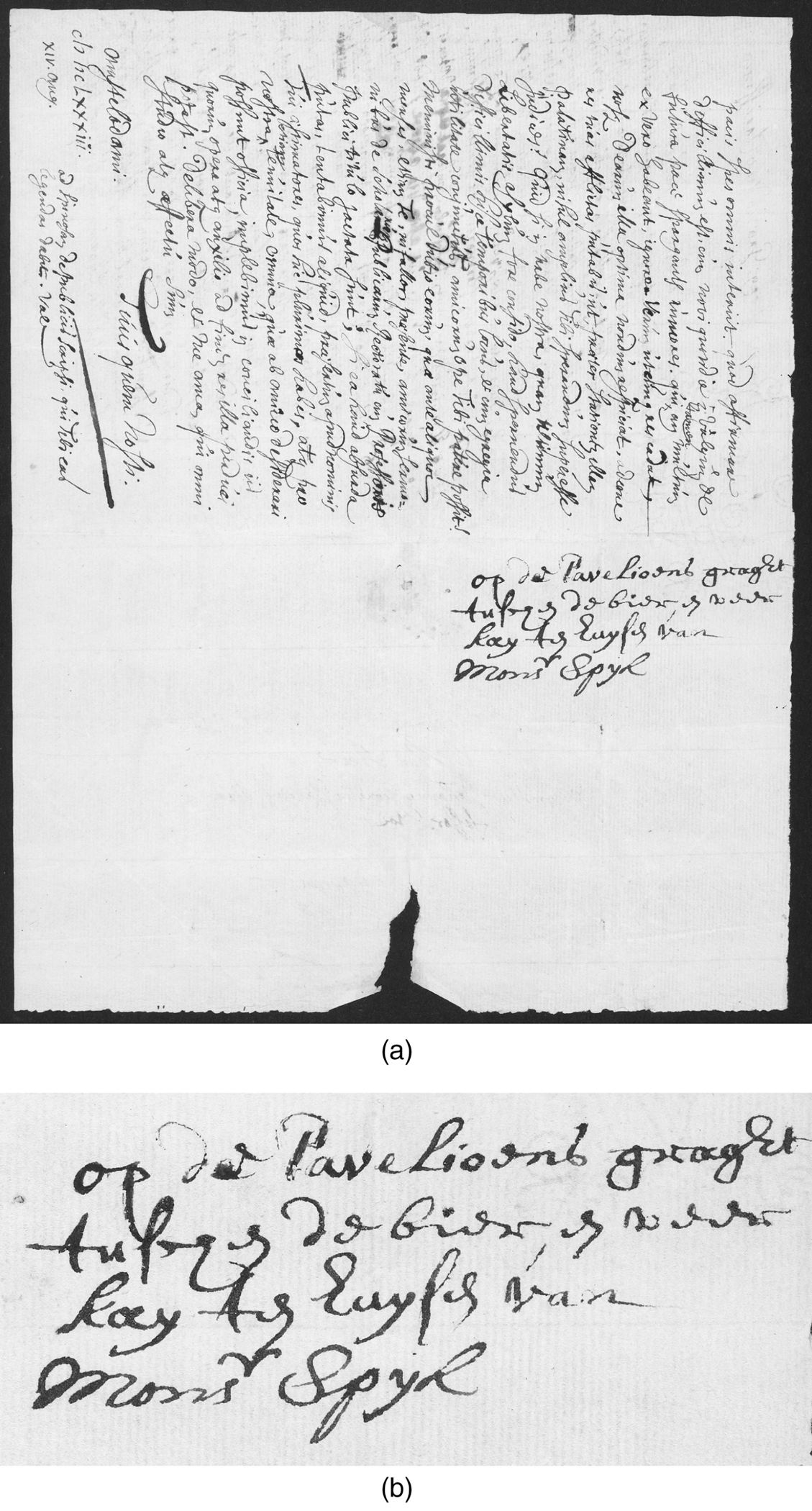
Armed with a French and (presumably also) a Dutch passport, Spinoza at long last set out from The Hague on 26 July 1673, and, traveling via Gouda, arrived in Utrecht a day or two later.Footnote 61 He spent three weeks there, in the course of which the situation back home turned increasingly precarious under the threat of the British fleet stationed on the coast of the republic. On 7 August 1673, Bouwmeester, who had switched roles with Graevius and now used the latter as his intermediary to reach Spinoza, reported how the enemy's cannons had come within striking range of The Hague, scattering terror among the residents who “began to carry off their most precious belongings in carts and barges.” This was not just news sent as news, but had a direct bearing on Bouwmeester's philosopher friend. For he adds, “And, to be honest, I too am beginning to fear for the literary output of Spinoza's nocturnal studies, which I commit to a better destiny.”Footnote 62 Bouwmeester must have been thinking primarily of the Ethica, knowing as one of Spinoza's closest friends that he was finally nearing completion of this masterpiece, the future of which now seemed to be jeopardized. Fearing that it, and perhaps drafts of earlier writings like the Tractatus de intellectus emendatione and Korte verhandeling, would be lost to posterity, Bouwmeester requests Graevius to inform Spinoza of the situation, offering to carry out whatever instructions his friend might have for him in return.Footnote 63 A week later (14 August 1673) Bouwmeester sent Graevius a new letter, accompanied by an additional one for Spinoza himself containing the latest report on the situation in The Hague,Footnote 64 which seems to have prompted his friend to return almost immediately. For a hasty departure is suggested by the address Spinoza jotted down in Bouwmeester's letter for Graevius, so that the latter might be able to reach him in The Hague.Footnote 65 That Bouwmeester's final reports concerning the British naval threat were as alarming as the earlier ones, if not more so, might be deduced from the fact that it was not until the Battle of Texel at Kijkduin (21 August 1673) that the Dutch, under the leadership of the legendary admirals Michiel de Ruyter and Cornelis Tromp, finally managed to secure an important strategic victory. By 20 August 1673, however, Spinoza had already set out to return to The Hague.Footnote 66
Image (a) and detail (b) of Spinoza's hand in a letter from Johannes Bouwmeester to Johannes Georgius Graevius from 14 August 1673. Danish Royal Library, Thott 1267 4°, folder “Breve til Graevius uden Underskrift.”
Given the paucity of available source material, it is difficult to determine how exactly Spinoza spent his three weeks in Utrecht. Yet at his arrival, he was no doubt greeted by a French welcoming committee whose members included Stoupe and presumably the Duke of Luxembourg, the highest-ranking nobleman left in Utrecht following the departure of Condé.Footnote 67 Spinoza will have been surprised not to find Condé among his hosts. For while Stoupe had expressed his doubts to Graevius that the prince would allow his name to be used for an invitation, he may have been wrong in this supposition. In fact, there is also reason to think he was, since if Condé did agree to be the figurehead, it would explain why his name has from the very beginning been connected to the trip. And if the prince did lend his name to the invitation, then one might assume that he became at least somewhat enthused about Spinoza once the idea had been pitched to him. It thus remains possible that, as the early reports variously insist, Condé ordered a warm welcome for Spinoza and a gift to be given him at his departure; that he, much to the delight of the curieux (i.e. his libertine officers) who appreciated Spinoza's presence in Utrecht, repeatedly asked him to await his expected return; or that he plied him with offers of his own patronage or that of the king.Footnote 68 Without new evidence, the veracity of these reports cannot be fully proven one way or another. But in the end it is perhaps telling that the prince's extant correspondence from this time—with the one exception of the letter from Pierre Stoupe—is altogether silent on Spinoza, although for the rest it does occasionally touch on matters of a more personal nature, aside from strictly military and political affairs.Footnote 69
Spinoza presumably devoted much time to conversation with a new and interested audience, daring perhaps to be more open with men who would have been much less worried about the potential threat his views represented for the stability of the republic. Foremost among his listeners was Stoupe. After all, Johannes Braun was entirely correct to point out that the Swiss lieutenant colonel's attempt in La religion to undermine the orthodox Protestant character of the United Provinces by referring to Spinoza was rather disingenuous given his involvement in the latter's Utrecht visit, suggesting that the two in fact had common—that is, atheistic—interests.Footnote 70 Some contemporary readers even saw the passage where Stoupe, who had a penchant for books of a questionable orthodoxy,Footnote 71 remarks on the curious absence of a rejoinder from orthodox theologians to the Tractatus as a thinly veiled accolade to Spinoza, particularly for the Hebraica and weighty arguments he brought to bear in the work.Footnote 72 The philosopher's French audience probably also included the aforementioned Marquis of Feuquières. Since the occupiers retained their forms of sociability on the campaign trail, Spinoza's conversations with Stoupe, Feuquières, and other French officers will for the most part have taken place in a dinner setting.Footnote 73 Interestingly, such dinners are even alluded to in a verse that the Dutch Collegiant poet Joachim Oudaan (1628–92) prefaced to Adriaan Verwer's refutation of Spinoza's Ethics, evoking not only his general reversal of religion, but specifically also his revelations to the French while at table with them in Utrecht: “Never cleansed will be that stain / in which [Spinoza] took pride while dining with the French. / Utrecht knows what it is; here it is better left unspoken.”Footnote 74
For the French officers, listening to Spinoza no doubt formed a welcome diversion on their campaign. After all, by that time he had become something of a Dutch “must-see,” with his fame extending beyond the borders of the United Provinces. The German mathematician and natural philosopher Johann Christoph Sturm (1635–1703) had in fact already been curious to see “this exotic animal” (exoticum hoc animal) prior to the publication of the 1663 Principia philosophiae and the appended Cogitata metaphysica, while a decade later the chancellor Christoph Joachim Nicolai von Greiffencrantz (1649–1715) depicted the philosopher as an attraction of sorts.Footnote 75 Something similar can be observed in the French context, as the poet Jean Dehénaut (1611–82) reportedly looked up Spinoza while traveling through Holland in 1668–69, as did Charles de Saint-Denis, sieur de Saint-Évremond (1613–1703), during a stay there from 1665 to 1670.Footnote 76 How many French officers in Utrecht had actually heard of Spinoza prior to their arrival in Utrecht cannot be determined with certainty. In any case, some of them, like Stoupe, developed a genuine interest in him, inspired by what they had heard from their newfound Utrecht Cartesian friends, but for most this Dutch “exotic animal” was just another thing to distract them from the humdrum of military life.
DUTCH ECHOES OF THE UTRECHT VISIT
Spinoza undoubtedly also spent considerable time in conversation with the Utrecht Cartesians, perhaps in the company of their new French friends, but also on their own. The way Bouwmeester came to use Graevius to relay information to and from Spinoza leaves no doubt that the Utrecht classicist had easy access to him. Although Graevius never did alter his tone on the blasphemous nature of Spinoza's philosophy,Footnote 77 the two did apparently develop an amicable personal relationship of sorts during the summer of 1673. After all, the address the philosopher jotted down at their parting in Utrecht has every appearance of an invitation to stay in touch. Less than a week after he had returned to The Hague, Spinoza in a hitherto unknown episode of his life paid a visit to Heinsius, a classicist and statesman with close connections to the Prince of Orange, and announced himself in Graevius's name.Footnote 78 Since Heinsius missed the philosopher as he was out walking at the time, and no further mention is made of this episode in the later correspondence, one is unfortunately left speculating about Spinoza's intentions for visiting Heinsius and the background to the affair, which presumably goes back to his stay in Utrecht. Nevertheless, what is almost certain is that Spinoza and Graevius discussed Descartes and his legacy. Cartesian heritage would, of course, already have been a natural topic for Spinoza to discuss with the Utrecht “savants,” but the suggestion is further bolstered by the letter Spinoza sent to Graevius on 14 December 1673, asking him to return “that letter on the death of Descartes,” written by the physician Johannes van Wullen (fl. 1615–50) to Willem Piso (1611–78), since it did not belong to him.Footnote 79 Interestingly, the letter in question includes certain passages less favourable to Descartes, as when Van Wullen expresses the hope that at his death he did indeed commit his spirit to God, “although, if you examine his writings carefully, a theologian recently charged him with atheism.”Footnote 80
Another person with whom Spinoza no doubt conversed in Utrecht is Van Velthuysen, who in 1671 had identified the Tractatus as the work of an atheist. He says as much in the preface to his collected works, published in 1680, writing that he exchanged “many words” (multos . . . sermones) with him.Footnote 81 It should come as no surprise that Spinoza and Van Velthuysen, whose philosophical and theological acumen far surpassed that of Graevius, enjoyed each other's conversation. There are, after all, similarities in their respective accounts on the interpretation of Scripture, on the freedom of thought, and on the separation of theology and philosophy, as well as their efforts to construct a naturalist ethics.Footnote 82 While these affinities may have compromised Van Velthuysen in the public eye, forcing him to create some distance by delineating his position more carefully,Footnote 83 for their in-person meetings, on the contrary, they represented promising material for discussion. By the end of the three weeks in Utrecht, Spinoza had so adjusted his original judgment on Van Velthuysen that in 1675 he sent him an altogether congenial letter, seeking permission to include the latter's manuscript refutation in a planned new edition of the Tractatus, together with a reply. He adds,
But to confess the truth, you would do something much more pleasing to me, if you were willing to write down those arguments by which you think you can combat my treatise, and add them to your manuscript. I beg you, most earnestly, to do this. For there is no one whose arguments I would be more pleased to weigh carefully.Footnote 84
In Utrecht Spinoza thus came to recognize Van Velthuysen as a critic different from all others, of whom he was generally contemptuous. Spinoza had good reason to feel the way he did, as Van Blyenbergh had hardly been the only one who proved unable really to grapple with his thought, which many “refuted” with little more than horrified gasps at its blasphemous nature. Van Velthuysen, on the other hand, describes how far he went to make sure he had first properly understood him. A proper refutation, he insists, must be preceded by a lucid exposition of an opponent's thought—and this, he writes, is where many have failed in regard to Spinoza, with some even preferring for his views to remain “enshrouded in darkness.”Footnote 85 In spite of the fear that Van Velthuysen's readiness to grapple with Spinoza's thought might be taken ill of him,Footnote 86 contemporaries soon noticed how his refutation surpassed the efforts of many theologians precisely because they had failed to comprehend him and he had succeeded.Footnote 87
During their conversations, Van Velthuysen and Spinoza could hardly have avoided the topic of God. This was, after all, the greatest question the early readers of the Tractatus were left with, as Spinoza had only lifted the tip of the veil on the God of the later Ethics. Nevertheless, to many his denial of the distinction between God's will and intellect and his identification of divine decrees with natural laws in chapters 3 and 6 already seemed to impose a necessity on all things, including God, and to suggest an equation of God and nature. This point is repeatedly raised by the earliest detractors of the Tractatus, from the German Reformed pastor Johannes Melchior (1646–89), to the Remonstrant theologian Jacobus Batelier (1593–1672), and the Collegiant Johannes Bredenburg (1643–89),Footnote 88 but Van Velthuysen was among the very first to do so: “What room can there be for a last judgment, or what expectation of reward or punishment, when everything is ascribed to fate and it's maintained that all things emanate from God by an inevitable necessity—or rather, when one maintains that this whole universe is God? For I fear that our author is not very far from that opinion.”Footnote 89 In Utrecht Van Velthuysen may thus have derived much pleasure from his conversations with Spinoza on a variety of topics, but as the latter, under probing from his attentive audience, presumably revealed more of the underlying metaphyscis, he also had his worst fears confirmed. Van Velthuysen's 1680 refutation of the Ethica and Tractatus theologico-politicus thus devotes the most of its attention to the Divine Being, the preface noting that he will pass in silence over the many objectionable specifics, preferring a wholesale approach, since, “once the first foundations which the author lays in his posthumous work have been torn down, the rest of the structure will fall.”Footnote 90 When this work emerged from the press, Christopher Wittich (1625–87), another leading Dutch Cartesian, praised Van Velthuysen in particular for his treatment of Spinoza's God.Footnote 91
In Utrecht Spinoza also became acquainted with Joachim Nieuwstad (c.1623–96), secretary to the city and thus a vroedschap member. This is clear from the aforementioned letter that Spinoza sent to Van Velthuysen in 1675, where Spinoza wrote that he had told “our friend Nieuwstad” about his intention to publish Van Velthuysen's letter on the Tractatus.Footnote 92 After Spinoza had left his city, Nieuwstad therefore corresponded with him or even looked him up in The Hague, perhaps taking letters from Utrecht on occasion.Footnote 93 A mathematician by trade, the reasons for Nieuwstad's interest in Spinoza would seem to have differed from those of Graevius and Van Velthuysen. If one might hazard a guess, perhaps it was a common concern for fluid mechanics and its application in civil engineering that united them. In the early 1670s Nieuwstad was performing depth measurements in the Rhein, Waal, and IJssel rivers for a project spearheaded by Johannes Hudde (1628–1704), a mathematician in Amsterdam and later burgomaster there.Footnote 94 In 1675 Nieuwstad appears as a member of a party that presented plans to the States of Utrecht for a canal connecting Utrecht to the Eem river, in order to improve its accessibility by water.Footnote 95 That Spinoza too was interested in matters of fluid motion has long been known from a 1660 letter to his friend Jarig Jelles, describing an experiment that readily envisions application in projects of the kind in which Hudde was involved.Footnote 96 Hudde was in fact a correspondent of Spinoza's and even collaborated on scientific projects with him, so Nieuwstad's name might already have been familiar to the philosopher prior to the Utrecht visit. Presumably Nieuwstad, who belonged to the same patrician class as Van Velthuysen, was not the only member from the circle of Utrecht's ruling class that Spinoza met in 1673, but any such meetings have failed to leave a record of themselves.
A notable figure on the Dutch side whom Spinoza missed was the “savant” Burman. As a young student of theology Burman had visited Descartes in 1648 to discuss key philosophical problems he perceived in the latter's Meditationes de prima philosophiae (1644), Principia philosophiae (1644), and Discours de la méthode (1637),Footnote 97 and as a mature, convicted Cartesian he read the Tractatus theologico-politicus several times upon its publication.Footnote 98 Later his interest in Spinoza even sparked rumours that he had drawn “all his doctrine” from him.Footnote 99 In the summer of 1673, however, much like Condé, he left Utrecht right around the time Spinoza arrived, and did not return from Leiden until the latter was gone.Footnote 100 Yet it is certain that Graevius reported on Spinoza in the regular updates he sent to Burman. On 20 August 1673, he wrote, “I would like to see the disputations of Wittich concerning which I recently spoke. The one he is said to be opposing has returned home. He said that he knew nothing about these disputations, except what he had heard from Wittich's colleagues.”Footnote 101 There is little doubt that Graevius is referring to Spinoza here, choosing to write obliquely lest Burman and he himself become associated with the philosopher.Footnote 102 At the time Wittich was finishing up a series of twenty-two disputations on the “actual providence” of God, directed against “those who either doubt whether there is a God, or openly deny that he exists, or substitute the world or nature for God.”Footnote 103 Although Spinoza does not make a direct appearance in these disputations, it is easy to see how—as Graevius had heard—they might have been framed as an attack on him, especially since Wittich's historical survey reveals that those who confuse God and nature are his primary target, and since he, reflecting Van Velthuysen's “atheism letter,” charges that when God's providence is overturned, “the subversion of all piety and a great confusion of all things are to be expected.”Footnote 104 When Burman returned to Utrecht a week or so after Spinoza had left again, Graevius and Van Velthuysen evidently filled him in on the conversations that had taken place. Several years later Burman would attack his conservative Voetian colleagues at the university by suggesting that they had intimated the existence of a third kind of substance aside from body (extension) and mind (thought). This, he provocatively added, came close to the “secret and private opinion [of Spinoza and his followers] insofar as I have come to know it.”Footnote 105 The clandestine view that Burman ascribes to Spinoza is a notion of substance that surpasses what one might have been able to cull from the 1663 Cogitata metaphysica, while still falling short of what could be expected from someone who has read the Ethica—a work that Burman in fact could not have read at the time, since Spinoza's posthumous works were still at press.Footnote 106
CONCLUSIONS
The above reconstruction makes it possible, first of all, to offer a new account of the reason why Spinoza was moved to travel to Utrecht. The most common suggestion that his primary motive was to undertake a political mission—whose nature, tellingly, scholars have on the whole failed to specify—finds little support in this reconstruction. After all, while Colerus's report does indicate that the mob suspected political motives, Spinoza's purported appeal to highly placed men who knew of the reasons for his trip, if reported accurately at all, can also be readily understood to refer to those through whom he had obtained a passport from William III.Footnote 107 In fact, it is altogether unlikely that Spinoza undertook a diplomatic mission of any significance at all, since such a mission would have had to come from those who held power on either the Dutch or the French side. Yet it cannot have come from the Dutch, since the above reconstruction clearly shows the initiative to have been on the Utrecht side, nor would Bouwmeester, on that account, have needed to warn Graevius that Spinoza's departure was conditional upon his procuration of a passport from the Prince of Orange. So too a commission from the French makes little sense in light of Condé’s at best distant interest in Spinoza. What Bouwmeester's correspondence suggests is that Spinoza would have been almost as content not to make the trip to Utrecht as to make it, but that the scales were eventually tipped in favour by something—which, in light of Graevius's insistence to Stoupe on involving Condé must almost certainly have included the prince. Admittedly, what is known of Spinoza's character makes it somewhat unlikely that he went to Utrecht just for some good conversation with the prince, or that he was awed by the prospect of a brush with fame. But what le Grand Condé with his stature and network could have offered Spinoza in his eyes was an avenue for the wider diffusion of his thought beyond the borders of the United Provinces. It is, after all, no secret that the dissemination of the Tractatus, which spread quickly in Dutch and German territories, passed rather slowly in both England and France, due at least in part to the Anglo- and Franco-Dutch wars.Footnote 108 That his limited audience concerned the all too human Spinoza can be gathered from his efforts in 1675, following the end of the Third Anglo-Dutch war, to have the Tractatus sold in England through Henry Oldenburg (1619–77), who could ill hide his discomfort at the possibibility of becoming associated with the project in the public eye.Footnote 109 Such a prosaic account of the philosopher's motives for accepting the invitation to Utrecht is entirely in line with the image of a hesitant Spinoza, for whom the pros finally outweighed the cons. Ironically, it also means that Condé’s involvement, however marginal, probably was what ultimately pushed Spinoza over the line.
While the diminished role of Condé in the Utrecht visit may initially seem a disappointment, the new reconstruction focused around the city's resident Cartesians actually turns the event into an integral part of the history of Spinoza's reception in the Dutch Republic, with an importance far surpassing that of the nebulous curiosity it once was. For one thing, the knowledge that Burman had obtained of Spinoza's private opinions indicates that once he was in Utrecht, he let on more than his careful self typically did, revealing certain tenets that up to that time had been almost exclusively the prerogative of his closest friends. The revelations, some of which reached even the ears of the poet Joachim Oudaan, were not without effect. This can be concluded from one of the instructions that the consistory of the Utrecht Walloon church gave on 22 August 1675 to its delegates to the upcoming synod, namely to table a motion for the churches to petition the States General, the individual provincial states, and the Prince of Orange “to use their authority . . . to prevent the man Spinoza from spreading his detestable errors and his atheism in this country.” Significantly, the consistory specifies that Spinoza is “all too well known in these quarters by the impieties he has taught here both in his books and in his conversations.”Footnote 110 Since this proposed motion came after the republic-wide banning of the Tractatus by the States General (1674), it must relate to the rumours that were circulating at the time about Spinoza's plans to publish another workFootnote 111—and it was after his visit to Utrecht that people outside his immediate circle were finally able to form an idea of just how pernicious that new work would be. The Walloon synod's adoption of this motion, and the efforts the ecclesiastical leaders subsequently made, in turn form the direct background to Spinoza's complaint to Oldenburg in the fall of 1675 that “certain Theologians . . . took the opportunity to complain about me to the Prince [of Orange] and the Magistrates,” and his decision to abandon the printing of the Ethica which he had been planning to commit to press at that very time.Footnote 112 Spinoza may thus have undertaken the trip to Utrecht to gain a greater audience abroad, but his revelations there only brought additional scrutiny that ended up curtailing the public dissemination of his thought within the very republic itself. Having survived the threat of the British cannons in The Hague, the manuscript of the Ethica would remain unpublished as long as its author was alive.
Finally, in discarding older scholarship's myopic fascination with the French and framing the Utrecht visit as a key moment in the Dutch reception history of Spinoza, the intellectual historian also has a new challenge to face. Typically the relationship between Spinoza and the Dutch Cartesians has been depicted in terms reflective of his famous frustrations in the aforementioned letter to Oldenburg at “the stupid Cartesians [who], because they are believed to favor me, try to remove that suspicion from themselves by constantly denouncing my opinions and writings everywhere.”Footnote 113 Scholarship has thus consistently been a story of philosophical incompatibilities, and of the political discomfort into which the Dutch Cartesians were driven by the likes of Samuel Maresius (1599–1673), who exploited the evident Cartesian heritage of the Tractatus to vindicate his prophecies about the evils to which Descartes's philosophy would lead. But Spinoza showed himself entirely congenial to Graevius and Van Velthuysen in the wake of his visit. So too Graevius's continued denunciations of the former's thought bely his evident fascination with all things related to Spinoza in his correspondence. As for Van Velthuysen, he was so captivated by the Ethica that he persisted in his wrestles with this difficult work well after he had published his extensive refutation in 1680.Footnote 114 While some thought ill of Van Velthuysen's attention to understanding Spinoza's philosophy, Spinoza appreciated it, as he lets on in his 1675 letter to him—which serves to mitigate the philosopher's harsh reference to the “stupid Cartesians” in those very same days in its application to Van Velthuysen, or even to exclude him altogether. The discussions held in Utrecht thus signal a newfound mutual respect, which ought to incite scholars to consider at greater length the topics they might have discussed with greater agreement between them than the notion of substance, for example. Among them are the extent of the authority wielded by religious leaders and the grounding of ethics, as two issues that both had a wide impact on the wider culture of the United Provinces. Therefore, as an exercise in understanding “real historical figures in all their complexity,”Footnote 115 a new account of the relationship between Spinoza and the Dutch Cartesians must move beyond a discourse of opposition alone, and seek to address also the commonalities between their respective projects within the intellectual and political context of the Dutch Republic.



