INTRODUCTION
Holothuriidae is one of the families of echinoderms most widely distributed in the shallow waters, with about 180 known species (O'Loughlin et al., Reference O'Loughlin, Paulay, VandenSpiegel and Samyn2007). Their representatives are classified in the genera Actinopyga, Bohadschia, Labidodemas, Pearsonothuria and Holothuria (Massin et al., Reference Massin, Samyn and Thandar2004). Among these, the genus Holothuria contains about 80% of the species and comprises 19 subgenera (Honey-Escandón et al., Reference Honey-Escandón, Solís-Marín and Laguarda-Figueras2011). The subgenus Holothuria (Holothuria) is characterized by the presence of buttons with rounded or pointed knobs giving the button a very rugose appearance (Rowe, Reference Rowe1969). This subgenus has eight valid species: Holothuria (Holothuria) caparti Cherbonnier, Reference Cherbonnier1964; Holothuria (Holothuria) dakarensis Panning, Reference Panning1939; Holothuria (Holothuria) fungosa Helfer, Reference Helfer1912; Holothuria (Holothuria) helleri Marenzeller von, Reference Marenzeller1877; Holothuria (Holothuria) mammata Grube, Reference Grube1840; Holothuria (Holothuria) massaspicula Cherbonnier, Reference Cherbonnier1954; Holothuria (Holothuria) stellati Delle Chiaje, Reference Della Chiaje1824; and Holothuria (Holothuria) tubulosa Gmelin, Reference Gmelin1791. According to Borrero-Pérez et al. (Reference Borrero-Pérez, Pérez-Ruzafa, Marcos and González-Wangüemert2009) the species H. (H.) dakarensis, H. (H.) stellati, H. (H.) tubulosa and H. (H.) mammata belong to a similar species complex whose taxonomic status is the subject of frequent discussions. Of these, H. (H.) dakarensis was found only in the north-western Atlantic and on the Atlantic coast of Africa. The purpose of this study is to record the species Holothuria (Holothuria) dakarensis in the south-western Atlantic for the first time. We provide morphological, geographical and ecological updates, based on material from hypersaline mangroves in north-eastern Brazil.
MATERIALS AND METHODS
The material examined was deposited in the Coleção de Invertebrados Paulo Young, Universidade Federal da Paraíba, Brazil. The methods used to analyse the specimen followed those of Rowe & Doty (Reference Rowe and Doty1977) and Pawson et al. (Reference Pawson, Pawson and King2010). Tissue fragments from tentacles, body wall, papillae and tube feet were immersed in a 3% solution of sodium hypochlorite and washed in five changes of distilled water and afterwards in five changes of absolute ethanol for the extraction of ossicles. Slides were prepared and observed under a light microscope. Other samples were dried and mounted on metal stubs, coated with gold and observed under a scanning electron microscope. Photographs of the specimen were taken using a Canon Powershot A2000IS digital camera.
Abbreviations used: International Union for Conservation of Nature (IUCN); Echinodermata from Coleção de Invertebrados Paulo Young, Universidade Federal da Paraíba (UFPB.ECH).
RESULTS
SYSTEMATICS
Phylum ECHINODERMATA (Klein, Reference Klein1734)
Class HOLOTHUROIDEA (Blainville, Reference Blainville1834)
Order ASPIDOCHIROTIDA Grube, Reference Grube1840
Family HOLOTHURIIDAE Ludwig, Reference Ludwig1894
Genus Holothuria Linnaeus, Reference Linnaeus1767
Subgenus Holothuria (Holothuria) Linnaeus, Reference Linnaeus1767
Holothuria (Holothuria) dakarensis Panning, Reference Panning1939
(Figures 1&2)
Holothuria stellati dakarensis—Panning, Reference Panning1939: 538–541.
Holothuria (Holothuria) dakarensis—Pawson & Shirley, Reference Pawson and Shirley1977: 915– 920; Pawson et al. Reference Pawson, Pawson and King2010: 37–38.
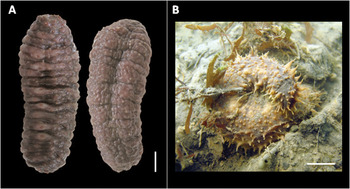
Holothuria (Holothuria) dakarensis (UFPB.ECH-2158): (A) outer aspect, dorsal and ventral views, respectively; (B) living specimen in its natural environment. Scale bars: A, B, 10 mm.

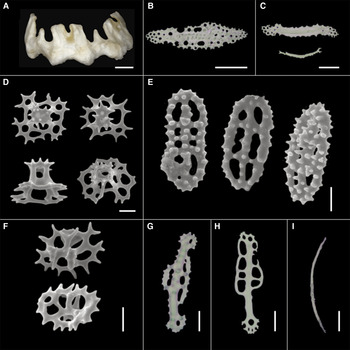
Ossicles in Holothuria (Holothuria) dakarensis (UFPB.ECH-2158): (A) calcareous ring; (B) perforated plate of tentacles; (C) perforated and simple rods of tentacles; (D) tables of ventral body wall; (E) buttons with rugosities of dorsal body wall; (F) smaller tables of dorsal body wall; (G) perforated plate with rugosities of ventral body wall; (H) perforated plate with smooth margin of ventral body wall; (I) curved rod of tube feet. Scale bars: A, 1 mm; B, 100 µm; C, 50 µm; D, 20 µm; E, 20 µm; F, 25 µm; G, H, 40 µm; I, 50 µm.

TYPE MATERIAL
Holotype in the Zoological Museum, Natural History Museum of Denmark, Denmark (Panning, Reference Panning1939).
TYPE LOCALITY
Dakar, Senegal (Panning, Reference Panning1939).
MATERIAL EXAMINED
UFPB.ECH-2158, 1 sp., Macau mangroves, State of Rio Grande do Norte, Brazil, coll. T. Dias, 2012.
DIAGNOSIS
The species reaches about 14 cm long, body approximately cylindrical, with terminal mouth and anus. Dorsally there are few papillae, about ten on each side. Tube feet ventral aggregated into four to six rows of tube feet. Body wall is relatively thin, coriaceous and rough to touch. Colour in life is light brown, with ventral surface pale. Ossicles from tentacles are perforated plates and rods. Body wall has tables of four pillars, disc of spinous margin with a central hole and about ten smaller marginal holes, buttons with rugosities, smaller tables of spinous margins and perforated plates with rugosities or smooth margins. Tube feet have buttons, rods, perforated plates and endplate (Pawson et al., 2010, amended herein).
DESCRIPTION
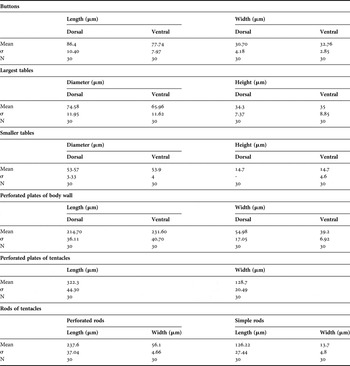
Specimen 72 mm long and 26 mm wide in its widest point, cylindrical, ventral slightly flattened (Figure 1A). Body wall relatively thin, slightly rough, dorsal side with eleven papillae on each side, tube feet scattered. Ventral tube feet arranged in four to six rows of two paired series along the radii. The mouth is terminal with ten small papillae around and ten peltate tentacles. Anus terminal, perianal papillae presents, lacking anal teeth. Radial pieces of the calcareous ring are square-shaped, 2.5 mm high and 3 mm wide, with a central notch and posterior margin with triangular indentation (Figure 2A). Interradial pieces triangular-shaped, 2 mm high and wide, with an anterior spire, posterior margin indented. There is one large polian vesicle, a stone canal with an elongate and rounded madreporite. Gonads have unbranched tubules. Longitudinal muscles divided in two, with free margins. Respiratory tree slightly branched. Colour in life is dark brown, with a few brown spots along lateral walls of body (Figure 1B). Conical papillae with elongate tips yellow to brown in colour. Tube feet same colour as the papillae. Ventral surface is lighter than dorsal. In alcohol, colour dark-brown dorsally, brown ventrally. Tube feet and papillae light brown. Ossicles of the tentacles are perforated plates about 320 µm long (Figure 2B), perforated rods about 230 µm long and simple rods about 125 µm long (Figure 2C). The body wall has tables of four pillars, disc of spinous margins, approximately 45–100 µm in diameter and 30–60 µm high, with a central hole and occasionally 10 smaller marginal holes (Figure 2D); buttons with rugosities, about 50–160 µm long, usually with two or more series of holes (Figure 2E); smaller tables of spinous margins (Figure 2F); perforated plates with rugosities (Figure 2G) and smooth margins 150–320 µm long (Figure 2H). Tube feet with buttons, plates similar to those of the body wall, rods about 220–240 µm long (Figure 2I) and endplate approximately 140 µm in diameter. The buttons are bigger in the dorsal surface of the body and broader in the ventral. Tables have bigger diameters in dorsal side, being slightly higher in ventral. The perforated plates are longer in ventral surface, broader in dorsal. Plates of tentacles are bigger than in body wall and tube feet. In tentacles, perforated rods are bigger and broader than simple rods (Table 1).
Micrometry of the calcareous ossicles of Holothuria (Holothuria) dakarensis Panning, Reference Panning1939 (σ, standard deviation; N, number of samples).

DISTRIBUTION
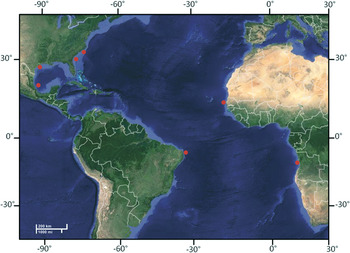
Western Atlantic from North Carolina to Georgia (Pawson et al., Reference Pawson, Pawson and King2010), Gulf of Mexico at Seven and One Half Fathom Reef, Texas and Isla de Lobos, Mexico (Pawson & Shirley, Reference Pawson and Shirley1977) and Brazil from Rio Grande do Norte; eastern Atlantic at Dakar, Senegal (Panning, Reference Panning1939) and Angola (Cherbonnier, Reference Cherbonnier1965) (Figure 3). Pawson & Shirley (Reference Pawson and Shirley1977) found this species to 14 m depth in the Seven and One-Half Fathom Reef and about 28 m depth in Isla de Lobos. In the localities of Senegal and Angola it was found at about 17 m depth (Cherbonnier, Reference Cherbonnier1965). Pawson et al. (Reference Pawson, Pawson and King2010) record a bathymetric distribution from 10–54 m. Our material comes from 1.5 m.
Distribution of Holothuria (Holothuria) dakarensis in Atlantic Ocean.

ECOLOGICAL NOTES
The specimen was found in muddy substrates surrounded by banks of macroalgae, in the hypersaline estuary of the River Tubarão, located in the semi-arid region of the State of Rio Grande do Norte, Municipality of Macau (5°04′37″S and 36°27′24″W). The specimen was partially folded, with the oral extremity raised above the median region of the body. The local salinity was 44%, with a water temperature of 26°C. Our study extends the bathymetric distribution to shallow waters and indicates a new habitat, hypersaline mangroves. The specimens from Seven and One-Half Fathom Reef were most abundant where steeply angled rock surfaces interface with the surrounding sandy bottom and some individuals were also found partly buried in sediment in crevices and on sand under rocks throughout the reef. In Isla de Lobos the specimens were found on a calcareous sand and coral rubble bottom around the hull of a shipwreck (Pawson & Shirley, Reference Pawson and Shirley1977). According to these authors H. (H.) dakarensis presents saxicolous habits and this can contribute to its late discovery. Mercier (Reference Mercier2013) lists H. (Holothuria) dakarensis in the IUCN Red List in the category of ‘least concern’, indicating the necessity of more information on population aspects, biology and conservation of this species.
REMARKS
Holothuria (Holothuria) dakarensis is similar to Holothuria (Holothuria) stellati, Holothuria (Holothuria) tubulosa and Holothuria (Holothuria) mammata. The taxonomic status is still under discussion. Panning (Reference Panning1939) elevated Holothuria stellati to superspecies level, suggesting that the remaining species represented varieties. According to Cherbonnier (Reference Cherbonnier1950) it would be more correct to use the name Holothuria tubulosa for Panning's superspecies, as this taxon was named before H. stellati. The same author argued that H. (H.) dakarensis, H. (H.) tubulosa and H. (H.) mammata can be differentiated by morphology and size of ossicles, and thus preferred to maintain these taxa at the specific level. Cherbonnier (Reference Cherbonnier1956) analysing size and distribution of dorsal papillae, quantity and disposition of ventral podia, and size or absence of Cuvierian tubules distinguished H. (H.) tubulosa from H. (H.) mammata. According to Cherbonnier (Reference Cherbonnier1960) the ossicles of H. (H.) dakarensis are bigger, H. (H.) tubulosa and H. (H.) mammata have ossicles of intermediate sizes, and H. (H.) stellati have the smallest ossicles. Furthermore, H. (H.) mammata may be distinguished by the mammillate shape of the dorsal papillae. Holothuria (Holothuria) tubulosa differs by having small papillae. Rowe (Reference Rowe1969) noted that the presence of Cuvierian tubules is an unsatisfactory distinguishing character due to the capacity of evisceration in these animals. Gustato & Villari (Reference Gustato, Villari and Jangoux1980) noted that H. (H.) stellati and H. (H.) tubulosa may be distinguished by overall body differences, in addition to the distribution and shape of the ossicles. Zavodnik (Reference Zavodnik1999) recognized H. (H.) stellati, H. (H.) tubulosa and H. (H.) mammata, but concluded that the systematics of these species and of H. (H.) dakarensis is still ambiguous. Borrero-Pérez et al. (Reference Borrero-Pérez, Pérez-Ruzafa, Marcos and González-Wangüemert2009) considered H. (H.) stellati a juvenile of H. (H.) tubulosa, while the remaining species were considered valid on the basis of molecular evidence, morphological data and the literature.
ACKNOWLEDGEMENTS
We thank Helena Giomar Borrero-Perez for her important contributions in the early analysis of this material; the anonymous referees for comments on an earlier version of this manuscript; and Catherine Marbenya for the revision of the English language usage. J.P. acknowledges the Master in Sciences Scholarship received from Coordenação de Aperfeiçoamento do Ensino Superior. M.L.C. was supported by a productivity scholarship from Conselho Nacional de Desenvolvimento Científico e Tecnológico.