Introduction
Only two dipterans occur naturally in Antarctica, the brachypterous Belgica antarctica (Jacobs) and the winged Parochlus steinenii (Gerke) chironomids. Both species inhabit the limnologically relevant Byers Peninsula and their presence has been well documented since 1967 (Greene et al. Reference Greene, Gressit, Korb, Llano, Rudolph, Singer, Steere and Ugolini1967). However, the most complete information regarding the distribution and ecology of both species on Byers Peninsula is reported by Richard et al. (Reference Richard, Convey and Block1994), covering data on density and habitats occupied in some lakes and an un-identified stream for P. steinenii, together with similar information for B. antarctica at just one location. Toro et al. (Reference Toro, Camacho, Rochera, Rico, Bañón, Fernández-Valiente, Marco, Justel, Vincent, Avendaño, Ariosa and Quesada2007) characterized aquatic ecosystems on Byers Peninsula and in the present study we provide more detailed information relative to the distribution and location of stable and unstable populations, and also novel ecological data on feeding habits, distribution patterns, methods of dispersal and coexistence between these two Antarctic species.
Materials and methods
Benthos samples in streams and lakes throughout Byers Peninsula were collected during several expeditions from summer 2001/02 to 2009/10 either with a hand net (200 μm mesh size) by kick or sweep sampling or with a Surber sampler (200 μm mesh size and 30 x 30 cm surface). Moss samples were collected with a 6cm diameter corer. Animals were fixed in the field using 4% formaldehyde and subsequently preserved in 70% ethanol. Some samples were processed in vivo in the field laboratory where the animals were either preserved directly in absolute alcohol or frozen for isotopic analysis. Isotopic 13C analysis was made using an Elemental Analyzer Carlo Erba 1108 coupled to an Isotope Ratio Mass Spectrometer Micromass Isochrome in continuous flow mode. A diel cycle of chironomid drift was investigated between 18 and 19 January 2003 in Belgica stream (unofficial name) using a drift net (500 μm mesh size). Irradiance was measured with an automatic meteorological station equipped with a CR-10X datalogger (Campbell Scientific, Shepshed, UK), located at the proximity of Lake Limnopolar.
Results and discussion
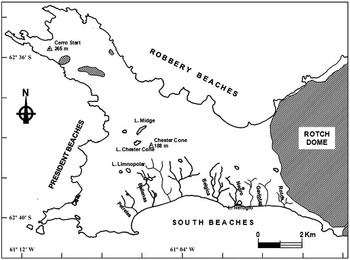
Extensive sampling throughout Byers Peninsula shows that the two chironomid species are only present in some of the lakes of the central plateau and in some streams of the South Beaches area (Fig. 1). Most of the freshwater ecosystems of Byers Peninsula lack macrozoobenthos, in general, and chironomids in particular.
Location of the streams and lakes where chironomid species have been recorded on Byers Peninsula (see text for details).

Parochlus steinenii
Our sampling efforts indicate that, on Byers Peninsula, populations of P. steinenii are mainly located in lakes. Abundant and stable populations only appear where the aquatic moss Drepanocladus longifolius (Mitt.) Paris occurs on the bottom (Midge Lake, Lake Limnopolar, Chester Lake) and are not present in other lakes where the aquatic moss is absent. Agius et al. (Reference Agius, Gibson, Rico and Quesada2009) confirmed the presence of P. steinenii in sediments from lakes on Byers Peninsula (Limnopolar Lake) at least over the last 2000 years.
Richard et al. (Reference Richard, Convey and Block1994) found larvae and adults of this species at the edge of a stream but its location was not given, and thus the stability of the population remains uncertain. Our initial hypothesis was that the presence of this species in streams was due to its high dispersal ability enabling re-colonization from lakes. Whether this species completes its entire life cycle in the streams or not remains unclear because the streams freeze solid over winter. However, we have collected pupae in the streams Belgica and Ballenas (unofficial name), indicating that P. steinenii can develop their life cycle in these habitats. Belgica stream population has remained stable over several years (data from 2001–10). However, a very abundant larvae and pupae population in a stretch of the Ballenas stream was recorded in February 2002, but disappeared completely after an ice dam break-up phenomenon in January 2003. Larvae of P. steinenii were also collected in other streams from the South Beaches (Petreles, Negro, Gaviotas, Rotch (unofficial names) (Fig. 1)). In Petreles stream larvae were found only during one year (January 2003) despite searching every year since 2001 to 2010 suggesting that the presence of this larval population was unusual.
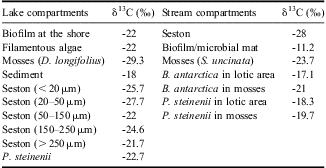
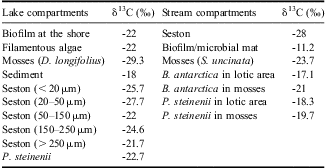
The feeding habits of P. steinenii larvae are unknown but Convey & Block (Reference Convey and Block1996) suggested a detritivorous diet. Isotopic 13C analysis made of summer samples from a stream and a lake (Table I) suggests that the larvae feed on shore biofilm in the lake, representing a complete trophic independence of P. steinenii from aquatic mosses. The life cycle of P. steinenii in lakes (first instars larvae were associated with the edges and the final stage pre-pupal larval instars with the bottom) may help explain the apparent contradiction with the aquatic mosses hypothesis. Juvenile larvae would be feeding on what is available at the shore edge (biofilm) while the final larval stages feed on mosses at the lake bottom during the ice cover period. In streams P. steinenii larvae seems to have a more varied diet than in lakes, with an intermediate isotopic signal between the biofilm/microbial mat and mosses.
Isotopic signal δ13C for compartments (seston, producers and chironomid species) in Belgica stream and Limnopolar Lake.
Belgica antarctica
Frequent general surveys over most of Byers Peninsula during ten expeditions indicated that the South Beaches area is probably the only place inhabited by B. antarctica. The presence of B. antarctica was documented on the south-facing slopes of Negro Hill (Richard et al. Reference Richard, Convey and Block1994) and our data show that it is still present at this location but also in streams that run through areas where the moss Sanionia uncinata (Hedw.) Loeske is present, and also in coastal lagoons situated between 61°02′W and 60°58′W up to Rotch Dome (streams Belgica, Negro, Gaviotas, and lake Refugio (unofficial name)). Our data also shows a dependence of this species on S. uncinata, although the presence of this moss does not imply its occurrence. Convey & Block (Reference Convey and Block1996) associated the distribution of this species with a suitable moist vegetated habitat near coastal areas, and Richard et al. (Reference Richard, Convey and Block1994) noted that their distribution on Byers Peninsula and Snow Island could be related to areas protected from the prevailing strong north-westerly winds.
Population density data for Belgica stream show only seven larvae m-2 in lotic zones, but in littoral zones, with slow flow and mosses the mean density reaches 193 larvae m-2 (maximum values of 333 larvae m-2). Within water-saturated mosses density reaches 42.3 x 10³ individuals m-2. Pupae have not been recorded in the bed samples of streams, but are clearly associated with the mosses.
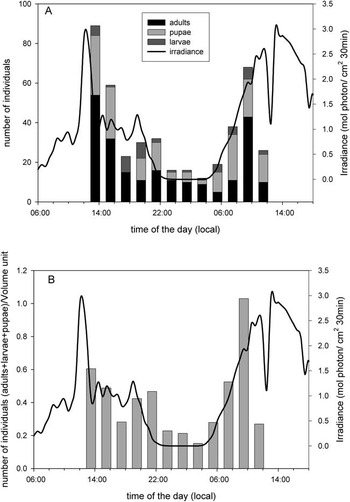
Local dispersal of adults is limited and based on travelling downstream on the water using surface tension. Our results on a daily drift cycle indicate that drift is driven by light, being higher at the maximum irradiance periods and minimal during the darkest hours (Fig. 2a). During daylight hours, the magnitude of the drift is proportional to the irradiance. Both adults and pupae are active and follow this pattern. In contrast, a very low number of larvae drift during the day, which is apparently not related to the time of the day. In this study pupae and adults follow similar drift patterns, but Peckman (Reference Peckman1971) indicated that larvae (and to a lesser extent pupae) exhibit a strong photonegative response, and adults, particularly males, show a photopositive response. The number of drifted animals in Belgica stream was independent of the stream flow, and when represented by units of volume, the same drift pattern was evident (Fig. 2b).
Photosynthetically active radiation measurements and number of drifting Belgica antarctica during the daily cycle. a. Absolute abundances of larvae, pupae and adults in two hours periods. b. Relative abundance of animals per unit volume filtered (cubic metres).

One of the factors that generally seem to have more influence on macroinvertebrate drift is the defence against predators, but apparently this is not the case in our study because in Byers Peninsula streams aquatic predators do not exist. However, we have observed since 2001 isolated individuals or small groups (four or five individuals) of the shorebird Calidris fuscicollis (Vieillot) actively predating on the larger larvae and adults of B. antarctica at the riverbanks and mosses.
Larvae are thought to be non-selective feeders consuming dead moss material, algae and microorganisms (Convey & Block Reference Convey and Block1996). Richard et al. (Reference Richard, Convey and Block1994) suggested a trophic relationship between B. antarctica and the red cyanobacterial felt (Phormidium spp.). Our isotopic 13C analysis made in Belgica stream suggests that larvae located close to the moss S. uncinata have a great trophic association with it (Table I), but larvae situated in lotic parts of the stream, and more related with a substrata colonized by biofilm-microbial mats have a shifted isotopic signal towards a mixed carbon source, indicating a non-selective trophic behaviour.
Coexistence between P. steinenii and B. antarctica
Several streams of the South Beaches area on Byers Peninsula are inhabited by both P. steinenii and B. antarctica (Belgica, Negro and Gaviotas streams). In Belgica stream both midge species populations have remained stable from 2001–10. The upper part of Belgica stream located on the plateau was found to be devoid of chironomids. Belgica antarctica is distributed throughout the stream on the South Beaches terraces, and inhabits the upstream area characterized by a fairly flat terrain where the stream channel runs among the mosses smoothly. Parochlus steinenii does not inhabit the upstream area, but it is found in the middle part formed by riffles and coexists with B. antarctica downstream where P. steinenii larvae dominate the open channel (4–5 times more abundant than B. antarctica). Here, B. antarctica is more associated with mosses and the protected areas of riverbank. Slow flow may be an important feature of the habitat of B. antarctica as Richard et al. (Reference Richard, Convey and Block1994) suggested. In contrast, P. steinenii seems to prefer deeper streams with a higher flow rate excluding shallow streams with low flow. Larvae of both species are found in areas of open channel and in mosses associated with the riverbank. Pupae of both species are only found in the riverbank associated with mosses. Therefore, it is conceivable that the mosses are an important factor for the successful colonization of the midges providing a refuge for pupation.
Acknowledgements
Fieldwork was supported by Spanish grants REN2000-0435-ANT, REN2002-11617-E/ANT, CGL2004-20451-E, CGL2005/06549/02/01-ANT and POL2006-06635. Logistics were provided by UTM (Maritime Technology Unit, CSIC) and Las Palmas crew (Spanish Navy). We especially thank the field assistance of researchers in the Limnopolar projects (A. Camacho, E. Fernandez, A. Justel, M. Toro, C. Rochera and D. Velazquez). We thank the reviewer for helpful comments.