Introduction
Common lilac (Syringa vulgaris L.) is a popular ornamental shrub in the family Oleaceae. The species is native only to the Balkan Peninsula, from Central Albania to Romania (Govaerts, Reference Govaerts2020), where it grows in mountain crevices and on rocky hills. Despite its European origin, common lilac was first introduced into cultivation in the geographical area of modern Turkey, from where it was brought to European gardens around mid-16th century (Lack, Reference Lack2000). The lilac was cherished for its lovely, sweet-scented flowers, and since the shrub is easy to propagate by root suckers, common lilac was soon spread into Central Europe. In one hundred years, it had reached Denmark (Lange, Reference Lange1999) and Sweden (Martinsson and Ryman, Reference Martinsson and Ryman2008). The first introduction of common lilac into Finland is known in detail from an academic thesis published in 1756 by D. E. Högman. The thesis refers to Jonas Synnerberg, a pharmacist, who brought the first lilac shrubs from Sweden to Finland in 1728, and ‘from his beautiful garden they have then been spread everywhere hereabouts [Turku, Finland]’ (Högman, Reference Högman1756, cited in Fiala and Vrugtman, Reference Fiala and Vrugtman2008).
Turku was the largest and the most important Finnish city in the 18th century. While lilacs may have spread quickly among educated people and burghers in Turku, it took quite a long time before common people living in the countryside got to know the plant. In the end of the 19th century, when the first investigation on cultivated plants in Finland was published, common lilac was recorded as the most frequent of the overall still quite rare ornamental shrubs grown in the country (Elfving, Reference Elfving1897). In those days, lilac was spread in vernacular yards ‘here and there in the western part of the country’, whereas in the east it was grown only by the sparse upper class (Elfving, Reference Elfving1897). Some 50 years later a domestic gardening book related common lilac as fully established in Finland, growing round nearly every cottage up to as far north as the species could survive (Schalin, Reference Schalin1953).
When common lilac became popular in vernacular gardens, the academic notice on its arrival in Finland (Högman, Reference Högman1756) was long ago forgotten. Instead, it was generally believed that the place of lilac's arrival and dissemination was the fortress of Sveaborg in Helsinki). Common lilac has flourished in Sveaborg since the 1760's at the latest (Helander et al., Reference Helander, Henttonen, Simons and Ahlqvist1987), and lush, old lilac hedges are still today characteristic of the fortress islands. According to tradition, common lilac was spread by officers and tenure soldiers who took root suckers with them when returning home from fortification works at Sveaborg (Selander, Reference Selander1939).
Two flower colour variants of common lilac, the white (S. vulgaris var. alba) and the purple (S. vulgaris var. purpurea) ones, were recorded from cultivation during the 17th century (McKelvey, Reference McKelvey1928). The diversity of flower colour and form increased little by little when the early lilac growers conducted selection among seedlings or started propagating spontaneous sports. The earliest known double-flowered variety (S. vulgaris ‘Azurea Plena’) was produced in 1843 from seed by a Belgian horticulturist (McKelvey, Reference McKelvey1928). While being a tiny-flowered curiosity with no ornamental value in itself, ‘Azurea Plena’ became the starting point in breeding the fine double ‘French hybrid’ lilac cultivars introduced to the market during the late 19th century (Havemeyer, Reference Havemeyer1917).
Around the mid-19th century, when the deliberate breeding of common lilac started, there were ca. 25 garden varieties available (Meyer, Reference Meyer1952). The number of selections exceeded one hundred in late 1870's, and by First World War, more than 300 common lilac cultivars were already known (Meyer, Reference Meyer1952). The Lemoine Family of Nancy, France, is the most famous one among the early lilac breeders. Up to the 1920's, the Lemoines, together with other continental nurseries, had raised many outstanding cultivars widely grown still today and frequently utilized in further crosses. In 1928, Susan Delano McKelvey published a standard work on the genus Syringa, ‘The Lilac’, a horticultural classic that treats garden forms and cultivars as well as the species. Breeding of S. vulgaris has continued throughout the 20th century until now, especially in North America and in the former Soviet Union. Most cultivars result from crosses between various forms of S. vulgaris. The closely allied Chinese S. oblata Lindl. was first hybridized with S. vulgaris by the Lemoines (Bean, Reference Bean1980). Several breeders later repeated the cross, and the resulting cultivars are usually designated as S. × hyacinthiflora Rehder.
The present number of common lilac cultivars is nearly 2 000 (Fiala and Vrugtman, Reference Fiala and Vrugtman2008). Many cultivars differ only slightly from each other in the form and colour of their inflorescences and flowers. The great number of cultivars, together with inadequate or missing cultivar descriptions, makes positive identification of nameless common lilac plants extremely difficult. The breeders will benefit greatly from genetic studies that utilize effective molecular tools for precise identification and characterization of cultivars, and for securing plant breeder's rights.
Previous DNA-based studies on Syringa have involved the use of random amplified polymorphic DNA (RAPD) markers to investigate hybrid origins (Marsolais et al., Reference Marsolais, Pringle and White1993), phylogenetic relationships (Kochieva et al., Reference Kochieva, Ryzhova, Molkanova, Kudriavtsev, Upelniek and Okuneva2004a, Reference Kochieva, Ryzhova, Molkanova, Kudryavtsev, Upelniek and Okuneva2004b) and cultivar identities (Xinlu et al., Reference Xinlu, Zhenfeng and Jing1999; Kochieva et al., Reference Kochieva, Ryzhova, Molkanova, Kudriavtsev, Upelniek and Okuneva2004a, Reference Kochieva, Ryzhova, Molkanova, Kudryavtsev, Upelniek and Okuneva2004b; Melnikova et al., Reference Melnikova, Borhert, Martynov, Okuneva, Molkanova, Upelniek and Kudryavtsev2009), Inter Simple Sequence Repeat markers to investigate interspecific relationships (Rzepka-Plevneš et al., Reference Rzepka-Plevnes, Smolik and Tanska2006), Amplified Fragment Length Polymorphism markers to study natural populations of S. oblata (Jun and Wanchun, Reference Jun and Wanchun2006), Expressed Sequenced Tag Containing Simple Sequence Repeat markers for genetic diversity studies and association mapping with floral traits in cultivated S. oblata (Yang et al., Reference Yang, He, Zheng, Hu, Wu and Leng2020), and single nucleotide polymorphism (SNP) markers for association mapping for remontancy in S. meyeri C.K.Schneid. × S. pubescens Turcz. (Chen et al., Reference Chen, Lattier, Vining and Contreras RN2020). In addition, sequencing of nuclear and chloroplast regions (Smolik et al., Reference Smolik, Andrys, Franas, Krupa-Małkiewicz and Malinowska2010; Lendvay et al., Reference Lendvay, Kadereit, Westberg, Cornejo, Pedryc and Höhn2016) and complete chloroplast genomes (e.g., Zhang et al., Reference Zhang, Jiang, Su, Zhao and Cai2019; Zhao et al., Reference Zhao, Zhang, Xin, Meng and Wang2020; Cheng et al., Reference Cheng, Jiang and Cai2021; Wang et al., Reference Wang, Tian, Han, Ye, Ma, Meng, Xie and Zhou2021) has been conducted in several Syringa taxa. Reliable microsatellite markers have been developed for several species in the Oleaceae family (de la Rosa et al., Reference de la Rosa, James and Tobutt2002; Harbourne et al., Reference Harbourne, Douglas, Waldren and Hodkinson2005, Kodama et al., Reference Kodama, Yamada and Maki2008), and de la Rosa et al. (Reference de la Rosa, James and Tobutt2002) reported that some markers developed for olive (Olea europaea L.) amplified also in the genus Syringa. Later, microsatellite markers have been developed specifically for S. vulgaris (Juntheikki-Palovaara et al., Reference Juntheikki-Palovaara, Antonius, Lindén and Korpelainen2013) and S. josikaea J.Jacq. ex Rchb. (five markers, Lendvay et al., Reference Lendvay, Pedryc and Höhn2013). In the study by Juntheikki-Palovaara et al. (Reference Juntheikki-Palovaara, Antonius, Lindén and Korpelainen2013), nine novel microsatellite markers were developed and tested in 75 common lilac samples, including 17 accessions that represented named cultivars. Although these markers appeared valuable for detecting differentiation among common lilac cultivars, their resolving power was insufficient for high-precision cultivar identification.
SNP markers have become popular for molecular characterization and genetic variation analyses after the development of high-throughput genotyping methods (e.g., Bastien et al., Reference Bastien, Boudhrioua, Fortin and Belzile2018; Ho et al., Reference Ho, Urban and Mills2020). In this study, we performed simultaneously SNP discovery and genotyping that allows comprehensive genome-wide analysis of genetic diversity. Our aim was to obtain a large set of SNP markers and, by using them, to reveal the precise identities of the investigated S. vulgaris accessions and to discover genetic relationships among them. The studied plant material included local Finnish, previously unidentified accessions, known reference cultivars, and so-called historical accessions i.e., old shrubs growing in historic cultural landscapes. Specifically, we intended (1) to verify cultivar names for some valuable local common lilac accessions, and (2) to provide insights into the history of common lilac cultivation in Finland.
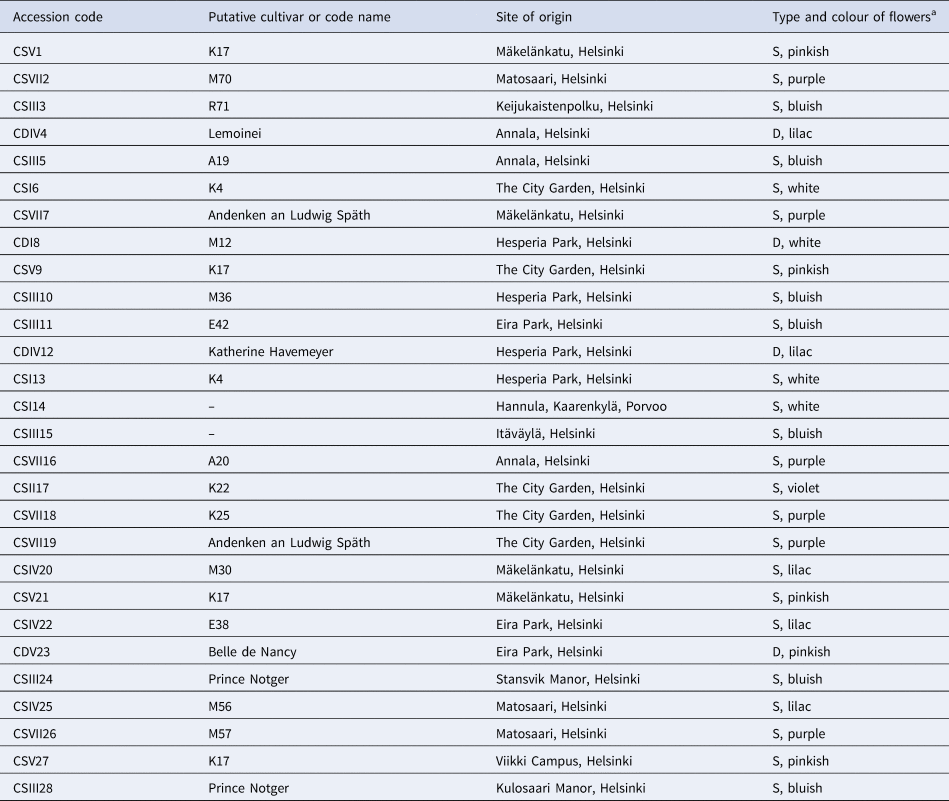
Materials and methods
Sampling
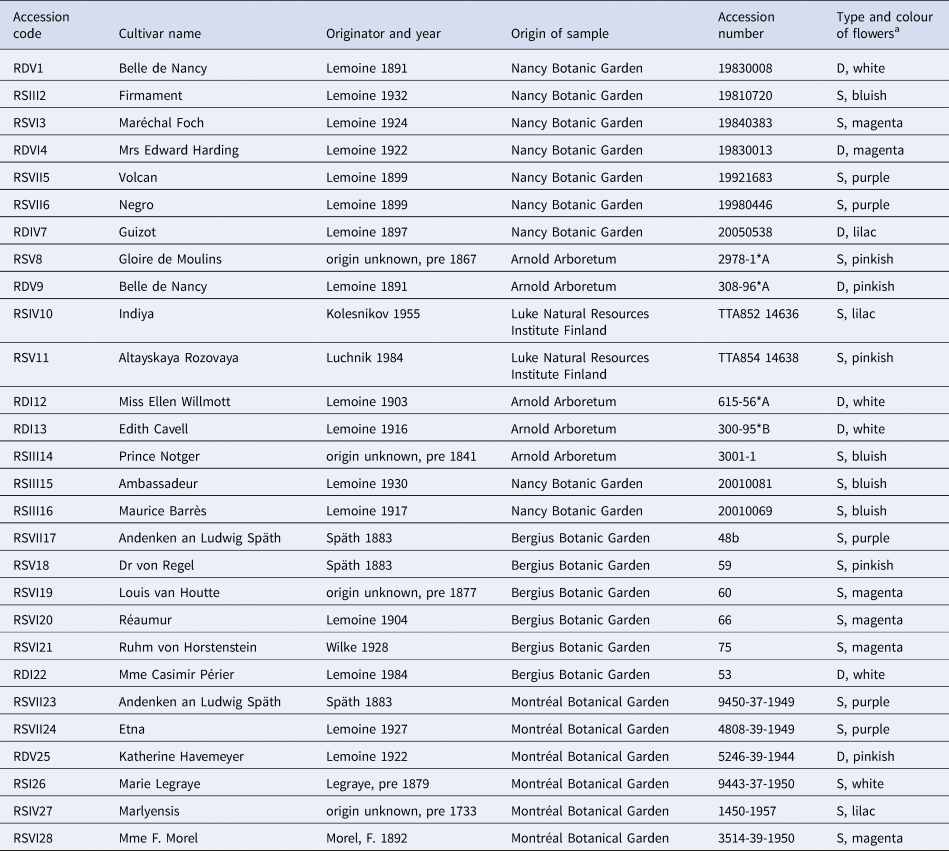
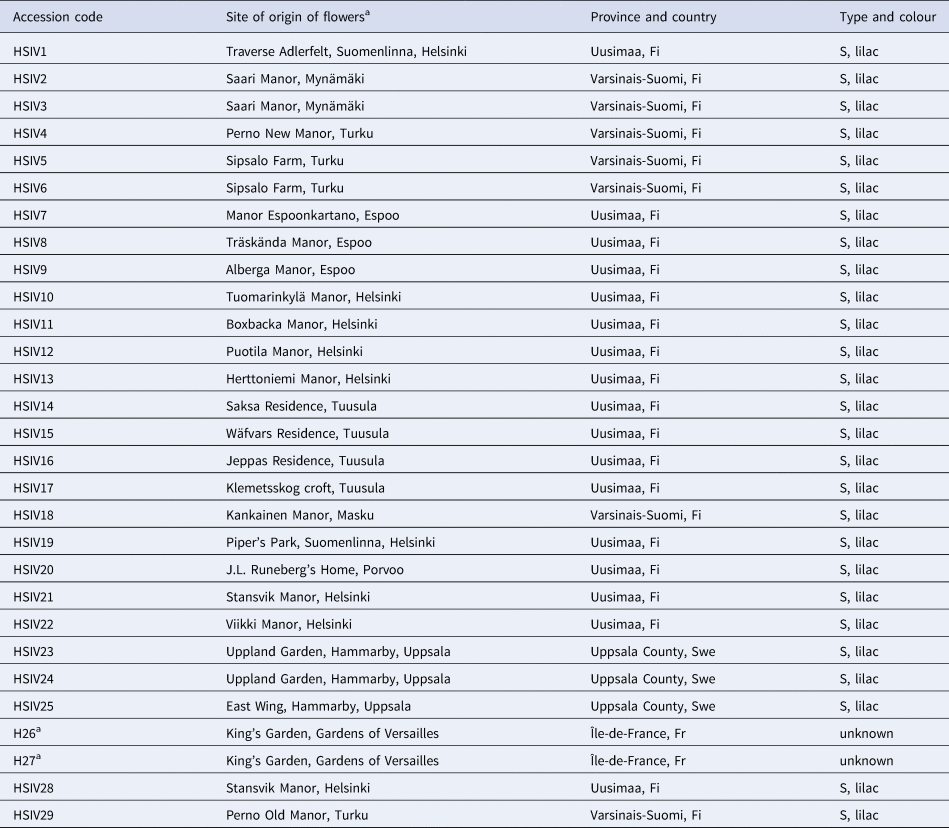
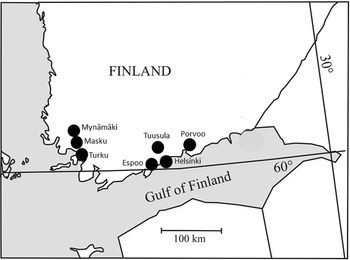
Originally, a total of 94 samples of S. vulgaris were included in this study. However, nine samples failed due to poor DNA quality and are not shown in Tables 1–3, which give basic information for the 85 samples successfully investigated. The sampled shrubs comprised 28 unidentified local accessions (Table 1), 28 reference cultivars (Table 2) and 29 historical accessions (Table 3). Most of the unidentified local accessions were old specimen shrubs recorded during a common lilac survey conducted in the city of Helsinki, Finland, in 2005 (Lindén et al., Reference Lindén, Hauta-aho, Temmes and Tegel2010). A few additional shrubs from Helsinki and Porvoo, Finland, were included on grounds of their interesting phenotype. The choice of the reference cultivars was based on the presumed identity of the 28 unidentified local accessions and on the cultivar assortment that has been on sale in Finland. The historical accessions included 24 samples from such parks and gardens that were settled in the 18th or early 19th century in Southern Finland (Fig. 1). In addition, three historical samples were obtained from Carl Linnaeus' summer residence Hammarby near Uppsala, Sweden, and two samples were acquired from the gardens of Versailles, located ca. 20 km to the southwest of Paris, France. From a systematic point of view, we treat these genotypes as unidentified. The historical accessions group was assembled to investigate the early history of the common lilac in Finland.
Unidentified local accessions of common lilac (Syringa vulgaris L.) analysed in this study

The first letter in the code denotes the accession being unidentified accession (C), while the second letter stands for single (S) or double (D) flowers. The Roman numeral indicates flower colour according to the Wister colour classification (DeBard and ILS, 2019): I white, II violet, III blue and bluish, IV lilac, V pink and pinkish, VI magenta, VII purple. The Arabic numeral marks each accession's running number. Shrubs with a putative cultivar or code name were assumed to represent a cultivar, unidentified or known, based on morphological characters.
a S, single flowers; D, double flowers.
Reference cultivars of common lilac (Syringa vulgaris L.) analysed in this study
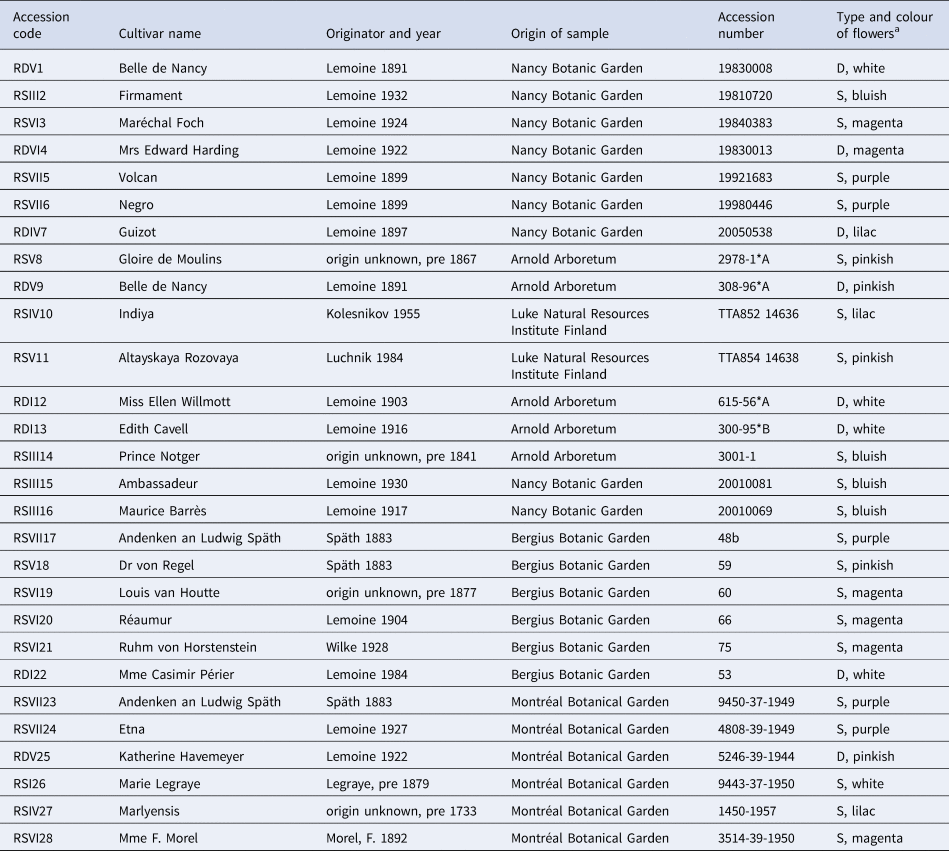
The first letter in the accession code denotes the cultivar being reference cultivar (R), while the second letter stands for single (S) or double (D) flowers. The Roman numeral indicates flower colour according to the Wister colour classification (DeBard and ILS, 2019): I white, II violet, III blue and bluish, IV lilac, V pink and pinkish, VI magenta, VII purple. The Arabic numeral marks each accession's running number.
a S, single flowers; D, double flowers.
Historical common lilac (Syringa vulgaris L.) accessions analysed in this study

The first letter in the accession code denotes the cultivar being historical cultivar (H), while the second letter stands for single (S) flowers. The Roman numeral indicates flower colour according to the Wister colour classification (DeBard and ILS, 2019): all IV lilac. The Arabic numeral marks each accession's running number.
a The samples were taken from a clipped hedge with no inflorescences, so the type and colour of flowers could not be ensured.

Leaf samples from unidentified and historical accessions were collected in 2006, 2009, 2013 and 2016 while the shrubs were in blossom. Morphological descriptors of single florets and inflorescences were registered for most of the chosen plants in connection with sample collection. Flower colour notation was based on the Royal Horticultural Society's Color Chart (2001). Reference samples were acquired from botanical collections in 2009, 2012, 2013 and 2016. All samples, packaged in plastic bags, were shipped to the Department of Agricultural Sciences, University of Helsinki, and stored in open Eppendorf tubes at −80°C until use.
DNA extraction and genotyping
Genomic DNA was extracted from leaf tissue using the CTAB protocol of Doyle and Doyle (Reference Doyle and Doyle1990) or a commercial kit (E.Z.N.A.™ Plant DNA Mini Kit Spin Protocol, Omega Bio-Tek, Norcross, Georgia, USA). The quality and quantity of extracted DNA were quantified with a spectrophotometer and further confirmed on 0.8% agarose gels. DNA concentrations were measured using NanoDrop Spectrophotometer (Thermo Scientific, Waltham, Massachusetts, USA) and adjusted to 50 ng μl−1. Genotyping of the S. vulgaris samples was conducted by Diversity Arrays Technology Pty Ltd. (Canberra, Australia, http://www.diversityarrays.com), following the DArT genotyping protocol of Kilian et al. (Reference Kilian, Wenzl, Huttner, Carling, Xia, Blois, Caig, Heller-Uszynska, Jaccoud, Hopper, Pompanon and Bonin2012). In this method, DNA samples were first exposed to digestion-ligation reactions using two restriction enzymes, Pst1 in combination with Sphl, together with barcoded adaptors corresponding to the overhangs of the restriction enzymes. The resulting fragments were amplified by PCR, and the amplicons from each sample were pooled and used for cBot bridge PCR and then sequenced using Illumina. All SNP data were first analysed using the DArTsoft software of the service provider. The SNP marker data were scored in a binary form using DArTsoft, which then computed several quality parameters for each SNP marker, such as the call rate, polymorphic information contents (PIC) and reproducibility.
Analysis of genetic relationships
We assumed that the plant materials were diploid based on the information that the members of the genus Syringa are primarily diploids with basic chromosome numbers reported at x = 22, 23 or 24 (Darlington and Wylie, Reference Darlington and Wylie1956). Pairwise genetic distances between S. vulgaris genotypes were calculated by GenAlEx 6.5 (Peakall and Smouse, Reference Peakall and Smouse2012). Based on the distance values, a phylogenetic tree was constructed and visualized using the neighbour-joining method (Saitou and Nei, Reference Saitou and Nei1987) with Mega 6 (Tamura et al., Reference Tamura, Stecher, Peterson, Filipski and Kumar2013). In addition, GenAlEx was used to provide descriptive statistics (BAFP), including the information index (I), expected heterozygosity (H e), unbiased expected heterozygosity (uH e) and the proportion of polymorphic loci (P).
A Bayesian analysis of population structure using software STRUCTURE 2.3.4. (Pritchard et al., Reference Pritchard, Stephens and Donnelly2000) was carried out to determine the number and distribution of genetic clusters among samples. The correlated allele model was used, which assumes that at each locus allele frequencies are correlated. With this assumption, the model infers a population structure with K number of clusters. An admixture model was applied. The analysis was repeated with different values of K (range 1–10) to discover the value with the highest rate of log-likelihood probability (lnPr(X|K)) of the data. For each value of K, ten independent runs were conducted with burn-in length of 105 iterations, followed by data collection period of 106 iterations. Furthermore, to identify the correct number of clusters, the rate of change in the log probability of data between successive K values (ΔK) was calculated according to Evanno et al. (Reference Evanno, Regnaut and Goudet2005) using STRUCTURE HARVESTER v0.6.94 (Earl and von Holdt, Reference Earl and von Holdt2012). Visualization was aided by CLUMPAK (Kopelman et al., Reference Kopelman, Mayzel, Jakobsson, Rosenberg and Mayrose2015), but the bar plot was edited and finalized manually. GenAlEx was used to conduct a principal coordinate analysis (PCoA) to investigate genetic relationships among genotypes and an analysis of molecular variance (AMOVA) to reveal contributions of among and within groups' variation to the total genetic variation. The significance of the variance components was evaluated using 999 permutations.
Results
A total of 15,007 SNP markers were generated to characterize the genetic diversity and relationships of 85 S. vulgaris genotypes including unidentified accessions from Finland, international reference samples, and historical accessions from Finland, Sweden and France. PIC values per SNP marker ranged from 0.012 to 0.500, with an average of 0.190. PIC values less than 0.1 were most frequent, while the frequency distribution was quite equal for PIC values between 0.1 and 0.5 (online Supplementary Fig. S1). The calculated descriptive statistics showed that the unidentified accessions possessed greater variability than the two other groups, and reference samples were more variable than the historical accessions. The values equalled 0.134, 0.130 and 0.124, respectively, for I; 0.082, 0.078 and 0.073, respectively, for H e; 0.083, 0.079 and 0.074, respectively, for uH e. All pairwise differences were significant (P < 0.05, t-test), except for the I value between the unidentified and reference samples. The proportions of polymorphic loci (P) did not follow the same pattern, equalling, 39.9, 48.8 and 57.3% for unidentified, reference and historical samples, respectively. Thus, the unidentified accessions from Finland had the lowest P value but highest I, H e and uH e values.
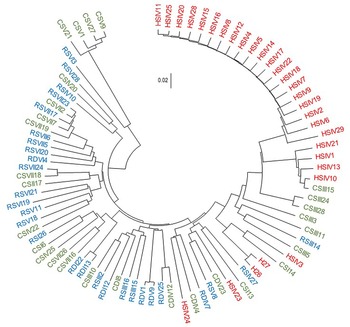
Based on pairwise genetic distances, a neighbour-joining tree was constructed to present the relationships among the genotypes (Fig. 2). It showed that the historical accessions grouped largely together, while the reference cultivars and unidentified accessions were highly mixed. An exception to the mixed positions of reference cultivars and unidentified accessions on the tree was formed by the accessions CSV1, CSV9, CSV21 and CSV27 that were clearly distinct from the rest. The reference sample from ‘Maréchal Foch’ (RSVI3) differed from the previous four accessions but still showed a relatively close relationship. Additionally, the unidentified accession CSIV20 formed an own cluster with the reference cultivars ‘Indiya’ (RSIV10) and ‘Mme F. Morel’ (RSVI28) (Fig. 2).

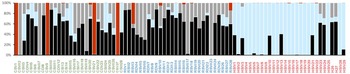
Genetic relationships among the S. vulgaris genotypes were assessed also using the Bayesian Structure analysis, which revealed that the highest ΔK value was detected at K = 4, showing that the number of clusters was four for the studied data set. Again, the historical accessions were generally differentiated from the rest, while the reference cultivars and unidentified accessions showed a mixed clustering pattern (Fig. 3). The Structure results were consistent with the pattern visible in Fig. 2. For instance, the unidentified accessions CSV1, CSV9, CSV21 and CSV27 were distinct from the rest. Their genomes represented almost completely a cluster, which was otherwise found, to a considerable extent, only in the reference cultivar RSVI3, and to a small extent in reference cultivars RSIV10, RSIII16 and RSVI28, and in the unidentified local accession CSIV20.
Assignment of Syringa vulgaris L. genotypes to four different gene pools (proportions shown) based on SNP markers as inferred by Bayesian clustering analysis. Green, blue and red sample codes represent unidentified accessions, reference cultivars and historical accessions, respectively. Accession codes are explained in Tables 1–3.

Three local accessions (CSVII2, CSVII7 and CSVII19) clustered with the two reference samples from ‘Andenken an Ludwig Späth’ (RSVII17 and RSVII23; Fig. 2). The results of the Bayesian clustering analysis (Fig. 3) were consistent though a bit less clear. Yet, the whole group appears to represent ‘Andenken an Ludwig Späth’. In addition, the SNP profiles revealed the cultivar identity of two local accessions (Figs 2 and 3): the single, purple-flowering CSVII18 was ‘Etna’ (RSVII24), and the double CDIV12 with lilac-coloured flowers proved to be ‘Katherine Havemeyer’ (RDV25), as was supposed even if the flower colour did not fully match the cultivar description. The local accessions CSIII24 and CSIII28 were identical with each other but diverged from all reference cultivars (Figs 2 and 3).
Among the 29 historical accessions included in the analyses we discovered six different genotypes. Two of the Swedish samples from Linnaeus' Hammarby at Uppsala, HSIV23 and HSIV24, were most distant from other historical shrubs, and different from each other (Fig. 2). At the same time, the third Hammarby sample, HSIV25, was found in the quite homogeneous group of otherwise Finnish historical accessions including a total of 20 accessions (Figs 2 and 3). The two samples from Versailles, France, H26 and H27, were identical, but clearly different from the Finnish and Swedish historical accessions (Figs 2 and 3).
The altogether 23 Finnish historical accessions represented three genotypes. The SNP profile of HSIV3 was unique, and least distant from the local CSI14 and the two samples from Versailles (Figs 2 and 3). Four historical accessions from Helsinki, HSIV1, HSIV10, HSIV13 and HSIV21, clustered closely together with the local, unidentified CSIII15, also from Helsinki (Figs 2 and 3). This cluster was somewhat different from the main group of historical accessions.
AMOVA showed that most genetic variation (89%) was present within the three groups, while a significant proportion of the variation occurred among them (11%, P0.001). When the four distinct unidentified accessions CSV1, CSV9, CSV21 and CSV27 were separated into a fourth group, the AMOVA results were slightly different: 84% of the genetic variation was present within the groups, while 16% (P < 0.001) of the variation occurred among them. The PCoA revealed that the first two coordinates explained 28% of the total variation based on the original three-group approach (online Supplementary Fig. S2a), and when using the four-group approach, the first two coordinates explained the same proportion, i.e., 28%, of the total variation (online Supplementary Fig. S2b).
Discussion
Using the novel SNP markers, we verified cultivar names for five local S. vulgaris accessions: CSVII2, CSVII7 and CSVII19 represented ‘Andenken an Ludwig Späth’, CSVII18 was ‘Etna’, and CDIV12 was ‘Katherine Havemeyer’. The phenotype of the local accessions matched their respective cultivars quite well apart from flower colour in the local accession CDIV12. ‘Katherine Havemeyer’ should have mixed pink flowers (Fiala and Vrugtman, Reference Fiala and Vrugtman2008), but we defined CDIV12 as lilac. The discrepancy may have resulted from environmental factors or flowering stage, as weather and edaphic conditions can affect colour hues in lilac, and the colour may also change during flower development (Meyer, Reference Meyer1952; Fiala and Vrugtman, Reference Fiala and Vrugtman2008).
The rest of the local accessions remained unidentified. However, the SNP results clarified their potential cultivar identity. For example, accessions CSIII10 and CDI8 were placed in the neighbour-joining tree among four blue- or white-flowering cultivars bred by the Lemoine nursery, so they could probably be determined by studying such phenotypically similar Lemoine cultivars that were not included in the present analysis. The local CDIV4 with unique flower characteristics was supposed to represent ‘Lemoinei’, one of the first double S. vulgaris cultivars (Havemeyer, Reference Havemeyer1917; Taylor, Reference Taylor1990). We could not trace ‘Lemoinei’ in any plant collection, but instead received a sample of ‘Guizot’ (RDIV7), a 20 years later Lemoine cultivar with several flower characteristics parallel to ‘Lemoinei’ (McKelvey, Reference McKelvey1928). The SNP profiles of CDIV4 and RDIV7 revealed that the local shrub was not ‘Guizot’, so our original hypothesis on the rare ‘Lemoinei’ genotype was left open.
The divergent group of four local accessions from Helsinki (CSV1, CSV9, CSV21 and CSV27) may represent a S. × hyacinthiflora cultivar with S. oblata in the pedigree. The only sample (RSVI3) related to these represented ‘Maréchal Foch’, which Bean (Reference Bean1980) quotes as an example of such Lemoine's later productions that may have S. oblata in their parentage even though they are classified as cultivars of S. vulgaris. Our genotyping results corroborate Bean's assumption, which was probably based on morphological and phenological features. The appearance of all four was very similar: the shrubs were tall, carrying showy, full panicles composed of extra-large flowers, deep pink when in bud, with a paler, bright pink shade when opened.
One of the earliest named garden forms of S. vulgaris is ‘Prince Notger’, which became commercially available round 1840 and was frequently cultivated around (McKelvey, Reference McKelvey1928). Based on old nursery catalogues, ‘Prince Notger’ has been traded in Finland since 1877. Our reference sample from ‘Prince Notger’ (RSIII14) came from the Arnold Arboretum, Boston, MA. The sampled shrub was the same that McKelvey (Reference McKelvey1928) compared with a plant of the same name in the Department of Parks, Rochester, NY, concluding that the two were dissimilar in appearance, and that she felt ‘uncertain which, if either, is true to name’. In the neighbour-joining Tree those local accessions provisionally identified as ‘Prince Notger’ (CSIII24 and CSIII28) were near neighbours with RSIII14, but in a separate branch of the family tree. The flower features fit well with historical descriptions of ‘Prince Notger’ (McKelvey, Reference McKelvey1928), yet the SNP profile did not match the reference sample.
We genotyped two reference accessions of the cultivars ‘Andenken an Ludwig Späth’ and ‘Belle de Nancy’. For both pairs, the SNP profiles were identical indicating that the plants were correctly named and quite likely originated from the same original plant as a vegetatively propagated line. The identical SNP profiles for RDI13 (‘Edith Cavell’) and RDI22 (‘Mme Casimir Périer’) proved that they belong the same cultivar and so one or the other of the reference samples came from a mislabelled plant. Mislabellings are rather common in germplasm collections (e.g., Nybom et al., Reference Nybom, Weising and Rotter2014; Venison et al., Reference Venison, Litthauer, Laws, Denancé, Fernández-Fernández, Durel and Ordidge2022).
The second aim of our study was to trace the history of common lilac in Finland. The SNP analyses revealed a group of 20 historical accessions, 17 of which were identical with each other. The minor differences shown by three accessions were probably due to somatic mutations accumulating in long-lived plant specimens (e.g., Tomimoto and Satake, Reference Tomimoto and Satake2023). In the main historical group, six specimens were collected from sites in or near Turku in the province of Varsinais-Suomi, thirteen samples originated from the province of Uusimaa, and one sample (HSIV25) came from Carl Linnaeus' country estate Hammarby in Uppsala, Sweden. HSIV25 came from a shrub, which is assumed to belong to the very oldest of Hammarby's common lilacs (Kårehed, e-mail 5 July 2013). The SNP profiles support the assumption considering that HSIV25 was identical with 16 Finnish accessions, which quite probably originate from the Linnean times. Furthermore, the present SNP analyses corroborate the old report on common lilac's arrival in Finland from Sweden (Högman, Reference Högman1756, cited in Fiala and Vrugtman, Reference Fiala and Vrugtman2008).
In addition to the main historical group, the Finnish historical accessions involved one unique accession (HSIV3) and a group of five accessions (CSIII15, HSIV1, HSIV10, HSIV13, HSIV21), which had strongly backwards curled, often twisted corolla-lobes, and a little larger flowers than shrubs in the main historical group. Based on their growing sites, the slightly different historical shrubs had been planted between the 1790's and the 1820's (Nikander, Reference Nikander and Nikander1928). The results indicate that more than one common lilac form was introduced into Finland already towards the end of the 18th century.
Four of the altogether five non-Finnish historical accessions we analysed were clearly different from all Finnish historical samples. Two of them (HSIV23 and HSIV24) came from the small Baroque style Uppland Garden, established in Linnaeus' Hammarby in the late 19th century. Uppland Garden's two samples differed that much from each other that they were placed in separate branches in the neighbour-joining tree indicating that S. vulgaris was introduced to Hammarby more than once and probably from more than one source.
The two historical accessions (H26 and H27) from the gardens of Versailles, France, proved to be identical and dissimilar from other historical samples. We wanted to compare lilacs from Versailles to Finnish historical accessions, because oral tradition says that common lilac was brought to the Finnish Sveaborg fortress in mid-18th century from France (Suominen, Reference Suominen and Pekonen1997), maybe directly from the gardens of Versailles (Pettersson, Reference Pettersson, Sario and Valpasvuo1948; Enkainen, Reference Enkainen1949). However, our SNP results did not lend any support to the story.
The informativeness of the novel SNP markers was estimated by the PIC index. The average PIC value equaled 0.190 (range 0.012–0.500), and the distribution was biased towards lower values. These values are in the same range of PIC values found in many other SNP-based investigations on mainly clonally propagated woody plants (e.g., Oh et al., Reference Oh, Lee, Kim, Han, Won, Kwack, Shin and Kim2019; Lyu et al., Reference Lyu, Dong, Huang, Zheng, He, Sun and Jiang2020). Based on the descriptive statistics, the unidentified accessions possessed greater variability than the two other groups, and reference samples were more variable than the historical accessions, although the proportion of polymorphic loci was lowest in the otherwise more variable unidentified accessions. These results indicate differences in the amount and pattern of genetic variation among the studied groups.
To the best of our knowledge, the present genotyping by sequencing study is the first one that analyses the genetic relationships of S. vulgaris L. genotypes in depth and provides detailed knowledge of the history, origin and identity of different accessions and cultivars of this popular ornamental shrub. The information can be used when utilizing present cultivars and developing new ones in future breeding programs.
Conclusions
Based on the data generated by genotyping in combination with existing historical and phenotypic knowledge, we discovered the identities, origin and genetic relationships of diverse S. vulgaris accessions, including previously unidentified Finnish accessions, known reference cultivars and historical accessions i.e., old shrubs growing in historic cultural landscapes. As far as we know, this is the first genetic analysis on S. vulgaris utilizing high-throughput genotyping that produces excessive amounts of genetic marker data, i.e., 15,007 SNP loci with an average PIC value of 0.190. We learned that when attempting to identify unknown accessions, it is a challenge to find correct reference cultivars for comparison, since plants representing different genetic backgrounds may show similar phenotypic traits. In the present study, the clearest results concerned those cultivars, which are likely to have S. oblata in their lineage. The local unidentified accessions from Helsinki (CSV1, CSV9, CSV21 and CSV27) were distinct from all other genotypes. In the neighbour-joining tree they clustered only with the phenotypically similar ‘Maréchal Foch’(RSVI3), which is supposed to be of hybrid origin. Our results also showed that most old common lilacs in Finland originate from one clone, which has been brought to the country from Sweden in the early 18th century. More common lilac origins were introduced round the turn of the 18th century and thereafter, including garden forms related to ‘Prince Notger’, which is an old, blue-flowered cultivar. The novel information generated in this study can be used when utilizing present genetic resources of Syringa and when developing new cultivars in future breeding programs.
Supplementary material
The supplementary material for this article can be found at https://doi.org/10.1017/S1479262123001053
Acknowledgements
We thank Juulia Kotkavuori and Maria Pietiläinen for help in sampling and laboratory work. This work was supported by funding from the University of Helsinki, and from the Maiju and Yrjö Rikala's Horticultural Foundation.
Author's contributions
H. K. and L. L. contributed equally to generating the research idea, discussing results, and writing the manuscript. H. K. conducted the SNP marker analyses.
Competing interests
None.
Data
Genotyping data are archived in Dryad https://doi.org/10.5061/dryad.x3ffbg7nh