INTRODUCTION
America’s current racial caste system has two mutually supporting pillars: carceral inequality and mass incarceration (Alexander Reference Alexander2010). Minorities are overrepresented at nearly every stage of the juvenile justice system (Sickmund and Puzzanchera, Reference Sickmund and Puzzanchera2014), and in the criminal justice system (Travis et al., Reference Travis, Western and Redburn2014). Blacks and Hispanics are incarcerated at six and three times the rate of Whites, respectively; indeed, there is more disparity between Blacks and Whites in imprisonment than in wealth, employment, poverty, or infant mortality (Travis et al., Reference Travis, Western and Redburn2014). Because of carceral inequality, the prison boom has “sealed the social immobility of poor blacks,” and “subtracted from the gains to African American citizenship hard won by the civil rights movement” (Western Reference Western2006, p. 191). Mass incarceration thus functions as a “system of racialized social control … [that] creates and maintains racial hierarchy,” and amounts to “the New Jim Crow” (Alexander Reference Alexander2010, pp. 11–13)
Imprisonment has detrimental effects on offenders, their families and communities; and minorities disproportionately suffer due to this carceral inequality (Clear Reference Clear2007; Western Reference Western2006). As Tonry explains, “a dose of prison can damage anyone, and usually does” (2011, p. 6). Job applicants with a criminal record are less likely to be hired, and this substantially effects minority applicants more so than White applicants (Pager Reference Pager2007; Pager et al., Reference Pager, Western and Sugie2009). In many states, particularly those with large Black prison populations, ex-felons are disenfranchised, often for life (Behrens et al., Reference Behrens, Uggen and Manza2003; Manza and Uggen, Reference Manza and Uggen2008). More broadly, it remains “legal to discriminate against criminals in nearly all the ways [e.g., in education, housing, jury service, etc.] that it was once legal to discriminate against African Americans” (Alexander Reference Alexander2010, p. 2). Further, the numerous adverse outcomes of parental incarceration, such as child homelessness, are concentrated most heavily among minority families (Wakefiled and Wildeman, 2011; Wildeman Reference Wildeman2014).
Racial differences in offending cannot fully explain the disparities in either the juvenile or criminal justice system (Engen et al., Reference Engen, Steen and Bridges2002; Leiber Reference Leiber2002; Tonry and Melewski, Reference Tonry and Melewski2008). In fact, “racial disparities in imprisonment have worsened substantially since the early 1990s relative to racial patterns of involvement in serious crimes” (Travis et al., Reference Travis, Western and Redburn2014, p. 94). Racial bias, both conscious and unconscious, in legal and legislative decision-making clearly plays a role in causing carceral inequality (Beckett et al., Reference Beckett, Nyrop, Pfingst and Bowen2005, Reference Beckett, Nyrop and Pfingst2006; Kutateladze et al., Reference Kutateladze, Andiloro, Johnson and Spohn2014; Spohn Reference Spohn, Bucerius and Tonry2013; Weaver Reference Weaver2007). For example, criminal defendants who have a darker skin tone and Afrocentric facial features tend to receive harsher court sentences, controlling for relevant case characteristics like prior record and offense severity (King and Johnson, Reference King and Johnson2016).
Punitive sentiment in America has plunged since the mid-1990s to a thirty-year low (Enns Reference Enns2016; Ramirez Reference Ramirez2013). Moreover, Whites’ tolerance for racial discrimination has been on the decline for four decades (Bobo et al., Reference Bobo, Charles, Krysan, Simmons and Marsden2012). Why, then, has no broad-based social movement emerged to oppose carceral inequality?Footnote 1 Perhaps more importantly, why haven’t legal actors working in the juvenile and criminal justice systems done more to reduce racial disparities in imprisonment? These are critical questions. Alexander argues that “nothing short of a major social movement can successfully dismantle the new caste system” (2010, p. 18). Yet, answers remain elusive. A sizable literature has investigated perceptions about the causes of Black-White socioeconomic inequality, and support for policies to reduce economic and educational disparities between the races (Bobo Reference Bobo1991, Reference Bobo1998; Bobo and Kluegel, Reference Bobo, Kluegel, Tuch and Martin1997; Hunt Reference Hunt2007; Kluegel Reference Kluegel1990; Kluegel and Smith, Reference Kluegel and Smith1982; Sears et al., Reference Sears, Hensler and Speer1979, Reference Sears, Van Laar, Carrillo and Kosterman1997). By contrast, perceptions about the causes, consequences, and policy importance of carceral inequality have largely escaped empirical attention (Unnever Reference Unnever2008). The least is known about juvenile and criminal justice workers’ (JCJW) perceptions of these issues. This is regrettable because “professionals’ perceptions help explain organizational outcomes” (Bridges and Steen, Reference Bridges and Steen1998, p. 554).
The criminal labeling process that underpins the racial caste system begins very early in offenders’ lives (Alexander Reference Alexander2010). Over 25% of Black and Hispanic males are arrested by the age of eighteen (Brame et al., Reference Brame, Bushway, Paternoster and Turner2014). The opportunities for racially biased decision-making are also greater in the juvenile than criminal justice system, because there is more discretion during processing (Sampson and Lauritsen, Reference Sampson and Lauritsen1997). For this reason, over the past three decades, there have been many efforts by scholars and activists to call attention to and lobby against carceral inequality in the juvenile justice system (Feyerherm Reference Feyerherm, Kempf-Leonard, Pope and Feyerherm1995; Kempf-Leonard Reference Kempf-Leonard2007). Indeed, since 1988, Congress has mandated that states develop plans to reduce the “disproportionate minority confinement” of youth (DMC) in order to receive federal formula grant funding for juvenile justice initiatives (Leiber Reference Leiber2002).Footnote 2 Despite the DMC mandate, pronounced racial disparities still exist throughout the juvenile justice system (Leiber and Rodriquez, 2011). “The persistence of DMC,” Geoff Ward and colleagues explain, “may relate in part to a failure among government and academic researchers to assess professional orientations toward the mandate, including perceptions of the severity of the problem” (2011, p. 174).
For this reason, our analysis focuses specifically on JCJW’s views about carceral inequality within the juvenile justice system. We build on and integrate three literatures to develop a theoretical model of JCJW’s views about whether carceral inequality constitutes a social problem: 1) the framing perspective (Benford and Snow, Reference Benford and Snow2000); 2) comparative conflict theory (Hagan et al., Reference Hagan, Shedd and Payne2005); and 3) group position theory and racial ideology (Blumer Reference Blumer1958; Bobo et al., Reference Bobo, Kluegel, Smith, Tuch and Martin1997). Scholarship on social movements has identified several specific types of beliefs that encourage social action to address social problems, including endorsement of attributional, severity, urgency, propriety and policy frames. We hypothesize that race directly influences JCJW’s endorsement of attributional frames about carceral inequality, and, in turn, indirectly influences endorsement of severity, urgency, propriety and policy frames about carceral inequality, through its effect on attributional frames. We test these hypotheses using data from a recent nationwide survey of JCJW.
FRAMES, EXPERIENCE, AND IDEOLOGY
Scholarship on collective action frames and social movements provides evidence about the types of beliefs, and relationships between them, that are essential for motivating both individual and collective efforts to address social problems (Benford and Snow, Reference Benford and Snow2000). The literature we review in this section offers insights about the various beliefs that likely encourage (or discourage) support for taking steps to reduce carceral inequality among JCJW.
Recent theoretical and empirical work identifies the importance of framing and frames for understanding attitudes toward crime, justice, and racial policy (Bonilla-Silva Reference Bonilla-Silva2014; Drakulich Reference Drakulich2015a, Reference Drakulich2015b; Hagan Reference Hagan2010). The absence of widespread mobilization against racial disparities in imprisonment—by either the public or JCJW—is what allows racial inequality to persist at current levels both within and outside of the justice system (Alexander Reference Alexander2010). This is despite repeated calls for a social movement to oppose carceral inequality (Alexander 2010; Tonry 2010). According to David Snow and Robert Benford, “the failure of mobilization efforts when structural conditions seem otherwise ripe” often reflects “the absence of resonant mobilizing frames” (1988, p. 214).
The framing perspective distinguishes between the activity of framing—the signifying or meaning work in social movements—and its negotiated cognitive outcomes, frames (Benford and Snow, Reference Benford and Snow2000). Framing activities focus on diagnosing a social problem and its causes, specifying specific solutions, and motivating corrective collective action (Snow and Benford, Reference Snow and Benford1988); they can be spearheaded by individuals, organizations, or the media (Gamson and Wolfsfeld, Reference Gamson and Wolfsfeld1993; Gamson et al., Reference Gamson, Croteau, Hoynes and Sasson1992). A frame, on the other hand, “is a central organizing idea … for making sense of relevant events, suggesting what is at issue” (Gamson and Modigliani, Reference Gamson and Modigliani1989, p. 3).
There are many types of attributional frames, but injustice frames are of particular importance. An injustice frame is a belief that an identifiable authority—a person, group, or agency—operates in a way that causes unjust harm and suffering, and violates shared moral principles (Gamson Reference Gamson1992; Gamson et al., Reference Gamson, Fireman and Rytina1982). For example, the belief that police bias causes carceral inequality is an injustice frame, or more accurately a “criminal injustice frame.” The adoption of an injustice frame breaks “the hegemony of the legitimating frame” (Gamson et al., Reference Gamson, Fireman and Rytina1982, p. 122), calls into question the status quo, and serves as “a critical catalyst for the appearance of other elements [agency and identity] of a collective action frame” (Gamson Reference Gamson1992, p. 58).
Audience members often decline to adopt injustice frames when exposed to relevant framing activities. Frames are most likely to be adopted when they resonate well with individuals (Benford and Snow, Reference Benford and Snow2000). Frame resonance is a function of several factors, with the most influential of these factors are the person’s relevant prior experiences (personal and vicarious) and ideology (Gamson Reference Gamson1992; Snow and Benford, Reference Snow and Benford1988, Reference Snow and Benford2000). These influence, respectively, an injustice frame’s experiential commensurability and narrative fidelity (Benford and Snow, Reference Benford and Snow2000).
The central theoretical argument advanced in the current paper is that criminal injustice frames about carceral inequality often fail to resonate with White JCJW. This, in turn, helps to explain the absence of widespread JCJW mobilization against the racial disparities that exist in either the juvenile or criminal justice systems. Theoretically, race should impact the resonance of criminal injustice frames through its effects on one’s life experiences (Hagan et al., Reference Hagan, Shedd and Payne2005; Unnever Reference Unnever2008; Weitzer and Tuch, Reference Weitzer and Tuch2006) and racial ideology (Bobo et al., Reference Bobo, Kluegel, Smith, Tuch and Martin1997; Bonilla-Silva, Reference Bonilla-Silva2014). Adoption of criminal injustice frames, more so than beliefs about racial differences in behavior, should shape JCJW’s judgments about the consequences and importance of carceral inequality (Gamson Reference Gamson1992), and policy preferences (Bobo and Kluegel, Reference Bobo, Kluegel, Tuch and Martin1997; Matsueda and Drakulich, Reference Matsueda and Drakulich2009). We discuss these theoretical expectations in more detail below.
RACE AND CRIMINAL INJUSTICE FRAME RESONANCE
Race and Discrimination Experiences
As noted above, relevant personal or vicarious experiences impact frame resonance by influencing the frame’s experiential commensurability—or relevance to adverse events and situations encountered in one’s life (Benford and Snow, Reference Benford and Snow2000). Black and Hispanic adolescents and adults report being more afraid of, and having more experience with, racial discrimination than their White counterparts (Herda Reference Herda2016; Kessler et al., Reference Kessler, Mickelson and Williams1999). This divide tends to be exceptionally large in the case of interactions with criminal justice actors (Herda Reference Herda2016; Weitzer and Tuch, Reference Weitzer and Tuch2005, Reference Weitzer and Tuch2006). One recent nationally representative poll of Americans revealed that 19% of Blacks and 17% of Hispanics reported being discriminated against by the police in just the past month, compared to only 3% of Whites (DiJulio et al., Reference DiJulio, Norton, Jackson and Brodie2015). Similarly, Callie Burt and colleagues (2012) found that over half of the Black adolescents in their sample reported experiencing racial discrimination by the police in just the past year.
Comparative conflict theory provides a framework for understanding the importance of minorities’ experiences at young ages with discrimination. According to this theory, minorities begin to develop an understanding of their relative subordination very early in their lives, by comparing the treatment they receive from authorities, and particularly from criminal justice actors, to that of Whites (Hagan and Albonetti, Reference Hagan and Albonetti1982; Hagan et al., Reference Hagan, Shedd and Payne2005). These comparisons are made on the basis of both personal and vicarious experiences, and have lasting attitudinal effects; they foster a sense of disadvantage in group position, as well as a general belief that legal authorities cannot be trusted and are racially biased (Matsueda and Drakulich, Reference Matsueda and Drakulich2009; Unnever and Gabbidon, Reference Unnever and Gabbidon2011; Weitzer and Tuch, Reference Weitzer and Tuch2005, Reference Weitzer and Tuch2006). Therefore, by a relatively young age, even before graduating high school and/or starting their careers, minorities develop a distinct appreciation for how racial bias contributes to their subordination (Hagan et al., Reference Hagan, Shedd and Payne2005; Unnever and Gabbidon, Reference Unnever and Gabbidon2011). For this reason, the experiential commensurability of criminal injustice frames should be greater for minority than White JCJW. That is, non-White JCJW should be more likely to perceive these frames as being consistent with their past personal and vicarious experiences (Unnever Reference Unnever2008).
Race, Group Position, and Racial Ideology
The narrative fidelity or cultural resonance of criminal injustice frames should also diverge for minority and White JCJW because of group differences in racial ideology. Group position theory connects a racial group’s particular racial ideology to their systemic location within an existing social structure and the nature of the social and political context (Blumer Reference Blumer1958). This theoretical perspective illuminates how a racial ideology protective of the structural arrangements that convey advantages on the dominant group emerges among its members, and changes over time in response to contextual shifts (Bobo et al., Reference Bobo, Kluegel, Smith, Tuch and Martin1997; Bonilla-Silva Reference Bonilla-Silva1997, Reference Bonilla-Silva2014).
A change or refinement in Whites’ racial ideology occurred during the post-civil rights era, when it became unacceptable to openly express Jim Crow-style prejudice (Jackman and Muha, Reference Jackman and Muha1984; Omi and Winant, Reference Omi and Winant1994). Over time, there were genuine reductions in Whites’ beliefs in innate racial differences and support for discrimination (Bobo et al., Reference Bobo, Charles, Krysan, Simmons and Marsden2012). At the same time, however, “a new mood of ‘social meanness’” took root among Whites (Omi and Winant, Reference Omi and Winant1994, p. 113), which reflected the emergence of a new racial ideology to ensure the continuance of minority subordination (Bobo et al., Reference Bobo, Kluegel, Smith, Tuch and Martin1997; Bonilla-Silva Reference Bonilla-Silva2014).
Many different theoretical conceptualizations of this new White racial ideology exist—e.g., symbolic racism (Kinder and Sears, Reference Kinder and Sears1981), modern racism (McConahay Reference McConahay, Dovidio and Gaertner1986), laissez-faire racism (Bobo et al., Reference Bobo, Kluegel, Smith, Tuch and Martin1997), and color-blind racism (Bonilla-Silva Reference Bonilla-Silva2014). Each “new racism” theory provides a different picture of Whites’ contemporary racial ideology, depicting it as composed of a unique set of perceptions, attitudes, and sentiments (Krysan Reference Krysan2000; Quillian Reference Quillian2006). For instance, the two central components of laissez-faire racism are racial stereotypes and the denial of discrimination (Bobo et al., Reference Bobo, Kluegel, Smith, Tuch and Martin1997); but in contrast, symbolic racism is theorized to reflect a combination of antiblack affect and individualism (Kinder and Sears, Reference Kinder and Sears1981).
Empirical tests of the new racism theories raise questions about the validity of the different theorized “blends” of racial views (Carmines et al., Reference Carmines, Sniderman and Easter2011; Zigerell Reference Zigerell2015). Michael Hughes, for example, finds that “the theoretical grounding of symbolic racism in individualism and antiblack affect is weak” (1997, p. 70). Likewise, the negative cultural stereotypes about Blacks that are central to both laissez-faire racism and color-blind racism are often endorsed by Blacks, sometimes even more so than by Whites (Sniderman and Piazza, Reference Sniderman and Piazza1993). Just as important, in today’s multiracial society, the scope of theoretical conceptualizations of Whites’ racial ideology must extend beyond their views about Blacks and Black-White relations.
The various new racism theories agree, however, that a key component of Whites’ current racial ideology is the general belief that discrimination (racial and ethnic) is in the past (Krysan Reference Krysan2000; Murakawa and Beckett, Reference Murakawa and Beckett2010). Poll evidence suggests that this is “the centerpiece of the modern racial divide” in attitudes (Bobo Reference Bobo, Smelser, Wilson and Mitchell2001, p. 280). The racial divide in beliefs about discrimination is very wide (Bobo and Thompson, Reference Bobo, Thompson, Markus and Moya2010; Hunt Reference Hunt2007; Norton and Sommers, Reference Norton and Sommers2011). Eduardo Bonilla-Silva (Reference Bonilla-Silva2014), for example, finds that of the four main components of color-blind racism, the largest difference between Whites and Blacks is in the extent to which the denial of discrimination informs their understanding of racial matters.
The racial divide in beliefs about discrimination reflects a fundamental disagreement between minorities and Whites about what constitutes racism (Bonilla-Silva Reference Bonilla-Silva2014; Carter and Murphy, Reference Carter and Murphy2015). The racial politics that forged Whites’ new racial ideology centered on narrowing the definition of racism and discrimination to the individual level (Omi and Winant, Reference Omi and Winant1994). As a result, Whites tend to narrowly define racism as explicit prejudice by individuals (Bonilla-Silva Reference Bonilla-Silva2014; Sommers and Norton, Reference Sommers and Norton2006). The dominant ideology among Whites thus holds that a behavior constitutes discrimination only when it meets two standards: 1) it results from intentional and explicit bias by an individual actor (intent standard), and 2) causes a specific instance of racial inequality (causation standard) (Murakawa and Beckett, Reference Murakawa and Beckett2010). Whites’ racial ideology is institutionally anchored in antidiscrimination law (Alexander Reference Alexander2010; Murakawa and Beckett, Reference Murakawa and Beckett2010), which produces a discursive opportunity structure that is generally unsupportive of criminal injustice frames (see Ferre 2003). By contrast, most minorities’ define racism broadly—explicit, subtle, or systemic bias—and understand discrimination simply to be unequal treatment, whether intentional or unintentional (Bonilla-Silva Reference Bonilla-Silva2014; Carter and Murphy, Reference Carter and Murphy2015). For this reason, the narrative fidelity (or cultural resonance) of criminal injustice frames should be greater among minority than White JCJW.Footnote 3
INJUSTICE FRAMES, VOCABULARIES OF MOTIVE, AND POLICY PREFERENCES
Injustice frames are communicated through diagnostic framing activities, which identify and attribute blame for a social problem (Benford and Snow, Reference Benford and Snow2000). Motivational framing activities provide individuals with the impetus to get moving to set things right. This is done by constructing and nurturing “vocabularies of motive,” which include frames about the severity of the problem, as well as about the urgency, efficacy, and propriety (or moral duty) of taking action (Benford Reference Benford1993). Prognostic framing activities propose specific ways to fix the problem, such as changing existing policies or implementing new policies (Snow and Benford, Reference Snow and Benford1988).
Theoretically, however, the process through which individuals come to adopt the different frames—injustice, motivational, and policy—disseminated by the above framing activities should have a particular causal order. Endorsing injustice frames should, in turn, greatly increase the probability of adopting the vocabularies of motive and policy preferences promoted in related framing activities (Gamson Reference Gamson1992; Gamson et al., Reference Gamson, Fireman and Rytina1982). William Gamson (Reference Gamson1992) suggests that endorsing an injustice frame leads to adoption of other mobilizing beliefs by increasing attention to and sympathy for framing efforts aimed at rectifying the injustice, and promoting personal identification with the victims of the injustice. Injustice frames have these effects because they collectivize victimization, and cause moral indignation, but they also imply that change is possible (Gamson Reference Gamson1992).
Research on views about racial policies supports the theory that injustice frames open the door for other types of mobilizing beliefs. Studies find that endorsing injustice frames for the Black-White socioeconomic gap strongly influences relevant policy preferences. Specifically, agreeing that this racial gap is caused, in part, by discrimination greatly increases support for government spending and intervention; indeed, the effect is even larger than that for racial stereotypes (Bobo and Kluegel, Reference Bobo, Kluegel, Tuch and Martin1997; Hughes and Tuch, Reference Hughes, Tuch, Sears, Sidanius and Bobo1999; Kluegel Reference Kluegel1990). Likewise, when citizens agree that the legal system treats minorities unfairly, another injustice frame, it reduces their racial prejudice and support for the movement to get tough on criminals (Bobo and Johnson, Reference Bobo and Johnson2004; Johnson Reference Johnson2008; Matsueda and Drakulich, 2011). In short, the extant theory and research both suggest that JCJD’s endorsement of injustice frames to explain racial disparities in imprisonment should be a primary factor; and perhaps should be the primary factor, influencing both their vocabularies of motive—or judgments about the salience of carceral inequality as a social problem—and policy preferences.
THE CURRENT STUDY
Literally hundreds of studies have investigated the sources and effects of views about racial matters such as busing, segregation, and the Black-White socioeconomic gap. For example, a large body of research has explored explanations for racial differences in support for ostensibly race-neutral crime policies, such as the death penalty (Bobo and Johnson, Reference Bobo and Johnson2004; Peffley and Hurwtiz, 2010). This research has consistently found that there is a large racial gap in punitiveness, which is explained primarily by differences between whites and minorities in their racial attitudes (Brown and Socia, Reference Brown and Socia2016; Unnever and Cullen, Reference Unnever and Cullen2007, Reference Unnever and Cullen2010; Unnever et al., Reference Unnever, Cullen and Jones2008).
By contrast, there is a paucity of research examining injustice frames for, or mobilizing beliefs about, carceral inequality, especially among JCJW. As a result, we currently know very little about the factors explaining attitudes toward the overrepresentation of minorities in the justice system. Yet, carceral inequality is the linchpin of America’s current racial caste system (Alexander Reference Alexander2010). Additionally, as Paul Sniderman and Thomas Piazza (1993) observe, the sources of “racial policy positions differ in significant ways from one type of racial policy to another” (p. 9); indeed, this “issue pluralism” is perhaps “the single most important feature of contemporary racial politics” (p. 20).
JCJW have opportunities in their day-to-day activities to either reproduce or reduce racial bias (Bridges and Steen, Reference Bridges and Steen1998). In the case of the DMC mandate specifically, the support and mobilization of JCJW is critical for the success of DMC interventions (OJJDP 2009), but it is often not forthcoming (Talley et al., Reference Talley, Rajack-Talley and Tewksbury2005; Ward et al., Reference Ward, Kupchik, Parker and Starks2011). Our analysis begins to shed light on the micromobilization processes that may help to explain why there is not greater mobilization against racial disparities in imprisonment, particularly by JCJW. We test four hypotheses about the factors that may function to legitimize or delegitimize carceral inequality as a social problem in the eyes of JCJW.
Theoretically, as noted above, race should shape the experiential commensurability and narrative fidelity of criminal injustice frames for JCJW. James Unnever’s (2008) analysis of public views supports this position. He found that Black citizens were more likely than Whites to believe that discrimination by the police and courts is a cause of carceral inequality. However, Blacks were also more likely than Whites to attribute carceral inequality to Blacks’ bad morals and poor parenting. This is consistent with research on citizens’ views about socioeconomic inequality, which suggests that minorities are especially likely to have a “dual consciousness,” such that they endorse both individualistic and structuralist frames to explain poverty (Hughes and Tuch, Reference Hughes, Tuch, Sears, Sidanius and Bobo1999; Hunt Reference Hunt1996, Reference Hunt2007). Building on this work, we test the following two hypotheses:
Hypothesis #1: Non-White JCJW will be more likely than White JCJW to endorse criminal injustice frames to explain carceral inequality.
Hypothesis #2: As compared to White JCJW, Non-White JCJW will either be more likely or equally likely, but not less likely, to endorse individualistic frames to explain carceral inequality.
We are aware of only one previous study that has examined the correlates of JCJW’s views about carceral inequality in either the juvenile or criminal justice system. This study found that Black juvenile probation officers were more likely than White officers to believe that minority overrepresentation in the juvenile justice system is a serious problem (Ward et al., Reference Ward, Kupchik, Parker and Starks2011). By contrast, the perception that “minority youth often require more restraint” was unrelated to this belief. Theoretically, however, injustice frames, more so than individualistic frames, should influence JCJW’s attention and receptivity to motivational and prognostic framing (Gamson Reference Gamson1992). Extant scholarship on framing and social movements suggests that endorsement of severity, urgency, propriety and policy frames are essential for motivating individual and collective action to address social problems. This literature also indicates that endorsement of these various frames should be influenced by individuals’ attributional beliefs. Comparative conflict theory suggests that individuals’ racial backgrounds and associated experiences should shape their attributional beliefs. Thus, the final two hypotheses that we test are:
Hypothesis #3: JCJW who endorse criminal injustice frames will, in turn, be more likely to hold vocabularies of motive and policy preferences that challenge carceral inequality.
Hypothesis #4: Criminal injustice frames will mediate the relationship between JCJW’s race and these variables.
DATA AND METHODS
In analyzing views of carceral inequality, all JCJW are relevant; there is no occupational group of JCJW with a monopoly of influence over racial disparities in imprisonment (Baumer Reference Baumer2013). Racial disparities not only exist at nearly all decision-making points in the justice system, but there is also “cumulative disadvantage,” whereby disparities at later stages build on disparities at earlier stages (Kutateladze et al., Reference Kutateladze, Andiloro, Johnson and Spohn2014; Sickmund and Puzzanchera, Reference Sickmund and Puzzanchera2014; Sutton Reference Sutton2013). As Besiki Kutateladze and colleagues explain, “law enforcement officials, prosecutors, and judges” are all “vested with key decision-making power that holds the potential to contribute to racial inequity in punishment” (2014, p. 515). Other JCJW—including, but not limited to, probation officers, defense attorneys, and administrators—may also influence case outcomes and/or help shape the organizational culture in which legal decisions are made (Birckhead Reference Birckhead2010; Bridges and Steen, Reference Bridges and Steen1998). Indeed, the Office of Juvenile Justice and Delinquency Prevention stresses that interventions to reduce racial disparities in youth justice require “the top-down support from local agency directors and bottom-up support from all line workers and other staff throughout the agencies involved in juvenile justice” (2009, p. 3).
Accordingly, for the current study, we sought to survey an occupationally diverse and nationwide sample of JCJW. We were able to do this by leveraging a Listserv containing email addresses of JCJW who participated in training offered by the National Criminal Justice Training Center (NCJTC). The NCJTC coordinates training programs for a large number of local, state and national juvenile and criminal justice agencies. JCJW from every U.S. state and territory have participated in NCJTC training on applied topics, such as investigative techniques and defensive tactics. The NCJTC has compiled contact information for every individual and organization attending its training programs since 2005. The NCJTC’s Listserv contained email addresses for approximately 50,000 JCJS workers from across the United States.Footnote 4 The diversity in the NCJTC Listserv allowed us to sample for heterogeneity, which is recommended when probability sampling is not an option (Blair et al., Reference Blair, Czaja and Blair2014; Shadish et al., Reference Shadish, Cook and Campbell2002). As Johnny Blair and colleagues explain, “measures of relationships should be resistant to sample bias as long as the sample is diverse but not necessarily if the sample is restricted” (2014, p.101; see also Pasek Reference Pasek2016). We emailed an invitation to complete an anonymous online questionnaire to the Listserv on July 8, 2014; a reminder email was sent on August 13, 2014. Following previous research (e.g., Tyler et al., Reference Tyler, Callahan and Frost2007), we also incorporated a chain snowball sampling technique in which we encouraged respondents to forward the survey link to other JCJW. Our sampling method made calculation of a response rate impossible, although it was clearly very low.Footnote 5 However, the most important consequence of using a nonprobability sample is that, regardless of the response rate, the generalizability of the findings remains unknown. Even still, several studies have found the use of a diverse online nonprobability sample generally allows for relatively accurate inferences about the direction and approximate magnitude of relationships between variables (Ansolabehere and Schaffner, Reference Ansolabehere and Schaffner2014; Bhutta Reference Bhutta2012; Pasek Reference Pasek2016; Simmons and Bobo, Reference Simmons and Bobo2015).Footnote 6
A total of 636 CJW completed the questionnaire. After excluding cases with item nonresponse on the measures used in the analysis, the analytic sample includes 543 JCJW from forty-seven states.Footnote 7 In the analytic sample, 260 (or 48%) respondents are sworn (local, state, or federal) law enforcement officers, and 283 (or 52%) work (or have previously worked) in the juvenile or criminal justice system in another capacity (e.g., probation officer, prosecutor, defense attorney, judge, court administrator, correctional officer, non-sworn law enforcement officer, dispatcher, or victim advocate).
As noted earlier, we focus on JCJW’s views about carceral inequality in the juvenile justice system—or DMC—because “the impact of the new [racial] caste system is most tragically felt among the young” (Alexander Reference Alexander2010, p. 185). Not only is there greater discretion in processing juveniles than adults, but “most adult offenders begin their criminal contact with the state through the juvenile justice system” (Sampson and Lauritsen, Reference Sampson and Lauritsen1997, p. 341). The DMC mandate in the Juvenile Justice and Delinquency Prevention Act (JJDPA) originally focused on “disproportionate minority confinement.” However, because carceral inequality is a cumulative result of disparities at multiple decision-making points, the 2002 amendment to the JJDPA expanded the DMC mandate to focus on disproportionate minority “contact” broadly.
Dependent Variables: Motivational and Policy Frames
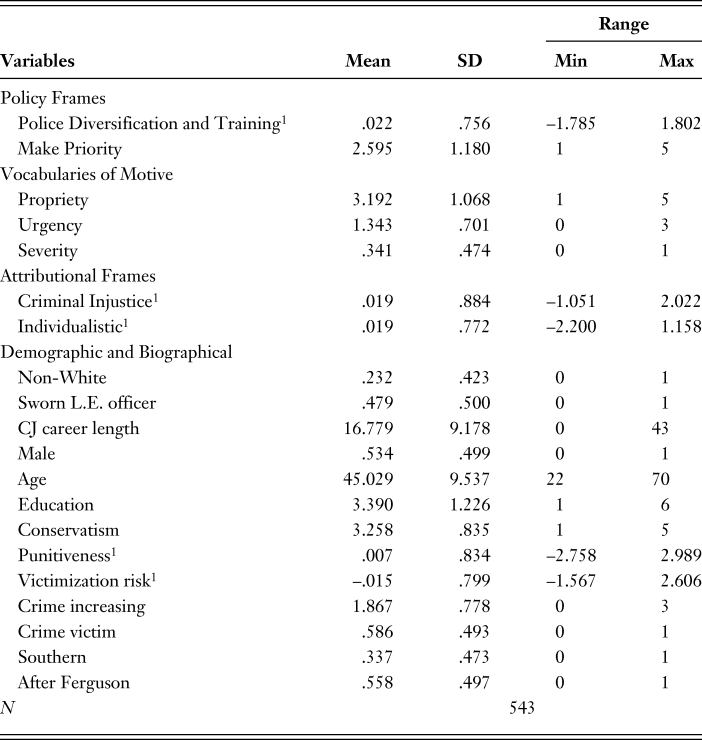
The objective of the analysis is to examine the predictors of beliefs about whether DMC is a serious and increasingly salient social problem that warrants ameliorative action. We accomplish this by analyzing endorsement of “vocabularies of motive” about DMC as well as relevant policy frames. The first variable measures whether JCJW endorse a severity frame about DMC.Footnote 8 Severity frames focus on the seriousness of a social problem—that is, the amount of harm it causes (Benford Reference Benford1993). We asked JCJW about the “key outcomes” of DMC, where: 0 = “increases public safety in minority communities,” and 1 = “increases inequality and poverty in minority communities.”Footnote 9 Another important motivational frame focuses on urgency, or the belief that a problem is increasingly salient and/or that time is running out to fix it (Benford Reference Benford1993). We asked JCJW whether over the past ten years, DMC had decreased greatly, decreased, stayed about the same, increased, or increased greatly. Less than 1% of JCJW believed that DMC had decreased greatly, so we recoded responses so that: 0 = decreased, 1 = stayed about the same, 2 = increased, and 3 = increased greatly. Another important motivational frame is the “propriety of taking action”—that is, the belief that one has a personal duty to address the problem (Benford, Reference Benford1993, p. 206). We asked JCJW “how important or unimportant is the issue of disproportionate minority contact to you personally?” (1 = very unimportant, 5 = very important). The descriptive statistics for these measures and those discussed below are presented in Table 1.
Descriptive Statistics

NOTES: 1Variable is a standardized mean index.
ABBREVIATIONS: DMC = disproportionate minority contact; SD = standard deviation.
We also incorporate two measures of policy frame endorsement. The first is measured with a question that asked: “should reducing disproportionate minority contact (or minority overrepresentation) be a very low, low, medium, high, or very high priority for legal authorities?” The responses were coded such that 1 = very low priority, and 5 = very high priority.Footnote 10 Among the most frequent policy recommendations for reducing DMC are to increase law enforcement diversity and cultural competence (Cabaniss et al., Reference Cabaniss, Frabutt, Kendrick and Arbuckle2007; Leiber Reference Leiber2002). The second variable is therefore measured with a question that asked JCJW how much they supported or opposed (1 = strongly oppose, 5 = strongly support): 1) “Making sure that the racial makeup of a police department is the same as that of the local community,” 2) “Eliminating affirmative action preferences for minority applicants in the hiring of police officers,” and 3) “Reducing the amount of time police spend in diversity (or ‘cross-cultural’) training.” We recoded the responses so that higher values indicated greater support for police diversification and cross-cultural training, and then standardized and averaged across the responses to generate a mean index (factor loadings = .561, .640, and .484, respectively; α = .633).Footnote 11
Mediating Variables: Attributional Frames
Prior studies have often measured public perceptions of the extent of racial bias by legal actors like the police (Bobo and Johnson, Reference Bobo and Johnson2004; Matsueda and Drakulich, Reference Matsueda and Drakulich2009). There is an important difference, however, between perceiving that bias exists and believing that it is, in fact, a principal cause of carceral inequality (Talley et al., Reference Talley, Rajack-Talley and Tewksbury2005; Unnever Reference Unnever2008). Our interest is specifically in JCJW’s endorsement of attributional frames to explain carceral inequality in the juvenile justice system. We asked the JCJW in our sample “how much of a role does each of the following play in causing disproportionate minority contact (or minority overrepresentation)?” Next, we listed nine different attributional frames, which included five separate types of legal bias, and four types of individual differences in behavior (see Table 1). The responses were: 1 = a very small role, 2 = a small roll, 3 = a moderate role, 4 = a large role, and 5 = a very large role.
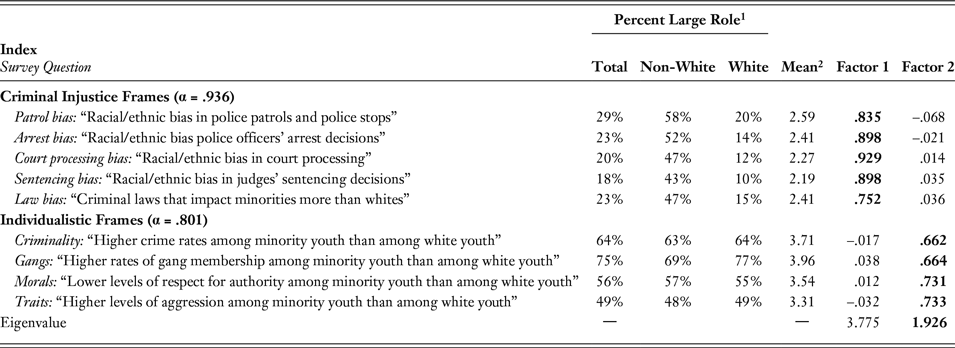
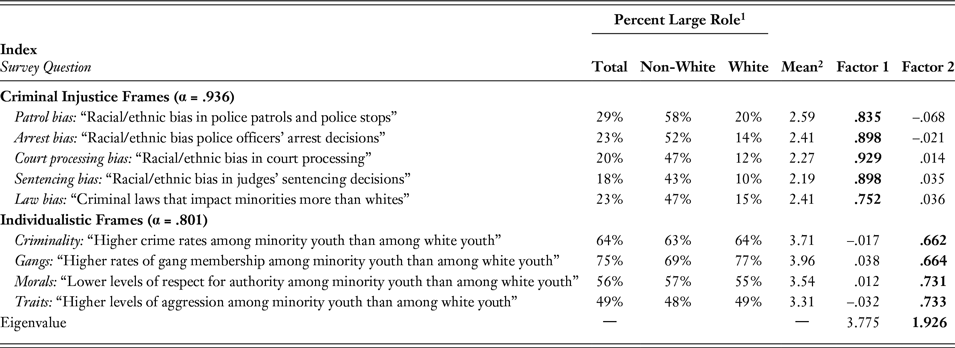
Table 2 provides the question wording and descriptive statistics for each of the nine attributional items. The JCJW in our sample are far more likely to endorse individualistic frames than criminal injustice frames to explain carceral inequality in the juvenile justice system. The magnitude of this endorsement gap cannot be overstated; between 49% and 75% of the JCJW believe that each of the individualistic factors play a large or very large role in causing DMC, compared to only 18% to 29% for the different types of criminal injustice. When disaggregated by race, we can see that between 43% and 58% of non-Whites believe that each form of bias plays a large or very large role in causing DMC, compared to only 10% to 20% of Whites. Comparing the means (for the full sample) for the five types of criminal injustice, we see that JCJW tend to believe that police and legislative bias play larger roles in causing DMC than bias in court processing or sentencing. These differences in means are highly significant (p < .01).
Question Wording, Response Distributions and Factor Loadings for Attributional Frames About DMC
NOTES: 1Includes respondents saying either “a very large role” or “a large role.” 2Responses are coded 1 = a very small role, 2 = a small role, 3 = a moderate role, 4 = a large role, and 5 = a very large role.
Table 2 also presents the result of a promax-rotated exploratory factor analysis for the nine attributional frames. Two factors emerge with eigenvalues greater than one. The five criminal injustice frames all load on a single factor, with loadings between .752 and .929. By contrast, the individualistic frames all load on a separate factor, with loadings between .662 and .733. This is consistent with research on endorsement of attributional frames for racial differences in socioeconomic inequality, which finds that individualistic and structural attributions represent distinct attitudinal commitments (Bobo Reference Bobo1991; Hunt Reference Hunt2007). Accordingly, we construct two standardized mean indices to measure separately the endorsement of criminal injustice (α = .936) and individualistic frames (α = .801). The two indices are weakly correlated (r = –.087), which further supports the theoretical distinction between injustice and individualistic frames.
Independent and Control Variables
The key independent variable in our analysis is JCJW’s race, coded 0 = non-Hispanic White, 1 = non-White.Footnote 12 The analysis also incorporates controls for respondents’ total number of years working in the justice system, occupation (1 = sworn law enforcement officer), gender (1 = male), age in years, education (1 = high school degree or less, 6 = PhD), political ideology (1 = very liberal, 5 = very conservative), and region of residence (1 = south). Our interest is specifically in the relationship between endorsing criminal injustice frames and adopting motivational and policy frames about DMC, net of the effect of the former on punitive attitudes (Johnson Reference Johnson2008; Matsueda and Drakulich, Reference Matsueda and Drakulich2009); thusly, we control for punitiveness. The measure is a standardized mean index of JCJW’s preferred sentences in two sentencing vignettes describing juvenile offenders convicted of felonies (burglary and murder) (r = .401).Footnote 13
Finally, we include three controls for crime salience. The first measures whether anyone in the respondent’s family had been the victim of a crime in the past five years (1 = yes). The second is a standardized mean index measuring perceived victimization risk (1 = not at all likely, 7 = very likely) for four crimes (theft, burglary, assault, and murder) (α = .818). The third variable measures perceptions of the juvenile crime trend over the past ten years. Very few JCJW believed juvenile crime had decreased, thus the responses were coded 0 = decreased or decreased greatly, 1 = stayed about the same, 2 = increased, and 3 = increased greatly. Finally, because the highly publicized police killing of Michael Brown in Ferguson, Missouri, occurred during the survey administration period, we control for whether respondents completed the questionnaire before or after the event (1 = after Ferguson).
FINDINGS
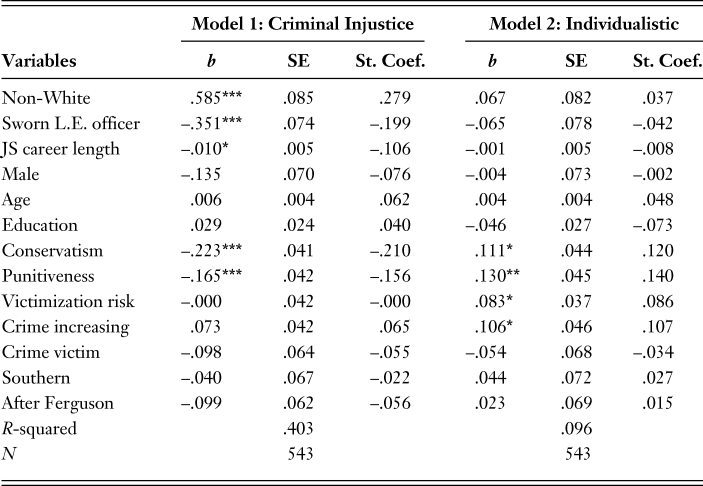
The starting point for the analysis is to examine whether JCJW’s race affects their endorsement of different attributional frames to explain DMC. Table 3 contains two OLS regression equations in which criminal injustice frames (model 1) and individualistic frames (model 2) are specified as the dependent variables. The coefficients for model 1 show a very large and highly significant (b = .585, p < .001) effect of race on endorsement of criminal injustice frames. As hypothesized, non-White JCJW are much more likely than their White counterparts to believe that bias in the legal system causes DMC. Indeed, the standardized coefficients show that JCJW’s race is the strongest predictor of whether they endorse criminal injustice frames to explain DMC.
OLS Regressions Predicting Endorsement of Attributional Frames for DMC
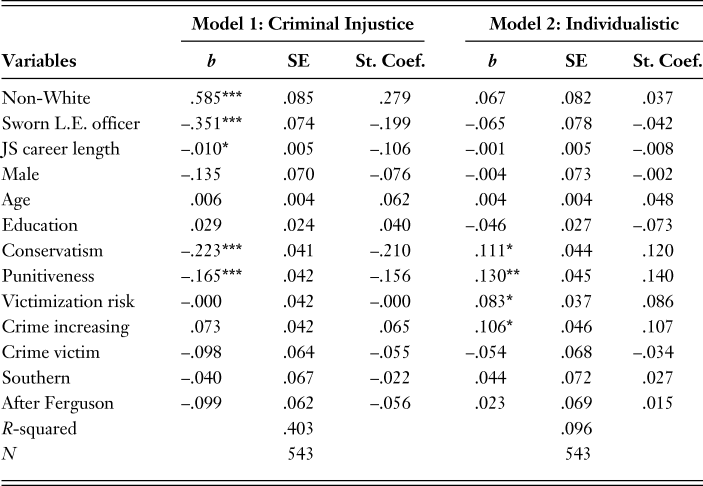
ABBREVIATIONS: b = unstandardized coefficient; JS = justice system; LE = law enforcement; SE = robust standard error; St. Coef. = standardized coefficient.
*p < .05; **p < .01; ***p < .001 (two–tailed).
By contrast, the results for model 2 reveal that race is not a significant predictor of endorsing individualistic frames to explain DMC. This conclusion is not an artifact of using arbitrary significance cutoffs; the coefficient for race is close to zero (b = .067, p = .413). Non-White and White JCJW thus have similar likelihoods of attributing DMC to minorities’ criminality, gang membership, disrespect for authority, and propensity for aggression. This evidence suggests that the foremost racial divide among JCJW is not in their perceptions of racial differences in antisocial behavior, but rather is in their beliefs about discrimination.
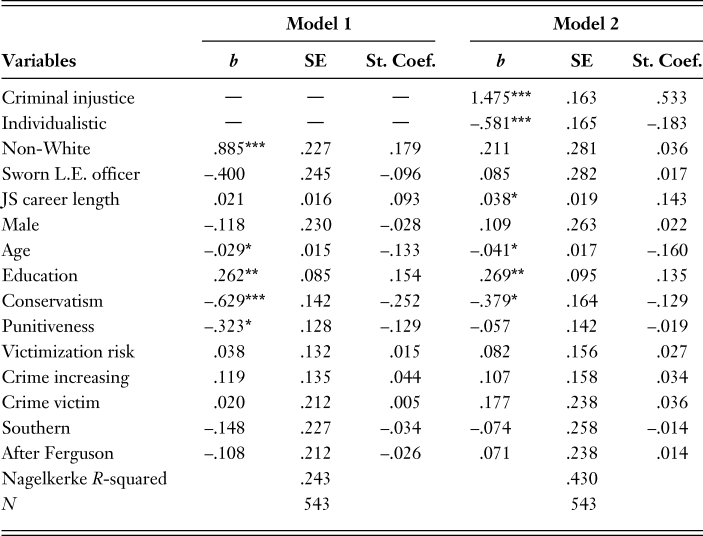
Next, we analyze endorsement of motivational frames—or vocabularies of motive—to challenge DMC. The variables measuring endorsement of motivational frames are either binary (severity) or ordinal (urgency, propriety); thus, we estimate the models using logistic or ordinal logistic regression. Tables 4–6, respectively, display the results for the severity, urgency, and propriety frames. There are two regression equations for each motivational frame, which are identical with the exception that the indices measuring endorsement of attributional frames are excluded from model 1, but are included in model 2. We use the KHB method (Karlson et al., Reference Karlson, Holm and Breen2012; Kohler et al., Reference Kohler, Karlson and Holm2011) to test for mediation for these binary and ordinal outcomes; the method accounts for coefficient rescaling in nonlinear probability models due to changes in residual variability.
Logistic Regressions Predicting Endorsement of Severity Frame for DMC

ABBREVIATIONS: b = unstandardized coefficient; JS = justice system; LE = law enforcement; SE = robust standard error; St. Coef. = standardized coefficient.
*p < .05; **p < .01; ***p < .001 (two–tailed).
Ordinal Regressions Predicting Endorsement of Urgency Frame for DMC

ABBREVIATIONS: b = unstandardized coefficient; JS = justice system; LE = law enforcement; SE = robust standard error; St. Coef. = standardized coefficient.
*p < .05; **p < .01; ***p < .001 (two–tailed).
Ordinal Regressions Predicting Endorsement of Propriety Frame for DMC

ABBREVIATIONS: b = unstandardized coefficient; JS = justice system; LE = law enforcement; SE = robust standard error; St. Coef. = standardized coefficient.
*p < .05; **p < .01; ***p < .001 (two–tailed).
We first focus on the results for the severity frame, which are presented in Table 4. The coefficients for model 1 show that race has a large and statistically significant effect (b = .885, p < .001) on endorsement of the severity frame—the belief that DMC increases socioeconomic disadvantage in minority communities. The odds of endorsing this motivational frame are 142% higher for non-White than White JCJW (odds ratio = 2.423). The coefficients in model 2 reveal that including attributional frames in the equation reduces the coefficient for race substantially and renders it nonsignificant (b = .211, p = .452). The attributional frames endorsed by JCJW to explain DMC are the strongest predictors of whether they endorse the severity frame. Endorsing criminal injustice frames is positively related (b = 1.475, p < .001) and endorsing individualistic frames is negatively related (b = –.581, p < .001) to endorsing the severity frame. However, the former relationship is much more pronounced than the latter. A one-unit increase in endorsement of criminal injustice frames is associated with a 337% increase in the odds of endorsing the severity frame (odds ratio = 4.370). The formal KHB test for mediation shows that JCJW’s race has a large indirect effect (b = .823, p < .001) on whether they endorse the severity frame via their endorsement of criminal injustice frames.
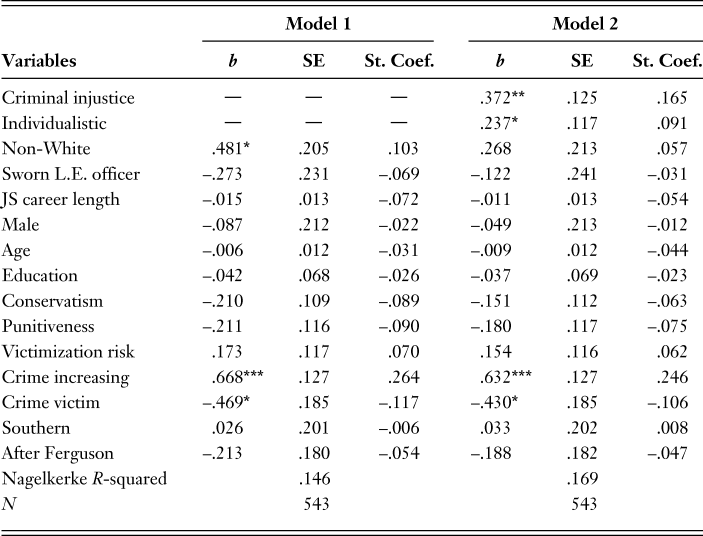
Table 5 presents the results for the urgency frame—the belief that DMC is increasing. As with the severity frame, race has a statistically significant effect (b = .481, p = .019) on endorsing the urgency frame (model 1). The odds of endorsing this motivational frame are 62% higher for non-White than White JCJW (odds ratio = 1.618). However, the coefficient for race is reduced in size and rendered nonsignificant once attributional frames are included in the equation (model 2). There are statistically significant positive associations (b = .372, p < .01; b = .237, p = .042, respectively) between endorsing criminal injustice and individualistic frames to explain DMC and endorsing the urgency frame. However, the former is much more pronounced than the latter. A one-unit increase in endorsement of criminal injustice frames is associated with a 45% increase in the odds of endorsing this motivational frame (odds ratio = 1.451). A formal test for mediation using the KHB method shows that race has a significant indirect effect (b = .233, p < .01) on endorsement of the urgency frame via endorsement of criminal injustice frames.
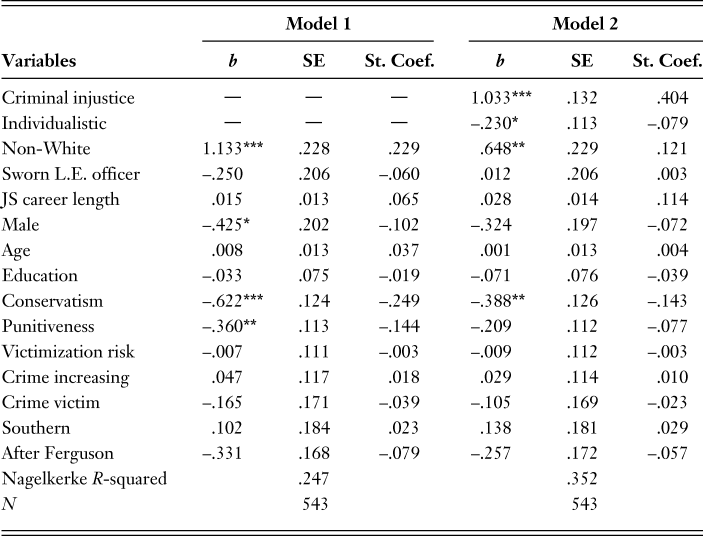
The results for the propriety frame—the belief that one has a personal obligation or duty to respond to DMC—are displayed in Table 6. As with the other motivational frames, race has a sizable and statistically significant effect (b = 1.133, p < .001) on endorsing the propriety frame (model 1). The odds of endorsing this motivational frame are 210% higher for non-White than White JCJW (odds ratio = 3.104). The coefficient for race is reduced substantially in size, although it remains significant (b = .648, p < .01), once attributional frames are included in the equation (model 2). Endorsing criminal injustice frames is positively related (b = 1.033, p < .001) and endorsing individualistic frames is negatively related (b = –.230, p = .042) to endorsing the propriety frame. The standardized coefficients indicate that endorsing criminal justice frames is by far the strongest predictor of endorsing the propriety frame. A one-unit increase in endorsement of criminal injustice frames is associated with a 181% increase in the odds of endorsing the propriety frame (odds ratio = 2.809). As before, the results from the KHB test for mediation reveal that JCJW’s race has a large significant indirect effect (b = .588, p < .001) on whether they endorse the propriety frame via their endorsement of criminal injustice frames.
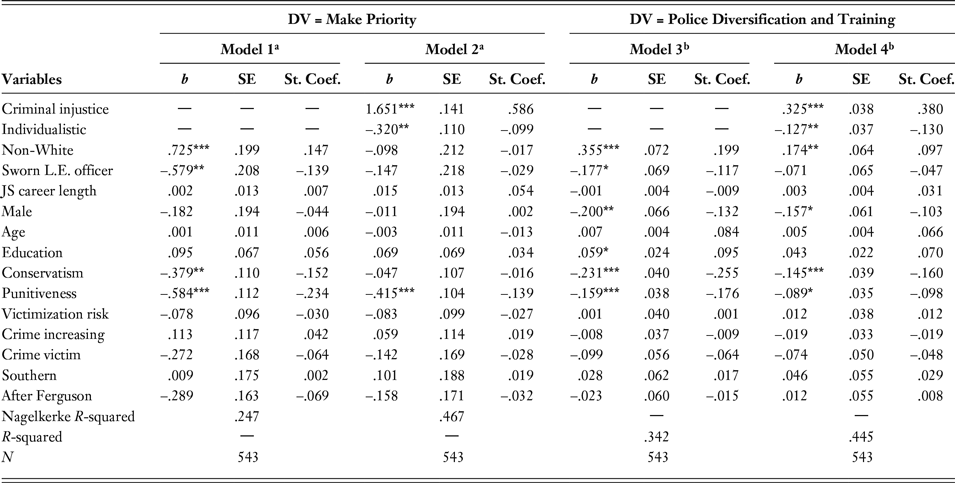
The final portion of the analysis examines the endorsement of policy frames about DMC. Table 7 presents four regression equations with the two separate policy frames specified as the dependent variables. There are two equations for each dependent variable; one includes and the other excludes the measures of attributional frames. The results from these equations are easily summarized. First, JCJW’s race strongly predicts both policy frames (b = .725, p < .001; b = .355, p < .001, respectively). Non-White JCJW are much more likely than their White counterparts to believe that DMC should be a policy priority and to support police racial diversification and cultural training. Second, in both cases, the coefficient for race is reduced substantially after including the measures of attributional frames. Third, criminal injustice frames are positively related to both policy frames (b = 1.651, p < .001; b = .325, p < .001, respectively), whereas individualistic frames are negatively related to both frames (b = –.320, p < .01; b = –.127, p < .001, respectively). Fourth, endorsing criminal injustice frames is by far the strongest predictor for both policy frames. For example, in model 4, which predicts support for police racial diversification and cultural training, the standardized coefficient for criminal injustice frames (Beta = .380) is more than twice as large as that for any other variable, including race (Beta = .097) and conservatism (Beta = –.160). Fifth, JCJW’s race has a large and statistically significant indirect effect on whether they endorse the policy frames through their endorsement of criminal injustice frames (b = .944, p < .001; b = .190, p < .001, respectively).
Ordinal and OLS Regressions Predicting Endorsement of Policy Frames for DMC

NOTES: aOrdinal logistic regression; blinear regression.
ABBREVIATIONS: b = unstandardized regression coefficient; JS = justice system; DV = dependent variable; LE = law enforcement; SE = standard error; St. Coef. = standardized coefficient.
*p < .05; **p < .01; ***p < .001 (two-tailed).
DISCUSSION AND CONCLUSION
Racial caste systems do not require racial hostility or overt bigotry to thrive. They need only racial indifference.
—Michelle Alexander, The New Jim Crow (2010, p. 14)
Our study sought to understand indifference to carceral inequality among JCJW. Less than 20% of the JCJW in our sample believed that reducing carceral inequality in the juvenile justice system (or DMC) should be a high or very high priority for policy makers and practitioners; 45% thought it should be a low or very low priority. Prior studies have also documented low levels of concern about DMC among JCJW (Talley et al., Reference Talley, Rajack-Talley and Tewksbury2005; Ward et al., Reference Ward, Kupchik, Parker and Starks2011). Yet, the explanations for this indifference have thus far remained elusive.
Drawing on insights from the framing perspective, comparative conflict theory, and group position theory, we theorized that criminal injustice frames fail to resonate with many JCJW, especially Whites, and that this explains why JCJW often dismiss the argument that carceral inequality is a social problem that warrants ameliorative action. The evidence from our analysis of JCJW’s views about DMC strongly supports our theory. Across the different outcomes examined, three findings emerged consistently: 1) JCJW’s race had a strong effect on their endorsement of motivational and policy frames challenging DMC; 2) this effect reflected the heavy influence of race on the resonance of criminal injustice frames about DMC; and 3) criminal injustice frames were more strongly related than race, individualistic frames, and most other variables to endorsement of each of the motivational and policy frames about DMC.
Our findings strongly support the framing perspective, which holds that endorsement of an injustice frame “is the seedling for the development of a [complete] collective action frame” (Benford Reference Benford1997, p. 416, emphasis in original). A collective action frame is the full set of “action-oriented … beliefs and meanings that inspire and legitimate” ameliorative mobilization (Benford and Snow, Reference Benford and Snow2000, p. 614). More generally, the findings are consistent with the theoretical argument that a sense of injustice facilitates endorsement of motivational and policy frames by increasing attention to relevant framing activities and personal identification with the victims of injustice (Gamson Reference Gamson1992). Additional research is needed, however, to test these hypothesized mediating mechanisms.
Our study also shows that many of the key conclusions from research on public opinion about Black-White socioeconomic inequality generalize to JCJW’s views about carceral inequality. First, similar to attributions for socioeconomic disparities (Bobo Reference Bobo1991; Hunt Reference Hunt2007; Kluegel Reference Kluegel1990), we find that structural and individualistic attributions for racial disparities in justice system involvement are not opposites, but rather constitute distinct attitudes. The evidence herein thus strongly supports the notion that “ambivalence or inconsistency is an important hallmark of contemporary racial attitudes” (Kleugel 1990, p. 512). Second, we show that perceived discrimination is far more important than individualistic attributions for explaining policy attitudes about carceral inequality, which parallels findings for attitudes about policies to reduce socioeconomic disparities (Bobo and Kluegel, Reference Bobo, Kluegel, Tuch and Martin1997; Kluegel Reference Kluegel1990).
The results herein are also similar to findings from the literature on public support for punitive crime policies. That research has found that race plays a large role in shaping attitudes toward policies like the death penalty (Bobo and Johnson, Reference Bobo and Johnson2004; Peffley and Hurwtiz, 2010). Further, those studies have shown that the effect of race on punitiveness is largely explained by racial attitudes, especially views about the presence and importance of racial discrimination (modern racism, symbolic racism) (Brown and Socia, Reference Brown and Socia2016; Unnever and Cullen, Reference Unnever and Cullen2007; Unnever et al., Reference Unnever, Cullen and Jones2008). Similarly, in our study, the relationship between race and endorsement of severity, urgency, propriety, and policy frames was largely indirect through beliefs about discrimination in the criminal justice system—or criminal injustice frames.
Although the relationship between endorsing criminal injustice frames (or perceiving discrimination by legal actors) and JCJW’s beliefs about the importance of addressing carceral inequality may seem commonsensical, it has substantial implications. Racial disparities in justice system involvement sustain the vast socioeconomic inequalities that exist between racial groups in America (Pager Reference Pager2007; Western Reference Western2006). Alexander warns that the current racial caste system—racialized mass incarceration—“may prove to be more durable than its predecessors,” precisely because it “is not explicitly based on race” (2010, p. 179). That is, the fact that the system is formally colorblind vindicates its racialized nature and consequences in the eyes of many JCJW and citizens. An important policy question, then, is how to break this “spell of callous colorblindness” (Alexander Reference Alexander2010, p. 228) among JCJW as well as members of the public?
Naomi Murakawa and Katherine Beckett (2010) suggest that what allowed racialized mass incarceration to occur even as explicit prejudice declined—or what they label the “post-civil rights paradox”—was a narrowing of definitions of racism and discrimination, particularly among Whites, to focus only on intentional bias that causes specific instances of inequality. Theoretically, a narrow ideological understanding of what constitutes racial bias should reduce the narrative fidelity of criminal injustice frames (Benford and Snow, Reference Benford and Snow2000). This likely explains, in part, the low resonance of criminal injustice frames among White JCJW. However, if interventions could be designed to broaden definitions of racial bias, we would expect an increase in concern among JCJW about carceral inequality. Prior research suggests that attitudes toward racial issues are “strikingly pliable” (Sniderman and Piazza, Reference Sniderman and Piazza1993, p. 143). Indeed, Glen Adams and colleagues (2008) reported experimental evidence that tutorials on the systemic nature of racism can cause lasting changes in individuals’ definitions and perceptions of racial bias. Future studies are therefore needed that examine whether similar interventions can increase JCJW’s concern about carceral inequality and support for policies aimed at reducing it.
Our study is not without limitations, which provide opportunities for future research. Most notably, similar to previous research with justice system actors (Bridges and Steen, Reference Bridges and Steen1998; Nix and Pickett, Reference Nix and Pickett2017; Tyler et al., Reference Tyler, Callahan and Frost2007), we analyze data from a nonprobability, albeit nationwide, sample of JCJW. As a result, we simply cannot be sure that our findings will generalize to any broader population. We do anticipate that our results will generalize given that they are consistent with extant theory, and are also very similar to those observed in prior research examining related topics (Bobo Reference Bobo1991; Bobo and Kluegel, Reference Bobo, Kluegel, Tuch and Martin1997; Kluegel Reference Kluegel1990; Unnever Reference Unnever2008; Ward et al., Reference Ward, Kupchik, Parker and Starks2011). Nonetheless, future research is needed that attempts to replicate our findings using representative samples of JCJW, as well as representative samples of specific types of JCJW, such as police officers or juvenile probation officers.
Additionally, our data did not include measures of the empirical credibility of injustice frames or the adoption of vocabularies of efficacy for addressing carceral inequality. There is thus a need for additional studies that explore the factors that impact the empirical credibility of injustice frames, and whether endorsement of injustice frames can, in turn, help to explain adoption of efficacy frames. More generally, we advocate for devoting greater empirical attention to views about racial disparities in the juvenile and criminal justice systems. Given that carceral inequality has profound social effects (Western Reference Western2006), and is a linchpin of America’s new racial caste system (Alexander Reference Alexander2010), the paucity of research on views about the causes, consequences, and policy importance of racial disparities in justice system involvement is startling (Unnever Reference Unnever2008; Ward et al., Reference Ward, Kupchik, Parker and Starks2011).