Introduction
Studies of the in vitro maturation (IVM), in vitro fertilization (IVF) and development of minke whale oocytes have been attempted in our laboratory (Asada et al., Reference Asada, Tetsuka, Ishikawa, Ohsumi and Fukui2001; Fukui et al., Reference Fukui, Mogoe, Ishikawa and Ohsumi1997a, Reference Fukui, Mogoe, Ishikawa and Ohsumib). Although minke whale oocytes developed to the morula stage following IVM and IVF (Asada et al., Reference Asada, Tetsuka, Ishikawa, Ohsumi and Fukui2001), blastocyst-stage embryos have not been obtained. Iwayama et al. (Reference Iwayama, Ishikawa, Ohsumi and Fukui2005) recently reported successful shortening of the IVM culture period for fresh minke whale oocytes from 120 h to 30 h by supplementing an IVM medium with whale follicular fluid instead of with calf or whale serum. Additionally, the IVM rates of vitrified and warmed minke whale oocytes have been increased to about 30% by using the cryotop as a cryodevice and changing the osmolarity of the IVM medium to 390 mosmol (Iwayama et al., Reference Iwayama, Hochi, Kato, Hirabayashi, Kuwayama, Ishikawa, Ohsumi and Fukui2004).
Fujihira et al. (Reference Fujihira, Kishida and Fukui2004) reported on the effectiveness of pretreatment with cytochalasin B (CB) and the effect of two types of cryoprotectant solutions on vitrified porcine oocytes, and found that treatment with 7.5 μg/ml CB for 30 min before vitrification resulted in a threefold higher maturation rate (46.8%) than that of non-CB-treated oocytes (13.9%). In addition, the use of ethylene glycol (EG) alone as a cryoprotectant for vitrification resulted in a significantly higher maturation rate (37.1%) than a mixture of EG and dimethylsulfoxide (DMSO) (23.9%) (Fujihira et al., Reference Fujihira, Kishida and Fukui2004). We here hypothesize that Antarctic minke whale oocytes may show an improved maturation rate after vitrifying and warming following CB pretreatment and alteration of the cryoprotectants (EG alone or EG + DMSO) used for vitrification.
In the present study, the effects of the sexual maturity (adult or prepubertal) of whale oocyte donors on the in vitro nuclear maturation rate and in vitro parthenogenetic development capacity of fresh whale oocytes were examined (experiments 1 and 2, respectively). In experiment 3, the effects of CB pretreatment and two types of cryoprotectant solutions (EG and EG + DMSO) on the nuclear maturation of vitrified-warmed immature whale oocytes were examined, and in experiment 4, the developmental capacity of vitrified immature whale oocytes following IVM and intracytoplasmic sperm injection (ICSI) was also examined.
Materials and methods
The present study was approved by the Animal Experimental Committee of Obihiro University of Agriculture and Veterinary Medicine in accordance with the Guiding Principles for the Care and Use of Research Animals.
Whales and oocyte collection
The Antarctic minke whales used in this study were captured between November 2004 and March 2005 in the Japanese Whale Research Programme with a Special Permit for the Antarctic (JARPA), which was organized by the Institute of Cetacean Research in Tokyo, Japan. A total of 205 female minke whales (prepubertal: n = 33, 6.38 ± 0.97 m, 3.33 ± 1.29 tonnes; adult: n = 172, 8.86 ± 0.40 m, 7.82 ± 1.16 tonnes) were captured in an area 60°S to the edge of the Antarctic ice and 130°E to 145°W. Explosive harpoons were used as the primary killing method for all whales, which have been recognized by the International Whaling Commission as the most humane method for killing whales, and are provided for by Schedule III (Capture) in the International Convention for the Regulation of Whaling. Special efforts were made to reduce the time to death for all sampled whales. A large-caliber rifle was used as the secondary killing method when required. The ovaries were collected within 3 h of death, and were kept warm at 20–25 °C until oocyte collection (within 8 h).
The sexual maturity of the minke whales was determined by the presence or absence of a corpus luteum and/or corpora albicans on either ovary. Whales with neither a corpus luteum nor a corpus albicans were considered prepubertal.
The minke whale oocytes were aspirated from follicles (2–15 mm in diameter) using a 10 ml syringe fitted with an 18 gauge needle. Oocytes surrounded by more than two layers of cumulus cells and with a homogeneous cytoplasm were selected and washed three times in Medium 199 (Sigma) containing 0.1% (w/v) polyvinyl alcohol (PVA, Sigma), 2 mM NaHCO3 (Wako), 10 mM HEPES (Sigma) and 75 mg/l kanamycin (Sigma; M199-PVA).
In vitro maturation (IVM)
The IVM medium used was Medium 199 adjusted to 390 mosmol by changing the concentration of NaCl, KCl, MgSO4(anhydrous) and CaCl2.2H2O at a constant ratio with Medium 199 and supplemented with 10% (v/v) whale follicular fluid (wFF), 0.33 mM sodium pyruvate (Wako), 1 mM glutamine (Wako), 100 μM cysteamine (Sigma), 0.6 mM cysteine (Sigma), 25 mM HEPES, 75 mg/l kanamycin (Sigma), 0.02 AU/ml pFSH (Antrin; Kawasaki Pharmaceutical), 1 μg/ml estradiol-17β (Sigma) and 10 ng/ml epidermal growth factor (Sigma). The cumulus–oocyte complexes (COCs) were washed three times in an IVM medium. Ten to 40 COCs were transferred to 500 μl IVM medium in a four-well dish (Nunc #176740) and cultured for 40–50 h at 37 °C in 5% CO2 in air.
Vitrification and warming
The basic medium for the equilibration or dilution of cryoprotectant was HEPES-buffered Medium 199 supplemented with 20% (v/v) newborn calf serum (M199-NBCS). In the present study, two types of cryoprotectant solutions were used, one consisting of ethylene glycol (EG) only and another composed of a mixture of EG and dimethylsulfoxide (DMSO; EG + DMSO). The COCs were transferred to M199-NBCS. The COCs were first exposed to 7.5% cryoprotectant (7.5% EG or 3.75% EG and 3.75% DMSO) in M199-NBCS for 8 min and then 15% cryoprotectant (15% EG or 7.5% EG and 7.5% DMSO) in M199-NBCS for 4 min at 37 °C. Finally, the COCs were exposed to 30% cryoprotectant (30% EG or 15% EG and 15% DMSO) and 0.5 M sucrose (Wako) in M199-NBCS. Within 1 min, three to eight COCs were placed on a sheet of cryotop (Kitazato Supplies, Japan) (Katayama et al., Reference Katayama, Stehlik, Kuwayama, Kato and Stehlik2003), which was then immersed in liquid nitrogen. For warming, the cryotop sheet holding the COCs was immersed in 0.5 M sucrose in M199-NBCS at 37 °C, and the COCs were diluted by exposure to 0.5 M and 0 M sucrose in M199-NBCS for 5 and 5 min, respectively, at 37 °C.
Occyte activation and in vitro culture
After IVM, the cumulus cells were removed by pipetting the COCs for 3–5 min in the presence of 0.1% (w/v) hyaluronidase (Sigma). The denuded oocytes were activated by exposure to 5 μM ionomycin (IM; Sigma) in M199-PVA for 4 min and then 2 mM 6-dimethylaminopurine (DMAP; Sigma) in IVC medium for 3.5 h. Following activation, the oocytes were transferred into 500 μl of in vitro culture medium and incubated at 37 °C in 5% CO2 in air. The in vitro culture medium used was Medium 199 adjusted to 360 mosmol and supplemented with 10% (v/v) fetal whale serum, 2 mM glutamine, 5 mM hypotaurine (Sigma), 7 mM taurine (Sigma) and 75 μg/ml kanamycin. At day 4 of culture, the non-cleaved oocytes were fixed and stained by whole-mount preparation to assess the nuclear status, and the cleaved embryos were cultured for another 6 days. At day 10 of culture, the nuclei of the cleaved embryos were examined by staining with 5 μg/ml Hoechst 33342 for 20 min followed by exposure to ultraviolet light.
Intracytoplasmic sperm injection (ICSI)
ICSI was performed according to the method reported previously (Fujhira et al., Reference Fujihira, Kishida and Fukui2004) with some modifications. Frozen-thawed minke whale spermatozoa were treated with 5 mM dl-dithiothreitol (Sigma) for 20 min and washed by centrifugation (300 g, 4 min). Each spermatozoon was aspirated into the injection pipette tail-first and injected into the oocyte cytoplasm, and then thoroughly mixed with the cytoplasmic components using an open tube controlled by mouth.
Experimental design
In experiment 1, the effect of the sexual maturity of the oocyte donor on the in vitro nuclear maturation rate of fresh whale oocytes was examined. After IVM for 40–50 h, the nuclear status of the oocytes was determined by wholemount preparation.
In experiment 2, the effect of the sexual maturity of the oocyte donor on the in vitro parthenogenetic development of in vitro matured whale oocytes was examined. At day 4 of culture after parthenogenetic activation, the nuclear status of the non-cleaved oocytes was examined by whole-mount preparation to calculate the activation rate, and the cleaved zygotes were cultured for another 6 days. Activation was defined as the resumption of meiosis arrested at the metaphase II stage.
In experiment 3, the effect of pretreatment with cytochalasin B (CB; Sigma) on the nuclear maturation of vitrified-warmed whale oocytes was examined (experiment 3a). The oocytes were treated with 7.5 μg/ml CB in M199-NBCS for 10–15 min before exposure to cryoprotectant solutions. The CB-treated and non-treated (control) oocytes from adult donors were vitrified using EG + DMSO as a cryoprotectant. Additionally, a comparison of the two types of cryoprotectant solutions (EG and EG + DMSO) on the nuclear maturation of vitrified and warmed whale oocytes without CB treatment was conducted in experiment 3b.
In experiment 4, the developmental capacity of vitrified immature whale oocytes derived from adult whales following IVM culture and ICSI was examined. After IVM, ICSI was performed using only oocytes with a first polar body. The nuclear status of oocytes without a first polar body was examined by whole-mount preparation to record the maturation rate. Oocytes injected with sperm were activated by the method described above. In this experiment, a mixture of EG + DMSO was used for vitrification, and the oocytes were not treated with CB before vitrification. The wFF used in this experiment was from different sources (batches) than those used in experiments 1 to 3. Additionally, sperm-injected and parthenogenetically activated oocytes were co-cultured with Vero cells during the IVC. Two days before of the IVC, the Vero cells were seeded into a four-well dish (500 μl IVC medium) at a concentration of 1 × 10⁴ cells/ml and cultured at 37 °C in 5% CO2 in air. Half of the culture medium (250 μl) was replaced with fresh medium every 72 h during the IVC.
Statistical analysis
The data on oocyte maturation and activation were compared by chi-square test. A value of p < 0.05 was chosen as an indication of significance.
Results
In experiment 1 (Table 1), there was no significant difference (p = 0.41) in the nuclear maturation rates of oocytes from adult (60.9%) and prepubertal (53.1%) donors.
Effect of sexual maturity of oocyte donors on in vitro maturation of fresh whale oocytes

Six replicates were run.
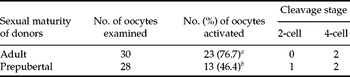
In experiment 2 (Table 2), the activation rate of the oocytes from adult donors was significantly (p < 0.05) higher than that of the oocytes from prepubertal donors (76.7% and 46.4%, respectively). A total of five oocytes were cleaved to the 2-cell or 4-cell stage after parthenogenetic activation treatment, but no more advanced stage was observed.
Effect of sexual maturity of oocyte donors on in vitro parthenogenetic development of in vitro matured whale oocytes

a,b Values with different superscripts within the same column are significantly different (p < 0.05).
Three replicates were run.
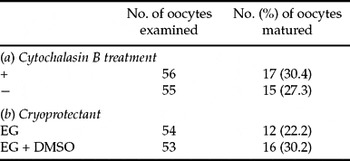
In experiments 3a and 3b (Table 3), there was no significant effect (p = 0.88) of CB treatment on the nuclear maturation rates of vitrified oocytes (30.4% and 27.3% for the CB+ and CB− groups, respectively). Also, there was no significant difference (p = 0.55) in the nuclear maturation rates of vitrified oocytes between the two types of cryoprotectant solutions (22.2% and 30.2% for the EG and EG + DMSO groups, respectively).
Effects of cytochalasin B pretreatment and two types of cryoprotectant solutions on the nuclear maturation of vitrified-warmed immature whale oocytes

Three replicates were run.
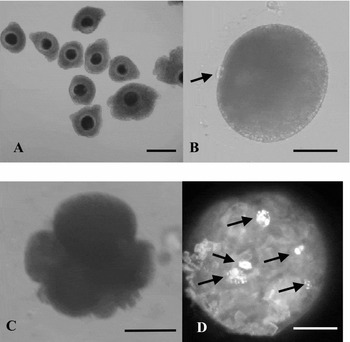
In experiment 4 (Table 4), the maturation rate of vitrified immature whale oocytes was 15.4% (Fig. 1A, B). The cleavage rate after ICSI was 46.2%, and a total of six embryos developed to the 2-cell (n = 3), 4-cell (n = 1) or 5-cell (n = 2) stages (Fig. 1C). The nuclei of a 5-cell stage embryo are shown in Fig. 1D.
Developmental capacity of vitrified immature whale oocytes following IVM and ICSI

aAll oocytes with the first polar body were injected.
Four replicates were run.
(A) Immature minke whale oocytes after vitrification and warming (scale bar represents 200 μm). (B) An oocyte extruding from the first polar body after vitrification, warming and IVM (arrow; first polar body, scale bar represents 50 μm). (C) A cleaved embryo (5-cell stage) after ICSI (scale bar represents 50 μm). (D) The embryo was stained with Hoechst 33342 and had five nuclei (arrows) (scale bar represents 50 μm).

Discussion
Asada et al. (Reference Asada, Tetsuka, Ishikawa, Ohsumi and Fukui2001) reported that the maturation rate of immature fresh oocytes from Antarctic minke whales after IVM was less than 32%, but in the present study the maturation rate of the oocytes were greatly enhanced to 60.9%. Major improvement of the IVM method in the present study resulted from changing the osmolarity of the IVM medium to 390 mosmol and supplementing the IVM medium with whale follicular fluid instead of fetal whale serum. The sodium concentration of minke whale serum (179 mmol/l) (Fukui et al., Reference Fukui, Mogoe, Terawaki, Ishikawa, Fujise and Ohsumi1995) is higher than those of porcine (147 mmol/l) (Chang et al., Reference Chang, Jones, Ellefson and Ryan1976) and mouse serum (148 mmol/l) (Roblero et al., Reference Roblero, Biggers and Lechene1976), and the osmolarity of minke whale follicular fluid (388 mosmol) was also higher than those of porcine and bovine follicular fluid (approximately 300 mosmol) (Iwayama et al., Reference Iwayama, Ishikawa, Ohsumi and Fukui2005). The high sodium concentration in the serum and high osmolarity in the follicular fluid are probably specific characteristics of marine mammals. It has been considered that elevating the osmolarity of the IVM medium could provide a physiological environment more conducive to oocyte maturation. Suzuki et al. (Reference Suzuki, Misumi, Ozawa, Noguchi, Kaneko, Ohnuma, Fuchimoto, Onishi, Iwamoto, Saito, Nagai and Kikuchi2005) reported that supplementing porcine IVM medium with porcine follicular fluid increased maturational capacity compared with fetal bovine serum. It appears that some components of follicular fluid, such as hormones and growth factors, have a better effect on nuclear and cytoplasmic maturation than serum components. However, it has been reported that the concentrations of various hormones in bovine and porcine follicular fluid vary depending on the follicular size (Chang et al., Reference Chang, Jones, Ellefson and Ryan1976) or the estrous cycle (Wise, Reference Wise1987), and that the IVM rates of porcine oocytes were different depending on the follicular size (Iwata et al., Reference Iwata, Hashimoto, Ohota, Kimura, Shibano and Miyake2004). In the present study, the maturation rate of vitrified oocytes was lower in experiment 4 (15%) compared with experiment 3 (30%). Therefore, the best follicular fluid collected from a suitable-sized follicle and certain period of the estrous cycle should be used.
Asada et al. (Reference Asada, Tetsuka, Ishikawa, Ohsumi and Fukui2001) reported that the maturation rates of fresh minke whale oocytes were similar in donors at different stages of sexual maturity. Furthermore, it has been reported in several species that higher polyspermic fertilization rates (Marchal et al., Reference Marchal, Feugang, Perreau, Venturi, Terqui and Mermillod2001; O'Brien et al., Reference O'Brien, Dwarte, Ryan, Maxwell and Evans1996) and a lower developmental capacity (Revel et al., Reference Revel, Mermillod, Peynot, Renard and Heyman1995) were observed in oocytes from prepubertal donors compared with those from adult donors. In the present study, the maturation rates did not vary significantly with sexual maturity, as was also shown by Asada et al. (Reference Asada, Tetsuka, Ishikawa, Ohsumi and Fukui2001), but the activation rate after parthenogenetic activation of oocytes from adult donors was significantly higher than that of oocytes from prepubertal donors. It has been reported that a transient rise in intracellular calcium caused by parthenogenetic activation leads to the resumption of meiosis and subsequent pronuclear formation (Wang et al., Reference Wang, Machaty, Abeydeera, Prather and Day1998). It could be considered that oocytes from prepubertal donors were still incomplete in the events from the rise in intracellular calcium to pronuclear formation, and the parthenogenetic activation treatment used in the present study may be not optimal for such oocytes.
Epidermal growth factor and cysteine were added to the IVM medium to promote glutathione synthesis in the present study. Glutathione is an indicator of cytoplasmic maturation and has an intimate involvement in reducing reactive oxygen species (Funahashi et al., Reference Funahashi, Cantley, Stumpf, Terlouw and Day1994; Kishida et al., Reference Kishida, Lee and Fukui2004; El Mouatassim et al., Reference El Mouatassim, Guérin and Ménézo1999). However, although in the present study pronuclear formation was observed in some oocytes after parthenogenetic activation, the great majority of the whale oocytes did not cleave. Furthermore, the oocytes injected with sperm developed to the 4-cell stage but no further than the 8-cell stage. Further studies are needed to promote cytoplasmic maturation in IVM culture systems as well as to establish an IVC system for minke whale zygotes.
It has been reported that CB, as a cytoskeletal relaxant, makes the cytoskeletal elements less rigid and more elastic, and thus might reduce cryoinjury to oocytes and embryos during vitrification (Dobrinsky et al., Reference Dobrinsky, Pursel, Long and Johnson2000; Dobrinsky, Reference Dobrinsky2002; Isachenko et al., Reference Isachenko, Soler, Isachenko, Perez-Sanchez and Grishchenko1998). In a previous study (Fujihira et al., Reference Fujihira, Kishida and Fukui2004), CB treatment before the vitrification of immature porcine oocytes resulted in a significantly higher IVM rate than that of non-CB-treated oocytes (46.8% and 13.9%, respectively). However, in the present study CB treatment before vitrification did not improve the nuclear maturation rate of vitrified immature whale oocytes. Vieira et al. (Reference Vieira, Mezzalira, Barbieri, Lehmkuhl, Rubin and Vajta2002) also reported that treatment with cytochalasin D had no effect on the development to the blastocyst stage of vitrified bovine immature oocytes. It seems that the efficacy of cytochalasins is species-specific.
Cha et al. (Reference Cha, Chung, Lim, Ko, Han, Choi and Yoon2000) used EG as a cryoprotectant when human immature oocytes were vitrified, due to its high permeability into oocytes and low toxicity. High maturation rates of vitrified immature bovine and porcine oocytes were obtained by EG alone compared with a mixture of EG and DMSO (Certin & Bastan, Reference Certin and Bastan2005; Fujihira et al., Reference Fujihira, Kishida and Fukui2004). However, in the present study there was no significant difference in the nuclear maturation rates of the whale oocytes vitrified either with EG alone or with EG + DMSO. The reason or reasons for these contradictory results were not clarified in the current study.
In conclusion, it was shown that the maturation rate of Antarctic minke whale oocytes was greatly improved by elevating the osmolarity of IVM medium by adding wFF. However, the developmental capacity after parthenogenetic activation or ICSI was still low, and further studies are needed to improve the IVM system. The present study has also shown that CB treatment before vitrification does not have a positive effect on the vitrification of immature whale oocytes, and that using different vitrification solutions (EG alone and EG and DMSO) had no effect on the IVM rate of immature whale oocytes.
Acknowledgements
We thank the captain and crew members of the research base ship for their help in obtaining the Antarctic minke whale ovaries, and Dr M. Kuwayama, Kato Lady's Clinic, Japan for sypplying the cryotop. The present study was partly supported by the Cooperative Program of the National Institute for Physiological Sciences.