1. Introduction
1.1. Rationale
Infectious bovine keratoconjunctivitis (IBK) or pinkeye is one of the most important production-limiting diseases of pre-weaned beef calves. The clinical signs of IBK include lacrimation, photophobia, corneal edema, ocular pain, corneal ulceration, and the potential for vision loss (Alexander, Reference Alexander2010). Calves with IBK lesions have decreased weaning weight by 15–30 lb compared with unaffected calves (Thrift and Overfield, Reference Thrift and Overfield1974; Funk et al., Reference Funk, O'Connor, Maroney, Engelken, Cooper, Kinyon and Plummer2009, Reference Funk, Reecy, Wang, Tait and O'Connor2014). Moraxella bovis is considered the primary causal organism associated with IBK (George et al., Reference George, Wilson, Baggot and Mihalyi1984; Brown et al., Reference Brown, Brightman, Fenwick and Rider1998; Gould et al., Reference Gould, Dewell, Tofflemire, Whitley, Millman, Opriessnig, Rosenbusch, Trujillo and O'Connor2013). M. bovoculi has also been suggested to play a role in IBK disease etiology (Angelos et al., Reference Angelos, Spinks, Ball and George2007). However, available evidence suggests prevention of IBK with either commercially available or autogenous M. bovis or M. bovoculi vaccines is ineffective (Funk et al., Reference Funk, O'Connor, Maroney, Engelken, Cooper, Kinyon and Plummer2009; Cullen et al., Reference Cullen, Engelken, Cooper and OConnorin press). In the absence of evidence supporting an effective IBK vaccine, antibiotic therapy is the best method for reducing the production and welfare impacts of IBK. In 2006, members of our group published a review of antibiotic treatments of IBK that included nine randomized controlled trials (RCT) (O'Connor et al., Reference O'Connor, Wellman, Evans and Roth2006). In that review, only one trial included an active-to-active treatment comparison of different antibiotics and no antibiotic regime was employed more than once. Therefore, in the prior review a pairwise meta-analysis was not appropriate (O'Connor et al., Reference O'Connor, Wellman, Evans and Roth2006). Further, the 2006 review focused on risk of unhealed corneal ulcers as the outcome. As 10 years have passed since the conduct of the initial review, it was decided to update the review and determine if additional IBK treatment trials had been published in the ensuing decade that would enable better understanding of comparative efficacy of antibiotic treatment options for IBK. Additionally, statistical methods that allow for the comparison of multiple treatments (mixed treatment comparisons meta-analyses, MTCMA) and methods that allow for comparison of different outcomes (multivariate meta-analysis, MVMA) have become more accessible and it was thought these might enable better synthesis of the data (Higgins and Whitehead, Reference Higgins and Whitehead1996; Lu and Ades, Reference Lu and Ades2004; Jansen et al., Reference Jansen, Crawford, Bergman and Stam2008). Therefore, the purpose of this systematic review was to update the previous review of antibiotics available for IBK treatment (O'Connor et al., Reference O'Connor, Wellman, Evans and Roth2006) with all available relevant trials and to conduct, if feasible, either a MTCMA or a MVMA to better understand the comparative efficacy of antibiotic treatment options for IBK. The overall objective of this review was to provide veterinarians and producers with information about the comparative efficacy of antibiotic treatments for IBK in calves. Unlike the prior review, treatment efficacy was measured using a variety of outcomes including clinical ulcer score as described by the authors, duration until healing following antibiotic treatment, cure risk based on authors' definition of resolution of corneal ulcers, and corneal ulcer surface area. A secondary outcome of interest was weight gain, either total weight gain or average daily gain (ADG).
2. Methods
This paper was assembled using the Preferred Reporting Items for Systematic Reviews and Meta-Analyses (PRISMA) guidelines (Moher et al., Reference Moher, Liberati, Tetzlaff and Altman2009). The PRISMA Checklist with corresponding section page numbers is available in the supplemental materials.
2.1. Protocol and registration
A protocol for the update was developed by four coauthors (J. N. C., J. F. C., C. W., A. O. C). The time-stamped protocol (21 December 2015) was submitted for record keeping to the journal prior to starting the review, and any modifications that occurred after approval of the protocol are noted in the paper. The original protocol is available in the supplemental materials.
2.2. Eligibility criteria i.e. the PICOS criteria
The review question was ‘What is the comparative efficacy of antibiotics for the treatment of IBK in beef and dairy cattle?’ The eligibility criteria were defined in terms of the population (P), intervention (I), comparator (C), outcomes (O), and study design (S). The eligible population of interest (P) consisted of beef or dairy cattle diagnosed with naturally occurring IBK. IBK diagnoses were defined either by bacterial isolation of Moraxella spp., Neisseria spp., or Branhamella catarrhalis (reclassified as Moraxella catarrhalis) or by the authors' clinical definition when bacterial isolation was not conducted. No restrictions were placed on the population age, weight, or the country where the trial was conducted. Eligible interventions (I) included any antibiotic treatment not banned for use in cattle and non-active placebos. This restriction does not limit antibiotic interventions to those registered for the treatment of IBK. Interventions banned for use were based on Group 1 and Group 2 lists from the Food Animal Residue Avoidance Databank (FARAD; http://www.farad.org), which was consulted during the review process. Multidrug interventions (i.e. antibiotic combined with anti-inflammatory component or antibiotic combined with antibiotic), non-antibiotic treatments, vitamins, or homeopathic treatments were excluded as not relevant to the review. The clarification to exclude vitamins or homeopathic treatments was a protocol change. For example, if one arm of a three-arm trial treated with penicillin plus dexamethasone, only the other two arms (penicillin and placebo) were extracted. As multiple interventions were of interest, no specific comparator (C) was specified.
The protocol initially defined the primary relevant outcome (O) as the incidence of unhealed corneal lesions (or healed lesion) and the secondary relevant outcome as measures of weight gain. However, the outcomes relevant to the review were expanded during the review process to include clinical ulcer scores, duration until ulcer healing, or corneal ulcer surface area. The rationale for this protocol change and expansion was that many studies reporting relevant information included these outcomes.
With respect to study design (S) characteristics, only RCT that allocated calves at the individual level were considered relevant to the review. Trials must have been conducted under field conditions with naturally occurring disease.
2.3. Information sources
All available years were searched in the Centre for Biosciences and Agriculture International (CABI; http://www.cabi.org) and MEDLINE® (http://www.ncbi.nlm.nih.gov/pubmed) databases using the Iowa State University Web of Science Interface. The proceedings table of contents from the last 20 years (1996–2016) of the American Association of Bovine Practitioners (AABP) and World Buiatrics Association were reviewed for potentially relevant conference abstracts. The Food and Drug Administration (FDA) Freedom of Information (FOI) New Animal Drug Application (NADA) summaries database (http://www.fda.gov/RegulatoryInformation/FOI/) was searched for IBK trial data of approved cattle antibiotics. Searches of the Zoetis (Zoetisus, http://www.zoetis.com/animal-health/) and Boehringer Ingelheim (Boehringer Ingelheim Vetmedica, http://www.bi-vetmedica.com) websites were conducted to look for potentially relevant technical bulletins. We searched these sites because Zoetis is the manufacturer of tulathromycin, a product registered for treatment of IBK, and both companies make a non-generic injectable oxytetracyline, another antibiotic for use to treat IBK. IBK reviews published after 2013 were also examined for relevant trials. After the completion of relevance screening, the bibliographies of relevant papers were examined for trials meeting the eligibility criteria.
2.4. Search
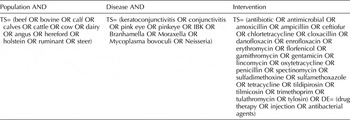
The search strategy followed the general form of ‘population’, ‘disease’ and ‘intervention’. For MEDLINE® ‘Drug Therapy’, ‘Injections’, and ‘Anti-Bacterial Agents’ were searched as Medical Subject Headings. For CABI, ‘drug therapy’, ‘injection’, and ‘antibacterial’ were searched as Descriptors. The search strategy for CABI is presented in Table 1.
Database search terms for the Centre for Biosciences and Agriculture Internatinal (CABI) and MEDLINE databases

2.5. Study selection
The online systematic review software, DistillerSR (DistillerSR (web-based software), Evidence Partners, https://distillercer.com) was used to manage all literature records and associated data. The relevance assessment form was pilot tested by two reviewers for approximately 20 papers and modified to ensure agreement. After establishing the final set of questions, the two reviewers independently read all abstracts to identify potentially relevant papers. One reviewer (J. C.) assessed the proceedings table of contents from both conferences. Only one reviewer needed to indicate potential relevance for the full text to be acquired. Full text papers were assessed by two reviewers for relevance. When two reviewers could not agree on trial relevancy questions based on the full text, a third reviewer (A. O. C) would decide. This decision was made as this reviewer is the most experienced with IBK. For trials considered relevant by both reviewers or decided by the third reviewer (A. O. C), all relevant data were extracted.
Originally, we intended to only include papers written in English. However, a protocol modification was made such that papers in languages other than English were considered eligible. For foreign-language papers, we assessed the abstract (if in English) and determined if there were reasons for exclusion based on the above exclusion criteria (e.g. treatment combinations, banned treatment regimens, non-random allocation, etc.). If it was not possible to exclude based on the English abstract, we attempted to obtain the full text and where possible translated the document using Google translate and again evaluated the text for exclusionary evidence. PDF image files written in French, Italian, Spanish and Chinese that could not be automatically translated were given to a single native speaker with a background in statistics and study design to determine if the trials were randomized and contained at least two comparative groups. Therefore these papers did not have two reviewers and were based on the judgement of the single native speaker. Other foreign-language papers with PDF image files were excluded as were papers that could not be obtained. Foreign-language theses were not translated and were excluded.
The PRISMA flow diagram was used as a template to present the study selection results (Moher et al., Reference Moher, Liberati, Tetzlaff and Altman2009).
2.6. Data extraction process
The data extraction process was pilot tested by two authors for a single outcome, unhealed corneal ulcer risk (A. O. C. and J. N. C.). Upon inclusion of the other outcomes, the form was modified to include all relevant outcome data. Data extraction was completed from all eligible papers by two reviewers independently. Extracted data conflicts were resolved by a single author (J. N. C.) in consultation with the original paper data to ensure accuracy. When a trial was identified from multiple sources, all sources were combined in order to obtain the most complete trial description.
2.7. Data items
Data extracted from each individual trial included: country in which the trial was conducted, age and weight means or ranges of calves, included genders and breed, concurrent management interventions (i.e. fly control or vaccinations), author definitions of eligible IBK case and ‘cured’, duration of observation period, cattle weights pre- and post-treatment, whether random allocation based on IBK severity occurred, dose and route of each intervention, number of unhealed corneal ulcers and total ulcer number per treatment, duration until healing, clinical scores, and corneal ulcer surface area.
For all continuous covariates and outcomes, standard deviations or standard errors of the mean (SEM) were extracted. If in the paper authors presented a standard error, it was converted to the standard deviation as this was a required input for the statistical analyses (see below). The outcome data were extracted for each time point reported when applicable. This protocol change was deemed necessary in order to obtain sufficient outcome data. When outcome data were presented only in figures or plots, WebPlotDigitizer (version 3.9) (Ankit Rohatgi, WebPlotDigitizer, Texas, http://arohatgi.info/WebPlotDigitizer/) was used to digitize the figures in order to extract relevant data. Plot digitizing was conducted in triplicate for continuous outcomes per figure by a single reviewer (J. C.). If corneal ulcer surface area was presented as square-root transformed, the data were back transformed to the raw mean surface area and an approximate standard deviation to ensure the scales were the same between studies (Jørgensen and Pedersen, Reference Jørgensen and Pedersen1998). This was accomplished as follows:
x represents the square rooted value, then the mean value is defined as
 $${\rm mean} = \displaystyle{{n - 1} \over n}{({\rm S}{{\rm D}_x})^2} + {({\rm mea}{{\rm n}_x})^2}$$
where (SD x ) stands for the standard deviation of the squared rooted value, and (mean x ) stands for the mean value of the squared rooted value. The approximate standard deviation was
 $${\rm SD} = 2({\rm S}{{\rm D}_x}\sqrt {{\rm mean}} )$$
To assess the accuracy of transformation, samples were randomly generated from a normal distribution and the mean of x and the mean using the transformation formula were compared. This procedure was repeated multiple times using different random samples. The results were considered reasonable based on the opinion of one author (C. Y.). No statistical tests were utilized to compare predictions.
If authors reported only the percentage of unhealed corneal ulcers (calf or eye level), counts were calculated based on the described arm's sample size and rounded to the nearest whole number. When continuous outcome data were presented in a stratified manner (e.g. healing times for calves with moderate lesions versus severe lesions), outcomes were combined using an appropriate statistical method (Higgins et al., Reference Higgins, Green, Julian and Green2008). Similarly when discrete data were stratified by severity (i.e. unhealed corneal ulcers for calves mild and moderate ulcers), counts were combined. When authors reported outcomes on multiple days, all were extracted and the day of measurement was recorded. Data that were presented for multiple location sites were extracted separately per site.
2.8. Geometry of the network of studies
The geometry of the treatment network for each outcome were assessed using the probability of interspecific encounter (PIE) index and C-score (Salanti et al., Reference Salanti, Kavvoura and Ioannidis2008). The PIE index describes the network diversity where a value >0.75, suggests the network has a relatively high diversity. The C-score test measures co-occurrence, meaning particular intervention comparisons are more likely than others and a small p-value indicates there exists statistically significant co-occurrence in the network. PIE index was calculated by customer written R script (R Core Team, 2015) and C score test was accomplished via R package EcoSimR (Gotelli et al., Reference Gotelli, Hart and Ellison2015) version 0.1.0.
2.9. Risk of bias within individual studies
Risk of bias was assessed at study level considering nature of the outcome (subjective versus objective outcome) using the Cochrane Risk of Bias for trials (Higgins et al., Reference Higgins, Green, Julian and Green2008). Two reviewers assessed each paper as ‘high risk’, ‘low risk’, or ‘unclear risk’ for selection, detection, attrition, reporting, and other potential sources of bias. Disagreements as to the level of risk were discussed between three reviewers (J. N. C., S. T., and R. D.). If consensus could not be reached, unclear risk was chosen. For the single foreign language paper that was considered relevant, the translator was asked the risk of bias questions, the translator provided the answers and one of the authors (A. O. C.) made the risk of bias assessment. Papers that described how randomization was implemented (e.g. randomization schedule or by random number draw) or randomization was stratified by clinical severity of IBK were considered low risk for randomization. Allocation concealment was considered unclear risk unless the authors described sequential allocation to ensure even numbers between treatment arms (high risk). Lack of caregiver blinding was considered unclear risk unless treatment selectively caused a reaction in one treatment group and not the other. For example one reviewer (S. T.) suggested that if application of an antibiotic caused eyelid swelling in one treatment group, there were concerns that the affected group may be placed in one specific pasture over another. When blinding of outcome assessor was not described, papers were considered at low risk of bias if the outcome was objective or assessed in an objective manner (e.g. fluorescein stain uptake) otherwise for subjectvie outcomes they were considered at high risk of bias. Attrition bias was considered unclear risk if outcome data were missing from the results without author explanation. If <10% of outcome data were missing, attrition bias was considered low risk. Selective reporting was considered to be associated with a low risk of bias if all described outcomes were reported in the results, otherwise the risk of bias was considered unclear. Additionally, pharmaceutical sponsorship was considered for each included trial with extractable data. A study was considered sponsored by a company if one of the authors was identified as being from a company or the authors indicated a company as a funding source.
2.10. Summary measures
The summary measure for the incidence risk of unhealed corneal ulcers was the odds ratio (OR) calculated from the log OR. Data were organized such that the non-active control arm would be the referent when calculating the OR. In this way an OR <1 would indicate that the active treatment (numerator) is more effective than placebo (denominator). An OR >1 would thus indicate that the placebo is more effective than active treatment. For clinical scores, the standardized mean difference (SMD) was the principal summary measure. The SMD was chosen to account for different scales employed between papers. For all other outcomes (duration until healing and corneal ulcer surface area), the mean difference (MD) was the principal summary measure. Duration until healing and ulcer surface area (following appropriate transformation as described above) are on the same scales, respectively, thus the summary measure is a more interpretable effect size. When calculating the SMD and MD, active treatment is subtracted from placebo. Therefore a positive MD implies that the placebo had a higher mean than the intervention group. As lower levels of clinical score, shorter healing time, or smaller ulcer surface area imply improved healing, positive MD implies the intervention is better. For example, if calves that received placebo had on average higher clinical scores (i.e. more severely affected eyes) than calves receiving active treatment, the SMD would be >0. Similarly, if calves that received placebo had on average larger corneal ulcer surface areas than calves receiving active treatment, the risk difference would be >0.
2.11. Planned method of statistical analysis – pairwise meta-analysis
Pairwise meta-analyses were conducted for each outcome separately for trials that included a non-active control arm. Meta-analyses of active-to-active comparisons were not conducted due to the lack of trials assessing the same intervention. The meta-analyses were conducted using the R package metafor and the rma function using the default restricted maximum likelihood estimation method (Viechtbauer, Reference Viechtbauer2010). The rma function requires data in the form of an effect size and variance for continuous outcomes and count data for dichotomous outcomes. The escalc function was used to generate this data for all analyses (Viechtbauer, Reference Viechtbauer2010). For calculating the log OR (unhealed ulcer risk), a continuity correction of 0.5 was included and added to each cell for instances when a cell within a ‘2 X 2’ table contained zero. A nested multilevel structure, which included a fixed effect for measurement day nested within a random effect for trial was employed. The compound symmetry covariance structure was used to account for repeated measures within a single trial. This model structure was considered appropriate, because outcome data from the same population assessed on multiple days should be correlated within each trial. The pairwise model equation for the log OR and SMD was as follows:
Let y
st
stand for the observed effect size in the s-th study at time point t, where s = 1, 2, …, n, t = 1, 2, …, m
s
. n is the number of studies with a particular outcome, and m
s
is the total number of time points in study s. Let
 ${{\bf y}_s} = ({y_{s1}},{\rm \ldots}, \;{y_{s{m_s}}}{)^T}$
 $${{\bf y}_s}\,{\rm \sim}\, N\left( {\mu, \;{\Sigma _{{m_s}{^\ast}{m_s}}}} \right)$$
where variance covariance matrix
 ${\Sigma _{{m_s}^{*}{m_s}}}$
follows compound symmetric structure:
 $${\Sigma _{{m_s}{^\ast}{m_s}}} = {\sigma ^2}\left( {\matrix{ 1 & \rho & \cdots & \rho \cr \rho & 1 & \cdots & \rho \cr \cdots & \cdots & \cdots & \cdots \cr \cdots & \cdots & \cdots & 1 \cr}} \right)$$
Summary effects were calculated as active treatment subgroups, all of which were compared with a non-active arm. We presented the data on forest plots for ease of interpretation; however we did not present summary effect sizes across the active treatment subgroups as these would be meaningless.
We assessed heterogeneity when more than one study or time point within a study was available for a comparison of interest. When this occurred we used Cochran's Q homogeneity test. Cochran's Q tests the null hypothesis that the observed treatment effect between trials or repeated measures within a trial are equivalent at statistical threshold α (Tate and Brown, Reference Tate and Brown1970).
2.12. Risk of bias assessment
We did not conduct an analysis for small size effect across the studies as there was an insufficient number of studies for either a meaningful visual interpretation or a statistical analysis (Sterne et al., Reference Sterne, Sutton, Ioannidis, Terrin, Jones, Lau, Carpenter, Rücker, Harbord, Schmid, Tetzlaff, Deeks, Peters, Macaskill, Schwarzer, Duval, Altman, Moher and Higgins2011).
2.13. Ancillary analysis
The expectation was that a number of included trials would have provided calf weight data before and after treatment. This weight data (total weight gain or ADG) would have allowed for pairwise analyses and summary measures at least for active to non-active comparisons. A mixed treatment comparison meta-analysis was planned based on the a priori belief that a suitable number of trials fitting our inclusion criteria would be recovered from the literature search.
3. Results
3.1. Study selection
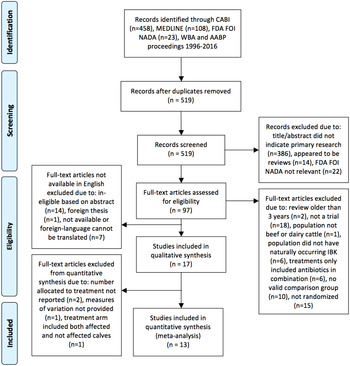
The search results are presented in Fig. 1. The citation database searches were completed on 21 December 2015. The FDA FOI NADA summaries contained 23 potentially relevant summaries based on the search of ‘infectious bovine keratoconjunctivitis’. Fourteen papers described reviews and were set aside to be examined later if published in the last 3 years. The list of full texts assessed and the first reason for exclusion based on the order of questioning in the screening forms are provided in the supplemental material.
Flow chart illustrating the database searches and paper exclusions during the screening and data extraction processes.

No additional relevant papers were identified (that were available through an inter-library loan system) from recent IBK reviews, reference lists from the full text relevant papers, or the last 20 years of AABP proceedings. Nine of the last ten World Buiatrics Association conference proceedings were assessed for potentially relevant trials. One conference proceedings (2010 World Buiatrics Congress) could not be examined as the holding library declined to loan the requested materials. One relevant randomized trial was identified from the 1998 proceedings (Cosgrove et al., Reference Cosgrove, Simmons, Johnson and Varma1998).
3.2. Study characteristics
Of the 97 papers, 16 were trials that described randomization to treatment arm and were included for data extraction. Thus the conference proceedings and database searches combined resulted in a total of 17 relevant trials. The trial from the conference proceedings could not be extracted as the authors did not report the number of calves allocated to each treatment arm (Cosgrove et al., Reference Cosgrove, Simmons, Johnson and Varma1998). One paper could not be extracted because measures of variation for the reported outcome, clinical eye score, were not reported (Roeder et al., Reference Roeder, Skogerboe, Clark and Kelly1995). No data from an additional paper could be extracted as the authors only reported comparative efficacy for healing time without measures of variation (Edmondson et al., Reference Edmondson, George and Farver1989). A Spanish language trial could not be extracted because the authors did not report the number of calves allocated per treatment arm (Abdala et al., Reference Abdala, Canavesio, Zimmermann, Abramovich and Calvinho2002). Thus, from the 17 papers, 13 contained data suitable for extraction (George et al., Reference George, Mihalyi, Edmondson, Daigneault, Kagonyera, Willits and Lucas1988, Reference George, Keefe and Daigneault1989; Chadli, Reference Chadli1992; Allen et al., Reference Allen, George and Willits1995; Eastman et al., Reference Eastman, George, Hird and Thurmond1998; Angelos et al., Reference Angelos, Dueger, George, Carrier, Mihalyi, Cosgrove and Johnson2000; Gokce et al., Reference Gokce, Citil, Genc, Erdogan, Gunes and Kankavi2002; Zielinski et al., Reference Zielinski, Piscitelli, Perez-Monti, Stobbs and Zimmermann2002; Dueger et al., Reference Dueger, George, Angelos, Tankersley, Luiz, Meyer, Portis and Lucas2004; Freedom of Information Summary, 2007; Senturk et al., Reference Senturk, Cetin, Temizel and Ozel2007; Starke et al., Reference Starke, Eule, Meyer, Im Winkel, Verspohl and Rehage2007; Quesada et al., Reference Quesada, Jeny and Lopez2010). Author definitions of the outcomes are included in the supplemental material.
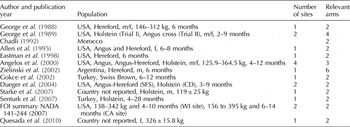
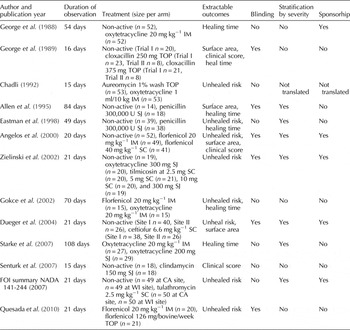
Tables 2 and 3 provide the population and study characteristics of each paper for which data were extracted. Since the original systematic review in 2006, four new randomized trials have been published (Freedom of Information Summary, 2007; Senturk et al., Reference Senturk, Cetin, Temizel and Ozel2007; Starke et al., Reference Starke, Eule, Meyer, Im Winkel, Verspohl and Rehage2007; Quesada et al., Reference Quesada, Jeny and Lopez2010). One of the four trials was only available in French (Senturk et al., Reference Senturk, Cetin, Temizel and Ozel2007) and one was an FDA drug application (Freedom of Information Summary, 2007). The drug application results were also published as a technical bulletin found by one of the reviewers (J. F. C.) and available on the manufacturer website (Zoetisus, http://www.zoetis.com/animal-health/) (Pfizer Animal Health, 2008). One trial was published in 2002 (Gokce et al., Reference Gokce, Citil, Genc, Erdogan, Gunes and Kankavi2002) but was incorrectly excluded from the original systematic review. Concurrent management interventions were rarely reported and thus not included in the descriptive results.
Population characteristics for each extractable trial. Weight presented as a range or ± the SD

Trial characteristics for each extractable trial

IM=intramuscular, SC=subcutaneous, SJ=subconjunctival, TOP=topical opthalmic.
Although 13 randomized trials had at least some extractable outcome data, this did not mean all the outcomes measured and reported by all 13 trials could be extracted. For some studies, unhealed corneal ulcer data could not be extracted because the study population contained both affected and unaffected calves (George et al., Reference George, Mihalyi, Edmondson, Daigneault, Kagonyera, Willits and Lucas1988; Eastman et al., Reference Eastman, George, Hird and Thurmond1998) or because the figure contained treatment arms combined for calves diagnosed with IBK (Starke et al., Reference Starke, Eule, Meyer, Im Winkel, Verspohl and Rehage2007). For another paper, the image resolution was too low to extract ulcer surface area data beyond days 3–4 (Dueger et al., Reference Dueger, George, Angelos, Tankersley, Luiz, Meyer, Portis and Lucas2004). Clinical score data could not be extracted because the population contained both affected and unaffected calves (George et al., Reference George, Mihalyi, Edmondson, Daigneault, Kagonyera, Willits and Lucas1988) or authors did not provide any measures of variation (Allen et al., Reference Allen, George and Willits1995; Zielinski et al., Reference Zielinski, Piscitelli, Perez-Monti, Stobbs and Zimmermann2002). Ulcer surface area data could not be extracted due to the population containing both affected and unaffected calves (George et al., Reference George, Mihalyi, Edmondson, Daigneault, Kagonyera, Willits and Lucas1988). For three papers, healing time data could not be extracted as the authors did not provide any variance measures but only a range (Angelos et al., Reference Angelos, Dueger, George, Carrier, Mihalyi, Cosgrove and Johnson2000; Freedom of Information Summary, 2007; Quesada et al., Reference Quesada, Jeny and Lopez2010).
3.3. Summary of the treatment network geometry
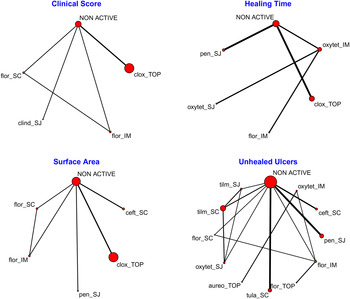
The network of treatment comparisons for each outcome is presented in Fig. 2. With the exception of the unhealed ulcers network, we observed a general lack of available comparisons suitable for a MTC meta-analysis. Specifically, very few trials of the same intervention were available. A MVMA was also not possible due to the overall lack of multiple common treatment comparisons across outcomes.
Network of treatment arms for each outcome. The size of the node and line width represent the relative number of arms and direct comparisons, respectively. IM=intramuscular, SC=subcutaneous, SJ=subconjunctival, TOP=topical opthhalmic, aureo=aureomycin, ceft=ceftiofur, clind=clindamycin, clox=cloxacillin, flor=florfenicol, oxytet=oxytetracycline, pen=penicillin, tilm=tilmicosin, tula=tulathromycin.

3.4. Analysis of the treatment network geometry
For the outcome clinical score, the PIE encounter index was 0.79, the C-score was 1.20 with an associated p-value of 0.86.
For the outcome healing time, the PIE index was 0.85, the C-score was 1.20 with an associated p-value of 0.14.
For the outcome risk of unhealed ulcers, the PIE index was 0.86, the C-score was 1.88 with an associated p-value of 0.81.
For the surface area outcome, the PIE index was 0.78, the C-score was 1.20 with p-value is 0.93.
The PIE index was >0.75 for all four outcomes suggesting relatively high network diversity. This is not surprising as the 13 studies did represent different interventions. None of the C-score p-values were significant meaning co-occurrence is not occurring within the four outcome networks. These results may reflect the fact that multiple studies on the same intervention rarely occurred in this dataset and may also be due to the smaller number of trials available.
3.5. Risk of bias within studies
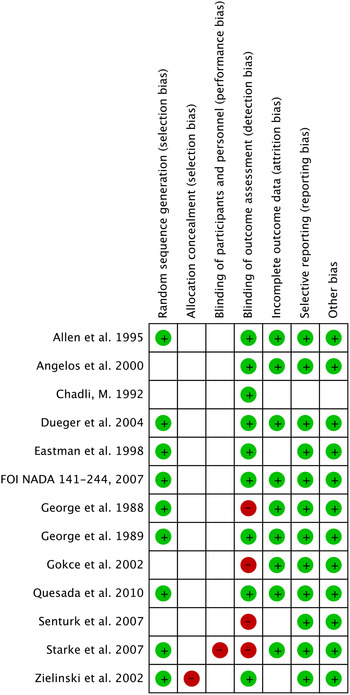
Risk of bias for each study are presented in Fig. 3. The main concerns for bias were insufficient descriptions of randomization. No papers in our sample set described concealment of the allocation sequence. It should be noted that although all studies were included based on randomization, one study (Zielinski et al., Reference Zielinski, Piscitelli, Perez-Monti, Stobbs and Zimmermann2002) was included in the meta-analysis as a randomized trial because the authors self described the paper as a ‘randomized block design’ however it was considered high risk by the reviewers for selection bias due to a description of sequential allocation. However as other papers were not required to prove random allocation by documenting the method of allocation, it was decided to retain the paper and consider it randomized.
Risk of bias per paper for which data were extracted. Low risk is indicated by green, high risk by red, and unclear risk is blank.

The risk of bias assessment resulted in a fairly large number of unclear risk assessments. This was due to the fact that these biases are often difficult to assess in older papers that frequently do not report in a manner consistent with recent recommendations such as the REFLECT guidelines (O'Connor et al., Reference O'Connor, Sargeant, Gardner, Dickson, Torrence, Dewey, Dohoo, Evans, Gray, Greiner, Keefe, Lefebvre, Morley, Ramirez, Sischo, Smith, Snedeker, Sofos, Ward and Wills2010).
3.6. Synthesis of pairwise meta-analysis of active treatments compared with placebo and exploration of heterogeneity
For presentation of the data, we grouped drugs together by compound and ignored the route of dose as there were insufficient data for further refining the treatment protocol.
3.7. Clinical score as outcome
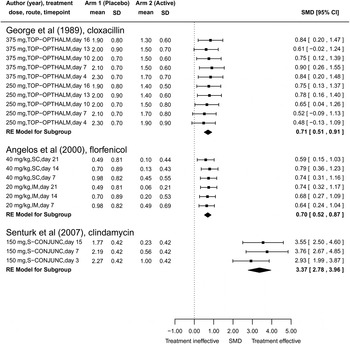
Figure 4 contains the summary SMD for the comparison of active treatments with non-active treatments. Notice that each antibiotic only has data from a single study assessed at multiple time points. The SMD and 95% confidence interval (95% CI) for cloxacillin 0.71 (0.51, 0.91), florfenicol 0.70 (0.52, 0.87), and clindamycin 3.37 (2.78, 3.96) suggest lower clinical scores (i.e. treatment successful) in calves assigned to active treatments compared with non-active treatment.
Standardized mean difference (SMD) for clinical score – all available pairwise treatments that included a non-active arm.

For clinical score there was no evidence of heterogeneity within the studies for each antibiotic. It should be noted that normally in meta-analysis heterogeneity assessment aims to assess across studies, but in this analysis the comparison is across time points within each study. The Q test statistic was 1.8 with p-value 0.99 for cloxacillin, 0.58 with p-value 0.99 for florfenicol, and 1.5 with p-value 0.48 for clindamycin. These Q statistics and associated p-values suggest insufficient evidence to reject the null hypothesis of homogeneity (Hoaglin, Reference Hoaglin2016).
3.8. Healing time as outcome
The durations until corneal ulcer healing are presented in Fig. 5. Healing time was the only outcome that contained effect measures for the same active to non-active comparison from more than one trial (Allen et al., Reference Allen, George and Willits1995; Eastman et al., Reference Eastman, George, Hird and Thurmond1998). These studies assessed 300,000 IU of penicillin administered into the subconjunctiva. The MD and 95% CI for penicillin 3.23 (−5.85, 12.31) and cloxacillin 2.34 (0.28, 4.40) indicate active treatment reduces healing time compared with placebo. However for the penicillin subgroup one trial suggested penicillin was ineffective based on the point estimate and CI (Allen et al., Reference Allen, George and Willits1995). This difference in estimates across the studies for penicillin is reflected in the test for heterogeneity. The Q test statistic was 9.1 with p-value 0.0026 for penicillin and 0.057 with p-value 0.81 for cloxacillin.
Mean difference for healing time – all available pairwise treatments that included a non-active arm.

3.9. Unhealed corneal ulcers as outcome
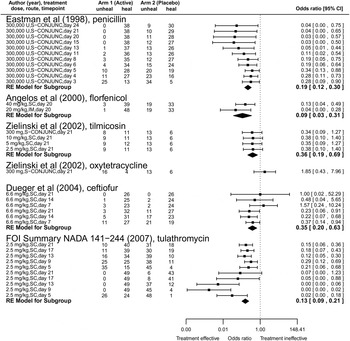
The results of the pairwise meta-analysis for unhealed corneal ulcers by active treatment subgroup are presented in Fig. 6. Compared with non-active arms, OR (95% CI) from the random effects models were as follows, penicillin 0.19 (0.12, 0.30), florfenicol 0.092 (0.027, 0.31), tilmicosin 0.36 (0.19, 0.69), tulathromycin 0.13 (0.085, 0.21), and ceftiofur 0.35 (0.20, 0.63). These results suggest, as expected, active treatment is overall more effective than no treatment. A summary effect was not calculated for the oxytetracycline subgroup as only one arm of one trial used oxytetracycline to treat IBK (Zielinski et al., Reference Zielinski, Piscitelli, Perez-Monti, Stobbs and Zimmermann2002).
Odds ratio for unhealed corneal ulcers – all available pairwise treatments that included a non-active arm.

The Q test statistic was 9.8 with p-value 0.45 for penicillin, 1.1 with p-value 0.29 for florfenicol, 0.024 with p-value 1 for tilmicosin, 25 with p-value 0.0035 for tulathromycin, and 3.8 with p-value 0.58 for ceftiofur.
3.10. Corneal ulcer surface as outcome
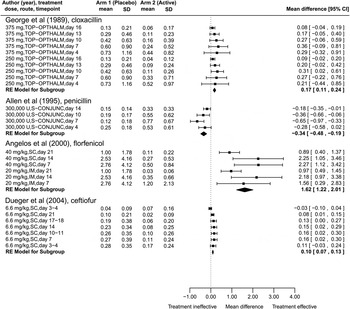
Figure 7 displays the summary MD for each active to non-active subgroup. The MD and 95% CI for cloxacillin 0.17 (0.11, 0.24), florfenicol 1.62 (1.22, 2.01), and ceftiofur 0.096 (0.066, 0.13) suggest active treatment results in smaller corneal ulcer surface areas compared with placebo. The summary MD for penicillin −0.34 (−0.48, −0.19) would suggest non-treatment reduces corneal ulcer size more effectively than treatment with penicillin in this trial population.
Mean difference for surface area – all available pairwise treatments that included a non-active arm.

The Q test statistic was 5.6 with p-value 0.78 for cloxacillin, 12 with p-value 0.04 for florfenicol, 13 with p-value 0.038 for ceftiofur, and 6.6 with p-value 0.086 for penicillin.
3.11. Assessing sources of systematic bias
The typical sources of systematic bias are a lack of randomization, outcome blinding, and trial sponsorship. Our dataset included only randomized trials, seven of which employed random allocation stratified by IBK severity, six described blinding of outcome(s), and five were pharmaceutical company sponsored. To assess risk of bias across studies, it is necessary to have multiple studies of the same intervention; however the sparse data in this data set precluded such an analysis. We were therefore unable to assess these methodological variables further beyond reporting the numbers here.
The rationale for not assessing bias due to caregiver blinding is that no studies reported this process, so it could not be assessed. Loss-to-follow-up was also not assessed because it was not possible to accurately determine, due to the approach to reporting if authors made the decision a priori to only report for animals that completed the study. Any assessment of loss-to-follow-up would be inaccurate, highly subjective and likely meaningless. These decisions were made while the protocol was being developed, and should have been included in the protocol but were not.
3.12. Risk of bias across studies
The sample set did not contain multiple trials comparing the same active treatment for one of the four outcomes thus we did not examine funnel plots. Only for duration until ulcer healing comparing penicillin with placebo was there more than one trial (Allen et al., Reference Allen, George and Willits1995; Eastman et al., Reference Eastman, George, Hird and Thurmond1998).
3.13. Active-to-active comparisons of interest
As can be seen from the networks, only three studies assessing active to active comparisons have been conducted that did not just use different doses or routes of the same drugs. Gokce et al. (Reference Gokce, Citil, Genc, Erdogan, Gunes and Kankavi2002) reported that florfenicol was more effective than oxytetracycline for healing time [MD = 5.42 and 95% CI (−7.98, 18.82) extra days until healing for oxytetracycline] and lower risk of unhealed ulcer by day 28 [OR = 0.05 and 95% CI (0.00, 0.94) – oxytetracycline as the referent]. For risk of unhealed ulcer, Chadli (Reference Chadli1992) indicated oxytetracycline was more effective than aureomycin [OR = 17.26 (5.43, 54.86) – oxytetracycline as the referent at day 15]. Zielinski et al. (Reference Zielinski, Piscitelli, Perez-Monti, Stobbs and Zimmermann2002) suggested that tilmicosin was more effective at multiple doses than oxytetracycline. For example, an OR of 0.18 (0.044, 0.76) at day 21 was observed when comparing 300 mg of either antibiotic administered sub-subconjunctivally.
3.14. MTCMA
Based on the small sample size of randomized trials with extractable data, the MTCMA failed to produce interpretable results. We did conduct the analysis for the most commonly measured outcome, unhealed ulcers, which had the largest network. However, for the resulting ranking of treatment analysis all active treatments and even placebo had overlapping credibility intervals around 0–11 (data not shown). This was likely due to the relatively close effect measure estimates and lack of enough available trial data to distinguish between treatment efficacies. As a result the MTC meta-analysis was not investigated further or reported further. We also considered conducting a multivariable meta-analysis, which would enable us to borrow information across outcomes, but the data were too sparse to even attempt such an analysis.
3.15. Ancillary analysis – IBK effect on weight
As it has been previously observed that IBK-affected calves have decreased weaning weight compared with unaffected herd mates (Thrift and Overfield, Reference Thrift and Overfield1974; Funk et al., Reference Funk, O'Connor, Maroney, Engelken, Cooper, Kinyon and Plummer2009, Reference Funk, Reecy, Wang, Tait and O'Connor2014; O'Connor et al., Reference O'Connor, Brace, Gould, Dewell and Engelken2011), the expectation was that a number of trials would include ADG or final weight. However of the included trials, only two papers reported weight as an outcome (Roeder et al., Reference Roeder, Skogerboe, Clark and Kelly1995; Zielinski et al., Reference Zielinski, Piscitelli, Perez-Monti, Stobbs and Zimmermann2002). Additionally the authors of one of the two papers did not report measures of variance for final weight or ADG and therefore the data cannot be used (Zielinski et al., Reference Zielinski, Piscitelli, Perez-Monti, Stobbs and Zimmermann2002). As a result ancillary analysis was not conducted.
4. Discussion
This systematic review update identified 17 randomized trials, 13 of which had data that could be extracted. Four of the 13 were published since the last review in 2006. This review expanded the outcomes of interest to include not only risk of unhealed ulcers but also clinical scores, duration until healing, and ulcer surface area. With the exception of oxytetracycline for unhealed ulcer risk and penicillin for ulcer surface area, the results indicate that overall any active intervention is more effective than placebo for the treatment of IBK in cattle. This result was observed for all assessed outcomes and should be expected. Unfortunately, we were not able to conduct a meaningful mixed treatment analysis that would provide additional information about the comparative efficacy of the drugs, because of the sparse data for each intervention. We had initially proposed to conduct a mixed treatment comparison that would use direct and indirect information to provide information of the comparative efficacy of the active drugs. With so few trials reporting active to active comparisons, this would provide critical information for treatment selection.
Of particular interest were the sideways parabola-type shapes produced from lining up the effect measures for each day within an active treatment subgroup. For example, the cloxacillin results from the ulcer surface area forest plot (Fig. 7), appear as two (one for 250 mg and one for 375 mg) sideways parabolas starting around the null (zero) at day 4, bending away from the null, and returning back by day 16. Although not necessarily statistically relevant based on the CI, the greatest effect size point estimate (or the furthest from the null on the parabola) was observed on day 7 or day 10 depending on the dose. These results suggest that the best time, in which to observe a difference between treatments using surface area as an outcome, should be between day 7 and 10, and that beyond day 16 the choice of an active antibiotic intervention or placebo makes no difference. Similar shapes were observed for ceftiofur, florfenicol (largest observed effect size at day 7 or day 14), tulathromycin, and penicillin. For the penicillin subgroup, however, the parabola is orientated in the other direction, indicating penicillin made no impact on surface area. Considering our summary measures are compared with placebo, we would expect the difference to be even smaller for trials comparing active-to-active treatments. Although to a lesser extent, similar shapes were observed for some of the active treatment subgroups for the clinical score (Fig. 4) and unhealed ulcer risk (Fig. 6) forest plots.
By using multiple time points from within the same studies for our summary measures, we expected the Q statistic and p-value to indicate heterogeneity. This is due to IBK self-healing without the application of antibiotics and producing the sideways parabolas. For healing time (penicillin), unhealed ulcer risk (tilmicosin and tulathromycin), and the surface area (florfenicol and ceftiofur) outcomes, the null hypothesis of homogeneous effect measures across days was rejected at an α of 0.05 within active subgroups.
One of the reasons for conducting an MTC meta-analysis is to make active-to-active treatment comparison efficacy predictions that do not exist as publicly available data. These comparison predictions allow for the ranking of treatments by effectiveness, which ultimately enable the clinician to make the best treatment decision for their clients and patients. In the absence of a suitably large enough trial data set, this type of meta-analysis is not possible. As this systematic review demonstrated, this is exactly the case for the antibiotic treatment of IBK. In these circumstances the clinician should use whatever available active-to-active data that exists, realizing there is more variability based on the one or two estimates as they are single random events.
We found only one study that made this direct comparison at a single time point (28 days). That trial compared 20 mg kg−1 IM oxytetracycline with 20 mg kg−1 IM florfenicol using unhealed ulcer risk as the outcome (Gokce et al., Reference Gokce, Citil, Genc, Erdogan, Gunes and Kankavi2002). The results suggested florfenicol was superior (OR = 0.05). This single observation suggests florfenicol might be more effective than oxytetracycline. However, this does not mean that florfenicol should be the treatment of choice, as comparative efficacy is only one factor in treatment decisions. Interestingly, only oxytetracyline and tulathromycin are registered for use for IBK in the USA. We could not find any peer-reviewed studies of the efficacy of tulathromycin that met our PICOS criteria [one trial published in Italian did not have a valid comparator (Emarcora et al., Reference Emarcora, Morassi, Soriolo, Piva, Bregoli and Schiavon2010) and one trial employed a challenge model (Lane et al., Reference Lane, George and Cleaver2006)]. The only data we have for this treatment option is from the FDA FOI NADA summary (Freedom of Information Summary, 2007) and a technical bulletin from the manufacturer website (Pfizer Animal Health, 2008). These are not places we would expect many producers or veterinarians to look for information about efficacy. In Canada florfenicol is also registered for use for treatment of IBK, but we could not find the equivalent of the FDA NADA FOI for this use.
In summary, the results of this systematic review and meta-analysis strongly indicate that antibiotics of many kinds improve healing compared with placebo. The trial results also suggest a need for more active-to-active randomized trials in the treatment of IBK in calves. Finally, the maximum power of those studies to detect differences between treatments is perhaps around 7–14 days post treatment.
Supplementary material
The supplementary material for this article can be found at http://dx.doi.org/10.1017/S1466252316000050.
Acknowledgments
Thank you to Samantha Tyner for translation assistance for the French language article.
Authorship declarations
J. N. C. conducted the update of the review, screening and data extraction, the analysis, interpreted the results, coordinated the update, and prepared the report. C. Y. assisted with the analysis of the update review. S. T. conducted data extraction and assisted with interpretation of the risk of bias. R. D. conducted data extraction and assisted with interpretation of the risk of bias. J. F. C. provided guidance about the conduct of the study and relevant interventions. N. D. S. provided relevance screening, verified risk of bias information, and data extraction for papers published in Italian or Spanish. C. W. provided guidance about the conduct of the study and analysis of the data. A. O. C. conceived of and coordinated the project conduct, supervised the analysis, interpreted the data, and prepared/approved the final paper for the original and updated paper. All authors read the final draft and approved the final paper for the updated review.
Publication declaration
The authors declare that this is a full and accurate description of the project and no important information or analyses are omitted.
Sponsorship
No external funding agency provided financial or material support for this project.
Declarations of conflicts of interest
A. O. C. – No funding from companies with products in the review except a study about IBR diagnosis funded by Pfizer Animal Health in 2009–2010. J. F. C. has been a consultant for Intervet-Schering Plough Animal Health (now Merck), Boehringer-Ingelheim Vetmedica, Zoetis Animal Health and Norbrook Laboratories Ltd. N. D. S. – No interest to declare. C. Y., J. N. C., R. D., S. T. – No interests to declare, and funded by O'Connor Research Group. C. W. – No interests to declare.